
Digital Examination Attendance and Verification Management
System
T. Manikumar, Chavata Siva Charan, G. Manoj, J. Vinay, Bhuvan Naga Sai and S. Dharmesh
Department of Computer Science and Engineering, Kalasalingam Academy of Research and Education, Krishnankoil,
Srivilliputhur, Tamil Nadu, India
Keywords: Attendance, Faculty, Community Member, Update, Web- Based.
Abstract: The project is based on the web-based platform that it is takes the attendance by using the online updating
system where the in problem statement we took our college requirements based upon that the faculty update
the take the attendance and update the attendance and community members are view the attendance this type
of system is very useful to all who want to update the exam and this will reduce the errors. The solution of
this problem statement became very useful to update attendance.
1 INTRODUCTION
Managing student attendance during examination is a
very tough task for educational institutions. this
process has happened on manual methods, such as
paper-based attendance sheets, which can lead to
mistakes, and delays in data reporting. To address this
challenge, this project proposes the development of a
web-based platform that allows faculty members allot
to specific exam halls to update student attendance.
This system will be accessible to both faculty and
members of the exam committee ensuring that
attendance data is stored and easily accessible. Faculty
members can log in to the system, mark the
attendance of students assigned to their exam halls,
and update it as necessary. The exam committee can
then view the updated attendance information
instantly, improving the website and reducing
administrative burdens.
By performing attendance system and providing
secure system and easy-to-use this system enhances
the accuracy, speed, of exam administration
processes. The platform will contribute to more
efficient exam management, minimizing errors and
ensuring a easy flow of information across the
institution.
2 LITERATURE REVIEW
The identification is the process of searching for a
perfect match in the stored database for the query
biometric sample. The fingerprints scanning system
operates, it will generate a new template when prints
are scanned and compare this with the archive
templates. If a match is made the identification is
verified. 1
Fingerprints are the oldest biometric even used
for identification. Use in forensic Science and
biometrics Modern times In forensic Science,
electronic images of fingerprint scans stored in
databases known as Automated Fingerprint
Identification System (AFIS) are used in conjunction
with software to analyze the scanning points of the
finger to identify criminals. Since they are simple to
use and very accurate, fingerprints have been used for
human identification for many years. There are two
conditions for fingerprint recognition. 3
The construction of a time attendance system with
fingerprint recognition will demand the 16
administrators processing all student to capture the
student’s fingerprints sample to save in the database
instead of the barcode on the matric ID that was
already available at the time the matric ID was issued
6
In contrast, when the new attendance system is
considered to replace the traditional one, fingerprint
scanning system is likely to be the most
recommended. However, with the time limitation,
this project will contribute to finalize a barcode
version protocol and an initial framework for the
biometric scan version. (
Joseph, Jomon, and K. P.
Zacharia.)
(Patil, Ajinkya, and Mrudang Shukla., 2014).
Manikumar, T., Charan, C. S., Manoj, G., Vinay, J., Sai, B. N. and Dharmesh, S.
Digital Examination Attendance and Verification Management System.
DOI: 10.5220/0013901500004919
Paper published under CC license (CC BY-NC-ND 4.0)
In Proceedings of the 1st International Conference on Research and Development in Information, Communication, and Computing Technologies (ICRDICCT‘25 2025) - Volume 3, pages
541-546
ISBN: 978-989-758-777-1
Proceedings Copyright © 2025 by SCITEPRESS – Science and Technology Publications, Lda.
541

The system can also generate a proof of
attendance for Student Finance systems and be used
with mandatory attendance courses. The scanning of
the student identification card is a fast, secure and can
be error free whereas the manual records comes
across errors. Onyx Collection works with stationary
and/or portable scanners, and can be used with most
current cards* 5
Quickly and accurately when they present their
current ID card in lectures, etc by means of fixed
and/or portable readers. This creates a portrait of
engagement that can single out any students who are
struggling while there’s still time to intervene. The
system could also be used to log other significant
events such as exam attendance or handing in
coursework, thus guaranteeing completion of courses.
Craig Utley
Onyx Collector is the way to get attendances not
taken, in part and whole, by any single class or as an
aggregate, for analysis with third party tools or for
exporting to a third-party system. The system has
been developed in order to help improve student
retention via early identification of course
disengagement and assist with the Institution’s
responsibilities in relation to the UK Border Agency
Regulations. The students' attendance is taken
directly 11
The PET Group e-attendance system allows
employers, including managers, to monitor their
employee's attendance online electronically through
web browser. 17 paperless e-attendance system, in
which host computer is to act as a server receiving
request from users as client machines to produce data
of select period & calculating it, no other server in-
between it or it‟ll become costly in maintain and
equipment modernization is very difficult with a
handful users i.e., If there are only a few users based
on local area network then it‟ll be very useful for
them but not for an organization, then its cost should
be much for each client machine and server, this extra
cost could be eliminated by an on-line e-attendance
system, in which it is linked to the internet and act as
server only and subscribers are clients who going use
it by sending / receiving data(in the form of packet)
& the host server will update it and produce report of
each subscriber on each day or week of select period
etc. Advantages and Disadvantages of e-Attendance
System The 17 advantage of an on-line e-Attendance
system is that as the system being a webserver
paperless easy to use system, to get the attendance and
punctuality of employee‟s computerized, just by
checking the system from the authorized superiors‟
office and it could be used by the employees in their
authorized computer with the userid and password.
Some pros of the system include unlimited roster,
live employee and personnel tracking. Managers can
even see employee updates in real time, no matter
where they are or what time it is. They can also use
this system to verify the authenticity of the overtime
claim by the employer. (
Selvi et al., 2014) (Kanti, et al.,
2012)
Wasp time Wasp time is a time attendance system
that is commercially used, it integrates with various
automatic identification technologies such as the
barcode, biometric (fingerprint log in), RFID and also
the regular punch card clock in. It is build to the
business industry requirements and are available in
Standard, Pro and Enterprise version for variety of
type businesses 17
Through the contrast of multiple technology, can
choose other ways of auto-identification (other than
bar code) to improve security and speed. Since the
development of this system is a project for using
prototyping system, in the first version the barcode
system will be used, in case that in system evaluation
stage, if 15 target user need, using other automatic
identification such as RFID is possible (
Mehta, Preeti,
and Pankaj Tomar., 2016) (Robinson-Riegler et al., 2008)
And as the number of manual labour is reduced,
the amount of labour cost can also be reduced.
(Panos& Freed, 2007). As the company will
have less man power cost, so there will be a great
saving in cost of the long company and there
will also break even the cost of plant &
machinery & the one adopted the new system.
(Margaret Rouse, 2012) Wagh, Priyanka, et al.
Barcodes come in many styles. Different
barcodes are used to accomplish different
organizational functions. (Iksan& Norizan, 2009).
Barcodes that comes in parallel lines of different
width placed above each other in a single row are 1-
Dimensional barcode, whereas the barcodes which
comes in terms of patterns and squares or hexagon
placed in multiple rows are spacious in nature than 1-
Dimensional are known 2- Dimensional matrix code.
2D symbols have error detection and optionally error
correction capabilities. (Baharav et. 2al) See figure
1.1 and figure 1.2 below for image of sample
barcodes.
(Bhattacharya, Shubhobrata, et al., 2018)
A barcode is a graphical pattern that is specially
designed so that it can be automatically read
electronically most of the time. Barcode scanner
refers to a device that captures barcode and then
stores the information in a database for later use.
Barcode technology and a barcode scanner provide a
quick and accurate alternative for examination
invigilators to the examination tracking system. The
most modern barcode reader works based on WLAN
ICRDICCT‘25 2025 - INTERNATIONAL CONFERENCE ON RESEARCH AND DEVELOPMENT IN INFORMATION,
COMMUNICATION, AND COMPUTING TECHNOLOGIES
542
or Bluetooth for wireless usage (Li et al., 2017).
3 METHODOLOGY
3.1 Proposed Methodology
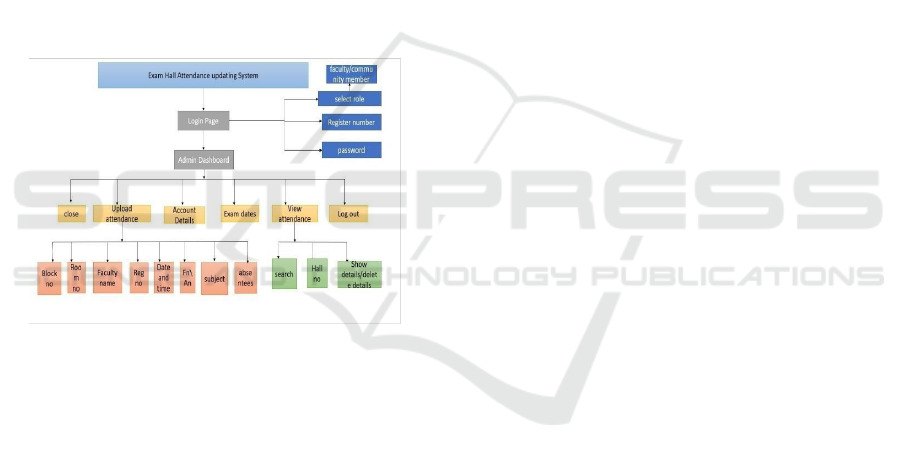
The Proposed methodology consist of the as per the
architecture of the diagram that the diagram tells that
whole process of the attendance updating system.in
that the main points are that the faculty should update
the attendance that is that like should mark the
attendance and community members can view the
attendance that is that the community check that the
members who came to the exam and who not came to
the exam hall and most of the members are very.
Privacy concerns can also arise, especially with
biometric data. For institutions with limited
resources, high-tech solutions may be impractical,
prompting a need for more system attendance.
Figure 1: Architecture of exam attendance updating system.
3.2 Functional Requirements
User Authentication: Allow users to log in with a
register number and password. and differentiate
between user roles (faculty and community members)
upon login.
Role Selection: Enable role as (faculty or community
member) to customize permissions.
Admin Dashboard: Provide an admin dashboard with
such as uploading attendance, viewing attendance,
managing account details, and setting exam dates.
Upload Attendance: Allow faculty members to
upload attendance for each exam, including details
like: Block number, room number, faculty name,
register number, date and time, subject, and list of
absentees.
View Attendance: Allow community members to
view attendance records with options to search by
specific criteria that. Provide detailed attendance
information, including options to show, edit, or delete
details if permissions allow.
Account Section: Enable users to view and manage
their account details.
Exam Date Management: Allow admins or faculty to
set and view exam dates within the system.
Log Out: Provide a logout feature for users to securely
exit the system.
Non-Functional Requirements:
Usability: The system should have an intuitive, user-
friendly interface with clear navigation and labelling.
Ensure role-based access is straightforward for users
to understand and navigate.
Performance: The system should be able to handle
simultaneous access from multiple users (faculty and
students) without lag. Attendance uploads and
searches should be efficient and quick, even with a
large number of records.
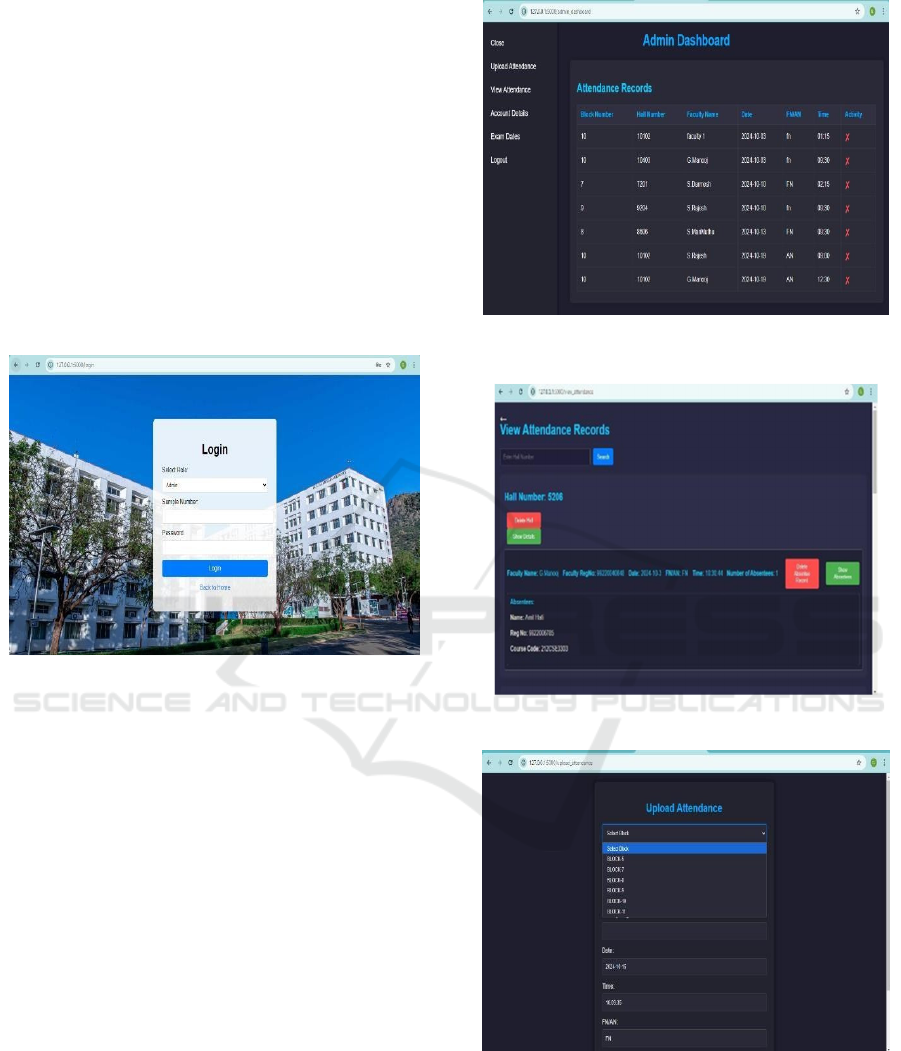
Log in page: The page consists of the select role
(Admin or Faculty) and down of that registered
register number we have to type and registered
password.
Admin Dashboard-The Admin dashboard contains
the attendance records.ie that we have to take the
attendance at that particular subject exam.
Upload attendance: In this we have to select the block
first. And then faculty name, register number date and
time and Number of absentees and the subject name
with subject code and for absentees we require the
name and register number and then we can submit it.
View Attendance Records-There will be search bar
also is resent to view the records. We can view the
attendance records by typing the hall number.by
clicking show details it will show that particular block
attendance records.
Exam Date Updates-In this we can add the Exam
dates on the day which subject going to conduct
exam.
Account details- It will show the details of the
account like the name, register number and phone
number, email and role. Easily we can tell by simply
a sentence to update the exam hall attendance by the
respective faculty allotted to the exam hall through
the website which can be seen by the community
members.
4 IMPLEMENTATIONS
The project combines of the Front end and Back end
which the consist of the in Front end Html, CSS, JS
and Back end consist of the Flask. Which it give the
very successful design to this project the main is that
the Structure of the interface it was made up with the
Digital Examination Attendance and Verification Management System
543
Html that is that like the log in page for example and
CSS for the Design part and color part that is that we
have to combine the CSS with Html then only the for
the structure the design part is combined and we
added the some of the pictures to the interfaces like
background images that is that Java Script is useful
for to function the requirements like log in button and
register . the flask is used for the to run on the local
host the server should run on the given port at last we
have to combine this all and give the output for the
implementation this project.
5 RESULT & DICUSSION
Figure 2: Log in page.
The implementation of this process is the result here
we can see that the interface of the system these give
the actual Output of the system is that how it works
first select role as faculty log in the faculty update the
attendance and check in dashboard attendance is came
or not after that log out and again select role as the
community log in and view the attendance in the
dashboard at which date is conducted the exam they
can view the attendance that all came or not to the
exam. The figure 2 shows login page.
Figure 3: Admin dash board.
Figure 4: Upload attendance.
Figure 5: View attendance.
The Figure 3 shows admin dashboard. Figure 4
shows upload attendance. Figure 5 and 6 shows view
attendance and account details.
ICRDICCT‘25 2025 - INTERNATIONAL CONFERENCE ON RESEARCH AND DEVELOPMENT IN INFORMATION,
COMMUNICATION, AND COMPUTING TECHNOLOGIES
544
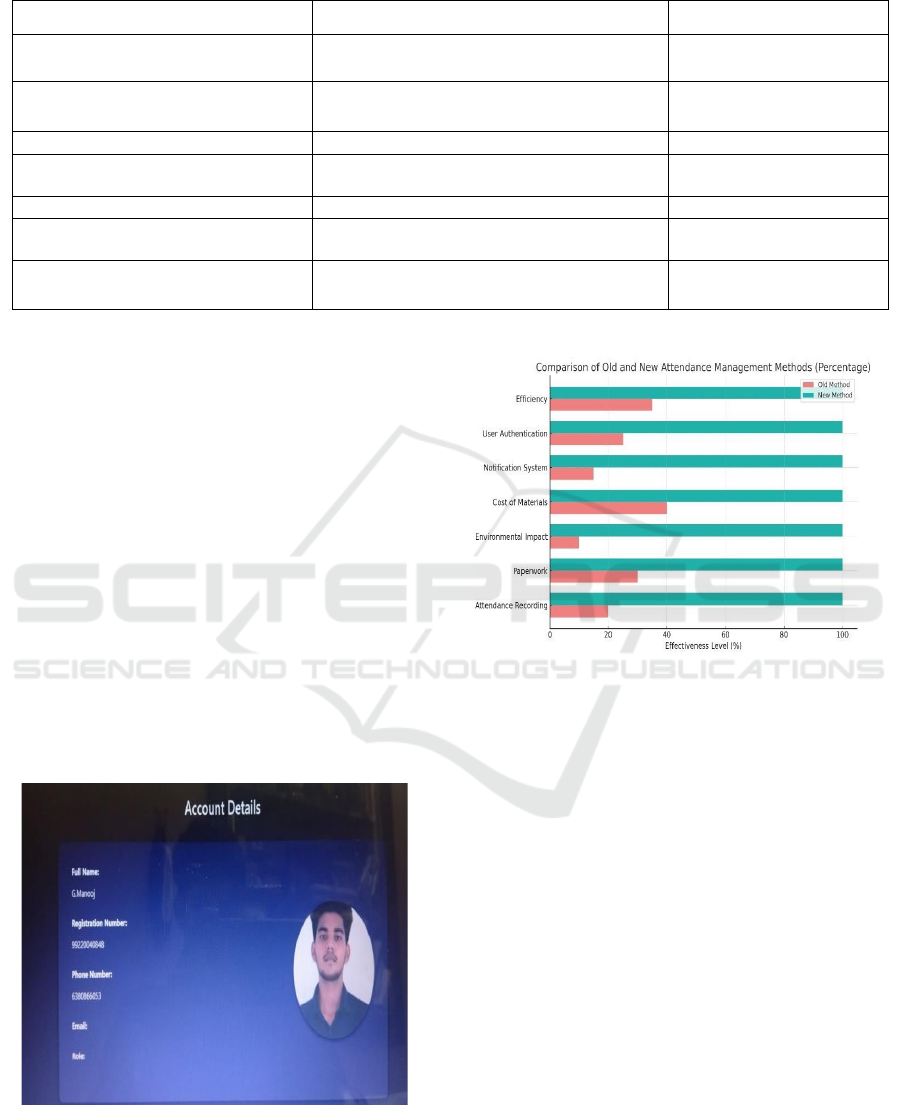
Table 1: Methods Comparison.
Features
Traditional method
Modern method
Attendance Recording They will take in papers
Take in online app or
website
Paper work Long paperwork; storage needed.
Minimal paperwork; data
stored digitally
Environment Impact
High paper consumption
No need paper usage
Cost of product For paper and Print Means it take more costs
No need paper and Less
cost
Notification S
y
ste
m
No notifications on manual checks notifications for u
p
dates
User Authentication
Unauthorize
Authentication
No secure access; potential
unauthorized access
Efficiency Time-consuming More
No-time
consuming
Figure 6 compares the effectiveness of old and new
attendance management methods across various
criteria, illustrating the clear advantages of the new
approach. The new method, represented in teal,
significantly outperforms the old method in areas
such as efficiency, user authentication, notification
system, cost of materials, environmental impact,
paperwork, and attendance recording. It demonstrates
high levels of effectiveness in all these areas, often
nearing 100%, while the old method, in red, shows
limitations, particularly in user authentication,
notification capabilities, and environmental impact.
The old method also incurs higher costs due to
reliance on materials and paperwork. Overall, the new
attendance management system is more efficient,
sustainable, and user- friendly, highlighting a major
improvement in managing attendance. Table 1 shows
Methods comparison.
Figure 6: Account details.
Figure 6: Comparison graph for traditional method
attendance system. and modern method attendance system.
6 CONCLUSIONS
Exam Hall attendance updating is very useful for the
university to take attendance of the exam without
having the any error.it will reduce the work of the
faculty to take attendance writing on the exam paper.
The faculty can take the attendance and committee
members can view the attendance.it is very
sustainable to others.
REFERENCES
“SQL”, Tata McGraw Hill Publication, 7 West Patel Nagar,
New Delhi, India.
(n.d.). Retrieved June 17, 2012, from Active Query Builder:
http://www.activequerybuilder.com
Alan Dennis, B. H. (2005). System Analysis and Design
with UML Version 2.0. John Wiley&Son,Inc.
Digital Examination Attendance and Verification Management System
545

Arsenovic, Marko, et al. "FaceTime Deep learning-based
face recognition attendance system."2017 IEEE 15th
International Symposium on Intelligent Systems and
Informatics (SISY). IEEE,2017.
Bhattacharya, Shubhobrata, et al. "Smart Attendance
Monitoring System (SAMS): A Face Recognition
Based Attendance System for Classroom
Environment." 2018 IEEE 18th International
Conference on Advanced Learning Technologies
(ICALT). IEEE, 2018.
Craig Utley, “A Programmer‟s introduction to Visual
Basic.NET”, Indianapolis, IN 46290 USA, Sams
Publication.
Deshmukh, Badal J., and Sudhir M. Kharad. "Efficient
Attendance Management: A Face Recognition
Approach." (2014).
Gordon B. Davis, Margrethe H. Olson, “Management
Information System”, 2nd Ed., New Delhi, Tata
McGraw-Hill Publishing Company Ltd.
IJFMR23044583 Volume 5, Issue 4, July-August 2023 34
algorithms."2015 International Conference on Green
Computing and Internet of Things (ICGCIoT). IEEE,
2015.
Ilker, S. (2001). Implementation of Data Flow Query
Language.
James A. O‟Brien, “Management Information System”, 5th
Ed., New Delhi, Tata McGraw-Hill Publishing
Company Ltd.
Joseph, Jomon, and K. P. Zacharia. "Automatic attendance
management system using face recognition."
International Journal of Science and Research (IJSR)
2.11 (2013): 327- 330.
Kanti, Jyotshana, and Shubha Sharm. "Automated
Attendance using Face Recognition based on PCA with
Artificial Neural Network." International journal of
science and research IJSR (2012).
Kar, Nirmalya, et al. "Study of implementing automated
attendance system using face recognition technique."
International Journal of computer and communication
engineering 1.2 (2012): 100.
L. Cinque, S. L. (1991). An expert visual query system.
Journal of Visual Languages & Computing, 101-113.
Li, Xiang-Yu, and Zhen-Xian Lin. "Face recognition based
on HOG and fast PCA algorithm." The Euro-China
Conference on Intelligent Data Analysis and
Applications. Springer, Cham, 2017.
Margaret Rouse. ―Big Data and Data Storageǁ(Margaret
Rouse, 2012)
Mehta, Preeti, and Pankaj Tomar. "An Efficient Attendance
Management Sytem based on FaceRecognition using
Matlab and Raspberry Pi 2." International Journal of
Engineering Technology Science and Research IJETSR
3.5 (2016): 71-78
Michele Angelaccio, T. C. (1990). Query by diagram: A
fully visual query system. Journal of Visual Languages
& Computing, 255-273.
Mohd Ikhsan Moksin, Norizan Mohd Yasin. (2009). Web-
based Query Builder. International Journal on
Computer Science and Engineering, 552-556.
MuthuKalyani, K., and A. VeeraMuthu. "Smart application
for AMS using face recognition."Computer Science &
Engineering 3.5 (2013): 13.
Patil, Ajinkya, and Mrudang Shukla. "Implementation of
classroom attendance system based on face recognition
in class." International Journal of Advances in
Engineering & Technology 7.3 (2014):974
Robinson-Riegler, G., & Robinson-Riegle, B.ǁ the image
projected into our eyesǁ Robinson-Riegler, G., &
Robinson-Riegle, B. (2008)
RoshanTharanga, J. G., et al. "Smart attendance using real
time face recognition (smart-fr)."Department of
Electronic and Computer Engineering, Sri Lanka
Institute of Information Technology (SLIIT), Malabe,
Sri Lanka (2013)
Selvi, K. Senthamil, P. Chitrakala, and A. Antony Jenitha.
"Face recognition-based attendancemarking system."
Corresponding Author: S. Rajkumar*, Email:
rajkumarsrajkumar@ gamil. com (2014)
Wagh, Priyanka, et al. "Attendance system based on face
recognition using eigen face and PCA International
Journal for Multidisciplinary Research (IJFMR) E-
ISSN: 2582-2160 Website: www.ijfmr.com Email:
editor@ijfmr.com
ICRDICCT‘25 2025 - INTERNATIONAL CONFERENCE ON RESEARCH AND DEVELOPMENT IN INFORMATION,
COMMUNICATION, AND COMPUTING TECHNOLOGIES
546
