
Distributive Denial of Service Attack Detection Using Cat: Boost
Algorithm in Machine Learning
Parvathi M., Dharanidharan A., Kirubasankar K. R.,
Mohamaad Ishaaq S. and Navaneetha Krishnan S.
Department of AI&DS, Nandha Engineering College, Erode, Tamil Nadu, India
Keywords: Distributed Denial of Service (DDOS) Attacks, Machine Learning, Cat‑Boost Algorithm, DDoS Attack
Detection.
Abstract: DDOS (Distributive denial of service) attacks is worked by overloading the server with multiple connections
at the same time, making the site unable to take any more requests which in turn causes overloading of the
server, triggering response time error's. This work is done on ubuntu operating system with tools such as
mininet installed inside virtual machine and controller which helps by acting as a framework of the virtual
machine which specializes in detection of the attack. The current existing system is done on the algorithm
named as "random forest" (K. G. Maheswari, et.al., 2023). which utilities the concept of decision trees
whereas in this project the current algorithm is replaced with a different one to operate which is "cat-boost".
It works on the principles of categorizing the data's by assigning values of the same class together.
1 INTRODUCTION
Network security is seriously threatened by
distributed denial of service (DDoS) attacks which
overload servers with so many connections at once
that they are unable to process valid requests in the
end this leads to issues with response times and server
overload which reduce service availability the project
intends to improve the DDoS assault detection
system.( K. G. Maheswari, et.al., 2023) In order to
solve this issue to detect fraudulent traffic the current
system uses the random forest approach which makes
use of decision trees this study suggests using a more
sophisticated algorithm called cat-boost to increase
detection efficiency and accuracy by grouping values
of the same class together cat-boost enhances model
performance and works well with categorical data it
accomplishes this by applying the gradient boosting
approach (Y. Yu, et.al., 2018). DDoS attack
detection needs to installs technologies such as the
Ryu controller and mininet onto pcs running ubuntu
in order to simulate network (H. S. Abdulkarem and
A. Drawod, 2020). circumstances instead of using
random forest to identify attacks the ryu controller
framework uses catboost this study intends to
improve network security and attack mitigation
strategies in addition to providing a more dependable
and efficient DDoS detection system (Y. Xiang, et.al.,
2011).
1.1 Technological Achievement
In their early iterations traditional DDoS detection
methods mostly depended on rule-based systems and
basic statistical analysis which regularly fell behind
the increasing complexity and reach of attacks the
introduction of machine learning algorithms such as
random forest was a significant breakthrough
enabling decision trees to recognize and decide on
increasingly complex patterns however these
methods were still limited in their capacity to manage
category data and scale for large dynamic
networks(K. G. Maheswari, et.al., 2023).It includes
some Modern Innovations The CatBoost approach, a
cutting- edge machine learning technique that is
excellent at handling categorical data and improving
classification accuracy, enables a more precise
identification of fraud traffic by efficiently combining
and evaluating data of the same type. This has led to
considerable advancements in the detection of DDoS
attacks (K. G. Maheswari, et.al., 2023). The random
forest approach, which uses decision trees, is a more
traditional approach that might not be able to handle
complicated data-patterns (J. Ye, et.al., 2018). And it
has some limitations like its effectiveness, the
496
M., P., A., D., R., K. K., S., M. I. and S., N. K.
Distributive Denial of Service Attack Detection Using Cat: Boost Algorithm in Machine Learning.
DOI: 10.5220/0013900600004919
Paper published under CC license (CC BY-NC-ND 4.0)
In Proceedings of the 1st International Conference on Research and Development in Information, Communication, and Computing Technologies (ICRDICCT‘25 2025) - Volume 3, pages
496-503
ISBN: 978-989-758-777-1
Proceedings Copyright © 2025 by SCITEPRESS – Science and Technology Publications, Lda.

suggested approach has a number of drawbacks that
must be noted and we can make the Controlled
Environment of DDoS detection using Mininet and
the Ryu controller in an Ubuntu virtual machine, the
system is put into practice and evaluated in a
simulated setting (Y. Yu, L. et.al., 2018). The
intricacies and dynamism of actual network settings
could not be adequately captured by this controlled
arrangement, which could restrict how broadly the
findings can be applied (N. M. Saravana Kumar,
et.al., 2016).
Computational Resources has effectiveness with
categorical data, the Cat-Boost method may
necessitate a large amount of computing power and a
great deal of hyper- parameter adjustment. Large-
scale deployments or situations with limited resource
provide difficulties (K. G. Maheswari, et.al., 2023).
Some Dataset Dependency need to add to get better
performance of the system is highly dependent on the
quality and diversity of the training dataset. If the
dataset lacks sufficient representation of various
types of DDoS attacks, the model's detection
accuracy may be adversely affected (N. Zhang, et.al.,
2019). Also, it includes some Lack of Mitigation
Strategies this is because of the current
implementation focuses solely on the detection of
DDoS attacks and does not address the mitigation of
detected attacks. A comprehensive solution would
require integrating mitigation strategies to effectively
neutralize threats (W. Zhijun, et.sl., 2020). It also
focusses on the Scalability Concerns to achieve
system's scalability to larger and more complex
networks has not been thoroughly tested. Further
research is needed to evaluate its performance in
high- traffic and heterogeneous network
environments (S. Dong, et.al., 2019). We can use this
system for Real-Time Detection by improving the
system's ability to detect DDoS attacks in real-time
has not been extensively evaluated. Real- world
deployment would require ensuring minimal latency
and high accuracy in real-time detection scenarios (N.
Agrawal and S. Tapaswi, et.al., 2019).
1.2 Impact on Customer Experience
and Efficiency
Impact on customer satisfaction and productivity the
proposed technique for detecting distributed denial of
service has a substantial influence on both operational
efficiency and user experience. The system ensures
continuous service availability by preventing server
overload, which reduces downtime and disruptions
that could otherwise annoy users. This directly
improves customer satisfaction as users can rely on
services without experiencing delays or outages.
DDoS attacks are successfully detected and mitigated
by the cat- boost algorithm, which also reduces
latency and maintains optimal response times.
Because customers can depend on the platform for
consistent performance, this is particularly crucial for
time- sensitive applications like financial services and
e-commerce games. Increased reliability of the
network infrastructure fosters client confidence and
loyalty (Y. Xiang, t.al., 2011).
DDOS detection automation operationally
removes the need for human intervention by
establishing a safe, efficient, and customer-Caused
work environment (M. Baskar, et.al., 2013). This
allows employees to focus on other crucial tasks and
more efficiently allocate resources. The solution also
lowers the costs related to human monitoring and
response, increasing operational efficiency. Enhances
organizational performance and user experience, and
the system's proactive feature makes early threat
detection possible. Last but not least, its scalability
allows it to adjust to shifting network requirements
and sustain peak performance even as traffic levels
rise, reducing harm and guaranteeing business
continuity (K. G. Maheswari,et.al , 2023).
2 EXISTING SYSTEM
The Random Forest method, which uses the idea of
decision trees to categorize and identify harmful
traffic patterns, is the foundation of the current system
for detecting Distributed Denial of Service (DDoS)
assaults. In order to increase accuracy and decrease
overfitting, this method entails building many
decision trees during training and combining their
output. Utilizing technologies like Mininet, which
mimics network settings, and the Ryu controller,
which serves as a framework for controlling the
virtual machine and identifying threats, the system is
deployed on the Ubuntu operating system. In order to
avoid server overload brought on by too many
concurrent connections, the Random Forest algorithm
analyzes network traffic data to separate malicious
from legal requests (O. Osanaiye, et.al., 2016).
3 PROPOSED SYSTEM
The system that is being suggested by using the
CatBoost algorithm, which is an advancement over
the conventional Random Forest-based detection
technique, the suggested system seeks to improve the
Distributive Denial of Service Attack Detection Using Cat: Boost Algorithm in Machine Learning
497

detection of Distributed Denial of Service (DDoS)
assaults (M. H. Bhuyan and E. Elmroth, 2018). The
Ryu controller acts as the SDN (Software-Defined
Networking) framework, and the system is set up on
an Ubuntu- based environment utilizing Mininet
within a virtual machine. By effectively managing
categorical data and enhancing decision- making in
real-time assault scenarios, the gradient boosting
algorithm CatBoost improves detection accuracy. To
more accurately categorize and detect malicious
activity, the model is trained using network traffic
data. CatBoost exhibits better flexibility to a variety
of attack patterns and lowers false positive rates when
compared to current Random Forest techniques
(Saied, et.al, 2016).
3.1 Packets
Table 1: D/B random forest and CatBoost.
RANDOM FOREST CATBOOST
Random Forest is a
bagging algorithm that
combines decision trees
trained on different
subsets of data
)
CatBoost is a boosting
algorithm (sequentially
builds trees, where each
tree corrects the errors
of the
p
revious one
)
Random Forest requires
manual encoding which
has to be processed by
the user onto the
algorithm while training
Cat-Boost automatically
handles categorical
feature without
requiring preprocessing.
Random Forest grows
trees independently and
in parallel that can be
used for decision
making
CatBoost grows trees
sequentially, with each
tree focusing on the
mistakes of the previous
one
Random Forest is less
prone to overfitting due
to averaging predictions
from multiple trees.
CatBoost is more prone
to overfitting but
includes regularization
techniques to mitigate
it.
Random Forest is
generally faster to train
because trees are built
independently.
CatBoost is slower to
train due to its
sequential nature and
handling of categorical
features
Table 1 shows the D/B Random Forest and
Catboost. The program checks a total of 44 various
features before confirming the status of the network
The 44 different features are namely: 'Protocol', 'Flow
Duration', 'Total Fwd Packets', 'Total Backward
Packets', 'Fwd Packets Length Total', 'Bwd Packets
Length Total', 'Fwd Packet Length Max', 'Fwd Packet
Length Min', 'Fwd Packet Length Mean', 'Fwd Packet
Length Std', 'Bwd Packet Length Max', 'Bwd Packet
Length Min', 'Bwd Packet Length Mean', 'Bwd Packet
Length Std', 'Flow Bytes/s', 'Flow Packets/s', 'Flow
IAT Mean', 'Flow IAT Std', 'Flow IAT Max', 'Flow
IAT Min', 'Fwd IAT Total', 'Fwd IAT Mean', 'Fwd IAT
Std', 'Fwd IAT Max', 'Fwd IAT Min', 'Bwd IAT
Total', 'Bwd IAT Mean', 'Bwd IAT Std', 'Bwd IAT
Max', 'Bwd IAT Min', 'Fwd PSH Flags', 'Bwd PSH
Flags', 'Fwd URG Flags', 'Bwd URG Flags', 'Fwd
Header Length', 'Bwd Header Length', 'Fwd Packets/s',
'Bwd Packets/s', 'Packet Length Min', 'Packet Length
Max', 'Packet Length Mean', 'Packet Length Std',
'Packet Length Variance', 'FIN Flag Count', 'SYN Flag
Count', 'RST Flag Count', 'PSH Flag Count', 'ACK
Flag Count', 'URG Flag Count', 'CWE Flag Count',
'ECE Flag Count', 'Down/Up Ratio', 'Avg Packet Size',
'Avg Fwd Segment Size', 'Avg Bwd Segment Size',
'Fwd Avg Bytes/Bulk', 'Fwd Avg Packets/Bulk', 'Fwd
Avg Bulk Rate', 'Bwd Avg Bytes/Bulk', 'Bwd Avg
Packets/Bulk', 'Bwd Avg Bulk Rate' (Z. Li, et.al.,
2020).
4 METHODOLOGY
There are three techniques the current system uses a
random forest approach to create a large number of
decisions during the training phase and increase
results, increase prediction accuracy existing random
forests do not work well in dynamic network
environments with complex traffic patterns and high
data collections even if it is successful the gradient
boost technology is based on catboost created this
way beyond traditional methods in relation prediction
accuracy with minimal preparation. And in this
methodology, we are using this catboost technology
in windows. As traditional Techniques and other
Algorithms mainly works on the Ubuntu and Linus.
But by using this methodology we can work the
catboost algorithm in both Windows and Linus
Operating System. By using the Catboost Algorithm
it achieves the success rate of 99 percentage on both
windows and Linus (M. H. Bhuyan,et.al., 2014).
Figure 1 shows the bar chart of cat-boost and random
forest comparison.
Mathematically, CatBoost can be represented as
follows:
Given a training datasеt with N samples and M
features, where each sample is denoted as (x_i, y_i),
as x_i is a vector of M features and y_i is the
corresponding target variablе, CatBoost aims to learn
a function F(x) that predicts the target variable y.
𝐹
𝑥
=𝐹0
𝑥
+
∑
𝑚=1𝑀
∑
𝑖=1𝑁𝑓𝑚
𝑥𝑖
𝐹
𝑥
=
𝐹0
𝑥
+
∑
𝑚=1𝑀 ∑𝑖 = 1𝑁𝑓𝑚 (1)
ICRDICCT‘25 2025 - INTERNATIONAL CONFERENCE ON RESEARCH AND DEVELOPMENT IN INFORMATION,
COMMUNICATION, AND COMPUTING TECHNOLOGIES
498

where, F(x) represents thе overall prediction
function that CatBoost aims to learn. It takes an input
vector x and predicts the corresponding target
variable y.
F0() F(x) is the initial guess or the baseline
prediction. It is often set as the mean of the target
variable in the training dataset. This term captures the
overall average behavior to the target variable.
Σm=1MΣm=1M represents the summation over the
ensemble of trees. M denotes the total number of trees
in the ensemble. Σi=1 NΣi=1N. Represents
summation over training samples. N denotes the total
number of training samples.fm (xi) fm (xi)
represents the prediction of the m-th tree for the i-th
training sample. Each tree in the ensemble
contributes to the overall prediction by making its
own prediction for each training sample (O.
Osanaiye, et.al., 2016).
Figure 1: Bar Chart of CatBoost and random forest
comparison.
Table 2: Tools used in this system.
Too
l
Purpose
Ubuntu (OS)
Provides a secure environment for
execution.
Minine
t
Simulates a virtual networ
k
for testing.
Ryu Controller
Acts as an SDN controller for traffic
monitoring.
Virtual Machine Hosts the networ
k
simulation setup.
CatBoost
Algorith
m
Implements machine learning for
attack detection.
Python
Used for programming and model
implementation.
Windows (OS)
An Operating System used for testing
of the proposed system.
4.1 Tools
The following tools (table 2) are used for
implementing the DDoS attack detection system:
These tools are essential for simulating and detecting
DDoS attacks effectively. Kali-Linux, Windows,
RyuController, CatBoost Algorithm and Python.
Where this tool is used to detect DDoS and helps and
each working property are explanations are Ubuntu is
an operating system based on Linux that may be used
to execute the machine learning model and simulation
in a secure and reliable setting. It is the perfect
solution for our project because it is open-source and
works with different networking technologies. And
mininet is a network emulator made to simulate a
network and assess how well it works. It facilitates
the modeling of extensive network topologies and
aids in the controlled study of DDoS attack behavior.
The main tool for the DDoS detections is Ryu
Controller it is a software-defined networking (SDN)
controller controls network traffic and makes it easier
to identify attacks in real time. It offers an adaptable
framework for creating unique network applications
and putting security measures in place (J. Cui, et.al.,
2019). The network simulation environment is
housed in a virtual machine (VM), which makes it
possible to run the Ryu controller, Ubuntu, and
Mininet. This guarantees isolated and repeatable
DDoS attack detection testing circumstances. And
CatBoost is a gradient boosting technique designed
for high- performance machine learning applications.
It is used in this project to precisely classify network
traffic and identify potential DDoS attacks. Its ability
to handle categorical data well makes it suitable for
intrusion detection systems. The language used for
this is Python. It is the primary computer language
utilized in the development of the detection model. To
detect threats in real time, it analyzes data, trains the
CatBoost algorithm, and communicates with the Ryu
controller. And it also works on Windows. It is an
Operating System. Here we can use this operating
system for testing and implementation of the project (S.
Dong,et.al., 2019).
4.2 Modules Descriptions
Mininet-Based Network Simulation is a virtual
network environment is created using Mininet, a
network emulation program. The system can
examine the behavior of DDoS assaults in a
controlled environment by simulating different
network topologies and traffic patterns. Integration of
Ryu Controller to control the Network traffic and to
dynamically managed and monitored by the Ryu
Software-Defined Networking (SDN) controller (T.
A. Pascoal, et.al.,2017). It serves as a foundation for
network packet capture and analysis inside the virtual
machine, guaranteeing efficient communication and
early identification of unusual traffic. And the main
Process includes in data preprocessing and feature
extraction is to extract key characteristics that
differentiate legitimate traffic from possible DDoS
Distributive Denial of Service Attack Detection Using Cat: Boost Algorithm in Machine Learning
499
assaults, network traffic data is gathered and
evaluated. Preprocessing methods like data
transformation and normalization are used to increase
classification accuracy. Putting the Cat-Boost
Algorithm into Practice and it is used in the suggested
system in place of the Random Forest method. Cat-
Boost is an effective gradient boosting method that
improves classification accuracy for DDoS detection
by classifying and processing data by clustering
related class values. The best possible network
performance (H. Kumawat and G. Meena, 2014).
4.3 Work Flow Chart
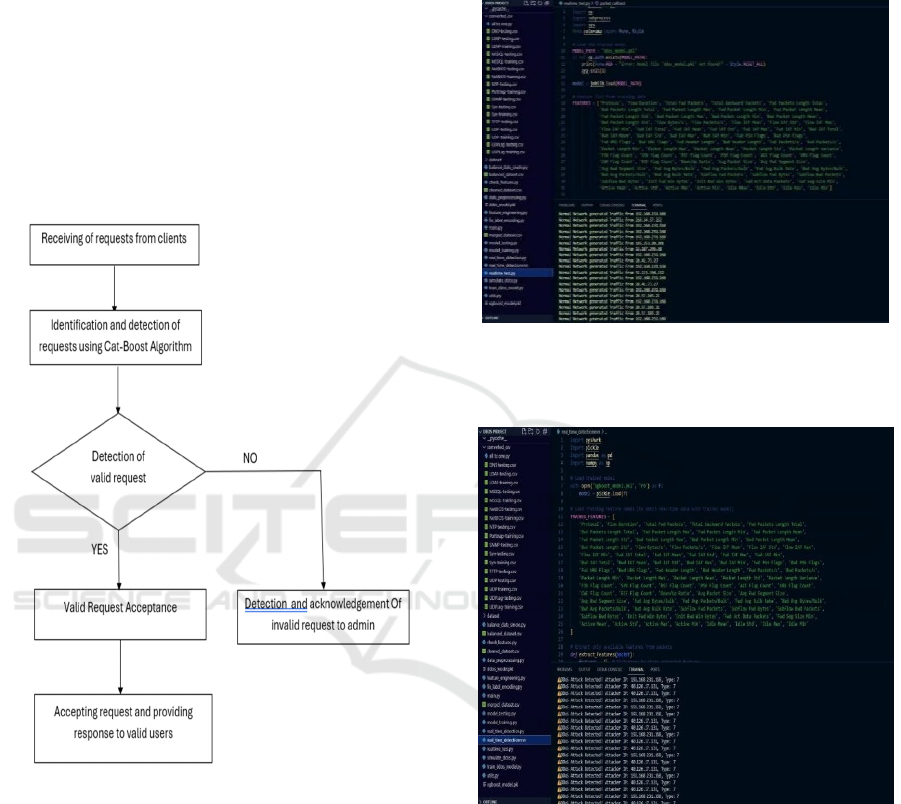
Figure 2: Ddos Process Using Cat-Boost Algorithm.
Figure 2 shows the DDoS Process using cat-boost
algorithm.
5 OUTCOMES
5.1 Screenshot of Output
Figure 3: Output of Legal Request from Users.
5.2 Terminal
Figure 4: Output of Request from Users With Ipaddress.
Using the Ryu controller and mininet
implementation on an Ubuntu-based virtual machine,
the proposed system successfully enhances
classification accuracy and ddos attack detection by
moving from the random forest method to the
catboost algorithm. Attack scenarios can be tested
and evaluated in a controlled simulation environment
by handling categorical data more effectively. The
catboost technique also reduces false positive rates
and boosts model efficiency. Experiments show a
notable improvement in detection speed, which
lowers the error of server response times caused by
ICRDICCT‘25 2025 - INTERNATIONAL CONFERENCE ON RESEARCH AND DEVELOPMENT IN INFORMATION,
COMMUNICATION, AND COMPUTING TECHNOLOGIES
500

DDoS assaults. Network resilience is significantly
increased by the architecture's ability to differentiate
between malicious and legitimate traffic.
Performance metrics like accuracy and f1-score recall
demonstrate how trustworthy the recommended
method is in spotting various DDoS attack patterns.
In contrast to traditional random forest detection Cat
boost offers greater scalability and adaptability to
evolving attack tactics. The proposed model
demonstrates how it might be used in real-world
network security systems. Software-defined
networking (SDN) in the Ryu controller provides
dynamic and real-time response capabilities to
successfully thwart attacks. Strengthening the
defenses overall Future advancements might focus on
optimizing feature selection and integrating real-time
anomaly detection techniques for enhanced security
(E. Adi, et.al., 2015). We analyze the performance of
the DDoS attack detection method in SDN
simulation network and evaluates the effectiveness
and feasibility of the method in terms of accuracy,
recall and misjudgment rate. In addition, we select the
detection method based on joint and SOM-based
machine learning detection algorithm as comparison
(H. S. Abdulkarem and A. Drawod,2020). Most
DDoS attack detection algorithms over SDN can be
classified as methods based on entropy and methods
based on machine learning. The comparison method
JESS selected in this work is a DDoS detection
method based on joint entropy (J. Ye, X. Cheng,et.al.,
2018). This method not only considers the entropy of
the target IP address, but also pays attention to the
combination of IP address and TCP attributes, and
selects the appropriate dynamic attributes for the
current attack during the detection process. Although
the detection method based on entropy (X. Liu, et.al.,
2020).
6 APPLICATIONS
The application of this study is very relevant to
network security, namely in thwarting Distributed
Denial of Service (DDoS) attacks, which pose a
severe risk to online services and it can also use
infrastructure.
Using the Cat-Boost algorithm, this system offers
a comprehensive way to detect DDoS attacks are
characterized by overloading servers with concurrent
connections, leading to response time problems and
service unavailability. The implementation is carried
out on the Ubuntu operating system using
technologies such as Mininet and the Ryu controller
in a virtual machine environment. The mininet
facilitates network topology simulation, while the
Ryu controller serves as a framework with an
emphasis on attack detection. By classifying data
according to class similarities, cat-boost substitutes
the conventional random forest technique, improving
attack detection speed and accuracy while increasing
system efficiency. protecting web servers, cloud-
based apps, and vital network infrastructure against
DDoS attacks Two essential uses for this project are
preserving peak performance and guaranteeing
continuous service availability [15]. The
development of resilient and intelligent cybersecurity
systems has been significantly accelerated by the use
of machine learning techniques, especially the cat-
boost algorithm. By doing the following
programming code. We get to determine the
frequency of our network system whether its
currently stable or is under any attack or is vunerable
to attacks that may cause some anomalies on the
network flow of its packets. It has a total of 44
different packets that needs to be checked each and
individually. Even if one value mismatches it comes
out as an anomaly in the network flow stream [24].
7 CHALLENGES AND FUTURE
DIRECTIONS
The execution of this project ensures improved
security for network systems by making a substantial
progress in the detection of Distributed Denial of
Service (DDoS) assaults. By substituting the Cat-
Boost algorithm for the conventional Random Forest
method, the system is able to identify fraudulent
traffic with more accuracy. Because DDoS assaults
can negatively affect availability and performance,
this initiative is especially helpful for businesses that
depend on cloud-based services, data centers, and
web hosting platforms. Real-time monitoring and
attack prevention are made possible by the scalable
and effective network simulations made possible by
the integration of Mininet within virtualized
environment (Y. Yu, et.al., 2018). Future studies
might concentrate on the endurance and scalability
of the detection systems. The issue of acquiring
labeled datasets might be resolved by using
unsupervised or semi-supervised learning techniques.
Utilizing distributed systems and edge computing for
real- time detection might save computational
overhead. Lastly, the deployment of sophisticated
threat intelligence and anomaly detection systems
might provide a more thorough defense against
changing DDoS assault plans. A range of machine
Distributive Denial of Service Attack Detection Using Cat: Boost Algorithm in Machine Learning
501

learning techniques, including ensemble approaches,
could increase detection accuracy and decrease false
positives. All of these enhancements would
contribute to the development of more resilient and
adaptable systems that can protect networks from
more attackers (Saied, R. E. et.al., 2016).
8 CONCLUSIONS
The project's main goal is to identify Distributed
Denial of Service (DDoS) assaults, which take
advantage of server weaknesses by flooding them
with connections at once, causing server overload and
response time issues. Utilizing technologies like
Mininet in a virtual machine environment and the
Ryu controller, a framework with a focus on attack
detection, the implementation was done on the
Ubuntu operating system. This project presents the
Cat-Boost method, which categorizes data by
assigning values that belong to the same class, in
contrast to the current system that uses the Random
Forest algorithm based on decision trees. This paper
offers a fresh technique to DDoS assault detection by
substituting the CatBoost algorithm for the
conventional Random Forest methodology (N. Zhang
et.al.,
2019). It is built with Mininet and the Ryu
controller, which serves as an attack detection
framework, in a virtualized Ubuntu environment.
CatBoost improves detection accuracy over the
traditional method by efficiently applying gradient
boosting to decision trees for data categorization.
This technique strengthens the network's security and
resilience by enhancing the system's ability to
distinguish between malicious and legal traffic (3. N.
M. Saravana Kumar, et.al. 2016) The findings show
that the suggested approach offers a more dependable
and efficient way to guard against DDoS assaults,
guarantee peak network performance, and lower the
frequency of reaction time mistakes. Further
optimization and practical implementation in future
studies to enhance scalability and flexibility. The
Figure 3 & 4 shows the output of the project where it
has a process to identify the IP Address of every users
who are requesting to the website and using this
system we can identify the legal and illegal requests
and its IP Address. And we can give the response to
the legal requesting users.
REFERENCES
A. Saied, R. E. Overill, and T. Radzik, "Detection of known
and unknown DDoS attacks using artificial neural
networks," Neurocomputing, vol. 172, pp. 385–393,
Jan. 2016.
E. Adi, Z. Baig, C. P. Lam, and P. Hingston, "Low-rate
denial-of-service attacks against HTTP/2 services," in
Proc. 5th Int. Conf. IT Convergence Security (ICITCS),
Aug. 2015.
H. Kumawat and G. Meena, "Characterization, detection
and mitigation of low-rate DoS attack," in Proc. Int.
Conf. Inf. Commun. Technol. Competitive Strategies,
2014.
H. S. Abdulkarem and A. Drawod, "DDoS attack detection
and mitigation at SDN data plane layer," in Proc. 2nd
Global Power, Energy and Communication Conf.
(GPECOM), Oct. 2020, pp. 322–326.
J. Ye, X. Cheng, and J. Zhu, "A DDoS attack detection
method based on SVM in software-defined network,"
Secur. Commun. Netw., vol. 2018, Apr. 2018, Art. no.
9804061.
J. Cui, M. Wang, and Y. Luo, "DDoS detection and defense
mechanism based on cognitive-inspired computing in
SDN," Future Gener. Comput. Syst., vol. 97, pp. 275–
283, Aug. 2019.
K. G. Maheswari, C. Siva, and G. Nalinipriya, "Optimal
cluster-based feature selection for intrusion detection
system in web and cloud computing environment using
hybrid teacher learning optimization enables deep
recurrent neural network," 2023.
K. G. Maheswari, C. Siva, and G. N. Priya, "An optimal
cluster-based intrusion detection system for defense
against attack in web and cloud computing
environments," 2023.
M. Baskar, T. Gnanasekaran, and S. Saravanan, "Adaptive
IP traceback mechanism for detecting low-rate DDoS
attacks," in Proc. IEEE Int. Conf. Emerg. Trends
Comput., Commun. Nanotechnol. (ICECCN), Mar.
2013.
M. H. Bhuyan, D. K. Bhattacharyya, and J. K. Kalita,
"Network anomaly detection: Methods, systems and
tools," IEEE Commun. Surveys Tuts., vol. 16, no. 1, pp.
303–336, 1st Quart. 2014.
M. H. Bhuyan and E. Elmroth, "Multi-scale low-rate DDoS
attack detection using the generalized total variation
metric," in Proc. 17th IEEE Int. Conf. Mach. Learn.
Appl. (ICMLA), Dec. 2018.
N. M. Saravana Kumar, S. Deepa, C. N. Marimuthu, T.
Eswari, and S. Lavanya, "Signature-based vulnerability
detection over wireless sensor network for reliable data
transmission," 2016.
N. Zhang, F. Jaafar, and Y. Malik, "Low-rate DoS attack
detection using PSD based entropy and machine
learning," in Proc. 6th IEEE Int. Conf. Cyber Security
and Cloud Comput., Jun. 2019.
N. Agrawal and S. Tapaswi, "Defense mechanisms against
DDoS attacks in a cloud computing environment: State-
of-the-art and research challenges," IEEE Commun.
Surveys Tuts., vol. 21, no. 4, pp. 3769–3795, Oct. 2019.
O. Osanaiye, K.-K. R. Choo, and M. Dlodlo, "Distributed
denial of service (DDoS) resilience in cloud: Review
and conceptual cloud DDoS mitigation framework," J.
Netw. Comput. Appl., vol. 67, pp. 147–165, May 2016.
ICRDICCT‘25 2025 - INTERNATIONAL CONFERENCE ON RESEARCH AND DEVELOPMENT IN INFORMATION,
COMMUNICATION, AND COMPUTING TECHNOLOGIES
502

S. Dong, K. Abbas, and R. Jain, "A survey on distributed
denial of service (DDoS) attacks in SDN and cloud
computing environments," IEEE Access, vol. 7, pp.
80813–80828, 2019.
T. A. Pascoal, Y. G. Dantas, I. E. Fonseca, and V. Nigam,
"Slow TCAM exhaustion DDoS attack," in ICT
Systems Security and Privacy Protection, S. De
Capitani di Vimercati and F. Martinelli, Eds. Cham,
Switzerland: Springer, 2017.
T. Apostolovic, N. Stankovic, K. Milenkovic, and Z.
Stanisavljevic, "DDoSSim—System for visual
representation of the selected distributed denial of
service attacks," in Proc. Zooming Innovation
Consumer Technol. Conf. (ZINC), May 2018.
W. Zhijun, X. Qing, W. Jingjie, Y. Meng, and L. Liang,
"Low-rate DDoS attack detection based on
factorization machine in software defined network,"
IEEE Access, vol. 8, pp. 17404–17418, 2020.
X. Liu, X. Yin, and Y. Hu, "CPSS LR-DDoS detection and
defense in edge computing utilizing DCNN Q-
learning," IEEE Access, vol. 8, pp. 42120–42130, 2020.
Y. Xiang, K. Li, and W. Zhou, "Low-rate DDoS attacks
detection and traceback by using new information
metrics," IEEE Trans. Inf. Forensics Security, vol. 6,
no. 2, pp. 426–437, Jun. 2011.
Y. Yu, L. Guo, Y. Liu, J. Zheng, and Y. Zong, "An efficient
SDN-based DDoS attack detection and rapid response
platform in vehicular networks," IEEE Access, vol. 6,
pp. 44570–44579, 2018.
Y. Tarasov, E. Pakulova, and O. Basov, "Modeling of low-
rate DDoS attacks," in Proc. 12th Int. Conf. Security
Inf. Netw., 2019.
Y. Wang, T. Hu, G. Tang, J. Xie, and J. Lu, "SGS: Safe-
guard scheme for protecting control plane against
DDoS attacks in software-defined networking," IEEE
Access, vol. 7, pp. 34699–34710, 2019.
Z. Li, H. Jin, D. Zou, and B. Yuan, "Exploring new
opportunities to defeat low-rate DDoS attack in
container-based cloud environment," IEEE Trans.
Parallel Distrib. Syst., vol. 31, no. 3, pp. 695–706, Mar.
2020.
Distributive Denial of Service Attack Detection Using Cat: Boost Algorithm in Machine Learning
503
