
Identifying Cyberbullying and Hate Speech via Sentiment Analysis of
Social Media Text Social Networks
Loveleen Kaur Pabla
1
, Prashant Kumar Jain
2
, Prabhat Patel
2
and Shailja Shukla
3
1
Department of Information Technology, Jabalpur engineering College, Jabalpur, Madhya Pradesh, India
2
Department of Electronics and Telecommunication, Rajiv Gandhi Proudyogiki Vishwavidyalaya, Bhopal, Madhya
Pradesh, India
3
Professor & Head, Department of Electrical Engineering, Jabalpur engineering College Jabalpur, Madhya Pradesh, India
Keywords: Sentiment Analysis, Text Mining, Natural Language Processing, Cyber Bulling, Hate Speech.
Abstract: In the current digital era, in addition to being a vital component of modern life, social media has also given
rise to the pervasive and dangerous issue of cyberbullying. The rise of social media platforms has coincided
with an increase in cyberbullying, a type of abuse that takes place on these sites. Social networks on the
internet are expanding quickly in many ways. These platforms are being utilised by various businesses to
advertise their goods and interact with final customers. Conversely, some groups are abusing these platforms
to spread hate speech, violent materials, and offensive or harassing material. The social climate both online
and offline is out of balance as a result of all these events. The proposed work analyses the text content of
social media posts, messages, and blogs to provide a research proposal on the identification of hate and
bullying content online. Machine learning methods and sentiment analysis are used in this context as crucial
instruments to handle large volumes of data. In addition to finding bullying terms, sentiment analysis has the
ability to identify victims in danger of hurting themselves or others. In order to detect signs of bullying in
social media posts, our research relies on applying deep learning and natural language comprehension
approaches. A Recurrent Neural Network with Long Short-Term Memory (LSTM) cells was constructed
using multiple embeddings. One method makes use of BERT embeddings, while the other uses OpenAI's
freshly published embeddings API in place of the embeddings layer.
1 INTRODUCTION
Hate speech and cyberbullying continue to occur in a
similar way to traditional forms. Direct bullying or
hate speech simply altered their appearance and had a
detrimental effect on the victim's mental state. This
social threat is becoming more widespread every day
on a variety of social media sites, not just in India but
globally as well. Teenagers are not the only age group
affected by these things; they work for all ages. It is
unacceptable to disseminate the dubious text by
various means of communication, such as social
media, SMS, emails, and others. Thus, text analysis
methods are helpful for examining texts and
identifying patterns of bullying and hatred. These
days, these methods are used for prediction,
recommendation, and decision making in a variety of
application domains, including business, banking,
education, engineering, and medicine. However,
assessing the attitudes in a document requires more
than just basic text analysis and categorization
methods. As a result, NLP-based text analysis is
employed to identify the attitudes and emotions
contained within the text. Understanding text
sentiments requires a solid understanding of natural
language processing (NLP). Human life preservation
may benefit from it. Finding text communication's
sentiment classes and intensity scores is the main goal
of the suggested effort. Finding the subclasses of
sentiment classes is the goal of the technique, which
offers more than just sentiment classification.
provides a sentiment score as well, which aids in
determining the degree of hate. This work focusses on
the domains of natural language processing (NLP)
and machine learning. NLP is a field that deals with
in-text blocks, text classification, and emotion
detection. Sentiment analysis can be used to content
found on forums, microblogs, e-commerce product
448
Pabla, L. K., Jain, P. K., Patel, P. and Shukla, S.
Identifying Cyberbullying and Hate Speech via Sentiment Analysis of Social Media Text Social Networks.
DOI: 10.5220/0013899800004919
Paper published under CC license (CC BY-NC-ND 4.0)
In Proceedings of the 1st International Conference on Research and Development in Information, Communication, and Computing Technologies (ICRDICCT‘25 2025) - Volume 3, pages
448-453
ISBN: 978-989-758-777-1
Proceedings Copyright © 2025 by SCITEPRESS – Science and Technology Publications, Lda.

reviews, social media, and other sources. This effort
analyses text from a variety of public sources using
machine learning methods. Therefore, a suggestion to
build and implement a hate speech and cyberbullying
detection system is put forth. There have been
numerous contributions in this area recently from
different authors. However, the majority of them can
only forecast positive or negative orientations and
their subclasses. However, there are no appropriate
methods to address the influence of emotions.
Therefore, the suggested task entails creating a data
model to gauge how strongly the bully or hate speech
is conveyed in the text. We also attempted to
subdivide the emotion classes based on the feelings'
intensity. Social media has become an essential
component of everyday life in recent years, enabling
previously unheard-of levels of connection and
communication. But it has also played a part in the
increase in online harassment and cyberbullying
(Feinberg and Robey, 2009). Cyberbullying, in
contrast to traditional bullying, can occur at any time,
and because of the anonymity offered by the internet,
offenders are encouraged to behave without fear of
instant repercussions (Hasan et al., 2023). When
compared to in-person bullying, this anonymity
frequently results in higher rates of cyberbullying.
2 NATURAL LANGUAGE
PROCESSING
There have been numerous contributions in this area
recently from different authors. However, the
majority of them can only forecast positive or
negative orientations and their subclasses. However,
there are no appropriate methods to address the
influence of emotions. Therefore, the suggested task
entails creating a data model to gauge how strongly
the bully or hate speech is conveyed in the text. We
also attempted to subdivide the emotion classes based
on the feelings' intensity. Natural language describes
the speech and text that humans use to communicate
with one another. Text is all around us, and we use
menus, signage, emails, SMS, websites, and more.
We communicate via writing and speaking to one
another. Speaking might be simpler to learn than
writing. We connect with one another via text and
voice. Like other forms of data, natural language
requires tools for comprehension and reasoning.
Automatic Summarization- Data is the
most valuable resource in this day and age.
We obtain the necessary and helpful
quantity of information from a variety of
sources. We have access to far more
knowledge than we can comprehend, and the
amount of information is overwhelming.
Since there will always be an abundance of
information available online, we require an
automatic text summarization system. The
process of producing a concise, precise
synopsis of text documents is known as text
summarization. In less time, text
summarization will provide us with
pertinent information. Automatic text
summarization relies heavily on natural
language processing.
Question-answering- Question-answering
(QA) is another use case for natural
language processing. Although search
engines make the world's knowledge
accessible, they nevertheless fall short when
it comes to providing answers to our queries.
This is the route that businesses like Google
are taking. It is a branch of NLP and AI. Its
main goal is to create systems that can
automatically respond to human enquiries.
In order to create valid answers, a computer
system that comprehends the NL can
transform the sentences into an internal
representation. Syntax and semantic analysis
can produce the precise answers. Among the
difficulties NLP has in creating an effective
QA system are lexical gaps, ambiguity, and
multilingualism.
Sentiment Analysis- Sentiment analysis is
another way that NLP is used. To determine
the sentiments of several posts, sentiment
analysis is utilised. When feelings are not
clearly conveyed, it is used to determine the
sentiment. Sentiment analysis is an NLP
application that businesses use to find out
what their customers think. Knowing what
their clients think of the goods and services
will be beneficial. They can use sentiment
analysis to assess their reputation based on
consumer reviews. Sentiment analysis helps
us better understand the motivations behind
the opinions expressed by analysing
sentiments in context.
Identifying Cyberbullying and Hate Speech via Sentiment Analysis of Social Media Text Social Networks
449

3 HATE SPEECH AND CYBER
BULLING
Targeting an individual or a group on the basis of their
religion, race, ethnic origin, handicap, sexual
orientation, or gender is known as online hate speech,
and it typically occurs on social media. It is where
several tensions converge: [weasel words]. It is vivid
when diverse groups express themselves differently
from one another. Multilateral and multi-stakeholder
procedures is a broad word. Hate speech is becoming
a common term and is growing daily. Threats to the
security of both individuals and groups are being
mixed together. Google, Twitter, Facebook, and other
social media sites started defining hate speech in their
own ways. It is necessary for national and regional
bodies to raise awareness of such phrase. Because of
the speed and breadth of the Internet, governments
find it difficult to enforce laws in this situation.
Because of the problems with hate speech, private
channels for expression that operate in public spaces,
like Facebook and Twitter, have become more
popular. What is hate speech, how it relates to offline
and success, what constitutes apparent hate speech,
and likely punishment have led to a lot of discussion
about the solution and how it should be based.
However, this emphasis has also hindered more
thorough efforts to identify the root reasons of the
phenomena.
Bullying or harassment via digital devices, such
as smartphones, laptops, and computers, is known as
cyberbullying. Chat rooms, social networking, and
gaming are examples of platforms where
cyberbullying can happen since users can read and
share content. The various forms of bullying include
abusive remarks, text messages, and messages. It
includes sending, posting, and disseminating
inaccurate or unfavourable information. Do you think
your child has a smartphone addiction? Has he or she
grown more reclusive and socially insensitive?
Changes in a child's behaviour might cause parents
great concern. Watch out! It's possible that your
youngster is being bullied online. Parents can report
cyberbullying according to research on the topic.
Some typical forms of cyberbullying are as follows:
Posting offensive or derogatory remarks
rumours, or pictures about someone
making a phoney or offensive webpage
about someone
threatening or inciting someone online
inciting hate speech about someone based on
their race, religion, ethnicity, or politics
posing as someone else online in order to
post personal or false information about
someone
Information about someone's social media accounts is
obtained and utilised for online abuse, slander, and
other purposes. Cyberbullying has seen a sharp
increase in India as social media and reasonably
priced broadband services have become more widely
available. Studies show that over eight out of ten
people experience some form of cyberbullying. Of
these, around 63% were subjected to online
harassment and abuse, and 59% were the target of
unfounded rumours and gossip. Furthermore, a
number of research show that India has the greatest
rate of cyberbullying in Asia. In particular, 50% of
Indian city women experience abuse online.
4 PROPOSED WORK AND
PROPOSED DATA MODEL
The proposed work's goal is to research and enhance
the sentiment analysis method for identifying hate
speech and posts related to cyberbullying on social
media. Anyone can post anything on social media.
Therefore, the following goals are set in order to keep
an eye on and maintain the cleanliness of social
networks.
To investigate and learn about hate
speech and cyberbullying detection
methods- A survey of the current methods
and resources for sentiment analysis, hate
speech, and cyberbullying is necessary
because there has been a lot of work done
recently on social media text processing for
sentiment label recovery. As a result, this
survey aids in the formulation of our
solution development plan.
For automatic sentiment identification, to
expand and enhance current sentiment
analysis methods- The promising
classification methods are retrieved from the
literature review in order to improve their
performance in sentiment classification.
Furthermore, the updated features allow for
precise detection of hate speech and
bullying.
Incorporating sentiment's intensity and
semantics into text- Here, the sentiment
analysis method that was previously
provided is changed to determine the
sentiment impact on the target individual or
ICRDICCT‘25 2025 - INTERNATIONAL CONFERENCE ON RESEARCH AND DEVELOPMENT IN INFORMATION,
COMMUNICATION, AND COMPUTING TECHNOLOGIES
450
community. As a result, a scale and score are
created to quantify the hate and bad attitudes
expressed in the text.
To research and evaluate the suggested
cyberhate detection framework's
performance in comparison to cutting-
edge methods- The rationale behind the
suggested model is attempted to be
illustrated. Furthermore, a performance
comparison between the suggested work and
pertinent existing methodologies is shown.
Additionally, utilising the information and
facts that were available on Twitter, we
attempted to follow an actual case.
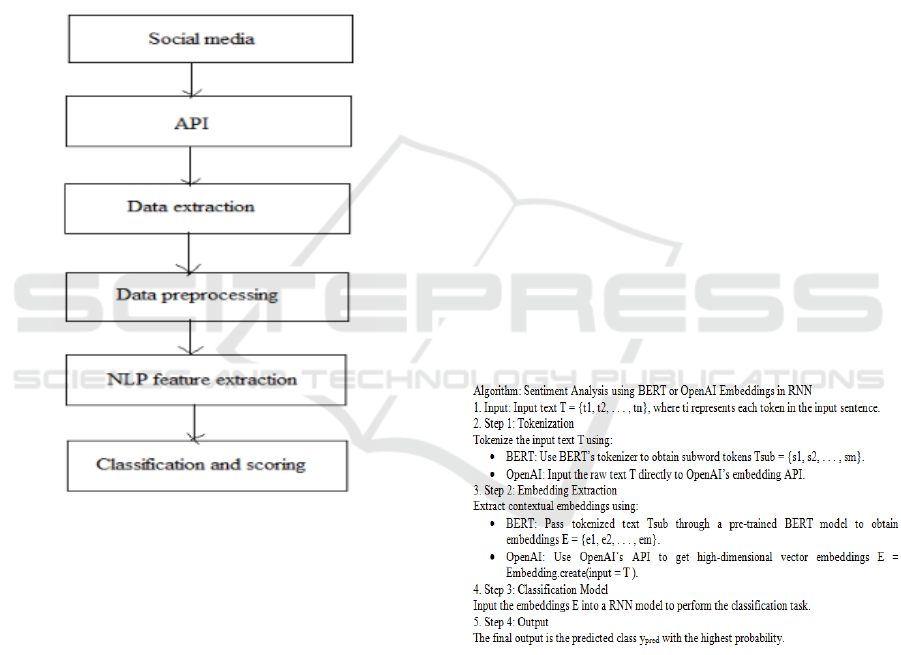
Figure 1: Proposed Data Model.
Figure 1 shows the proposed data model. The goal
of the proposed work is to enhance the sentiment
analysis method already in use. A score system based
on delivered text will be incorporated into the
extension to gauge the sentiment intensity.
Cyberbullying and hate speech content detection
applications are utilised in conjunction with this
scoring system. Thus, image 1 illustrates a basic
model. Twitter is therefore chosen as the social media
platform for data collection and experimentation. In
this context, we can locate a variety of offline and
online dataset resources. Furthermore, social media
sites like Facebook and Twitter offer web APIs for
retrieving data from live feeds. We must enhance the
quality of the raw offloaded data after offloading the
necessary data. Thus, in order to improve the quality
of the data, pre-processing is used first. Since the
offloaded data is essentially in text format, or
unstructured format, it comprises a variety of
undesirable characters and stop words. The offline
contents were attempted to be removed by the pre-
process. Following content refining, feature
extraction methods are applied. Here, we must
identify a few text-based or natural language
processing (NLP) feature selection techniques and
assess their efficacy before implementing them in the
feature extraction of the suggested model. To identify
the desired patterns, supervised, semi-supervised, and
unsupervised learning approaches are used with the
computed features from the pre-processed text data.
This procedure is referred to as the suggested system's
training. Lastly, the sentiment class for the provided
data is generated by the suggested model. In essence,
we are unable to judge a social media post's criticality
based on its polarity, or whether it is accurate or not.
In order to determine the severity and negativity of a
hate speech post, we are attempting to calculate a
sensitivity score utilizing the various facts that are
currently accessible. An overview of the suggested
data model is presented in this paper, and the specifics
of the model are provided in the next piece.
5 EXPERIMENTATION
Binary Cross Entropy Loss (BCELoss), which works
well for binary classification tasks, is used to train
the model. The definition of the BCELoss is
𝐿
𝑦log
𝑝
1𝑦
log
1𝑝
(1)
Where, the anticipated probability for the positive
class is denoted by p and the true label by y. The
classifier performs better when BERT-base or
OpenAI embeddings that is our hybrid architectures
are used than when the RNN is used alone.
Identifying Cyberbullying and Hate Speech via Sentiment Analysis of Social Media Text Social Networks
451
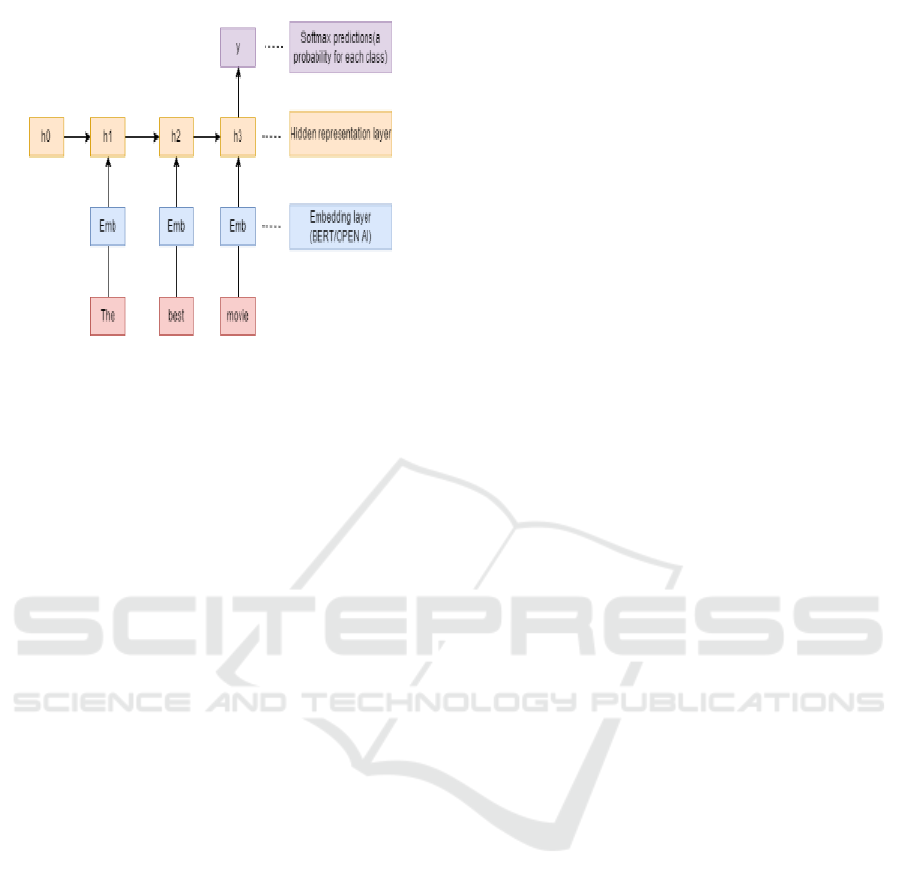
Figure 2: Bert/Openai Api Embeddings in an Rnn Network.
Providing high-quality feature vectors that were
taken from the text data allows for this improvement.
The RNN network with BERT or OpenAI
embeddings is displayed in Figure 2.
Implementation Details- Training and testing
data were divided in an 80:20 ratio. We employed
dropout to reduce overfitting and gradient clipping to
avoid exploding gradients, with a learning rate of
0.001. The training procedure, which lasted ten
epochs, used the Adam optimiser.
6 CONCLUSIONS
Bullying and hate are becoming more and more of a
social threat worldwide, manifesting in different ways
such as race, religion, body, physical ability, and
others. It is overly delicate and has a detrimental
effect on a person's thinking as well as the target
community. Furthermore, hatemongers are using
digital communication platforms and social media to
spread their malicious content. In this regard, the
suggested work is an endeavour that aids in the
collection and examination of textual content from
widely used social media platforms in order to
identify contents that are counterfeit. The suggested
effort first identifies the questionable content,
preventing it from going viral across many channels
and ultimately saving many lives.
To accomplish the necessary goal, the
following next stages are included in the
suggested sentiment analysis based on
bullying and hate speech detection
technique:
To identify appropriate sentiment-based
feature selection methods and text feature
selection methods, do a comparative
performance analysis.
To handle the text input and pertinent feature
set, find a classifier that is both accurate and
efficient.
Look for some engineered qualities that
contribute to the legitimacy of the
source.For a target event, identify the origin
of compromised content and potential
distribution channels.
Our research showed that in capturing the nuances
of cyberbullying language, both OpenAI and BERT
embeddings performed noticeably better than a
simple RNN model. OpenAI embeddings were the
most effective of them all, demonstrating their
exceptional capacity to comprehend sentiment and
context in user-generated information. Going
forward, the dataset's modest size presents difficulties
for model performance. In order to solve this, we
intend to investigate zero-shot or few-shot learning
techniques in subsequent research, which may
improve the model's generalisation and precision in
forecasting cases of cyberbullying with a small
amount of labelled data.
REFERENCES
A. kumar, “What is data mining”, CSE Dept, Dr. APJ Abdul
Kalam UIT Jhabua (M.P.) “Investment: Unit – 1,
Security Analysis and Portfolio Management”,
http://www.pondiuni.edu.in/storage/dde/downloads/
finiv_ sapm.pdf
B. Krawczyk, “Learning from imbalanced data: open
challenges and future directions”, Prog Artif Intell
(2016) 5:221–232
C. Clavel, Z. Callejas, “Sentiment Analysis: From Opinion
Mining to Human-Agent Interaction”, IEEE
Transactions on Affective Computing, VOL. 6, NO. X,
XXXXX 2015 “Preparing for the Future of Artificial
Intelligence”, Executive Office of the President
National Science and Technology Council Committee
on Technology, Oct. 2016, https:// obamawhitehouse.
archives.gov/sites/default/files/whitehouse_files/micro
sites/ostp/NSTC/preparing_ for_the_future_of_ai.pdf
D Cross. 2008. Cyberbullying: International comparisons,
implications, and recommendations. In 20th biennial
meeting of the International Society for the Study of
Behavioural Development, Wurzburg, Germany.
G. W. Blood, I. M. Blood, “Cyberbullying: Responsibility,
Concerns and Personal Experiences of School-based
Speech-Language Pathologists”, International Journal
for Infonomics (IJI), Volume 9, Issue 1, March 2016
ICRDICCT‘25 2025 - INTERNATIONAL CONFERENCE ON RESEARCH AND DEVELOPMENT IN INFORMATION,
COMMUNICATION, AND COMPUTING TECHNOLOGIES
452

G. Peters, R. Weber, “DCC: a framework for dynamic
granular clustering”, Granul. Comput. (2016) 1:1–11,
DOI 10.1007/s41066-015-0012-z
I. V. Serban, C. Sankar, M. Germain, S. Zhang, Z. Lin, S.
Subramanian, T. Kim, M. Pieper, S. Chandar, N. R.
Ke,S. Rajeshwar, A. d. Brebisson, J. M. R. Sotelo, D.
Suhubdy, V. Michalski, A. Nguyen, J. Pineau, Y.
Bengio, “A Deep Reinforcement Learning Chatbot”,
arXiv:1709.02349v2 [cs.CL] 5 Nov 2017
J. Wan, D. Wang, S. C.H. Hoi, P. Wu, J. Zhu, Y. Zhang, J.
Li, “Deep Learning for Content-Based Image Retrieval:
A Comprehensive Study”, Proceedings of the ACM
International Conference on Multimedia: November 3-
7, 2014, Orlando. pp. 157-166
J. Jayasree, Sri M. A. Mathi, S. Malini, E. Bavithra, Dr. P.
Boobalan, “Product Ranking System in E-Commerce
Website for Validation using Sentimental Analysis”,
International Journal of Science Technology &
Engineering, Volume 3, Issue 09, March 2017
Jacob Devlin, Ming-Wei Chang, Kenton Lee, and Kristina
Toutanova. 2019. Bert: Pre-training of deep
bidirectional transformers for language understanding.
In North American Chapter of the Association for
Computational Linguistics.
Jalal Omer Atoum. 2020. Cyberbullying detection through
sentiment analysis. 2020 International Conference on
Computational Science and Computational Intelligence
(CSCI), pages 292–297.
Jalal Omer Atoum. 2021. Cyberbullying detection neural
networks using sentiment analysis. 2021 International
Conference on Computational Science and
Computational Intelligence (CSCI), pages 158–164.
M. Rajan, T. S. Rinku, V. Bhojane, “Information Retrieval
in Malayalam Using Natural Language Processing”,
International Journal of Scientific & Engineering
Research, Volume 5, Issue 6, June-2014
M. M. Kampert, J. J. Meulman, J. H. Friedman, “rCOSA:
A Software Package for Clustering Objects on Subsets
of Attributes”, Journal of Classification 34:514-547
(2017)
M. M. Mironczuk, J. Protasiewicz, “A recent overview of
the state-of-the-art elements of text classification”
,Expert Systems With Applications, 106, 2018, 36-54
Michael Agbaje and Oreoluwa Afolabi. 2024. Neural
network-based cyber-bullying and cyber-aggression
detection using twitter(x) text. Revue d’Intelligence
Artificielle.
Nhan Cach Dang, María N. Moreno García, and Fernando
de la Prieta. 2020. Sentiment analysis based on deep
learning: A comparative study. ArXiv,abs/2006.03541.
S. Zhang, C. Zhang, Q. Yang, “Data Preparation For Data
Mining”, Applied Artificial Intelligence, 17:375– 381,
2003, Copyright # 2003 Taylor & Francis, 0883-
9514/03$12.00+.00,DOI:10.1080/0883951039021926
“DataMiningOverview”,https://www.tutorialspoint.co
m/data_mining/dm_overvie w.htm
S. Khemka, “Why Data Mining? Editor’s Point of View”,
digital valley, Vol.1, No 4, July 2018
Stefano Baccianella, Andrea Esuli, Fabrizio Sebastiani, et
al. 2010. Sentiwordnet 3.0: an enhanced lexical
resource for sentiment analysis and opinion mining. In
Lrec, volume 10, pages 2200–2204. Valletta.
T. Wuest, D. Weimer, C. Irgens, K. D. Thoben, “Machine
learning in manufacturing: advantages, challenges, and
applications”, Production & Manufacturing Research:
An Open Access Journal, 2016, VOL. 4, NO. 1, 23–45
U. Fayyad, G. P. Shapiro, P. Smyth, “From Data Mining to
Knowledge Discovery in Databases”, AI Magazine
Volume 17 Number 3 (1996) (© AAAI)
V. Gupta, G. S. Lehal, “A Survey of Text Mining
Techniques and Applications”, Journal of Emerging
Technologies in Web Intelligence, Vol. 1, No. 1, Aug
2009
W. Medhat, A. Hassan, H. Korashy, “Sentiment analysis
algorithms and applications: A survey”, Ain Shams
Engineering Journal 2014, 5, 1093-1113
Y. Roh, G. Heo, S. E. Whang, “A Survey on Data
Collection for Machine Learning”,arXiv:1811.03402v2
[cs.LG] 12 Aug 2019
Identifying Cyberbullying and Hate Speech via Sentiment Analysis of Social Media Text Social Networks
453
