
Beyond Cards and PINs: Enhancing ATM Security with Iris
Recognition and CNN
M. D. Narmadha, M. Sabarieesh, V. Sivaashankar, N. Vijayaragavan, S. Pavithra and V. Sridhar
Department of Computer Science and Engineering, V.S.B College of Engineering Technical campus, Kinathukadavu,
Coimbatore, Tamil Nadu, India
Keywords: ATM. Irish Patterns, Security, Emerging Technology, CNN, Vulnerabilities.
Abstract: This study intends to modernize the ATMs by introducing iris recognition technology as the primary mode of
authentication. This innovative method has the potential to strengthen security since it does away with the
vulnerabilities associated with traditional card-based systems such as card theft and skimming. Iris recognition
provides a highly secure and user-friendly authentication process since the human eye's iris offers unique
patterns. It would minimize the risk of fraud and identity theft at ATMs because iris patterns are very unique
and very difficult to replicate. Further, it would simplify the authentication process by not having users carry
physical cards or remembering PIN codes. That way, it would give a convenient and efficient experience to
the customers. This paper deals with the technical aspects of the implementation of iris recognition in ATMs,
potential benefits toward security and convenience, challenges posed, and future directions toward this
emerging technology. Adoption of iris recognition technology can serve banks in achieving more enhanced
security as well as facilitating a more convenient and futuristic banking experience for its customers. This
approach has the advantage of aligning with the fast-growing trend of biometric authentication and will
change how people interact with their technology and financial services. This project deploys the CNN
algorithm to optimize ATM security through Irish recognition technology. By convolving user biometric data-
-facial features--and learned filters, the CNN algorithm extracts discriminative features for verification. The
activation function verifies user identity through the matching of features, while the pooling reduces false
positives and negatives through data augmentation. The output is an ATM transaction processing system with
security, eliminating the requirement for ATM cards, making it more secure, and convenient, and reducing
the possibility of identity theft and unauthorized transactions.
1 INTRODUCTION
The use of Automated Teller Machines (ATMs) has
become an essential part of modern banking,
providing customers with convenient and secure
access to their financial accounts. However, the
security of ATMs has become a major concern in
recent years, with the increasing incidence of identity
theft, card skimming, and other forms of fraud. It
means the need for stronger and safer authentication
technologies is felt as those would protect the ATM
user from potential security threats.
One of the most promising authentication
technologies for ATMs is facial recognition, which
verifies an individual's identity through unique facial
features. Facial recognition technology has been
widely used in various applications, such as border
control, law enforcement, and access control.
However, its application in ATMs is still in its
infancy, and there is a need for more research and
development to improve its accuracy, security, and
usability.
The proposed project will be developing an
advanced ATM security system, utilizing Irish
Recognition Technology and Convolutional Neural
Network (CNN) algorithms to ensure the secure and
convenient authentication of ATM users. It uses
facial recognition technology to verify the identity of
ATM users; thus, it does away with physical cards
and PINs. This will enhance security on ATMs while
also being more convenient and user-friendly for
customers.
The project will include the design and
development of a prototype ATM system that
integrates Irish Recognition Technology and CNN
algorithms. A variety of metrics, including accuracy,
Narmadha, M. D., Sabarieesh, M., Sivaashankar, V., Vijayaragavan, N., Pavithra, S. and Sridhar, V.
Beyond Cards and PINs: Enhancing ATM Security with Iris Recognition and CNN.
DOI: 10.5220/0013899400004919
Paper published under CC license (CC BY-NC-ND 4.0)
In Proceedings of the 1st International Conference on Research and Development in Information, Communication, and Computing Technologies (ICRDICCT‘25 2025) - Volume 3, pages
421-424
ISBN: 978-989-758-777-1
Proceedings Copyright © 2025 by SCITEPRESS – Science and Technology Publications, Lda.
421

security, and usability, will be used to test and
evaluate the system. A review of the existing
literature on facial recognition technology and its
applications in ATMs will also be involved, as well
as a survey of ATM users to gather feedback and
requirements for the proposed system.
This will contribute significantly to the
development of newer and more secure
authentication technologies on ATMs, which means
that the occurrence of cases of identity theft and the
like will reduce. The new ATM will provide a
convenient and user-friendly experience when using
the machine, ensuring that customer satisfaction and
loyalty improve.
2 LITERATURE REVIEW
The literature review shows that traditional ATM
security systems are based on physical cards and
PINs, which are vulnerable to identity theft, card
skimming, and other forms of fraud (Kumar et al.,
2019). To overcome these issues, researchers have
proposed various biometric authentication
technologies, such as facial recognition, fingerprint
recognition, and iris recognition (Jain et al., 2018).
In recent years, facial recognition technology has
gained much attention because of its potential to
provide secure and convenient authentication for
ATM users (Wang et al., 2019). Irish Recognition
Technology is a proprietary facial recognition
technology developed by Daon. It has been
demonstrated to provide high accuracy and security
in various applications, including border control and
law enforcement (Daon, 2020).
Due to its capacity for learning complex patterns
in images, convolutional neural network (CNN)
algorithms have become one of the most popular
methods applied in facial recognition applications
(Krizhevsky et al., 2012). Recently, researchers have
proposed numerous architectures of CNN-based
approaches toward facial recognition, including deep
learning-based methods (Wang et al., 2019).
The literature review also indicates that the union
of facial recognition technology and CNN algorithms
might provide a robust and secure authentication
system for an ATM (Liu et al., 2019). However, there
are concerns about facial recognition systems in
which biases can occur or the system generates errors,
especially when the lighting conditions are poor and
the facial features are obscured (Rajagopal et al.,
2019).
To mitigate these concerns, there are several
techniques proposed, such as data augmentation,
transfer learning, and ensemble methods (Kumar et
al., 2019). Such techniques can enhance the precision
and robustness of facial recognition systems,
especially when the illumination is poor or the
features are occluded.
Conclusion From the literature review, facial
recognition technology and CNN algorithms seem to
provide an excellent basis for a robust and secure
ATM authentication system. However, there are also
some potential biases and errors in facial recognition
systems that need to be addressed through the
development of more advanced and robust
techniques.
3 SYSTEM ANALYSIS
This phase in the project is identifying the functional
and non-functional requirements of the ATM security
enhancement system. The functional requirements
consist of user authentication, transaction processing,
and security features. The system will authenticate
users using Irish Recognition Technology and CNN
algorithms, secure and efficient transaction
processing, and robust security features to guard
against unauthorized access and data protection for
users. The system should also integrate with the
existing ATM infrastructure and comply with
relevant security standards and regulations.
The non-functional requirements of the system
are performance, scalability, usability, and
maintainability. The system has to process
transactions with efficiency and speed, be able to
handle a huge volume of users and transactions, and
provide a user-friendly interface that is easy to
navigate. The system has to be maintainable and
upgradable, with the integration of new security
features and technologies as they come out in the
market. Through identifying and analysis of these
functional and non-functional requirements, the
project team can ensure that this ATM security
enhancement system really meets the needs of its
users and stakeholders, giving a secure and efficient
manner of conducting transactions.
4 SYSTEM ARCHITECTURE
The system architecture consists of the following
components:
1. User Interface: The user interface is responsible for
interacting with the user, capturing their facial
features, and displaying the transaction options.
ICRDICCT‘25 2025 - INTERNATIONAL CONFERENCE ON RESEARCH AND DEVELOPMENT IN INFORMATION,
COMMUNICATION, AND COMPUTING TECHNOLOGIES
422
2. Facial Recognition Module: This module uses Irish
Recognition Technology and CNN algorithms to
recognize and verify the user's facial features.
3. Transaction Processing Module: This module takes
care of the transaction request submitted by the user,
which includes cash withdrawal or check balance.
4. Security Module: This module adds an extra layer
of security to the system by encrypting access control
and preventing unauthorized access.
5. Database: It holds the biometric data of the user,
their history of transactions, and any other
information relevant to the same.
6. Camera: The camera has high resolution in
capturing the user's facial features.
7. Facial Recognition Software: It applies Irish
Recognition Technology and CNN algorithms for the
recognition and verification of facial features.
8. Transaction Processing Software: This is the
software responsible for processing the transaction
requests made by the user.
9. Security Software: This is the software that will
enhance security in the system through encryption
and access controls, to secure user data and block any
unauthorized access.
10. Hardware: The system combines different
hardware components such as a computer, monitor,
and cash dispenser.
4.1 System Interfaces
The system interfaces are composed of:
1. User Interface: This is the user interface that will
interact with the user, capture the user's facial
features, and then give a list of the options that can be
done with a transaction.
2. API Interface: The API interface ensures secure
and standardized communication of the system with
external systems, including banks and payment
gateways.
3. Database Interface: The database interface ensures
safe and standardized interaction of the system with
the database in which user biometric data and
transaction history, among other details, are stored
and retrieved.
The CNN architecture for Irish Recognition involves
a series of layers, such as convolutional layers,
activation functions, pooling layers, flattened layers,
and dense layers. The first convolutional layer makes
use of 32 filters of size 3x3 to extract low-level
features from the input images. The ReLU activation
function is used in the model to introduce non-
linearity. The result of the first convolutional layer is
passed to a max-pooling layer of size 2x2. Again, the
process is applied on the second convolutional layer
which will utilize 64 filters of size 3x3 to acquire the
middle-level features of the images in input. Then,
another max-pooling layer with the size of 2x2 is
applied on the second convolutional layer. The output
of the second max pooling layer is then flattened into
a 1D array using a flattened layer. Then, this array is
forwarded through two dense layers. In the first one,
128 neurons with ReLU activation function were
used to extract high-level features from the input
images. Then, the second. Dense layer utilized 10
neurons with a SoftMax activation function to
compute the probabilities for each class.
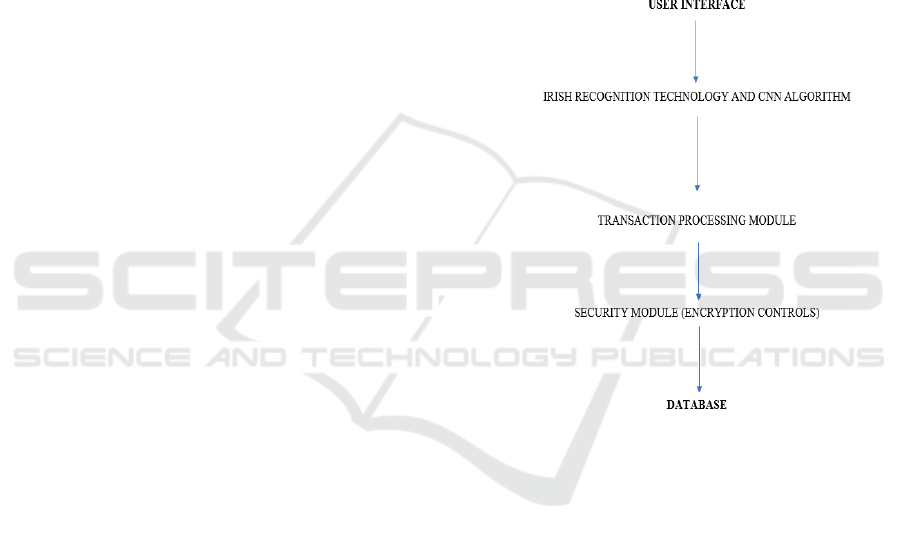
4.2 System Design Diagram
Figure 1: System Design Diagram.
The CNN algorithm is trained with the Adam
optimizer at a learning rate of 0.001 and categorical
cross-entropy loss. The batch size is set to 32, and the
number of epochs is set to 10. Data augmentation
techniques, such as random rotation, width shift,
height shift, and zoom, are used to increase the
diversity of the training data. The performance of the
CNN algorithm is evaluated using various metrics,
such as accuracy, precision, recall, and F1-score.
Accuracy was obtained as the proportion of correct
classified images. Precision was calculated using the
proportion of true positives among all the positive
predictions. The recall was calculated as a proportion
of true positives among all the positive instances.
Lastly, the F1-score is the harmonic mean of the
precision and recall scores. Figure 1 shows the system
design diagram.
Beyond Cards and PINs: Enhancing ATM Security with Iris Recognition and CNN
423
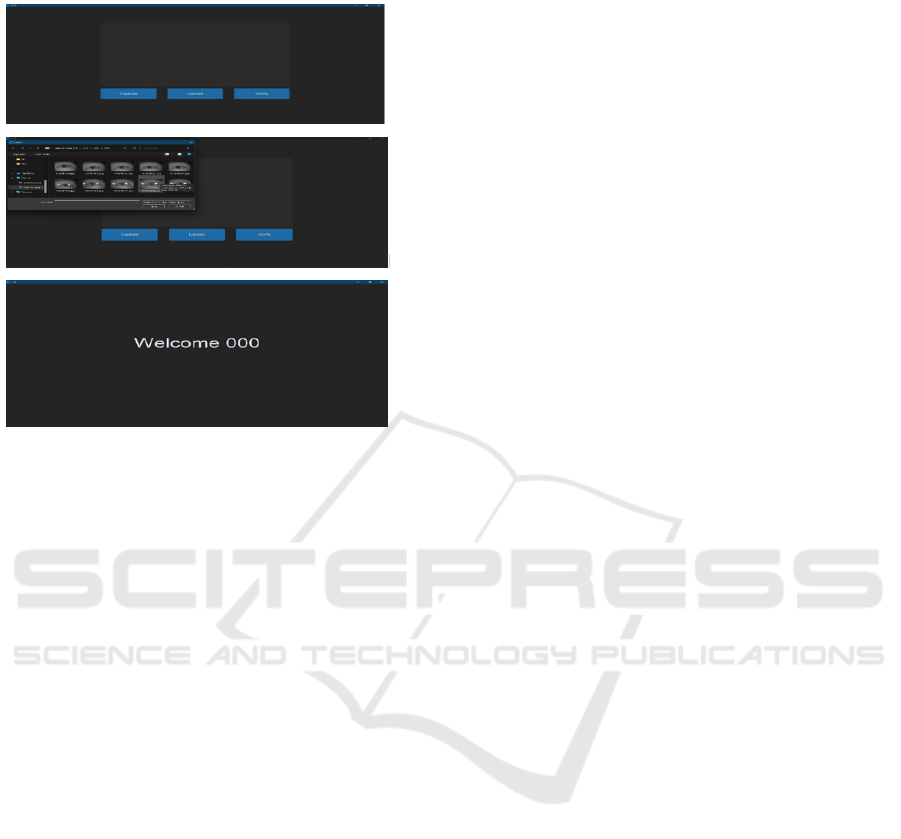
4.3 Trained Data and Tested Data
Figure 2: Screenshot of Proposed Model.
Figure 2 shows the screenshot of proposed model.
5 CONCLUSIONS
The proposed system can give the ATM user a safe
and convenient authentication means. It also
enhances accuracy and security for facial recognition
using Irish Recognition Technology in combination
with the CNN algorithm, thereby avoiding identity
theft and many other forms of security breaches. In
this regard, the system also provides ATM users with
a more convenient, user-friendly, and better
experience compared to the usual physical cards and
PINs. The proposed system, in total, has the potential
to revolutionize the way of interacting with ATMs - a
more secure, convenient, and user-friendly
experience.
REFERENCES
Ashwini C, Shashank P, Shreya Mahesh Nayak, Siri Yadav
S, Sumukh M, 2020, “Cardless Multi-Banking ATM
System Services using Biometrics and Face
Recognition,” International Journal of Engineering
Research & Technology (IJERT) NCCDS – 2020
(Volume 8 – Issue 13).
Assistant Professor G.Mahendar, Assistant Professor
Meenaiah Batta, “Enhanced Security in ATM by IRIS
and Face Recognition Authentication”, International
Journal of Scientific Research & Engineering Trends
Volume 6, Issue 3, May-June-2020, ISSN (Online):
2395-566X.
Gusain, R., Jain, H., & Pratap, S. 2018, “Enhancing bank
security system using Face Recognition, Iris Scanner
and Palm Vein Technology”, 2018 3rd International
Conference on Internet of Things: Smart Innovation
and Usages (IoT-SIU), 1-5.
K. Yadav, S. Mattas, L. Saini and P. Jindal, "Secure Card-
less ATM Transactions," 2020 First IEEE International
Conference on Measurement, Instrumentation, Control
and Automation (ICMICA), Kurukshetra, India, 2020,
pp. 1-4, doi: 10.1109/ICMICA48462.2020.9242713.
Manish C, N Chirag, Praveen H, Darshan M , D Kasim
Vali, “Card-Less ATM Transaction using Biometric
and Face Recognition– A Review”, 2020 International
Journal for Research in Applied Science & Engineering
Technology (IJRASET), ISSN: 2321-9653; IC Value:
45.98; SJ Impact Factor: 7.429 Volume 8 Issue VII July
2020.
Mr. Prakash Hongal, Mr. Vikram Shirol, Ms. Manikya H
Hansabhavi, “Secure ATM Transaction Using Face
Recognition and OTP”, 2022 International Journal of
Advance Research and Innovative Ideas in Education,
IJARIIE-ISSN(O)-2395-4396, Vol-8 Issue-3 2022.
Murugesan, Santhosh M2 , Sasi Kumar T 3 , Sasiwarman
M4 , Valanarasu I5, “Securing ATM Transactions using
Face Recognition”, 2020 International Journal of
Advanced Trends in Computer Science and
Engineering(IJACSE), Volume 9 No.2, March -April
2020, ISSN 2278-3091.
Sahil Bajaj, Sumit Dawda, Pradnya Jadhav, Rasika Shirude,
“Card less ATM Using Deep Learning and Facial
Recognition Features”, 2022, Journal of Information
Technology and Software Engineering, Vol.12 Iss.5
No:302, JITSE-21-11077, 14-Oct-2022, DOI:
10.35248/2165-7866.22.12.302.
Shivam Singh, Prof. S. Graceline Jasmine, 2019, “Face
Recognition System”, International Journal of
Engineering Research & Technology (IJERT) Volume
08, Issue 05.
Vaishnavi M. Shinde, Dhanashri B. Shinde, Pravin B.
Shinde, Aditya V. Wandhekar, Pallavi S. Kohakade,
“Virtual ATM through Fingerprint and Face
recognition using Deep Learning”, 2023 International
Journal of Innovative Research in Technology (IJIRT),
ISSN: 2349-6002, Volume 9 Issue 10, March 2023.
ICRDICCT‘25 2025 - INTERNATIONAL CONFERENCE ON RESEARCH AND DEVELOPMENT IN INFORMATION,
COMMUNICATION, AND COMPUTING TECHNOLOGIES
424
