
AI‑Powered Secure LPG Monitoring and Control System for Smart
Kitchens
Kamalanaathan S., Arunprasath B., Nandhakumar S., Sruthi R.,
Ishwarya Niranjana M. and Parthiban V.
Department of ECE, Sri Eshwar College of Engineering, Coimbatore, Tamil Nadu, India
Keywords: Smart LPG Stove, STM32F103C8T6 Microcontroller, Gas Leakage Detection, AI, ML Integration, Kitchen
Safety System, Automated Safety Measures, PIR Sensor, Intelligent Decision‑Making, Motion Deduction
Control.
Abstract: This project presents an advanced safety mechanism to extend kitchen safety through automated monitoring
and controlling using the STM32F103C8T6 microcontroller and the "AI-Powered Secure LPG Monitoring
and Control System." It brings together multiple sensors to sense possible hazardous conditions and react
preventively. use gas sensor which detect LPG leakage, it uses flame sensor to ensure flame present in utensil,
and use ultrasonic sensor to check whether utensil is placed correctly. These features also aid in detecting and
addressing dangers like gas leaks, unattended flames and improper stove use. Using AI & ML algorithms in
conjunction with a PIR sensor camera, the system identifies whether the motion is from a human or an animal.
Doing so increases accuracy of detection and reduces false alarms. The system will also automatically close
cylinder valve and power supply in case of a gas leak. This prevents gas from flowing unless a flame or a
utensil is detected. Furthermore, in the event of a fire, the system instantly notifies emergency services,
facilitating a swift response. SMART LPG STOVE: Integrating advanced sensing technology with AI-driven
decision-making, the Smart LPG Stove offers a revolutionary solution that not only increases kitchen safety
but also effectively reduces accidents and promotes energy efficiency. This cutting-edge solution is a
significant leap forward in the realm of contemporary kitchen appliances, providing a cooking experience that
is both safer and more intelligent.
1 INTRODUCTION
Liquefied Petroleum Gas (LPG) is used as a
domestic energy in many countries and is a major
source of home cooking. Though LPG has improved
cooking efficiency and convenience, it comes with
fire risks. Gas leak and other type of kitchen accidents
are common and hence, can bring serious injuries or
even fatalities. Hence, it is crucial to prevent gas leak
and other items in Kitchen to ensure Kitchen safety.
To mitigate this problem, we proposed the “AI-
Powered Secure LPG Monitoring and Control System
for Smart Kitchens”
Advanced sensors, AI, ML and IOT technology
can be integrated with a kitchen safety system to track
potential hazards and act against them in real-time. Its
aim for the cooking space specifically will likely zero
in on core safety concerns, like gas leaks, unattended
flame, and spontaneous combustions.
1.1 System Functionality
The system includes several sensors for full hazard
detection:
If there is no flame or utensil detected at the
cooking platform, the system will automatically turn
off the gas regulator, thereby preventing gas wastage.
If there is an LPG leak, the device instantly shuts the
cylinder valve and disconnects the power supply,
which lowers the probability of an explosion. In case
of fire detection, the system sends emergency
messages through GSM module, for quick response
to users and nearest safety department providers.
An AI-powered camera, integrated with a passive
infrared (PIR) sensor, differentiates between human
and animal motion, improving motion detection
accuracy and reducing false alarms. This intelligent
decision-making capability enhances the system’s
efficiency and reliability.
S., K., B., A., S., N., R., S., M., I. N. and V., P.
AI-Powered Secure LPG Monitoring and Control System for Smart Kitchens.
DOI: 10.5220/0013899200004919
Paper published under CC license (CC BY-NC-ND 4.0)
In Proceedings of the 1st International Conference on Research and Development in Information, Communication, and Computing Technologies (ICRDICCT‘25 2025) - Volume 3, pages
407-413
ISBN: 978-989-758-777-1
Proceedings Copyright © 2025 by SCITEPRESS – Science and Technology Publications, Lda.
407

1.2 The Growing Concern over LPG-
Related Accidents
According to the National Crime Records Bureau
(NCRB), recent statistics highlight the severity of
LPG-related accidents. In Tamil Nadu, 586 people
lost their lives due to gas cylinder explosions, while
Gujarat recorded 735 fatalities. Among the southern
states, Tamil Nadu reported the highest number of
casualties, surpassing Andhra Pradesh (426),
Karnataka (386), and Kerala (52). On average, gas
cylinder explosions in Tamil Nadu claim around 10
lives per week. In the previous year, there were 632
reported incidents related to LPG explosions (Rohan
Chandra Pandey).
Another report reveals a significant
rise in gas leakage accidents, increasing from 0.72%
to 10.74% of all cooking-related mishaps.
1.3 The Role of LPG in a Sustainable
Energy Future
LPG has over 1,000 applications, serving hundreds of
millions worldwide across industries such as
commerce, agriculture, transportation, electricity
generation, heating, and cooking. It is recognized for
its environmental benefits, immediate availability,
versatility, and ease of transportation. As the world
transitions toward a more sustainable and secure
energy economy, LPG remains a crucial energy
source, particularly for clean cooking solutions in
various countries.
1.4 A Smarter and Safer Kitchen
Solution
By integrating IoT, AI, and automation, the Smart
LPG Stove represents a breakthrough in modern
kitchen technology. It enhances safety, reduces
household risks, and improves energy efficiency,
making it a transformative solution for smarter and
safer cooking environments.
2 OBJECTIVES
• Develop an AI-powered automated system that
can accurately detect gas leaks, flame presence,
utensil placement, and abnormal heat levels to
prevent LPG-related kitchen accidents.
• Implement an intelligent safety mechanism that
automatically shuts off the gas regulator, cylinder
valve, and power supply in the event of a gas leak,
unattended flame, or absence of a utensil,
minimizing fire risks.
• Integrate IoT and AI-driven monitoring to provide
real-time gas and flame status updates, alert users
and nearby safety authorities through a GSM
module anenable remote monitoring via a smart
interface.
• Enhance motion detection accuracy using an AI-
powered camera with a PIR sensor, differentiating
between human and animal movement to reduce
false alarms and improve system reliability.
• Ensure user-friendly operation by offering an
intuitive interface that allows households and
commercial kitchens to easily configure and
operate the system with minimal effort.
• Promote safer, more energy-efficient, and cost-
effective LPG usage by minimizing gas wastage,
reducing accident risks, and optimizing energy
consumption for both residential and commercial
kitchens.
3 LITERATURE SURVEY
The increasing realization of the hazards linked to the
use of LPG has resulted in an increased demand for
the creation of automated intelligent solutions for gas
safety at home featuring smart home technology. The
field has progressed through research and projects
working on sensor and IoT technologies that would
prevent things like gas leaks, unattended flame, and
explosions. The Automatic Smart LPG Stove using
IOT was designed and developed based on some
significant researches and developments as cited
below. Most research has addressed devices for
detecting gas leaks to prevent explosions triggered by
undiscovered leaks. MQ series gas sensors, especially
the MQ4 and the MQ6 models, are commonly used
to detect the methane and the LPG gases. Studies like
those from Suryawanshi et al. (2018) have also
pointed out that the detection of gas concentrations in
the environment and the start of the alert with the
combination of gas sensor and microcontrollers.
These devices help prevent emergencies but often just
serve as an alarm without controlling the gas supply.
Many research efforts have studied integrated
systems that consist of gas sensors with flame
sensors and use Internet of Things. Rao et al. sensors
to detect temperature changes, gas leakage and
flames. In the case of an anomaly, IoT-enabled
alarms would alert users. While this system is focused
more on commercial use, it utilizes many of the same
ICRDICCT‘25 2025 - INTERNATIONAL CONFERENCE ON RESEARCH AND DEVELOPMENT IN INFORMATION,
COMMUNICATION, AND COMPUTING TECHNOLOGIES
408

aspects and ideas as the design of the Smart LPG
Stove and provides automatic shut-off as well as
notifications in real-time. With these concepts in
mind, the use of IoT with gas, flame and ultrasonic
sensors using IoT features gives us the Automated
Smart LPG Stove, which is fully automated and easy
to use. This approach not only helps to learn about
potential risks, but also proactively responds in
managing to avoid an accident, making cooking a far
safer environment to be in.
4 PROBLEM STATEMENT
Liquefied petroleum gas (LPG) that is commonly
used in homes for cooking is a highly flammable gas
and poses a serious safety risk. Gas leaks, flames left
unattended and forgetting to place utensils on a
burner are leading causes in kitchen disaster that can
lead to death, major injuries and property destruction.
Gas leak detectors and flame monitoring equipment
are already on the market; however, the majority of
existing systems are either manual or a combination
of manual and automatic, which are not fast enough
to prevent incidents in the real time. In addition, there
is a lack of sensor integration in the utensils presence
detection system, which helps eliminate unnecessary
gas and potential dangers if used accordingly.
Current systems do not only cover utensil
detection, causing excessive gas flow that causes
energy waste and, moreover, a safety issue.
Additionally, most solutions available today are not
integrated with the IoT, meaning that they cannot
send out emergency alerts, remote figure control, and
monitor conditions in real-time. The challenge lies in
designing an automated LPG stove system that can
detect flames, gas leaks and utensils simultaneously,
and is also able to shut off automatically to prevent
dangerous situations. Besides, the notifications
should be real time so that either the user or
emergency services can act swiftly in case of critical
event.
Existing systems combine the gas flow detection
without any utensil detection leading to unnecessary
gas flow which increases the energy consumption and
introduces safety risks. Additionally, most
implemented solutions are unable to integrate IoT
technologies, which significantly limits their
potential for real- time monitoring, remote control
and emergency alerts. So, the task is to design
automatic IoT-enabled LPG stove system based on
the environment in order to detect gas leak, flame as
well as utensil presence all at the same time with
automatic shut off functionality in order to get rid of
vulnerable conditions. And it should also be able to
send alerts in real-time to the users or to emergency
services so that action can be taken immediately when
a critical event happens.
5 OPERATIONAL
FRAMEWORKS
The AI-Powered Secure LPG Monitoring and Control
System operates through three primary layers:
sensing, processing, and control. These layers work
together to detect hazards, analyze data, and take
necessary actions to ensure kitchen safety.
The sensing layer consists of gas sensors, a flame
sensor, an ultrasonic sensor, and an AI-powered
camera with a PIR sensor to detect gas leaks,
unattended flames, utensils, and human or animal
presence.
The processing layer uses AI and ML to analyze
sensor data, differentiate between human and animal
movement, and make automated decisions to prevent
accidents.
The control layer includes a motorized actuator to
shut off the gas knob, a power cut-off mechanism for
major leaks, and a GSM module for emergency alerts.
This system addresses the growing concern over
LPG-related accidents by providing real-time
monitoring, automatic gas shutoff, and emergency
response, ensuring a safer kitchen environment. With
its IoT and AI integration, it enhances safety, reduces
risks, and promotes energy efficiency in modern
kitchens.
6 EMERGING TECHNOLOGY
The development and application of the internet of
things-based AI-Powered Secure LPG Monitoring
and Control System for Smart Kitchens heavily relies
on emerging technologies. Advancements in sensor
technologies, microcontroller systems, and the
internet of things have brought about the development
of smart kitchen solutions that improve automation
and safety.
Important developments in gas sensors, including
the gas sensor, enable accurate detection of methane
and LPG gas leaks, guaranteeing real-time
monitoring of hazardous levels. The user's mobile
phone received alert messages from our devised
system with success. To get these messages on the
user's phone, no application needs to be installed. The
GSM technology is used to send these alert messages.
AI-Powered Secure LPG Monitoring and Control System for Smart Kitchens
409
Furthermore, by lowering the possibility of an
unsupervised gas flow, flame sensors improve stove
safety by responding instantly to the presence or
absence of a flame.
7 LPG SAFETY SYSTEM
Gas leaks are a severe issue that are currently seen in
a lot of locations, including homes, businesses, cars,
etc. LPG, also known as liquefied petroleum gas, is a
combustible blend of hydrocarbon that can be used as
fuel in a range of facilities, including homes, hotels,
businesses, and automobiles. It also has a high
temperature, low smoke and soot content, and little
effect on the environment. Even when it is far from
the source of the leak, LPG can quickly catch fire due
to its high flame-retardant properties. LPG is mostly
used for cooking in homes. They could blow up when
the dumping gases combine with oxygen molecules
and the amount of LPG in the atmosphere, or if
there’s a flame or an electric spark present.
In this work, the classic k-ε model describes
the gas flow field. The k equation for turbulent
dissipation and the 'k' equation for turbulent kinetic
energy rate are computed using the two equations that
make up the model. The variable 'k' denotes turbulent
kinetic energy, which can be expressed as m2s−2.
Additionally, ok represents the Plant-Schmidt
constant of this energy, & denotes the turbulent
kinetic energy dissipation, and C2 is the constant in
the k-equation.
Generally, this equation reduces the combustion of
propane and butane to a single, irreversible. In gas
consumption, the combined effects of turbulence and
the chemical reaction are considered using the finite
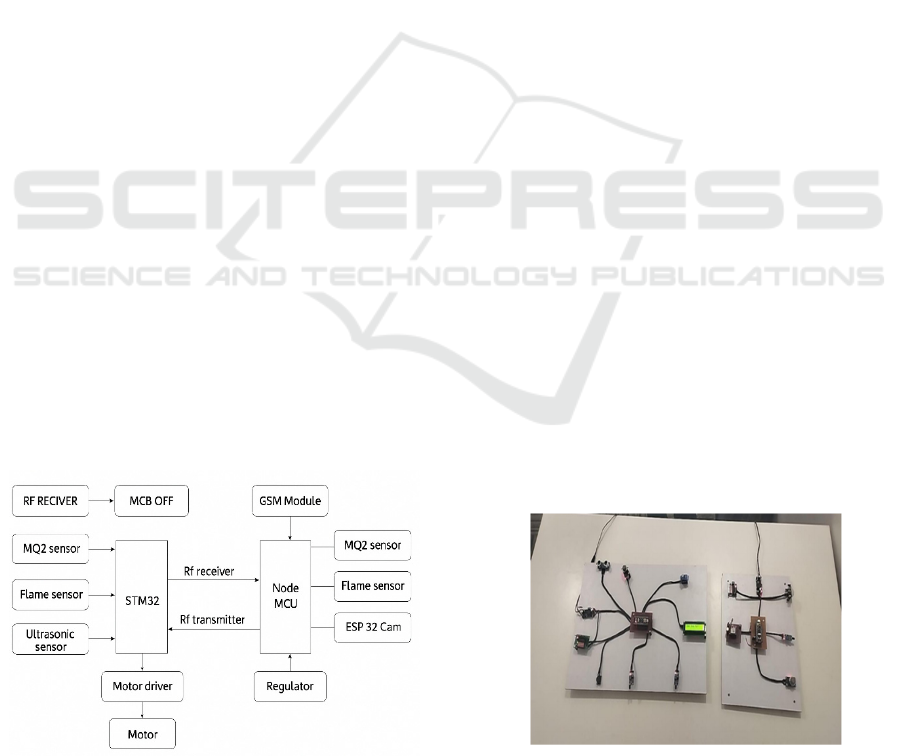
rate/eddy current dissipation model. Figure 1 show the
Block Diagram.
Figure 1: Block diagram.
8 DESIGN AND WORKING
The AI-Powered Secure LPG Monitoring and Control
System for Smart Kitchens is designed to enhance
kitchen safety by detecting gas leaks, monitoring
flame presence, identifying utensil placement, and
distinguishing between human and animal
movement. Built around the STM32F103C8T6
microcontroller, the system integrates multiple
sensors and AI-based automation to prevent hazards
in real time. The gas sensor (MQ2) continuously
monitors the environment for LPG leaks, and if a leak
is detected, the system immediately shuts off the gas
supply using a servo motor and cuts power to prevent
ignition. Simultaneously, it triggers a buzzer alarm
and sends real-time alerts via GSM and IoT to inform
users and emergency responders. The flame sensor
(KY-026) ensures the presence of a stable flame. If
the flame goes out unintentionally, the system closes
the regulator valve to prevent gas buildup. In case of
a fire, it sends emergency alerts to nearby fire stations
for a quick response.
An ultrasonic sensor (KY-050) detects if the utensil
is present on the stove to improve energy efficiency.
When no utensil is detected, gas supply is
automatically turned off, saving gas from being
wasted. Also, the PIR sensor and the ESP32 camera
differentiate between humans and animals. In the
case of unattended cooking, gas would continue to
flow, but if no human presence was sensed near an
active stove for a certain period of time, the system
would cut the gas to avoid any hazards. In addition, it
is enhanced with AI and ML algorithms that analyze
motion data to reduce false alarms and process
intelligent decisions. With GSM (SIM800L) through
IoT connectivity gives users a mobile notification in
real-time to monitor the kitchen appliances from a
distance. In addition, AI not only detects early signs
of potential hazards through predictive analytics but
also suggests preventive safety measures.
Figure 2: STM32F103C8T6 controller connection with
sensors.
ICRDICCT‘25 2025 - INTERNATIONAL CONFERENCE ON RESEARCH AND DEVELOPMENT IN INFORMATION,
COMMUNICATION, AND COMPUTING TECHNOLOGIES
410
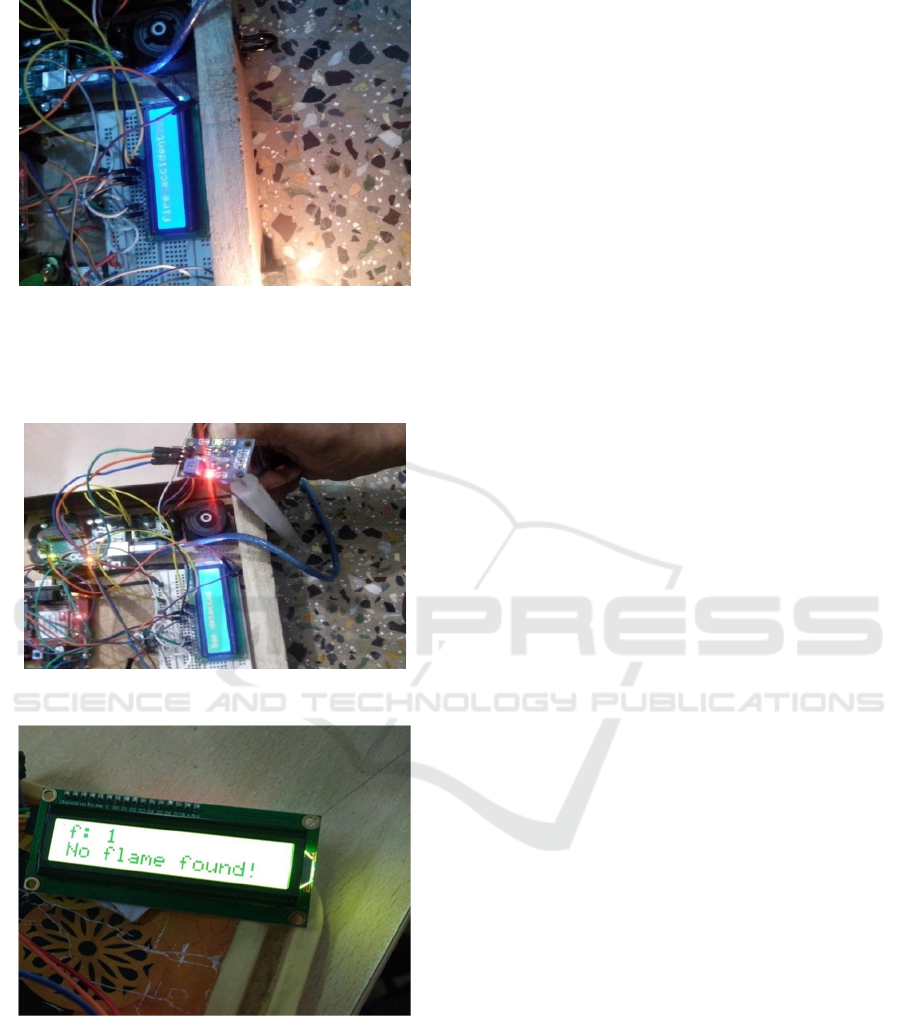
Figure 3: Testing setup with fire.
Figure 2 and 3 shows the STM32F103C8T6
controller connection with sensors and Testing setup
with fire respectively.
Figure 4: Testing gas detection.
Figure 5: Testing with no flame.
Figure 4 and 5 shows the Testing gas detection and
Testing with no flame respectively. The Smart LPG
Stove System is a highly secure and energy-efficient
appliance for today's kitchens, thanks to a mix of
advanced sensors, AI-powered automation, and IoT
integration. It provides real-time hazard alerts,
automated shutoff solutions, and remote
notifications, making cooking safer and more
convenient.
The following components were used in the
development of the “AI-Powered Secure LPG
Monitoring and Control System for Smart Kitchens”
• STM32F103C8T6
• Flame sensor
• ESP 32 Cam
• Servo motor
• Gas sensor (MQ2)
• GSM module (SIM800L)
• Encoder (RF transmitter)
• Decoder (RF receiver)
• Display (optional, eg., LCD)
• Ultrasonic sensor
• IR sensor
• Buzzer
9 PROPOSED METHODOLOGY
This paper aims to provide a proposed design
methodology of Automated Smart LPG Stove using
IoT that assures kitchen safety through real time
monitoring, automated control and notifications to
users. It is a sensor, microcontroller, and actuator-
based system to check for gas leakage, flame status
and utensil presence on the stove. Gas sensors
monitor the levels of LPG and methane, continuously
checks the levels of the gas. A flame sensor is placed
near the burners to check if the flame is on, and an
ultrasonic sensor to see if utensils are being used.
The STM32F103C8T6 microcontroller receives
real-time data from these sensors and executes
predefined safety protocols. When the gas is not off
when it should be, the system then has the ability to
rely on sensor input and has the intelligence to turn
off the gas knob by itself in times of crisis, such as
gas leaks, no flame, or no utensil detected when the
gas is on.
The IoT module will allow the user to connect
their devices to the kitchen to remotely monitor
whether the kitchen is safe. To make the system more
usable, a smartphone application and web portal
interface is developed that allows users to set alert
thresholds and monitor the stove remotely. Finding
such a smart solution would reduce the chances of gas
accidents happening as it is a complete solution for
automated kitchen safety.
AI-Powered Secure LPG Monitoring and Control System for Smart Kitchens
411

10 RESULTS
Through the very successful IoT connection, an
extinguished flame or gas leak could be detected
remotely with the help of a smartphone app, and
customers would receive immediate notifications in
the face of any danger. At the system's core was a set
of valves that could be opened and closed remotely,
allowing users to manage the gas supply from a
distance.
Testing demonstrated that the microprocessor
responded accurately and quickly to sensor inputs,
and that the system functioned reliably and
consistently in a variety of conditions. The user
interface also provided users with real-time data
about gas concentrations, flame status, and utensil
presence, which gave them full control and
supervision over the system.
When we take all of these into account, the
accuracy of detection, timely response and IoT-
based remote monitoring of the system practically
assured the kitchen safety. Best User Interface, User
Experience for Device: The user interface was
designed to put the users in full control and
supervision of the device and to show real-time data
about the concentration of gas, state of flame, and
presence of the utensil. Conclusively, the system's
accurate detection, early response, and Remote
Monitoring based on Internet of Things and Secured,
smart kitchen ensures Kitchen safety.
11 CONCLUSIONS
The Smart LPG Stove based on STM32F103C8T6
controller, on the other hand, aims to make the
kitchen safe by protecting it from the effects of gas,
flames, and utensils automatically, by recognizing the
risk of leakage and turning off the gas knob.
Customers may also feel more comfortable knowing
that the device is simple to install and use, and it can
help avoid disasters in the kitchen. In the system,
there are 4 sensors used (STM32F103C8T6 controller
board _ flame sensor _ gas sensor _ ultrasonic sensor
original).
You can enhance the project to add voice control,
multi-language, and mobile app compatibility
features. Overall, the smart LPG stove project is an
effective and useful of STM32F103C8T6 controller
technology that can improve the safety of your
kitchen significantly.
12 FUTURE SCOPE
The IoT- powered Automated Smart LPG Stove has
an extensive scope to grow and adapt, and the way
ahead can have a few suggestions for improvement in
the future.
Integration with Smart Home Systems: As the
Internet of Things evolves, the system can be
integrated into broader smart home ecosystems,
allowing seamless communication with other smart
devices, smoke alarms, ventilation systems, and fire
detectors.
Improved User Interface and Analytics:
Additionally, this information could be used to
develop more sophisticated online or mobile
applications with full data, allowing users to
contribute to monitoring safety events, reviewing gas
consumption over time and receiving guidelines for
improving energy efficiency.
REFERENCES
A. Gupta," Economical and Optimal Gas Leakage
Detection and Alert System," International Journal of
Scientific and Research Publication, vol. 7. no. 11, pp.
260-263,2017.
A.Shrivastava, R. Prabhakar, R. Kumar, and R. Verma,
"Gsm Based Gas Leakage Detection System,"
International Journal of Emerging Trends in Electrical
and Electronics, vol. 1, no. 2, pp. 42–45, 2013.
B. SakthiKumar, M. I. Niranjana, M. Abinath, I. G. Prasath,
K. Jugasri and S. Kailash, "Survey on Smart
Agriculture Using Iot," 2023 International Conference
on Computer Communication and Informatics (ICCCI),
Coimbatore, India, 2023, pp. 1-5, doi:
10.1109/ICCCI56745.2023.10128531.
C.O.Folorunso, W.A. Raheem, L.A. Akinyemi, and A.A.
Raji, "Development of a Liquified Petroleum Gas
Leakage Detector, Level Indicator, and Automatic
Shutdown System," Covenant Journal of Engineering
Technology (CJET), Vol.3, No.2, 2019.
K. Krishnadas, N. P. Prajith, P. Sidharthan, S. Mariyam,
and V.H. Arul,” Automatic Gas Controller Unit,”
International Journal of Engineering Research &
Technology (IJERT), Vol. 8, no. 05,2019.
K.Manoj Senthil, R. Karthick, M.Kavin,
S.I.Musthakahamed," Gsm Based Automation Of Gas
Stove,” International Journal Of Scientific &
Technology Research, vol. 9, no. 3, 2020.
M. I. Niranjana, V. Parthipan, J. Dhanasekar, M. Jesheer,
M. G. Giridaran and K. L. Harishankar, "An Innovative
IoT Based Surveillance Robot for Smart Applications,"
2023 7th International Conference on Electronics,
Communication and Aerospace Technology (ICECA),
Coimbatore, India, 2023, pp. 377-382, doi:
10.1109/ICECA58529.2023.10395527.
ICRDICCT‘25 2025 - INTERNATIONAL CONFERENCE ON RESEARCH AND DEVELOPMENT IN INFORMATION,
COMMUNICATION, AND COMPUTING TECHNOLOGIES
412

Mohammed Khalafalla, Prof. Zhang Jun, "Automatic Gas
Cooking Control System based on Microcontroller,”
International Journal of Engineering Research &
Technology, vol. 5, no. 2, pp. 2278-0181, 2016.
Neha R. Shahapurkar, Shubham P. Deshpande, M. R.
Rajput, "A novel technique for LPG gas leakage
detection and control for safety," International Journal
for Research & Development in Technology, vol. 7, no.
3, 2017.
Rohan Chandra Pandey, "Internet of Things (IoT) Based
Gas Leakage Monitoring and Alerting System with
MQ-2 Sensor," International Journal of Development
Research, vol. 5, no. 2, pp. 2321-9939,2017.
S. P. S. Selvapriya C, A. M, and A. K. C, “LPG Leakage
Monitoring and Multilevel Alerting System,” Int. J.
Eng. Sci. Res. Technol., vol. 2, no. 11, pp. 1–4, 2013.
S. Jahan, S. Talukdar, M. M. Islam, M. M. Azmir, and A.
M. Saleque,” Development of Smart Cooking Stove:
Harvesting Energy from the Heat, Gas Leakage
Detection and IoT Based Notification System,”
International Conference on Robotics, Electrical and
Signal Processing Techniques (ICREST), Dhaka,2019.
S. S. K. S. Senthilkumar, “A Wireless Gas Leakage & Level
Detection with Auto Renewal System,” IJAREEIE, pp.
2095– 2100, 2015.
V. Abishek and M. Aierselvam, “Wireless Auto Power Trip
during Gas Leakage,” Advance in Electronic and
Electric Engineering, Vol.3, no.3, pp.327-332, 2013.
V. Abishek, and M. Aierselvam, "Wireless Auto Power
Trip during Gas Leakage," Advance in Electronic and
Electric Engineering, Vol. 3, no. 3, pp. 327-332,2013.
AI-Powered Secure LPG Monitoring and Control System for Smart Kitchens
413
