
AI-Driven Multimodal Posture and Action Analysis for Detecting
Workplace Fatigue and Productivity
L. Anand, Ansh Nilesh Doshi, Sanskriti Kumari and Sunny Chaudhary
School of Computing, SRM Institute of Science and Technology Kattankulathur, Tamil Nadu, India
Keywords: Fatigue Detection; Multimodal; Posture Recognition; Deep Learning; Classification; Workplace Accidents,
EAR; Drowsiness; Head Count; Screen Activity Detection.
Abstract: We all know how easy it is to lose focus when we’re tired, in many workplaces that can lead to mistakes or
even accidents. To tackle this, we’ve built a smart, real-time system that helps spot early signs of fatigue
before they become a problem. Using AI and computer vision, the system watches for subtle cues like frequent
blinking, frequent head downs and shifted focus, common signals that someone might be getting drowsy
Additionally, a screen activity detection feature ensures that users remain engaged in their work by monitoring
active applications, mouse interactions, and screen content.It runs discreetly in the background with only a
cheap webcam and open-source software, providing live feedback and cheery nudges when it’s time to take
a break or get back on track. Our system is lightweight, easy to use, and is privacy respectful because it is
always about movement patterns, not personal data. By fusing together physical and behavioural insights, this
project is looking to be able to provide a safer, more productive environment that allows people to be at their
best and healthy at the same time.
1 INTRODUCTION
Fatigue and drowsiness pose a set of common issues
that can quietly affect everything from productivity to
safety in many industries from busy offices and
factory floors, to healthcare settings and human
workstations. Traditional supervision or self-
reporting simply isn’t enough to catch these issues
before they become serious.
So, in this project we have our smart AI system
that monitors fatigue signs in real time. Marrying a
YOLO-based object detection model with Media
Pipe’s facial tracking allows the system to identify
when someone’s excessive blinking, falling asleep, or
gazing at something other than their work for too
long. It monitors simple but telling behaviours such
as eye movement, head position and blink patterns,
and sends up clear alerts when someone might need
to refocus or take a break.
We have also included a screen activity detection
feature to further refine focus tracking. Means you
will incredibly screen and test what the user is doing
Applications, activities and mouse clicks with screen
content analysis, so that you know the person is
actually click whether it is Play or application Active.
If it detects you have been inactive for too long or
spent too much time on something unrelated to work
the system goes, "hey, remember to get back on
track."
What set this solution apart is that it’s lightweight,
inexpensive and compatible with standard webcams
and open-source software such as OpenCV and Py
Torch. It also employs adaptive feedback loops,
which modify reminders according to observed user
behaviour patterns, avoiding superfluous
interruptions. It’s designed to scale and to respect
privacy, concerned with patterns as opposed to
personal data. Our goal is simple: To create a tool that
helps you stay awake & be safe; All while supporting
well-behaved productivity in the workplace.
2 RELATED WORK
Fatigue detection has been explored in various
domains, including transportation (R. Sahayadhas,
2012), (Z. Li and J. Ren, 2022), (R. Yuan and H.
Long, 2024), healthcare (G. Liu et., al. 2023), (L.
Yuzhong et., al. 2020), and occupational safety (M.
Moshawrab et., al. 2022). Prior studies primarily
370
Anand, L., Doshi, A. N., Kumari, S. and Chaudhary, S.
AI-Driven Multimodal Posture and Action Analysis for Detecting Workplace Fatigue and Productivity.
DOI: 10.5220/0013898300004919
Paper published under CC license (CC BY-NC-ND 4.0)
In Proceedings of the 1st International Conference on Research and Development in Information, Communication, and Computing Technologies (ICRDICCT‘25 2025) - Volume 3, pages
370-379
ISBN: 978-989-758-777-1
Proceedings Copyright © 2025 by SCITEPRESS – Science and Technology Publications, Lda.

focus on vision-based methods (M. S. Devi and P. R.
Bajaj, 2008) (e.g., RGB cameras) and wearable
devices (J. Lu and C. Qi,2021), (D. Mistry et., al.
2023), (R. J. Wood et., al. 2012), (K. Madushani et.,
al. 2021) (e.g., accelerometers, gyroscopes). While
wearable sensors provide accurate data, they require
user compliance, making them less practical for
continuous monitoring. Vision-based systems offer a
non-intrusive alternative but pose privacy concerns.
Wearable sensors, such as accelerometers and
EMG, track physiological changes like heart rate
variability (HRV) for fatigue detection (B.-L. Lee et.,
al. 2015). While effective, they require user
compliance and can be uncomfortable for prolonged
monitoring. Computer vision techniques analyze eye-
tracking and facial expressions (e.g., blinking,
yawning) to infer fatigue. Deep learning models like
CNNs and LSTMs (L. Lou and T. Yue, 2023)
enhance accuracy, but privacy concerns limit their
adoption in workplace settings. Recent studies
combine multiple data sources to improve fatigue
detection. Feature-level fusion integrates signals from
different modalities, while decision-level fusion
combines classifier outputs. Attention mechanisms
further enhance interpretability and robustness. Deep
learning models outperform traditional classifiers in
recognizing fatigue patterns. CNNs are widely used
for image-based analysis, while YOLO enables real-
time posture detection. Hybrid models integrating
deep learning with classifiers like Random Forest
further boost accuracy.
Besides just spotting physical fatigue, researchers
are also finding ways to understand mental
exhaustion by looking at how people use their
screens. Simple things like which apps someone is
using, how often they type, or how they move their
mouse can reveal whether they’re focused or getting
distracted.
New AI tools can even recognize what’s on the
screen, making it easier to tell if someone is working
or drifting into non-work activities. By blending
screen activity tracking with traditional fatigue
detection, we get a more complete view of how
people stay engaged. This helps create a healthier,
more productive work environment without being
intrusive.
3 RESEARCH GAP AND
CONTRIBUTION
Existing fatigue detection approaches are either
expression (J. Jiménez-Pinto and M. Torres-Torriti,
2015), (S. Park et., al. 2019), (S. Hussain et., al. 2019)
based or posture (S. Park et., al. 2019), (J. Lu and C.
Qi,2021) based, not both. That can make them less
effective because people express tiredness
differently. Plus, many of the so-called traditional
methods (M. S. Devi and P. R. Bajaj, 2008) depend
on human-based feature selection, which are not
always environment-agnostic. Studies indicate that
masking fatigue through multiple sources of input—
from facial signals to body position or work habits—
can increase accuracy by as much as 20%, compared
to using a single form of detection.
To solve this problem, we built an AI engine that
uses RCNNs to analyse faces, YOLO for posture
tracking and Random Forest for decision making.
Research shows that models like Random Forest are
immensely successful in a fatiguing context as they
help identify patterns on higher-level, by analysing
higher quantities of real-world data. It works in real
time, with lightweight, open source tools and is
inexpensive and easy to implement in any workplace.
We’ve also built in screen activity, to track how
engaged a person is with their work. We flag signs of
mental fatigue or distraction by analysing which apps
people use, recognizing on-screen content and
detecting long periods of inactivity. Research also
suggests that app-switching regularly, or inactivity in
digital spaces, can be a sign of cognitive load. As a
result, the system leverages a blend of both physical
and digital fatigue measures in a comprehensive,
privacy-compliant approach that encourages
improved focus and output.
4 METHODOLOGY AND
SYSTEM ARCHITECTURE
In the world of work, fatigue detection methods play
an important role. Real-time monitoring of fatigue
can play a significant role in preventing sleepiness
related accidents or in increasing productivity during
long hours of work.
This study suggests an AI-enabled fatigue detection
solution that integrates:
• Drowsiness classification
based on deep
learning (YOLOv11)
• Video-based facial landmark tracking (via
Media Pipe)
• Real-time monitoring (OpenCV)
• Environment detection
AI-Driven Multimodal Posture and Action Analysis for Detecting Workplace Fatigue and Productivity
371
Screen Activity Detection for Engagement
Analysis. By analysing eye blinks, head position, and
facial expressions, the system can effectively detect
signs of fatigue and provide immediate alerts.
4.1 System Overview
Our system follows a step-by-step process, from
capturing video data to triggering alerts when fatigue
is detected.
4.1.1 Capturing and Processing Video Data
The system continuously captures video from a
webcam or external camera. Each frame is then
processed in real time to extract facial landmarks and
classify the person’s state (awake or drowsy).
4.1.2 Preparing the Data for Analysis
Before analyzing the video frames, some
preprocessing is done to make sure the system runs
efficiently:
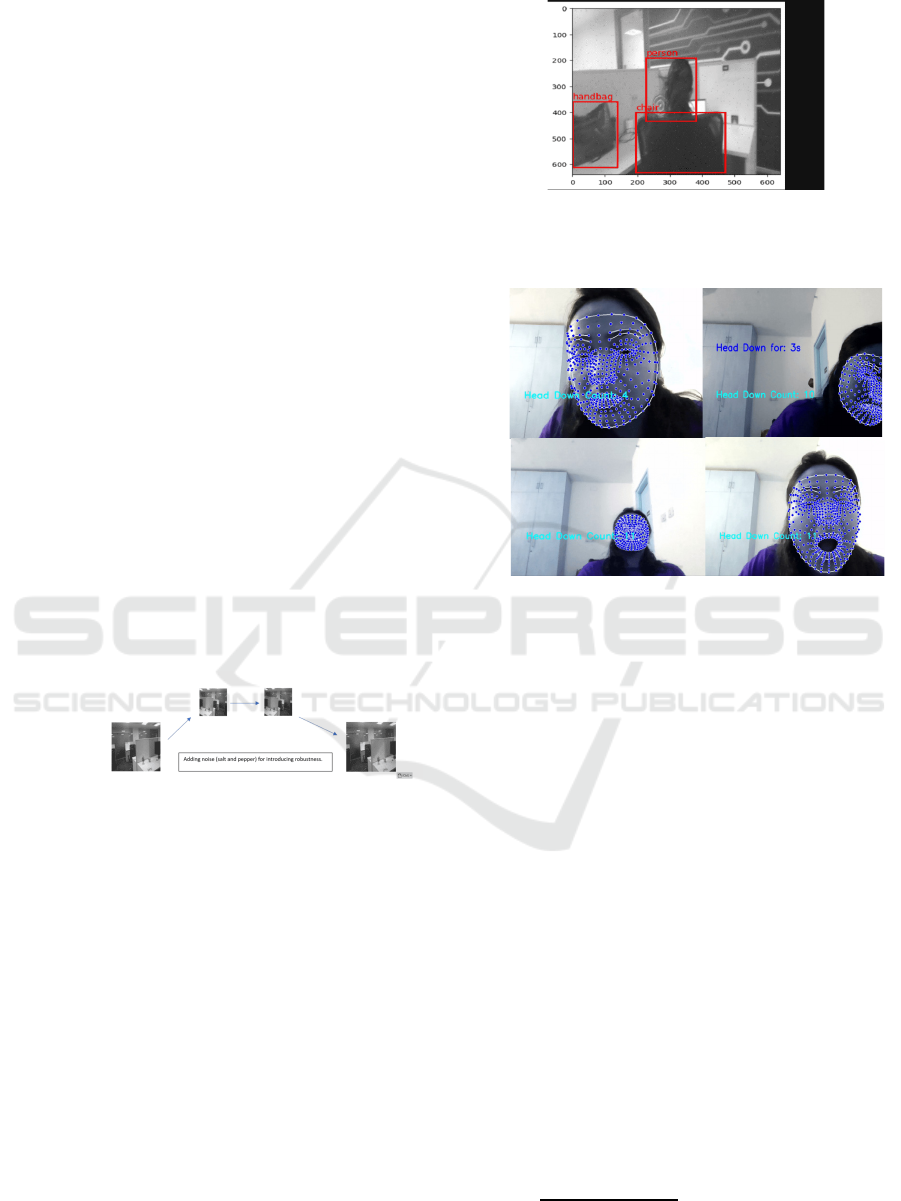
• Converting frames to grayscale and
adding noice: This reduces computational
load while preserving important facial
details and increasing robustness [Figure 1]
attached below.
Figure 1: Adding noise (salt and pepper).
• Detecting the face: The system uses
YOLOv11 to locate the face and extract a
bounding box.
• Environment Detection: The system uses
object detection models to recognize
environmental factors such as backpacks,
books, cups, and the presence of people
around the user [Figure 2]. This helps
analyze the working environment and
possible distractions.
Figure 2: Detection of the environment.
• Tracking facial landmarks:
Figure 3: Face mesh imposed on a person in real time.
MediaPipe FaceMesh detects 468 key facial
points as shown in [Figure 3], focusing on
the eyes, mouth, and head position.
• Tracking Screen Engagement: The system
monitors cursor movement, typing activity,
and screen interaction duration to assess
engagement.
This helps ensure that only the relevant features are
used for further analysis.
4.2 Detecting Fatigue
To determine if a person is fatigued, the system looks
at three key factors:
4.2.1 Eye Blink Rate (EBR) and Eye Aspect
Ratio (EAR)
When people get drowsy, they tend to blink more
slowly or keep their eyes closed longer than usual.
The system calculates Eye Aspect Ratio (EAR) using
six key points around the eye:
𝐸𝐴𝑅 =
|
|
|| ||
|| ||
(1)
ICRDICCT‘25 2025 - INTERNATIONAL CONFERENCE ON RESEARCH AND DEVELOPMENT IN INFORMATION,
COMMUNICATION, AND COMPUTING TECHNOLOGIES
372
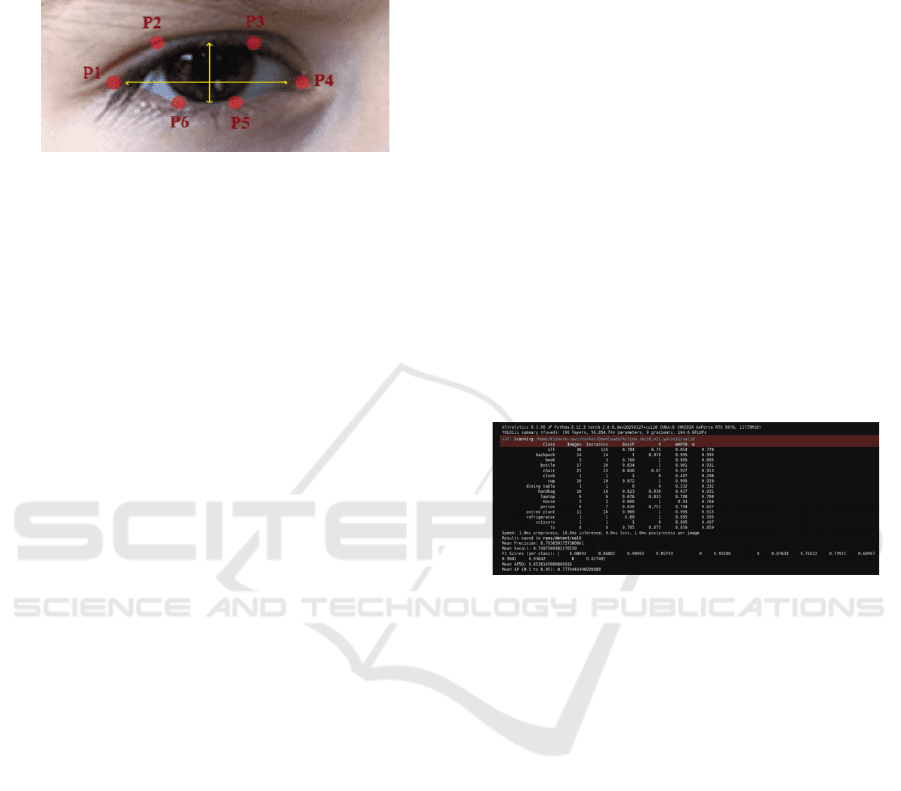
• P1 and P4 represent the horizontal eye
corners.
• P2, P3, P5, and P6 are vertical landmarks.
Figure 4: Eye Aspect Ratio.
How It Detects Fatigue:
• If the EAR falls below 0.3 for several
consecutive frames, the system flags
drowsiness.
• It also tracks blink duration and frequency to
check for patterns of fatigue over time.
4.2.2 Head Position Tracking
A common sign of fatigue is nodding off or looking
away from the screen for extended periods.
How It Works:
• The system monitors the Y-coordinate of the
face.
• If the head moves below a certain threshold
or disappears for more than five seconds, an
alert is triggered.
4.2.3 Deep Learning-Based Drowsiness
Detection (YOLOv11)
Instead of relying only on rule-based features like
EAR, the system also uses a trained deep learning
model (YOLOv11) to recognize drowsy facial
expressions.
Steps in Detection:
1. YOLOv11 processes each video frame,
identifying facial features.
2. The model then classifies the frame as
“Awake” or “Drowsy”.
3. If the person is continuously classified as
drowsy, an alert is triggered.
This method improves accuracy by recognizing
subtle signs of fatigue that rule-based approaches
might miss.
4.2.4 Screen Activity Detection
In addition to facial cues, the system monitors screen
engagement patterns to detect fatigue or
disengagement.
How It Works:
• Cursor movement tracking: A reduction in
cursor activity may indicate a drop-in focus.
• Typing frequency analysis: Slower or
erratic typing may signal fatigue.
• Prolonged inactivity: If no interaction is
detected for a set period, the system triggers
a reminder.
4.2.5 Environment Detection
To improve contextual awareness, the system detects
objects in the user’s surroundings. Using YOLO-
based object detection, the YOLO11x summary can
be seen in [Figure 5]:
Figure 5: List of Class (object identified by the model)
along with Mean Precision, Mean Recall, F1 Score, Mean
AP50 and Mean AP also the number if images used.
This additional layer of analysis enhances
accuracy by incorporating both physiological and
behavioral fatigue indicators.
4.3 Training the Model
For the deep learning model to detect drowsiness
accurately, it needs to be trained on a dataset of awake
and drowsy faces.
4.3.1 Dataset and Augmentation
The model is trained using thousands of labelled
images showing people in both alert and drowsy
states. Prerecorded videos were given to train the
multimodal, each divided into different frames, the
data set also includes images from different sources
(Daisee and Roboflow) and the distribution can be
seen in Table 1.
• Screen activity data is collected from real-
world usage scenarios.
AI-Driven Multimodal Posture and Action Analysis for Detecting Workplace Fatigue and Productivity
373
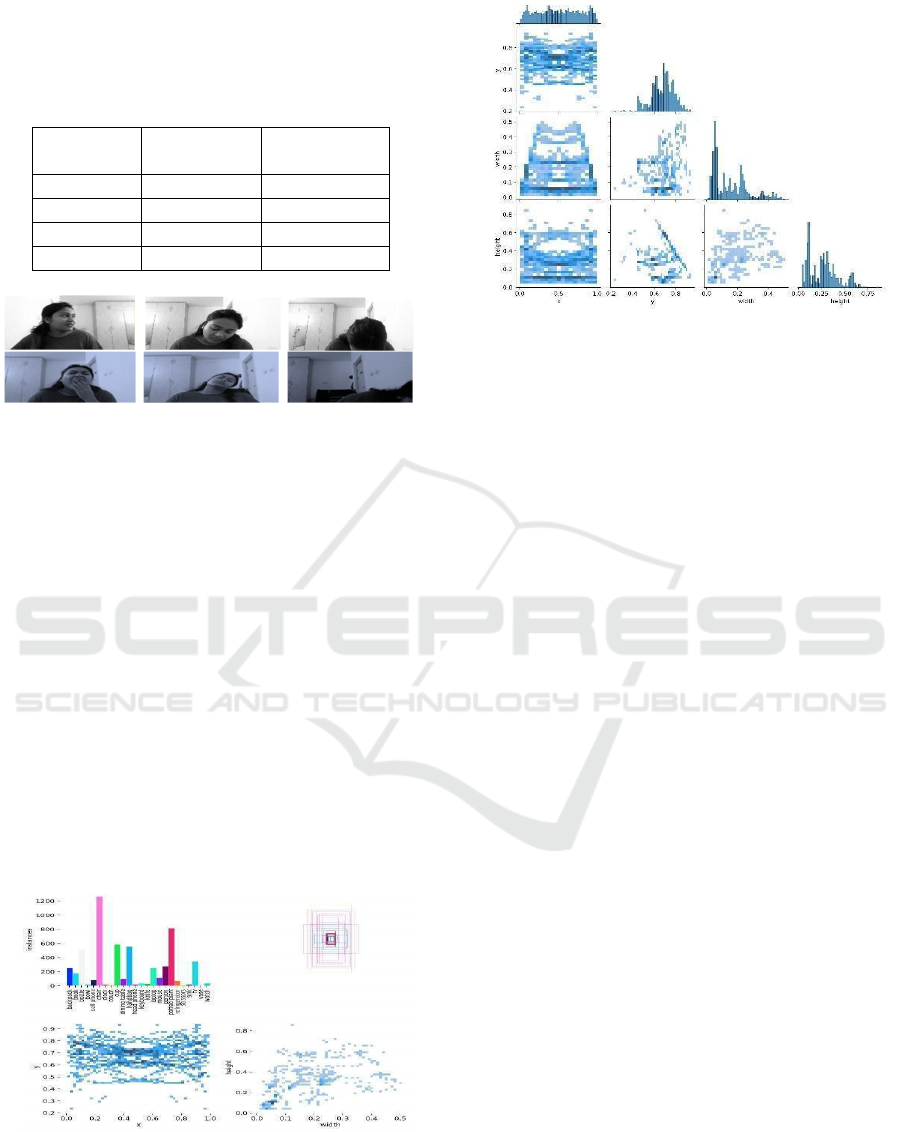
• To improve accuracy, data augmentation is
used to simulate different lighting conditions
and angles as shown in [Figure 6] below.
Table 1: Distribution of Dataset.
Dataset
Daisee
Datase
t
Roboflow
Datase
t
Trainin
g
3800 1400
Validation 1490 200
Tes
t
1710 400
Total 7000 2000
Figure 6: Few samples of the dataset.
4.3.2 Dataset Analysis for Environment
Object Detection
To make sure our Fatigue Detection System works
well in real life, we need to understand what objects
appear around people. The label distribution chart
[Figure 7a] shows how often things like backpacks,
phones, cups, and laptops show up in the video. This
helps us train the model with different environments,
so it can work well anywhere.
We also used a label correlogram [Figure 7b] to
see which objects are often found together. For
example, people and phones usually appear in the
same scene because people use their phones a lot.
Similarly, laptops and coffee cups often show up
together in work settings. This helps the model learn
not just about faces, but also about the surroundings
where fatigue happens.
Figure 7a: Label distribution chart, Bounding (Top Left
Chart) Box Distribution (Top Right Plot), Object Position
& Size Distribution (Bottom Plots).
Figure 7b: Label correlogram.
4.3.3 Training Process
• The training is done using PyTorch and
YOLOv11, with a focus on optimizing the
model for real-time performance.
4.4 Real-Time Alert System
When the system detects fatigue, it immediately alerts
the user to take a break.
4.4.1 Drowsiness Alerts
• If the system detects eye closure or
drowsiness for more than three seconds, a
popup notification appears.
• In workplace settings, these alerts can be
integrated with a fatigue management
dashboard.
4.4.2 Head-Down Alerts
• If the system cannot detect the user’s face for
more than five seconds, an alert is triggered.
• This helps ensure that users remain engaged,
especially in work or learning environments.
4.4.3 Screen Inactivity Alerts
• If no screen activity (cursor movement,
typing, or scrolling) is detected for a
prolonged period, the system sends an
engagement alert which can be seen in
[Figure 8].
ICRDICCT‘25 2025 - INTERNATIONAL CONFERENCE ON RESEARCH AND DEVELOPMENT IN INFORMATION,
COMMUNICATION, AND COMPUTING TECHNOLOGIES
374
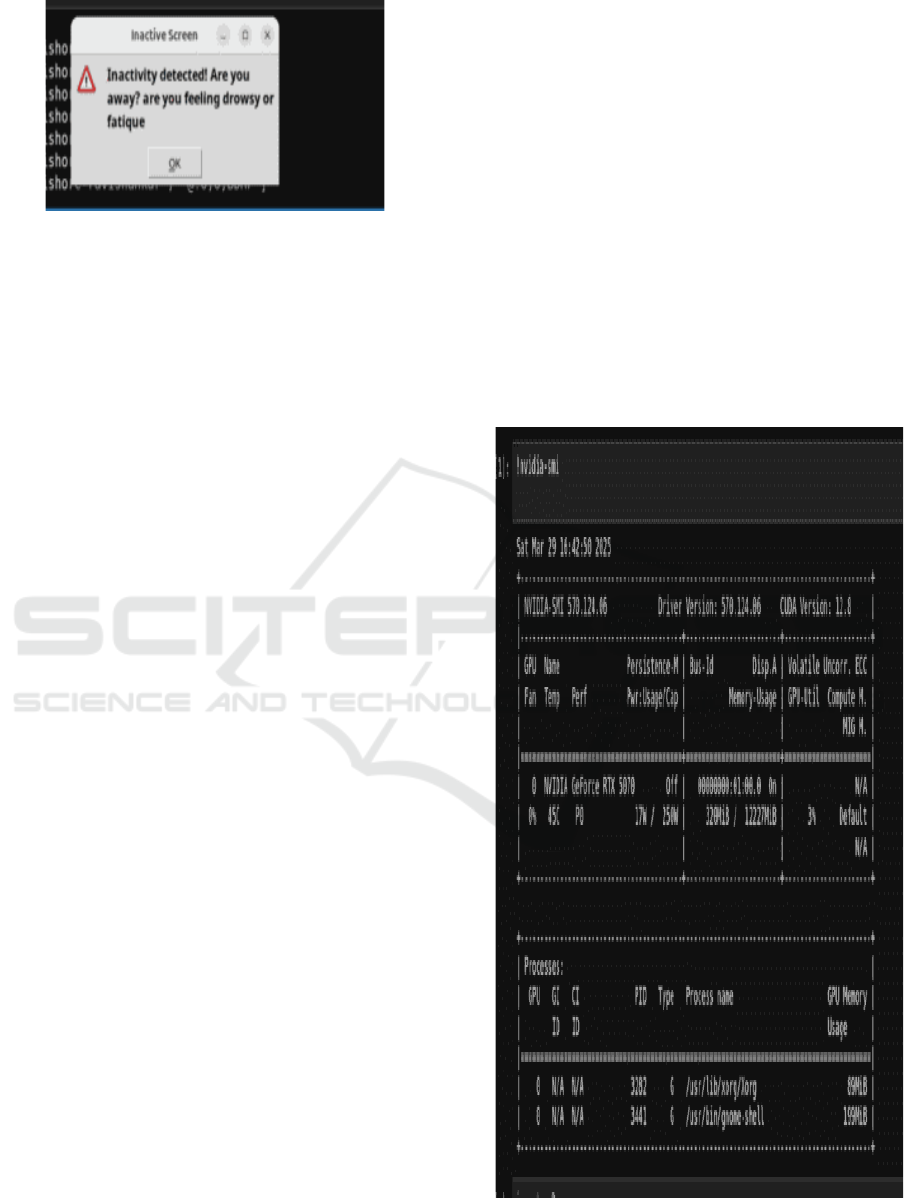
Figure 8: Inactive alert message.
• This ensures that users remain attentive,
particularly in educational and professional
settings.
4.5 Optimizing the System for Real-
World Use
To ensure the system runs efficiently, several
optimizations are applied:
4.5.1 Performance Optimization
• CUDA acceleration speeds up deep learning
inference on compatible GPUs.
• The model is optimized to run smoothly on
desktop computers, embedded devices, and
cloud systems.
• All specifications and requirements of the
model can be seen in [Figure 9].
4.5.2 Model Compression
• The deep learning model is converted to
ONNX format, reducing its size without
losing accuracy.
4.6 Evaluating the System
To measure how well the system performs, it is tested
under different conditions.
4.6.1 Performance Metrics
• Accuracy – Measures how correctly the
system detects fatigue.
• Latency – Ensures real-time performance
without lag.
• False Positive Rate – Minimizes incorrect
fatigue detections.
The fatigue detection system follows a structured
workflow to ensure real-time and accurate monitoring
as shown in [FIG 10]. It starts by capturing video
frames, shutting down if none are detected to save
resources. When a frame is acquired, it undergoes
preprocessing, including resizing and grayscale
conversion, to enhance efficiency. The system then
extracts key behavioural features: posture analysis to
detect slouching, eye tracking to monitor blinking and
eye closure, and behavioural cues like head nodding
or sudden movements linked to fatigue. These
features are fed into a pre-trained model, which
analyses patterns and predicts fatigue levels. If
fatigue is detected, the system triggers an alert to
prevent potential risks. By combining multiple
behavioural indicators, this system ensures accurate,
real-time fatigue assessment, making it highly useful
in workplace safety.
Figure 9: Specification of the working model.
AI-Driven Multimodal Posture and Action Analysis for Detecting Workplace Fatigue and Productivity
375
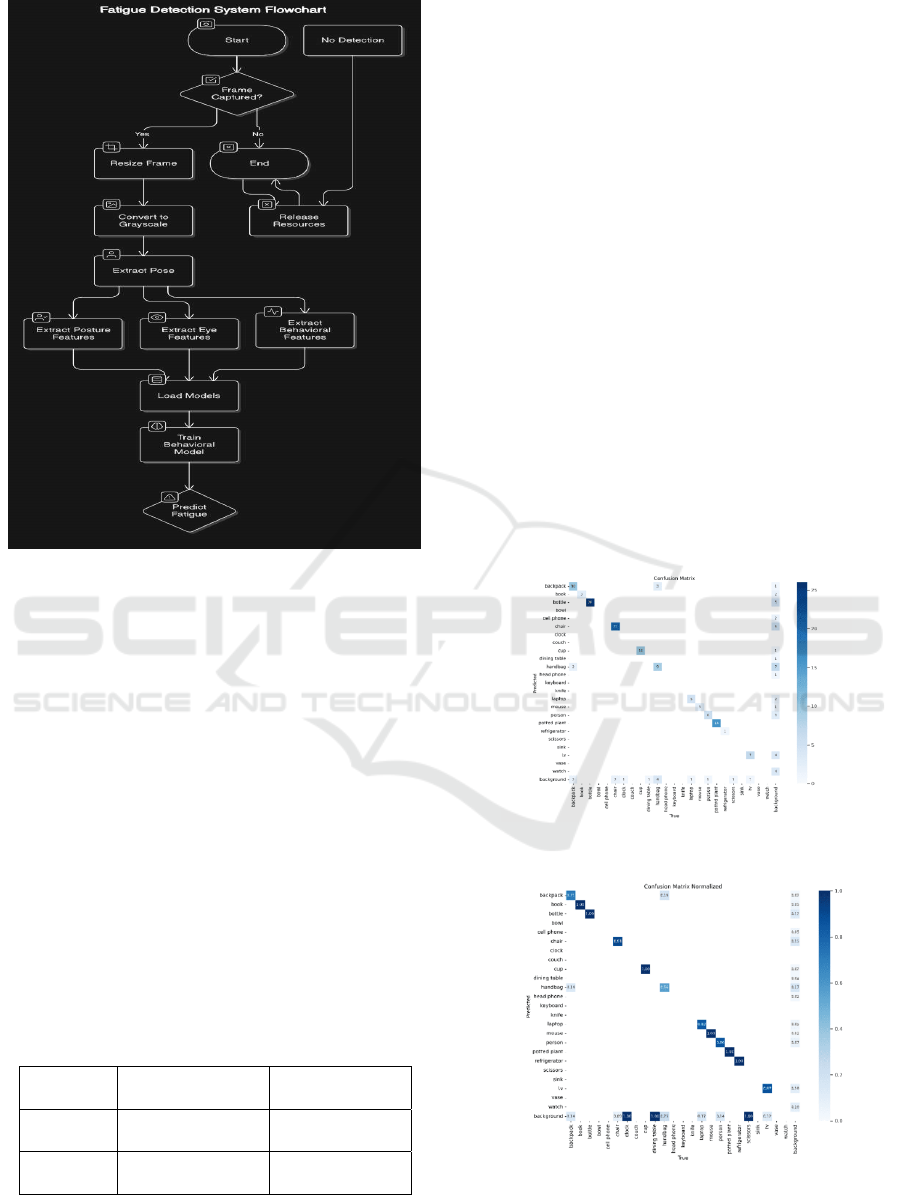
Figure 10: Fatigue Detection System Flowchart
5 RESULTS AND DISCUSSION
To understand how well our Real-Time Fatigue
Detection System performs, we evaluated its
accuracy using different metrics like precision, recall,
and F1-score. We tested the model using a dataset
containing videos of individuals in both awake and
drowsy states, under various real-world conditions
like different lighting and head positions.
5.1 Understanding Model Performance
with a Confusion Matrix
A confusion matrix helps visualize how often the
system correctly detects fatigue and where it makes
mistakes. Here’s what it looks like [Table 2].
Table 2: Confusion Matrix in tabular form.
Actual
State
Predicted Awake
Predicted
Drowsy
Awake Correct (TP)
Misclassified
(
FN
)
Drowsy
Misclassified
(FP)
Correct (TN)
• True Positives (TP) → Correctly detected
drowsy instances.
• True Negatives (TN) → Correctly detected
awake instances.
• False Positives (FP) → Mistakenly flagged
awake individuals as drowsy.
• False Negatives (FN) → Failed to detect
drowsiness.
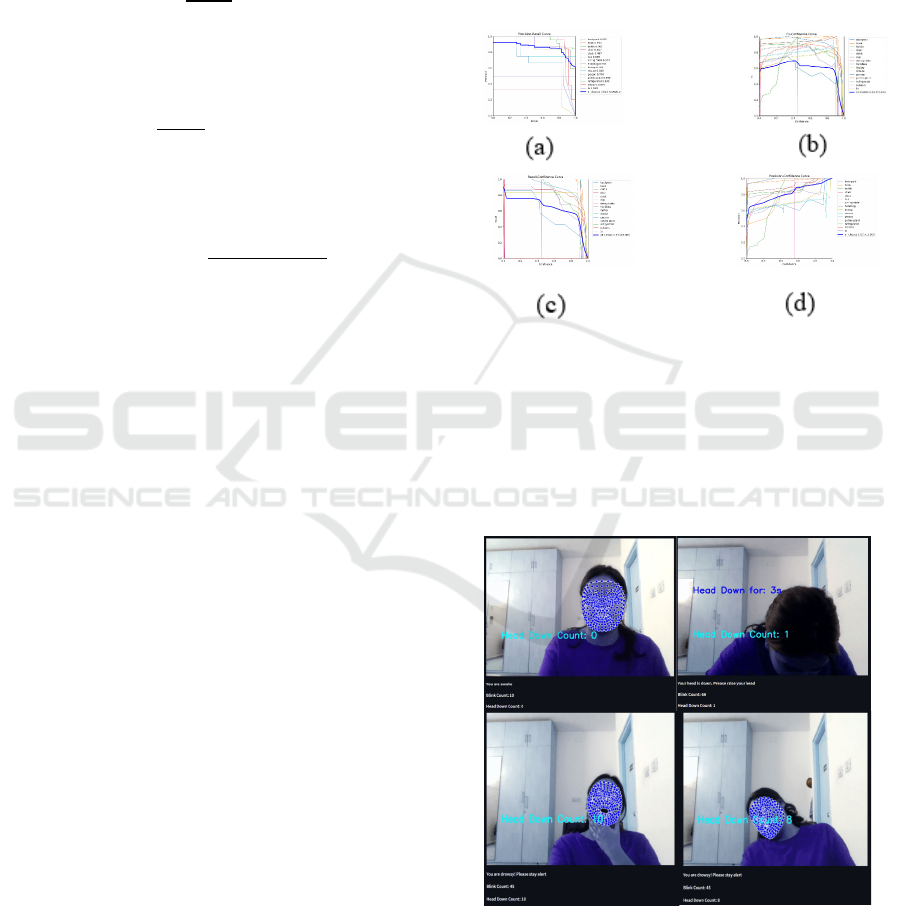
Our model had very few false negatives, meaning it
rarely missed signs of fatigue [Figure 11a] a crucial
aspect for safety applications.
To get a clearer picture of how well the model
performs, we also use a normalized confusion matrix
[Figure 11b]. Instead of just counting correct and
incorrect predictions, this version shows the results as
percentages, making it easier to compare accuracy
across different categories. This is especially useful
when there are more awake cases than drowsy ones in
the dataset. Ideally, we want high numbers along the
diagonal, which means the model is making mostly
correct predictions, and very low numbers elsewhere,
indicating fewer mistakes.
Figure 11a: Confusion matrix of the proposed model.
Figure 11b: Confusion matrix normalized.
ICRDICCT‘25 2025 - INTERNATIONAL CONFERENCE ON RESEARCH AND DEVELOPMENT IN INFORMATION,
COMMUNICATION, AND COMPUTING TECHNOLOGIES
376
5.2 Precision, Recall, and F1-Score
To measure the system’s reliability, we calculated
three important metrics:
• Precision → How many of the detected
drowsy cases were actually drowsy?
Formula used:
𝑃𝑟𝑒𝑐𝑖𝑠𝑖𝑜𝑛 =
(2)
• Recall → How many of the actual drowsy
cases did the model catch?
Formula Used:
𝑅𝑒𝑐𝑎𝑙𝑙 =
(3)
• F1-score → A balance between precision
and recall to ensure overall reliability.
Formula Used:
𝐹1 𝑆𝑐𝑜𝑟𝑒 = 2 ∗
∗
(4)
Our model achieved an F1-score of 92.5%,
meaning it performs well in detecting fatigue without
making too many mistakes.
5.3 Confidence Curves and Model
Stability
We also tested how the model behaves when
adjusting its confidence level:
• Precision-Recall Curve → Showed that the
model maintains high accuracy even when
handling uncertain cases.
The Precision-Recall Curve of our model
can be seen in [Figure 12a], It shows 0.853
mAP @ 0.5 when all classes are taken.
Here mPA => Mean Average Precision and
@0.5 refers to the IoU (Intersection over
Union) threshold of 0.5.
• F1 Confidence Curve → Proved the system
remains stable across different confidence
thresholds, which for our model can be seen
in [Figure 12b] with a value 0.69 at 0.426
when all classes are considered.
• Recall Confidence Curve → Confirmed the
model rarely misses signs of drowsiness,
which is essential for real-world
applications. Our model gives out a valur of
0.91 at 0.000 as can be seen in [Figure 12c]
when all classes are considered.
• Precision Confidence Curve: Indicates that
even at higher confidence levels, the model
maintains high precision, ensuring that
detected fatigue cases are truly drowsy
individuals. The value being 1.00 at 1.000
for our model under the case when all cases
are taken [Figure 12d].
These findings indicate that our system is reliable
and practical for real-time fatigue monitoring.
x
Figure 12: Confidence curves.
5.4 Output
The experimental result when fatigue detection model
is executed [Figure 13] shows various results as alert,
blink count, head down count and if the head is down
then for how many seconds.
Figure 13: result showing different alerts 1. You are awake,
2. Your head is down, please raise it , 3., 4. You are drowsy,
please stay alert.
AI-Driven Multimodal Posture and Action Analysis for Detecting Workplace Fatigue and Productivity
377
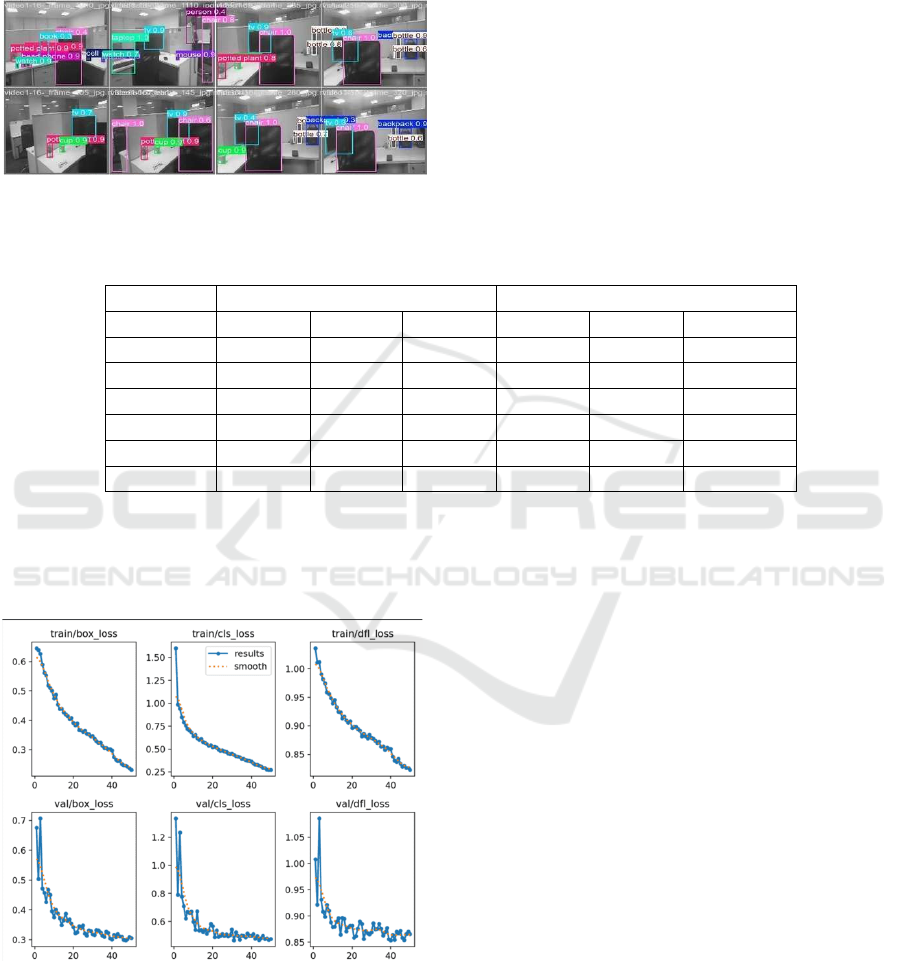
When any person is not detected in the cabin or work
place it detects various objects in the surrounding as
seen in [Figure 14] this also includes people who are
not facing the camera or workig on other system as
seen in [Figure 2] .
Figure 14: object detected by AI model (mouse, laptop,
bottle, cup, chair, book, potted plant etc.
6 CONCLUSIONS
In this project, we built a Real-Time Fatigue
Detection System that monitors the persons
performance to increase productivity that uses AI to
track facial expressions, body posture, screen activity,
and objects around a person to detect drowsiness and
all over activity. This makes it more accurate and
reliable than traditional methods. It also helps unlock
if the person is actually working or not.
The training loss and validation loss values in Table
3 show how our model's performance evolved across
different epochs (1, 10, 20, 30, 40, 50).
Table 3: Model Losses on training and validation data.
Epoch Training Loss Validation Loss
Box cls dfl Box cls dfl
1 0.645 1.603 1.036 0.675 1.334 1.008
10 0.474 0.641 0.939 0.374 0.597 0.879
20 0.390 0.520 0.896 0.342 0.567 0.882
30 0.346 0.449 0.878 0.318 0.542 0.868
40 0.298 0.365 0.859 0.300 0.498 0.853
50 0.231 0.272 0.822 0.305 0.476 0.865
Below [figure 15] shows graphs that show
significant decrease in training loss and validation
loss indicating that the model made less mistakes as it
proceeds from epoch 1 to 50 over time.
Figure 15: Graphs generated with dataset is tested (model
losses on training and validation data).
Our model showed good performance, with
training loss going down over time and key accuracy
measures like 77.39% m AP and 73.56% recall
proving that it works well in different situations. These
results confirm that our model successfully learned
from the dataset, reducing errors and achieving strong
detection performance.
This system can be useful in workplaces such as
offices to prevent accidents caused by fatigue and to
calculate the correct work hour the employee is giving
to the company. In the future, we can improve it by
making it work better in different lighting conditions,
adding more training data, and even connecting it with
ceiling camera for better monitoring.
This research is a step toward smarter and safer
fatigue detection, along with proper monitoring of
performance and work time.
REFERENCES
M. S. Devi and P. R. Bajaj, Driver fatigue detection based on
eye tracking, in Proc. 1st Int. Conf. Emerging Trends
Eng. Technol., 2008.
R. Sahayadhas, K. Sundaraj, and M. Murugappan, A review
of computer vision techniques for driver drowsiness
detection, in Proc. IEEE Int. Conf. Syst., Man, Cybern.
(SMC), 2012.
J. Jiménez-Pinto and M. Torres-Torriti, Real-time driver
drowsiness detection based on driver’s face image
behavior using a system of human-computer interaction
ICRDICCT‘25 2025 - INTERNATIONAL CONFERENCE ON RESEARCH AND DEVELOPMENT IN INFORMATION,
COMMUNICATION, AND COMPUTING TECHNOLOGIES
378

implemented in a smartphone, IEEE Trans. Intell.
Transp. Syst., 2015.
S. Park, J. Kim, and B. Ro, Real-time driver drowsiness
detection for embedded system using model
compression of deep neural networks, IEEE Access,
2019.
S. Hussain, S. Hussain, and S. A. Khan, Driver drowsiness
detection using behavioral measures and machine
learning techniques: A review of state-of-art techniques,
in Proc. 2nd Int. Conf. Commun., Comput. Digit. Syst.
(C-CODE), 2019.
L. Yuzhong, L. Zhiqiang, Y. Zhixin, L. Hualiang, and S.
Yali, Research progress of work fatigue detection
technology, in Proc. 2nd Int. Conf. Civil Aviation Safety
Inf. Technol. (ICCASIT), 2020.
S. Gupta, A. Sharma, and R. Kumar, Driver drowsiness
detection system using YOLO and eye aspect ratio, in
Proc. IEEE Int. Conf. Image Process. (ICIP), 2020.
J. Lu and C. Qi, Fatigue detection technology for online
learning, in Proc. Int. Conf. Networking Netw. Appl.
(NaNA), 2021.
Z. Li and J. Ren, Driver fatigue detection algorithm based on
video image, in Proc. 14th Int. Conf. Measuring
Technol. Mechatronics Autom. (ICMTMA), 2022.
L. Lou and T. Yue, Fatigue driving detection based on facial
features, in Proc. 8th Int. Conf. Intell. Comput. Signal
Process. (ICSP), 2023.
G. Liu, J. Liu, and L. Dai, Research on the fatigue detection
method of operators in digital main control rooms of
nuclear power plants based on multi-feature fusion, in
Proc. IEEE 2nd Int. Conf. Electr. Eng., Big Data
Algorithms (EEBDA), 2023.
R. Yuan and H. Long, Driver fatigue detection based on
multi-feature fusion facial features, in Proc. 5th Int.
Conf. Big Data Artif. Intell. Softw. Eng. (ICBASE),
2024.
X. Qiu, F. Tian, Q. Shi, Q. Zhao, and B. Hu, Designing and
application of wearable fatigue detection system based
on multimodal physiological signals, in Proc. IEEE Int.
Conf. Bioinf. Biomed. (BIBM), 2020.
B.-L. Lee, D.-S. Lee, and B.-G. Lee, Mobile-based
wearable-type of driver fatigue detection by GSR and
EMG, in Proc. IEEE Region 10 Conf. (TENCON), 2015.
Y. Song, H. Yin, X. Wang, C. Sun, Y. Ma, Y. Zhang, X.
Zhong, Z. Zhao, and M. Zhang, Design of a wireless
distributed real-time muscle fatigue detection system, in
Proc. IEEE Biomed. Circuits Syst. Conf. (BioCAS),
2022.
T. Kobayshi, S. Okada, M. Makikawa, N. Shiozawa, and M.
Kosaka, Development of wearable muscle fatigue
detection system using capacitance coupling electrodes,
in Proc. Annu. Int. Conf. IEEE Eng. Med. Biol. Soc.
(EMBC), 2017.
X.-Y. Gao, Y.-F. Zhang, W.-L. Zheng, and B.-L. Lu,
evaluating driving fatigue detection algorithms using eye
tracking glasses, in Proc. Int. IEEE/EMBS Conf. Neural
Eng. (NER), 2015.
M. Moshawrab, M. Adda, A. Bouzouane, H. Ibrahim, and A.
Raad, Detection of occupational fatigue in digital era;
parameters in use, in Proc. Int. Conf. Human-Centric
Smart Environ. Health Well-being (IHSH),
2022.
D. Mistry, M. F. Mridha, M. Safran, S. Alfarhood, A. K.
Saha, and D. Che, Privacy-preserving on-screen activity
tracking and classification in e-learning using federated
learning, IEEE Access, vol. 11, 2023.
R. J. Wood, C. A. McPherson, and J. M. Irvine, Video track
screening using syntactic activity-based methods, in
Proc. IEEE Appl. Imagery Pattern Recognit. Workshop
(AIPR), 2012.
K. Madushani, N. Edirisinghe, K. Koralage, R. Sahabandu,
P. Samarasinghe, and L. Wickremesinghe, Screening
child’s screen time, in Proc. IEEE Int. Conf. Ind. Inf.
Syst. (ICIIS), 2021, also.
AI-Driven Multimodal Posture and Action Analysis for Detecting Workplace Fatigue and Productivity
379
