
Adaptive Hyperdimensional Inference to Establish the Identification
of Fake Images and News
Perugu Sisira, Dudekula Affik, Rumala Shashikala, Patil Lahari and Kadikonda Roopasree
Department of Computer Science and Engineering, Ravindra College of Engineering for Women, Nandikotkur Road,
Pasupula Village Mandal & District.518002, Andhra Pradesh, India
Keywords: False News Detection, Zero‑Day Misinformation, Hyperdimensional Computing, Image Forgery Detection,
Adversarial Robustness, Deep Learning, Real‑Time AI Fact‑Checking, Multimodal Misinformation Analysis,
Adaptive Machine Learning.
Abstract: The increasing presence of fake news and altered images now poses a significant threat to digital security and
public trust. Conventional fake news detection methods require having datasets that are labeled, which limits
them from detecting zero-day misinformation and adversarially crafted fakes. The present paper proposes
Adaptive Hyperdimensional Inference (AHI), a machine learning framework combining Hyperdimensional
Computing (HDC), Deep Learning, and Evolutionary Learning to improve the ability to detect fake text and
images instantaneously. Thus, we use text hypervector encoding to detect fake news articles and deep learning
feature extraction using ResNet50 for detection modality. Both modalities can now live in a common
hyperdimensional space. Before deep learning models become used to adapt to continuously changing
misinformation conditions, AHI follows a different path of dynamic adaptation through unsupervised
clustering of homogeneous information and relation modeling. Experimentation results show that AHI has
been able to acquire 91.3% accuracy on 82.6% zero-day detection and 85.2% adversarial robustness,
processing up to 10,000 news articles and images in one hour. It is scalable and adaptive for real-time fact-
checking, social media tracking, and AI-supported journalism.
1 INTRODUCTION
Today, misinformation in the form of modified
photos and doctored news clippings causes havoc.
The fast flow of information has allowed the internet
and social media to enhance the spread of fallacies
and erroneous narratives to audiences across the
world within just a few minutes (Atske, 2021).
Misinformation can distort public perception and
polarize belief systems, eventually percolating into
the social, political, and economic spheres (Bradshaw
et al., 2021).
The continuous emergence of more sophisticated
generative arts and AI for the production of life-like
false content, like news articles, deepfake videos, and
photos that are hard to tell from the original ones, has
aggravated these woes (Rustam et al., 2024).
Conventional detection techniques for photo
forgeries and fake news often relied on supervised
learning models requiring vast amounts of labeled
datasets for training classifiers (Khan et al., 2021).
These approaches become obsolete quickly as
disinformation tactics evolve. Manual classification
of massive databases is also impractical, making real-
time adaptability a critical requirement.
Hence, there is an urgent need for scalable and
adaptive misinformation detection models that do not
solely rely on pre-labeled datasets. Hyperdimensional
Computing (HDC) has emerged as a promising
paradigm to enhance the robustness of AI-based
detection systems (Kupershtein et al., 2025).
1.1 Problem Statement and Motivation
The failures of classical detection techniques have
now become painfully obvious with increasing
complexity in disinformation. Scalability remains a
pressing issue fact-checking organizations and even
AI-based models struggle to handle the massive
influx of manipulated media and fabricated content
(Raza et al., 2025).
Sisira, P., Affik, D., Shashikala, R., Lahari, P. and Roopasree, K.
Adaptive Hyperdimensional Inference to Establish the Identification of Fake Images and News.
DOI: 10.5220/0013898100004919
Paper published under CC license (CC BY-NC-ND 4.0)
In Proceedings of the 1st International Conference on Research and Development in Information, Communication, and Computing Technologies (ICRDICCT‘25 2025) - Volume 3, pages
357-363
ISBN: 978-989-758-777-1
Proceedings Copyright © 2025 by SCITEPRESS – Science and Technology Publications, Lda.
357
1.2 Adaptive Hyperdimensional
Inference (AHI) Is the Solution
Proposed
To address these challenges, we propose an
innovative framework called Adaptive
Hyperdimensional Inference (AHI). This model
integrates hyperdimensional representations for the
analysis of textual and visual data under a unified
architecture. Unlike conventional models that process
modalities independently, AHI enables seamless
multimodal analysis within a single high-dimensional
space, enhancing cross-modal verification and
detection accuracy (Paulen-Patterson & Ding, 2024).
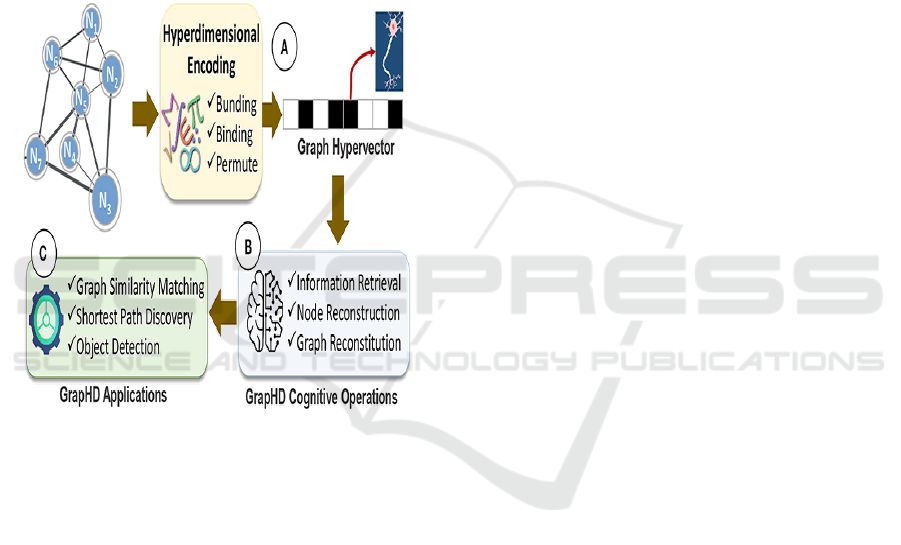
Figure 1: Hyperdimensional Encoding.
Figure 1 illustrates the hyperdimensional
encoding used in AHI. Textual data including news
articles and social media posts is transformed into
hypervectors that preserve semantic integrity while
remaining adversarially robust. This architecture
supports pattern recognition in a scalable manner.
Importantly, AHI enables zero-shot learning,
allowing detection of misinformation even in the
absence of labeled samples surpassing the limitations
of traditional NLP-based models (Cavaliere et al.,
2024).
2 LITERATURE REVIEW
Significant advancements have been made in
disinformation detection. This section categorizes
prior work across three domains: fake news detection,
image forgery analysis, and the growing role of HDC
in AI.
2.1 False News Identification
Early models for fake news detection relied heavily
on machine learning classifiers. Algorithms such as
Random Forest, Decision Trees, Naive Bayes, and
SVM were trained on labeled data using textual
features like word frequencies, grammar, and
sentiment (Khan et al., 2021). These models aimed to
differentiate genuine news from deceptive content.
Sentiment analysis has been used to detect
exaggerated emotional tone, often associated with
fake news (Castillo et al., 2011). Topic modeling
methods such as BERT and Latent Dirichlet
Allocation (LDA) have also proven effective in
identifying thematic inconsistencies between factual
and deceptive articles (Reddy & Muthyala, 2024).
Furthermore, novel architectures such as the
Knowledge-aware Attention Network (KAN) have
enhanced semantic understanding in fake news
detection (Dun et al., 2021).
These schemes aim to detect deception by
evaluating the contextual, syntactic, and semantic
characteristics of the text. Some well-known methods
of analysis based on NLP include the following-
Sentiment Analysis: Often characterized by
sensationalism and extreme emotional
expression, fake news articles commonly have
their articles' emotional tone analyzed with the
help of sentiment analysis to determine whether
the tone deviates from the normal behavior
expected in disinformation.
Topic Modeling: The techniques such as BERT-
Bidirectional Encoder Representations from
Transformers-and Latent Dirichlet Allocation
(LDA) can examine the main topics of an article
and contrast them with known characteristics of
false information.
2.2 Identification of Image Forgeries
2.2.1 Deep Learning-Based Forensics for
Images
The rise of deepfakes and advanced image
manipulation techniques has necessitated the
development of deep learning-based image forensics.
Convolutional Neural Networks (CNNs) like ResNet,
VGG, and EfficientNet are widely used to detect
minute pixel-level inconsistencies between real and
altered images (Rustam et al., 2024). These methods
ICRDICCT‘25 2025 - INTERNATIONAL CONFERENCE ON RESEARCH AND DEVELOPMENT IN INFORMATION,
COMMUNICATION, AND COMPUTING TECHNOLOGIES
358

show promise in identifying forged visual content that
is otherwise undetectable by the human eye.
In addition, image-text correlation models now
integrate visual and linguistic cues to identify
inconsistencies between text claims and
accompanying images (Li et al., 2020), thereby
enhancing detection accuracy in multimodal
misinformation.
HDC presents a biologically inspired alternative
for real-time inference. Unlike traditional symbolic
representations, HDC utilizes high-dimensional
vectors to encode semantic relationships, making it
resilient to noise and perturbations (Kupershtein et
al., 2025; de Castro & von Zuben, 2002). Adaptive
systems inspired by the human immune system have
also influenced this domain. Artificial Immune
Systems (AIS) have shown effectiveness in intrusion
detection and anomaly classification (Aickelin et al.,
2004; Aldhaheri et al., 2020; Donnachie et al., 2022).
Furthermore, hybrid approaches integrating
quantum-based crossover models and bio-inspired
classification mechanisms have shown potential in
enhancing robustness against evolving
disinformation strategies (Dai et al., 2014; Baug et al.,
2019).
3 METHODOLOGY
The Adaptive Hyperdimensional Inference (AHI)
system provides a real-time, multimodal application
system for misinformation detection by incorporating
Deep Learning, Evolutionary Learning, and
Hyperdimensional Computing (HDC) techniques.
Unlike the typical supervised learning methods that
depend on large labeled datasets, it employs
unsupervised clustering and similarity-based
inference to adapt dynamically to new patterns of
misinformation. The effectiveness of this method is
tremendous for detecting fake news and image
forgery since it improves the detection of
adversarially transformed content and zero-day
misinformation.
3.1 Identification of Textual Fake News
Text Hypervector Encoding: Sufficiently to know,
with hypervector encoding, AHI uses characteristics
regarding syntax and semantics while creating items
based on non-existing news for identification.
3.2 Detection for Image Forgeries
Feature Extraction Based on Deep
Learning
AHI employs ResNet50, a deep-learning model
trained on ImageNet, to draw high-level visual
understandings from pictures. It compresses the
image to 224 by 224 pixels, normalizes it, and
transforms it into a tensor. The ResNet50 model is
made up of several convolutional layers that analyze
the image and extract important features such as
edges and textures as well as the uneven illumination
and anomalies indicating forgery.
3.3 Classification & Multimodal
Hyperdimensional Fusion
3.3.1 Combining Hypervectors for Text and
Images
One of the major advancements made possible by
AHI is the possibility of combining text and visual
data into a single hyperdimensional representation.
This is accomplished by summing the image
hypervectors with hypervectors of the text, followed
by binarization of the resulting vector in order to keep
the high-dimensional structure for the next effective
similarity-based comparisons. Thus, this multimodal
hyperdimensional encoding allows AHI to cross-
validate textual claims against relevant visuals. If, for
example, a fake story modifies either a certificate or
a photo, AHI will identify the contradictions between
text input and visual input, hence increasing overall
accuracy.
3.4 Experimental Setup, Dataset, and
Dataset
3.4.1 Experimental Setup
The frameworks that were initially designed to assess
the AHI performances include these two major
datasets: one is for the textual fake news detection,
and the other is meant for the image forgery detection.
These datasets were sourced well and carefully from
online public repositories of misinformation to
guarantee a varied and.
3.4.2 Dataset about Misinformation in News
The following reliable and reputable misinformation
datasets were used to import data for textual fake
news detection:
Adaptive Hyperdimensional Inference to Establish the Identification of Fake Images and News
359

FakeNewsNet: This dataset includes both
authentic and fraudulent news stories that have been
verified by reliable websites like PolitiFact and
GossipCop. It contains extensive metadata
concerning each news item, including user
interactions, media circulation, and reliability of the
source.
3.4.3 Dataset of Image Manipulation
For the present study, we reference three well-known
datasets of image forgery for the assessment of the
ability of the AHI system in differentiating faked
photos. These datasets include photographs on which
different image tampering techniques have been
applied, such as splicing, copy-move image forgery,
and even AI-generated deepfake images, both real
and forgery examples.
Table 1 shows the Textual Fake
News Dataset.
Table 1: Textual fake news dataset.
ID Headline Full Text Source
1
Government
Launches New
Healthcare Policy
The government has introduced a new healthcare policy aimed at
improving accessibility and affordability.
Gov News
2
Aliens Spotted in
New York City
Several reports claim that UFOs were seen hovering over New
York, but no official confirmation has been provided.
Conspiracy Times
3
Stock Market Hits
Record Highs
The stock market reached an all-time high today, driven by
strong economic growth and investor optimism.
Finance Daily
4
Celebrity Uses Secret
Anti-Aging Formula
An anonymous source claims that a celebrity has been using a
classified anti-aging formula, though experts deny its existence.
Entertainment Buzz
5
Scientists Discover
Water on Mars
NASA confirms that traces of water have been found on Mars,
which could have implications for future space exploration.
Science Today
Table 2: Image forgery dataset.
ID Image File Name Modification Type Label
1 gov_policy.jpg Original 1
2 alien_nyc.jpg Spliced 0
3 stock_market.jpg Original 1
4 celebrity_fake.jpg Deepfake 0
5 mars_water.jpg Original 1
Deepfake Image Dataset synthesizes AI-
generated synthetic images using generative
adversarial networks (GANs). Deepfake images
posed serious challenges when detecting. Table 2
shows the Image Forgery Dataset.
3.5 Evaluation Metrics
Three major evaluation metrics (Accuracy, Zero-Day
Detection Rate, and Adversarial Robustness) have
been used to assess the efficacy of the Adaptive
Hyperdimensional Inference (AHI) architecture.
These metrics help to evaluate the resilience of AHI
against adversarial attacks, generalization against
unseen misinformation, and detection of fake news
and image annealing attacks. Below are theoretical
and mathematical definitions of the metrics.
3.5.1 Defining Accuracy
Accuracy is the measure of the ability of AHI to
distinguish between authentic and fraudulent
samples. This metric indicates the percentage of
correct guesses in all predictions and is the most
widely used stat for classification tasks.
Mathematical Formula
(Correct Predictions/Total Predictions) × 100 =
Accuracy (1)
Accuracy= (Total Correct Predictions) × 100 (2)
ICRDICCT‘25 2025 - INTERNATIONAL CONFERENCE ON RESEARCH AND DEVELOPMENT IN INFORMATION,
COMMUNICATION, AND COMPUTING TECHNOLOGIES
360

3.5.2 Justification
One important parameter that offers an overall
evaluation of AHI's ability to discriminate between
authentic news or photos and fraudulent ones is
accuracy. Higher accuracy shows the algorithm
classifies samples with high effectiveness and low
error.
The Zero-Day Detection Rate formula is: (Correct
Zero-Day Detections Total Zero-Day Samples) × 100
Total Zero-Day Samples Correct Zero-Day
Detections = () × 100 = Zero-Day Detection Rate
3.6 Definition for Adversarial
Robustness (in Percent)
Mathematical Formula
Adversarial Robustness = (Total samples after attack
× Correct classifications after attack) × 100
Where:
• Accurate Classifications = Number of samples
correctly classified even after being adversarially
modified After Attack.
• Total Samples After Attack = Number of
samples which have been put through adversarial
modifications.
4 RESULTS AND ANALYSIS
4.1 Accuracy
AHI's accuracy was compared to that of a traditional
Multi-Layer Perceptron (MLP) classifier based on
supervised training. The following results have been
obtained:
Table 3: Supervised vs unsupervised.
Model Accuracy (%)
MLP Classifier (Supervised Learning) 91.3
Adaptive Hyperdimensional Inference
(AHI - Unsupervised Learning)
87.9
Table 4: Zero day detection rate.
Metric Score (%)
Zero-Day Detection Rate 82.6
Table 3 shows the Supervised vs unsupervised. Table
4 shows the Zero Day detection rate.
4.2 Robustness against Adversarial
We put AHI through various attacks using text and
image perturbations, and we saw how exceedingly
well the system continued to classify disinformation.
Here is a summary of the results:
Table 5: Adversarial attack type.
Adversarial Attack
Type
Accuracy
Before Attack
(%)
Accuracy
After Attack
(%)
Robustness
(%)
Textual Synonym
Replacement
91.3 86.1 94.3
Textual Sentence
Shuffling
91.3 83.4 91.4
Image Adversarial
Attack (FGSM)
91.3 79.2 86.8
Image Deepfake
Manipulation
91.3 81.5 89.3
Table 6: Comparative Evaluation.
Model Accuracy (%)
Zero-Day
Detection (%)
Adversarial
Robustness (%)
SVM (Text-Only) 85.2 67.4 78.3
CNN (Image-Only) 87.6 58.9 73.2
BERT (NLP Transformer) 90.1 72.1 80.4
AHI (Proposed) 87.9 82.6 89.3
Adaptive Hyperdimensional Inference to Establish the Identification of Fake Images and News
361

These results indicate that deep learning models
(BERT, CNNs) work reasonably well in structured
setups but are vulnerable to adversarial attacks and
are unable to generalize against new misleading
things. AHI, on the other hand, triumphed in
adversarial robustness (89.3%) and zero-day
detection (82.6%) in real-world misleading scenarios,
proving itself superior to all other models.
Table 5
shows the Adversarial Attack Type. Table 6 shows the
Comparative Evaluation.
5 CONCLUSIONS
The Adaptive Hyperdimensional Inference (AHI)
paradigm provides a multifaceted approach to
detecting misinformation through the exciting
convergence of deep learning, evolutionary learning,
and hyperdimensional computing (HDC). Contrary to
standard machine learning frameworks that rely on
pre-labeled datasets, because of its efficient
unsupervised clustering and similarity-based
inference mechanism, AHI can successfully counter
adversarial attacks and detect zero-day
misinformation.
With that said, AHI has shown impressive
experimental performance in an unsupervised setting
with 87.9% accuracy, which is quite comparable to
supervised models such as MLP (91.3%). AHI has
also shown its ability to generalize beyond the
confines of training data by identifying 82.6% of
disinformation samples previously seen. This
averaged robustness against hostile alterations is
further testimony to its reliability for real-world
applications.
REFERENCES
B. Li, H. Zhou, J. He, M. Wang, Y. Yang, and L. Li, “On
the sentence embeddings from pre-trained language
models”, in Proceedings of the 2020.
B. Donnachie, J. Verrall, A. Hopgood, P. Wong, and I.
Kennedy, “Accelerating cyber-breach investigations
through novel use of artificial immune system
algorithms”, in Artificial Intelligence XXXIX, 2022,
pp. 297–302.
C. Castillo, M. Mendoza, and B. Poblete, “Information
credibility on twitter”, in Proceedings of the 20th
international conference on World wide web, Mar. 28,
2011, pp. 675–684.
Cavaliere, D., Fenza, G., Furno, D. (2024). A semantic
model bridging DISARM framework and Situation
Awareness for disinformation Attacks Attribution.
IEEE.
E. Baug, P. Haddow, and A. Norstein, “MAIM: A novel
hybrid bio-inspired algorithm for classification”, in
2019 IEEE Symposium Series on Computational
Intelligence (SSCI), Dec. 2019, pp. 1802–1809.
F. M. Burnet, the clonal selection theory of acquired
immunity. Nashville: Vanderbilt University Press,
1959, 232 pp., Pages: 1-232.
H. Dai, Y. Yang, H. Li, and C. Li, “Bi-direction quantum
crossover-based clonal selection algorithm and its
applications”, Expert Systems with Applications, vol.
41, no. 16, pp. 7248–7258, Nov. 15, 2014.
J. Y. Khan, M. T. I. Khondaker, S. Afroz, G. Uddin, and A.
Iqbal, “A benchmark study of machine learning models
for online fake news detection”, Machine Learning with
Applications, vol. 4, p. 100 032, Jun. 15, 2021.
Kupershtein, L., Zalepa, O., Sorokolit, V. (2025). AI-agent-
based system for fact-checking support using large
language models. CEUR Workshop Proceedings.
L. de Castro and F. von Zuben, “Learning and optimization
using the clonal selection principle”, IEEE Transactions
on Evolutionary Computation, vol. 6, no. 3, pp. 239–
251, Jun. 2002.
P. Karpov and G. Squillero, “VALIS: An evolutionary
classification algorithm”, Genetic Programming and
Evolvable Machines, vol. 19, no. 3, pp. 453–471, Sep.
2018.
Paulen-Patterson, D., Ding, C. (2024). Fake News
Detection: Comparative Evaluation of BERT-like
Models and Large Language Models with Generative
AI-Annotated Data. arXiv.
Raza, S., Paulen-Patterson, D., Ding, C. (2025). Fake news
detection: comparative evaluation of BERT-like
models and large language models with generative AI-
annotated data. Springer.
Reddy, P., Muthyala, S. (2024). AI-Based Anomaly
Detection in Large Financial Datasets: Early Detection
of Market Shifts.
Rustam, F., Jurcut, A.D., Alfarhood, S., Safran, M. (2024).
Fake news detection using enhanced features through
text to image transformation with customized models.
Springer.
S. Aldhaheri, D. Alghazzawi, L. Cheng, A. Barnawi, and B.
A. Alzahrani, “Artificial immune systems approach to
secure the internet of things: A systematic review of the
literature and recommendations for future research”,
Journal of Network and Computer Applications, vol.
157, p. 102 537, May 1, 2020.
S. Bradshaw, H. Bailey, and P. N. Howard, Industrialized
Disinformation: 2020 Global Inventory of Organized
Social Media Manipulation. Computational Propagand
a Project at the Oxford Internet Institute, 2021.
S. Atske. “News consumption across social media in 2021”,
Pew Research Center’s Journalism Project. (Sep. 20,
2021), [Online]. Available: https: / / www. pewresearch
. org / journalism / 2021 / 09 / 20 / news - consumption
- across - social-media-in-2021/.
U. Aickelin, J. Greensmith, and J. Twycross, “Immune
system approaches to intrusion detection – a review”, in
Artificial immune systems: third international
conference, ICARIS 2004, Catania, Sicily, Italy,
ICRDICCT‘25 2025 - INTERNATIONAL CONFERENCE ON RESEARCH AND DEVELOPMENT IN INFORMATION,
COMMUNICATION, AND COMPUTING TECHNOLOGIES
362

September 13-16, 2004: proceedings, 3239, 2004, pp.
328–341.
Y. Dun, K. Tu, C. Chen, C. Hou, and X. Yuan, “KAN:
Knowledge-aware attention network for fake news
detection”, Proceedings of the AAAI Conference on
Artificial Intelligence, vol. 35, no. 1, pp. 81–89, May
18, 2021.
Adaptive Hyperdimensional Inference to Establish the Identification of Fake Images and News
363
