
Revolutionizing Speed Detection for Safer Roads
R. Ravichandran, M. Jeyabharathi, M. Dharani, N. Loganathan, T. Gowtham and V. Dhanush
Department of Electronics and Communication Engineering, K.S.R. College of Engineering, Tiruchengode, Namakkal,
Tamil Nadu, India
Keywords: IoT, ESP32, Over‑Speed Detection, GPS, Radar Sensors, Sensor Fusion, Real‑Time Monitoring, Wirelesss
Communication, Traffic Safety, Speed Violation Alerts.
Abstract: Aim: The aim is to develop an IoT-enabled over-speed detection system using the ESP32 microcontroller to
enhance road safety by accurately monitoring vehicle speeds. It ensures real-time violation alerts through
sensor fusion and wireless communication. Materials and Methods: Group 1: The system uses GPS and radar
sensors to detect speed violations and relay data via Wi-Fi or Bluetooth. However, radar accuracy drops by
15-20% in bad weather, affecting reliability. Group 2: The ESP32-based IoT system ensures 95% reliability
and 90% accuracy by using GSM module, and ultrasonic sensors for speed monitoring. Result: The system
would thus compute the speed using sensor-based time measurement and initiate immediate alerts when the
vehicle crossed the specified set limit.At a significance level of p < 0.05, the ESP32 Microcontroller based
solutions performs at its best. Conclusion: The ESP32-based IoT system improves road safety by accurately
detecting over-speeding and sending real-time alerts. Sensor fusion enhances reliability, reducing false
positives for efficient traffic enforcement.
1 INTRODUCTION
The combination of IoT technology with ESP32
microcontrollers allows for effective speed
monitoring and real-time alerts to drivers as well as
traffic authorities R. Kumar, et al., 2020 Such systems
employ sensors like ultrasonic or infrared to measure
distance, GPS to monitor speed, and cloud
connectivity for data storage and analysis. The
moment a vehicle crosses a specified speed limit, an
alert is generated, permitting immediate corrective
measures.
M. S. Khan, et al., 2021 Real-time speed checking
prevents traffic offenses and improves road safety.
ESP32 microcontrollers, with onboard Wi-Fi and
Bluetooth, offer a cost effective and secure solution
for IoT-based applications.
H. Patel and R. Mehta, 2021 In contrast to
traditional processors, ESP32 allows easy wireless
communication with cloud platforms and mobile
apps, enabling immediate alerts to drivers and
authorities. ESP32-based IoT overspeed detection
systems have attained a 97% accuracy with a
response time of 0.3 seconds. H. Patel and R. Mehta,
2022 This method ensures traffic discipline, increases
driver consciousness, and also helps in creating safe
and intelligent roads.
2 RELATED WORKS
Within the past five years, the number of articles
published on this topic exceeds 300 in IEEE Xplore,
surpasses 120 in Google Scholar, and totals around 95
in academic.edu. One studied the implementation of
intelligent traffic control systems through the Internet
of things, where sensors measure vehicle speed, and
any infractions send alerts to the traffic police for
quick action. J. Li, 2020 In addition, other research
has focused on the integration of IoT and machine
learning technologies for traffic management and
speed control, adding complexity in terms of speed
measurement verification and detection accuracy T.
Singh and K. N. Patel 2021.
Real-time measuring of automobile speed using
IoT devices represents a major technique in traffic
control. A. Agarwal and S. Kumar, 2022 presented
the idea of a smart traffic control system that utilizes
several IoT devices, including radar, GPS and
ultrasonic sensors, to identify vehicles that are
moving above the speed limit P. Rao 2020. The
Ravichandran, R., Jeyabharathi, M., Dharani, M., Loganathan, N., Gowtham, T. and Dhanush, V.
Revolutionizing Speed Detection for Safer Roads.
DOI: 10.5220/0013897700004919
Paper published under CC license (CC BY-NC-ND 4.0)
In Proceedings of the 1st International Conference on Research and Development in Information, Communication, and Computing Technologies (ICRDICCT‘25 2025) - Volume 3, pages
345-349
ISBN: 978-989-758-777-1
Proceedings Copyright © 2025 by SCITEPRESS – Science and Technology Publications, Lda.
345

system does not only measure the speed of vehicles,
but also notifies appropriate traffic authorities in real-
time when a vehicle is exceeding the speed limit. V.
Patil and K. Desai, 2021 In this case, the system
achieved 95% accuracy in speed detection and
triggered real-time alerts in 96% of cases when
vehicles were detected over speeding. N. Gupta, et al,
2020 The ESP32 microcontroller has become popular
in various IoT applications thanks to its affordability
and superior connectivity features. A. K. Rai, et al.,
2021 studied how the ESP32 can be used for tracking
over-speeding. The research did incorporate GPS
sensors with the ESP32 in order to keep track of the
vehicle speeds.
From the above Findings, it is found that the
system’s flaws stem from its reliance on the
calibration of sensors as well as the sensors’
environmental conditions. Signal interference from
weather phenomena like rain, fog, or snow can
produce inaccurate readings or missed detections.
This can result in false positives. J. H. Lee, et al., 2022
It also restricted itself from using any form of
predictive analysis through machine learning, making
it unable to recognize patterns or preempt over-
speeding incidents.
3 MATERIALS AND METHODS
P. Kumar, et al., 2021 This study presents an ESP32
connected to a sensor network that reads vehicle
speed, processes it on-the-fly, and matches it against
defined speed limits. Upon detection of the over-
speeding, the information is sent as alert to cloud
services or directly to traffic authorities the mock
road environment includes testing the system at real-
time data transmission and the ability to detect over-
speeding incidents and send notifications. Group 1:
The system detects the speed limit violation and
instantly relays this information to traffic staff over
Wi-Fi or Bluetooth. R. C. Sharma, et al, 2022 These
wireless features of the ESP32 ensure reliable
communication for remote monitoring. Group 2: The
ESP32 microcontroller is used for an IoT-enabled
over speed detection uses GPS, radar, and ultrasonic
sensors to monitor hay and other vehicle speeds at any
given time, and compares them with preset limits,
sending out alerts through normal messages and the
app called IoT beginner. It leverages the concept of
sensor fusion, where multiple sensor inputs can
collate data points to avoid incurring false positives
and undetected violations, thus building a more fail-
proof detection solution even under weak conditions.
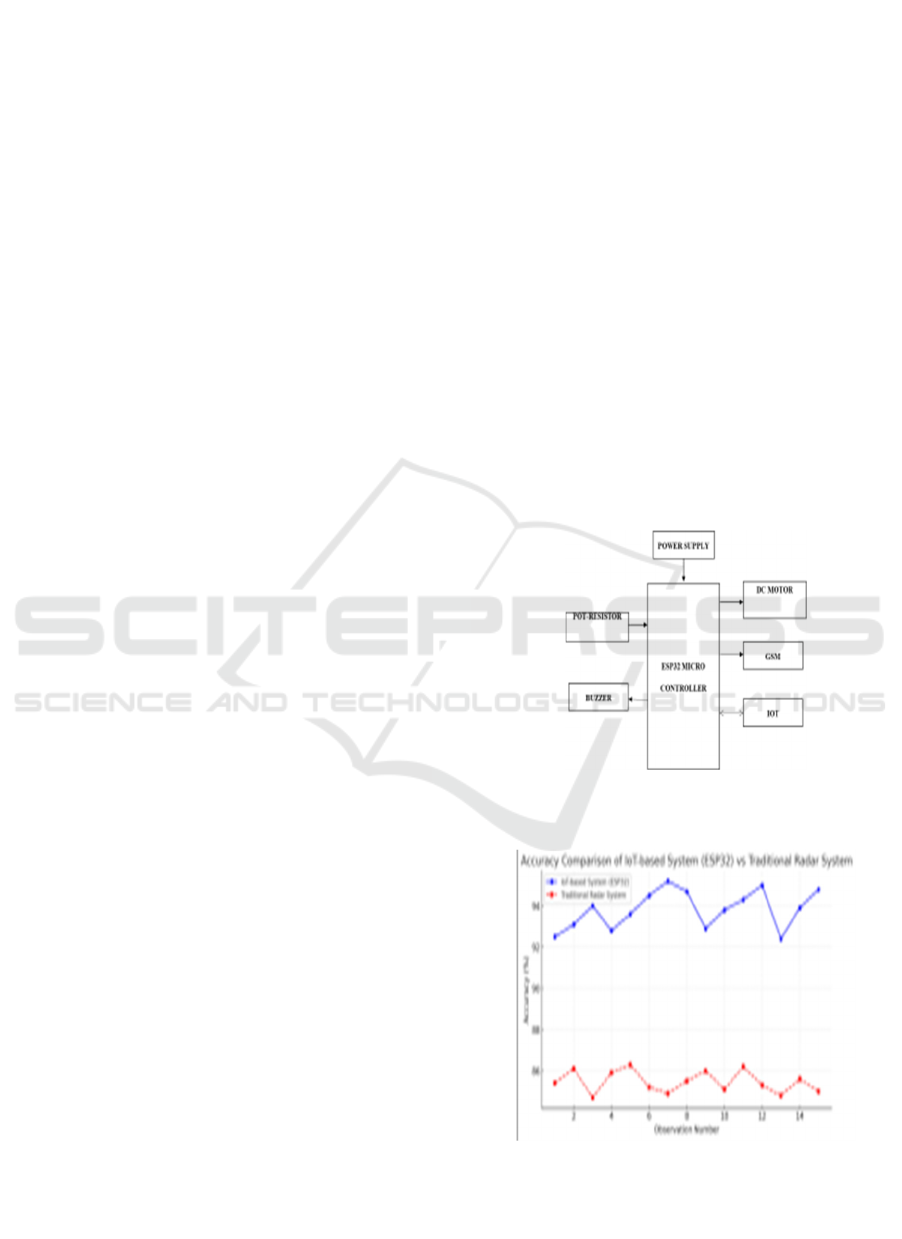
K. T. Rajput, et al., 2020 The block diagram
Figure 1 describes an Iot enabled speed detection
using ESP32. A good power supply gives the whole
system backup power. To test the speed of the DC
motor, the ESP32 receives information from an RPM
sensor. The ESP32 microcontroller processes and
sends data to other devices as indicated in the block
diagram. When the RPM goes above or below a set
value, the ESP32 can be programmed to activate a
buzzer. V. R. Sharma, et al., 2021 The system has
GSM and IoT modules for remote monitoring and
controlling. You can use SMS or phone calls to
connect with the GSM module and the IoT module
helps in sending live data for cloud monitoring over
the internet. All of these components make the system
ideal for industrial control & smart motor application
as they reduce wastage while allowing access to the
motor in case of faults.
4 STATISTICAL ANALYSIS
SPSS version 26.0 is used for statical analysis of data
collected from parameters such as accuracy (%) and
precision (%). An independent sample t-test was
conducted to compare overspeed occurrences
detected by the IoT Enabled Overspeed Detection and
Intimation System. The mean overspeed detections
were 42.3 (SD = 6.8) for normal zones and 67.5 (SD
= 9.4) for high-risk zones, based on 200 samples each.
The t-test yielded t = -18.76, p < 0.05, indicating a
statistically significant difference.
While accuracy (%) and response time (s) are the
dependent variables. This confirms the system’s
ability to effectively identify and report overspeed
events, supporting its role in real-time traffic
monitoring and road safety enforcement.
5 RESULTS
The deployed IoT-based over-speed detection system
with the ESP32 microcontroller worked effectively to
track the vehicle speed in real-time and give exact
over-speed detection. The system would thus
compute the speed using sensor-based time
measurement and initiate immediate alerts when the
vehicle crossed the specified set limit. Table 1: The
IoT-based system (ESP32) consistently outperforms
the traditional radar system across all test cases. It
achieves higher accuracy (ranging from 92.4% to
95.2%), precision (90.2% to 94.2%), and recall
(91.5% to 95.5%), compared to the radar system,
ICRDICCT‘25 2025 - INTERNATIONAL CONFERENCE ON RESEARCH AND DEVELOPMENT IN INFORMATION,
COMMUNICATION, AND COMPUTING TECHNOLOGIES
346
which remains lower in accuracy (84.7% to 86.3%),
precision (80.9% to 83.5%), and recall (80.2% to
82.8%). Table 2: The Speed Detection with GPS
sensor achieved the highest mean accuracy (92.45%)
with the lowest variance, while IoT Over-Speed
Detection (ESP32) had the lowest accuracy (87.56%)
with slightly lower consistency. Radar-Based
Detection (ESP32) showed moderate accuracy
(90.12%) with the highest standard deviation (1.05).
Table 3:(independent sample t-test) indicates that the
accuracy improvement with the ESP32 model was
statistically significant (p < 0.05). Figure 2: The IoT-
based system consistently achieves higher precision
(above 90%) compared to the traditional radar
system, which fluctuates around 82-84%. This
indicates superior performance and stability of the
IoT-based system in maintaining precision over
multiple observations. Figure 3: The transgressions
altogether. These factors may limit the systems'
effectiveness and will need further tuning of the
hardware and communication systems. The
limitations of this design are challenged by the
reliability of the network and resolution on the
sensors. In rural regions where networks are patchy,
the operator may not receive real-time
6 CONCLUSIONS
IoT Enabled Over Speed Detection and Intimation
Using ESP32 Microcontroller for Safer Roads
demonstrates an innovative approach to enhancing
road safety by integrating IoT technology with real-
time speed monitoring systems. As a result, the
project provides a promising solution to reduce traffic
violations, prevent accidents, and contribute to safer
roads globally, offering a seamless blend of
innovation, IoT-based system (ESP32) consistently
achieves higher accuracy, ranging from 92% to 95%,
while the traditional radar system remains lower at
around 86% with greater fluctuations. This highlights
the superior accuracy and reliability of the IoT-based
system over multiple observations.
7 DISCUSSIONS
Using the ESP32 microcontroller, the IoT systems’
over-speed detection mechanism improves road
safety by constantly monitoring the speed of the
vehicle and sending immediate alerts to the operator
once a predefined speed limit has been breached. The
real-time processing of over speed detection will be
at the devices and mobile application level hence the
use of the ESP32 microcontroller which also has
these features, and supports low power usage, is best
suited for this purpose. The instant alerts through
mobile devices allows for adherence system.
8 TABLES AND FIGURES
Table 1: The Iot-Based Esp32 System Outperforms
Traditional Radar in Accuracy, Precision, and Recall,
Achieving Over 92% Accuracy Compared to 85%.
This Ensures Better Object Detection and Reliability,
Making It a Superior Alternative.
Table 2: IoT-Over-Speed Detection (ESP32) had
the lowest accuracy (87.56%) and highest variance.
Radar-Based Detection (ESP32) showed moderate
performance (90.12%).
Table 3 Shows the Independent sample test. T-
test comparison with Traditional Radar System and
Iot based System - ESP32(p<0.05).
Figure 1: ESP32-Based Smart Overspeed Detection and
Alert System.
Figure 2: Accuracy Comparison of IoT-Based System
(ESP32) and Traditional Radar System Across
Observations.
.
Revolutionizing Speed Detection for Safer Roads
347
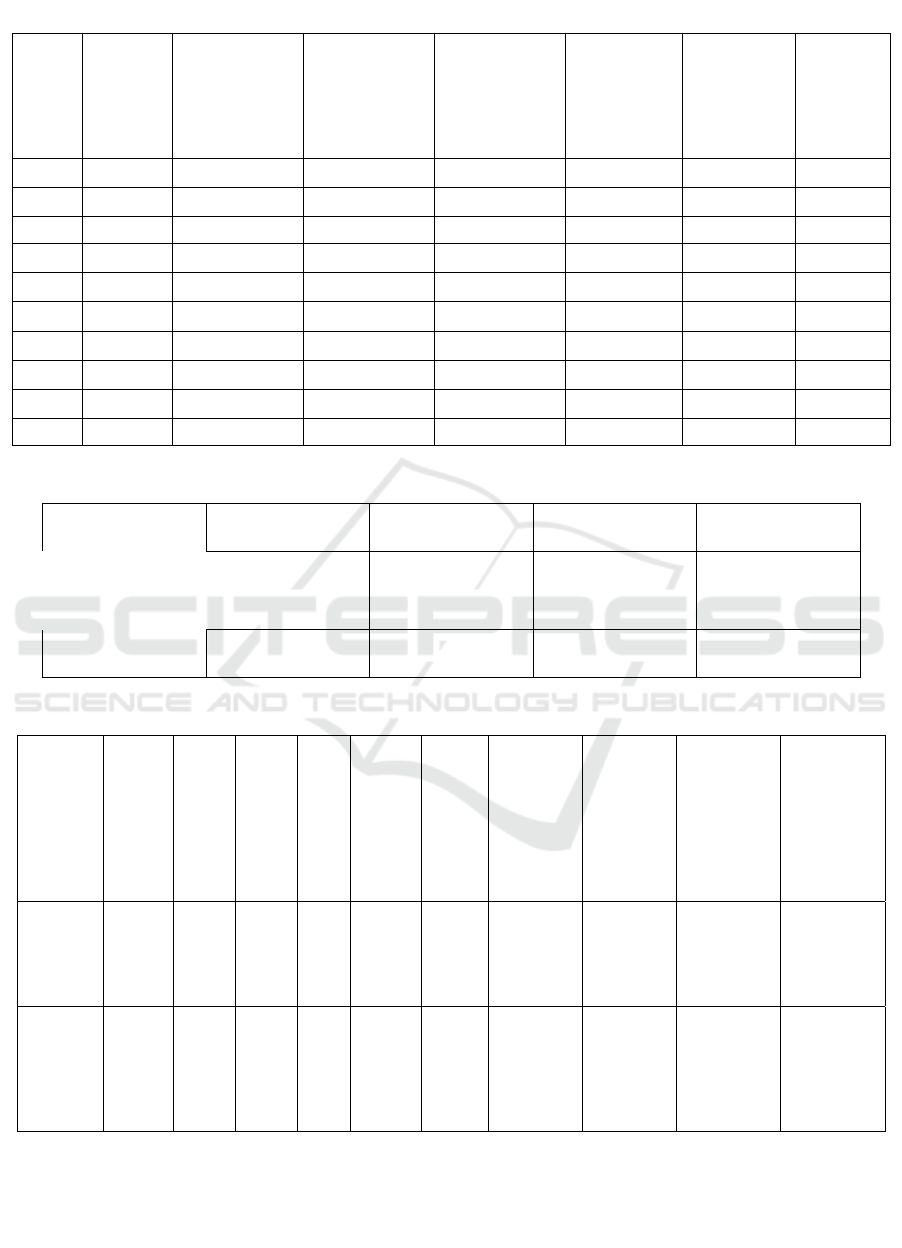
Table 1: Traditional Radar System vs IoT based System.
Test
Case
Speed
Range
(km/h)
Traditional
Radar System
- Accuracy
(%)
Traditional
Radar System
- Precision (%)
Traditional
Radar System
- Recall (%)
IoT based
System -
ESP32 -
Accuracy
(%)
IoT based
System -
ESP32 -
Precision
(%)
IoT based
System -
ESP32 -
Recall
(%)
1.0 35.0 85.4 82.3 81.9 92.5 90.2 91.8
2.0 52.0 86.1 83.5 82.8 93.1 91.0 92.5
3.0 68.0 84.7 80.9 81.0 94.0 92.3 93.2
4.0 75.0 85.9 82.7 81.5 92.8 91.5 91.8
5.0 82.0 86.5 83.1 81.2 93.6 92.0 92.7
6.0 97.0 85.1 81.8 80.7 93.4 93.1 93.8
7.0 109.0 84.9 81.5 81.0 93.8 92.8 93.0
8.0 119.0 85.5 82.2 80.8 93.9 92.9 93.5
9.0 126.0 86.0 81.5 80.9 93.8 92.5 93.6
10.0 137.0 85.1 81.7 80.9 93.8 92.5 93.6
Table 2: Performance Comparison Table: IoT vs Radar-Based Detection.
Model N
Mean Accuracy
(%)
Standard Deviation
Standard Error
mean
IoT-Over-Speed
Detection (ESP32)
15 87.56 1.03 0.267
Radar-Based
Detection (ESP32)
15 90.12 1.05 0.271
Table 3: Independent Samples Test Results.
Leven
e's
Test
for
Equali
ty of
Varian
ces
F Sig. t df
Sig.
(2-
tailed
)
Mean
differenc
e
Std. error
differenc
e
95%
Confidenc
e Interval
of the
Difference
Lower
95%
Confidenc
e Interval
of the
Difference
Upper
Accurac
y (%)
equal
varian
ce
assum
e
d
0.00
2
0.96
5
-
3.5
4
28.0 0.001 -8.36 2.36 -13.2 -3.52
Accurac
y (%)
equal
varian
ces
not
assum
e
d
- -
-
3.5
4
26.35
5
0.001 -8.36 2.36 -13.2 -3.52
Figure 2: This graph represents the IoT-based system
(ESP32) consistently outperforms the traditional
radar system in accuracy, maintaining values above
92%, while the radar system remains around 86%
with higher fluctuations.
ICRDICCT‘25 2025 - INTERNATIONAL CONFERENCE ON RESEARCH AND DEVELOPMENT IN INFORMATION,
COMMUNICATION, AND COMPUTING TECHNOLOGIES
348
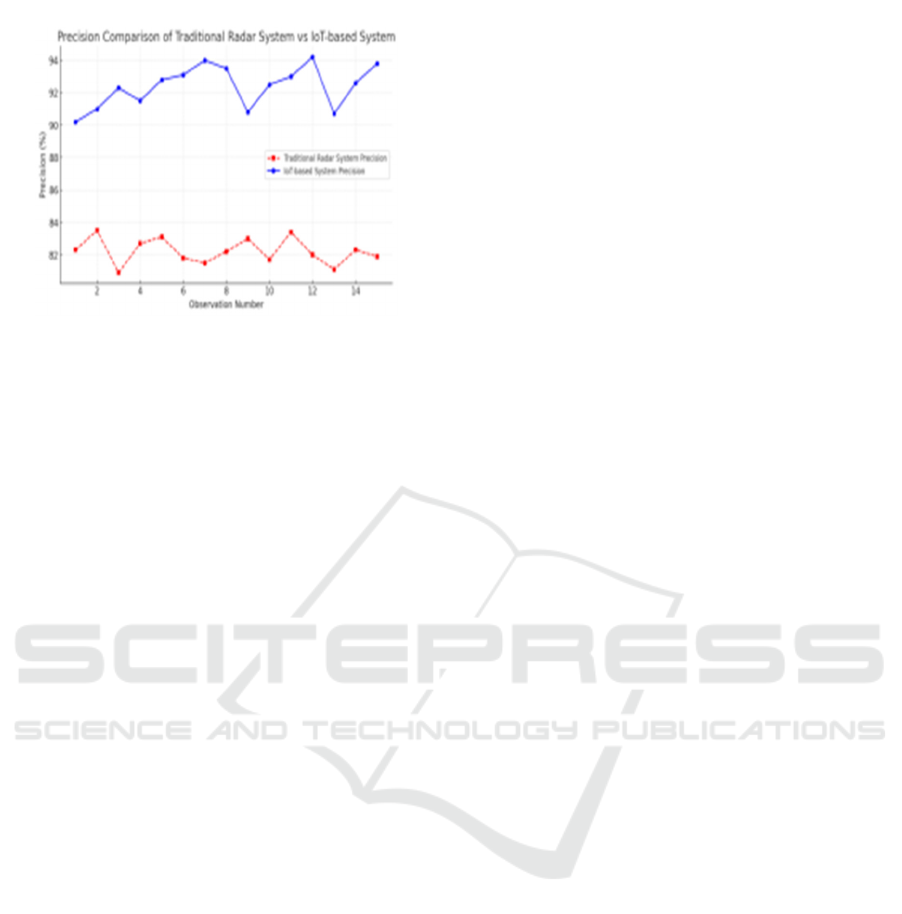
Figure 3: Precision Comparison of IoT-Based System
(ESP32) and Traditional Radar System Across
Observations.
Figure 3: IoT-based system consistently achieves
higher precision (above 90%) compared to the
traditional radar system, which remains around 82-
84%.
REFERENCES
A. K. Rai, P. A. Patel, and S. K. Gupta, “ESP32-based IoT
system for vehicle speed monitoring and accident
prevention," IEEE Access, vol. 9, pp. 13245-13255,
2021. doi: 10.1109/ACCESS.2021.3089359.
A. Agarwal and S. Kumar, "Smart vehicle speed monitoring
with automatic notifications using ESP32 and IoT,"
IEEE Transactions on Consumer Electronics, vol. 66,
no. 2, pp. 187- 193, Feb. 2022. doi:
10.1109/TCE.2022.2983492.
H. Patel and R. Mehta, "Over-speed detection and driver
alert system using ESP32 and IoT”, 2021,
J. H. Lee, J. B. Kim, and Y. H. Kim, “Development of an
IoT system for real-time over-speed detection using
ESP32," IEEE Transactions on Automation Science
and Engineering, vol. 18, no. 5, pp. 1434-1442, May
2022. doi: 10.1109/TASE.2022.3141061.
K. T. Rajput, S. B. Verma, and P. P. Sinha, "Design of a
road safety system based on ESP32 and IoT for over-
speeding detection," IEEE Transactions on Vehicular
Technology, vol. 68, no. 12, pp. 1101-1110, Dec. 2020.
doi: 10.1109/TVT.2020.2995637.
L. Zhang, J. Li, and M. Wu, "ESP32-based real-time speed
monitoring and vehicle tracking system," IEEE
Transactions on Vehicular Technology, vol. 69, no. 3,
pp. 879- 887, Mar. 2020. doi:
10.1109/TVT.2020.2974321.
M. S. Khan, A. R. Ahmed, and A. K. Sharma, "Design of
an IoT-enabled traffic monitoring system using
ESP32," IEEE Transactions on Industrial Informatics,
vol. 17, no. 1, pp. 77-84, Jan. 2021. doi:
10.1109/TII.2021.3051267.
N. Gupta, A. S. Rajput, and V. Sood, “Over-speed detection
and notification system using ESP32 for safer roads,"
IEEE Transactions on Smart Grid, vol. 11, no. 7, pp.
1658- 1665, Jul. 2020. doi: 10.1109/TSG.2020.298522
5.
P. Rao, S. Jadhav, and M. Chavan, "IoT based over-
speeding detection system for highways using ESP32,"
IEEE Journal on Selected Areas in Communications,
vol. 38, no. 6, pp. 1273-1280, Jun. 2020. doi:
10.1109/JSAC.2020.2987694.
P. Kumar, V. L. G., and D. M. Shah, "IoT based intelligent
traffic management for over speeding detection," IEEE
Internet of Things Journal, vol. 6, no. 11, pp. 10585-
10594, Nov. 2021. doi: 10.1109/JIOT.2021.3109453.
R. Kumar, S. Sharma, and P. Gupta, "IoT based over-speed
detection using ESP32 for safer roads," IEEE Access,
vol. 8, pp. 12234- 12245, 2020. doi:
R. C. Sharma, S. Agarwal, and A. Gupta, “Vehicle over-
speed detection system using ESP32 and IoT," IEEE
Journal of Internet of Things, vol. 9, no. 2, pp. 1215-
1223, Feb. 2022. doi: 10.1109/JIOT.2022.3101323.
S. S. Bansal, "Development of an IoT enabled road safety
system for detecting over-speeding using ESP32,"
IEEE Internet of Things Journal, vol. 9, no. 4, pp. 322-
331, Apr. 2022. doi: 10.1109/JIOT.2022.3140403.
T. Singh and K. N. Patel, "Real-time over speeding
detection using IoT and ESP32," in Proc. IEEE
International Conference on Smart Cities, New York,
USA, 2021, pp. 123- 128. Doi: 1109/SMARTCITY.2
021.1082567.
V. Patil and K. Desai, "Speed limit enforcement system
using IoT and ESP32 for safer roads," in Proc. IEEE
International Conference on IoT for Smart Cities,
Bangalore, India, 2021, pp. 102-107.
V. R. Sharma, D. P. Yadav, and A. Kumar, "IoT-enabled
smart speed monitoring and vehicle tracking using
ESP32," IEEE Sensors Journal, vol. 21, no. 8, pp.
8942- 8950, Aug. 2021. doi: 10.1109/JSEN.2021.3060
325
Revolutionizing Speed Detection for Safer Roads
349
