
Soft Computing Techniques for Fuzzy Digraph Analysis
Tharani S
1
, Kavitha T
1
, Deepa R
1
and Sarala N
2
1
Department of Mathematics, E.G.S. Pillay Engineering College, Nagapattinam, Tamil Nadu, India
2
Department of Mathematics, A.D.M. College for Women (Affiliated to Bharathidasan University),
Nagapattinam, Tamil Nadu, India
Keywords: Fuzzy Soft Bipartite Digraph, Punnette Square, Genetic Skin Colour.
Abstract: This study explores the use of bipartite fuzzy soft digraphs as an innovative approach for the comprehensive
modeling of inherited skin tone determination. Skin tone is a multidimensional trait influenced by combined
environmental and hereditary factors. It is important in dermatology, genetics, and customized medicine.
Due to their inherent complexity and ambiguity, traditional modeling tools occasionally fail to
capture the complex relationships between various components. In order to create a reliable model of genetic
skin tone determination, we suggest combining fuzzy logic and soft computing techniques with bipartite
fuzzy soft digraphs. This approach takes into consideration the inherent ambiguity in the relationships
between genes and environmental influences by defining vertices for genes, external variables, and
phenotypic outcomes, and edges for the connections between them. We go over how we created this model
and its implications for comprehending the basic processes underlying skin pigmentation.
1 INTRODUCTION
Molodtsov introduced the concept of "soft sets,"
which address uncertainty. Building on this
foundation, Rosenfeld expanded the notion of fuzzy
graphs by examining fuzzy interactions within the
fuzzy sets initially proposed by Zadeh in 1965.
Mordeson and C.S. Peng explored various operations
related to fuzzy graphs. Following this, Ali and his
team examined fuzzy soft sets that emerge from soft
sets within the framework of set theory. In 2015, M.
Akram and S. Nawaz presented the concept of fuzzy
soft graphs for the first time. Concurrently, T. K.
Samanta and Sumitmohinta also introduced fuzzy
soft graphs independently.
The basic structural and operational unit of
heredity is the gene. Genes are constructed from
DNA. Sometimes, genes act as the building blocks for
the production of proteins. In contrast, a significant
portion of genes do not need to code for proteins. The
majority of human genes are made up of only a few
hundred more than 2 million DNA nucleotides.
According to the Genome Project, a multinational
initiative to elucidate the human genome's structure
and catalog its genes, humans are believed to have
between 20,000 and 25,000 genes.
Each individual carries two copies of every gene,
inherited from their parents. Although less than 1
percent of genes show small variations among
individuals, most genomes remain similar throughout
the population. Alleles are the variations in these
genes, marked by slight differences in their sequences
of base pairs. These small variations play a role in
shaping the unique physical traits of every individual.
The suggested approach creates opportunities for
further study in the creation of sophisticated
computational models for comprehending and
forecasting complicated genetic features, leading to a
better knowledge of the complex interactions
between genetic variables and their phenotypic
manifestations. This article illustrates how fuzzy soft
bipartite digraphs can be applied to the analysis of the
most prevalent human skin tones.
2 GENETIC SKIN COLOUR
The concept of "polygenic inheritance" pertains to the
transmission of traits that are shaped by multiple
genes. When these polygenes are expressed together,
they give rise to specific traits. This differs from
Mendelian inheritance, where traits are dictated by a
single gene. In polygenic inheritance, the interactions
S., T., T., K., R., D. and N., S.
Soft Computing Techniques for Fuzzy Digraph Analysis.
DOI: 10.5220/0013897600004919
Paper published under CC license (CC BY-NC-ND 4.0)
In Proceedings of the 1st International Conference on Research and Development in Information, Communication, and Computing Technologies (ICRDICCT‘25 2025) - Volume 3, pages
335-344
ISBN: 978-989-758-777-1
Proceedings Copyright © 2025 by SCITEPRESS – Science and Technology Publications, Lda.
335

among various alleles can lead to a diverse range of
phenotypes (observable characteristics). Human traits
such as skin color, eye color, hair color, body shape,
height, and weight exemplify those inherited through
polygenic inheritance. For instance, skin color is
regulated by at least three genes, with the possibility
of additional genes also influencing this trait. The
level of melanin, a dark pigment in the skin, plays a
crucial role in determining skin tone. Each gene
responsible for skin color has two alleles, which are
located on different chromosomes.Only the three
genes known to affect skin tone need be taken into
account; each gene has two alleles, one for dark and
one for light skin tones. Dark skin colour (D) allele is
more prevalent than light skin colour (L) allele (d).
How many dark alleles a person possesses determines
their skin tone. If a person inherits only dark alleles,
their skin colour will be very dark, whereas if they
inherit no dark alleles, their skin colour will be very
light. The phenotypes of different skin tones will be
present in people who inherit various combinations of
the light and dark alleles. A medium skin tone occurs
when there is a balanced presence of both dark and
light alleles. Conversely, a darker skin tone is the
result of inheriting a greater number of dark alleles.
The melanocortin 1 receptor (MC1R) gene is the
main gene linked to skin color. This gene codes for
the production of a protein that is essential in
identifying the kind of melanin that melanocytes
make. In addition, other genes that are implicated in
the process include TYR, OCA2, SLC24A5, and
SLC45A2. Diversities in these genes are responsible
for the great diversity of skin tones found in human
communities. For instance, darker skin is a result of
some genetic differences linked to greater melanin
synthesis, whereas lighter skin is a result of genetic
variations linked to decreased melanin production.
Table 1 shows the Various Shades of Human Skin
Colour.
Table 1: Various Shades of Human Skin Colour.
Phenotypes Genotypes Units of
p
igment
Extremely dark AABBCC 6
Very dark AaBBCC 5
Dark AaBbCC 4
Intermediate AaBbCc 3
Light aaBbCc 2
Very light aabbCc 1
Extremely
li
g
ht
aabbcc 0
The Punnett square is a tabular summary of possible
combinations of maternal alleles with paternal
alleles. These tables can be used to examine the
genotypic outcome probabilities of the offspring of a
single trait (allele) or when crossing multiple traits
from the parents. Phenotypes may be predicted with
at least better-than-chance accuracy using a Punnett
square, but the phenotype that may appear in the
presence of a given genotype can in some instances
be influenced by many other factors, as
when polygenic inheritance and/or epigenetic are at
work.
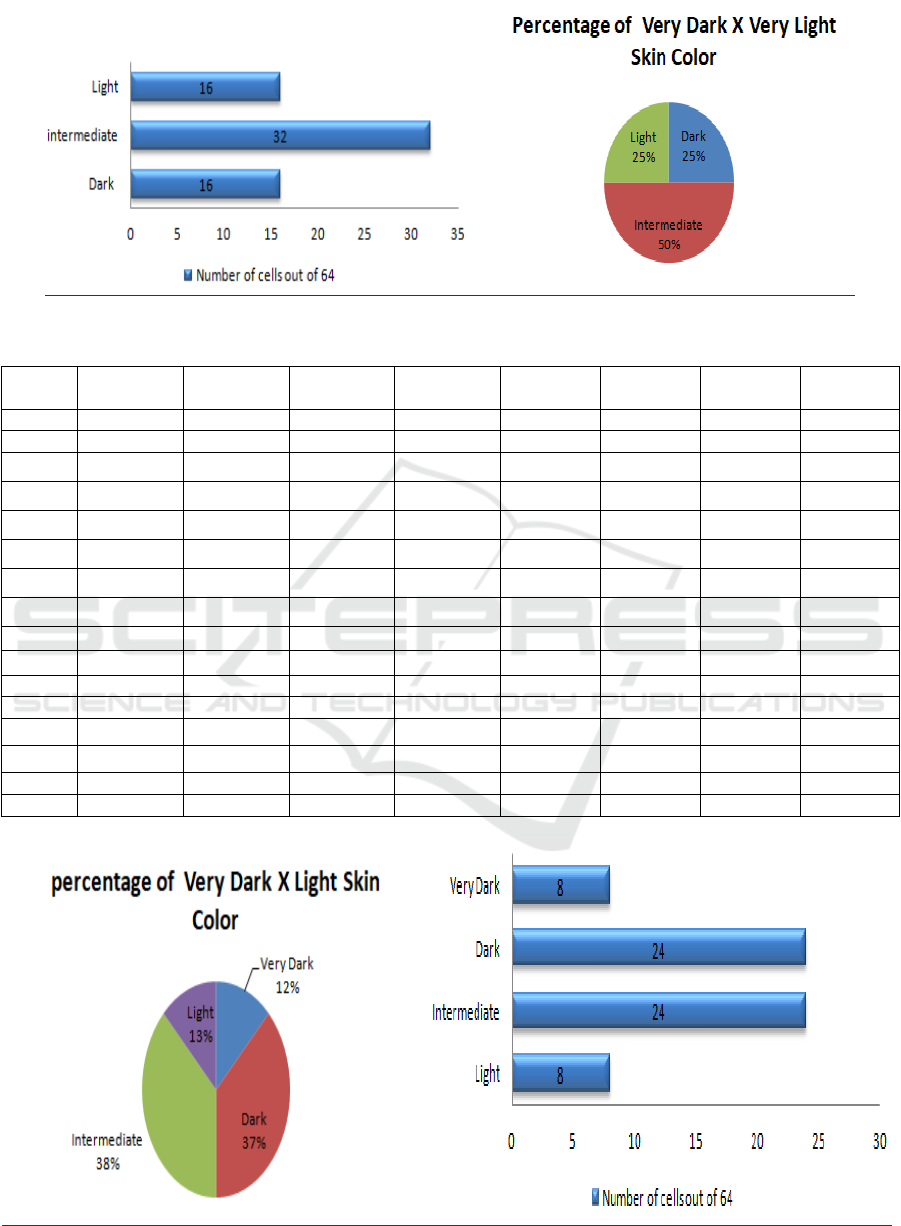
Example Crosses: Shown on a Punnett Square
Example 2.1
Parent 1: Very Dark Skin Colour, Genotype: AaBBCC
Parent 2: Very Light Skin Colour, Genotype: aabbCc
Pt-1:
P
t
-2:
ABC
ABC
ABC ABC aBC aBC aBC aBC
abC AaBbCC AaBbCC AaBbCC AaBbCC aaBbCC aaBbCC aaBbCC aaBbCC
4 4 4 4 3 3 3 3
abc AaBbCc AaBbCc AaBbCc AaBbCc aaBbCc aaBbCc aaBbCc aaBbCc
3 3 3 3 2 2 2 2
abC AaBbCC AaBbCC AaBbCC AaBbCC aaBbCC aaBbCC aaBbCC aaBbCC
4 4 4 4 3 3 3 3
abc AaBbCc AaBbCc AaBbCc AaBbCc aaBbCc aaBbCc aaBbCc aaBbCc
3 3 3 3 2 2 2 2
abC AaBbCC AaBbCC AaBbCC AaBbCC aaBbCC aaBbCC aaBbCC aaBbCC
4 4 4 4 3 3 3 3
abc AaBbCc AaBbCc AaBbCc AaBbCc aaBbCc aaBbCc aaBbCc aaBbCc
3 3 3 3 2 2 2 2
abC AaBbCC AaBbCC AaBbCC AaBbCC aaBbCC aaBbCC aaBbCC aaBbCC
4 4 4 4 3 3 3 3
abc AaBbCc AaBbCc AaBbCc AaBbCc aaBbCc aaBbCc aaBbCc aaBbCc
3 3 3 3 2 2 2 2
ICRDICCT‘25 2025 - INTERNATIONAL CONFERENCE ON RESEARCH AND DEVELOPMENT IN INFORMATION,
COMMUNICATION, AND COMPUTING TECHNOLOGIES
336
Example 2.2
Parent 1: Very Dark Skin Colour, Genotype: AaBBCC
Parent 2: Light Skin Colour, Genotype: aaBbCc
Pt-1:
Pt-2:
ABC ABC ABC ABC aBC aBC aBC aBC
aBC AaBBCC AaBBCC AaBBCC AaBBCC aaBBCC aaBBCC aaBBCC aaBBCC
5 5 5 5 4 4 4 4
aBc AaBBCc AaBBCc AaBBCc AaBBCc aaBBCc aaBBCc aaBBCc aaBBCc
4 4 4 4 3 3 3 3
abC AaBbCC AaBbCC AaBbCC AaBbCC aaBbCC aaBbCC aaBbCC aaBbCC
4 4 4 4 3 3 3 3
abc AaBbCc AaBbCc AaBbCc AaBbCc aaBbCc aaBbCc aaBbCc aaBbCc
3 3 3 3 2 2 2 2
aBC AaBBCC AaBBCC AaBBCC AaBBCC aaBBCC aaBBCC aaBBCC aaBBCC
5 5 5 5 4 4 4 4
aBc AaBBCc AaBBCc AaBBCc AaBBCc aaBBCc aaBBCc aaBBCc aaBBCc
4 4 4 4 333 3
abC AaBbCC AaBbCC AaBbCC AaBbCC aaBbCC aaBbCC aaBbCC aaBbCC
4 4 4 4 3 3 3 3
abc AaBbCc AaBbCc AaBbCc AaBbCc aaBbCc aaBbCc aaBbCc aaBbCc
3 3 3 3 222 2
Soft Computing Techniques for Fuzzy Digraph Analysis
337
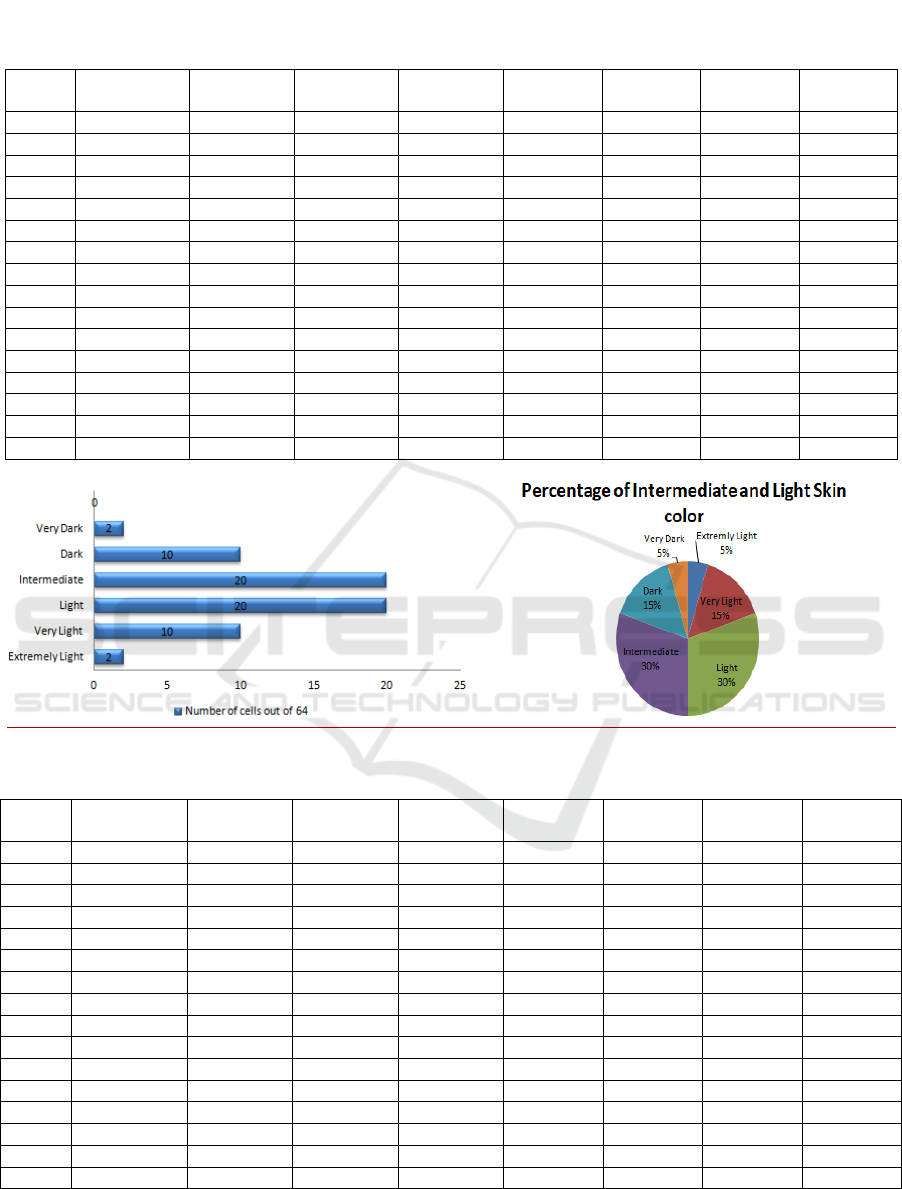
Example 2.3
Parent 1: Intermediate Skin Colour, Genotype: AaBbCc
Parent 2: Light Skin Colour, Genotype: aaBbCc
Pt-1:
Pt-2:
ABC ABc AbC Abc aBC aBc abC abc
aBC AaBBCC AaBBCc AaBbCC AaBbCc aaBBCC aaBBCc aaBbCC aaBbCc
5 4 4 3 4 3 3 2
aBc AaBBCc AaBBcc AaBbCc AaBbcc aaBBCc aaBBcc aaBbCc aaBbcc
4 3 3 2 3 2 2 1
abC AaBbCC AaBbCc AabbCC AabbCc aaBbCC aaBbCc aabbCC aabbCc
4 3 3 2 3 2 2 1
abc AaBbCc AaBbcc AabbCc Aabbcc aaBbCc aaBbcc aabbCc aabbcc
3 2 2 1 2 1 1 0
aBC AaBBCC AaBBCc AaBbCC AaBbCc aaBBCC aaBBCc aaBbCC aaBbCc
5 4 4 3 4 3 3 2
aBc AaBBCc AaBBcc AaBbCc AaBbcc aaBBCc aaBBcc aaBbCc aaBbcc
4 3 3 2 3 2 2 1
abC AaBbCC AaBbCc AabbCC AabbCc aaBbCC aaBbCc aabbCC aabbCc
4 3 3 2 3 2 2 1
abc AaBbCc AaBbcc AabbCc Aabbcc aaBbCc aaBbcc aabbCc aabbcc
3 2 2 1 2 1 1 0
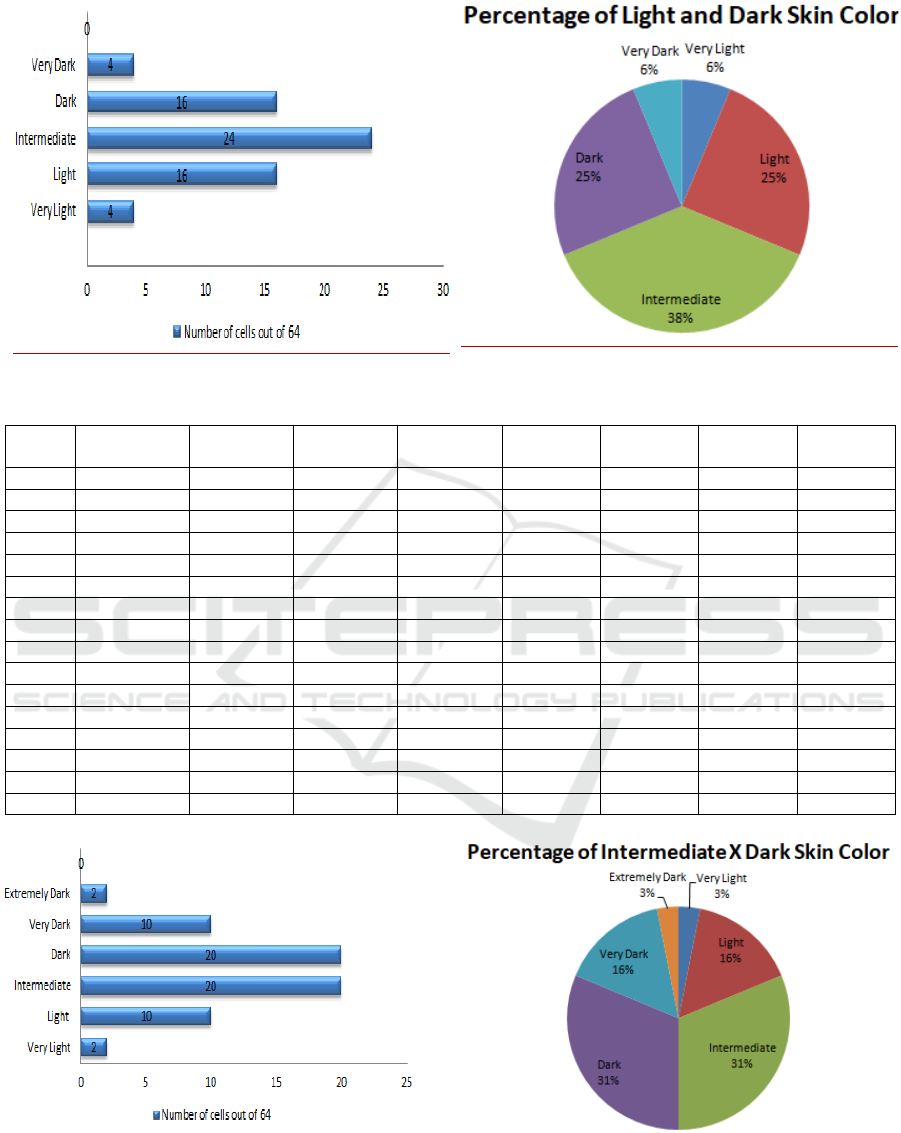
Example 2.4
Parent 1: Light Skin Colour, Genotype: aaBbCc
Parent 2: Dark Skin Colour, Genotype: AaBbCC
Pt-1:
Pt-2:
aBC aBc abC abc aBC aBc abC abc
ABC AaBBCC AaBBCc AaBbCC AaBbCc AaBBCC AaBBCc AaBbCC AaBbCc
5 4 4 3 5 4 4 3
ABC AaBBCC AaBBCc AaBbCC AaBbCc AaBBCC AaBBCc AaBbCC AaBbCc
5 4 4 3 5 4 4 3
AbC AaBbCC AaBbCc AabbCC AabbCc AaBbCC AaBbCc AabbCC AabbCc
4 3 3 2 4 3 3 2
AbC AaBbCC AaBbCc AabbCC AabbCc AaBbCC AaBbCc AabbCC AabbCc
4 3 3 2 4 3 3 2
aBC aaBBCC aaBBCc aaBbCC aaBbCc aaBBCC aaBBCc aaBbCC aaBbCc
4 3 3 2 4 3 3 2
aBC aaBBCC aaBBCc aaBbCC aaBbCc aaBBCC aaBBCc aaBbCC aaBbCc
4 3 3 2 4 3 3 2
abC aaBbCC aaBbCc aabbCC aabbCc aaBbCC aaBbCc aabbCC aabbCc
3 2 2 1 3 2 2 1
abC aaBbCC aaBbCc aabbCC aabbCc aaBbCC aaBbCc aabbCC aabbCc
3 2 2 1 3 2 2 1
ICRDICCT‘25 2025 - INTERNATIONAL CONFERENCE ON RESEARCH AND DEVELOPMENT IN INFORMATION,
COMMUNICATION, AND COMPUTING TECHNOLOGIES
338
Example 2.5
Parent 1: Intermediate Skin Colour, Genotype: AaBbCc
Parent 2: Dark Skin Colour, Genotype: AaBbCC
Pt-1:
Pt-2:
ABC ABc AbC Abc aBC aBc abC abc
ABC AABBCC AABBCc AABbCC AABbCc AaBBCC AaBBCc AaBbCC AaBbCc
6 5 5 4 544 3
ABC AABBCC AABBCc AABbCC AABbCc AaBBCC AaBBCc AaBbCC AaBbCc
6 5 5 4 544 3
AbC AABbCC AABbCc AAbbCC AAbbCc AaBbCC AaBbCc AabbCC AabbCc
5 4 4 3 433 2
AbC AABbCC AABbCc AAbbCC AAbbCc AaBbCC AaBbCc AabbCC AabbCc
5 4 4 3 433 2
aBC AaBBCC AaBBCc AaBbCC AaBbCc aaBBCC aaBBCc aaBbCC aaBbCc
5 4 4 3 433 2
aBC AaBBCC AaBBCc AaBbCC AaBbCc aaBBCC aaBBCc aaBbCC aaBbCc
5 4 4 3 433 2
abC AaBbCC AaBbCc AabbCC AabbCc aaBbCC aaBbCc aabbCC aabbCc
4 3 3 2 322 1
abC AaBbCC AaBbCc AabbCC AabbCc aaBbCC aaBbCc aabbCC aabbCc
4 3 3 2 322 1
Soft Computing Techniques for Fuzzy Digraph Analysis
339
3 THE UTILIZATION OF FUZZY
SOFT BIPARTITE DIGRAPHS
IN EXAMINING THE
PREDOMINANT HUMAN SKIN
TONES
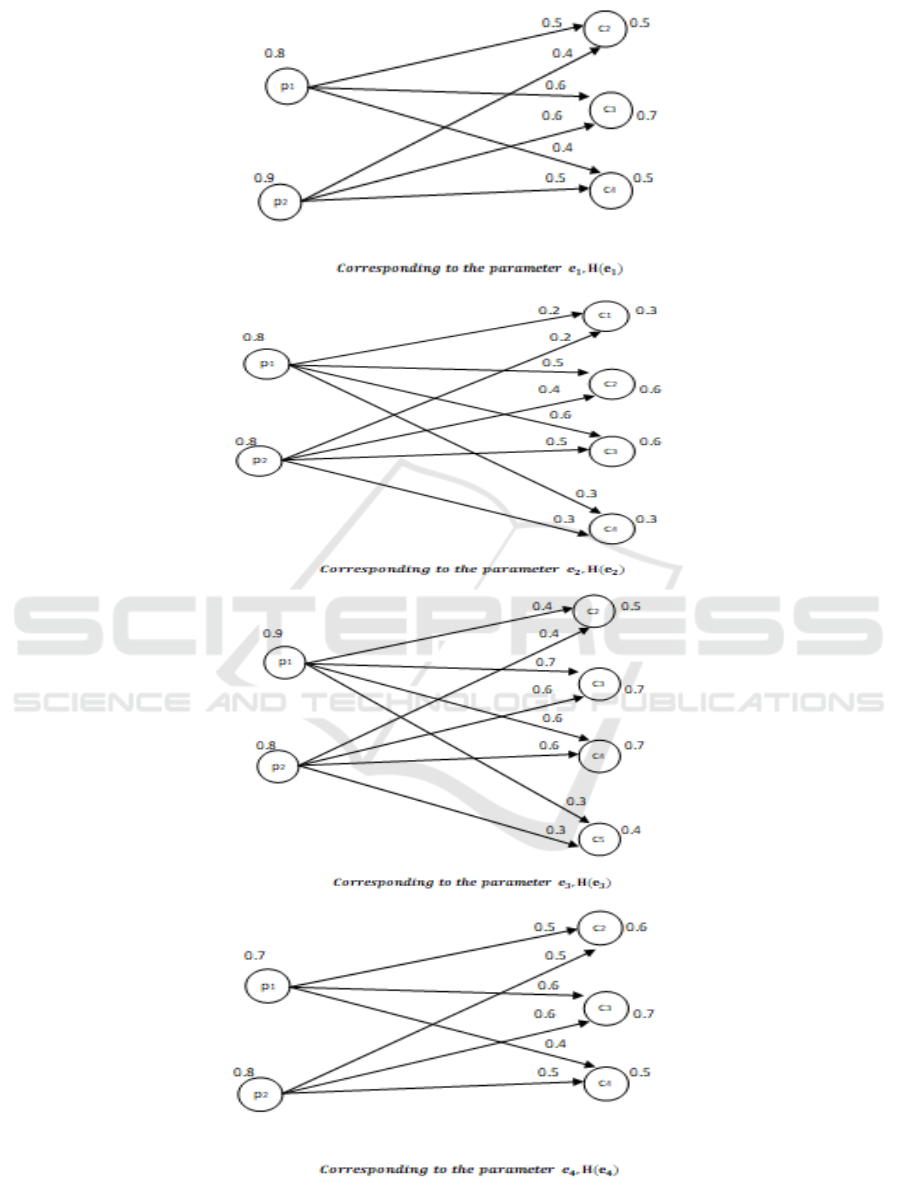
The explanation of discussions involving Punnett
Squares can be enhanced through the use of fuzzy soft
bipartite digraphs. The following pattern explains the
chances of the young acquiring the colour of their
skin
Vertex Set 1: { 𝐩
𝟏
stands for Parent 1 ;
𝐩
𝟐
stands for Parent 2 } ;
Vertex Set 2: { 𝐜
𝟏
stands for child with
Very Dark Skin ;
𝐜
𝟐
stands for child with Dark Skin ;
𝐜
𝟑
stands for child with Intermediate Skin ;
𝐜
𝟒
stands for child with Light Skin,
𝐜
𝟓
stands for child with Very Light Skin ;
𝐜
𝟔
stands for child with Extremely Light Skin ;
𝐜
𝟕
stands for child with Extremely Dark Skin.}
We can fix the parameters for argument
e
represents the colour of the skin of parents: p
1
:
Very Dark Skin & p
2
: Very Light Skin.
e
represents the colour of the skin of parents: p
1
:
Very Dark Skin & p
2
: Light Skin.
e
represents the colour of the skin of parents: p
1
:
Intermediate Skin & p
2
: Light Skin.
e
represents the colour of the skin of parents: p
1
:
Light Skin & p
2
: Dark Skin.
e
represents the colour of the skin of parents: p
1
:
Intermediate Skin & p
2
: Dark Skin.
e
represents the colour of the skin of parents: p
1
:
Extremely Dark Skin & p
2
: Light Skin.
e
represents the colour of the skin of parents: p
1
:
Extremely Light Skin & p
2
: Dark Skin.
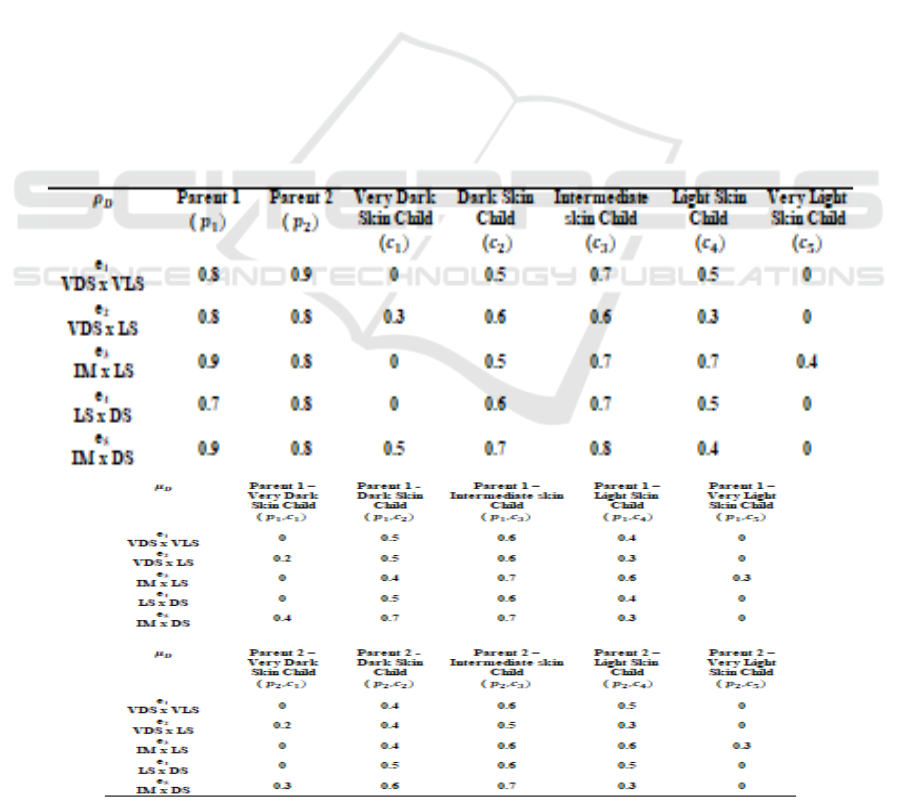
Example: 3.1
Consider 𝑉
= { p
1
, p
2
}; 𝑉
= {c
1
,c
2
,c
3,
c
4
,c
5
} and E
= { e
1
, e
2
,e
3
, e
4
, e
5
, e
6
, e
7
}.
Let A = { e
1
, e
2
,e
3
, e
4
, e
5
} . D
A,V
is characterized by
a table and
µ
e
(x
i
, x
j
) = 0 ∀ (x
i
, x
j
) ∈ V
1
X V
2
\ ((p
1
,c
1
), (p
1
,c
2
),
(p
1
,c
3
), (p
1
,c
4
), (p
1
,c
5
), (p
2
,c
1
), (p
2
,c
2
), (p
2
,c
3
), (p
2
,c
4
),
(p
2
,c
5
)) and e ∈ A.
Table 2.
ICRDICCT‘25 2025 - INTERNATIONAL CONFERENCE ON RESEARCH AND DEVELOPMENT IN INFORMATION,
COMMUNICATION, AND COMPUTING TECHNOLOGIES
340
Soft Computing Techniques for Fuzzy Digraph Analysis
341
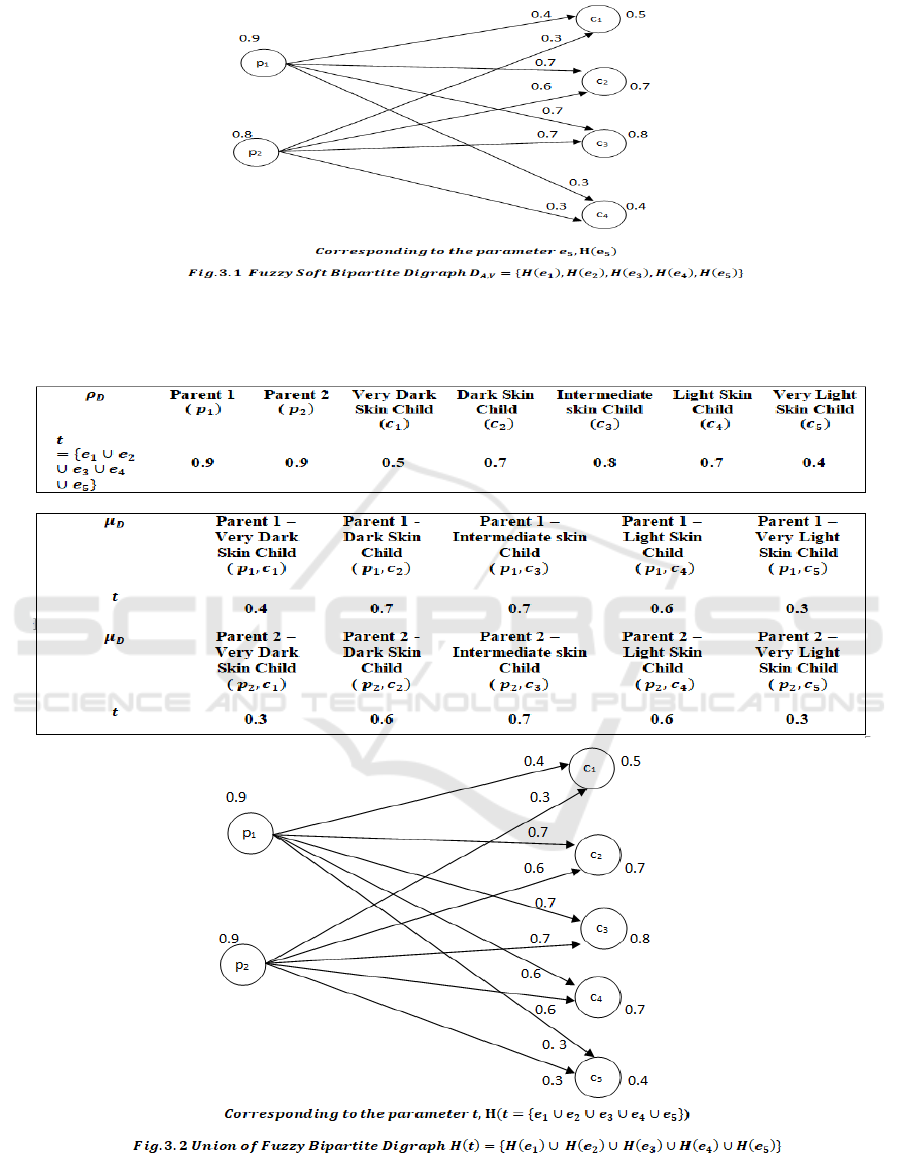
By taking the Union of fuzzy digraphs 𝐻
(
𝑒
)
,𝐻
(
𝑒
)
,𝐻
(
𝑒
)
,𝐻
(
𝑒
)
𝑎𝑛𝑑 𝐻
(𝑒
), we derive a resultant fuzzy
digraph. 𝐻
(
𝑡
)
,𝑡 = 𝑒
∪𝑒
∪𝑒
∪𝑒
∪𝑒
Table 3.2
By taking the Intersection of fuzzy digraphs 𝐻
(
𝑒
)
,𝐻
(
𝑒
)
, 𝐻
(
𝑒
)
,𝐻
(
𝑒
)
𝑎𝑛𝑑 𝐻
(𝑒
), we derive a resultant
fuzzy digraph. 𝐻
(
𝑑
)
,𝑑 = 𝑑
∩𝑑
∩𝑑
∩𝑑
∩𝑑
ICRDICCT‘25 2025 - INTERNATIONAL CONFERENCE ON RESEARCH AND DEVELOPMENT IN INFORMATION,
COMMUNICATION, AND COMPUTING TECHNOLOGIES
342
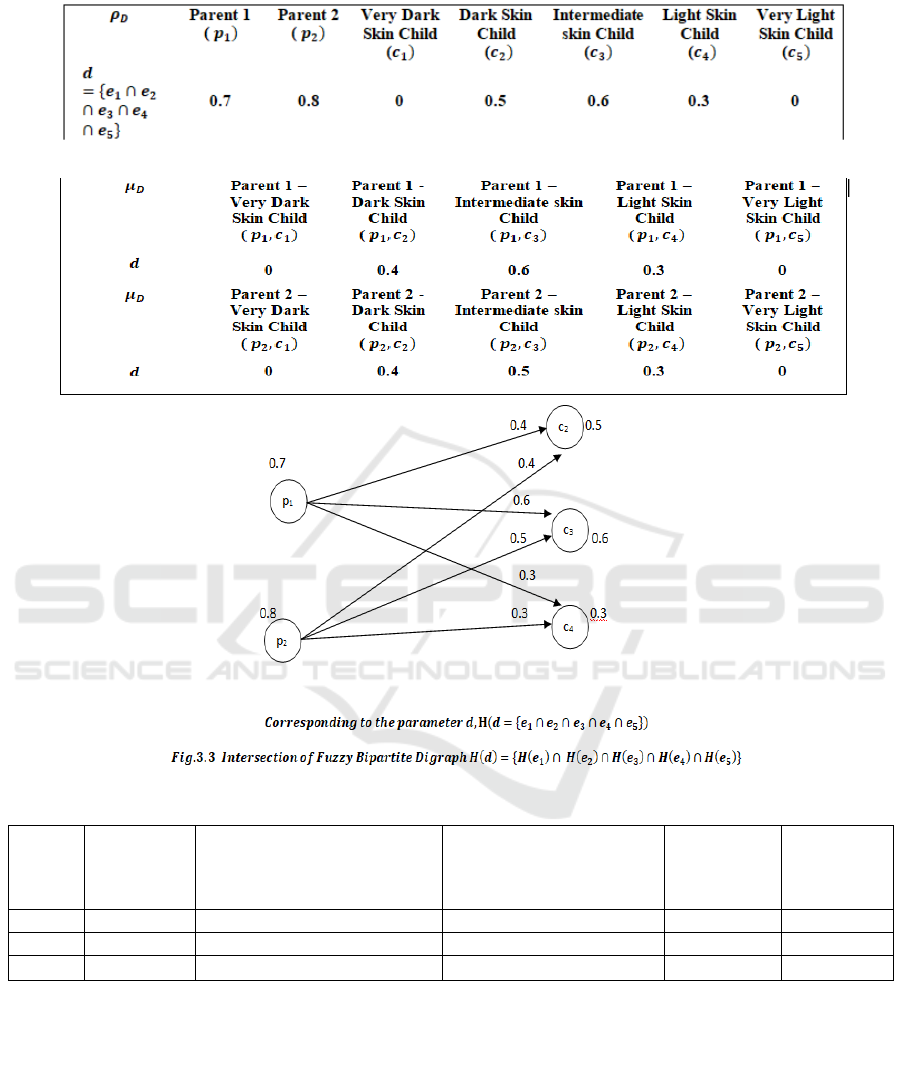
Table 3.
Table 4.
𝑫
𝑨,𝑽
Deg (𝐜
𝟏
)
child with
Very Dark
Skin
Deg (𝐜
𝟐
)
child with Dark Skin
Deg (𝐜
𝟑
)
Intermediate Skin
Deg (𝐜
𝟒
)
Light Skin
Deg (𝐜
𝟓
)
child with
Very Light
Skin
H(t) 0.5 0.7 0.8 0.7 0.4
H(d) 0 0.5 0.6 0.3 0
Deg 0.5 1.2 1.4 1.0 0.4
The vertex C
3
has a greater degree than the other skin color. As a result, the most prevalent skin tone is only
intermediate.
4 CONCLUSIONS
In summary, the range of skin tones observed in
human populations can be attributed to the interplay
of multiple genes, particularly those involved in the
synthesis and control of melanin. The enormous
variety of skin tones that may be found all across the
world is influenced by both genetic variations
inherited from our ancestors and environmental
factors. Finally, we are able to agree that skin tones
that are genetically intermediate will predominate
Soft Computing Techniques for Fuzzy Digraph Analysis
343

over other tones. Applying mathematical values to
genetic phenomena has proven this. This kind of
research can be used in a variety of fields, such as
diseases and transportation scenarios that call for
complex judgments to be made.
REFERENCES
Akram.M, Nawaz.S, On fuzzy soft graphs, Italian Journal
of Pure and Applied Mathematics 34 (2015) 497 – 514.
Akram.M, Nawaz.S, Operations onsoft graphs, Fuzzy
Information and Engineering 7(4) (2015) 423 – 449.
Akram.M, Nawaz.S, Fuzzy soft graphs with applications,
Journal of Intelligent and Fuzzy Systems 30 (6) (2016)
3619 – 3632.
Anas Al – Masarwah. Majdoleen Abu Qamar, Some New
Concepts of Fuzzy Soft Graphs, Fuzzy Information and
Engineering, (2016) August: 427 – 438.
Molodtsov. D.A, Soft set theory -first results, Computers
and Mathematics with Applications 37
(
1999
)
19 – 31.
Mohinta.S, Samanta.T.K, An Introduction to fuzzy soft
graph, Mathematics Moravica 19 – 2 (2015) 35 – 48.
Mordesonan.J.N,Peneg.C.S, Operations on fuzzy graphs,
Information sciences, 79, September 1994, 159 – 170.
Sarala.N, Tharani.S, An Introduction to Fuzzy Soft
Digraph, IOSR Journal of Mathematics 13(3) (2017) 46
– 54.
Sarala.N, Tharani.S, Intuitionistic Fuzzy Soft Digraph in
Road Safety Measures, A Journal of Composition
Theory 13(6) (2020), 435 – 45.
Sarala.N, Tharani.S, Implementation of Fuzzy Soft Digraph
in Genetic Eye and Hair Colour, Journal of Xidian
University 14(4) (2020), 3000 – 3005.
ICRDICCT‘25 2025 - INTERNATIONAL CONFERENCE ON RESEARCH AND DEVELOPMENT IN INFORMATION,
COMMUNICATION, AND COMPUTING TECHNOLOGIES
344
