
Disease Identification & Classification in Millet Crops Using ML
Techniques
Meena Kumari
1
, Devansh Kulshreshtha
2
, Anshul Agrawal
2
and Aniket Sharma
2
1
Department of Computer Science & Engineering (IoT), ABES Institute of Technology, Ghaziabad, Uttar Pradesh, India
2
Department of Computer Science & Engineering (AI), ABES Institute of Technology, Ghaziabad, Uttar Pradesh, India
Keywords: Machine Learning, Deep Learning, CNN, Transfer Learning, Image Classification, Millet Disease Detection,
Precision Agriculture, Smart Farming, Computer Vision, Crop Health Monitoring, Weed Detection.
Abstract: Millets, including pearl, finger, and sorghum varieties, are essential crops known for their adaptability to harsh
conditions and significant contribution to food security. However, their cultivation is frequently disrupted by
plant diseases and weed infestations, which affect yield and quality. Traditional methods of addressing these
issues often require manual effort and are limited in scalability, making them inefficient for large-scale
farming. This project aims to provide a comprehensive solution through Machine Learning (ML) and
Computer Vision technologies. Using the pre-trained VGG16 model, the system identifies and classifies
diseases in millet crops, determining whether the plants are healthy or affected by specific conditions such as
rust, mildew, or blast. Additionally, a weed detection feature is incorporated to facilitate effective
management of weeds. The solution is deployed as a user-friendly application designed to deliver real-time
insights, improving agricultural practices and promoting sustainable millet farming.
1 INTRODUCTION
1.1 Significance of Millets
Millets are resilient and nutritious crops, widely
cultivated in regions where other staples struggle to
grow. Pearl, finger, and sorghum millets, in
particular, provide essential nutrients and are critical
to addressing food security challenges. They are also
environmentally sustainable, requiring minimal water
and chemical inputs.
1.2 Challenges in Millet Cultivation
Despite their resilience, millets are not immune to
agricultural challenges. Two primary issues
impacting millet productivity are:
• Diseases: Common diseases such as rust,
smut, and blast can severely affect millet
growth, resulting in reduced yields.
• Weed Infestation: Weeds compete with
crops for essential resources like sunlight,
water, and nutrients, further reducing
productivity.
1.3 Drawbacks of Current Practices
Farmers traditionally rely on manual inspection for
disease and weed management. This technique has
drawbacks such as: -
• Being time-intensive and unsuitable for
large-scale farming.
• Prone to errors and inconsistencies.
• Inability to provide timely interventions for
early-stage disease or weed management.
1.4 Role of Technology
The integration of ML and Computer Vision in
agriculture presents an opportunity to address these
challenges efficiently. Pre-trained models such as
VGG16 enable quick and precise identification of
diseases and weeds, allowing for automated solutions
tailored to millet cultivation. Table shows the
proposed Diseases.
328
Kumari, M., Kulshreshtha, D., Agrawal, A. and Sharma, A.
Disease Identification & Classification in Millet Crops Using ML Techniques.
DOI: 10.5220/0013897500004919
Paper published under CC license (CC BY-NC-ND 4.0)
In Proceedings of the 1st International Conference on Research and Development in Information, Communication, and Computing Technologies (ICRDICCT‘25 2025) - Volume 3, pages
328-334
ISBN: 978-989-758-777-1
Proceedings Copyright © 2025 by SCITEPRESS – Science and Technology Publications, Lda.

Table 1: Proposed Diseases.
S No. Title Year Author Diseases
Proposed
Diseases
1.
Deep-millet: a
deep learning
model for pearl
millet disease
identification to
envisage precision
agriculture
2024
Jhonson et
al
Rust
Disease
Blast
Disease
Powdery
Mildew
Downy
Mildew
Blast
Disease
Rust
Disease
2.
A Smart and
sustainable
framework for
millet crop
monitoring
equipped with
disease detection
using enhanced
predictive
intelligence
2023
Mishra et
al
Blast Disease
Rust Disease
3.
IoT and
Interpretable
Machine Learning
Based Framework
for Disease
Prediction in Pearl
Millet
2021
Nidhi
Kundu et al
Blast Disease
Rust Disease
2 LITERATURE SURVEY
In (I Johnson, 2024), The paper presents the Deep
Millet model, a CNN-based solution for detecting
pearl millet diseases with 98.86% accuracy, enabling
real-time disease identification through a mobile app
to support precision agriculture. (Johnson et al,
2022). In (
Mohamed Salama, 2024), Agriculture faces
threats from pests and diseases. This paper reviews
AI's role in automating detection, noting its efficiency
and accuracy. It discusses implementation challenges
and solutions, and calls for ongoing research to
enhance AI in pest and disease management. (Salama
et al, 2024). In (
Nivargi Anil Basavant, 2024), The paper
presents a machine learning-based agricultural
system for disease classification, crop prediction, and
fertilizer recommendation. It helps optimize farming
practices, improve productivity, and promote
sustainability. Future enhancements aim to refine
algorithms and integrate real-time data for
broader adoption. Basavant et al, 2024).
In (
Sanika kadam, 2024), The research uses machine
learning and optimized CNN models, such as AlexNet
and GoogleNet, to identify soybean diseases with high
accuracy. It underscores the potential of AI to enhance
agricultural productivity and sustainability. Kadam et
al, (2024). In (
Rushikesh Pawar,2024), The research
focuses on using machine learning, particularly CNN
models such as LeNet and VGG16, for identifying
diseases in soybean leaves. It introduces the SoyNet
dataset to enhance accuracy, supporting better crop
health and productivity. Pawar et al, (2024). In (
Payam
Delfani,2024)
, This paper explores how smart
technologies like IoT, machine learning, and AI are
transforming modern farming. It focuses on how these
tools help farmers predict plant diseases early, make
better decisions about resource use, and boost crop
yields—especially as climate change adds new
challenges to agriculture. Delfani et al, (2024).
In (
K. Sai Susheel et al,2023), This review explores
intelligent techniques like machine learning, image
processing, & IoT in identifying, monitoring, &
managing crop pests & diseases, aiming to enhance
agricultural productivity and sustainability. This
review includes different crops & diseases. Susheel et
al, (2023). In (
Sushruta Mishra et al,2023), The paper
proposes a smart millet crop monitoring system using
IoT and a Customized CNN, achieving 98.8%
Disease Identification & Classification in Millet Crops Using ML Techniques
329

accuracy in disease detection to support farmers
and enhance yield. Mishra et al, (2023). In (
Riya Walia
et al., 2023)
, The paper addresses sugarcane’s
susceptibility to Top Borer disease and introduces an
AI system using CNNs and high-resolution images
for precise detection. It advocates sustainable farming
and highlights the need for ongoing updates to tackle
emerging challenges. Walia et al, (2023). In (
Md.
Mehedi Hasan et al., 2023)
, The document discusses
machine learning and image processing techniques
for detecting rice diseases, focusing on their role in
improving accuracy and boosting
agricultural productivity. Hasan et al, (2023).
In (
Wanjie Feng et al., 2024)
, This paper shows how
AI models like SoyDNGP are changing crop breeding
by helping predict plant traits, choose the best parent
plants, and blend genetic and environmental data to
grow better crops faster. Feng et al, (2024). In (
Bita
Parga Zen et al., 2022)
, This study will discuss the
implementation of Artificial Intelligence-based plant
disease detection software. At this stage, deep
learning models are created using cameras matched.
Zen et al, (2022). In (
Md. Ashraful Haque, et al,2022)
,
The paper presents a deep learning-based approach
for identifying three major maize diseases using in-
field images. It applies an Inception-v3 CNN model,
achieving a classification accuracy of 95.99%. The
approach demonstrates improved disease detection
performance, even with varied backgrounds and
enhanced brightness conditions. Haque et al, (2022).
In (
Tiago Domingues, et al., 2022)
, The paper
reviews machine learning techniques for detecting,
classifying, and predicting crop diseases and pests. It
emphasizes the potential of ML in sustainable
farming, using weather, image, and spectral data to
improve crop yield and reduce pesticide use.
(Dominques et al, 2022). In (
Sana Akbar, et al., 2022)
,
The study integrates IoT and machine learning for
wheat disease detection, using MobileNet and
EfficientNet-B3. Techniques include image
preprocessing, augmentation, and CNN-based
classification, emphasizing IoT's role in monitoring
and improving crop yield management. Akbar et al,
(2022).
In (
Nidhi Kundu, et al., 2021)
, The shift to high-yield
grains has worsened malnutrition, prompting India to
promote millets as "Nutri Cereals" for food security.
This paper proposes using machine learning and IoT
for automated disease detection in pearl millet.
(Kundu et al,2021). In (
Muhammad Hammad Saleem, et
al., 2019)
, The paper reviews the application of deep
learning (DL) techniques for detecting and
classifying plant development of a fuzzy expert
system for integrated disease management in finger
millet crops, leveraging fuzzy logic to diagnose
diseases and recommend control measures for
effective crop management. Roseline et al, (2012).
3 METHODOLOGY
The project follows a structured approach divided
into three key modules:
• Disease Detection: Identifying whether
millet crops (Pearl, Finger, Sorghum) are
healthy or diseased.
• Disease Classification: Categorizing
diseases like Rust, Smut, or Blast.
• Weed Detection: Differentiating crops from
weeds for better yield management.
Figure 1: Disease Detection.
As shown if figure 1 The Disease Detection
Module follows a systematic approach, starting with
data collection from public datasets, field surveys,
and research institutions. Images are labeled as
healthy or diseased (Rust, Smut, Blast). In data
preparation, preprocessing (resizing, normalization,
noise reduction) and augmentation (rotation, flipping,
brightness adjustment) enhance model performance.
The disease detection phase employs VGG16 fine-
tuning and custom CNN models for better accuracy.
Model training uses Categorical Cross-Entropy loss,
the Adam optimizer, and dynamic learning rate
scheduling, with data split into training, validation,
and test sets. Evaluation relies on accuracy, precision,
recall, F1-score, and k-fold cross-validation. The
workflow includes image collection, preprocessing,
disease detection, prediction, and result output with
diagnosis and treatment recommendations.
ICRDICCT‘25 2025 - INTERNATIONAL CONFERENCE ON RESEARCH AND DEVELOPMENT IN INFORMATION,
COMMUNICATION, AND COMPUTING TECHNOLOGIES
330
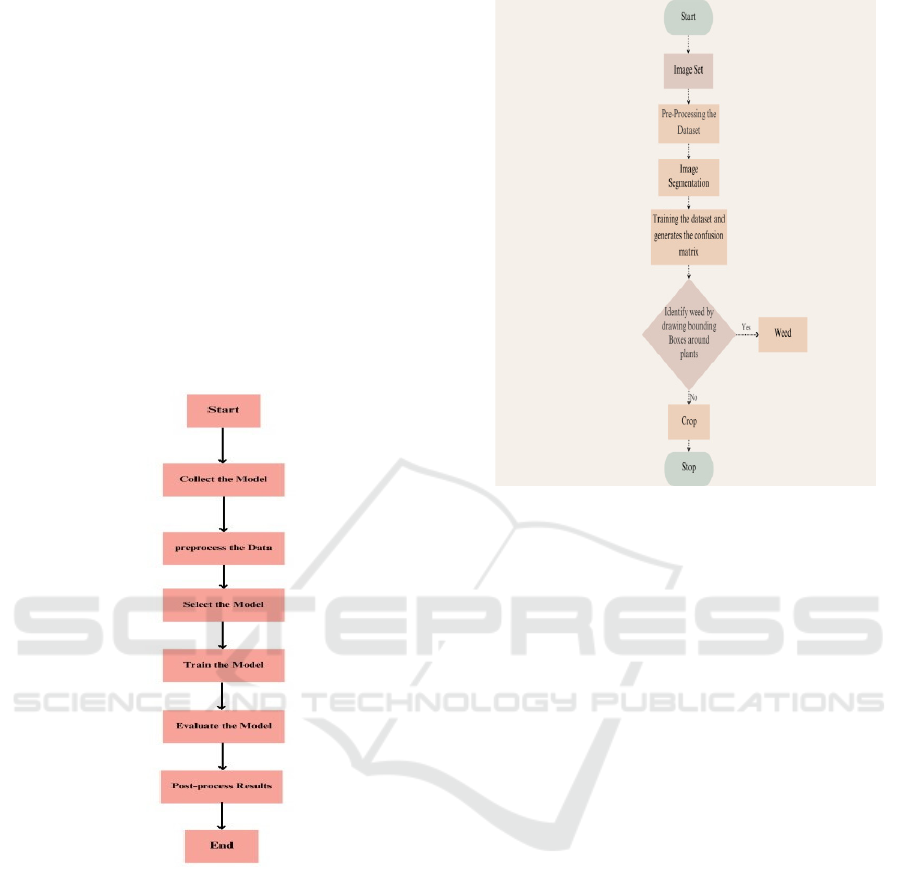
As shown if figure 2 below the Disease
Classification Module categorizes millet diseases
(Leaf Spot, Rust, Downy Mildew, Blight) using crop
images. It involves dataset collection, pre-processing
(resizing, normalization, augmentation), and model
selection (pre-trained CNNs like ResNet, VGG16, or
custom models). Feature extraction captures color,
texture, and edge patterns. Model training optimizes
performance using categorical cross-entropy and the
Adam optimizer, while evaluation relies on accuracy,
precision, recall, and F1-score. Post-processing
assigns labels based on probability thresholds and
visualizes results. The workflow follows dataset
collection, preprocessing, model selection, training,
evaluation, and result visualization for accurate
disease identification.
Figure 2: Disease Classification.
As shown if figure 3 The Weed Detection Module
automates weed identification in Pearl millet, Finger
millet, and Sorghum millet fields, improving crop
management. It collects images from drones,
smartphones, and cameras, supplemented with open-
source datasets. Preprocessing includes resizing
(224x224 pixels), noise reduction, brightness
adjustments, and data augmentation. The system uses
U-Net/Mask R-CNN for segmentation and CNN
models like ResNet, MobileNet for classification,
with transfer learning for better accuracy. The dataset
is split (70% training, 20% validation, 10% testing),
optimized using Adam, and evaluated with IoU, Dice
Coefficient, Precision, Recall, and F1-Score.
Figure 3: Weed Detection.
3.1 Components
3.1.1 Image Acquisition & Preprocessing
Components Used:
• Digital Camera / Smartphone / Web
Scraping (for collecting images).
• Image Dataset (124 images of diseased &
healthy millet).
• OpenCV / PIL (for image processing).
Functions:
• Capture and store images of healthy and
diseased millet crops.
• Resize images to 150×150 px for input into
the CNN.
• Convert images to RGB format if required.
3.1.2 Data Augmentation
Components Used:
• Keras Image Data Generator
• NumPy, OpenCV
Techniques Applied:
• Rotation (Randomly rotating images).
Disease Identification & Classification in Millet Crops Using ML Techniques
331

• Flipping (Horizontal & Vertical).
• Zooming (Rescaling images).
• Brightness Variation (Simulating real-world
lighting).
Purpose:
• Increase dataset size (from 124 to 711
images).
• Reduce overfitting.
3.1.3 Transfer Learning with VGG16
Components Used:
• VGG16 Pre-Trained Model (Keras /
TensorFlow)
• Feature Extraction Layers (Convolutional &
Pooling layers).
Function:
• Freeze the initial layers of VGG16 to retain
learned features.
• Extract features from input images to detect
disease patterns.
3.1.4 Fully Connected Layers (Custom
Classification Head)
Components Used:
• Dense Layers (Fully Connected Layers)
• Dropout Layer (To prevent overfitting)
• Activation Functions: ReLU & Sigmoid
Structure:
• Two fully connected layers added on top of
VGG16.
• Final Layer: Sigmoid Activation → Binary
Classification (Healthy / Diseased).
3.1.5 Model Training & Optimization
Components Used:
• Optimizer: Stochastic Gradient Descent
(SGD) with Momentum (0.9)
• Loss Function: Binary Crossentropy
• Early Stopping (To prevent overfitting).
• 80-20 Split (Training & Validation).
Training Configuration:
• Learning Rate: 1e-4
• Epochs: 30 (Early stopping applied).
3.1.6 Disease Classification & Prediction
Components Used:
• Trained CNN Model
• Softmax / Sigmoid Activation for
Classification
• Performance Metrics: Accuracy, Precision,
Recall, F1-Score
Function:
• Input: New millet leaf image.
• Processing: Feature extraction &
classification.
• Output: Healthy or Mildew-Affected (with
95% accuracy).
4 FUTURE SCOPE
• The future of this model holds great
potential for smart agriculture. It can be
expanded to detect multiple diseases in
millet crops like finger millet, sorghum,
and foxtail millet, as well as wheat, rice,
and maize.
• Integrating it into mobile apps and IoT
devices will allow farmers to snap pictures
for instant disease detection, making it
accessible and affordable.
• Using advanced deep learning models like
Efficient Net and Vision Transformers will
improve accuracy, while segmentation
techniques (U-Net, Mask R-CNN) can
help classify disease severity.
• Drones and remote sensing can be used for
large-scale farm monitoring, optimizing
pesticide use and resource management.
• Adding multi-language support will make
it easier for farmers worldwide, and fine-
tuning for regional diseases will improve
effectiveness.
• This AI-driven approach will help farmers
detect diseases early, boost crop yields,
and ensure sustainability, ultimately
contributing to global food security.
ICRDICCT‘25 2025 - INTERNATIONAL CONFERENCE ON RESEARCH AND DEVELOPMENT IN INFORMATION,
COMMUNICATION, AND COMPUTING TECHNOLOGIES
332

5 CONCLUSIONS
This project offers an integrated solution for millet
farming by combining disease detection and weed
identification into a single platform. Leveraging
VGG16 and state-of-the-art ML techniques ensures
high accuracy and efficiency, addressing the
limitations of traditional methods. The deployable
system promises to enhance millet productivity,
reduce losses, and promote sustainable farming
practices. Future work could include extending the
model to additional crops and incorporating IoT-
based monitoring for continuous field data collection.
ACKNOWLEDGEMENTS
We would like to profoundly express sincere
gratitude to the ABES Institute of Technology,
Ghaziabad for their significant support, which
essentially made this really important research
possible. We also extend our deepest appreciation to
Dr. Upasana Pandey and Ms. Meena Kumari for their
extremely valuable guidance and insights throughout
this awesome project Finally, but certainly, not least,
we give thanks to all the wonderful participants who
kindly volunteered their precious time and expertise
for data collection and testing, without whom this
groundbreaking research would maybe not have been
even a little bit feasible.
REFERENCES
Bita Parga Zen, Iqsyahiro Kresna A, Diandra Chika
Fransisca, Applications for Detecting Plant Diseases
Based on Artificial Intelligence, Volume 6, Number 4,
October 2022.
https://doi.org/10.33395/sinkron.v7i4.11833
Habib Khan, Ijaz Ul Haq, Muhammad Munsif, Mustaqeem,
Shafi Ullah Khan and Mi Young Lee, Automated
Wheat Diseases Classification Framework Using
Advanced Machine Learning Technique, Agriculture
2022, 12(8).
https://doi.org/10.3390/agriculture12081226
I Johnson, X Anitha Mary, A Peniel Winifred Raj, J
Chalmers, M Karthikeyan and Andrew J, Deep-millet:
a deep learning model for pearl millet disease
identification to envisage precision agriculture– a
review, Environ. Res.Commun.6(2024)105031.
https://doi.org/10.1088/2515-7620/ad8415
K. Sai Susheel, R. Rajkumar, A Comprehensive Review on
Intelligent Techniques in Crop Pests and Diseases,
IJRITCC | September 2023.
https://doi.org/10.17762/ijritcc.v11i9.8328
Md. Ashraful Haque, Sudeep Marwaha, Chandan Kumar
Deb, Sapna Nigam, Alka Arora, Karambir Singh
Hooda, P. Lakshmi Soujanya, Sumit Kumar Aggarwal,
Brejesh Lall, Mukesh Kumar, Shahnawazul Islam,
Mohit Panwar, Prabhat Kumar & R. C.Agrawal, Deep
learning‑based approach for identifcation of diseases of
maize crop, (2022) 12:6334.
https://doi.org/10.1038/s41598-022-10140-z
Md. Mehedi Hasan, A F M Shahab Uddin, Mostafijur
Rahman Akhond, Md. Jashim Uddin, Md. Alamgir
Hossain 2 and Md. Alam Hossain 1, Machine Learning
and Image Processing Techniques for Rice Disease
Detection: A Critical Analysis, 2023, Int. J. Plant Biol.
2023, 14, 1190– 1207.
https://doi.org/10.3390/ijpb14040087
Mohamed Salama, Ali Retha Hasoon, Mohamed K Zidan,
Sarah M. Ayyad, Role of AI for Plant Disease Detection
and Pest Detection, 22- 25 July 2024.
https://doi.org/10.1109/ITC-
Egypt61547.2024.10620496
Mr. Rushikesh Pawar, Mr. Rushikesh Awatade , Mr. Omkar
Shedge , Mr. Saif Shaikh, Crop Leaf Disease Prediction
Using Machine Learning, 2024, IJSREM.
https://doi.org/10.55041/IJSREM30693
Muhammad Hammad Saleem, Johan Potgieter and Khalid
Mahmood Arif, Plant Disease Detection and
Classification by Deep Learning, Plants 2019, 8, 468.
http://dx.doi.org/10.3390/plants8110468
Nidhi Kundu, Geeta Rani 1, Vijaypal Singh Dhaka, Kalpit
Gupta, Siddaiah Chandra Nayak, Sahil Verma,
Muhammad Fazal Ijaz and Marcin Wozniak, IoT and
Interpretable Machine Learning Based Framework for
Disease Prediction in Pearl Millet, Sensors 2021, 21,
5386. https://doi.org/10.3390/s21165386
Nivargi Anil Basavant, Gururaj V, Kavya N L, Crop
Prediction Analysis and Plant Disease Detection Using
Machine Learning, Volume 6, Issue 3, May-June 2024.
https://doi.org/10.36948/ijfmr.2024.v06i03.20123
Payam Delfani, Vishnukiran Thuraga, Bikram Banerjee,
Aakash Chawade, Integrative approaches in modern
agriculture: IoT, ML and AI for disease forecasting
amidst climate change, The Author(s) 2024.
https://doi.org/10.1007/s11119-024-10164-7
Philomine Roseline, Clarence J M Tauro, N Ganesan, PhD,
Design and Development of Fuzzy Expert System for
Integrated Disease Management in Finger Millets,
Volume 56– No.1, October 2012.
https://doi.org/10.5120/8857-2815
Riya Walia, Dr. Satender kumar, Advancing Sugarcane
Disease Detection through CNN-Based Deep Learning,
International Journal of Membrane Science and
Technology, 2023, Vol.10, No. 1, pp1851-1861.
https://doi.org/10.15379/ijmst.v10i1.3501
Sana Akbar, Dr. Khawaja Tehseen Ahmad, Muhammad
Kamran Abid, Dr. Naeem Aslam, Wheat Disease
Detection for Yield Management Using IoT and Deep
Learning Techniques, Volume 10, Number 3, July-
September 2022.
https://doi.org/10.21015/vtse.v10i3.1108
Disease Identification & Classification in Millet Crops Using ML Techniques
333

Sanika kadam, Priya Kadam, Rutuja Karvekar, Rutuja
Mohite, AI Based Soybean Crop Disease Detection,
2024, IJSREM.
https://doi.org/10.55041/IJSREM34409
Solemane Coulibaly, Bernard Kamsu-Foguem, Dantouma
Kamissoko, Daouda Traore, Deep neural networks with
transfer learning in millet crop images, S.Coulibaly et
al./ Computers in Industry 108 (2019) 115–120.
https://doi.org/10.1016/j.compind.2019.02.003
Sushruta Mishra, Dayal Rohan Volety, Navdeep Bohra,
Sultan Alfarhood, Mejdl Safran, A smart and
sustainable framework or millet crop monitoring
equipped with disease detection using enhanced
predictive intelligence– a review, Alexandria Enginee-
ring Journal 83 (2023) 298– 306.
https://doi.org/10.1016/j.aej.2023.10.041
Tiago Domingues, Tomás Brandão and João C. Ferreir,
Machine Learning for Detection and Prediction of Crop
Diseases and Pests: A Comprehensive Survey, Agricu-
lture 2022, 12, 1350. https://doi.org/10.3390/agricultu-
re12091350
Wanjie Feng, Pengfei Gao, Xutong Wang, AI breeder:
Genomic predictions for crop breeding, New Crops 1
(2024) 100010.
https://doi.org/10.1016/j.ncrops.2023.12.005
ICRDICCT‘25 2025 - INTERNATIONAL CONFERENCE ON RESEARCH AND DEVELOPMENT IN INFORMATION,
COMMUNICATION, AND COMPUTING TECHNOLOGIES
334
