
The Future Role of Environmental Performance Green Human
Resource Career Data Development
Pushpalatha S. and R. Duraipandian
Saveetha School of Management, Saveetha Institute of Medical and Technical Sciences , Saveetha University, Chennai,
Tamil Nadu, India
Keywords: Collaboration, Career Development, GHRM, Environmental, Organizational Culture, Sustainable Workforce.
Abstract: The offering environmental awareness training to staff members is a component of green career development.
If an organization recognizes and evaluates its employees' environmental training needs in order to build the
requisite knowledge and skills and to constantly enhance its training and development initiatives on eco-
friendly practices, it is engaging in green career development. Organizational excellence and green career
development are most strongly correlated according to the author, companies consider their employees'
environmental training needs in order to increase their concern for environmental issues. The study
emphasizes how important green career development is for environmental performance. Likewise, affirm a
strong link between environmental performance and green career development, highlighting its function in
promoting the learning of sustainable practices-related skills and knowledge. This idea is supported by
highlights that green career development enables people to build proficiency in eco-friendly technologies and
processes, improving environmental performance. According to a different study by green career development
helps to increase environmental performance in addition to encouraging innovation and research in
environmental sustainability. The company should reward and publicly recognize the staff members who take
use of the green benefits offered by the company. The organization's stakeholders should all be informed
about the advantages of being green. The local population and community should also be informed of this
information. For a firm to achieve its "green goals," the HR team must involve every employee. Only with
full collaboration from the organization's stakeholders, employees, and top executives will Green HRM be
able to be implemented successfully. The future of green human resource management is bright, and it will
play a significant part in lowering employee carbon emissions for sustainable growth.
1 INTRODUCTION
Accordingly, green career development promotes
innovation, a decrease in environmental effect, and a
general dedication to environmental responsibility
while bringing people and organizations into line with
sustainable practices (Preeti et al., 2024) Therefore,
the following theory is put forth Environmental
performance and green career growth are significantly
correlated (O. A. Diaz Triana et al., 2024)
Environmental performance and green performance
evaluation when performance evaluations incorporate
green performance indicators, this is known as "green
performance appraisal.When a business establishes
ecologically friendly objectives and duties and
penalizes infractions of environmental management
goals, it is engaging in green performance appraisal.
Performance reviews have the least influence on
organizational excellence, according to research,
although there was a positive and substantial
association. The impact of green performance
appraisal on employee performance was also studied
who came to the conclusion that increasing the
timeliness of green performance appraisals is a top
priority in order to boost employee performance (Z.
Yutian and W. Lu 2022) The green performance
reviews provide a forum for encouraging staff
members to work together in the direction of
sustainability.
Accordingly, green performance reviews are a
strategic instrument for encouraging and bolstering
ecologically friendly behavior among staff members.
Organizations can promote a sustainable culture,
encourage constructive behavioural change, and
eventually help to enhance environmental
performance by tying individual performance to
292
S., P. and Duraipandian, R.
The Future Role of Environmental Performance Green Human Resource Career Data Development.
DOI: 10.5220/0013896900004919
Paper published under CC license (CC BY-NC-ND 4.0)
In Proceedings of the 1st International Conference on Research and Development in Information, Communication, and Computing Technologies (ICRDICCT‘25 2025) - Volume 3, pages
292-297
ISBN: 978-989-758-777-1
Proceedings Copyright © 2025 by SCITEPRESS – Science and Technology Publications, Lda.
environmental goals (R. P. Devi 2024) The study
therefore postulated that eenvironmental performance
and green performance evaluation are significantly
correlated. performance in the environment and the
green reward system.
2 RELATED WORK
This relationship is explained by the system's capacity
to empower workers and cultivate a greater awareness
of their personal and professional ecological effect.
According to establishing a green reward system
actively supports the development of a sustainable
workplace culture (Y. Lu.2022) In a similar vein,
provide proof that a green incentive scheme is a key
factor in determining environmental performance.
This supports the idea that such a system is essential
in promoting a more extensive operational and
cultural change toward sustainability within a firm, in
addition to recognizing and rewarding good
environmental practices (W. Shi et al., 2024) Thus, the
following hypothesis is put forth environmental
performance and green incentive systems are
significantly correlated.
2.1 Employees
Environmental performance and green participation
green participation entails giving workers the
authority to decide on environmental matters, suggest
enhancements for environmental sustainability, and
value their contributions the direct effect of green
employee involvement methods on environmental
performance was substantiated in the study. The green
participation empowers workers by allowing them
both to all work together to improve environmental
performance (Y. Nakaya and S. Ishida 2023).
A significant decrease in resource consumption
and environmental impact results from encouraging a
large number of employees to adopt sustainable
practices. Similarly, green participation serves as a
road map for attaining environmental performance,
According to this viewpoint, offer proof that green
participation encourages resource efficiency, which
lowers energy use, minimizes waste, and conserves
water. This makes a substantial contribution to
sustainability and resource conservation in general.
According to environmental performance and green
participation are directly correlated (T. Khallouk
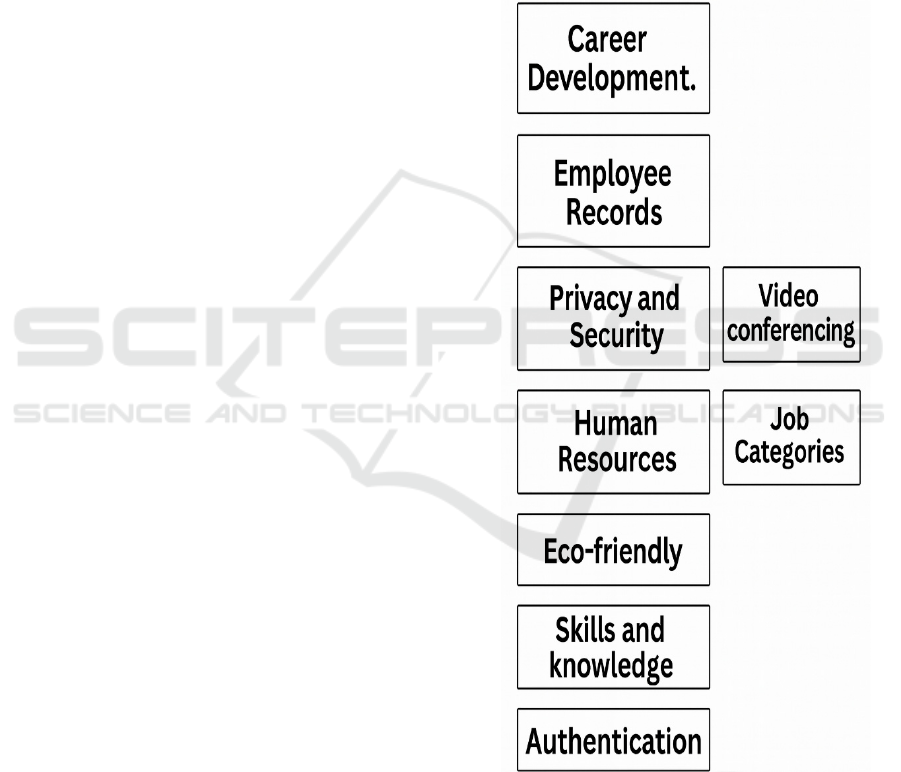
Yassine and A. Said 2023) The figure 1 green
involvement is also a reliable indicator of
environmental success.
2.2 Environmental Success
Additionally, reiterate that green participation serves
as a platform for including staff members in
environmentally friendly projects (V. R. Houndji and
K. B. Selegbe 2023). Their happiness and general
well-being are subsequently enhanced by this
involvement, which is consistent with the objectives
of positive environmental performance (K. B. Azzou
and H. Talei 2024). Thus, it is suggested that
environmental performance and green engagement are
significantly correlated (D.A. Kumari et al., 2024).
Figure 1: Block Diagram.
The mediating role of organizational culture one
important factor that affects the workplace, helps
people understand how businesses operate, and
establishes standards for performance within the
company is organizational culture (OC) is a set of
common beliefs, customs, conventions, and values
The Future Role of Environmental Performance Green Human Resource Career Data Development
293

that help people understand how businesses operate to
achieve environmental sustainability according to
earlier empirical research, OC can be used to influence
people's attitudes, behaviors, and interactions in a
green setting, hence promoting environmental
sustainability .
EP is established by existing research pointed out
that OC provides management with a basis for
understanding the collective values, beliefs, and
norms that impact the environmentally aware actions
of potential candidates. The empirically demonstrate
that OC, GRS, and EP are positively correlated (M.
Ramu et al., 2024). The confirm a substantial
correlation between EP, GRS, and OC in another
investigation. Similarly, finds that OC is positively
correlated with both GRS and EP (M. Ramu et al.,
2024). Similarly, earlier research has shown
empirically that OC acts as a powerful mediator
between GRS and EP .
3 PROPOSED METHODOLOGY
The Green hiring and selection practices and
environmental performance are mediated by
organizational culture. Organizational culture's
mediating role in environmental performance and
green career development (L. Hu and B. Fang 2022).
A substantial correlation between OC, GCD, and EP
has been confirmed by theoretical studies. The moral
foundations theory, for example, contends that
individual traits like beliefs, norms and values, and
sociodemographics are linked to employees' green
behavior (Z. Dong 2024). The moral foundations
theory shows that a green environment is linked to
harm/care and purity/sanctity (R. Khurana et al.,
2023). The green career development indirectly
affects environmental performance through the
mediation of organizational culture (OC), and moral
enthusiasm for the green environment among
employees is linked to sustainability (S. Amberkar et
al., 2023). The highlights how important green career
development is to achieving environmental
performance, especially in the context of OC (R.
SAKURAI and T. WATANABE (2020). The
significance of green career development for people
with eco-friendly cultures is also confirmed a crucial
component for enhancing environmental performance
(H. AL-Qassem et al., 2023). The association between
environmental performance and involvement is
mediated by organizational culture (M. Nirmala et al.,
2023). All senior managers and staff members
employed by food and beverage enterprises in
Southwest India make up the research population (J.
Chen 2023). These businesses were chosen because of
their Southwest indian locations and because it was
thought that they had similar GHRM practices and OC
policies that raise knowledge of environmental
sustainability. The study's sample size of respondents
was established using the formula proposed by Taro
Yamane, which is detailed below the study's
population consisted of managers and employees.
Because they are expected to have a deep
awareness of the topic, respondents were chosen based
on their direct responsibility for HRM practices. The
researchers, with the help of two research assistants,
distributed the questionnaires to study volunteers.
With the successful retrieval of all distributed
questionnaires, the response rate was 100%. The pre-
discussion with managers, which emphasized the
importance of the study and gained their approval
prior to distributing the questionnaires, may have
contributed to this high response rate. The overall
response rate was also influenced by the research
assistants' assistance in elucidating any ambiguities.
The dedication was the main focus of earlier
research, but this study adopts a more thorough
approach by looking into employees' wider
organizational commitment and a possible boundary
condition. We propose that pro environmental conduct
and affective organizational commitment are related
to employees' views of green HRM and their
convictions about its validity. According to vignette
experiment results, these impacts are more
pronounced when people view green HRM as genuine
rather than fake. These results are further supported by
a later time-lag field survey study, which contends that
green HRM encourages pro-environmental behavior,
which subsequently influences affective
organizational commitment. Employees who believe
in authenticity more strongly exhibit this indirect
relationship. These findings provide fresh
perspectives on how green HRM may foster
dedication to the company and the environment,
emphasizing how crucial it is to embrace this position
in an authentic way.
The more emphasis is now placed on the proper
management of natural resources when hiring new
staff members and promoting existing ones. Employee
training and development programs include climate
awareness and encouraging eco-friendly behavior on
their agenda. Supervisors must formally assess if their
staff members are meeting ecological goals and
advocate for green ideals. By giving them a bonus or
letting them play a key role in implementing their
suggestions, the HRM department actively
encourages staff members to share their thoughts on
how to have a net-zero climate effect.
ICRDICCT‘25 2025 - INTERNATIONAL CONFERENCE ON RESEARCH AND DEVELOPMENT IN INFORMATION,
COMMUNICATION, AND COMPUTING TECHNOLOGIES
294
4 RESULT AND ANALYSIS
The data used in this study came from a variety of
secondary data sources. The information is derived
from a variety of research publications that are
accessible on their websites or reports. Additionally,
the information was gathered from journals, research
papers, etc. The advancement Of Green HRM A green
workforce that comprehends, values, and participates
in green activities across the company is created
through the application of green HRM principles. By
upholding its green goals throughout the whole HR
process from hiring and training staff to paying them
the Green Workforce contributes to the advancement
of the company's human capital.
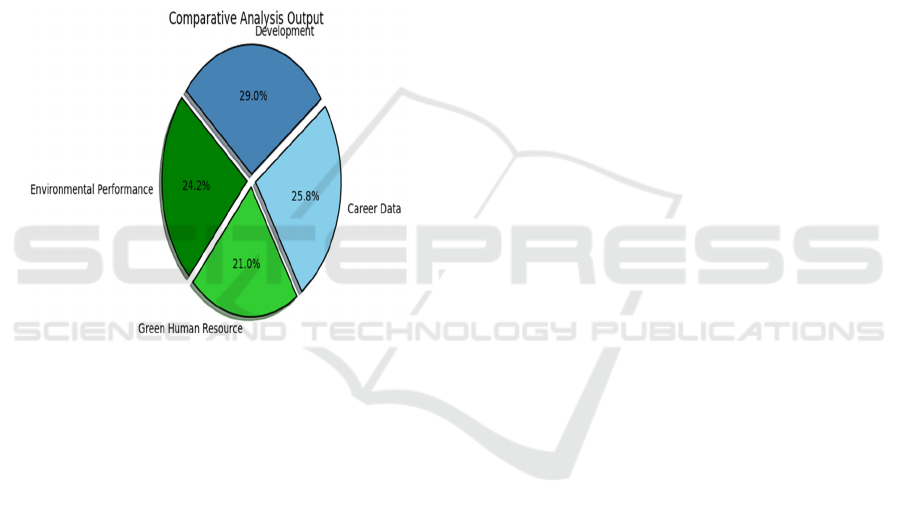
Figure 2: Comparative Analysis Output.
In figure 2 order to reduce travel requirements,
green HRM practices involve using video recruiting
approaches, such as conducting online interviews via
Skype or video conferencing Putting the Best Green
HR Practices into Practice As an approach The
primary benefit of green HRM is lowering employees'
carbon footprints within the company. It also aids in
the organization's ability to retain personnel. It entails
implementing eco-friendly HR procedures that
improve employee engagement and reduce
organizational expenses.
5 FUTURE WORK
The hiring procedure resumes can now be submitted
online through the business website. Candidates may
use the internet to look for jobs, and companies may
ask them to upload their resumes to their website. This
will significantly lessen the needless waste that comes
from printing and mailing resumes. With the
introduction of new and sophisticated technologies,
the HR staff may use an organization's website to
recruit new applicants and to receive their resumes and
supporting documentation. Offer letters and
acceptance letters can also be issued by email, among
other channels. It is possible to do the entire hiring and
selection process online, which will drastically cut
down on the amount of paper, stationery, and other
supplies used by the company.
6 CONCLUSIONS
The company must create awareness campaigns to
inform staff members about its green goals and
actions.Customers ought to be taught various
techniques for fostering a more environmentally
friendly atmosphere. Additionally, being green will
help businesses maintain their investment base and
client base. It will assist the company in preserving its
market share and improving its environmental
friendliness and efficiency. Digitalization will support
the organization's transition to a paperless
workplace.To raise awareness among employees,
employers, and society at large, conferences,
workshops, and training programs may be planned.
The HR department may encourage staff members to
embrace "Green initiatives" in their homes and
communities. In order to encourage "green behavior"
on the workplace grounds, the staff may also be
observed.
REFERENCES
D. A. Kumari, I. A. Karim Shaikh, S. Gangadharan, P. B.
Narendra Kiran, S. R. Ramya and A. S. Nargunde,
"Machine Learning for Diversity and Inclusion:
Addressing Biases in HR Practices," 2024 5th
International Conference on Recent Trends in
Computer Science and Technology (ICRTCST),
Jamshedpur, India, 2024, pp. 182-187, doi:
10.1109/ICRTCST61793.2024.10578442.
doi: 10.1109/ICMNWC56175.2022.10031950.
doi: 10.1109/ICIRCA54612.2022.9985629.
doi: 10.1109/ICBATS57792.2023.10111172.
doi: 10.1109/IEEM58616.2023.10406561.
doi: 10.1109/AmITIC62658.2024.10747646.
doi: 10.1109/ISCTIS63324.2024.10699177.
doi: 10.1109/ICPECTS62210.2024.10780054.
H. AL-Qassem, K. Agha, M. Vij, H. Elrehail and R.
Agarwal, "Leading Talent Management: Empirical
investigation on Applicant Tracking System (ATS) on
e-Recruitment Performance," 2023 International
The Future Role of Environmental Performance Green Human Resource Career Data Development
295

Conference on Business Analytics for Technology and
Security (ICBATS), Dubai, United Arab Emirates,
2023, pp. 1-5.
J. Chen, "A B/S Architecture Based Evaluation System for
College Student Employment Planning," 2023 3rd
International Conference on Mobile Networks and
Wireless Communications (ICMNWC), Tumkur, India,
2023, pp. 1.11, doi: 10.1109/ICMNWC60182.2023.1
0435806.
K. B. Azzou and H. Talei, "A Machine Learning Approach
for Automated CV Data Analysis and Job Profile
Identification," 2024 Sixth International Conference on
Intelligent Computing in Data Sciences (ICDS),
Marrakech, Morocco, 2024, pp. 1-7, doi:
10.1109/ICDS62089.2024.10756435.
L. Hu and B. Fang, "Analysis of Regional Talent Demand
based on Recruitment Website Text Mining," 2022 9th
International Conference on Dependable Systems and
Their Applications (DSA), Wulumuqi, China, 2022, pp.
887-892, doi: 10.1109/DSA56465.2022.00125.
M. Nirmala, B. Rajalakshmi, S. Mandava, S. R. M.
Sarvepally and M. Megana, "Survey on Personality
Detection for Recruitment," 2023 International Confe-
rence for Advancement in Technology (ICONAT),
Goa, India, 2023, pp. 1- 5, doi: 10.1109/ICONAT571
37.2023.10080507.
M. Ramu, T. Ilakkiya, P. Venkatesh, R. S. Anantharajan, K.
M and C. R. Senthilnathan, "Understanding The Scope
Of Artificial Intelligence In HR Technology E-
Recruitment – A Theoretical Perspective," 2024
International Conference on Power, Energy, Control
and Transmission Systems (ICPECTS), Chennai,
India, 2024, pp. 1-5.
N. Gangoda, K. P. Yasantha, C. Sewwandi, N. Induvara, S.
Thelijjagoda and N. Giguruwa, "Resume Ranker: AI-
Based Skill Analysis and Skill Matching System," 2024
Sixth International Conference on Intelligent
Computing in Data Sciences (ICDS), Marrakech,
Morocco, 2024, pp. 1-8, doi:
10.1109/ICDS62089.2024.10756304.
O. A. Diaz Triana, F. Gutierrez Portela, F. A. Reina, E.
Catherine Oviedo Barbosa and G. R. Higuera,
"Utilization of Data Governance as Support for Quality
Assurance in the Systems Engineering Program at the
Universidad Cooperativa de Colombia, Ibagué Espinal
Campus," 2024 IEEE VII Congreso Internacional en
Inteligencia Ambiental, Ingeniería de Software y Salud
Electrónica y Móvil (AmITIC),
David, Panama, 2024, pp. 1-7.
Preeti, S. Patil, R. M. Lenka, D. Sandhya, M. Lourens and
M. K. Chakravarthi, "Enhancing Workplace Efficiency
with The Implementation of the Internet of Things to
Advance Human Resource Management
Practices," 2024 International Conference on Trends in
Quantum Computing and Emerging Business
Technologies, Pune, India, 2024, pp. 1-5, doi:
10.1109/TQCEBT59414.2024.10545155.
R. SAKURAI and T. WATANABE, "Grit as a Determinant
of Success in the Teacher Recruitment
Examination," 2020 9th International Congress on
Advanced Applied Informatics (IIAI-AAI),
Kitakyushu, Japan, 2020, pp. 341-346, doi:
10.1109/IIAI-AAI50415.2020.00076.
R. Khurana, M. Yadav, M. Quttainah, A. P. Srivastava, A.
Balodi and P. K. Singh, "Neural Networks in
Recruitment: Trends and Future Directions," 2023
International Conference on Ambient Intelligence,
Knowledge Informatics and Industrial Electronics
(AIKIIE), Ballari, India, 2023, pp. 1-5, doi:
10.1109/AIKIIE60097.2023.10390017.
R. P. Devi, P. Neeraja, V. K. Ajay, A. N. Raj, D. V. L.
Reddy and G. Ramachandran, "Analysis of Artificial
Intelligence Hybrid Security Cloud System Intelligent
Technology and its Applications," 2024 4th
International Conference on Soft Computing for
Security Applications (ICSCSA), Salem, India, 2024,
pp. 506-509, doi: 10.1109/ICSCSA64454.2024.00087.
S. Amberkar, S. Chandorkar, M. Dalvi, A. Gawand and M.
Cherian, "Survey on Virtual Recruitment
System," 2023 5th Biennial International Conference
on Nascent Technologies in Engineering (ICNTE),
Navi Mumbai, India, 2023, pp. 1-5, doi:
10.1109/ICNTE56631.2023.10146637.
T. Khallouk Yassine and A. Said, "Implementing AI in
HRM: Leveraging Machine Learning for Smart
Recruitment Systems," 2023 IEEE International
Conference on Technology Management, Operations
and Decisions (ICTMOD), Rabat, Morocco, 2023, pp.
1-11, doi: 10.1109/ICTMOD59086.2023.10472910.
V. R. Houndji and K. B. Selegbe, "C-Elect, An Automatic
Candidate Selection Tool Using Constraint
Programming," 2023 International Conference on
Electrical, Computer and Energy Technologies
(ICECET), Cape Town, South Africa, 2023, pp. 1-4,
doi: 10.1109/ICECET58911.2023.10389290.
W. Shi, Q. Deng, Z. Li, S. Long, H. Liu and X. Pang,
"Location and Bid Privacy Preserving-Based Quality-
Aware Worker Recruitment Scheme in MCS," in IEEE
Internet of Things Journal, vol. 11, no. 12, pp. 21841-
21856, 15 June15, 2024, doi:
10.1109/JIOT.2024.3376799.
Y. Lu, "Network Dynamic Communication of Recruitment
Channels in Expanding Talent Introduction in Colleges
based on Intelligent Information Mining and Push
Algorithm," 2022 4th International Conference on
Inventive Research in Computing Applications
(ICIRCA), Coimbatore, India, 2022, pp. 1027-1030.
Y. Nakaya and S. Ishida, "Utilizing Deep Learning for
Semi-Automatic Conversation Analysis During
Recruitment and Employee Education in the Seed
Phase of High-Tech Startups," 2023 IEEE International
Conference on Industrial Engineering and Engineering
Management (IEEM), Singapore,
Singapore, 2023, pp. 1073-1077.
Z. Yutian and W. Lu, "Application of Data Mining in
Human Resource Management in Colleges and
Universities," 2022 IEEE 2nd International Conference
on Mobile Networks and Wireless Communications
(ICMNWC), Tumkur, Karnataka, India, 2022, pp. 1-5.
ICRDICCT‘25 2025 - INTERNATIONAL CONFERENCE ON RESEARCH AND DEVELOPMENT IN INFORMATION,
COMMUNICATION, AND COMPUTING TECHNOLOGIES
296

Z. Dong, B. Meng and S. Qiu, "Design of a Recruitment
Mini-Program Based on Blockchain and Item-based
Collaborative Filtering Algorithm," 2024 4th
International Symposium on Computer Technology
and Information Science (ISCTIS), Xi’an, China,
2024, pp. 282-285.
The Future Role of Environmental Performance Green Human Resource Career Data Development
297
