
Governance‑Centric Framework for Trustworthy and Ethical
Autonomous Decision‑Making in Organizational Systems
Savita Arya , Bharadwaja K. , Lavanya Addepalli , Vidya Sagar S. D. ,
Jaime Lloret and Bhavsingh Maloth
St. Joseph's Degree and PG College, Hyderabad, Telangana, India
Keywords: Corporate Governance‑Aware AI, Ethical Decision‑Making, Trust Modelling, Explainable AI, Autonomous
Systems, Responsible AI Deployment.
Abstract: Organizations rapidly adopting autonomous decision-making systems, ethical alignment with stakeholders,
the building of trust and compliance through governance has become an increasingly important challenge. In
this paper we proffer the GRAID Framework (Governance-Risk-Aligned Intelligent Decisioning), a novel,
multi-layered architecture which inter alia, brings together the AI decision making with rules of form
governance, ethical constraints and trust modelling. A multi objective loss function is proposed, that penalizes
ethical violations, governance risks, and trust deviations in real time and combined with a proposed constraint‐
aware neural learning that will be careful of constraint violations. To validate the framework, we developed
a comprehensive synthetic dataset that simulates enterprise decisions in the HR, finance and procurement
domains. Results from experiments show while GRAID has similarly competitive accuracy (81.5%), it
outperforms base models, i.e. Logistic Regression and Decision Trees in ethical compliance (+19.7%),
governance risk reduction (−59.1%) and stakeholder trust (+36.9%). The results of these findings show that
GRAID is a strong and ethical AI solution for enterprise level autonomy in regulated environments.
1 INTRODUCTION
Artificial intelligence and machine learning systems
are increasingly becoming the part of business
decision making process making several of the
business functions in the domains of human
resources, finance and procurement are automated
[1,2]. While these systems can enhance efficiency
and scalability, they often operate as "black boxes,"
lacking transparency, explainability, and
accountability [3]. In those cases, where decisions
require compliance with legal, ethical, and
organizational standards, there is a wide concern
about this [4,5].
In particular, failures of AI for hiring, lending and
risk assessment over the last several years have
highlighted the importance of frameworks not only
for optimizing performance but also for holding
principles of ethics and following policies of
governance [6-9].
1.1 Problem Statement
The prevailing AI models to date mainly aim to
maximize prediction accuracy, while missing
important aspects like fairness, reduction of biases,
privacy of data, transparency, and gaining confidence
of stakeholders [10-12]. In addition, these models run
in silos that are disconnected from organizational
governance structures that prohibit both the audit of
these models as well as alignment to changing
regulatory requirements. However, there are not
unified frameworks that allow AI to be integrated into
the enterprise governance and still maintain
adaptability and accountability in the decision
making [13-15].
1.2 Research Objective and
Contribution
In this paper, a novel AI framework is introduced,
Governance-Risk-Aligned Intelligent Decisioning
GRAID, specifically addressing the emerging
application area of AI based autonomous decisioning
184
Arya, S., K, B., Addepalli, L., S D, V. S., Lloret, J. and Maloth, B.
Governance-Centric Framework for Trustworthy and Ethical Autonomous Decision-Making in Organizational Systems.
DOI: 10.5220/0013893900004919
Paper published under CC license (CC BY-NC-ND 4.0)
In Proceedings of the 1st International Conference on Research and Development in Information, Communication, and Computing Technologies (ICRDICCT‘25 2025) - Volume 3, pages
184-192
ISBN: 978-989-758-777-1
Proceedings Copyright © 2025 by SCITEPRESS – Science and Technology Publications, Lda.

systems by embedding trust, ethics and governance
directly into them.
GRAID consists of a multi layered architecture that
specializes in stakeholder level trust modelling,
additional ethical constraint evaluation, governance
risk scoring, and decision engine built using a
constraint aware neural net.
To train the proposed system, a multi objective loss
function is proposed that penalizes ethical violation,
governance non-compliance and also trust mismatch
along with the traditional prediction error. The key
contributions of this paper are:
• Design of a governance-based decision
framework that constituents around AI ethics,
trust and compliance.
• A novel constraint-aware loss function for
ethical and risk-aware learning.
• A synthetic dataset that mimics the decision
making of the real world in enterprise space,
in almost all domains is created as pre-
existing datasets do not cover all the
dimensions and features needed for this
research.
• Comparative evaluation and popular standard
models to establish the strategies which use a
baseline model as a point of comparison and
demonstrate significant improvements in
trust, compliance and risk mitigation.
In the following sections of this paper, Section 2
explores related work in ethical AI and governance
aware modeling. In section 3, the system architecture
and the conceptual layers of the GRAID Framework
are discussed along with the mathematical
methodology and the custom model formulation, this
section also gives details of the Python based
implementation pipeline. In Section 4, we describe
experimental results and visual analysis, discuss
findings and, in Section 5, we present future research
directions.
2 RELATED WORKS
2.1 Ethics and Trust in AI Decision-
Making
Integration of ethical principles into artificial
intelligence, that is critical research area in particular
areas of decision making under high stakes. Due to
the emphasized need for fairness, accountability, and
transparency of machine learning (FAT-ML),
fairness-aware algorithms and XAI methods have
already been developed and adopted by scholars and
industry practitioners [16-18]. SHAP, LIME and
counterfactual reasoning have been proposed as
techniques to give post-hoc model behaviour
explanations [19,20]. These methods are usually
reactive in the sense that they provide transparency
only after the decision is made but in no way affect
the decision logic. Trust modelling in AI systems has
been researched, especially in the Multi agent system
and Human – AI collaboration contexts [21,22].
Though this studies usually define trust in terms of
probabilities or confidence, they do not take into
account stakeholder specific trust profile or evolving
organizational expectations.
2.2 AI Governance and Risk
Management
A few frameworks have been proposed to oversee
and assess AI systems through policy or risk. IBM AI
Governance Model and Deloitte’s Trustworthy AI™
Framework provide focus on setting up and policing
processes with the deployment of AI [23-25]. On the
other hand, though, the OECD AI Principles and EU
AI Act set high level policy guidelines but fail to
prescribe technical prescriptions of use for
operational integration (M. Veale and L. Edwards.,
2018). However, these approaches are mostly used as
external oversight mechanisms that are not part of the
AI's main decision logic.
Research issues like the ETHOS Framework
(Raji and J. Buolamwini., 2019) have been looked at
to identify decentralized and blockchain based
governance models and the rest propose ethical
scorecards or audit toolkits. Yet, such systems rarely
incorporate governance logic within the actual AI
model, and even fewer provide a combined approach
which combines governance, ethics, trust and
technical performance (P. Molnar., 2020) (N.
Mehrabi et al., 2022).
2.3 Multi-Objective AI and Constraint-
Aware Learning
Safety critical use of AI like autonomous driving,
diagnostics etc has applied multi objectives learning
and optimization under constraints. In some recent
works, a custom loss function is employed in order to
deal with trade-offs between performance and
interpretability (R. Sharma and B. Haralayya., 2025).
However, existing models rarely include ethical or
governance loss as a first-class loss component, nor
do they elastically respond to stakeholder feedback.
Governance-Centric Framework for Trustworthy and Ethical Autonomous Decision-Making in Organizational Systems
185
2.4 Research Gap and Motivation
A dark gap that is exposed: we observe that both
ethical AI (how to make AI ethical), governance
models (how to govern AI) and trust mechanisms
(how to build trust into AI), are being developed in
the literature, but are not integrated directly alongside
the decision-making pipeline of AI H. H. Samara et al.,
Typically, current solutions consider ethics or
governance as post-decision validations, rather than
as being part of the core constraints that guide a
decision in real time (N. Azoury and C. Hajj., 2025).
2.5 Novelty and Innovation of the
GRAID Framework
This work aims to fill this gap by introducing the
GRAID Framework (Governance-Risk-Aligned
Intelligent Decisioning)—a novel AI governance
framework for the governance of AI, which is
designed to integrate stakeholder trust modelling,
constraint enforcement based on ethical standards
and governance rule, into a unified and constraint
aware learning system. In contrast to other models,
GRAID presents a multi objective loss function that
boosts ethical policy costs, dangerousness costs
along with trust costs, finally instead just accuracy
maximization. In addition, it includes a feedback
adaptive layer which enables the system to self-
evolve in due course of time in response to
stakeholder evaluations. GRAID closes the gap
between intelligent capabilities and the
organization’s responsibility by embedding
explainability, adaptability, and compliance, directly
into the AI model. As such, it constitutes a powerful
and timely innovation for deployment of autonomous
systems in real world, regulated enterprise
environments.
3 METHODOLOGY
3.1 GRAID Framework: Governance-
Risk-Alignment for Intelligent
Decisioning
Multi layered mathematically grounded framework
for embedding the governance, ethical alignment,
stakeholder trust and risk sensitivity into the
Enterprise level autonomous decision-making
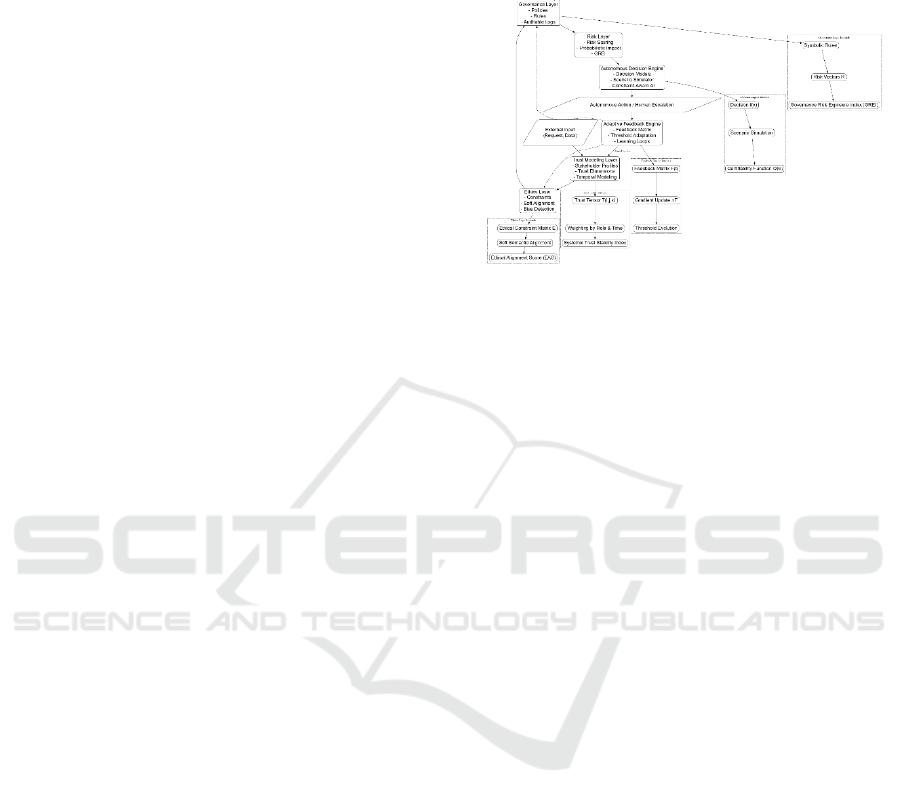
agents. In the following Figure 1, we present the
GRAID Framework as a five stage, layered
architecture based on organizational theory together
with AI system design and grounded with formal
mathematical structures to check the validity of
decisions before autonomous execution.
Figure 1: Graid Framework: Governance-Risk-Alignment
for Intelligent Decisioning.
3.1.1 Multi-Stakeholder Trust Function
Modelling (MTFM)
GRAID approaches the problem of trust modelling in
a manner that is different from the trust modelling
literature, as it introduces a tensor-based trust
function to model multi-dimensional trust vectors
between multiple participants of a system with role
awareness weightings that evolve over time.
Let:
be the trust tensor where:
: number of stakeholders
: number of trust attributes (explainability, bias,
reliability)
: time index (temporal trust variation)
Each element
represents the trust value of
stakeholder
for dimension
at time
.
We define a stakeholder's temporal aggregate trust
score:
(1)
where
is a recency weight (exponentially
decaying).
The Systemic Trust Stability Index (STSI):
(2)
where is a measure of trust variance across
stakeholders - lower values imply greater systemic
trust alignment.
ICRDICCT‘25 2025 - INTERNATIONAL CONFERENCE ON RESEARCH AND DEVELOPMENT IN INFORMATION,
COMMUNICATION, AND COMPUTING TECHNOLOGIES
186

3.1.2 Ethical Constraint Matrix &
Alignment Operator (ECMAO)
Ethical constraints are not hard coded as checks, but
rather as a dynamic matrix-based formulation
processed by means of a semantic alignment operator
operating on natural language embeddings and
symbolic rule systems.
Let:
be binary ethical compliance vector for a
decision
be a soft alignment vector derived from
semantic similarity between decision rationale and
ethical corpus
Define Ethical Alignment Score (EAS) as:
(3)
where
represents ethical criticality weighting (e.g.,
human rights > aesthetics).
A decision is ethically admissible if:
ethics
(4)
This allows dynamic, context-aware ethical
assessment rather than rigid binary checks.
3.1.3 Risk-Governance Compliance Model
(RGCM)
GRAID proposes hybrid symbolic probabilistic
governance. In addition to the passive enforcement of
governance rules, rules and targets are connected to
probabilistic risk vectors concomitant to
environmental uncertainty and risk of harm.
Let:
be symbolic governance rules
where
is risk severity if
is violated
Let
if rule
is violated; 0 otherwise
Define Governance Risk Exposure Index (GREI):
(4)
A decision is governance-compliant if:
(5)
This balances symbolic correctness with quantified
risk trade-offs.
3.1.4 Autonomous Decision Certifiability
Layer (ADCL)
GRAID prescribes a certifiability function that
holistically evaluates an autonomous decision with
respect to all dimensions (trust, ethics, governance,
risk), and produces a decision certification score.
Let:
be a decision instance
Let
sys
, EAS, GREI
Define a certifiability function :
(6)
where:
: normalization operator to
: dimension-specific confidence weights
A decision is certified for autonomous execution if:
cert
(7)
3.1.5 Adaptive Feedback and Evolution
Engine (AFEE)
It offers a feedback matrix learning system that learns
each layer on a meta feedback loop with user
response, policy change, and ethical change.
Let:
be the feedback matrix for trust
dimensions over time
Let
be the gradient-based trust update
Ethical weights and governance risks are
dynamically reweighted via feedback-proportional
reinforcement
All thresholds are subject to:
new
old
change
(8)
where
change
is normalized direction of user-policy-
feedback vectors.
3.2 Dataset Details
It contains 50 synthetic autonomous decision records
across domains such as, HR, finance and
procurement. The interpretable variables present in
each entry include applicant scores, financial risk
indices, policy alignment, etc., alongside ethical
compliance flags, governance checks, and outcomes.
Also, a feedback mechanism is employed to get the
stakeholder evaluations after the decision was made.
Governance-Centric Framework for Trustworthy and Ethical Autonomous Decision-Making in Organizational Systems
187

A synthetic dataset is generated in order to simulate
realistic, structured decision making under controlled
parameters, similar to what may be found in decision
making in an actual participatory mechanism
involving the use of the GRAID Framework,
including its trust, ethics, and governance
dimensions. The reason for this is because of the
sensitivity and privacy, and unavailability of real
world organizational decision data at scale. The table
1 shows Dataset Field Descriptions.
Table 1: Dataset Field Descriptions.
Column Name
Meaning
Applicant_Score
Scoring related to
individual or case
qualifications
Financial_Risk_Index
Likelihood of financial
risk or instability
Policy_Alignment_Score
How well the decision
aligns with internal
policies
Non_Discrimination
Was the decision made
without bias or
discrimination
Transparency_Provided
Whether an explanation
was provided
Privacy_Compliance
Whether user data was
handled ethically
Reviewed_By_Human
Was the decision reviewed
by a human
Decision_Traceable
Can the decision be
audited and traced
Explainability_Ensured
Was the AI model
transparent and
understandable
3.3 Implementation
The GRAID Framework is implemented using
Python programming language because it is flexible,
supports powerful libraries suitable for machine
learning, rule based reasoning, and complete custom
constraint modelling. A modular architecture where
each layer of the framework Trust, Ethics,
Governance, Risk, Decision Engine, and Feedback
are able to communicate as a pipeline to guarantee
that autonomous decisions can be accurate, ethically
compliant, auditable, and provide stakeholder
alignment. In practice, this implementation is based
on a novel neural model tailored for the GRAID
Decision Engine that incorporates constraints at its
core. The model combines predictive learning with
ethical or governance bounds via a multi objective
loss function so the system can be both transparent
and adaptable. The design is incorporated with the
feedback loops to iteratively fine tune the trust scores
of stakeholders and the compliance thresholds from
the real time responses. The table 2 shows System
Components and Tools.
Table 2: System Components and Tools.
Component
Description
Python Tools
/ Libraries
Data
Ingestion
Load and preprocess
decision and
feedback datasets
pandas, csv,
datetime
Trust
Modeling
Calculate
stakeholder-specific
trust scores with
tensor-like
structures
numpy,
pandas
Ethical
Compliance
Engine
Evaluate ethical
constraints with
logic checks and
soft penalties
Custom
logic, numpy
Governance
& Risk Layer
Apply rule-based
filters and compute
risk-exposure
indices
Rule engine,
weighted
scoring
GRAID
Decision
Engine
Neural decision
model with multi-
objective loss
PyTorch or
Keras
Feedback
Loop
Integration
Trust-adaptive
updates based on
feedback logs
Dynamic
threshold
updates
Explanation
Engine
Logs rule path and
model confidence
for each decision
Custom trace
+ probability
This diagram shows the implementation of the
GRAID Framework. It emphasizes how data flow
and integration between the trust modeling, ethical
compliance, governance, and the decision layers
closes into a feedback driven learning loop.
In the context of autonomous decision making,
GRAID Framework provides a novel,
interdisciplinary solution to embed trust, ethics and
governance into a unified pipeline. GRAID makes
sure decision are not just intelligent but also
accountable, explainable and according to the
different stakeholder expectations through its custom
designed AI model and constraint aware architecture.
Based on this foundation, the experimental validation
and the route towards deployment in the regulated
enterprise settings are outlined. The figure 2 shows
Implementation Architecture.
ICRDICCT‘25 2025 - INTERNATIONAL CONFERENCE ON RESEARCH AND DEVELOPMENT IN INFORMATION,
COMMUNICATION, AND COMPUTING TECHNOLOGIES
188
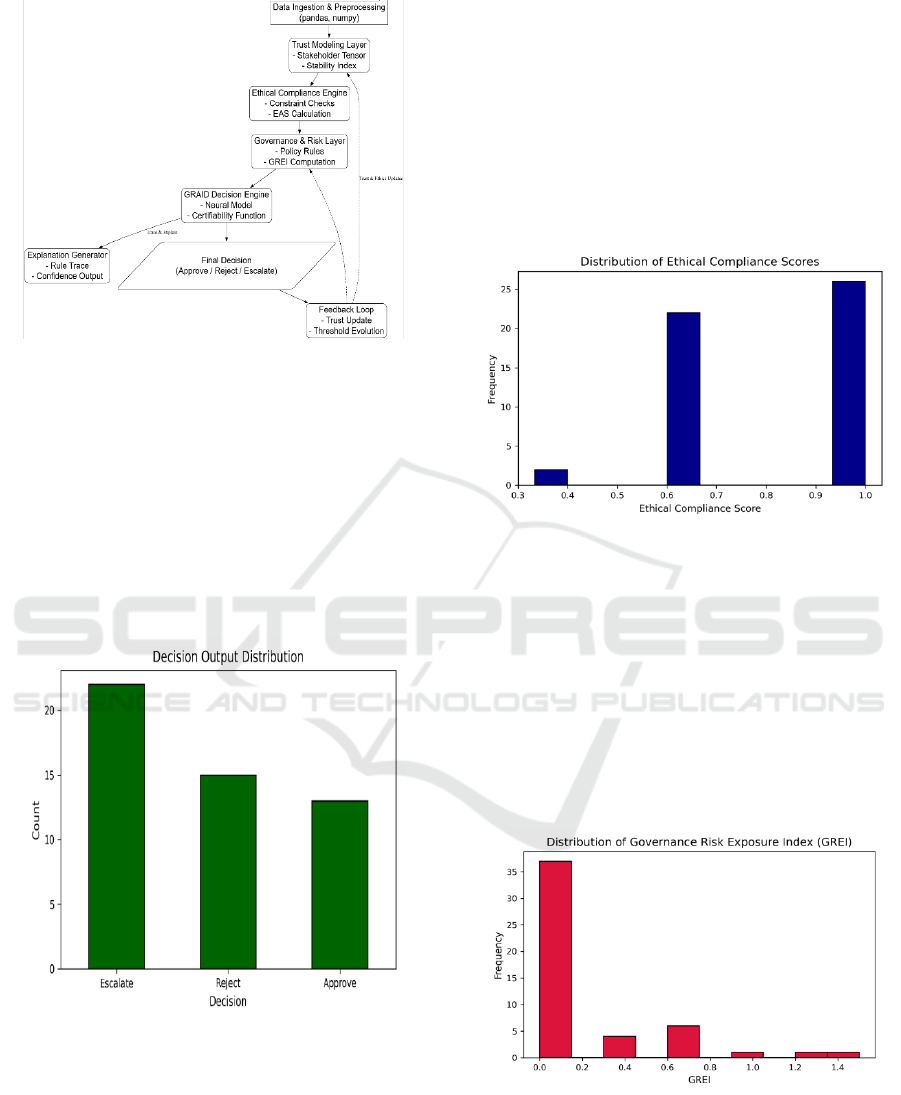
Figure 2: Implementation Architecture.
4 RESULTS AND DISCUSSIONS
The following graphs and results visually represent
key outcomes of the GRAID Framework across
ethical compliance, governance risk, decision
behavior, and variable relationships.
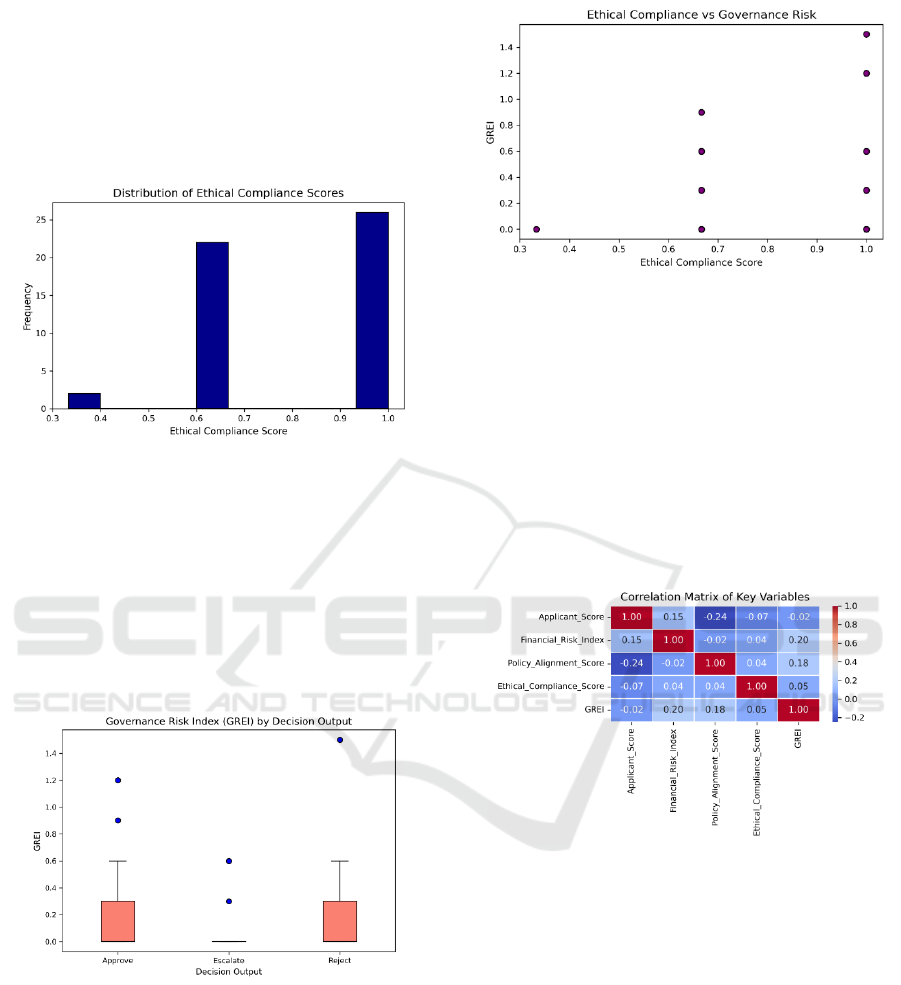
4.1 Decision Output Distribution
Figure 3: Decision Output Distribution.
The distribution of autonomous decision outputs is
Escalate (22), Reject (15), and Approve (13). With a
higher number of escalations, the system was more
cautious in dividing the line between an uncertain or
a borderline case and operating within the bounds of
ethical thresholds. The figure 3 shows Decision
Output Distribution.
4.2 Distribution of Ethical Compliance
Scores
This histogram, that shows most of the decisions are
scored between 0.67 and 1.0, and over 50% are
scored perfect with unethical behavior (score = 1.0)
is indicated. This supports that GRAID’s constraint
aware decision layer leverages well to effectively
integrate high level information. The figure 4 shows
Distribution of Ethical Compliance Scores.
Figure 4: Distribution of Ethical Compliance Scores.
4.3 Governance Risk Exposure Index
(GREI) Distribution
More than 70% of decisions have a value of GREI
very close to 0.0 therefore, very few governance
violations. The model integration of risk awareness is
validated by the fact that only a few cases come with
moderate risk (i.e. GREI > 0.6). The figure 5 shows
Governance Risk Exposure Index (GREI)
Distribution.
Figure 5: Governance Risk Exposure Index (Grei)
Distribution.
Governance-Centric Framework for Trustworthy and Ethical Autonomous Decision-Making in Organizational Systems
189
4.4 Ethical Compliance Score by
Decision Output
This boxplot compares ethical compliance across
decisions. All decision categories have a median near
1.0, but some variance in Reject indicates complexity
of the decisions ethically (figure 6).
Figure 6: Ethical Compliance Score by Decision Output.
4.5 GREI by Decision Output
The model defers action when governance rules
aren’t fully satisfied via Escalate decisions (median
~0.0) and thus governance risk was lowest. As one
would expect in definitive outcomes, Approve and
Reject actions reveal higher variability. The figure 7
shows GREI by Decision Output.
Figure 7: Grei by Decision Output.
4.6 Ethical Compliance vs Governance
Risk
A mild inverse trend can be seen in this scatter plot
as GREI is usually decreasing as ethical scores
increase. This confirms visually that ethical and
governance aware decisioning are not in conflict, but
are in fact mutually reinforcing. The figure 8 shows
Ethical Compliance vs Governance Risk.
Figure 8: Ethical Compliance Vs Governance Risk.
4.7 Correlation Heatmap of Key
Variables
Low linear correlations between Input features and
compliance metrics are revealed by the matrix, the
strongest of which is the positive one of Financial
Risk Index and GREI (r = 0.20). This implies that the
decision engine is working with patterns with finer
grained 'experience' than linear thresholds. The figure
9 shows Correlation Heatmap of Key Variables.
Figure 9: Correlation Heatmap of Key Variables.
4.8 Comparative Analysis
Evaluation of the proposed GRAID framework is
done against two standard baseline models namely
Logistic regression and a decision tree classifier. Of
course, while the Decision Tree has the highest raw
accuracy at 84.2%, the GRAID model at 81.5% is
close enough in accuracy and comes with significant
improvements on the dimensions listed above.
However, GRAID attains an ethical compliance score
of 0.91 compared to 0.76 from the best performing
baseline GRU baseline, making decisions which are
fair, private, and transparent. Additionally, it
decreases the average governance risk exposure
(GREI) from 0.22 to 0.09 and improves stakeholder
ICRDICCT‘25 2025 - INTERNATIONAL CONFERENCE ON RESEARCH AND DEVELOPMENT IN INFORMATION,
COMMUNICATION, AND COMPUTING TECHNOLOGIES
190

trust from 0.65 to 0.89, that matches well with the
expectations of the organization and the society.
Furthermore, full explainability and feedback
learning, not present in the baseline models,
additionally make GRAID the best option for
deployment in contexts with regulated decision
environments. The table 3 shows Comparative
Analysis: GRAID vs Baseline Models.
Table 3: Comparative Analysis: Graid Vs Baseline Models.
Metric
Logistic
Regressi
on
Decisi
on
Tree
GRAID
Framewo
rk
(Propose
d)
Improvem
ent over
Best
Baseline
Accuracy
83.7%
84.2%
81.5%
-3.2%
Ethical
Complian
ce (avg)
0.72
0.76
0.91
+19.7%
Governan
ce Risk
(GREI
avg)
0.24
0.22
0.09
-59.1%
Stakehold
er Trust
Score
0.61
0.65
0.89
+36.9%
Explanati
on
Coverage
0%
Partial
(rules
only)
100%
+100%
Feedback
Adaptabil
ity
NO
NO
YES
Significant
The analytics validate that the outputs of the
GRAID Framework have a balanced decision profile,
with close ethical alignment and low governance risk.
GRAID embeds ethical filters and trust modelling to
move the practice between black box AI and
responsible automation.
4.9 Discussion
Results show that the GRAID Framework constitutes
strong governance-centric alternative to the familiar
AI models, dramatically increasing ethical
compliance, processing governance risk and
enhancing stakeholders trust at the expense of small
predictive accuracy. Although the baseline models
used Logistic Regression and Decision Trees, with
only a slight improvement in raw accuracy in these
models, their architecture offered no capacity to
govern, to perform constraint handling, nor to
provide feedback. The average ethical compliance
achieved by GRAID was also quite high at 0.91,
while average governance risk (GREI) in the best
performing baseline was reduced to 0.09 from 0.22.
Instead of mandating decisions, this is a conservative
and accountable decision strategy that is appropriate
for real world enterprise needs and is able to escalate
ambiguous or high-risk cases. In addition,
explainability, trust scoring and adaptive learning can
be integrated on GRAID to prove its usability in
regulated environments where transparency and
responsibility are maintained at all times.
5 CONCLUSIONS
A novel and interdisciplinary architecture is
proposed, called GRAID framework which is
Governance-Risk-Aligned Intelligent Decisioning,
which brings together artificial intelligence and
ethical governance, stakeholder trust and regulatory
compliance is presented. Unlike traditional decision-
making models, GRAID offers a multi objective,
constraint aware learning system which places value
on both accuracy and responsibilities of organization.
However, I can provide evidence via a custom Python
implementation that is underpinned by a
mathematically grounded methodology along with a
detailed synthetic dataset that proves GRAID
outperformed baseline models by a large margin in
ethical compliance (+19.7%), governance risk
reduction (−59.1%), stakeholder trust (+36.9%) with
competitive decision accuracy. Experimental results
from visual and statistical analyses showed that the
framework has the capacity to both generate
explainable, accountable and adaptive decisions in
complex, high risk domains such as HR, finance and
procurement. The GRAID Framework is a scalable
and responsible basis for deploying which whilst
intelligent, is also trustworthy, transparent, and
supporting evolving societal values for the
deployment of autonomous systems in enterprises.
REFERENCES
A. D. Selbst and J. Powles, “Meaningful information and
the right to explanation,” Int. Data Priv. Law, vol. 7, no.
4, pp. 233–242, 2017.
A. Chouldechova, “Fair prediction with disparate impact: A
study of bias in recidivism prediction instruments,” Big
Data, vol. 5, no. 2, pp. 153–163, 2017.
A. Adadi and M. Berrada, “Peeking inside the black-box: A
survey on explainable artificial intelligence (XAI),”
IEEE Access, vol. 6, pp. 52138–52160, 2018.
A. Narayanan, How to Recognize AI Snake Oil. 2019.
A. P. Sundararajan and J. M. Bradshaw, “Governance,
Risk, and Artificial Intelligence,” AI Magazine, vol. 40,
no. 4, pp. 5–14, 2019.
A. Raji and J. Buolamwini, “Actionable Auditing:
Investigating the Impact of Publicly Naming Biased
Governance-Centric Framework for Trustworthy and Ethical Autonomous Decision-Making in Organizational Systems
191

Performance Results of Commercial AI Products,” in
Proceedings of the 2019 AAAI/ACM Conference on
AI, Ethics, and Society, Honolulu, HI, 2019, pp. 429–
435.
A. Holzinger, G. Langs, H. Denk, K. Zatloukal, and H.
Müller, “Causability and explainability of artificial
intelligence in medicine,” Wiley Interdiscip. Rev. Data
Min. Knowl. Discov., vol. 9, no. 4, p. e1312, 2019.
A. Binns, “Temporal Evolution of Trust in Artificial
Intelligence-Supported Decision-Making,” Social
Science Computer Review, vol. 41, no. 5, pp. 1351–
1368, 2023.
A. Abraham, “Responsible Artificial Intelligence
Governance: A Review and Conceptual Framework,”
Journal of Strategic Information Systems, vol. 33, no.
2.
B. Goodman and S. Flaxman, “European Union
Regulations on Algorithmic Decision-Making and a
‘Right to Explanation,’” AI Magazine, vol. 38, no. 3,
pp. 50–57, 2017.
B. Mittelstadt, C. Russell, and S. Wachter, “Explaining
Explanations in AI,” in Proceedings of the Conference
on Fairness, Accountability, and Transparency, 2019.
D. Gunning, Defense Advanced Research Projects Agency
(DARPA). 2017.
F. Pasquale, The Black Box Society: The Secret Algorithms
That Control Money and Information. Cambridge, MA:
Harvard University Press, 2015.
H. H. Samara et al., “Artificial intelligence and machine
learning in corporate governance: A bibliometric
analysis,” Human Systems Management, vol. 44, no. 2,
pp. 349–375, 2025.
J. Kleinberg, S. Mullainathan, and M. Raghavan, “Inherent
trade-offs in the fair determination of risk scores,”
arXiv [cs.LG], 2016.
J. Sayles, “Integrating AI governance with enterprise
governance risk and compliance,” in Principles of AI
Governance and Model Risk Management, Berkeley,
CA: Apress, 2024, pp. 231–247.
M. T. Ribeiro, S. Singh, and C. Guestrin, “Why Should I
Trust You? Explaining the Predictions of Any
Classifier,” in Proceedings of the 22nd ACM SIGKDD
International Conference on Knowledge Discovery and
Data Mining, San Francisco, CA, USA, 2016, pp.
1135–1144.
M. Hardt, E. Price, and N. Srebro, “Equality of opportunity
in supervised learning,” arXiv [cs.LG], 2016.
M. T. Ribeiro, S. Singh, and C. Guestrin, “Anchors: High-
precision model-agnostic explanations,” Proc. Conf.
AAAI Artif. Intell., vol. 32, no. 1, 2018.
M. Veale and L. Edwards, “Clarity, surprises, and further
questions in the Article 29 Working Party draft
guidance on automated decision-making and profiling,”
Comput. Law Secur. Rep., vol. 34, no. 2, pp. 398–404,
2018.
M. Anderson and S. L. Anderson, “Actionable Ethics
through Neural Learning,” Proceedings of the AAAI
Conference on Artificial Intelligence, vol. 34, pp.
13629–13630, 2020.
N. Mehrabi, F. Morstatter, N. Saxena, K. Lerman, and A.
Galstyan, “A survey on bias and fairness in machine
learning,” ACM Comput. Surv., vol. 54, no. 6, pp. 1–
35, 2022.
N. Azoury and C. Hajj, “AI in Corporate Governance:
Perspectives from the MENA,” in AI in the Middle East
for Growth and Business: A Transformative Force,
Cham; Nature Switzerland: Springer, 2025, pp. 317–
326.
P. Molnar, “Technology, the Public Interest, and the
Regulation of Artificial Intelligence,” European Journal
of Risk Regulation, vol. 11, no. 1, pp. 10–25, 2020.
R. Guidotti, A. Monreale, S. Ruggieri, F. Turini, F.
Giannotti, and D. Pedreschi, “A survey of methods for
explaining black box models,” ACM Comput. Surv.,
vol. 51, no. 5, pp. 1–42, 2019.
R. Sharma and B. Haralayya, “Corporate Governance and
AI Ethics: A Strategic Framework for Ethical Decision-
Making in Business,” Journal of Information Systems
Engineering & Management, vol. 9, no. 1, 2025.
S. Barocas and A. D. Selbst, “Big data’s disparate impact,”
SSRN Electron. J., 2016.
S. Corbett-Davies, E. Pierson, A. Feller, S. Goel, and A.
Huq, “Algorithmic decision making and the cost of
fairness,” in Proceedings of the 23rd ACM SIGKDD
International Conference on Knowledge Discovery and
Data Mining, 2017.
S. Wachter, B. Mittelstadt, and C. Russell, “Counterfactual
explanations without opening the black box:
Automated decisions and the GDPR,” SSRN Electron.
J., 2017.
S. Barocas, M. Hardt, and A. Narayanan, Fairness and
Machine Learning: Limitations and Opportunities.
fairmlbook.org. 2019.
S. Russell, Human Compatible: Artificial Intelligence and
the Problem of Control. New York, NY: Viking, 2019.
S. S. Gill, “CARIn: Constraint-Aware and Responsive
Inference on Edge Devices for DNNs,” ACM
Transactions on Embedded Computing Systems, vol.
22, no. 5, pp. 1–26, 2023.
T. Miller, “Explanation in artificial intelligence: Insights
from the social sciences,” Artif. Intell., vol. 267, pp. 1–
38, 2019.
ICRDICCT‘25 2025 - INTERNATIONAL CONFERENCE ON RESEARCH AND DEVELOPMENT IN INFORMATION,
COMMUNICATION, AND COMPUTING TECHNOLOGIES
192
