
Organizational Commitment in Higher Education: A Bibliometric
Analysis
Navjyoti Prasher and K. K. Mishra
University School of Business, Chandigarh University, NH‑95 Chandigarh‑Ludhiana Highway, Mohali, Punjab, India
Keywords: Job Satisfaction, Organizational Commitment, Vosviewer, Biblioshiny, Bibliometric Analysis.
Abstract: This paper presents a comprehensive review and bibliometric analysis of research focusing on organizational
commitment within the context of higher education. This research employed a bibliometric analysis approach,
focusing on papers listed in the Scopus database that delve into the topic of organizational commitment within
the context of higher education. A total of 330 papers published between 2003 and May 2023 were gathered
from the Scopus database for this purpose. Bibliometric tools such as VOS viewer version 1.6.18 and
Biblioshiny, used via R studio version 4.2.2, were instrumental in creating and visualizing scientific
landscapes, thematic networks, and thematic maps. The systematic mapping study conducted in this research
on the theme of organizational commitment in higher education helps in tracking the shift in research interests
over time. It also provides insights and foresight into potential future research directions.
1 INTRODUCTION
Organizational commitment plays a pivotal role in the
effective functioning of higher education institutions
1 (Shoaib, M., & Pathan, K. (2022)). It represents the
psychological bond that employees, including
faculty, staff, and administrators, form with their
institution, influencing their job performance,
satisfaction, and retention (
Lee et al., 2001). This
commitment reflects an employee's determination to
remain with the organization, adhering to its values
and ethics (Alonso-Cañadas et al., 2023; Pant et al.,
2024).
Organizational commitment is perceived as an
employee's acknowledgement and contribution to the
organization's well-being (Dahleez et al., 2020;
Sardana, F., & Mishra, K. K, 2012). It fosters a strong
relationship between the individual and the
organization, with the individual devoting their
energy and loyalty to the organization (
Yusuf, F. A.
2019
). Meyer and Allen proposed a three-dimensional
model of commitment, categorizing it into affective
(alignment with values and objectives), instrumental
(remaining with the organization due to received
rewards or costs incurred upon departure), and
normative (staying with the organization believing it
aligns with the organization's goals) dimensions.
In the Education Sector (ES), Organizational
Commitment (OC) is crucial in determining teachers'
engagement as it influences the quality of education
provided by an academic institution (Mishra, K. K.,
& Priya, S; Van Eck, N.J. and Waltman, L. 2010). A
robust education system is the backbone of any
developing country, and the success of such a system
relies on the quality of its committed teachers
(Ylijoki, O. 2011; Sardana et al., 2024). Committed
teachers are more likely to be productive, engaged,
and motivated, leading to improved student outcomes
(Nordin, N. 2011; Zaheer et al., 2024). OC reflects the
degree of loyalty and dedication that teachers feel
towards their educational institution (Sardana et al).
It is a psychological state that mirrors a teacher's
attachment to their academic institution and their
willingness to exert effort on behalf of the institution
(Ababneh & Hackett, 2018; Mishra & Pant, 2025).
Factors such as job satisfaction, organizational
culture, leadership, and job security can influence a
teacher's organizational commitment in the education
sector (Abbas et al., 2020; Nguyen & Le, 2023).
To navigate these transformations, organizations
are compelled to focus increasingly on human
resources, which are considered the most vital
production resource (Barnard et al., 2011; Yasmin et
al., 2023). They aim to attract and retain the most
qualified employees, those with extensive knowledge
in a specific field and those capable of quickly
Prasher, N. and Mishra, K. K.
Organizational Commitment in Higher Education: A Bibliometric Analysis.
DOI: 10.5220/0013893500004919
Paper published under CC license (CC BY-NC-ND 4.0)
In Proceedings of the 1st International Conference on Research and Development in Information, Communication, and Computing Technologies (ICRDICCT‘25 2025) - Volume 3, pages
149-160
ISBN: 978-989-758-777-1
Proceedings Copyright © 2025 by SCITEPRESS – Science and Technology Publications, Lda.
149

acquiring new knowledge and continually adapting to
organizational changes brought about by
technological and informational evolution (Gani et
al., 2020; Zippel et al., 2016). This strategy enhances
the organization's intellectual capital (Cameron,
2020; Yesufu, 2020).
In the current society, it is important to attract and
keep valuable employees within the organisation
(Dabić et al., 2022; Bano et al., 2020). Owing to rapid
technological and informational changes, companies
are forced to spend more and more money and time
on modifying the knowledge and skills of their
employees (BinBakr & Ahmed, 2018; Pant & Mishra,
2025). In such a situation, it is very important for
employees to remain in the organization as much as
they could, so that the firm could reduce knowledge
loss and be profitable to ensure the company is
receiving the return on its investment (Cafferty et al.,
2020; Singh et al., 2024).
Intentions of employees to quit or stay in an
organization are related to job satisfaction and
organizational commitment (De Lara, 2008; Mishra
et al., 2024). There is consensus among scholars and
practitioners that both are complex and multi-
dimensional concepts not explained by a single theory
(Kishore et al., 2024). Therefore, models, theories,
and tools that aim to cover as much as possible the
complexity of these phenomena have been proposed
(Bano et al., 2019; Mishra et al., 2024). It is their
purpose to reveal factors that would contribute to
increase or decrease job and organizational
satisfaction and get an estimate of the effects to
employees and the organization generated by changes
in its level (Arora et al., 2024; Mishra et al., 2024).
This paper employs bibliometric techniques to
systematically review the existing literature on
organizational commitment in higher education. The
aim is to identify major trends, key researchers,
influential publications, and thematic clusters within
the field. This review aims to build on previous
reviews of research, which have analysed the HESD
knowledge base according to implementation
barriers, teacher training, teaching and learning and
conceptual frameworks.
Understanding organizational commitment in the
context of higher education is essential for developing
strategies to enhance employee engagement and
institutional effectiveness.
This research delves into organizational
commitment and higher education literature in
several ways. Firstly, it offers a thorough exploration
of the existing literature on this crucial topic.
Secondly, it employs bibliometric analysis, a method
seldom used in the context of organizational
commitment and higher education, to provide a
comprehensive understanding of both domains and
their individual and collective evolution.
The paper is structured as follows: Section 1
introduces the key topics. Section 2 details the
research approach. Section 3 provides a thorough
review of the existing literature and includes a
bibliometric analysis based on research conducted in
the context of social media and financial literature.
Section 4 presents the data and methods used in the
study, along with the results of the bibliometric
investigations. Section 5 summarizes the study's
findings and conclusions, identifies key takeaways,
and offers recommendations for future research.
Finally, Section 6 concludes the paper."
This bibliometric study aims to seek the responses
to the below-said research questions:
RQ1: What are the annual publication trends in
Organizational Culture (OC) studies within the higher
education realm?
RQ2: Who are the leading authors of research papers
on OC in higher education?
RQ3: What are the premier sources or journals
publishing research on OC in the education sector?
RQ4: Which countries are at the forefront of OC
research in the higher education sector?
RQ5: What are the most influential articles or
documents in the field of OC research within the
higher education sector?
RQ6: What are the most frequently used keywords in
OC research in the higher education sector?
2 OBJECTIVES OF THE STUDY
Based on the research questions, the following
research objectives have been identified for this
bibliometric study on organizational commitment
(OC) in the higher education sector:
• To investigate the annual trends and volume
of scientific publications on organizational
commitment in the higher education sector.
• To identify and analyze the most prolific
and influential authors contributing to
research on organizational commitment in
higher education.
• To identify the top journals and sources that
publish significant research on
organizational commitment in the higher
education sector.
• To determine which countries or nations are
leading in research output on organizational
commitment in higher education.
ICRDICCT‘25 2025 - INTERNATIONAL CONFERENCE ON RESEARCH AND DEVELOPMENT IN INFORMATION,
COMMUNICATION, AND COMPUTING TECHNOLOGIES
150
• To identify the most impactful and
frequently cited documents and articles
related to organizational commitment in the
higher education sector.
• To analyze and identify the most commonly
used keywords in the research on
organizational commitment in the higher
education sector, highlighting the major
themes and topics of interest.
3 RESEARCH METHODOLOGY
Data Gathering: The bibliometric analysis data was
sourced from the Scopus databases, known for their
extensive collection of peer-reviewed academic
literature. Search terms such as "organizational
commitment" and "higher education" were used. The
search was confined to articles published from 2003
to 2023 to reflect current research trends.
3.1 Criteria for Data Selection
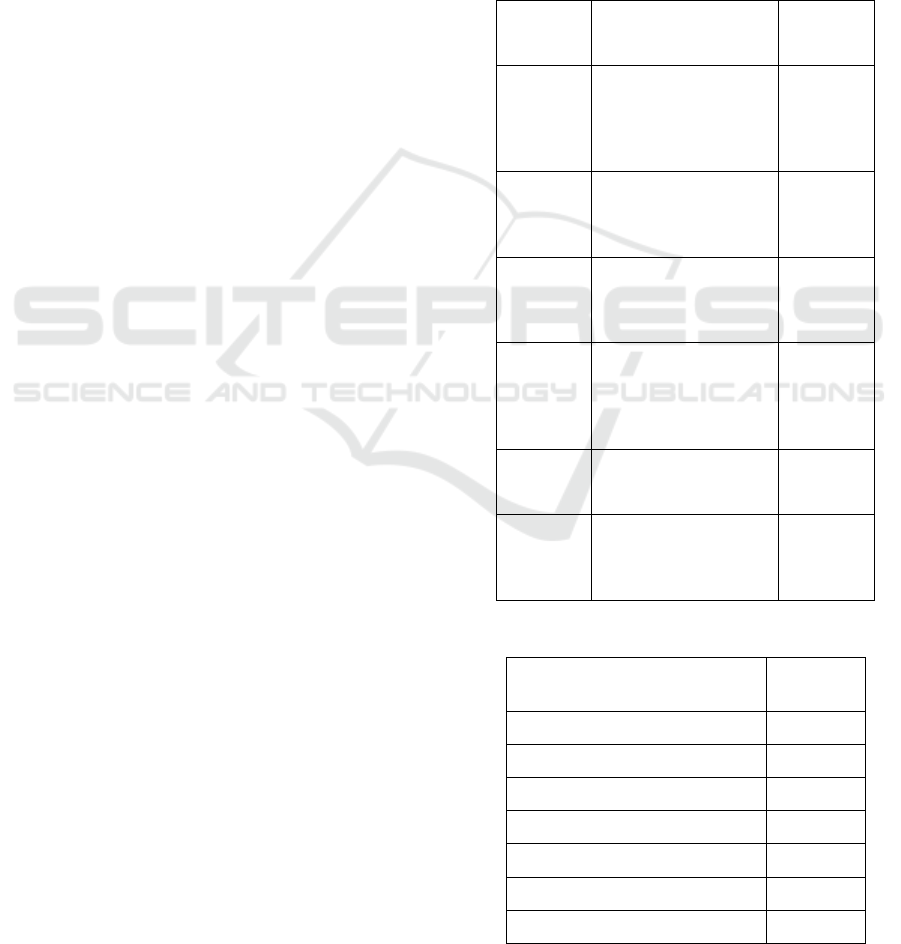
The data collection process for the query
"Organizational Commitment and Higher Education"
in the Scopus database was carried out step-by-step.
The initial search with the keywords "Organizational
Commitment" and "Higher Education" yielded 850
documents. This was then narrowed down to 368
documents by limiting the search to the higher
education sector. Further refining the search to
include only documents from the period 2004-2023
(excluding documents of 2024) resulted in 339
documents. The document type was then specified to
include only articles, book chapters, conference
papers, and reviews, which left 338 documents. The
search was then limited to the final stage of
submission, reducing the number of documents to
334. Finally, duplicate documents were removed
during the data cleaning process, resulting in a final
count of 330 documents (see Table 1)
General Results: The data collected spans a period
from 2003 to 2023. It comprises 330 documents
published in 236 different journals. These documents
were authored by a total of 888 authors. On average,
each document received 17.1 citations. The
documents collectively contain 17,935 references.
The data represents a global perspective, with
contributions from 70 different countries (see Table
2).
Total number of Publications year-wise: Figure 1
represents the number of publications made each year
from 2003 to 2023. The number of publications has
generally increased over this period. In 2003, there
were only two publications, but by 2023, the number
had risen to 36. The years 2007 to 2009 saw a steady
number of 6 publications each year. A significant
increase in publications began in 2010, with 11
publications, and this upward trend continued in the
following years. However, there is no data available
for the year 2016. The most substantial growth
occurred from 2017 onwards, with the number of
publications reaching into the thirties. The highest
number of publications occurred in 2023, with 36
publications.
Table 1: Step-wise procedure of collection of data.
Procedure Keywords used Document
results
STEP 1 "Organizational
Commitment”
AND” Higher
Education"
850
STEP 2 Limit to Faculty
Commitment in higher
education
368
STEP 3 Limit to the period
2003-2023, documents
of 2024 exclude
d
339
STEP 4 Document Type –
Articles, Book
Chapter, Conference
p
apers and Review
338
STEP 5 Limit to Submission
Final Sta
g
e
334
STEP 6 Data Cleaning -
Removal of duplicate
documents
330
Table 2: General results.
Description
Main information about data
Results
Time s
p
an 2003:2023
Documents 330
Journals 236
Authors 888
Avera
g
e citations
p
er doc 17.1
References 17935
Countries 70
Organizational Commitment in Higher Education: A Bibliometric Analysis
151
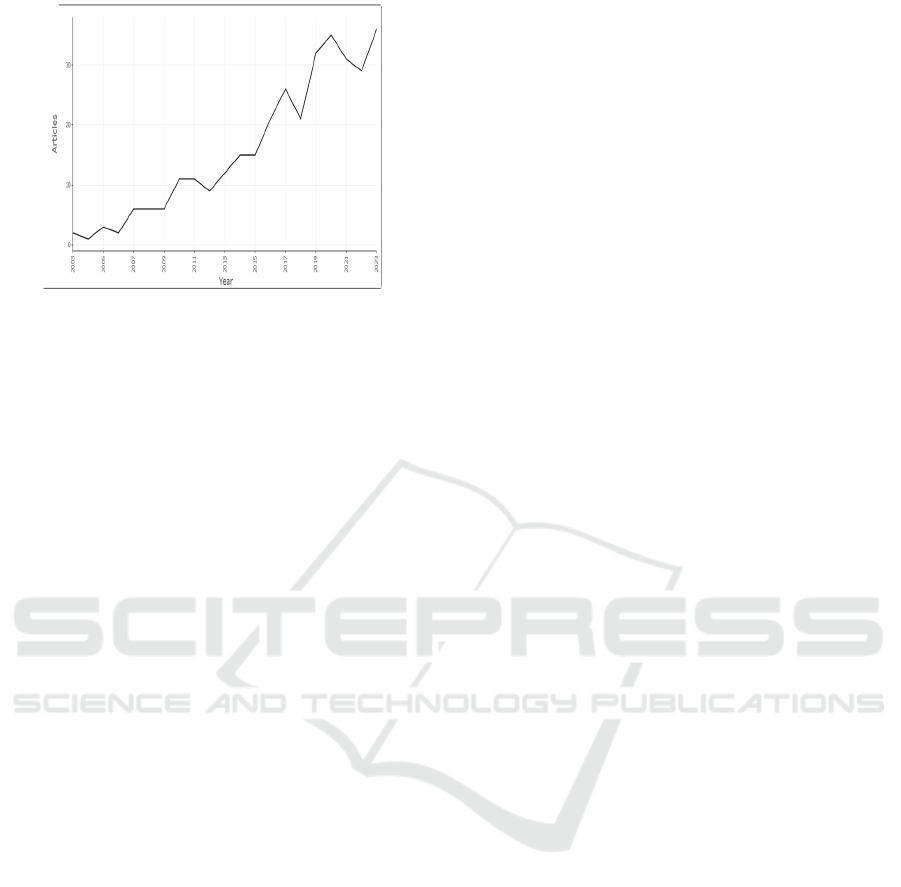
Figure 1: Publications overtime on organizational
commitment and higher education (N = 330). Source:
Bibliophagy is based on the scopus data provided.
3.2 Method
Microsoft Excel, the R Studio, and VOSviewer
1.6.17.1.exe were used in the present study. The co-
citation analysis, bibliographic coupling, and co-
occurrence were used for study analysis. Citation
analysis refers to citation patterns and citation graphs
in documents. Bibliographic coupling (BC) is a
measure of the relationship between the texts that cite
them, while co-occurrence reveals the important
information in the field of science itself (Su & Lee,
2010).
Bibliographic coupling refers to two reference
documents citing the same work. It is easy to
recognize that there are many articles of interest
between the articles in two journals with many
common citations in the two journals. Topic matter
similarity refers to the concept of bibliographic
coupling. To determine the key authors and papers on
organisational commitment and higher education, the
most appropriate method ‘co-citation’ has been used
(Boyack & Klavans, 2010). The amount of similar
citations between two journals is measured through
co-citation, while the number of common backward
citations is measured using bibliographic coupling
(Kov-Acs et al., 2015).
With co-citation and bibliographic coupling, one
can gain an idea of the past and present of the field of
research. Author keywords co-occurrence analysis
was employed to identify the core of the study field
(Ahmad et al., 2023). Hence, core themes concerning
organisational commitment are presented in the
summary. Relations between authors, publications,
journals, and keywords are visualized with the VOS
method. The VOSviewer is well-suited for star
symbolization analysis of this study.
4 RESULTS OF BIBLIOMETRIC
ANALYSIS
4.1 Co-Citation Analysis
The list you provided details the top 10 most cited
articles related to organizational commitment, with a
focus on higher education.
The most cited article is the acquaints of corporate
social responsibility, job satisfaction and
organizational commitment: A study of Pakistan
higher education sector, published in the Journal of
Cleaner Production by Asrar-ul-Haq et al. (2016). It
has been referenced 132 times, including studies
investigating a substantial link between people's
perceived CSR and organizational commitment (b =
0.63). Employees who perceive their university to be
committed to CSR are more likely to remain with the
institution.
The second most cited article is Investigating
Organizational Commitment and Employee
Performance in Indian Organizations: A First
Examination, published in the South Asian Journal of
Business Studies by Nazir and Islam (2017). It has
been cited 108 times and argues that perceived
organizational support enhances the impact of
employee performance and affective commitment.
Third on the list is Human Resources Practices
and Organizational Commitment in Higher
Education: The Mediating Role of Work Engagement
by Aboramadan et al. (2019), published in the
International Journal of Educational Management.
This article has been cited 76 times and demonstrates
that university leadership can utilize HRM practices
to improve positive work-related attitudes.
Research article four, Faculty Organizational
Commitment and Citizenship, published by
Lawrence et al. (2012), is well-cited (76 times) and
supports that quality of work life, exchange
relationships, and social learning are associated with
faculty organizational commitment.
The fifth article is The Relationship between
Training and Organizational Commitment among
Academicians in Malaysia, published in the Journal
of Management Development by Bashir and Gani
(2020). This article was referenced 56 times and
explains the employee organizational commitment–
training perception relationship through classical
theories, such as the three-component model of
organizational commitment and training-related
variables.
The sixth one is Independent and Joint Effects of
Perceived Corporate Reputation, Affective
ICRDICCT‘25 2025 - INTERNATIONAL CONFERENCE ON RESEARCH AND DEVELOPMENT IN INFORMATION,
COMMUNICATION, AND COMPUTING TECHNOLOGIES
152

Commitment and Job Satisfaction on Turnover
Intentions, published in Procedia - Social and
Behavioral Sciences by Alniacik et al. (2011). It has
been cited 51 times and investigates the independent
and interacting influences of (a) perceived reputation
of the company, (b) employees' affective
commitment, and (c) job satisfaction on turnover
intention.
The seventh article is The Determinants of
Teachers’ Continuance Commitment to E-Learning:
A Succession of the Technology Acceptance Model,
published in Education and Information
Technologies by San Martín et al. (2020). It has been
cited 48 times and addresses factors in e-learning
systems that affect teachers' continuance commitment
and contribute to the sustainability of e-learning
programs.
The eighth item is The Impact of Leadership
Behaviour and Organizational Commitment on
Organizational Readiness for Change in a Higher
Learning Institution by Nordin (2012), published in
the Asia Pacific Education Review. It has been cited
42 times and was designed to investigate the impact
of leadership behavior and organizational
commitment on departmental readiness for change in
higher education, using a medical university as the
case study.
The ninth article is Organisational Commitment:
An Empirical Study of Personality by Farrukh et al.
(2017), published in the Journal of Work-Applied
Management. It has been cited 37 times and explores
the influence of the five-factor model of personality
on the organizational commitment of university
faculty members in Pakistan.
The tenth item is Organizational Commitment of
Health Professional’s Faculty: Dimensions,
Correlates and Conditions, published in Medical
Teacher by Marchiori and Henkin (2004). It has been
cited 32 times and provides an overview of
organizational commitment in chiropractic academia.
The study finds that organizational commitment is
significantly influenced by length of service in higher
education, followed by gender and age. These
articles, each with their unique focus and perspective,
contribute significantly to the understanding of
organizational commitment in the context of higher
education. The number of citations indicates the
impact and influence of these works in the field.
Table 3: Top 10 most cited articles, authors with citation.
S.no. Title Authors Source title Citations Link strength
1 The relationship between corporate social
responsibility, job satisfaction, and
organizational commitment: Case of Pakistani
higher education
Asrar-ul-Haq et al.
(2017)
Journal of Cleaner
Production
132 284
2 Enhancing organizational commitment and
employee performance through employee
engagement: An empirical chec
k
Nazir and Islam
(2017)
South Asian Journal of
Business Studies
108 340
3 Human resources management practices and
organizational commitment in higher
education: The mediating role of work
engagemen
t
Aboramadan et al.
(2020)
International Journal of
Educational
Management
76 383
4 Faculty Organizational Commitment and
Citizenship
Lawrence et al.
(2012)
Research in Higher
Education
76 354
5 The relationship between training and
organizational commitment among
academicians in Malaysia
Bashir and Long
(2015)
Journal of Management
Development
56 181
6 Independent and joint effects of perceived
corporate reputation, affective commitment
and job satisfaction on turnover intentions
Alniacik et al.
(2011)
Procedia - Social and
Behavioral Sciences
51 236
7 The determinants of teachers’
continuance commitment to e-learning in
higher education
San et al. (2020) Education and
Information
Technologies
48 181
8 The influence of leadership behavior and
organizational commitment on organizational
readiness for change in a higher learning
institution
Nordin N. (2012) Asia Pacific Education
Review
42 232
9 Organizational commitment: an empirical
analysis of personality traits
Farrukh (2017) Journal of Work-
Applied Managemen
t
37 183
10 Organizational commitment of a health
profession faculty: Dimensions, correlates and
conditions
Marchiori and
Henkin (2004)
Medical Teacher 32 358
Organizational Commitment in Higher Education: A Bibliometric Analysis
153
4.2 Bibliographic Coupling of Sources
When two sources (journals) have more and more
references in common, stronger becomes their
bibliographic coupling, in accordance with Oltvai and
Barabasi 7; in the present case, the sources must be
citers of at least four papers. But, an article can have
at most five citation. Nine such sources were found.
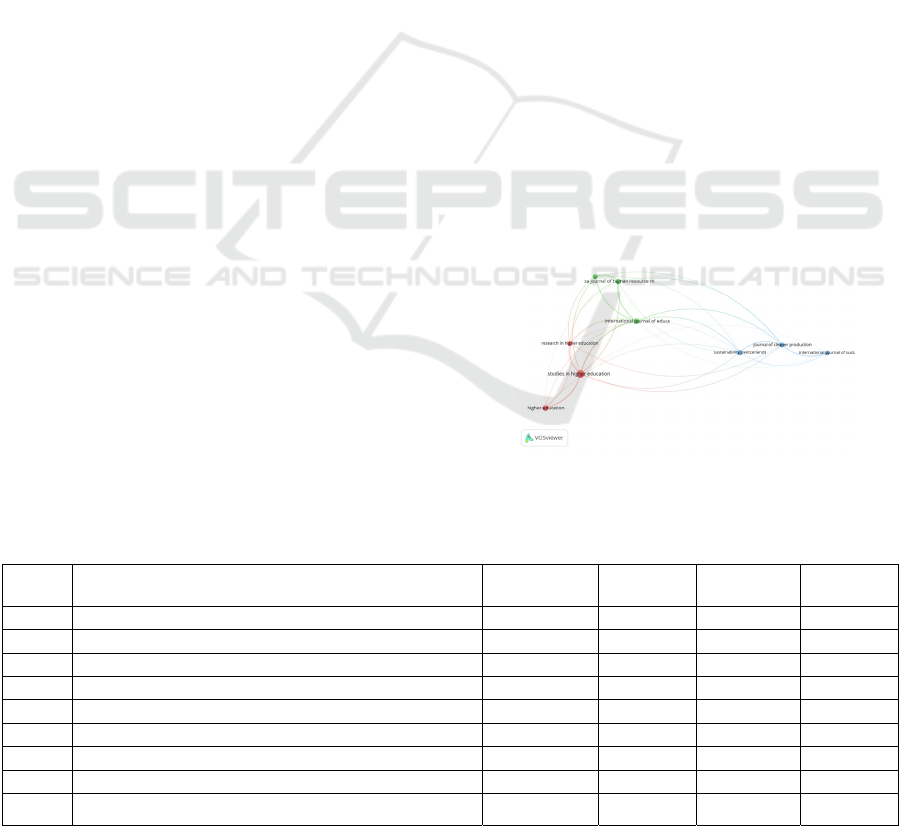
The VOS viewer computes the total link strength of
each source. The sources of the last graph are built on
the total link strength (Bano, K., & Mishra, K. 2020).
Three groups have arisen, the source said. The first
cluster is composed of three sources, each is indicated
with a red cluster in the plot and the high values are
correlated between them. The red cluster encompasses
higher education, research in higher education, and
studies in higher education. In cluster two, An
International Journal of Educational Management,
International Journal of Scientific and Technology
Research and Sa Journal of Human Resource
Management appears in green (\cellcolor[HTML]
{FCFEnglishRed}) respectively. Third cluster (blue)
contains International Journal of Sustainability in
Higher Education Journal, Journal of Cleaner
Production, Sustainability (Switzerland). The source
credentials and citations are detailed in Table 3. That's
an interesting cut of academic sources, with diverse
measures. The table you've supplied is an interesting
comparison of various academic sources, each with
its own metrics. Starting with 'Higher Education', it
has 6 documents and a substantial number of 471
citations, indicating a high degree of influence in the
field. However, its total link strength is relatively Low
at 46, suggesting that these documents might not be
frequently cited together with other works. The
'International Journal of Educational Management
also has six documents but fewer citations (171).
Interestingly, its total link strength is high at 138,
indicating that its articles might be frequently cited
alongside another research. The 'International Journal
of Scientific and Technology Research' has the lowest
number of citations (10) and average citation (2.5),
suggesting it might be less influential or newer in the
field. Despite this, its total link strength is 68, which is
higher than some sources with more citations. The
'International Journal of Sustainability in Higher
Education' and 'The SA Journal of Human Resource
Management' have similar profiles, with a moderate
number of documents and citations and total link
strengths of 38 and 80, respectively. The 'Journal of
Cleaner Production' stands out with the highest
number of citations (524) and the highest average
citation per document (131), indicating significant
influence or quality. Its total link strength is also
relatively high at 88. 'Research in Higher Education'
has a balanced profile with four documents, 200
citations, an average citation of 50, and a total link
strength of 70. 'Studies in Higher Education' has the
highest number of documents (10) with a substantial
number of 335 citations and a high total link strength
of 133, indicating that it is a prolific and influential
source. Finally, 'Sustainability (Switzerland)' has five
documents with 53 citations, an average citation of
10.6, and a total link strength of 57, suggesting a
moderate level of influence in the field. In summary,
these metrics provide valuable insights into the
influence and interconnectedness of these academic
sources, which can be useful for researchers when
choosing where to publish or which literature to
consult for their studies. Figure 2 shows Bibliographic
coupling map (see online version for colours).
Figure 2: Bibliographic Coupling Map (See Online Version
for Colours).
Table 4: Bibliographic coupling of the document with average citation per document.
S.
no
Source Documents Citations
Average
citation
Total link
strength
1 Higher Education 6 471 78.5 46
2 International Journal of Educational Management 6 171 28.5 138
3 International Journal of Scientific and Technology Research 4 102.5 68
4 International Journal of Sustainability in Higher Education 4 5614 38
5 Journal of Cleaner Production 4 524 131 88
6 Research in Higher Education 4 200 50 70
7 Sa Journal of Human Resource Managemen
t
6 67 11.167 80
8 Studies in Higher Education 10 335 33.5 133
9 Sustainability (Switzerland) 5 53 10.6 57
ICRDICCT‘25 2025 - INTERNATIONAL CONFERENCE ON RESEARCH AND DEVELOPMENT IN INFORMATION,
COMMUNICATION, AND COMPUTING TECHNOLOGIES
154
4.3 Bibliographic Coupling of Country
Many nations have made significant contributions to
the literature of organizational commitment and
higher education. The country with the most of
records is ranked as the top value, down to the last
listed as the lowest value. The citation-based average
per country and the total link strength are computed
in Table 4. The United States is leading the pack with
46 documents and 1252 citations, indicating a high
level of research activity. The average citation rate of
27.22 and a total link strength of 5616 further
underscores the impact and reach of its research.
Malaysia, despite having nearly as many documents
(42) as the United States, has significantly fewer
citations (543). However, its total link strength is the
highest at 6847, suggesting a greater
interconnectedness or collaboration within its
research network. India and Indonesia both have the
same number of documents (28), but India has more
citations (329) than Indonesia (195), suggesting that
India's research is more influential or widely
referenced. The United Kingdom stands out for
having a high average citation rate (24.88) despite
having fewer published documents (25) compared to
countries like Malaysia or India. This could indicate
that while the UK produces less research volume-
wise, its quality or relevance is recognized and cited
more frequently. South Africa, with fewer
publications (18), maintains a relatively high average
citation rate (21.89), suggesting impactful research
output relative to its size. Australia shows it has one
less document than South Africa but slightly more
citations overall and a higher average citation rate of
23.59, indicating the quality of its research. Spain has
fewer publications and lower citation metrics across
the board compared to most other countries listed
here, indicating lesser influence or smaller scale
within its research activities. China appears near the
bottom of this list with only 12 documents; however,
it maintains an average citation rate similar to
Malaysia's at 12.00, indicating the quality of its
research.
Portugal stands out for having the highest average
citation rate at 35.75 despite having only 12
documents published. This suggests that Portugal's
research is highly regarded on an individual paper
basis, even if not prolific in quantity. Lastly, Pakistan
closes out this list with ten publications but still
manages an impressive average citation rate of 20.50,
along with substantial total link strength in 2082,
indicating the quality and impact of its research.
In summary, Table 5 provides valuable insights
into the influence and interconnectedness of these
countries' academic research. They highlight the
balance between quantity and quality of research, the
impact of research as indicated by citations, and the
level of collaboration or interconnectedness as
suggested by the total link strength. These insights
can be useful for researchers when choosing where to
publish or which literature to consult for their studies.
They also offer a snapshot of the global research
landscape, revealing the leading contributors and
emerging players in academic research.
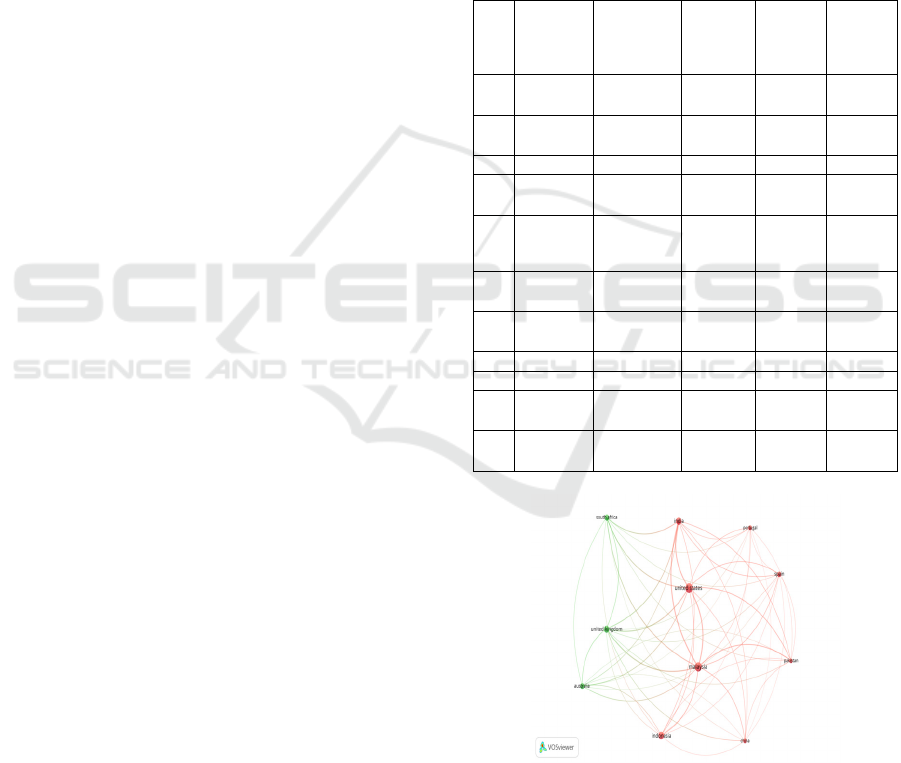
Figure 3
shows Country bibliographic coupling (see online
version for colours).
Table 5: Bibliographic Coupling of Country.
S.N
o
Country Documen
ts
Citation
s
Averag
e
Citatio
n
Total
Link
Strengt
h
1 United
States
46 1252 27.22 5616
2 Malaysi
a
42 543 12.93 6847
3 India 28 329 11.75 5679
4 Indonesi
a
28 195 6.96 1920
5 United
Kingdo
m
25 622 24.88 3687
6 South
Africa
18 394 21.89 2869
7 Australi
a
17 401 23.59 1909
8 Spain 15 127 8.47 1705
9 China 12 144 12.00 1387
10 Portugal 12 429 35.75 1071
11 Pakistan 10 205 20.50 2082
Figure 3: Country Bibliographic Coupling (See Online
Version for Colours).
Organizational Commitment in Higher Education: A Bibliometric Analysis
155
4.4 Bibliographic Coupling of
Documents
The table 6 demonstrates the data and provides a
comparative analysis of ten documents based on the
number of citations and total link strength.
Starting with the study by Nordin (2012), it has 42
citations and a total link strength of 34, indicating a
moderate level of influence in the academic
community. The study by San Martín et al. (2020) has
slightly more citations at 48 but a lower total link
strength of 24, suggesting that while it may be
frequently referenced, its overall impact is less than
that of Nordin (2012).
The study by Aboramadan et al. (2019) stands out
with a high number of 76 citations and an impressive
total link strength of 72, indicating a significant
influence and reach within the scholarly community.
Asrar-ul-Haq et al. (2016) has the highest number of
citations at 132, but a total link strength of 38,
suggesting that while it is frequently cited, its overall
impact may not be as substantial.
The studies by Bashir and Gani (2020) and
Farrukh et al. (2017) have relatively fewer citations
and lower total link strength, indicating a lesser
degree of influence. The study by Marchiori and
Henkin (2004), despite being one of the older
documents, maintains a respectable total link strength
of 52 with 32 citations, suggesting its enduring
relevance.
The study by Alniacik et al. (2011) has a balanced
number of citations and total link strength, indicating
a moderate level of influence. The study by Lawrence
et al. (2012) mirrors Aboramadan et al. (2019) in
terms of citations but falls short in total link strength.
Lastly, the study by Nazir and Islam (2017) has a high
number of 108 citations and a total link strength of
63, indicating a substantial impact on the academic
community.
In conclusion, while the number of citations gives an
indication of how often a document is referenced, the
total link strength provides a measure of its overall
impact or influence. A document like Aboramadan et
al. (2019) with high numbers in both categories can
be considered highly influential. Conversely, a
document like San Martín et al. (2020) with a high
citation count but low total link strength may be
frequently referenced but have less overall impact.
This analysis underscores the importance of
considering both factors when assessing the influence
of a document within the academic community.
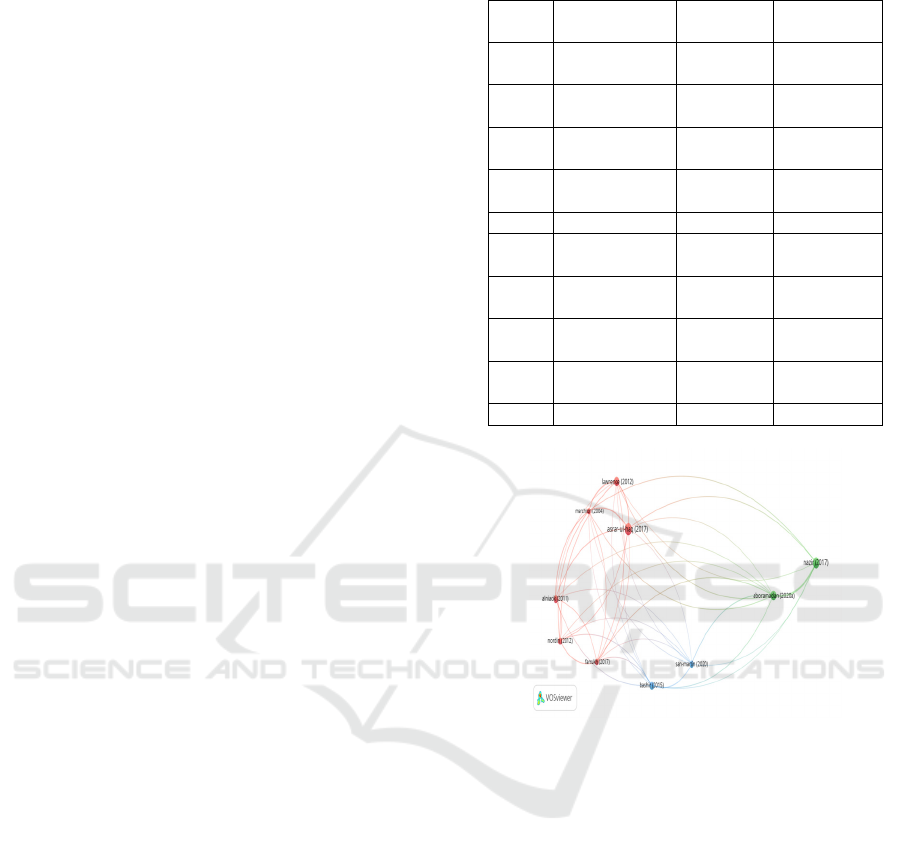
Figure 4 shows the map of documents' bibliographic
coupling (see online version for colours).
Table 6: Bibliographic Coupling of Documents.
Sr.
no.
Document Citations
Total Link
Strength
1
Nordin
(
2012
)
42 34
2
San-Martín
(2020)
48 24
3
Aboramadan
(2020a)
76 72
4
Asrar-Ul-Haq
(
2017
)
132 38
5Bashir
(
2015
)
56 27
6
Farrukh
(
2017
)
37 29
7
Marchiori
(2004)
32 52
8
Alniacik
(2011)
51 37
9
Lawrence
(
2012
)
76 53
10 Nazir
(
2017
)
108 63
Figure 4: Map of Documents Bibliographic Coupling (See
Online Version for Colours).
4.5 Keywords Co-Occurrence
4.5.1 Co-Occurrence of Keywords
The provided data offers an in-depth analysis of 16
keywords based on their occurrences and total link
strength.
The keyword "organizational commitment" tops
the list with 106 occurrences and a total link strength
of 99, indicating its significant relevance and
influence in the dataset. This is followed by "higher
education", with 92 occurrences and a total link
strength of 89, suggesting its prominence in the
dataset. Interestingly, "job satisfaction", despite
having fewer occurrences (54), has a higher total link
strength (90) than "higher education", implying its
strong interconnectedness within the dataset.
The keyword "organizational commitment", a
variant spelling of "organizational commitment", has
ICRDICCT‘25 2025 - INTERNATIONAL CONFERENCE ON RESEARCH AND DEVELOPMENT IN INFORMATION,
COMMUNICATION, AND COMPUTING TECHNOLOGIES
156
significantly fewer occurrences (29) and a lower total
link strength (25), indicating that the American
spelling is more commonly used in the dataset. The
keywords "education", "commitment", and "higher
education institutions" have relatively fewer
occurrences and lower total link strengths, suggesting
they are less influential in the dataset.
The keyword "affective commitment", a specific
type of organizational commitment, has 15
occurrences and a total link strength of 11, indicating
its limited but specific relevance. The keywords
"organizational culture", "university", "human",
"leadership", "transformational leadership", and
"academic staff" all have occurrences ranging from
11 to 14 and total link strengths ranging from 17 to
25, suggesting their moderate influence in the dataset.
Lastly, the keywords "sustainability" and
"universities" have the fewest occurrences (10) and
relatively low total link strengths (14 and 12,
respectively), indicating their limited influence in the
dataset.
In conclusion, this analysis provides valuable
insights into the prevalence and influence of various
keywords in the dataset. Table 7 shows Co-
occurrence of keywords. It underscores the
importance of "organizational commitment", "higher
education", and "job satisfaction" in the dataset, while
also highlighting the moderate influence of keywords
related to organizational culture, leadership styles,
and academic staff. The analysis also reveals the
limited influence of keywords related to sustainability
and universities. This could guide further research or
inquiry by focusing on the most influential keywords.
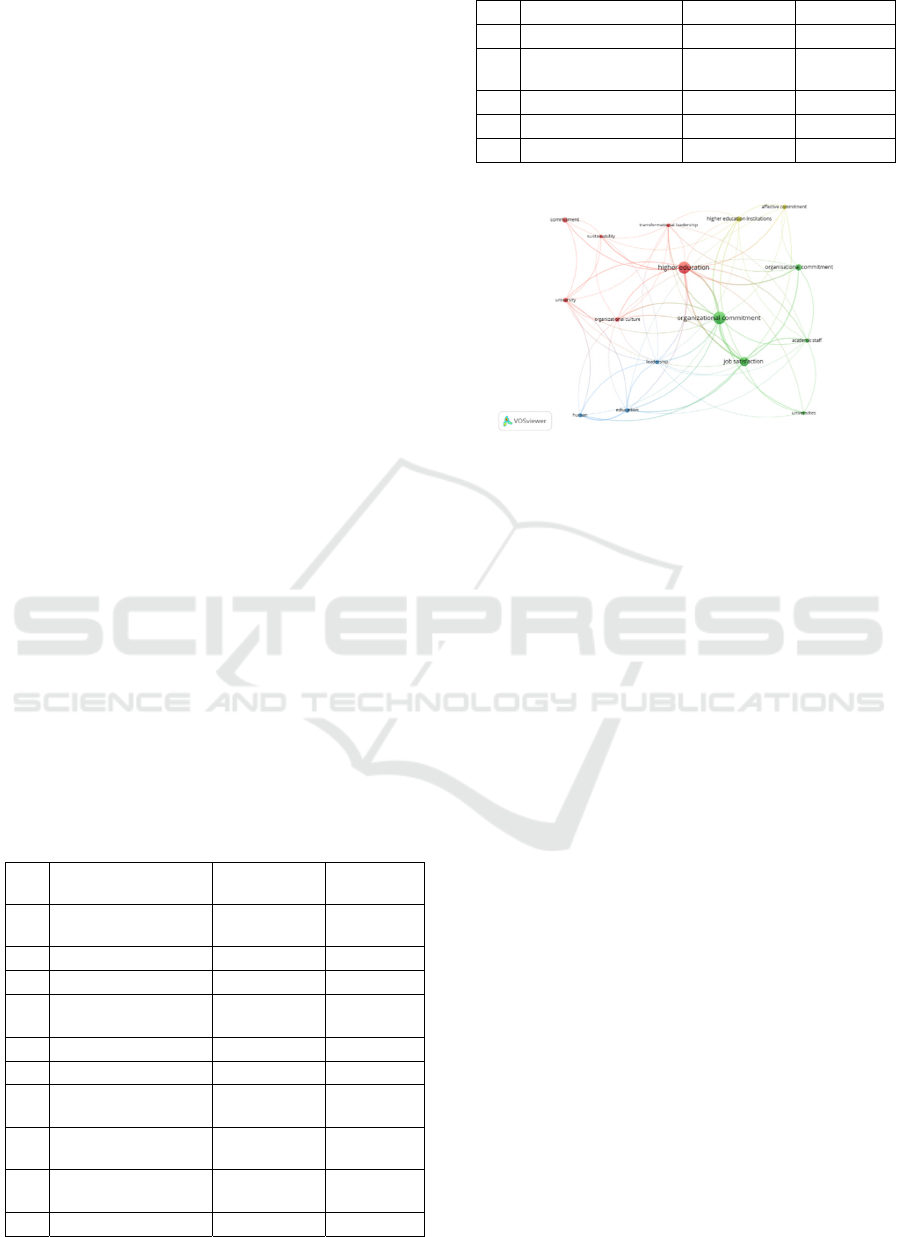
Figure 5 shows Results of co-occurrence of keywords
(see online version for colors).
Table 7: Co-Occurrence of Keywords.
Sr.
No
Keyword Occurrences
Total Link
Strength
1
Organizational
Commitment
106 99
2 Higher Education 92 89
3 Job Satisfaction 54 90
4
Organisational
Commitment
29 25
5 Education 18 34
6 Commitment 16 8
7
Higher Education
Institutions
16 17
8
Affective
Commitment
15 11
9
Organizational
Culture
14 25
10 University 13 22
11 Human 12 23
12 Leadership 12 23
13
Transformational
Leadership
12 17
14 Academic Staff 11 23
15 Sustainability 10 14
16 Universities 10 12
Figure 5: Results of Co-Occurrence of Keywords (See
Online Version for Colors).
5 RECOMMENDATIONS FOR
FUTURE RESEARCH
The purpose of this research was to investigate
existing literature on organizational commitment
(OC) within higher education. Although the focus
was on OC in relation to key factors such as employee
retention, happiness, and commitment, much of the
current research primarily addresses OC through
broader lenses. These include its links to job
satisfaction, leadership styles, and organizational
culture. Few studies thoroughly examine the role of
OC specifically within higher education institutions,
particularly in non-Western contexts. Additionally,
there is limited research on the impact of
technological advancements and the changing nature
of academic work on OC. The increasing influence of
remote and hybrid work models on faculty
commitment is another area that remains
underexplored. Future research should address these
emerging trends, especially regarding how
organizational policies and technological integration
influence long-term employee commitment in higher
education. Investigating how OC affects teaching
outcomes, student success, and institutional
effectiveness in various cultural settings could also
provide valuable insights for strengthening
educational institutions globally. Furthermore, more
research is needed to explore how professional
development and mentorship programs can enhance
organizational commitment in the education sector.
Organizational Commitment in Higher Education: A Bibliometric Analysis
157

6 FINDINGS AND
CONCLUSIONS
This article conducts a bibliometric analysis of
organizational commitment (OC) in higher education.
By employing bibliometric methods, the study
examines publication trends, geographical
distribution of research, key contributors, and
keyword occurrences in OC literature. The findings
highlight frequently used terms such as
Organizational Commitment, Higher Education, Job
Satisfaction, Organizational Culture, Leadership,
Academic Staff, and Sustainability. These terms
underscore the multifaceted nature of OC in
educational institutions, emphasizing the importance
of job satisfaction, leadership, and organizational
culture in fostering employee commitment.
The most influential publications originate from
countries including the United States, Malaysia,
India, Indonesia, the United Kingdom, South Africa,
Australia, Spain, China, Portugal, and Pakistan.
These nations significantly contribute to OC research
in higher education, with the United States leading in
both the quantity and impact of publications.
Additionally, the analysis shows that while a few key
researchers dominate the field, numerous new authors
are beginning to explore OC in higher education,
indicating a growing interest in the topic.
This research paper explores the trends,
influential works, and key contributors in the field of
organizational commitment within higher education
through a bibliometric analysis. By employing
bibliometric tools, we analyze publication patterns,
citation networks, and the thematic evolution of the
research domain. The findings provide insights into
the development and current state of organizational
commitment in higher education, highlighting
significant research contributions and potential
directions for future studies.
REFERENCES
Ababneh, K. I., & Hackett, R. D. (2018). The direct and
indirect impacts of job characteristics on faculty
organizational citizenship behavior in the United Arab
Emirates (UAE). Higher Education, 77(1), 19–36.
https://doi.org/10.1007/s10734-018-0252-3
Abbas, A., Saud, M., Suhariadi, F., Usman, I., & Ekowati,
D. (2020). Positive leadership psychology: Authentic
and servant leadership in higher education in Pakistan.
CurrentPsychology,41(9),58595871.https://doi.org/10.
1007/s12144-020-01051-1
Aboramadan, M., Albashiti, B., Alharazin, H., & Dahleez,
K. A. (2019). Human resources management practices
and organizational commitment in higher education.
International Journal of Educational Management,
34(1), 154–174. https://doi.org/10.1108/ijem-04-2019-
0160
Ahmad, M. F., Salamuddin, N., Surat, S., Safwan, N. S. Z.,
Latif, R. A., Basar, A., & Azemi, M. A. (2023). Linking
human resources management practices and
organizational commitment: the mediating role of
employability. Journal of Law and Sustainable
Development,11(2),e636.https://doi.org/10.55908/sdgs
.v11i2.636
Alniacik, Umit & ciğerim, erşan & Akçin, Kültigin &
Bayram, Orkun. (2011). Independent and joint effects
of perceived corporate reputation, affective
commitment and job satisfaction on turnover intentions.
Procedia - Social and Behavioral Sciences. 24. 1177-
1189. 10.1016/j.sbspro.2011.09.139.
Alonso-Cañadas, J., Saraite-Sariene, L., Galán-Valdivieso,
F., & Del Carmen Caba-Pérez, M. (2023). Green tweets
or not? The sustainable commitment of higher
education institutions. SAGE Open, 13(4).
https://doi.org/10.1177/21582440231220097
Arora, M., Mishra, K. K., Singh, M., Singh, P., & Tripathi,
R. (2024). Deepfake Technology and Its Implications
for Influencer Marketing. In Navigating the World of
Deepfake Technology (pp. 66-90). IGI Global.
Asrar-ul-Haq, Muhammad & Kuchinke, K. & Iqbal, Anam.
(2016). The relationship between corporate social
responsibility, job satisfaction, and organizational
commitment: Case of Pakistani higher education.
Journal of Cleaner Production. 142.
10.1016/j.jclepro.2016.11.040.
Baltaru, R. (2020). The rise of agentic inclusion in the UK
universities: maintaining reputation through (formal)
diversification. Studies in Higher Education, 47(1),
229–242.
https://doi.org/10.1080/03075079.2020.1739015
Bano, K., Ishrat, A., & Mishra, K. (2019). Factors affecting
organizational commitment of teachers in government
and private universities. International Journal of
Scientific and Technology Research, 8(11),
138152.https://www.ijstr.org/paperreferences.php?ref
=IJSTR-1119-24400
Bano, K., & Mishra, K. (2020). Transforming organization
through valuebased leadership. International Journal of
Scientific & Technology Research, 9(1), 2834-2842.
Bano, K., Ishrat, A., & Mishra, K. (2020). Identifying
institutional level variables which affects the level of
organizational commitment among university teachers.
International Journal of Scientific & Technology
Research, 9(3), 336-344.
Barnard, A., Croft, W., Irons, R., Cuffe, N., Bandara, W.,
& Rowntree, P. (2011). Peer partnership to enhance
scholarship of teaching: a case study. Higher Education
Research & Development, 30(4), 435–448.
https://doi.org/10.1080/07294360.2010.518953
Bashir, B., & Gani, A. (2020). Testing the effects of job
satisfaction on organizational commitment. Journal of
ICRDICCT‘25 2025 - INTERNATIONAL CONFERENCE ON RESEARCH AND DEVELOPMENT IN INFORMATION,
COMMUNICATION, AND COMPUTING TECHNOLOGIES
158

Management Development, 39(4), 525–542.
https://doi.org/10.1108/jmd-07-2018-0210
BinBakr, M. B., & Ahmed, E. I. (2018). High-involvement
work processes and organizational commitment of
female faculty in Saudi Arabia. International Journal of
Leadership in Education, 22(5), 597–616.
https://doi.org/10.1080/13603124.2018.1529819
Boyack, K.W. and Klavans, R. (2010) ‘Co-citation
analysis, bibliographic coupling, and direct citation:
which citation approach represents the research front
most accurately?’, Journal of the American Society for
Information Science and Technology, Vol. 61, No. 12,
pp.2389–2404, DOI: 10.1002/asi.21419.
Cafferty, L. A., Crawford, P. F., Jackson, J. T., & Ledford,
C. J. W. (2020). Residency Leader Motivations to
Engage Residents and Residency Faculty in
Scholarship: A Qualitative Study. Family Medicine,
52(8),581585.https://doi.org/10.22454/FamMed.2020.
437433
Cameron, C. L. (2020). Organisation-based self-esteem in
higher education: exploring subgroup differences in
perceptions of worth. Quality in Higher Education,
26(2),117134.https://doi.org/10.1080/13538322.2020.
1751308
Dabić, M., Stojčić, N., Pavičić, J., & Vlašić, G. (2022).
Inclusive internationalization as a driver of the
institutional entrepreneurial agenda in higher
education. In Borderlands (pp. 207–220).
https://doi.org/10.1007/978-3-031-05339-9_18
Dahleez, K. A., Aboramadan, M., & Bansal, A. (2020).
Servant leadership and affective commitment: the role
of psychological ownership and person–organization
fit. International Journal of Organizational Analysis,
29(2), 493–511. https://doi.org/10.1108/ijoa-03-2020-
2105
De Lara, P. Z. M. (2008). Fairness, teachers’ non‐task
behavior and alumni satisfaction. Journal of
Educational Administration, 46(4), 514–538.
https://doi.org/10.1108/09578230810882036
Farrukh, Muhammad & Chong, Wei Ying & Mansori,
Shaheen. (2017). Organizational commitment: an
empirical analysis of personality traits. Journal of
Work-Applied Management. 9. 18-34.
10.1108/JWAM-12-2016-0026.
Gani, K., Potgieter, I., & Coetzee, M. (2020). Dispositions
of agency as explanatory mechanisms of employees’
satisfaction with retention practices. Journal of
Psychology in Africa, 30(2), 143–150.
https://doi.org/10.1080/14330237.2020.1744278
Kishore, K. K., Absar, H., Pant, P., & Tripathi, B. (2024).
The Future of Robo-Advisors in Wealth Management.
In Artificial Intelligence and Machine Learning-
Powered Smart Finance (pp. 161-172). IGI Global.
Kov-Acs, A., Van Looy, B. and Cassiman, B. (2015)
‘Exploring the scope of open innovation: a bibliometric
review of a decade of research’, Scientometrics, Vol.
104, No. 3, pp.951–983, DOI: 10.1007/s11192-015-
1628-0.
Lawrence, J., Ott, M., & Bell, A. (2012). Faculty
Organizational Commitment and Citizenship. Research
in Higher Education, 53(3), 325-352.
https://doi.org/10.1007/s11162-011-9230-7
Lee, K., Allen, N. J., Meyer, J. P., & Rhee, K. (2001). The
Three‐Component Model of Organisational
Commitment: an application to South Korea. Applied
Psychology,50(4),596614.https://doi.org/10.1111/1464
-0597.00075
Marchiori, Dennis & Henkin, Alan. (2004). Organizational
Commitment of a Health Profession Faculty. Medical
teacher. 26. 353-8. 10.1080/01421590410001683221.
Meyer, J. P., Allen, N. J., & Topolnytsky, L. (1998).
Commitment in a changing world of work. Canadian
Psychology/Psychologie Canadienne, 39(1–2), 83–93.
https://doi.org/10.1037/h0086797
Mishra, K. K., Priya, S., Hussain, S. S., & Gupta, S. (2024).
Rural Communication Media: Its Impact on the Rural
Markets. In Sustainable Investments in Green Finance
(pp. 112-128). IGI Global.
Mishra, K. K., Pant, P., Singh, H., & Mishra, S. K. (2024).
The Philosopher's Stone: Applications of Data
Alchemy—Customer Personalization, Profiling, and
Retention. In Data Alchemy in the Insurance Industry
(pp. 77-95). Emerald Publishing Limited.
Mishra, K. K., & Pant, P. (2025). Subconscious Factors
Affecting Consumer Preferences Toward Green
Investments. Sustainability, Innovation, and Consumer
Preference, 119-148.
Mishra, K. K., & Priya, S. Rural communication strategic
model using a new unconventional media mix.
Nazir, O., & Islam, J. U. (2017). Enhancing organizational
commitment and employee performance through
employee engagement. South Asian Journal of
BusinessStudies,6(1),98114.https://doi.org/10.1108/saj
bs-04-2016-0036
Nguyen, P. N. D., & Le, D. N. T. (2023). Understanding
Organizational Citizenship Behaviour through
Organizational Justice and its Consequences among
Vietnamese’s Universities Employees. Emerging
Science Journal, 7, 93110.https://doi.org/10.28991/esj-
2023-sied2-08
Nordin, N. (2011). The influence of leadership behavior
and organizational commitment on organizational
readiness for change in a higher learning institution.
Asia Pacific Education Review, 13(2), 239–249.
https://doi.org/10.1007/s12564-011-9200-y
Nordin, N. The influence of leadership behavior and
organizational commitment on organizational readiness
for change in a higher learning institution. Asia Pacific
Educ. Rev. 13, 239–249 (2012).
https://doi.org/10.1007/s12564-011-9200-y
O’Mahony, K., & Garavan, T. N. (2012). Implementing a
quality management framework in a higher education
organisation. Quality Assurance in Education, 20(2),
184–200. https://doi.org/10.1108/09684881211219767
Pant, P., Mishra, K. K., & Mohan, A. (2024). Algorithmic
Approaches to Financial Technology: Forecasting,
Trading, and Forecasting. Artificial Intelligence and
Machine Learning-Powered Smart Finance, 50.
Pant, P., & Mishra, K. K. (2025). Behavioural Economics
and the Rise of Sustainable Investments: Urgency for a
Organizational Commitment in Higher Education: A Bibliometric Analysis
159

New Paradigm in Financial Decision-Making. In
Sustainability, Innovation, and Consumer Preference
(pp. 329-360). IGI Global Scientific Publishing.
san martín, Sonia & Jimenez, Nadia & Rodríguez-Torrico,
Paula & Piñeiro-Ibarra, Irati. (2020). The determinants
of teachers’ continuance commitment to e-learning in
higher education. Education and Information
Technologies. 25. 10.1007/s10639-020-10117-3.
Sardana, F., Mishra, K. K., Singh, A., & Saini, N. (2024).
Transforming Social Media Marketing Through
Deepfake Technology. In Navigating the World of
Deepfake Technology (pp. 431-453). IGI Global.
Sardana, F., & Mishra, K. K. 12 Artificial Intelligence
Enabled Virtual Reality for Product Showcase on
Social Media. Navigating the Digital Landscape, 163.
Sardana, F., & Mishra, K. K. Green Marketing Strategies
and Solution for Sustainable Business Practices. Green
Solutions A Handbook for Sustainable Business
Strategies and Models, 141.
Shoaib, M., & Pathan, K. (2022). The Influence of
Organizational Culture on Employee Commitment and
Turnover Intentions. III (4), 34–43.
https://doi.org/10.5281/zenodo.10115346
Singh, H., Mishra, K. K., & Singh, M. P. (2024). A Study
on Rural BPL Households' Perception Towards
Financial Inclusion Schemes. In Algorithmic
Approaches to Financial Technology: Forecasting,
Trading, and Optimization (pp. 146-159). IGI Global.
Su, H. and Lee, P. (2010) ‘Mapping knowledge structure by
keyword co-occurrence: a first look at journal papers in
technology foresight’, Scientometrics, Vol. 85, No. 1,
pp.65–79, DOI: 10.1007/s11192- 010-0259-8.
Van Eck, N.J. and Waltman, L. (2010) ‘Software survey:
VOSviewer, a computer program for bibliometric
mapping’, Scientometrics, Vol. 84, No. 2, pp.523–538,
DOI: 10.1007/s11192- 009-0146-3.
Yasmin, Z., Suryadi, E., Santoso, B., & Suparno, S. (2023).
Investigating employee performance in higher
education: The role of satisfaction and commitment.
International Journal of Evaluation and Research in
Education(IJERE),12(4),1819.https://doi.org/10.11591
/ijere.v12i4.25157
Yesufu, L. O. (2020). The impact of employee type,
professional experience and academic discipline on the
psychological contract of academics. International
Journal of Management in Education, 14(3), 311.
https://doi.org/10.1504/ijmie.2020.10026567
Ylijoki, O. (2011). Boundary-work between work and life
in the high-speed university. Studies in Higher
Education,38(2),242255.https://doi.org/10.1080/03075
079.2011.577524
Yusuf, F. A. (2019). The effect of organizational culture on
lecturers’ organizational commitment in private
universities in Indonesia. International Journal of
HigherEducation,9(2),16.https://doi.org/10.5430/ijhe.v
9n2p16
Zaheer, A., Singh, A., Mishra, K. K., &Vardari, L. (2024).
The Future of Alchemy: Emerging Trends and
Technologies Metaverse in Insurance–A Virtual
Customer Experience. Data Alchemy in the Insurance
Industry, 133-152.
Zippel, K., Ferree, M. M., & Zimmermann, K. (2016).
Gender equality in German universities:
vernacularising the battle for the best brains. Gender
andEducation,28(7),867885. https://doi.org/10.1080/0
9540253.2015.1123229
ICRDICCT‘25 2025 - INTERNATIONAL CONFERENCE ON RESEARCH AND DEVELOPMENT IN INFORMATION,
COMMUNICATION, AND COMPUTING TECHNOLOGIES
160
