(One, Two) Tri Vertex Domination in Fuzzy Graphs
Kavitha T., Tharani S. and Deepa R.
Department of Mathematics, E.G.S. Pillay Engineering College, Nagapattinam, 611002, Tamil Nadu, India
Keywords: (1, 2) Dominating Set in a Fuzzy Graph, (One, Two) Tri Vertex Domination Number in a Fuzzy Graph.
Abstract: Sarala.N and Kavitha.T has established the concept of triple connected domination in fuzzy graph. In this
paper we introduce the (One, two) tri-vertex domination number in fuzzy graph and present several intriguing
findings regarding this new parameter domination in fuzzy graphs.
1 INTRODUCTION
Mahadevan G and Selvam A created the notion of
triple-connected domination in graphs. In this study,
we investigate the limitations on the (One, two) tri-
vertex domination number in fuzzy graph and provide
various interesting insights about this innovative
parameter domination in fuzzy graphs.
2 PRELIMINARIES
Definition 2.1: Let G (a, b) be a fuzzy graph, then is
said to be a fuzzy dominating set of G, if for each v ±
V(G), where v∈V-D, There is an u in D such that
b(u,v) = a (u) a (v). There exists a u in D with
b(u,v) = a (u) a (v). The dominant fuzzy number is
representing by 𝛾(G) is the minimum scalar order of
D.
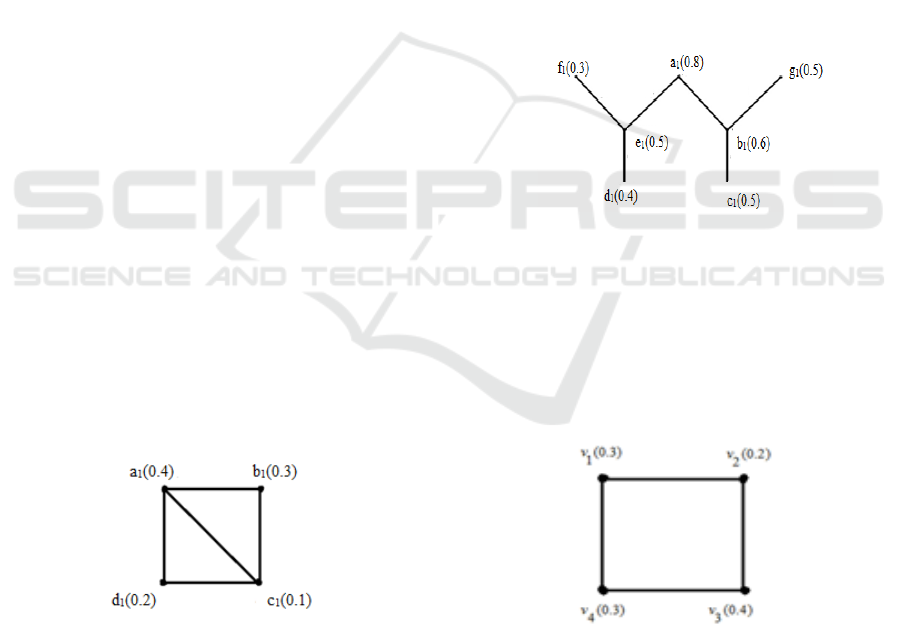
Figure 1: 𝐷=
𝑎1
,
𝐺
=4.
Definition 2.2: A subset D of V of a non-trivial
connected fuzzy graph G is referred to be triple
connected dominating set. If D is the dominating set
and the induced fuzzy sub graph <D> is triple
connected. The minimum cardinality of all tri
connected dominating set of G is called the triple
connected dominating number of G and is denoted by
ϒ
tc
(G).
Figure 2:
=
𝑎1, 𝑏1, 𝑒1
,
𝐺
= 0.8 + 0.5 + 0.6 = 1.9
Definition 2.3: A (1,2) dominant set in a fuzzy graph
G (V, E) is a set S with the characteristic that for every
vertex v in V - S. There is at least one vertex in S that
is one distance from v, and another that is nearly two
distances away. (1,2). The minimum cardinality of a
dominating set in a fuzzy graph G is known as the
(1,2) dominance number, denoted by ϒ(1,2).
Figure 3: (1,2) dominant set ϒ(1,2)=0.7
T., K., S., T. and R., D.
(One, Two) Tri Vertex Domination in Fuzzy Graphs.
DOI: 10.5220/0013893300004919
Paper published under CC license (CC BY-NC-ND 4.0)
In Proceedings of the 1st International Conference on Research and Development in Information, Communication, and Computing Technologies (ICRDICCT‘25 2025) - Volume 3, pages
139-142
ISBN: 978-989-758-777-1
Proceedings Copyright © 2025 by SCITEPRESS – Science and Technology Publications, Lda.
139
3 (ONE, TWO) TRI VERTEX
DOMINATION IN FUZZY
GRAPHS
In this section, we introduce several basic limits on
(One, two) tri vertex domination within fuzzy graphs.
The concept of (One, two) tri vertex domination
revolves around tri vertices. It is represented by ϒ
t
(One, two) along with related findings.
Definition 3.1: A (One, two) tri vertex dominant
set in a fuzzy graph G (V, E) is defined as a set S such
that for every vertex v in V - S, there are at least three
vertices in S that are one distance away from v, as
well as a second vertex in S that is almost two
distances away from v. The smallest size of a (One,
two) tri vertex dominating set in a fuzzy graph G is
known as the (One, two) tri vertex dominance
number, denoted by ϒ
t
(One, two).
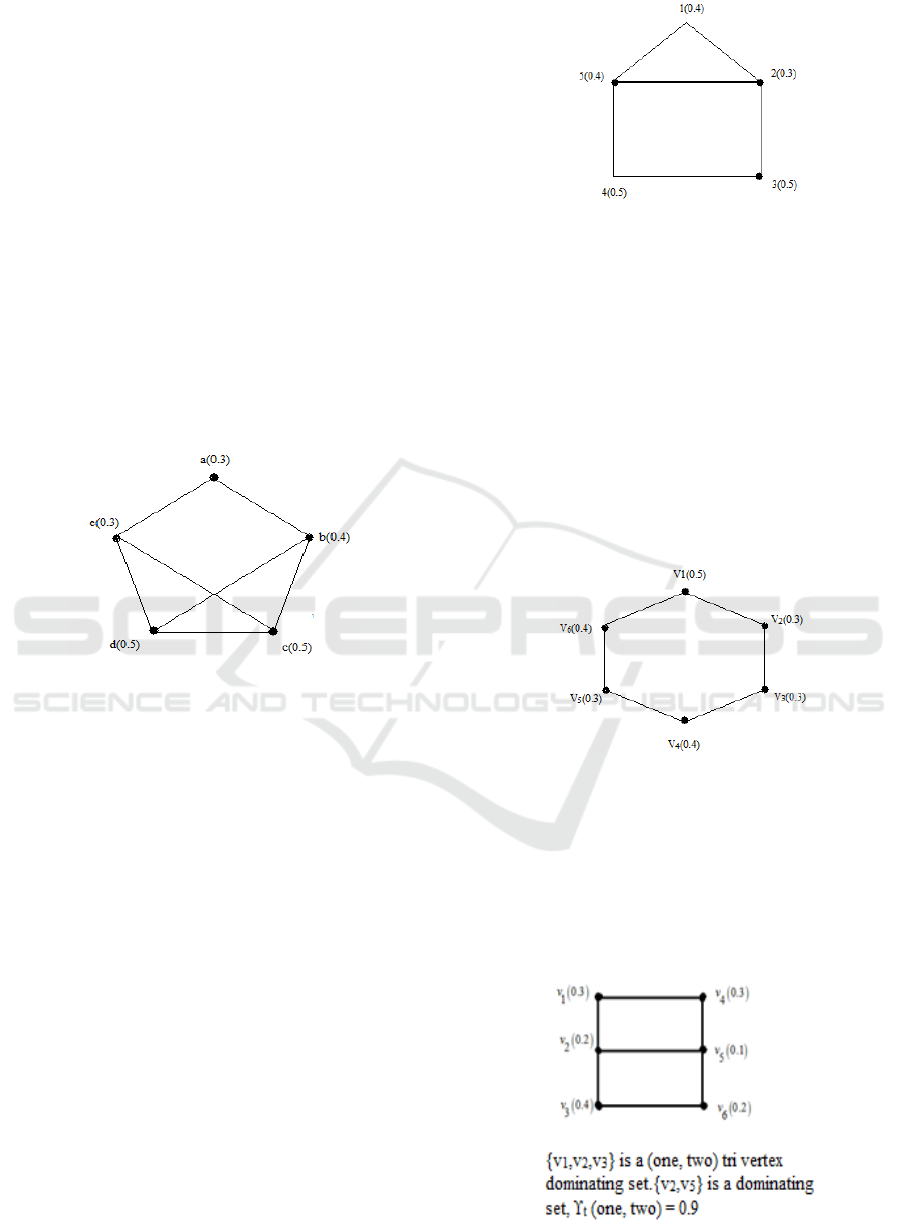
Figure 3.
Here (One, two) tri vertex dominating set is {b,c,d},
ϒ
t
(One, two)=1.4
Theorem 3.2: (One, two) tri-connected dominating
set for fuzzy graphs does not exist for all cases.
Proof: According to definition 3.1, if there are fewer
than three dominating vertices, the connected graph
cannot be considered tri-connected. We will focus
only on connected fuzzy graphs that have a
dominating set consisting of one or two vertices.
Theorem 3.3: The complement of a (One, two) tri
vertex dominating set is not necessarily a (One, two)
tri vertex dominating set.
Proof: For the fuzzy graph G, the set D serves as a
(One, two) tri vertex dominating set of G, while the
complement V-D does not qualify as a (One, two) tri
vertex dominating set.
Example 3.4: For the fuzzy graph G in Fig:4, (One,
two) tri vertex dominating set D= {1,3,4} and V-D=
{2,5} is not (One, two) tri vertex dominating set
Figure 4.
Theorem: 3.5: Every (One, two) tri vertex
dominating set qualifies as a dominating set, but the
reverse is not necessarily true.
Proof: According to the definition of a (One, two) tri
vertex dominating set, if D is a subset of V, then D
constitutes a tri vertex dominating set of G, which
means it is also a dominating set. However, it is
important to note that not every dominating set must
be a (One, two) tri vertex dominating set.
Example 3.6: For the fuzzy graph G in Fig:5, (One,
two) tri vertex dominating set = {v
1
, v
4
, v
6
} and
dominating set D= {v
1
, v
4
} but dominating set is need
not to be a (One, two) tri vertex dominating set.
Figure 5.
We look at ladder fuzzy graphs of orders 3 to 5
and find their domination number as well as the
domination number of (One, two) tri vertex. The
ladder fuzzy graph (Ln) is harmonious. This fuzzy
graph resembles a ladder, with two rails and n rungs
connecting them.
For n are three
For n are four
ICRDICCT‘25 2025 - INTERNATIONAL CONFERENCE ON RESEARCH AND DEVELOPMENT IN INFORMATION,
COMMUNICATION, AND COMPUTING TECHNOLOGIES
140
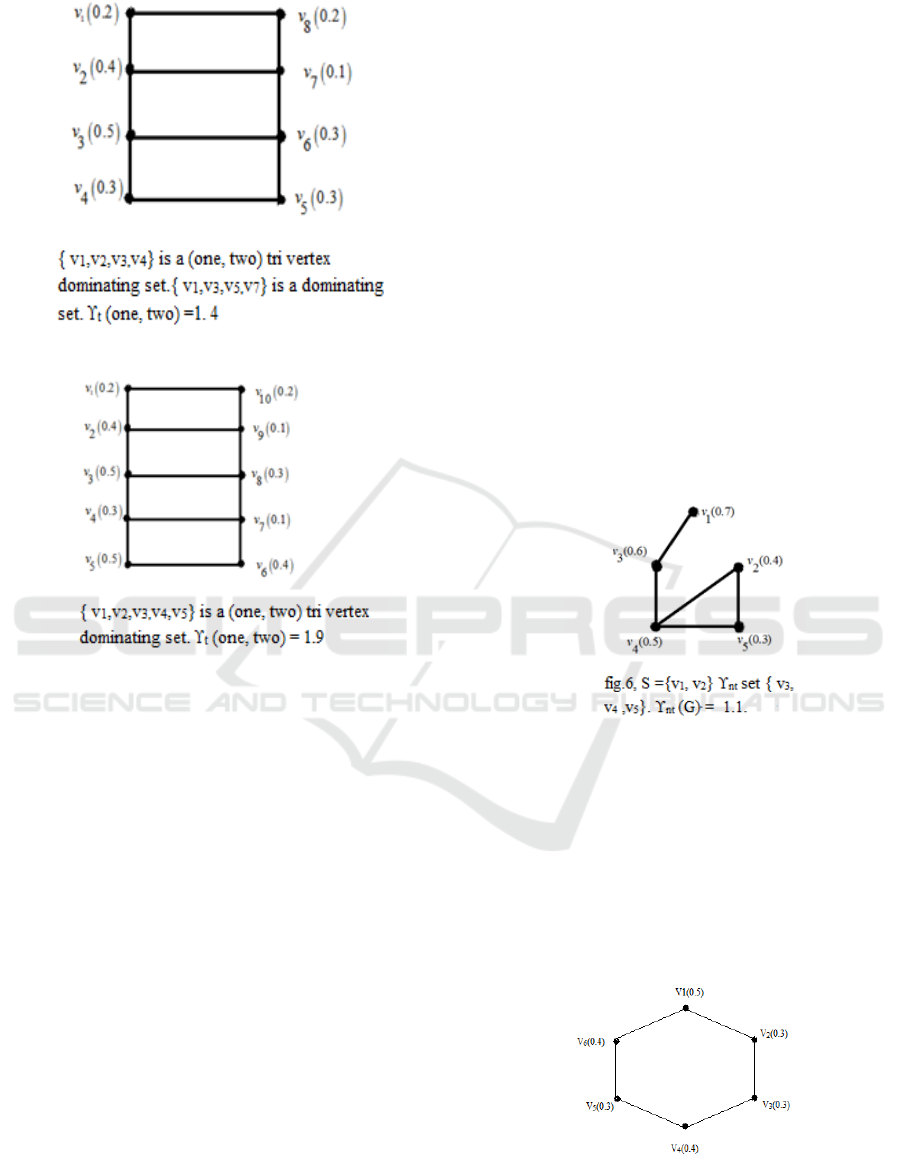
For n are five
From the cases above, we obtain the following
theorems:
Theorem 3.7: (One, two) tri vertex dominating
vertices is n for a ladder fuzzy graph.
Proof: In ladder fuzzy graph, twice of n vertices and
thrice of n vertices minus two edges also both rails
have n vertices. Assume that the right hand vertex in
the first rail is adjacent to left hand vertex in the
second rail. The other vertices in the first rail will be
at a distance greater than one from first left hand
vertex to build a (One, two) tri vertex dominating set;
we must include all of the vertices in a single rail and
connect at least three vertices. So the (One, two) tri
vertex dominating vertices are n
Theorem 3.8: (One, two) tri vertex dominating
vertices is n for a ladder fuzzy graph with n even
Proof: In ladder fuzzy graph, twice of n vertices and
thrice of n vertices minus two edges. If n is even, the
vertex in the inner rungs (n/2 rungs) can form a
dominant set. As each rung contains two vertices, the
dominating set will have n vertices.
4 (ONE, TWO)
NEIGHBOURHOOD TRI
VERTEX DOMINATION IN
FUZZY GRAPHS
In this part, we discuss fundamental constraints on
(One, two) Neighbourhood tri vertex domination in
fuzzy graphs. The idea behind (One, two)
Neighbourhood tri vertex domination revolves
around three Neighbourhood vertices. It is
symbolized as ϒ
nt
(One, two) together with related
findings.
Definition 4.1: A subset S of V of a fuzzy graph G is
called to be a Neighbourhood triple Connected
dominating set, if S is a dominating set and the
induced sub graph < N(S) > is triple connected. The
minimum cardinality of all Neighbourhood triple
connected dominating sets is known as the
Neighbourhood triple connected dominance number.
Definition 4.2: A (One, two) Neighbourhood tri
vertex dominant set in a fuzzy graph G (V, E) is
defined as a set N(S) such that for every vertex v in V
- N(S), there are at least three vertices in N(S) that are
one distance away from v, as well as a second vertex
in N(S) that is almost two distances away from v. The
smallest size of a (One, two) Neighbourhood tri
vertex dominating set in a fuzzy graph G is known as
the (One, two) Neighbourhood tri vertex dominance
number, denoted by ϒ
nt
(One, two).
Figure 6: (One, Two) Tri Vertex Dominating Set ={V1,
V4,V6} ,Dominating Set D= {V1,V4 } and (One, Two)
Neighbourhood Tri Vertex Dominating Set ={ V2,V3,V5}.
(One, Two) Tri Vertex Domination in Fuzzy Graphs
141

Observation 4.3: (One, two) neighbourhood tri
dominating set for fuzzy graph does not exist for all
cases
Observation 4.4: The complement of a (One, two)
neighbourhood tri dominating set is not necessarily
a (One, two) neighbourhood tri dominating set.
Observation 4.5: Every (One, two) neighborhood tri
dominating set qualifies as a dominating set, but the
reverse is not necessarily true.
5 CONCLUSIONS
(One, two) tri vertex dominance in a fuzzy graph is
defined, as is (One, two) neighbourhood tri vertex
dominating set. Theorems and observations about this
notion are derived, and the relationship between
dominance number in a fuzzy graph and (one, two)
and neighborhood tri vertex domination in fuzzy
graphs is established.
REFERENCES
Bhattacharya, Some remarks on fuzzy graphs, Pattern
Recognition letter 6,297-302.
Haynes T W, Hedetniemi S T and Slater P J, Fundamentals
of domination in Graphs, Marcel Dekker,New York,
1998.
Innovative Research in Science, Engineering and
Technology, Vol 5, Issue 9 (2016) 16501-16505
Mahadevan G and Selvam, (1, 2) - Domination in Graphs.
Murugesan N. and Deepa S. Nair, The Domination and
Independence of Some Cubic Bipartite Graphs, Int. J.
Contemp. Math Sciences, Vol.6, 2011, No.13,611-618.
Murugesan N and Deepa S Nair, (1,2) - domination in
Graphs,J. Math.Comput. Sci., Vol.2, 2012, No.4, 774-
783.
Rosenfeld A, Zedeh L A, Fu.K.Tanaka K S , Fuzzy sets and
their Application to cognitive and Decision processes
,Academic press, Newyork (1975) ,77-95.
Sarala N, Kavitha T,Connected Domination Number of
Square Fuzzy Graph ,IOSR-JM,Volume10, Issue 6 Vel
III (2014), 12-15
Sarala N,Kavitha T,Triple connected domination number of
fuzzy graph, International Journal of Applied
Engineering Research, Vol. 10 No.51 (2015)914-917
Sarala N,Kavitha T,Neighbourhood and efficient tri
connected domination number of a fuzzy graphIntern.
J. Fuzzy Mathematical Archive Vol. 9, No. 1, 2015, 73-
80
Sarala N, Kavitha T, Strong (Weak) Tri Connected
Domination Number of a Fuzzy Graph, International
Journalof Computational Engineering Research,
Volume, 05 Issue, 11 2015 ,18-22
Sarala N,Kavitha T,(1,2) vertex domination number in
fuzzy graph, International Journal of
ICRDICCT‘25 2025 - INTERNATIONAL CONFERENCE ON RESEARCH AND DEVELOPMENT IN INFORMATION,
COMMUNICATION, AND COMPUTING TECHNOLOGIES
142
