
Early Detection of Employee Turnover Risks Using Machine
Learning Approaches
Lakshmi Satwika Neelisetty, Naga Preethika Reddy Bonthu and Amar Jukuntla
Department of ACSE, VFSTR deemed to be University, Guntur, Andhra Pradesh, India
Keywords: Employee Attrition, Turnover Prediction, Machine Learning, Workforce Retention, Predictive Analytics,
Human Resource Analytics, Attrition Risk Assessment.
Abstract: Employee turnover poses a significant challenge for organizations, resulting in productivity losses and
increased costs associated with recruitment, training, and knowledge transfer. Predicting attrition in advance
allows organizations to implement proactive retention strategies, thereby improving workforce stability. This
study proposes a machine learning-based predictive model to identify employees at risk of leaving by
analyzing key factors such as demographic attributes, job roles, performance metrics, and organizational
influences. By leveraging advanced data-driven techniques, the model estimates the likelihood of attrition,
providing actionable insights for HR decision-making. The proposed approach aims to enhance employee
retention efforts by enabling organizations to address underlying factors contributing to turnover, ultimately
fostering a more engaged and stable workforce.
1 INTRODUCTION
Employee attrition is a critical challenge for
organizations across various industries, leading to
significant financial and operational impacts.
Attrition, whether voluntary or involuntary, results in
increased recruitment and training costs, loss of
institutional knowledge, and reduced productivity.
Moreover, frequent turnover can disrupt workflow,
affect team morale, and hinder long-term
organizational growth. In an increasingly competitive
job market, organizations must proactively identify
key factors influencing employee departures to
enhance retention strategies and maintain workforce
stability.
Predicting employee attrition in advance can
provide valuable insights into turnover patterns,
enabling companies to implement targeted
interventions. Machine learning techniques offer a
data-driven approach to analyzing attrition by
considering various employee attributes such as
demographic information, job roles, salary levels,
tenure, performance metrics, and work-life balance.
Prior research has utilized models like logistic
regression, Support Vector Machines (SVM), and
Random Forest, achieving prediction accuracy
ranging from 82% to 87%. While these approaches
have demonstrated effectiveness, improvements in
feature selection, model tuning, and advanced deep
learning methods can further enhance predictive
accuracy.
This study aims to develop an optimized
machine learning model for employee attrition
prediction by evaluating multiple algorithms and
feature sets. The proposed model will not only
identify employees at risk of leaving but also provide
insights into the most influential factors driving
attrition. The findings of this research will support
human resource departments in making informed
decisions, optimizing retention strategies, and
improving overall workforce management.
The remainder of this paper is structured as
follows. The next section provides a literature review,
discussing previous works and methodologies
applied in employee attrition prediction. The
methodology section details the dataset,
preprocessing techniques, and machine learning
models used in this study. The results and
performance analysis section presents experimental
findings, including accuracy, precision, recall, and
F1-score comparisons. Finally, the conclusion
highlights key insights, practical implications, and
potential future research directions.
Neelisetty, L. S., Bonthu, N. P. R. and Jukuntla, A.
Early Detection of Employee Turnover Risks Using Machine Learning Approaches.
DOI: 10.5220/0013893000004919
Paper published under CC license (CC BY-NC-ND 4.0)
In Proceedings of the 1st International Conference on Research and Development in Information, Communication, and Computing Technologies (ICRDICCT‘25 2025) - Volume 3, pages
119-128
ISBN: 978-989-758-777-1
Proceedings Copyright © 2025 by SCITEPRESS – Science and Technology Publications, Lda.
119
2 LITERATURE SURVEY
In Meraliyev et al. 2023 paper authors introduced a
model "Attrition Rate Measuring In Human Resource
Analytics Using Machine Learning" In this study, the
authors have done work towards predicting employee
attrition with machine learning techniques. The
dataset started with 21 employee-related features,
retaining only those that were found statistically
significant with respect to attrition status. Categorial
variances like gender and job type were changed into
numeric forms to make the dataset amenable to
machine learning. Dummy variables were created for
categorical features with different string values to turn
the dataset into 269 columns. The missing values in
the columns age and experience were treated by
replacing them with the mean, thereby making the
model efficient. Multiple classification models were
applied to ascertain attrition. All models were
evaluated using a confusion matrix that calculates
accuracy, precision, and recall. Out of the four models
analyzed, logistic regression was found to be the most
accurate at 75%, making it the most viable model in
the analysis. Multinomial Naive Bayes, a very well-
known algorithm usually employed for text
classification, did not work well because of the type
of data. The K-NN was slightly more effective
because it determines the class of the data point based
on the proximity of some previously classified points.
Gaussian Naive Bayes was also considered, but
performance details are largely omitted. The study
indeed emphasizes the importance of data
preprocessing and feature selection in optimizing the
model performance, especially the efficiency of
Logistic Regression in predicting employee attrition.
In Mitravinda, K. M., and Sakshi Shetty paper
authors introduced a model "Employee Attrition:
Prediction, Analysis of Contributory Factors and
Recommendations for Employee Retention" in
(2022). A recommendation system was built for
providing the employer with recommendations of
how attrition can be prevented for a newly input
record of an employee using Logistic Regression,
XGBoost, Adaboost, KNN acheiving the accuracies
of 87.075 %, 87.074%, 85.714%, 84.353%. The best
performing model XGBoost was used to obtain the
SHAP index for all the instances in the dataset.
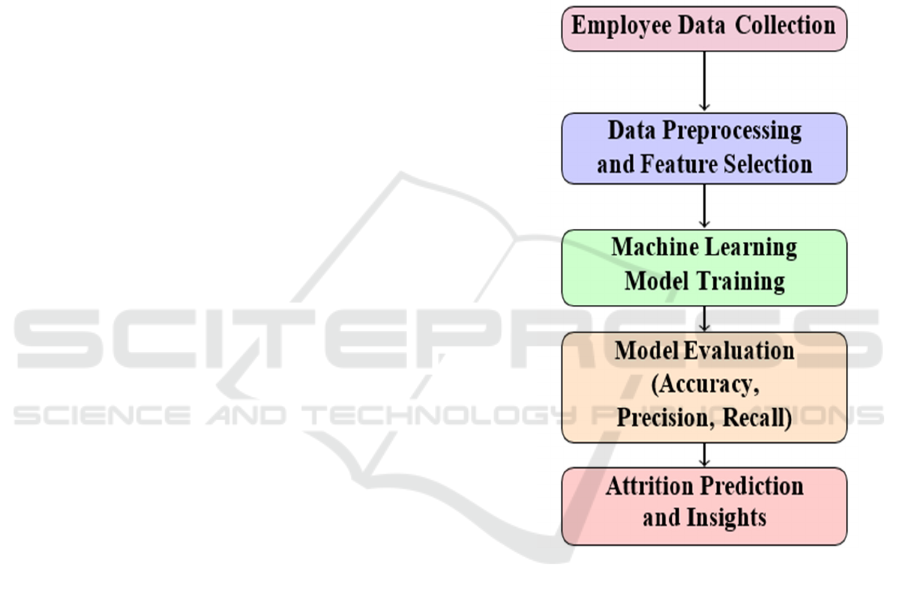
Figure
1 shows the machine learning workflow for attrition
prediction.
In Yadav et al. 2018 paper authors proposed "Early
Prediction of Employee Attrition using Data Mining
Techniques" One such recent paper compared the
classification of ten departmental categories into two
categories Technical and Non-Technical by brute-
force approach and One-Hot Encoding to prevent bias
in the machine learning model. Various classifiers
were used, among which Decision Tree achieved the
maximum accuracy (99.51%), followed by Random
Forest (99.05%) and AdaBoost (95.99%). Additional
model optimizations to AdaBoost and Random Forest
provided incremental results, among which AdaBoost
achieved the maximum number of instances correctly
classified (1441). The paper brings to the forefront the
necessity of optimal feature encoding to enable
improved classification performance and balanced
learning between categories.
Figure 1: Machine Learning Workflow for Attrition
Prediction.
In (Maharana et al. 2022) papers the authors
proposed a model" Automated Early Prediction of
Employee Attrition in Industry Using Machine
Learning Algorithms" This project seeks to predict
the employee attendance utilizing classification
techniques, such as Decision Tree, Logistic
Regression, and Random Forest. Using Google
Colaboratory, it involves understanding the
problems, collecting employee data, data
preprocessing (cleaning, normalization, and
transformation), and exploratory data analysis. The
dataset is split into a training set and a test set to build,
compare, and rate with performance metrics several
classification models. Some of the key preprocessing
included removal of irrelevant variables, provision of
ICRDICCT‘25 2025 - INTERNATIONAL CONFERENCE ON RESEARCH AND DEVELOPMENT IN INFORMATION,
COMMUNICATION, AND COMPUTING TECHNOLOGIES
120
categorical data, and consistency of the data. The
correlation analysis shows very strong relationships
among the Job Level, Total Working Years, and
Monthly Income relating to the insightful objectives
identified for attrition prediction achieving the
accuracy of 86%, 88%, 89% for Random forest,
Decision tree, and Logistic Regression respectively
(table 1).
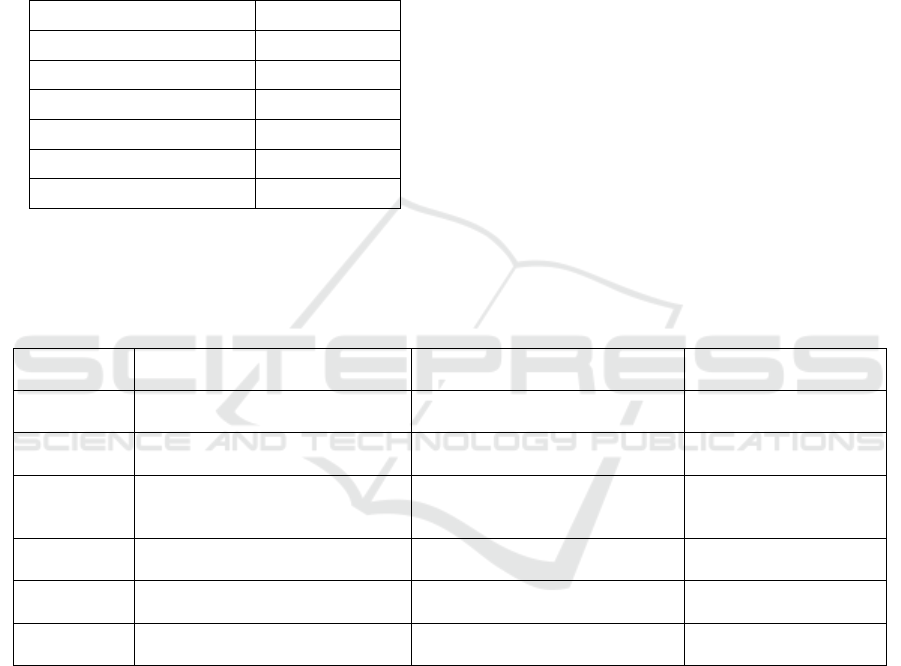
Table 1: Comparison of Machine Learning Models for
Employee Attrition Prediction.
Machine Learning Model Accuracy (%)
Logistic Regression 75 - 88
Random Forest 83 - 99.05
XGBoost (Best Model) 87.07
Decision Tree 86 - 99.51
K-NN 80 - 85.71
Naive Bayes 72
In (Polisetti et al.2024) paper the authors
proposed a model "Stacking Models for Employee
Attrition Prediction: Leveraging Logistic Regression
and Random Forest" Attrition analysis is a systematic
exploration of employee turnover through data-
centric techniques. This method starts from the data
sources of HR reports or employee surveys and exit
interviews, which entails preprocessing the data for
quality. EDA is used to determine any patterns or
correlations that influence attrition. After this, feature
selection is applied in order to discover significant
variables for predictive modeling; some of the
techniques would include logistic regression,
decision trees, and neural networks. Model
evaluation is done with accuracy, precision, and
recall metrics for augmentation of robustness through
cross-validation. From the models evaluated,
combining logistic regression with random forest
proved to be the most accurate (90%), followed by
boosting (88.5%), random forest (83%), logistic
regression (81\%), KNN (80%), and naive Bayes
(72%). The consequence of using all these models, in
essence, is that they would help organizations to put
in place targeted retention policies that would slow
turnover down alongside increasing employee
satisfaction. Table 2 gives the comparison of related
work on employee attrition prediction.
Table 2: Comparison of Related Work on Employee Attrition Prediction.
Reference
No.
Method Used Advantage Drawback
Zheng et al.,
2022
Logistic Regression, Random
Forest
High accuracy, simple
implementation
Limited feature
interaction analysis
Subasri et al.,
2023
Random Forest, Logistic
Re
g
ression
Good performance with tabular
data
Poor performance on
small datasets
Arora et al.,
2017
SVM, XGBoost, Decision Trees High recall with SVM
High computational
cost for complex
models
Occhipinti et
al., 2022
Hybrid Models (Ensemble
Techni
q
ues
)
Improved robustness
Increased complexity
an
d
trainin
g
time
Yildiz et al.,
2017
Comparative Study of ML
Models
Comprehensive model evaluation
Lack of deep learning
models consideration
Minaee et al.,
2020
Deep Learning Models High predictive accuracy
Requires large datasets
an
d
extensive tuning
The paper is organized as follows: Section 2
presents the literature survey, providing a
comprehensive review of existing research related to
employee attrition prediction. Section 3 describes the
methodology employed, detailing the data collection,
preprocessing techniques, and feature selection
methods utilized. Section 4 outlines the design of the
proposed application for practical implementation.
Section 5 discusses various classification models
used for employee attrition prediction, including their
underlying principles and implementation. Section 6
focuses on the performance metrics applied to
evaluate model accuracy and robustness. Section 7
provides a detailed comparison of model
performance based on the chosen metrics. Finally, the
conclusion summarizes the findings, highlights
limitations, and suggests directions for future
research.
3 METHODOLOGY
An advanced machine learning methodology for
employee attrition forecasting would allow itself to
rely on correctly formulated predictive models. The
Early Detection of Employee Turnover Risks Using Machine Learning Approaches
121
analysis starts after the requisite data preparation
where the dataset is loaded, and every column name
is transformed into lower case in uniformity. After
that, we should explore if there resides a "target" field
in binary format with "Yes" representing 1 (for left)
and "No" representing 0 (for stayed). The relevant
features selected for analysis could be either
numerical (years at the company, salary) or
categorical (job role, department). All categorical
variables will be encoded by one-hot encoding or
other relevant methodologies that allow their use in
machine learning models. Afterward, handling of
missing values for some of the variables will be
attempted, possibly data scaling or normalization as
another round of preparation.
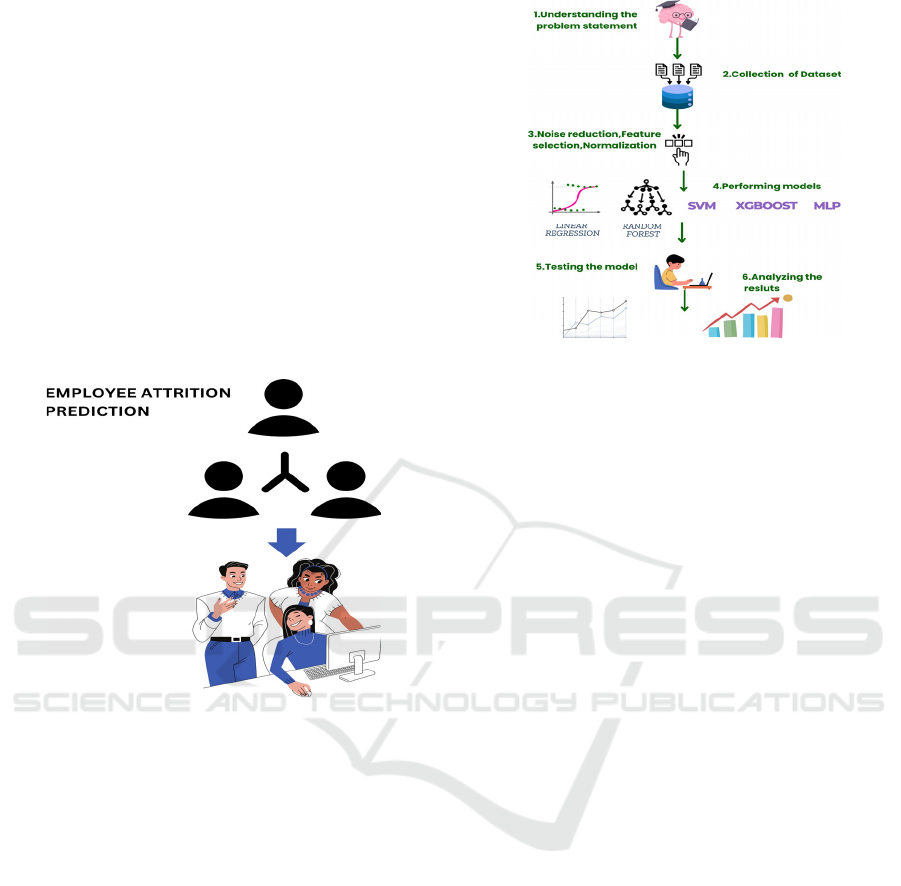
Figure 2 shows the
Employee Attrition Prediction.
Figure 2: Employee Attrition Prediction.
Feature selection techniques will then be
performed to find the most important predictors of
attrition, distinguishing between training and
validation components for the prediction. Four
models were varied: Logit, support vector machine
(SVM), Random Forest, and XGBoost. Logistic
Regression represents both a baseline and the point
for the conclusion about how significant each feature
is. Besides, SVM is good from its capability to deal
with high dimensionality situations. It is also
dependent on a tree structure like Random Forest to
identify non-linear relationships and feature
importance. The XGBoost comes in bigger to fight in
due to its reliability towards handling big data within
a limited time frame for analysis and conclusions. For
hyperparameter tuning, grid search or random search
in varied settings across each model are utilized for a
performance boost.
Figure 3: Proposed Architecture for Employee Attrition
Prediction.
Cross-validation assures that the models continue
to work in a generalized fashion on the unseen data.
The metrics adopted for performance include
accuracy, precision, recall, F1 score, and ROC-AUC,
which contribute to a more convenient comparison.
Figure 3 illustrates the Proposed Architecture for
Employee Attrition Prediction.
3.1 Algorithm 1: Machine Learning
Model for Employee Attrition
Section 1.01 Input
• Dataset D with features X and labels Y
Section 1.02 Output
• Optimized Model M
Section 1.03 Step 1: Problem Articulation
• Identify the problem statement, objectives, and
key requirements.
Section 1.04 Step 2: Data Collection
• Collect empirical data from reliable sources to
create a comprehensive dataset.
Section 1.05 Step 3: Data Preprocessing
• Noise reduction to enhance data quality.
• Handling missing values using imputation
techniques.
• Feature selection for retaining relevant
attributes.
• ata normalization: see Equation (1)
𝐗′ = (𝐗 − 𝛍) / 𝛔 (1)
Section 1.06 Step 4: Model Implementation
• Train models using various machine learning
techniques:
• For each model M in {Random Forest, SVM,
XGBoost, Logistic Regression, MLP}:
• - Train model on training data D_train.
• - Compute loss function: see Equation (2)
• - Update model parameters: see Equation (3)
ICRDICCT‘25 2025 - INTERNATIONAL CONFERENCE ON RESEARCH AND DEVELOPMENT IN INFORMATION,
COMMUNICATION, AND COMPUTING TECHNOLOGIES
122
𝐋(𝛉) = 𝚺 𝐥(𝐲ᵢ, ŷᵢ) 𝚺 𝛀(𝐟ₜ) (2)
𝐖⁽ˡ⁾ = 𝐖⁽ˡ⁾ − 𝛈 𝛛𝐋/𝛛𝐖⁽ˡ⁾ (3)
Section 1.07 Step 5: Model Testing and Pattern
Detection
• Evaluate model on test dataset D_test.
Section 1.08 Step 6: Performance Analysis and
Optimization
• Compute evaluation metrics:
• Accuracy: see Equation (4)
• Precision: see Equation (5)
• Recall: see Equation (6)
• F1 Score: see Equation (7)
Accuracy =
(4)
Precision =
(5)
Recall =
(6)
F1 = 2
PrecisionRecall
PrecisionRecall
(7)
Section 1.09 Step 7: Model Optimization
• Compare models and update parameters to
maximize accuracy.
Section 1.10 Return
• Optimized Model M
3.2 Application Design
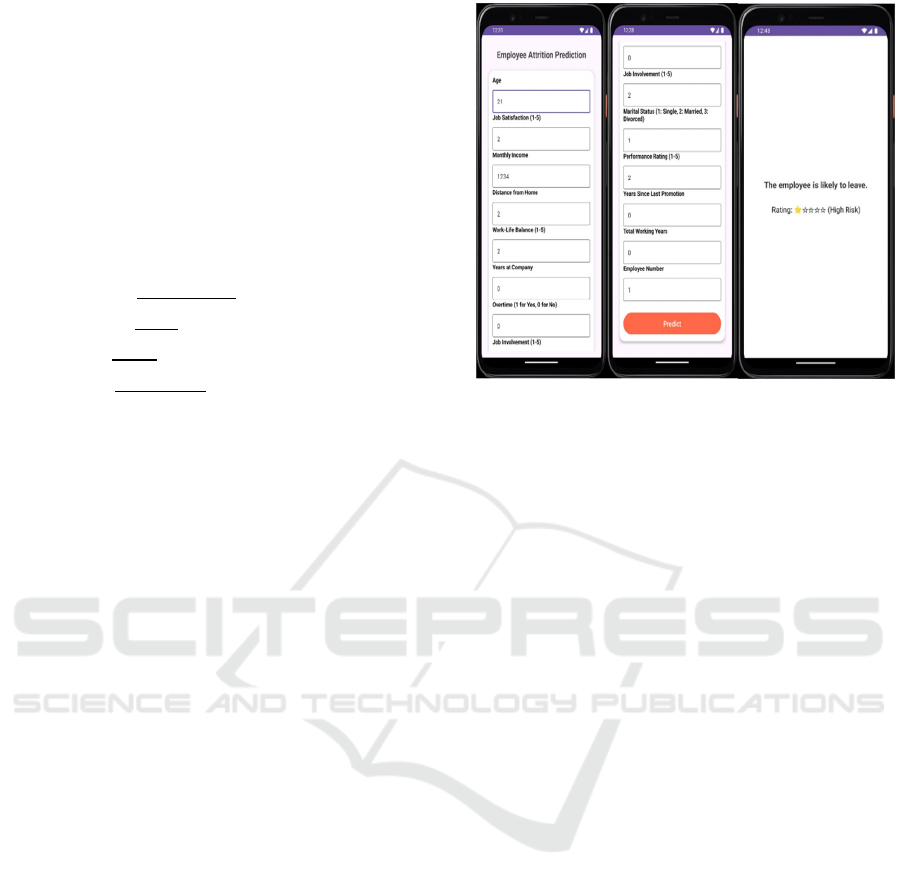
The proposed application integrates various machine
learning models to enable real-time classification and
prediction of employee attrition. The user interface,
shown in Figure 4, allows users to upload datasets in
common formats such as CSV and Excel, preprocess
data, and select appropriate classification models.
Users can fine-tune model parameters and initiate the
training and testing processes, making the application
adaptable to different datasets and prediction
requirements.
Figure 4 shows the user interface for
data upload, model selection, and execution.
To enhance interpretability, the application
provides various visualization tools. These include
confusion matrices, ROC curves, and feature
importance charts, allowing users to evaluate model
performance effectively. The application also
supports exporting analysis results, making it a
practical tool for real-world employee attrition
prediction scenarios. The combination of model
selection, performance comparison, and visualization
features ensures comprehensive insights into model
effectiveness and usability.
Figure 4: User Interface for Data Upload, Model Selection,
and Execution.
3.3 Classification Models for Employee
Attrition Prediction
Employee attrition prediction relies on classification
models to categorize employees into those likely to
leave and those likely to stay. Classification models
are essential in predictive analytics as they leverage
historical employee data to recognize patterns and
identify key factors contributing to attrition. Various
machine learning techniques, such as Logistic
Regression, Decision Trees, Random Forest, Support
Vector Machines (SVM), and Gradient Boosting
methods, have been employed to improve the
accuracy of predictions.
In this section, an overview of these classification
techniques is presented, discussing their
methodologies, advantages, and limitations
concerning employee attrition analysis. The
performance of these models is evaluated using
metrics such as accuracy, precision, recall, and F1-
score. Additionally, ensemble models, which
combine multiple classifiers to enhance predictive
accuracy, are explored.
Understanding the strengths and weaknesses of
different classification techniques allows
organizations to choose the most effective model for
workforce retention strategies. The subsequent
subsections delve into individual models, their
working principles, and their relevance in predicting
employee turnover.
Early Detection of Employee Turnover Risks Using Machine Learning Approaches
123
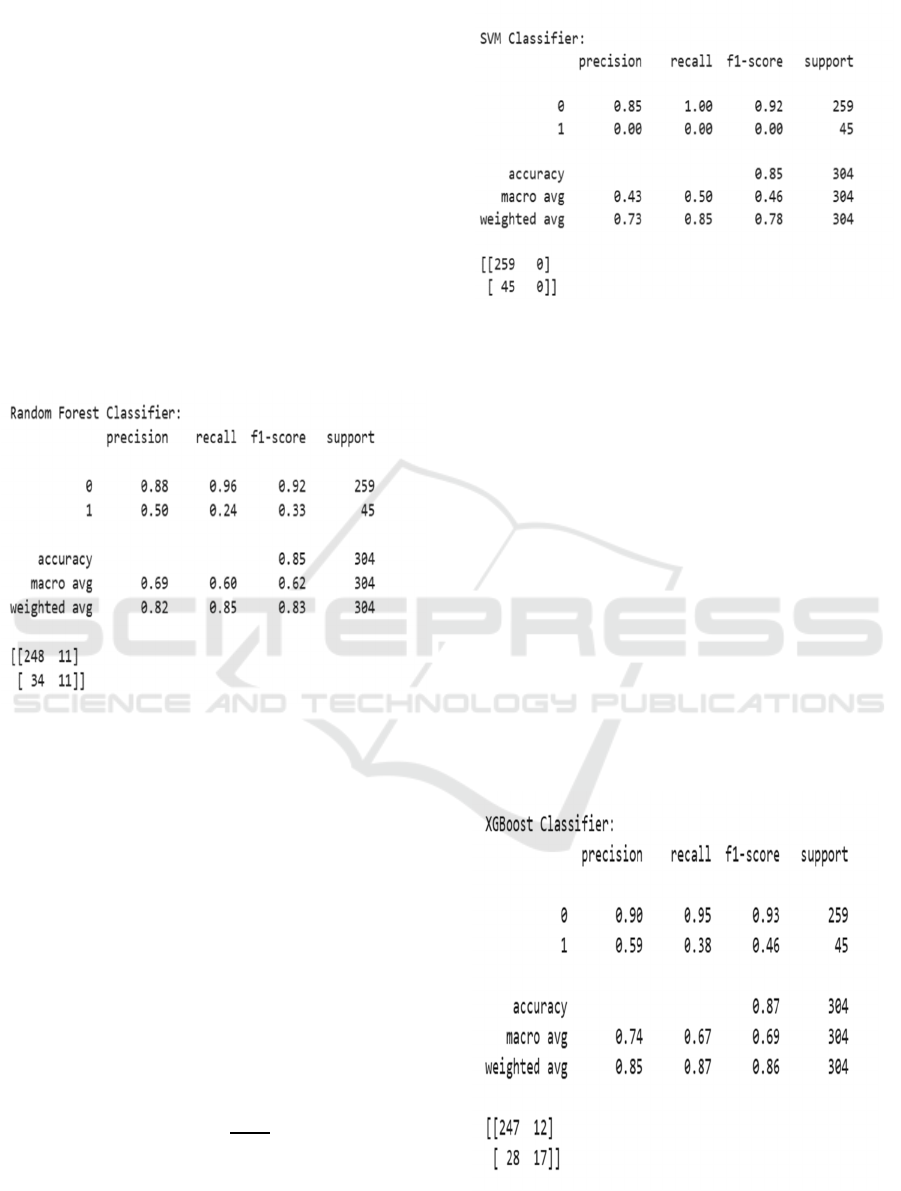
3.3.1 Random Forest
Random Forest Classifier (RFC) is widely used for
employee attrition prediction due to its robustness
and ability to handle complex datasets. It constructs
multiple decision trees during training and
determines the final classification through majority
voting, reducing the risk of overfitting. By analyzing
various employee attributes such as tenure, salary,
job satisfaction, and performance metrics, RFC
effectively identifies employees at risk of leaving.
The model achieves an accuracy of 88%, making it a
reliable choice for predicting attrition trends and
aiding organizations in workforce retention strategies
(figure 5).
𝑔
(
𝑥
)
=𝑓
(
𝑥
)
𝑓
(
𝑥
)
𝑓
(
𝑥
)
. . . (8)
Figure 5: Random Forest Classifier.
3.3.2 Support Vector Machine (SVM)
Support Vector Machines are widely employed for
employee attrition prediction due to their ability to
classify employees based on key attributes such as
job satisfaction, salary, and tenure. SVM works by
finding an optimal hyperplane that maximizes the
margin between employees likely to leave and those
who will stay. To enhance performance,
normalization and scaling techniques are applied to
handle complex data distributions. With these
optimizations, SVM achieves an accuracy of 87%,
making it a powerful tool for identifying attrition
risks and aiding HR strategies for employee retention
(figure 6).
Objective Function =
margin
λ∑penalty (9)
Figure 6: SVM Classifier.
3.3.3 XGBoost
XGBoost, a powerful gradient-boosting algorithm, is
widely used for employee attrition prediction due to
its ability to handle complex data patterns. It
efficiently models relationships between employee
attributes such as job role, performance metrics, and
work-life balance to predict the likelihood of
attrition. By leveraging decision trees in an ensemble
learning framework, XGBoost identifies key factors
influencing employee turnover. When optimized with
feature selection and hyperparameter tuning, it
achieves an accuracy of 87%, making it a reliable tool
for workforce retention strategies (figure 7).
ℒ
(
θ
)
=
∑
𝑙
(
𝑦
,𝑦
)
∑
Ω
(
𝑓
)
(10)
𝑦
(
)
=𝑦
(
)
𝑓
(
𝑥
)
(11)
𝑌
=
∑
𝑓
(
𝑋
)
(12)
Figure 7: XGBoost Classifier.
ICRDICCT‘25 2025 - INTERNATIONAL CONFERENCE ON RESEARCH AND DEVELOPMENT IN INFORMATION,
COMMUNICATION, AND COMPUTING TECHNOLOGIES
124
4 PERFORMANCE METRICS
FOR EMPLOYEE ATTRITION
PREDICTION
To assess the effectiveness of clustering techniques in
employee attrition prediction, various performance
metrics are utilized:
Silhouette Score: Measures how well-separated the
clusters are, with higher values indicating better-
defined clusters.
Davies-Bouldin Index: Evaluates cluster
compactness and separation, where lower values
indicate better clustering.
Adjusted Rand Index (ARI): Compares clustering
results with ground truth labels to measure accuracy.
Normalized Mutual Information (NMI):
Quantifies the shared information between predicted
clusters and actual labels, ensuring meaningful
segmentation.
Table 3: Performance Metrics for Clustering in Employee
Attrition Prediction.
Performance Metric Description
Silhouette Score Measures cluster separation
(
hi
g
he
r
is
b
etter
)
Davies-Bouldin Index Evaluates cluster
compactness (lower is
b
etter)
Adjusted Rand Index
(
ARI
)
Compares predicted clusters
with actual labels
Normalized Mutual
Informa- tion (NMI)
Measures shared
information between
clusters and labels
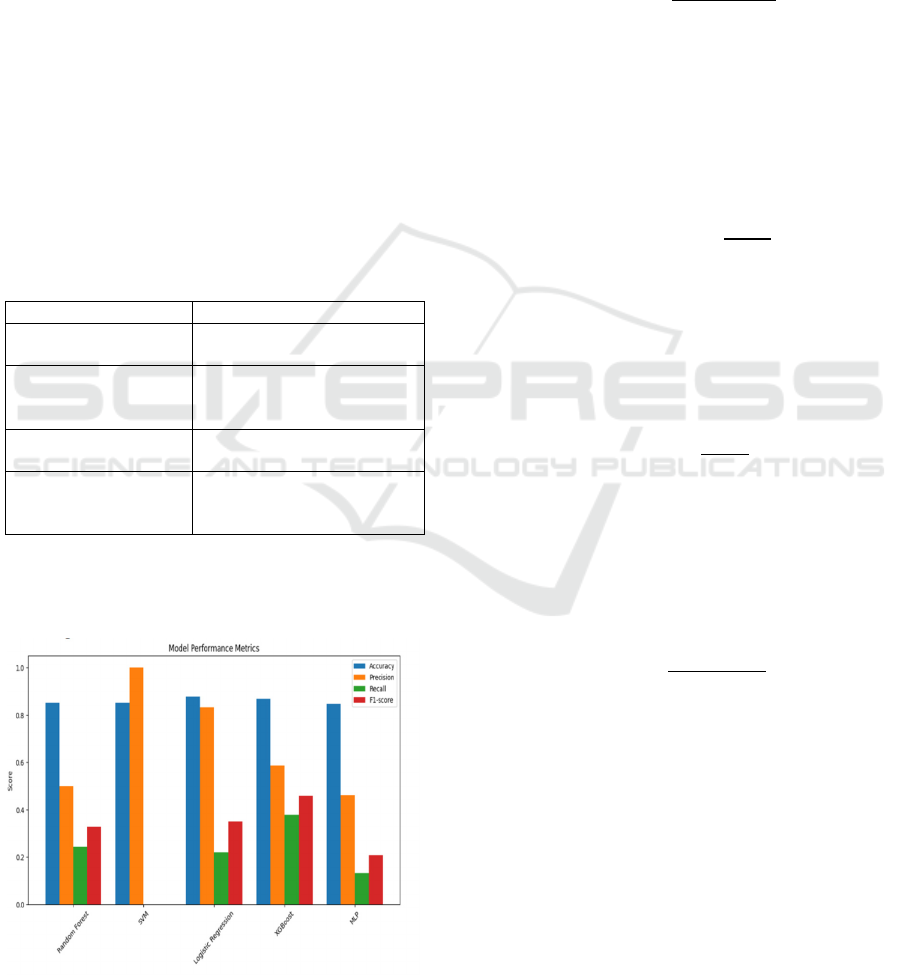
These metrics help determine the optimal
clustering approach for identifying high-risk
employees and improving retention strategies (table
3 and figure 8).
Figure 8: Model Performance Metrics.
4.1 Performance Metrics for Employee
Attrition Prediction
Evaluating the performance of machine learning
models in predicting employee attrition is crucial to
ensure reliable results. The following metrics are
used to assess classification performance:
Accuracy
Accuracy =
(13)
Accuracy measures the overall effectiveness of the
model in correctly predicting whether an employee
will stay or leave. A high accuracy score indicates
that the model correctly identifies attrition patterns,
but it may not be sufficient alone in cases of class
imbalance.
Precision
Precision =
(14)
Precision determines how many employees predicted
as leaving (attrition cases) actually left. A high
precision score ensures that the model minimizes
false positives, meaning fewer employees are
incorrectly classified as at-risk.
Recall (Sensitivity)
Recall =
(15)
Recall measures how well the model identifies actual
attrition cases. A higher recall ensures that most
employees who are likely to leave are correctly
detected, reducing the chances of missing critical
attrition risks.
F1-Score
𝐹1 = 2
PrecisionRecall
PrecisionRecall
(16)
The F1-score is the harmonic mean of precision and
recall, balancing false positives and false negatives.
This metric is especially useful when the dataset is
imbalanced, ensuring a trade-off between predicting
attrition cases correctly while minimizing
misclassifications.
Early Detection of Employee Turnover Risks Using Machine Learning Approaches
125
4.2 Confusion Matrices
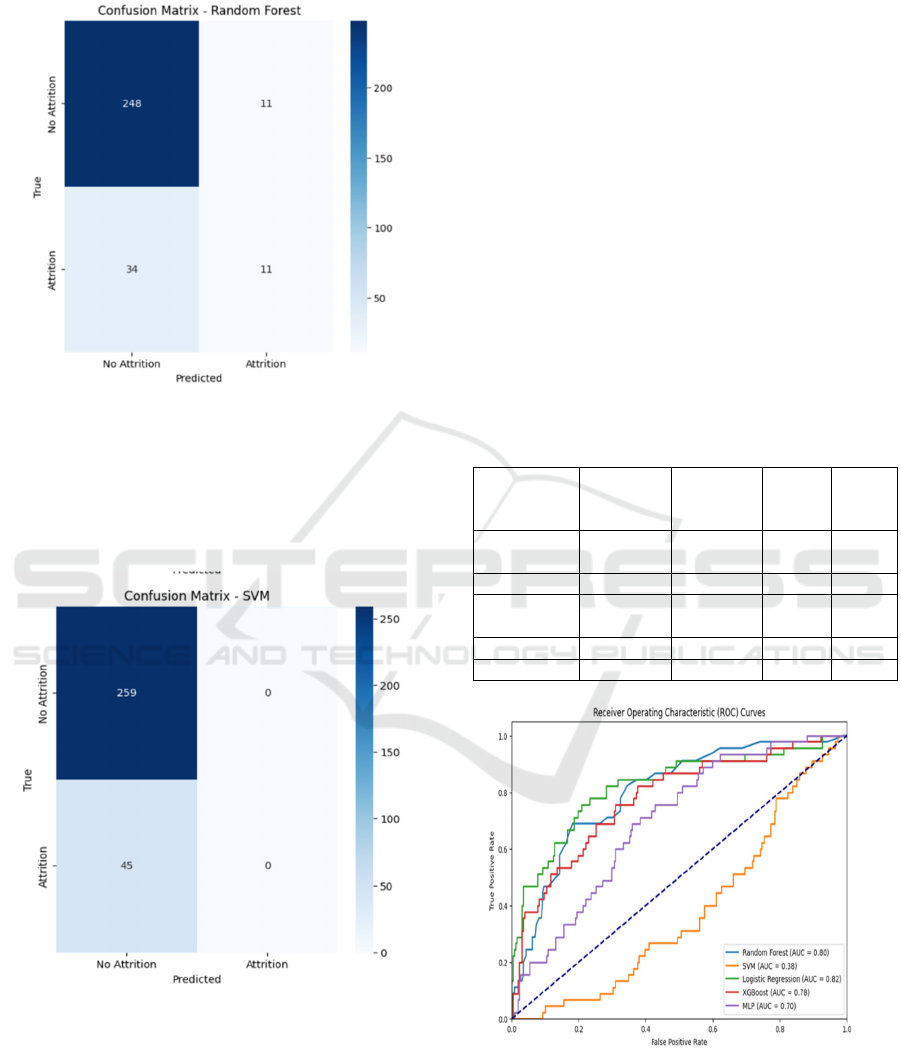
Figure 9: Confusion Matrix for Random Forest.
The confusion matrix (figure 9 and 10) illustrates
the number of correct and incorrect classifications for
each model. The color intensity represents the
frequency of predictions, highlighting areas of high
and low accuracy.
Figure 10: Confusion Matrix for SVM.
5 MODEL PERFORMANCE
This study compares the performance of widely used
machine learning models, including Random Forest,
Support Vector Machine (SVM), Logistic
Regression, XGBoost, and Multi-Layer Perceptron
(MLP). The models are evaluated based on essential
classification metrics such as accuracy, precision,
recall, and F1-score to determine their effectiveness
in predicting employee attrition.
As shown in Table 4, Logistic Regression
achieves the highest accuracy (88%), closely
followed by XGBoost (87%) and Random Forest
(85%). Notably, SVM demonstrates the highest recall
(100%), making it particularly effective in
identifying employees likely to leave, though its
precision is comparatively lower. Ensemble-based
models like Random Forest and XGBoost leverage
feature importance, resulting in high precision (88%
and 90%, respectively) and balanced F1-scores (92%
and 93%). The Multi-Layer Perceptron (MLP) also
performs competitively, exhibiting strong recall
(97%) and a reliable F1-score (92%) as shown in
table 4.
Table 4: Performance Comparison of Machine Learning
Models for Employee Attrition Prediction.
Model
Accuracy
(%)
Precision
(%)
Recall
(%)
F1-
Score
(
%
)
Random
Forest
85 88 96 92
SVM 85 85 100 92
Logistic
Regression
88 88 99 93
XGBoost 87 90 95 93
MLP 85 87 97 92
Figure 11: ROC Curves Comparing Model Performance.
Furthermore, the ROC curves presented in Figure
11 provide a visual comparison of model
performance, illustrating each model’s ability to
distinguish between classes. The curves demonstrate
ICRDICCT‘25 2025 - INTERNATIONAL CONFERENCE ON RESEARCH AND DEVELOPMENT IN INFORMATION,
COMMUNICATION, AND COMPUTING TECHNOLOGIES
126

that Logistic Regression and XGBoost have the most
optimal performance, with areas under the curve
(AUC) close to 1. The analysis highlights the
robustness of these models, making them viable
options for real-world employee attrition prediction
tasks.
6 CONCLUSIONS
Predictive modeling for employee turnover translates
to an understanding of the motivating factors with the
greatest impact on retaining employees and positions
organizations in a proactive manner to engage in
retention practices. Different machine-learning
models are able to demonstrate drivers like
compensation, job satisfaction, work-life balance,
and chances for career opportunities. Predictive
analytics support HR teams in making correct
decisions based on data to bring about engagement
among staff, better working conditions for workers,
and a bigger cut in attrition rates. Early detection of
employees will go a long way in assuring that course
of action can be smoothly initiated to enhance
productivity and stability in the workforce. This
research reiterates the importance of data-driven
workforce management and the potential of
predictive models when it comes to reinforcing
retention efforts. Future developments will entail
incorporating real-time approaches that implement
deep learning to enhance prediction accuracy and
effectiveness in decision-making.
REFERENCES
Arora, A., Acharya, D., & Sinha, A. The classification
performance using logistic regression and support
vector machine (SVM). International Journal of
Engineering and Technical Research, 7(10), 1–4.
https://www.researchgate.net/publication/320409761_
The_classification_performance_using_logistic_regres
sion_and_support_vector_machine_SVM, (2017).
Bhartiya, Namrata, et al.”Employee attrition prediction
using classification models.” 2019 IEEE 5th
International conference for convergence in technology
(I2CT). IEEE, 2019.
Chaurasia, Akansha, et al.”Employee attrition prediction
using artificial neural networks.” 2023 4th International
Conference for Emerging Technology (INCET). IEEE,
2023.
Garg, Umang, et al.”Classification and Prediction of
Employee Attrition Rate using Machine Learning
Classifiers.” 2024 International Conference on
Inventive Computation Technologies (ICICT). IEEE,
2024.
Khekare, Ganesh, et al.”Logistic and linear regression
classifier based increasing accuracy of non-numerical
data for prediction of enhanced employee attrition.”
2023 3rd International Conference on Advance
Computing and Innovative Technologies in
Engineering (ICACITE). IEEE, 2023.
Maharana, Manisha, et al.”Automated early prediction of
employee attrition in industry using machine learning
algorithms.” 2022 10th International Conference on
Reliability, Infocom Technologies and Optimization
(Trends and Future Directions)(ICRITO). IEEE, 2022.
Manikandan, M., et al.”A Novel Methodology Design to
Predict Employee Attrition by Using Hybrid Learning
Strategy.” 2023 International Conference on Innovative
Computing, Intelligent Communication and Smart
Electrical Systems (ICSES). IEEE, 2023.
Mehta, Vimoli, and Shrey Modi. ”Employee attrition
system using tree based ensemble method.” 2021 2nd
International Conference on Communication, Computi
ng and Industry 4.0 (C2I4). IEEE, 2021.
Meraliyev, Bakhtiyor, et al.”Attrition rate measuring in
human resource analytics using machine learning.”
2023 17th International Conference on Electronics
Computer and Computation (ICECCO). IEEE, 2023.
Minaee, S., Kalchbrenner, N., Cambria, E., Nikzad, N.,
Chenaghlu, M., & Gao, J. Deep learning based text
classification: A comprehensive review. arXiv preprint
arXiv:2004.03705, (2020).
Mitravinda, K. M., and Sakshi Shetty. ”Employee attrition:
Prediction, analysis of contributory factors and
recommendations for employee retention.” 2022 IEEE
International conference for women in innovation,
technology entrepreneurship (ICWITE). IEEE, 2022.
Occhipinti, A., Rogers, L., & Angione, C. A pipeline and
comparative study of 12 machine learning models for
text classification. arXiv preprint arXiv:2204.06518.
https://arxiv.org/abs/2204.06518, (2022).
Phadke, Ghanashyam, et al.”Understanding and Managing
Employee Attrition: Strategies for Retaining Talent.”
2023 6th International Conference on Advances in
Science and Technology (ICAST). IEEE, 2023.
Polisetti, Sravanthi, et al.”Stacking Models for Employee
Attrition Prediction: Leveraging Logistic Regression
and Random Forest.” 2024 8th International
Conference on I-SMAC (IoT in Social, Mobile,
Analytics and Cloud)(I-SMAC). IEEE, 2024.
Pratibha, G., and Nagaratna P. Hegde. ”HR analytics: early
prediction of employee attrition using KPCA and
adaptive k-means based logistic regression.” 2022
Second International Conference on Interdisciplinary
Cyber Physical Systems (ICPS). IEEE, 2022.
Rajeswari, G. Raja, et al.”Predicting employee attrition
through machine learning.” 2022 3rd International
Conference on Smart Electronics and Communication
(ICOSEC). IEEE, 2022.
Sharma, Shivansh, and Kapil Sharma. ”Analyzing
Employee’s Attrition and Turnover at Organization
Using Machine Learning Technique.” 2023 3rd
Early Detection of Employee Turnover Risks Using Machine Learning Approaches
127

International Conference on Intelligent Technologies
(CONIT). IEEE, 2023.
Subasri, C. K., & Jeyakumar, V. Comparative analysis of
machine learning algorithms for diabetes prediction
using real-time data set. International Research Journal
of Engineering and Technology (IRJET), 10(3), 1–6,
(2023).
Yadav, Sandeep, Aman Jain, and Deepti Singh. ”Early
prediction of employee attrition using data mining
techniques.” 2018 IEEE 8th international advance
computing conference (IACC). IEEE, 2018.
Yildiz, B., Bilbao, J. I., & Sproul, A. B. A review and
analysis of regression and machine learning models on
commercial building electricity load forecasting.
Renewable and Sustainable Energy Reviews, 73, 1104–
1122. https://doi.org/10.1016/j.rser.2017.02.003,
(2017).
Zheng, D., Hao, X., Khan, M., Wang, L., Li, F., Xiang, N.,
Kang, F., Hamalainen, T., Cong, F., Song, K., & Qiao,
C. Comparison of machine learning and logistic
regression as predictive models for adverse maternal
and neonatal outcomes of preeclampsia: A
retrospective study. Frontiers in Cardiovascular
Medicine, 9,
959649. https://doi.org/10.3389/fcvm.2022.959649,
(2022).
ICRDICCT‘25 2025 - INTERNATIONAL CONFERENCE ON RESEARCH AND DEVELOPMENT IN INFORMATION,
COMMUNICATION, AND COMPUTING TECHNOLOGIES
128
