
End‑to‑End Encryption in IoT System with AES Technique
A. V. Nageswara Rao, Bellamkonda Harshavardhan, Kollipara Sujith and Kyathi Priya
Department of Advanced Computer Science and Engineering, Vignan's Foundation for Science, Technology & Research
(Deemed to be University), Vadlamudi, Andhra Pradesh, India
Keywords: End‑to‑End Encryption, Internet of Things (IoT), Advanced Encryption Standard (AES), Security, Privacy,
Data Integrity, Cryptography.
Abstract: The Internet of Things (IoT) has deeply impacted various industries such as healthcare, smart home
automation, transportation, and industrial automation. However, the rapid uptake of IoT technologies has
introduced substantial concerns about security and privacy. Protecting the confidentiality and integrity of the
data that is communicated between IoT devices, particularly as the devices are often found in exposed and
vulnerable settings, is extremely important. End-to-end encryption (E2EE) is a reliable mechanism for
encrypting data transfer between IoT devices so that the information can only be accessed by the intended
sender and receiver. This article explores the use of end-to-end encryption in IoT systems using the Advanced
Encryption Standard (AES) algorithm. The AES encryption technique achieves an optimum balance between
computational cost and protection, making it highly appropriate for resource-constrained IoT devices. We
discuss the structure of IoT systems, the security challenges they pose, and the incorporation of AES to
enhance privacy and data integrity. Additionally, we evaluate the performance of AES encryption in IoT
settings, considering aspects such as power usage, processing overhead, and scalability.
1 INTRODUCTION
The Internet of Things (IoT) covers a group of
connected devices that are able to communicate and
exchange information via an autonomous action,
without direct human involvement. This network
involves sensors, actuators, and other common
objects that have computing power and are the ability
to join networks. IoT use is common in various
industries, including smart homes, healthcare, smart
cities, and industry automation.
With the increased spread of IoT devices, the
protection of the information shared through these
networks has become an important issue. The
confidential nature of the data being shared, such as
personal medical records and financial interactions,
makes it critical to secure such data from misuse or
unauthorized access. In such scenarios, end-to-end
encryption (E2EE) has played a crucial role in the
protection of data in IoT networks.
End-to-end encryption works by encrypting the
data at the source (sender) and decrypting it
exclusively at the destination (receiver) so that any
middlemen or attackers cannot read the data as it is
transmitted. The Advanced Encryption Standard
(AES) is well recognized to be a safe and effective
method of encryption and hence a perfect option for
data protection in IoT settings. AES is a symmetric
key block cipher that uses the same key for encryption
and decryption, allowing for relatively quick and
efficient processing—a critical consideration for IoT
applications that seek to keep power consumption and
computational requirements low. This paper
discusses the use of AES-based end-to-end
encryption in IoT systems, highlighting the benefits,
challenges, and performance considerations involved
in this approach.
IoT devices are constantly exchanging sensitive
information, making them good targets for
cyberattacks. Cybercriminals take advantage of
vulnerabilities in communication protocols to
intercept or tamper with data, leading to breaches and
unauthorized access. The problem is how to deploy
encryption mechanisms that provide strong security
while maintaining computational efficiency. Given
the resource constraints of many IoT devices. This
paper presents an approach using AES encryption
over TCP to enhance security without significantly
impacting system performance.
Rao, A. V. N., Harshavardhan, B., Sujith, K. and Priya, K.
End-to-End Encryption in IoT System with AES Technique.
DOI: 10.5220/0013892800004919
Paper published under CC license (CC BY-NC-ND 4.0)
In Proceedings of the 1st International Conference on Research and Development in Information, Communication, and Computing Technologies (ICRDICCT‘25 2025) - Volume 3, pages
105-112
ISBN: 978-989-758-777-1
Proceedings Copyright © 2025 by SCITEPRESS – Science and Technology Publications, Lda.
105

1.1 Security Requirements
IoT systems are frequently deployed in environments
that may be hostile or untrusted, leading to a
heightened risk of cyberattacks. The primary security
requirements for IoT systems include confidentiality,
which ensures that only authorized parties can access
the transmitted data; integrity, which guarantees that
the data remains unaltered and untampered with
during transmission; authentication, which verifies
the identities of the devices involved in
communication to prevent unauthorized access; non-
repudiation, which ensures that the sender cannot
deny having sent the message; and availability, which
makes sure that the IoT system and its data are
accessible to authorized users when needed.
IoT devices encounter a range of threats, such as
eavesdropping, where unauthorized parties intercept
data during transmission; Man-in-the-Middle (MitM)
attacks, which involve interception and alteration of
data between the sender and receiver; Denial-of-
Service (DoS) attacks, which overload IoT devices or
networks to render them unavailable; and physical
attacks, where unauthorized access to IoT devices is
used to extract sensitive information or compromise
the system.
End-to-End Encryption (E2EE) protects IoT data
by ensuring that only the intended recipient can read
it. Even if hackers intercept the data, they will only
see scrambled, unreadable text. Only the recipient
with the correct decryption key can unlock and view
the original information. To achieve this, different
encryption techniques are used. For IoT systems,
symmetric encryption, such as AES, is a popular
choice because it is both fast and efficient, making it
ideal for resource-limited devices.
1.2 AES Encryption Technique
The Advanced Encryption Standard (AES) is a
symmetric key block cipher that encrypts data in
fixed-size blocks of 128 bits. It supports three key
sizes: 128 bits, 192 bits, and 256 bits. AES is widely
recognized as a secure and efficient encryption
algorithm, having been adopted by various
organizations and standards, including the U.S.
National Institute of Standards and Technology
(NIST). AES functions through a series of well-
defined rounds that include substitution, permutation,
and mixing, which help it resist common
cryptographic attacks. The strength of AES lies in its
large key size (up to 256 bits), making it
computationally impractical to break through brute
force methods (S. P. Suresh, A. Kumar, and R. K.
Sharma., 2020).
1.3 AES in IoT Systems
IoT devices often have limited resources, including
processing power, memory, and battery life.
Therefore, selecting an encryption algorithm that
balances security with computational efficiency is
crucial. AES is particularly well-suited for IoT
systems for several reasons. It is highly efficient in
both encryption and decryption, which is vital for IoT
devices with limited processing capabilities.
Additionally, AES has a lower computational
overhead compared to other encryption algorithms,
helping to reduce the energy usage of IoT devices. It
is also highly scalable, making it suitable for both
small and large-scale IoT networks. Furthermore, (N.
Elgendy et al., 2023) AES offers robust encryption,
making it resistant to brute-force attacks and other
cryptographic vulnerabilities (] H. Zhang, Y. Liu, and
X. Wang., 2023).
An IoT system generally includes several
components. Devices gather data and transmit it over
the network. The gateway or router serves as a bridge
between IoT devices and cloud services or other
devices. The cloud or server processes and stores the
data collected by IoT devices, often providing
additional functionalities.
1.4 IoT System Components
An IoT system generally includes the following
components: Devices/Sensors, which are IoT devices
that gather data and transmit it over the network;
Gateway/Router, which serves as a bridge between
IoT devices and cloud services or other devices; and
Cloud/Server, which processes and stores the data
collected by IoT devices, often providing additional
functionalities (J. T. Olsson and P. Andersson., 2023).
2 LITERATURE REVIEW
End-to-end encryption (E2EE) is a security method
that keeps data safe and unchanged while it moves
from one device to another in an IoT system. This
means that only the intended recipient can access the
original information, keeping it safe from hackers or
unauthorized access. One of the most commonly used
encryption methods for this is AES (Advanced
Encryption Standard). AES is a type of encryption
that uses the same key to both lock (encrypt) and
unlock (decrypt) the data. It is popular in IoT because
ICRDICCT‘25 2025 - INTERNATIONAL CONFERENCE ON RESEARCH AND DEVELOPMENT IN INFORMATION,
COMMUNICATION, AND COMPUTING TECHNOLOGIES
106

it provides strong security without slowing down
devices, which often have limited processing power.
This survey looks at how AES is used in IoT to
protect data, discussing different ways it has been
implemented, the frameworks that support it, and the
challenges researchers have found in making it even
better.
2.1 ISA 100.11a
Several IoT frameworks have integrated AES to
secure data transmission effectively. The ISA
100.11a standard uses AES-128 for data
confidentiality and message integrity. This standard
employer’s device authentication and freshness
checks to prevent replay attacks. These mechanisms
ensure that IoT systems maintain a high level of data
security during trans mission and processing.
2.2 6LoWPAN
Another key approach is 6LoWPAN, which combines
IEEE 802.15.4 with IPv6. This framework uses AES-
based security modes at the link layer and integrates
IPsec at the network layer, offering comprehensive
end-to-end encryption. This dual-layer encryption
enhances both the security and reliability of data
exchanges in low-power, low-bandwidth IoT
environments.
2.3 LoRa Wan
LoRa WAN implements a dual-layer encryption
mechanism based on AES. It uses a network session
key to protect communication between devices and
network servers and an application session key to
ensure encryption at the application level. This
layered security architecture enhances the secure
transmissions of data across long-range IoT networks.
2.4 Adaptive Framework
Given the limited computational resources of many
IoT devices, adaptive and lightweight
implementations of AES have been proposed. One
such approach involves an adaptive framework that
considers five different AES implementation
schemes. This framework uses the Hungarian
algorithm to optimize resource consumption and
throughput, balancing security and performance in
heterogeneous IoT environments
2.5 Lightweight Encryptography
NIST’s lightweight encryption competition has
introduced encryption algorithms like GIFT-COFB
and Tiny JAMBU, which provide authenticated
encryption while maintaining efficiency. These
lightweight algorithms are specifically designed to
address the performance constraints of IoT devices
while ensuring robust data protection.
2.6 AES and Blockchain
Hybrid encryption approaches combining AES with
other cryptographic techniques offer enhanced
security and flexi bility. One innovative framework
integrates AES encryption with blockchain
technology.
Table 1: Literature Review.
Study
Focus Area
Key Findings
ISA 100.11a
AES-128 for data
confidentiality and message
integrity.
Prevents replay attacks using linchpins for
device authentication and freshness checks.
6LoWPAN
Combination of IEEE 802.15.4
with IPv6 and AES-based
security modes.
Provides link-layer and network-layer
security using Ipsec for comprehensive
encryption.
LoRaWAN
Dual-layer AES encryption:
network session key and
application session key.
Ensures secure communication between end
devices and network servers.
Adaptive Framework
Five AES implementation
schemes optimized using the
Hungarian algorithm.
Balances resource consumption and
encryption throughput in heterogeneous IoT
environments.
End-to-End Encryption in IoT System with AES Technique
107

IoT data is encrypted using AES in Cipher Block
Chaining (CBC) mode with dynamically generated
private keys, and the encrypted data is stored on
Solidity-based smart contracts. This method ensures
data con f identiality, integrity, and immutability
while leveraging the security benefits of blockchain.
In conclusion, AES is a robust solution for
securing data transmission in IoT systems through
end-to-end encryption. Ongoing research focuses on
improving key management strategies, optimizing
encryption algorithms, and exploring hybrid
encryption techniques to face the unique number of
challenges posed by IoT ecosystems. Table 1 shows
Literature Review.
3 EXISTING SOLUTIONS
End-to-End Encryption (E2EE) is increasingly being
implemented in IoT systems to ensure secure data
transmission between devices, gateways, and cloud
services. Given the growing cybersecurity threats,
E2EE is essential for protecting sensitive data from
unauthorized access and tampering. Include Smart
Homes Consumer IoT, where devices like smart
cameras, door locks, and voice assistants use E2EE to
secure communication between users and cloud
services, often employing protocols like MQTT with
TLS and HTTPS to encrypt data. In Healthcare IoT
(IoMT), E2EE protects sensitive medical data
transmitted between wearable health devices and
healthcare providers, with standards like HIPAA
enforcing encryption for remote patient monitoring.
Industrial IoT (IIoT) utilizes E2EE in
manufacturing plants to protect real-time sensor data
and control signals from cyber threats, with Secure
SCADA (Supervisory Control and Data Acquisition)
systems implementing AES encryption. Automotive
IoT sees connected vehicles employing E2EE to
protect vehicle-to-cloud and vehicle-to-vehicle
(V2V) communications, and technologies like V2X
(Vehicle-to-Everything) incorporate encryption to
prevent cyberattacks on autonomous systems. Smart
Cities Infrastructure, encompassing IoT-enabled
traffic systems, energy grids, and surveillance
networks, uses E2EE to prevent hacking and
unauthorized data access, with protocols like
LoRaWAN and NB-IoT supporting encryption for
securing large-scale deployments. However, current
E2EE implementations face challenges such as
computational overhead, where IoT devices with
limited resources struggle with processing-intensive
encryption, and key management, where secure key
distribution and storage remain major concerns.
4 PROPOSED SOLUTION
The current approach to implementing IoT systems
with AES follows these key steps:
• IoT Devices: Sensors and actuators collect
data from their environment.
• IoT Gateway: Serves as a bridge,
connecting devices to the cloud for secure
data transfer.
• Cloud Server: Stores and processes the
encrypted data received from IoT devices.
• End-User Applications: Provide users with
access to the decrypted data through apps or
dashboards.
4.1 Encryption and Transmission
Process
Step 1: Key Generation and Distribution AES keys
(128- bit, 192-bit, or 256-bit) are generated using a
secure key management system.
Step 2: Data Encryption at the IoT Device. Data is
encrypted using AES before transmission. Encrypted
data is transmitted securely over MQTT or HTTPS.
Step 3: Secure Transmission via IoT Gateway. The
gateway ensures secure routing but does not decrypt
the data. TLS/DTLS is applied to protect data
integrity during transmission.
Step 4: Decryption at the Cloud or End-User
Application. The recipient decrypts data using the
pre-shared AES key. The original plaintext data is
recovered.
Lightweight Cryptography
NIST lightweight encryption
competition, including GIFT-
COFB and Tiny JAMBU
Offers authenticated encryption suitable for
resource-constrained IoT devices
AES and Blockchain
AES-CBC mode encryption
with dynamic private keys and
smart contracts.
Ensures confidentiality, immutability, and
traceability in IoT data communication.
ICRDICCT‘25 2025 - INTERNATIONAL CONFERENCE ON RESEARCH AND DEVELOPMENT IN INFORMATION,
COMMUNICATION, AND COMPUTING TECHNOLOGIES
108
Step 5: Key Management and Security
Enhancements. Periodic key rotation and multi-factor
authentication (MFA) improve security.
Requirement Analysis: This phase focuses on
identifying security threats in IoT systems, choosing
suitable data transmission protocols, and
understanding the hardware and software limitations
of the system. The main objective is to establish the
necessary security measures and assess the
computational feasibility for IoT devices.
System Design: During this stage, the overall
architecture of the encryption system is outlined. The
AES encryption algorithm is chosen for its effective
balance of security and efficiency. Communication
protocols such as TCP and MQTT are incorporated
into the system to guarantee secure data transmission.
Furthermore, lightweight cryptographic techniques
are evaluated to enhance performance on resource-
limited IoT devices.
The implementation phase includes data
collection, where IoT devices like Raspberry Pi and
Arduino gather sensor data in real-time. The
encryption process follows, where the gathered data
is encrypted using the AES-128 encryption standard
prior to transmission. The encryption key is securely
exchanged between the sender and receiver to prevent
unauthorized access.Data transmission is carried out
using TCP/MQTT over a secure TLS/SSL layer,
ensuring that the communication channel is
safeguarded against cyber threats. Finally, decryption
and processing take place, where the receiver uses the
shared AES key to unlock the encrypted data and
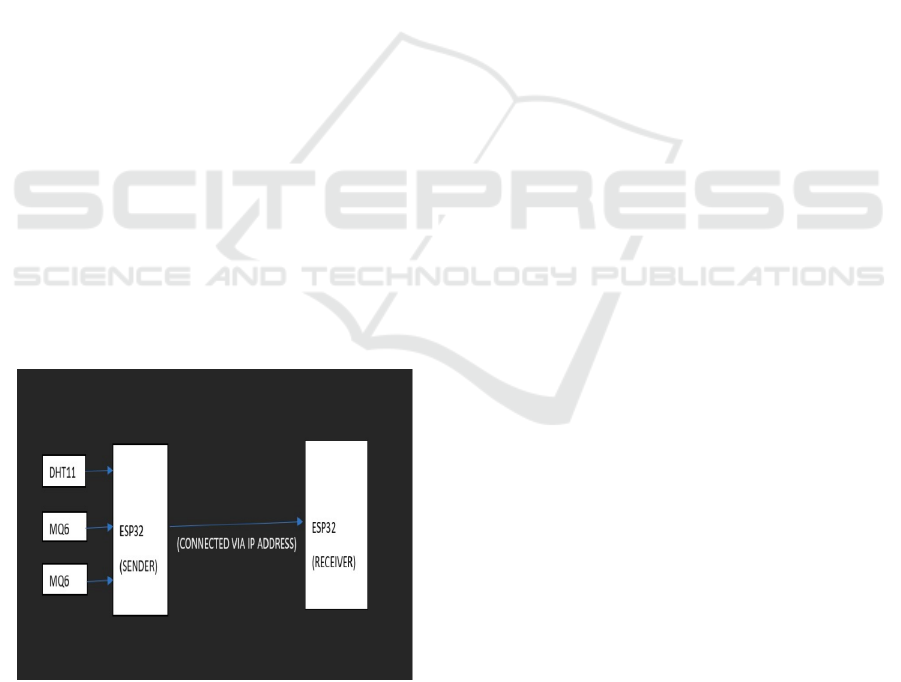
processes it for use within the IoT system. Figure 1
shows Block Diagram.
Figure 1: Block Diagram.
4.2 Technologies Used
Technologies Used: The implementation
methodology adopts a systematic approach.
Requirement Analysis: This phase focuses on
identifying security threats in IoT systems, choosing
suitable data transmission protocols, and
understanding the hardware and software limitations
of the system. The main objective is to establish the
necessary security measures and assess the
computational feasibility for IoT devices.
System Design: During this stage, the overall
architecture of the encryption system is outlined. The
AES encryption algorithm is chosen for its effective
balance of security and efficiency. Communication
protocols such as TCP and MQTT are incorporated
into the system to guarantee secure data transmission.
Furthermore, lightweight cryptographic techniques
are evaluated to enhance performance on resource-
limited IoT devices.
The implementation phase includes data collection,
where IoT devices like Raspberry Pi and Arduino
gather sensor data in real-time. The encryption
process follows, where the gathered data is m
encrypted using the AES-128 encryption standard
prior to transmission. The encryption key is securely
exchanged between the sender and receiver to prevent
unauthorized access.
Data transmission is carried out using
TCP/MQTT over a secure TLS/SSL layer, ensuring
that the communication channel is safeguarded
against cyber threats. Finally, decryption and
processing take place, where the receiver unlocks the
encrypted data using the shared AES key and
processes it for use within the IoT system. Figure 2
and 4 shows the flow diagram and figure 3 and 5 show
the hardware connection.
4.3 Hardware Used
• IoT Sensors Devices: Collects real-time data
(e.g., temperature, motion, humidity)
• Dht11 sensors: used for Temperature,
Humidity
• Gas sensors: mq135, mq137
• Microcontroller (Arduino/Raspberry Pi):
Processes sensor data and performs AES
encryption.
• Communication Module (Wi-
Fi/Bluetooth/LoRa): Transmits encrypted
data over TCP/MQTT.
End-to-End Encryption in IoT System with AES Technique
109
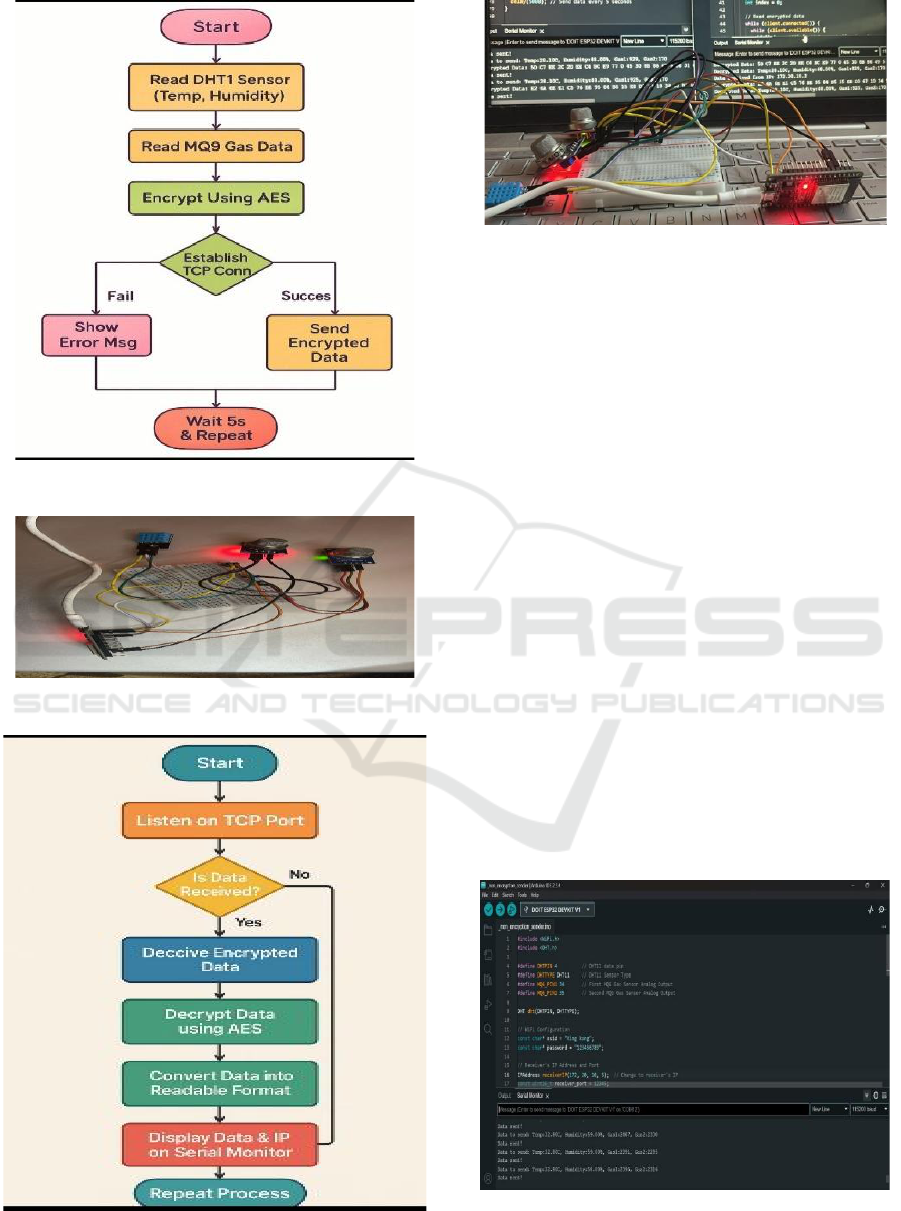
Figure 2: Sender Flowchart.
Figure 3: Physical Hardware.
Figure 4: Receiver Flowchart.
Figure 5: Device Connected to Laptop.
5 EXPERIMENTAL RESULTS
5.1 Sender Output
The ESP32 initiates sensor data collection by reading
temperature and humidity from the DHT11 sensor
connected to pin 4, as depicted in figure 4. It also
acquires gas concentration values from two MQ6 gas
sensors connected to pins 34 and 35. For network
connectivity, the ESP32 establishes a connection to a
WiFi network with the SSID "King kong" and the
password "123456789". Subsequently, the ESP32
transmits the collected sensor data to a receiving
device located at the IP address 172.20.10.5 and
listening on port 12345. The data is sent repeatedly in
the format "Temp:32.80C, Humidity:59.00",
confirming continuous measurement and
transmission. The serial monitor provides feedback
by logging messages indicating successful data
transmission, such as "Data to send: Temp:32.80C,
Humidity:59.00Data sent!". This output confirms the
ESP32's expected operation in acquiring sensor data
and transmitting it over the WiFi network. Figure 6
shows the Sender.
Figure 6: Sender.
ICRDICCT‘25 2025 - INTERNATIONAL CONFERENCE ON RESEARCH AND DEVELOPMENT IN INFORMATION,
COMMUNICATION, AND COMPUTING TECHNOLOGIES
110
5.2 Receiver Output
This output originates from an ESP32-based sender
program designed to transmit temperature, humidity,
and gas sensor data over WiFi to a designated
receiver. The ESP32 begins by collecting sensor data,
specifically temperature and humidity from a DHT11
sensor connected to pin 4, and gas concentration
levels from two MQ6 gas sensors connected to pins
34 and 35. For network access, the ESP32 connects
to a WiFi network identified by the SSID "King
kong" and the password "123456789". The collected
data is then directed to a receiver with the IP Address
172.20.10.5 on Port 12345. The transmission process
involves repeatedly sending data in the format "Data
to send: Temp:32.80C, Humidity:59.00Data sent!".
The serial monitor serves as a confirmation
mechanism, indicating successful transmission after
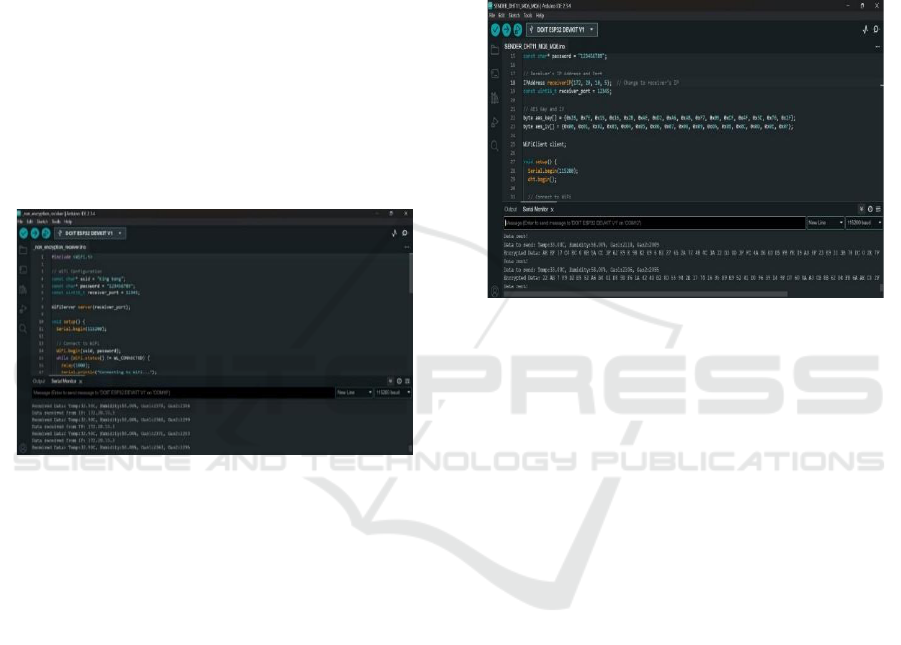
each data packet is sent. Figure 7 shows the Receiver.
Figure 7: Receiver.
5.3 Encrypted Sender Output
The ESP32 initiates encrypted sensor data collection
by reading temperature and humidity from a DHT11
sensor and gas concentration levels from two MQ6
gas sensors. For network connectivity, the ESP32
connects to a WiFi network with the SSID "King
Kong" and the password "123456789". It then
prepares to send encrypted data to a receiver at IP
Address 172.20.10.5 and Port 12345. Prior to
transmission, the sender encrypts the sensor data
using AES with a specified AES Key (0x2B, 0x7E,
0x15, 0x16, 0x28, 0xD2, 0xa6, 0xab, 0xf7, 0x09,
0xcF, 0x4F, 0x3C, 0x76, 0x2F) and AES
Initialization Vector (IV) (0x00, 0x01, 0x02, 0x03,
0x04, 0x05, 0x06, 0x07, 0x08, 0x09, 0x0A, 0x0B,
0x0C, 0x0C, 0x0C, 0x0D, 0x0D, 0x0D, 0x0). The
decrypted data at the sender matches the original
sensor reading (Temporary: 33.00C, Humidity:
58.00). The encrypted data itself appears as a long
string of hexadecimal values (e.g., Ae Bf 19 62 C0 8E
B5A ... 4A D6). The encrypted data is then sent to the
receiver, which is expected to use the same AES key
and IV for decryption. The serial monitor confirms
successful transmission with the message "Data
sent!". A key observation is that the sender
successfully attaches and transmits data, and the
encrypted data differs with each transmission due to
the AES encryption process. The receiver is expected
to decrypt and display the original sensor readings.
Figure 8 shows the Encrypted sender.
Figure 8: Encrypted Sender.
5.4 Encrypted Receiver Output
The ESP32, acting as an encrypted data receiver,
connects to a WiFi network named "King Kang" and
listens on Port 12345. It successfully receives
encrypted data packets transmitted from another
ESP32 sender over the WiFi network. Upon receiving
data, the ESP32 initiates the encryption and
decryption process. The received data, which is in
AES-encrypted form, is initially displayed as a
hexadecimal value (e.g., 22 AB 7F 29 ...). The ESP32
then decrypts this data using the pre-configured AES
Key and IV, subsequently printing the decrypted
sensor readings to the serial monitor. The serial
monitor output displays "Decrypted sensor data:
Decripted Data: Temp: 33.00C, Humidity:
58.00Encrypted Data: 22 AB7F 29 33 0 C 919D ...
Get IP Address Data received from IP: 172.20.10.3".
These decrypted values accurately represent the
temperature, humidity, and gas sensor readings
originally captured by the sender. This output
confirms that the receiver is successfully decrypting
the data transmitted by the sender, effectively
demonstrating end-to-end encrypted communication.
End-to-End Encryption in IoT System with AES Technique
111

Figure 9: Encrypted Receiver.
6 CONCLUSION AND FUTURE
WORK
This study shows that AES encryption is highly
effective in protecting IoT systems from unauthorized
access and cyber threats. It provides a strong yet
efficient encryption method that works well even on
devices with limited processing power. To ensure
secure and reliable data transmission, the study also
integrates TCP (Transmission Control Protocol),
which guarantees that encrypted data is delivered in
the correct order and without errors.
This makes AES and TCP a great com bination
for IoT applications that require continuous, secure
communication, such as smart homes, industrial
automation, and healthcare monitoring. The results
indicate that AES encryption adds very little delay
while still maintaining high security, making it
suitable for real-time applications. When compared to
older encryption methods, AES proves to be more
secure and more efficient, making it a preferred
choice for modern IoT systems. Future Research
Directions: Looking ahead, researchers can work on:
Optimizing encryption for ultra-low-power IoT
devices to enhance efficiency. Exploring hybrid en
cryption methods to improve security while
conserving energy. Developing lightweight
cryptographic techniques to strengthen security in
constrained environments, making se cure IoT
systems more widely accessible. Figure 9 shows the
Encrypted Receiver.
REFERENCES
Alaba, F. A., Othman, M., Hashem, I. A. T., Alotaibi, F.
(2017). Internet of Things security: A survey. Journal
of Network and Computer Applications, 88, 10-28.
Gurung, R. B., Lin, Y. D., Huang, Y. C. (2019).
Lightweight Intrusion Detection for IoT Systems Using
Convolutional Neural Networks. IEEE Internet of
Things Journal, 6(5), 8170-8179.Improving Chain of
Custody in Forensic Investigation of Electronic Digital
Systems Giuliano Giova.
H. Zhang, Y. Liu, and X. Wang, “Research on Data
Encryption Standard Based on AES Algorithm in
Internet of Things Environment,” International
Conference on Advanced Technologies for
Communications (ATC), 2020. Available:
ResearchGate.
H. Zhang, Y. Liu, and X. Wang, “Research on Data
Encryption Standard Based on AES Algorithm in
Internet of Things Environment,” International
Conference on Advanced Technologies for
Communications (ATC), 2020. Available:
ResearchGate.
Hassija, V., Chamola, V., Saxena, V., Jain, D., Goyal, P.,
Sikdar, B. (2019). A survey on IoT security:
Application areas, security threats, and solution
architectures. IEEE Access, 7, 82721-82743.
J. T. Olsson and P. Andersson, “Enhancing End-to-End
Communication Security in IoT Devices Through
Application Layer Protocol,” Master’s Thesis, Uppsala
University, 2023. Available: DiVA Portal.
Liu, Z., Zhang, Y., Xu, L. (2018). Secure and efficient data
transmission in IoT-enabled intelligent transportation
systems. IEEE Transactions on Intelligent
Transportation Systems, 19(7), 2174-2184.
M. I. Nofal, A. A. Ghoneim, and R. K. Iqbal, “A Novel
Secure End-toEnd IoT Communication Scheme Using
Lightweight Cryptography Based on Block Cipher,”
Applied Sciences, vol. 12, no. 17, p. 8817, 2022. DOI:
10.3390/app12178817.
N. Elgendy, O. Ismail, M. G. Alajmi, and A. M. Elhouni,
“Hybrid Cryptographic End-to-End Encryption Method
for Protecting IoT Devices Against MitM Attacks,”
International Journal of Computer Science and
Information Security (IJCSIS), vol. 19, no. 3, pp. 112–
121, 2023. Available: ResearchGate.
S. P. Suresh, A. Kumar, and R. K. Sharma, “Enhanced
Encryption Technique for Secure IoT Data
Transmission,” International Journal of Engineering
Research Technology (IJERT), vol. 9, no. 10, pp. 45–
52, 2020. Available: Academia.edu.
Singh, P. K., Rajan, R., Gupta, B. B., Conti, M. (2020).
Securing the Internet of Things: A survey on security
challenges, attacks, and countermeasures. Internet of
Things, 12, 100313.Providing Cryptographic security
and evidentiary Chain-of-Custody with the advanced
forensic format, library, and tools1 Simson L.
Garfinkel, Naval Postgraduate School and Harvard
University, USA.
ICRDICCT‘25 2025 - INTERNATIONAL CONFERENCE ON RESEARCH AND DEVELOPMENT IN INFORMATION,
COMMUNICATION, AND COMPUTING TECHNOLOGIES
112
