
The Wideband Implantable Antenna with Circular Polarization for
Monitoring the Thyroid
Jaya Prakash M., Kishore A., Shiyam P., Ramasamy K. and Sapna B. A.
Department of Electronics and Communication Engineering, KIT‑Kalaignarkarunanidhi Institute of Technology,
Coimbatore, Tamil Nadu, India
Keywords: Implantable Antenna, Broadband, Circular Polarized Antenna, Thyroid Monitoring.
Abstract: A small circularly-polarized implantable antenna for long-term thyroid monitoring. The dual port loop
structure proposed antenna covers a bandwidth of Wide band frequency 0.03 MHz - 6.02 GHz and it resonates
at frequency of 2.45 GHz and 5.8 GHz which are mostly adopted for the WBAN and the medical telemetry
applications. Antenna covers a super ultra-wide bandwidth due to the large operation band. An RO6010/droid
6010LM is selected as the substrate and the superstrate material within the compact design and its high
dielectric constant and low loss are employed to minimize the size and improve the performance. The antenna
footprint is 5 mm × 5 mm and its thickness are 0.57 mm in total. It demonstrates return losses of -22.45 dB at
2.45 GHz and -14 dB at 5.8 GHz. The antenna is -13dB (-19dB) at lower (upper) resonance frequency. SAR
is studied by placing the antenna on the neck of human head model for human safety. The signal is well
fastened yet dynamic in a dynamic environment, as a result of circular polarization. The simulation results
exhibit satisfactory impedance matching and reasonable radiation efficiency, implying the proposed antenna
is suitable to be used for the thyroid detection in biomedical applications.
1 INTRODUCTION
Implant antennas play a key role in biomedical
applications, offering real-time health monitoring
capabilities with minimal invasiveness. Recent
research has demonstrated significant advancements
in the design and performance of such antennas for
deep-tissue applications. For instance, a study by
Varvari (2024) focuses on the development of RF
sensors for thyroid tracking, showcasing their
effectiveness in early disease detection. Similarly,
Asif introduced a wide-band tissue-deeply
implantable antenna optimized for RF-powered
medical devices, ensuring efficient signal
transmission and power delivery. Metamaterial-based
antennas have also gained traction due to their
enhanced performance in miniaturized biomedical
systems. Shaw (2019) explored a metamaterial
implantable antenna with superior impedance
matching and improved radiation efficiency. In the
field of capsule endoscopy and deep-tissue
monitoring, Shah (2024) developed four-port triple-
band MIMO antenna, addressing the challenges of
high-data-rate communication within human tissues.
Additionally, Song proposed a dual-band circularly
polarized implantable antenna, ensuring robust signal
transmission in biomedical telemetry applications. A
comprehensive review by Jasim et al. (2025)
highlights the various design considerations,
fabrication techniques, and challenges associated
with implantable antennas for biomedical
applications. Their study provides valuable insights
into the evolution of implantable antennas,
emphasizing health considerations and geometric
optimizations for enhanced biocompatibility and
performance. An ultra-wideband compact meander
line antenna for brain implants and biotelemetry
application in 2.45 GHz ISM band is presented in
2024 by Mohan and Kumar. Their study
demonstrates the feasibility of miniaturized, high-
performance antennas for deep-tissue
communication, reinforcing the need for advanced
implantable antenna designs in biomedical
applications. These advancements underline the
growing importance of implantable antennas in
medical diagnostics and treatment. This paper
introduces a wideband implantable antenna tailored
for thyroid monitoring, integrating circular
polarization for improved signal stability. The
subsequent sections detail the antenna’s structural
100
M, J. P., A, K., P, S., K, R. and B A, S.
The Wideband Implantable Antenna with Circular Polarization for Monitoring the Thyroid.
DOI: 10.5220/0013892700004919
Paper published under CC license (CC BY-NC-ND 4.0)
In Proceedings of the 1st International Conference on Research and Development in Information, Communication, and Computing Technologies (ICRDICCT‘25 2025) - Volume 3, pages
100-104
ISBN: 978-989-758-777-1
Proceedings Copyright © 2025 by SCITEPRESS – Science and Technology Publications, Lda.
design, performance analysis, and SAR evaluation to
validate its suitability for biomedical applications.
This paper introduces an implantable antenna with
broadband capabilities for thyroid monitoring. The
introduction section provides an overview of antenna
types used in implantable devices. Segment 2
describes the structure of the proposed antenna.
Segment 3 presents a detailed analysis of the
antenna's performance, followed by the conclusion in
Segment 4.
2 ANTENNA DESIGN
2.1 Antenna Structure
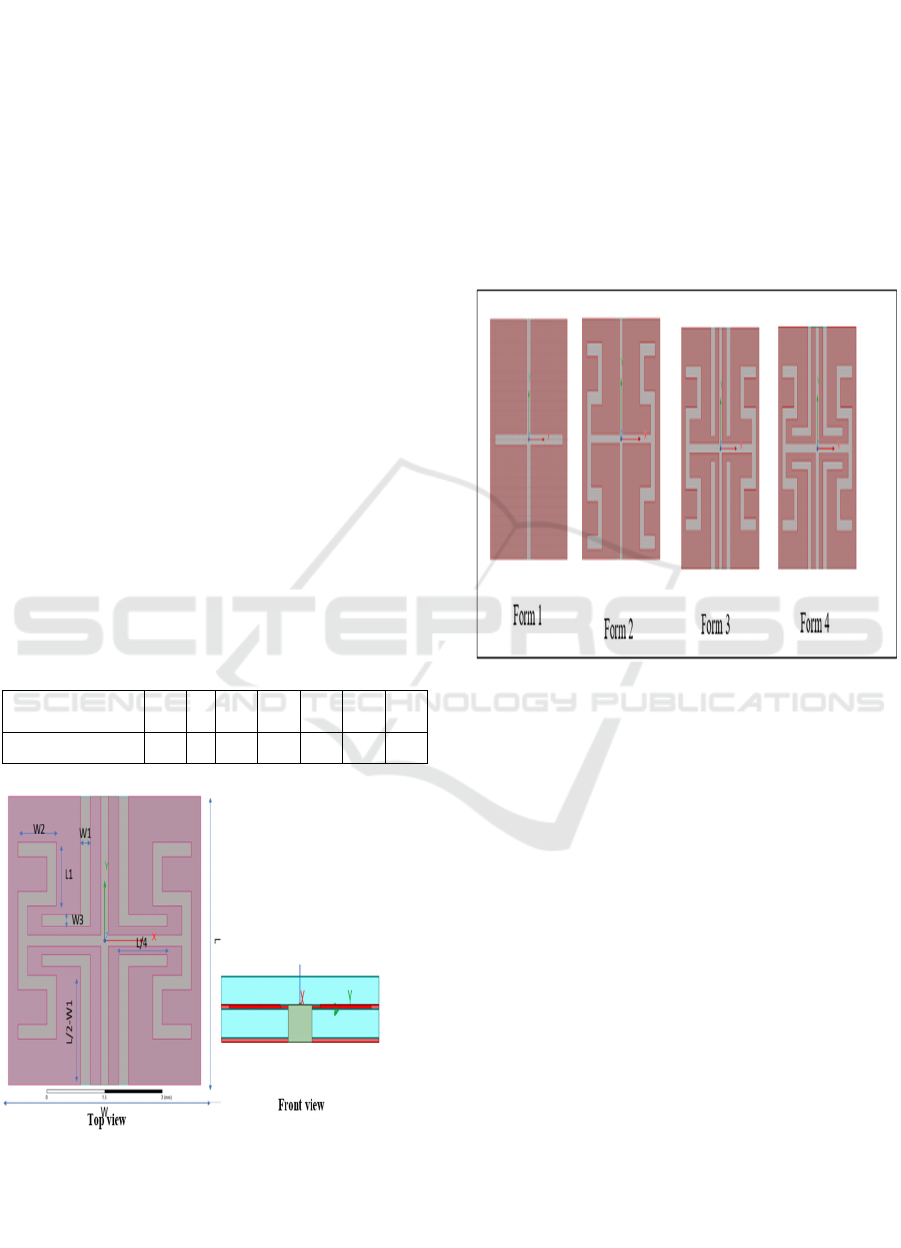
This implantable antenna is designed with a dual-port
feeding mechanism is utilized within a symmetrical
square layout of 5 mm × 5 mm and a total thickness
of 0.57 mm, shown in figure 1 making it well-suited
for integration into space-constrained medical
devices. Rogers RO6010/duroid 6010LM, selected
for its high permittivity (10.2) and low dielectric loss,
serves as both the substrate and superstrate, ensuring
effective miniaturization and improved operational
efficiency. The optimized dimensions are outlined in
the Table 1.
Table 1: Parameters of Antenna.
Antenna
Parameters
L W W1 W2 W3 L1 H
Dimension (mm) 5.0 5.0 0.30 1.0 0.20 0.850 0.254
Figure 1: Patch and Port View.
2.2 Feeding Mechanism
A dual-port feeding mechanism is utilized, where
rectangular strips interconnect at opposite ends to
form a closed-loop structure. This configuration
allows for precise excitation control, facilitating
circular polarization with a broad bandwidth. The
resulting stable wireless communication is critical for
dynamic implantable applications.
2.3 Design Evolution
Figure 2: Top View of Antenna Across Each Iterative
Cases.
The antenna design underwent four iterative
modifications to refine its performance. The initial
design used a Jerusalem cross-shaped patch, which
was later optimized by introducing L-shaped and
meandered slots to enhance impedance matching and
return loss. The last incarnation had much better
bandwidth and reflection coefficients. Each stage had
a small change to the patch to improve the bandwidth,
as well as the return loss of the antenna. The S 11 for
all four bands were compared as shown in Figure 3,
evidencing a gradual performance improvement
through the design procedure. The first patch had bad
TLRL (return loss) due to high reflect and loss and
only was excited at 5.58GHz. Strategic cuts and
variations of the dimensions of the patch in forms 2
and 3, resulted in an appreciative enhancement of
return loss. The topology-double negative materials
(DNGM)-TL SRR-R antenna and its parameters
inherited from iteration 4 (form 4), as is embodied in
figure 4, were designed, conducting a perfect
impedance matching, over a wider range of higher
frequencies from 39 kHz to 6 GHz with return loss of
The Wideband Implantable Antenna with Circular Polarization for Monitoring the Thyroid
101
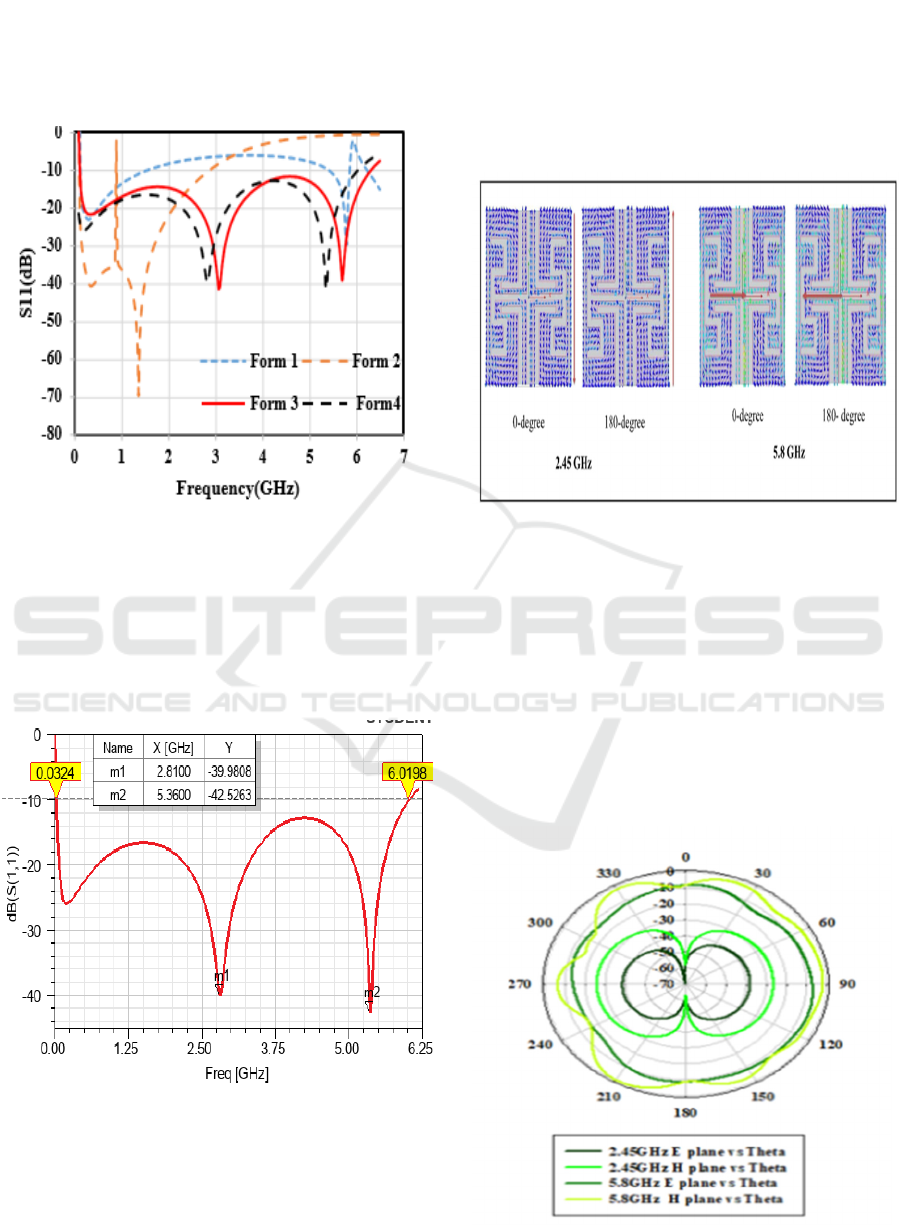
-39.0 dB at 2.8 GHz and -43.0 dB at 5.36 GHz. Figure
2 shows Top View of Antenna Across Each Iterative
Cases. The combined graph highlights the iterative
enhancement purpose and confirms the success of
design.
Figure 3: Iterative Levels Return Loss.
3 PERFORMANCE
EVALUATION
3.1 Reflection Coefficient Analysis
Figure 4: S11 Parameter.
Simulations conducted using HFSS confirmed the
antenna performance in both free space and a
phantom model simulating human tissue. The return
loss values of -23.0 dB at 2.45 GHz also -14.0 dB at
5.8 GHz confirm a wide bandwidth extending from
0.03 MHz to 6.2 GHz. Figure 4 shows S11 parameter.
The current flow plots illustrate the 180-degree phase
shift, ensuring effective circular polarization
displayed in Figure 5. The current direction changes
by 180 degrees, indicating that the antenna operates
with CP, which offers the advantage of easily sensing
signals from all directions.
Figure 5: Flow of Current in the Antenna.
3.2 Radiation Performance
Figure 6 illustrates Radiation pattern simulations at
the frequencies (as we mention in abstract) indicate
stable circular polarization with minimal back. The
gain performance of the antenna has been evaluated
across its working frequency range, showcasing
stable radiation characteristics. It achieves -19 dB and
-13 dB ensuring reliable functionality within the
intended frequency bands. Figure 7 shows Antenna
Gain plot.
Figure 6: Field Pattern of the Antenna.
ICRDICCT‘25 2025 - INTERNATIONAL CONFERENCE ON RESEARCH AND DEVELOPMENT IN INFORMATION,
COMMUNICATION, AND COMPUTING TECHNOLOGIES
102
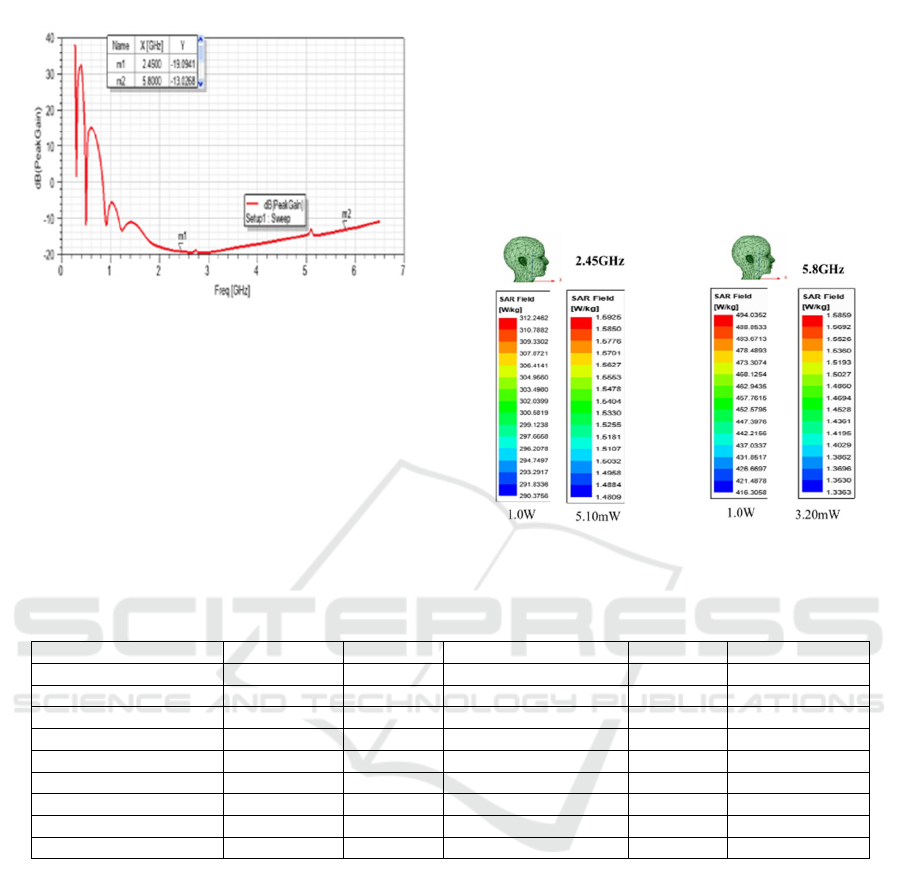
Figure 7: Antenna Gain Plot.
3.3 SAR (Specific Absorption Rate)
To ensure compliance with safety regulations, the
specific absorption rate (SAR) was evaluated at input
power levels of 1 W and reduced to maintain safe
exposure limits.
The maximum SAR values of 1.59 W/kg at 2.45
GHz and 1.58 W/kg at 5.8 GHz confirm the design's
suitability for biomedical applications with minimal
thermal effects on thyroid tissues. The input power
was reduced, resulting in maximum allowable input
power values of 5 mW at 2.45 GHz and 3.2 mW at
5.8 GHz. The simulated SAR, shown in Figure 8, was
calculated using a human head phantom with the
antenna placed in the neck region. The SAR analysis
demonstrates that the antenna meets medical safety
standards, effectively minimizing thermal impact on
nearby thyroid tissues. Literature compared in Table
2.
Figure 8: SAR Analysis of Antenna.
Table 2: Reference is compared with the antenna.
Ref. no Fre
q
(
GHz
)
Bandwidth Dimension
(
mm³
)
Gain
(
dB
)
SAR
(
W/k
g)
1 5 300 MHz 13.38 × 18.24 × 1.52 5.8 NA
3 2.45 NA 12 × 12 × 3 -14.07 8.72
4 0.915 9.7% 10.5 × 7.5 × 0.127 -37.3 251
1.780 7.8% -30.3 211
2.45 8.3% -27.9 252
5 0.915 220 MHz π × 0.0142 × 0.0027 -29.5 585.1
2.45 230 MHz -19.5 462.2
WORKED ANTENNA 2.45 5.97 GHz 5 × 5 × 0.57 -19.0 1.59
5.8 -13.0 1.58
4 CONCLUSIONS
Wideband implantable antenna with circular
polarization for monitoring the thyroid is operates
across 0.03 MHz to 6.0 GHz offering a total
bandwidth of 5.970 With compact dimensions of 5
mm × 5 mm × 0.57 mm, it ensures efficient
integration within biomedical applications. The
evaluation of both simulation and experimental
results confirms optimal impedance matching, with
S11 of -23.0 dB at 2.45 GHz and -14.0 dB at 5.8 GHz.
SAR analysis validates with medical safety standards,
maintaining maximum allowable power levels of 5.10
mW and 3.2 mW at the respective frequencies,
ensuring biocompatibility and minimal tissue heating.
This study confirms the antenna's suitability for
thyroid detection in biomedical applications, ensuring
stable and secure wireless communication. Future
advancements may focus on integrating it with
implantable sensors and further reducing its size to
expand its usability in diverse medical fields.
ACKNOWLEDGEMENTS
File No.8-122/FDC/RPS/POLICY-1/2021-2022.
The Wideband Implantable Antenna with Circular Polarization for Monitoring the Thyroid
103

REFERENCES
Jasim, Mosab, et al. "An extensive review on implantable
antennas for biomedical applications: Health
considerations, geometries, fabrication techniques, and
challenges." Alexandria Engineering Journal 112 (202
5): 110-139.
Mohan, Archana, and Niraj Kumar. "Implantable antennas
for biomedical applications: a systematic review."
BioMedical Engineering OnLine 23(1) (2024): 87.
Mohan, Archana, and Niraj Kumar. "An ultra–wideband
compact meander line antenna for brain implants and
biotelemetry applications in the 2.45 GHz ISM band."
Results in Engineering 24 (2024): 103345.
Samanta, Gopinath, and Debasis Mitra. "Dual-band circular
polarized flexible implantable antenna using reactive
impedance substrate." IEEE Transactions on Antennas
and Propagation 67(6) (2019): 4218-4223.
Shah, Syed Manaf Ali, et al. "Four-port triple-band
implantable MIMO antenna for reliable data telemetry
in wireless capsule endoscopy and deep tissue
applications." IEEE Transactions on Antennas and
Propagation (2024).
Varvari, Anna A., et al. "Thyroid Screening Techniques via
Bioelectromagnetic Sensing: Imaging Models and
Analytical and Computational Methods." Sensors 24
(18) (2024): 6104.
Zada, Muhammad, Izaz Ali Shah, and Hyoungsuk Yoo.
"Metamaterial-loaded compact high-gain dual-band
circularly polarized implantable antenna system for
multiple biomedical applications." IEEE Transactions
on Antennas and Propagation 68(2) (2019): 1140-1144.
ICRDICCT‘25 2025 - INTERNATIONAL CONFERENCE ON RESEARCH AND DEVELOPMENT IN INFORMATION,
COMMUNICATION, AND COMPUTING TECHNOLOGIES
104
