
Modern Safety Device for Women’s Protection Using IoT
Jayaram K., Gokul Krishna K., Hamsani C. and Karumanchi Karishma
Department of Electronics and Communication Engineering, KIT - KalaignarKarunanidhi Institute of Technology,
Coimbatore, Tamil Nadu, India
Keywords: Women’s Safety, AI‑Based Threat Verification, Emergency Response System, GPS Tracking, GSM
Communication, Fault Detection Mechanism, Real‑Time Location Sharing.
Abstract: Our project enhances traditional safety mechanisms by addressing their limitations, such as the inability to
verify accidental triggers and delays in response. This device, equipped with a switch, NodeMCU, GPS, and
GSM module, activates when the button is pressed, instantly sending the GPS location and recording audio.
The recorded audio is processed by AI to confirm if the user is genuinely in danger. If validated, the
coordinates are sent to a police admin via a Windows application, who can assign the nearest officer or activate
a "Notify Volunteers" feature to alert registered users within a 500-meter radius. Unlike conventional devices,
this system includes a fault detection mechanism, works without internet using GSM, and ensures seamless
communication even in low-connectivity areas. By integrating AI-based verification, faster response options,
and community involvement, this project provides a smarter, more efficient, and reliable solution for women’s
safety.
1 INTRODUCTION
Women's safety is a pressing concern in today’s
world. While several devices have been developed to
address this issue, many still face challenges like false
alarms, limited functionality, and delayed response
times. Our project, Modern Safety Device for
Women’s Protection Using IoT, introduces a smarter
and more reliable system by integrating AI, advanced
hardware, and community involvement. Below, we
explain the key components and unique features of
our project.
1.1 The Need for Smarter Safety
Devices
Existing safety devices send GPS locations or
messages to pre-registered numbers or authorities
when a button is pressed. However, these systems
lack a way to verify if the button was pressed
accidentally or if there is a real emergency. This often
leads to unnecessary actions and wasted time.
Additionally, many devices require internet
connectivity, which may not be available in remote
areas, making them unreliable in critical situations.
1.2 How Our Device Works
Our device is equipped with a switch, NodeMCU,
GPS, and GSM module. When the button is pressed,
it immediately sends the GPS coordinates and records
audio. The recorded audio is analyzed by AI to
determine if the woman is in genuine danger. If
confirmed, the system sends the location to a police
admin using a dedicated Windows application. The
admin can assign nearby officers or notify volunteers
within 500 meters using a mobile app. This multi-step
approach ensures a quicker and more accurate
response.
1.3 Unique Features and Benefits
Our project introduces several unique features to
enhance traditional systems. It includes an AI-
powered fault detection mechanism that reduces false
alarms and saves time. The GSM module ensures the
device works without internet, making it reliable even
in low-connectivity areas. Additionally, the “Notify
Volunteers” feature mobilizes nearby app users,
providing immediate assistance when authorities are
unavailable. These features, combined with AI
verification and community involvement, make our
72
Jayaram, K., K., G. K., Hamsani, C. and Karishma, K.
Modern Safety Device for Women’s Protection Using IoT.
DOI: 10.5220/0013891900004919
Paper published under CC license (CC BY-NC-ND 4.0)
In Proceedings of the 1st International Conference on Research and Development in Information, Communication, and Computing Technologies (ICRDICCT‘25 2025) - Volume 3, pages
72-77
ISBN: 978-989-758-777-1
Proceedings Copyright © 2025 by SCITEPRESS – Science and Technology Publications, Lda.
device a practical and efficient solution for improving
women’s safety.
2 METHODOLOGY
This project focuses on providing a smart and reliable
safety device for women using IoT and real-time
verification. The system is designed to reduce false
alarms, ensure quick response, and work even without
internet connectivity. The methodology involves both
hardware and software components, ensuring
efficient communication between the user, police,
and nearby volunteers.
2.1 System Workflow
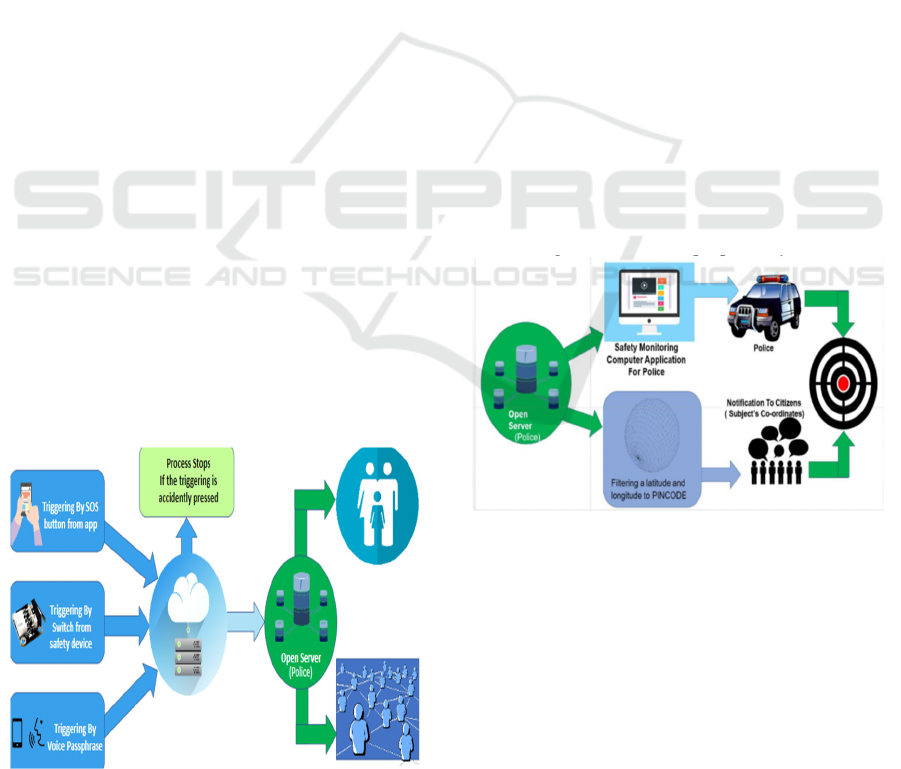
In case of danger, a woman can press a button on the
device, equipped with NodeMCU, SIM800L, and
GPS, which fetches her location and sends an SMS
alert with GPS coordinates to the police admin server.
A live audio call is initiated between the woman and
the police admin, allowing the police to analyze the
conversation and determine if it is a real emergency.
If the case is genuine, the admin assigns a nearby
police officer to the location. If no officer is available,
the "Notify Volunteers" feature is activated, sending
an SOS message via SMS to all registered volunteers
within a 500-meter radius. Even if their phone is
offline, it automatically rings, prompting them to
accept or dismiss the alert. Users who accept the alert
are connected to a group chat to coordinate help. The
system does not require an internet connection for
emergency communication, as the GSM module
ensures that the message is delivered via SMS,
allowing the system to function in remote areas.
Figure 1 shows the block diagram.
Figure 1: Block Diagram.
2.2 Advantages of the Proposed
Methodology
Combining real-time verification, AI-based decision-
making, and community support, this safety system is
more efficient than traditional solutions. It reduces
false alarms through live audio verification, ensuring
unnecessary police intervention is avoided, and offers
faster response times by sending alerts immediately
to either the police or registered volunteers. The
system operates through SMS and GSM
communication, making it functional without an
internet connection and accessible in remote areas.
By involving the community, it ensures help is always
available, even when law enforcement is not nearby.
Additionally, the methodology is scalable to other use
cases, such as child safety, elderly monitoring, and
public security.
3 PROPOSED SYSTEM
This system aims to provide a fast and reliable safety
solution for women by combining hardware-based
emergency alerts with real-time verification and
community help. It overcomes the shortcomings of
traditional safety devices by ensuring quick
communication, reducing false alarms, and working
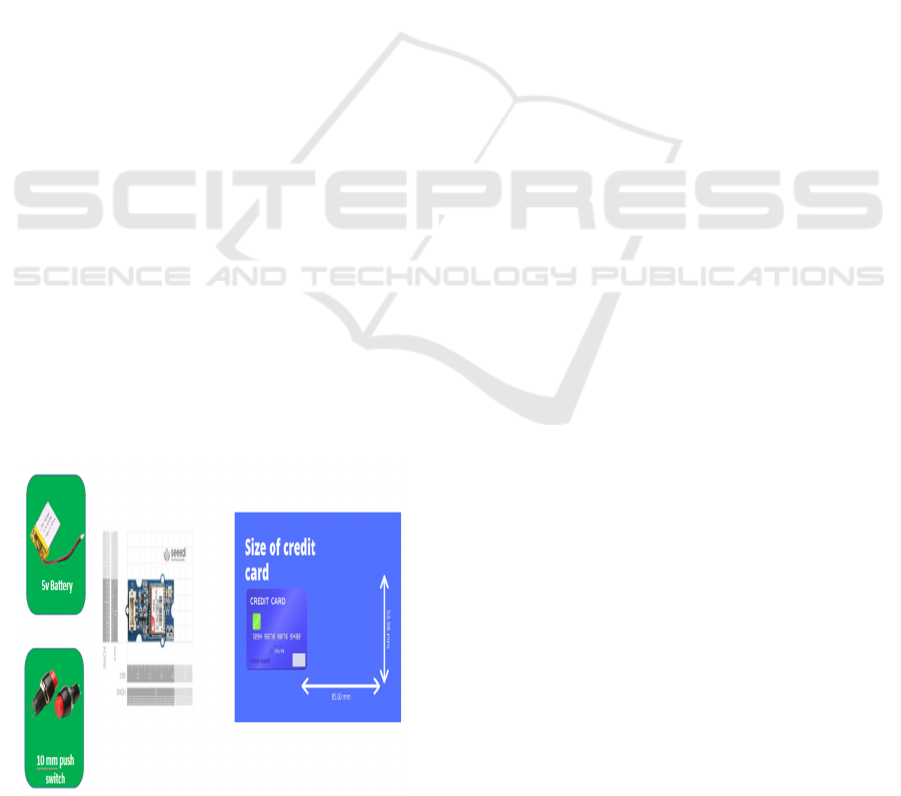
offline. Figure 2 shows the proposed system.
Figure 2: Proposed System.
3.1 Emergency Alert Activation
The system includes a portable device with a
microcontroller (NodeMCU), GPS, GSM module
(SIM800L), and a button. If a woman feels unsafe,
she can press the button. This action instantly fetches
her live location and sends an SOS message via SMS
to the police server. Unlike apps that need the
internet, this device works even in low-network or
offline conditions.
Modern Safety Device for Women’s Protection Using IoT
73
3.2 Real-Time Verification and
Response
To avoid false alarms, the system starts a live call
between the user and the police. The authorities can
listen to the background to check if the user is in real
danger. If it's a false alarm, the police can ignore it. If
the distress is genuine, the nearest police officer is
sent to the location.
3.3 Volunteer Assistance System
If no police officer is nearby, the system sends an
SOS message via SMS to all registered volunteers
within a 500-meter radius. Even if their phones are on
silent or offline, the alert forces the phone to ring
loudly to get their attention. Volunteers can accept or
dismiss the request. Those who accept are connected
to a group chat to coordinate help.
3.4 Key Advantages of the Proposed
System
This system offers immediate response, real-time
verification, and offline functionality, making it
highly reliable and efficient. By combining law
enforcement and community support, it ensures faster
intervention and increased safety in emergencies.
4 SYSTEM ARCHITECTURE
The system architecture for the Modern Safety
Device for Women's Protection using IoT includes
both hardware and software components that work
together seamlessly to ensure effective and reliable
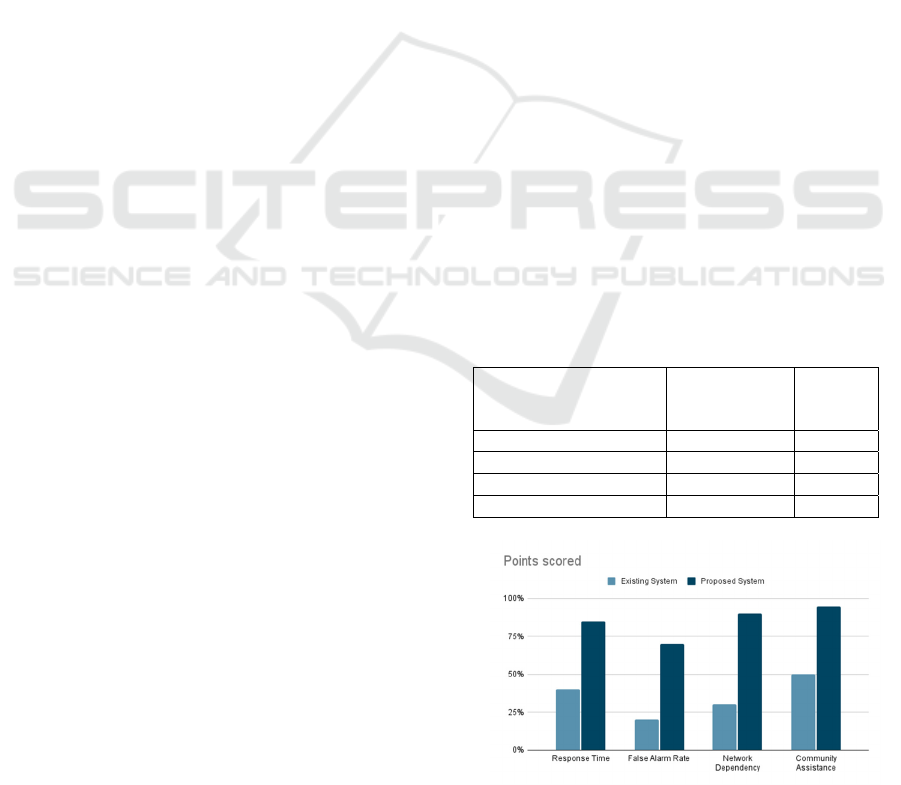
operation. Figure 3 shows the components.
Figure 3: Components.
4.1 Hardware Components
The main hardware components of the system include
the Node MCU, SIM800L GSM module, GPS
module, and a trigger button. The Node MCU serves
as the central processing unit, managing
communication between all components. The
SIM800L GSM module is responsible for sending
SMS messages and establishing communication with
the police server and registered numbers. The GPS
module fetches real-time location coordinates, and
the trigger button activates the device, initiating
emergency protocols. A dedicated power supply
ensures uninterrupted operation.
4.2 Software Components
The software components consist of embedded
software running on the Node MCU, which manages
interactions between hardware elements, processes
inputs from the trigger button, and controls the GSM
and GPS modules. The system also includes a server-
side component that receives location coordinates and
audio recordings from the safety device. The server is
equipped with software to coordinate responses,
either by alerting nearby police officers or notifying
registered volunteers through a mobile application.
The mobile app installed on users' smartphones
awakens and rings in emergency scenarios, even in
offline mode, prompting volunteers to assist.
4.3 Communication Flow
The communication flow within the system starts
with the activation of the device when the trigger
button is pressed. The Node MCU activates the
SIM800L GSM module and GPS module to fetch the
current location coordinates and start recording audio.
This data is sent to the police admin server via SMS.
The server then coordinates the emergency response,
either by sending alerts to nearby police officers or
notifying registered volunteers within a 500-meter
radius.
4.4 Fault Detection Mechanism
To prevent accidental triggers, the system includes a
fault detection mechanism. Police officers have the
option to dismiss alerts if they confirm that the user is
not in danger, ensuring the system remains efficient
and responsive. This fault detection mechanism helps
filter out false alarms and maintain the reliability of
the system.
ICRDICCT‘25 2025 - INTERNATIONAL CONFERENCE ON RESEARCH AND DEVELOPMENT IN INFORMATION,
COMMUNICATION, AND COMPUTING TECHNOLOGIES
74
5 EFFICIENCY OF PROPOSED
SYSTEM
Time efficiency and community involvement are key
features of the proposed system, making it highly
effective in responding to emergencies. The system is
designed to minimize response times, starting with
the immediate activation of the device when the
trigger button is pressed. This swift action ensures
that the user’s location coordinates and audio
recording are sent without delay. The AI verification
system automates the process of analyzing the audio
for distress signals, reducing the time required for
manual validation. The use of SMS for real-time data
transmission ensures that information reaches the
police admin server promptly, even in areas with
limited or no internet connectivity.
The centralized police admin server plays a
crucial role in coordinating the emergency response
by quickly determining the appropriate action,
whether it involves dispatching nearby police officers
or alerting registered volunteers. The system ensures
efficient resource allocation by tracking the user's
location and status in real time, enabling the nearest
available responders to act swiftly.
Community involvement further enhances the
system’s efficiency. Registered volunteers within a
500-meter radius are notified of the emergency,
creating a local support network that can provide
immediate assistance, especially in situations where
police response may be delayed. The mobile
application used by volunteers ensures that they
receive the SOS message instantly, even if their
phones are offline, by sending an alert that awakens
and rings their devices. Volunteers can quickly
respond to the alert, coordinating their efforts through
a group communication channel to assist the user
effectively.
By leveraging both technological advancements
and community support, the proposed system ensures
a rapid and coordinated response to emergencies,
significantly improving the chances of providing
timely assistance to those in need. This combination
of time efficiency and community involvement
makes the system a comprehensive and reliable safety
solution for women.
6 EFFICIENCY ANALYSIS
In terms of response time, the proposed system is
significantly more efficient. It ensures that alerts are
sent immediately to either the police or registered
volunteers, which leads to quicker action and
potentially life-saving interventions. This efficiency
is a marked improvement compared to the slower
response times of traditional systems.
The false alarm rate is considerably lower with the
proposed system. It incorporates real-time audio
verification, enabling authorities to assess the
situation accurately before dispatching help. This
feature ensures that unnecessary police interventions
are minimized, unlike existing systems where false
alarms can be more frequent.The proposed system
operates independently of internet connectivity,
which is a major advantage. By relying on SMS and
GSM communication, the system remains functional
even in areas with poor network coverage, making it
accessible in remote locations where traditional
mobile apps might fail.
Community assistance is greatly enhanced. The
system effectively mobilizes nearby volunteers by
sending them SOS messages and ensuring their
phones ring loudly, even if they are offline. This
community-driven approach means that help is
always available, even when law enforcement is not
immediately nearby.
Overall, the proposed safety system is more
reliable, responsive, and community-oriented. It
offers significant advancements in response time,
accuracy, network independence, and volunteer
engagement, making it a superior solution for
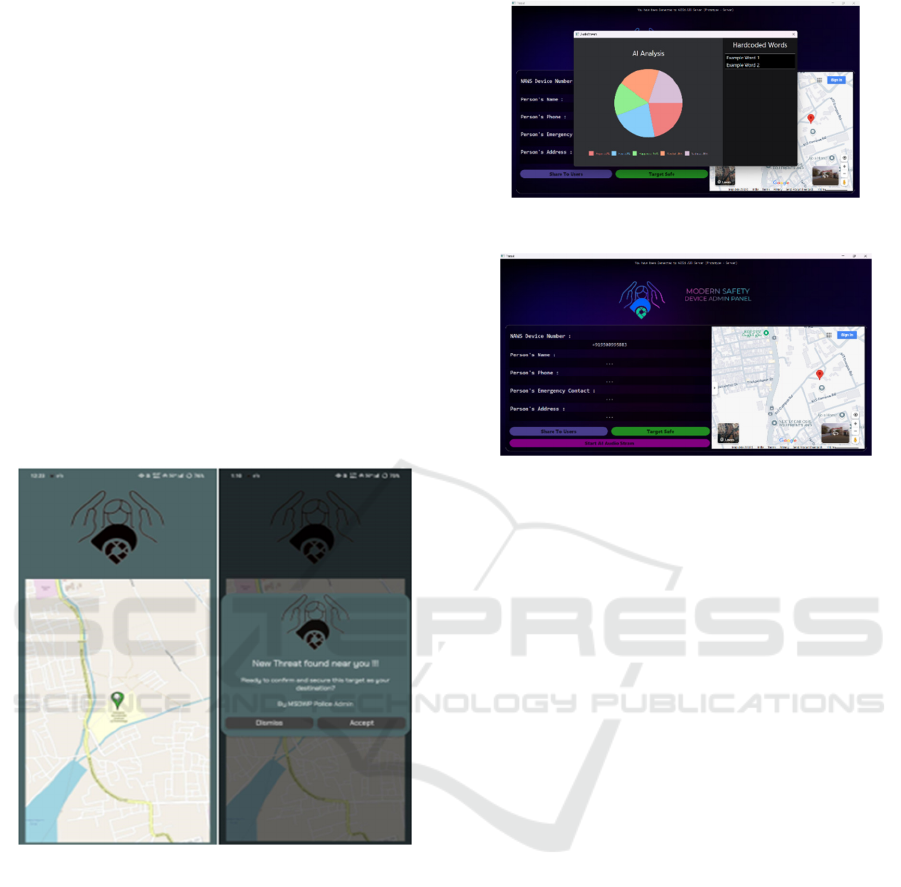
ensuring safety compared to existing systems. Table
1 shows the analysis and figure 4 shows the analysis
chart.
Table 1: Analysis Table.
Content Existing
System
Propose
d
S
y
stem
Res
p
onse Time 40% 85%
False Alarm Rate 20% 70%
Network Dependenc
y
30% 90%
Community Assistance 50% 95%
Figure 4: Analysis Chart.
Modern Safety Device for Women’s Protection Using IoT
75
7 SOFTWARE
IMPLEMENTATION
7.1 Android App: Client Software
The Android app is designed to provide users with a
seamless and intuitive interface for activating the
emergency alert system. Upon launching the app,
users are greeted with a simple home screen that
features an emergency button prominently displayed.
When this button is pressed, the app immediately
fetches the user's current location using the built-in
GPS module and sends an SOS message via SMS to
the police admin server. The app also initiates a live
audio call to verify the emergency. Users can also
register as volunteers through the app, receiving alerts
within a 500-meter radius and participating in
coordinated group chats for assistance. Figure 5
shows the mobile application.
Figure 5: Mobile Application.
7.2 Windows App: Admin Software
The Windows app provides a robust and user-friendly
platform for managing the emergency alert system.
The main dashboard offers an overview of all active
alerts and their statuses. Police admins can monitor
incoming SOS messages, initiate live audio calls for
verification, and assign nearby officers to genuine
emergencies. The app also integrates the Volunteer
Assistance System, displaying the locations of
registered volunteers and enabling admins to send
SOS messages. Volunteers can accept alerts, join
group chats, and coordinate their response directly
from the app. Figure 6 and 7 shows the admin panel
and AI analysis.
Figure 6: Admin Panel.
Figure 7: AI Analysis.
8 FUTURE ENHANCEMENTS
Artificial intelligence (AI) and machine learning
(ML) could be used to support predictive modeling
and behavioural tracking, which could then be used to
intervene when there is a potential risk for those
behaviors to occur. This will be accomplished by
extended battery and power operation, improved
usability with smart devices, and extended
connectivity between smart devices and construction
of an integrated safety mesh. This may be achieved
through the increased robustness of geofencing and
real-time video streaming and aided by voice control
which can be used for convenience and lifting.The
existence of an ability for increasing data security
and, as a result, establishing trust between the users,
results from the enhancement. These developments
will guarantee that MSDW will continue to lead the
field, an agile solution to a woman's individual
insecurity.
REFERENCES
A Helen,M. Fathima Fathila,R. Rijwana and V.K.G
Kalaiseli, IEEE Internationa Conference on Computing
and Communications Technologies (ICCCT)(2017)
A. Bhate, H Parveen Sultana, International Journal of
Recent Technology and Engineering 8.1- 8(2019).
ICRDICCT‘25 2025 - INTERNATIONAL CONFERENCE ON RESEARCH AND DEVELOPMENT IN INFORMATION,
COMMUNICATION, AND COMPUTING TECHNOLOGIES
76

Avantika Bhate,Praveen Sultana H ,International Journal of
Recent Technology and Engineering(IJRTE) May -
2019.
D.G Monisha,M. Monisha, G Pavithra, and R Subhashini,
Indian Joumal of Science and Technology, 9, 1-9(2016)
G C Harikiran,Karthick Menasinkai,Suhas
Shirol,International Conference on Electrical and
Optimization Techniques(ICEEOT) - 2016.
G C Harikiran, K. Menasinkai, and S. Shirol, IEEE
International Conference on Electrical Electronics, and
Optimization Techniques (ICEEOT)(2016).
M Kavitha and V Sivachidambaranathan, IEEE
International Conference on Computational
Intelligence and Computing Research (ICCIC), 2018
M. R Tejonidhì, Aishwarya K. S. Chaithra M K Dayana and
H Nagamma, IEEE International Conference on
Advances in Information Technology (ICAIT), 2019
N. Bhardwaj, and N Aggarwal, A Women Safety Device,
International Journal of information and Computational
Technology, 787-792(2014)
N. Prakash,E. Udavakumar, N. Kumareshan, R.
Gowrishankar. J Peter, S. Femandes, A Alavi,
Advances in Intelligent Systems and Computing,
Singapore, 1167 (2021).
N.R. Sogi, P. Chatterjee, U. Nethra, and V. Suma,
International Conference on Inventive Research in
Computing Applications (ICIRCA),451-454(2018).
N.V Kumar, and S Yahini, International Journal of
Advanced Research in Computer Science 8, 1-7(2017)
S. Ahir,S. Kapadia, J, Chauhan, and N Sanghavi,
International Conference on Smart City and Emerging
Technology (ICSCET), 1-3(2018).
Srinivasan P, Anthoniraj S, Anguraj K, Kumarganesh S,
Thiyaneswaran B, (2021), “Development of keyless
biometric authenticated vehicles ignition system”
Materials Today: Proceedings, Vol. 81(2), pp 464-469,
Elsevier.
Thiyaneswaran B, P Elayaraja, Srinivasan P, Kumarganesh
S, Anguraj K, (2021), “IOT Based Air Quality
Measurement and Alert System for Steel, Metal and
Copper Processing Industries” Materials Today:
Proceedings, Vol. 81(2), pp 127-132 Elsevier
Thiyaneswaran B, Anguraj K, Kumarganesh S, Martin
Sagayam K, Sourav Ghosh, (2022) “IOT based smart
cold chain temperature monitoring and alert system for
vaccination container” International Journal of
Przegląd Elektrotechniczny, Vol. 2022(8), pp. 206-208.
W. Akram,M. Jain, and C. Sweetlin Hemalatha, Procedia
Compufer Science 165, 656- 662(2019
Wasim Akram,Mohit Jain,C. Sweetlin
Hemalatha,International Conference on Inventive
Research in Trends in Advanced Computing
2019,ICRTAC 2019.
Modern Safety Device for Women’s Protection Using IoT
77
