
Detecting Jamming Attacks in Wireless Communication Using
Machine Learning Models
Paradesi Subba Rao, Nooka Varsha Reddy, Shaik Suhani, Kasetty Susmitha,
Lalam Jhansi and Pinjari Aneefa
Department of Computer Science and Engineering, Santhiram Engineering College, Nandyal‑518501, Andhra Pradesh,
India
Keywords: Jamming Detection, Machine Learning, RSSI, SNR, BER, Packet Loss Rate, Conventional, Software‑Defined
Radio, Threshold.
Abstract: Attacks from indiscriminate jammers could prevent communications by disrupting wireless networks. In
conventional jamming detection systems, software-defined radios or fixed-threshold signal evaluation
algorithms are incorporated in an attempt to solve the problem. These methods do not cope well with
sophisticated and adaptive jamming techniques due to inflexibility, excessive resource expenditure, and high
rates of false alarms. Fixed-threshold techniques cannot be adjusted adaptively, while methods based on SDR
necessitate high volumes of both processing power and costly radio frequency hardware. Machine learning
algorithms based jamming detection systems take features such as RSSI, SNR, BER, and packet loss rate as
detection model metrics. The proposed solution enhances the robustness and security of wireless
communication systems by providing fast, adaptable and hardware-independent response to jamming
inquiries.
1 INTRODUCTION
First of all, 5G, the Internet of Things, self-operation
systems and defense operations depend on this
technology of wireless communication. However,
such networks are vulnerable to interference attacks,
where a malicious person disrupts communication
to block transmission. These attacks can cause
serious security issues, loss of data and disruption of
networks, thus requiring effective detection
techniques.
More traditional jamming detection techniques
use Software-Defined Radios (SDRs), or fixed-
thresholds. Even with existing threshold-based
approaches monitoring network metrics (e.g., RSSI,
SNR, BER, packet loss rates), there are many false
positive events due to these disturbances.
Nonetheless, while the SDR-based method yields
accurate and precise results, the practical
implementation is limited by high computational
requirements and expensive hardware. In order to
cover these limitations, in this paper we propose a
machine learning-based jamming detection system.
The approach increases detection accuracy and
eliminates the need for additional devices.
Using Random Forest, Support Vector Machines
(SVM), Neural Networks, the proposed system
characterizes network states as normal or jammed in
real-time. Because the model continuously monitors
the actions in the network, it is highly scalable,
effective, and affordable, helping to discover new
kinds of jamming techniques and ensuring that
wireless networks work in a secure manner. The
optimal solution is applicable to various wireless
communication situations, ranging from 5G
networks, IoT ecosystems, and military defence
applications to critical infrastructure for its
convenience, effectiveness, and cost implications.
2 LITERATURE REVIEW
2.1 Machine Learning
Machine learning considers learning as a computer
science activity or task. In contrast to traditional
Rao, P. S., Reddy, N. V., Suhani, S., Susmitha, K., Jhansi, L. and Aneefa, P.
Detecting Jamming Attacks in Wireless Communication Using Machine Learning Models.
DOI: 10.5220/0013891700004919
Paper published under CC license (CC BY-NC-ND 4.0)
In Proceedings of the 1st International Conference on Research and Development in Information, Communication, and Computing Technologies (ICRDICCT‘25 2025) - Volume 3, pages
63-66
ISBN: 978-989-758-777-1
Proceedings Copyright © 2025 by SCITEPRESS – Science and Technology Publications, Lda.
63
programming, ML does not restrict itself to the
program specifying a sequence of steps. In this way,
"gathers" means that it learns to predict by analyzing
data and identifying patterns. In supervised (the
models are trained on labeled data), unsupervised
(the data themselves are exploited to learn patterns,
etc. without a priori assigned labels), and
reinforcement (learning the decision-making process
from trial-by-trial experience) ML it is also feasible
to partition the ML in various sub-classes. Speech
recognition, fraud detection, recommender systems,
and predictive analytics are among these. Computing
lies in the large, databases being updated and scored
continuously as a stream of new data comes in, an
important feature of businesses in the fields of
cybersecurity, health, and automation.
2.2 How Machine Learning Is Used in
Detecting in Jamming Attacks
Jamming attack detection over wireless
communications is claimed to be one of the most
difficult problems, as the attacker uses an adaptive
interference recovery that is more complex than the
standard assumptions to detect ordinary jammers.
These types of attacks introduce radio frequency
interference into the input channel to compromise or
stop communication. This results in a loss or
stopping of communication services, which in turn
causes network and service disruptions.
Machine learning (ML) offers a highly effective
method, as it can track network activities, learn from
the past, and identify malicious activities that
indicate jamming. The algorithms, based on machine
learning, can be trained to identify the attack
signatures in the network parameters, e.g., Received
Signal Strength Indicator (RSSI), Signal-to-Noise
Ratio (SNR), Bit Error Rate (BER), and Packet Loss
Rate. Jamming-type attacks usually cause substantial
packet loss, an increase in BER, and a sudden
decrease in RSSI, all of which the ML models are
trained to associate with jamming.
3 METHODOLOGY
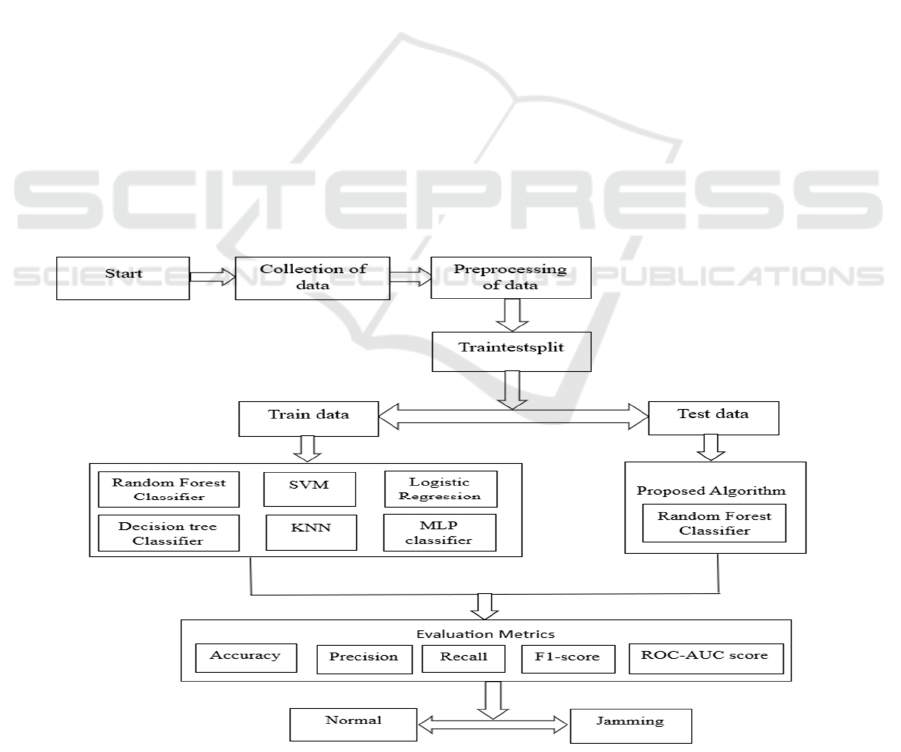
This section describes the methodology used to
identify jamming attacks; in particular, section 3.1
describes the project architecture (figure 1), section
3.2 describes the dataset information, section 3.3
describes the feature extraction approach.
3.1 Architecture
Figure 1: System Architecture.
ICRDICCT‘25 2025 - INTERNATIONAL CONFERENCE ON RESEARCH AND DEVELOPMENT IN INFORMATION,
COMMUNICATION, AND COMPUTING TECHNOLOGIES
64

3.1 Dataset Information
RSSI-Measures the strength of incoming signal in
dBm (decibel-milliwatts), lower value represents
weaker signals.
SNR - The measurement of the ratio of signal power
to noise power in decibels. Higher values indicate
better signal quality.
BER - Describes the percent of bits that were routed
incorrectly due to some form of destruction. Greater
number of errors means higher figure of BER.
Packet Loss Rate (%) - Percentage of packets that did
not reach their destination, indicative of disturb at the
network.
Label - Defines the state of network set to be
Jamming (1) or Normal (0).
3.2 Feature Extraction
F1: RSSI analyses normal operations that are
characterized by higher RSSI values, whereas lower
values signal jamming activity.
F2: SNR analyses Elevated SNR signifies positive
network conditions, while lower SNR denotes
potential jamming.
F3: BER Analysis the interference is likely with high
BER values, while low BER values indicate stable
communications.
F4: Packet loss rate Normal operations are
characterized by lower packet loss, whereas higher
packet loss indicates jamming activity.
F5: Jamming attack classification during training the
model, classify network states into 'normal' (0) or
'jamming' (1) for use in the model.
4 IMPLEMENTATION AND
RESULTS
In this section the implementation details are
mentioned to detect the jamming attacks. 4.1 Section
contains the model selection and 4.2 section contains
the results of the implements.
4.1 Model Selection
Model 1: Random Forest
Random Forest is a strong machine learning model
which predicts results by averaging a few decision
trees. Since every individual tree inspects other
segments of the data, the final model improves on
their accuracy and strength. The combined power
helps it to address various parameters like RSSI,
SNR, BER, and Packet Loss Rate making it more
useful for jamming threat identification.
Model-2: Support Vector Machine
In SVM we train the data of this type of model
which differentiate between the data which
experiences interference in the network and that
which works normal. Under the condition that there
are clean features that can significantly separate
normal signals from jamming attacks, performance
of the technique is at its best. While SVM is
relatively slow on large datasets, it is an invaluable
approach when working with high-dimensional data.
Model-3: K-Nearest-Neighbour
KNN estimates network states based on
neighbouring data points. If most of the closest points
have been marked as normal based on network
conditions, the new point is assigned normal; if the
area is congested, the new point is considered
jammed.
Model-4: Decision Tree Classifier
A Decision Tree Classifier is a simple and
interpretable machine learning method for
classification problems. Its decision rules create a
tree-like structure, where the data is partitioned into
branches based on certain features.
Model-5: Logistic Regression
The Logistic Regression model was a basic model
which looked at what the probability was that the
network was working correctly versus congested.
Simple to use, efficient in operation, but less
effective than other models like Random Forest or
Neural Networks in terms of complex jamming
attack pattern handling.
Model-6: Multi-Layer Perceptron
The MLP is just yet another neural network that is
aimed at classifying and identifying through
patterns. The architecture includes one input layer,
one or more hidden layers, and one final output layer.
As the computational weight of each neuron, it
carries its calculations through a function that takes
the incoming messages and sorts through them to
filter and enhance the respective elements, such as
through use of Rectified Linear Units (ReLU) or a
Sigmoid Functions. Therefore, since MLP is
adaptive to learn from RSSI, SNR, BER, and Packet
Loss Rate, one of the useful tools for learning
adaptively from the data of the inherent complex
patterns of these metrics is the detection of jamming
attacks.
Detecting Jamming Attacks in Wireless Communication Using Machine Learning Models
65
4.2 Results
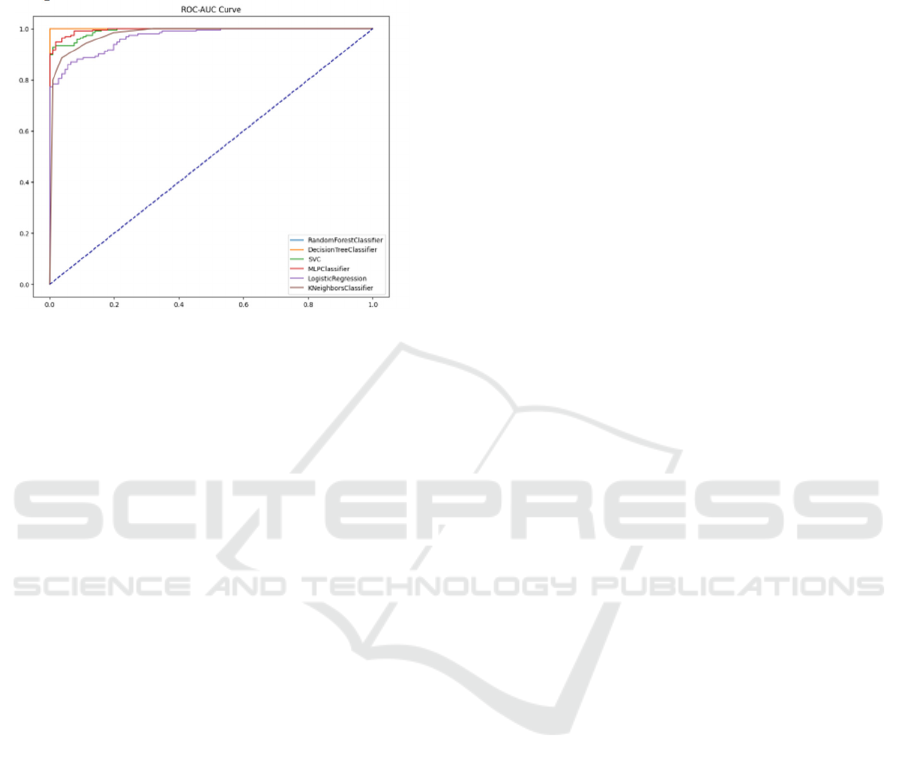
ROC-AUC curve as shown in figure 2 is a pictorial
representation of the true positive rate versus the
false positive rate.
Figure 2: ROC-AUC Scores of Test Data.
5 CONCLUSIONS
In our paper we provide a solution for jamming
attacks using machine learning models. Out of the
models tested, the Random Forest Classifier proved
to be the best performer with a test accuracy of 97%
and a ROC-AUC score of 99.01%. The performance
metrics demonstrate how well our method works to
differentiate between normal network traffic and
jamming attacks, which would significantly increase
the security of wireless networks.
REFERENCES
Chaitanya, V. Lakshmi, and G. Vijaya Bhaskar. "Apriori vs
Genetic algorithms for Identifying Frequent Item Sets."
International journal of Innovative Research
&Development 3.6 (2014): 249-254.
Chaitanya, V. Lakshmi. "Machine Learning Based
Predictive Model for Data Fusion Based Intruder Alert
System." journal of algebraic statistics 13.2 (2022):
2477-2483
Chaitanya, V. Lakshmi, et al. "Identification of traffic sign
boards and voice assistance system for driving." AIP
Conference Proceedings. Vol. 3028. No. 1. AIP
Publishing, 2024
Devi, M. Sharmila, et al. "Machine Learning Based
Classification and Clustering Analysis of Efficiency of
Exercise against Covid-19 Infection." Journal of
Algebraic Statistics 13.3 (2022): 112-117.
Devi, M. Sharmila, et al. "Extracting and Analyzing
Features in Natural Language Processing for Deep
Learning with English Language." Journal of Research
Publication and Reviews 4.4 (2023): 497-502.
Mahammad, Farooq Sunar, Karthik Balasubramanian, and
T. Sudhakar Babu. "A comprehensive research on
video imaging techniques." All Open Access, Bronze
(2019).
Mahammad, Farooq Sunar, and V. Madhu Viswanatham.
"Performance analysis of data compression algorithms
for heterogeneous architecture through parallel approa
ch." The Journal of Supercomputing 76.4 (2020): 2275-
2288.
Mahammad, Farooq Sunar, et al. "Key distribution scheme
for preventing key reinstallation attack in wireless
networks." AIP Conference Proceedings. Vol. 3028.
No. 1. AIP Publishing, 2024.
Mandalapu, Sharmila Devi, et al. "Rainfall prediction
using machine learning." AIP Conference Proceedings
. Vol. 3028. No. 1. AIP Publishing, 2024.
Mr.M.Amareswara Kumar, “Baby care warning system
based on IoT and GSM to prevent leaving a child in a
parked car” in International Conference on Emerging
Trends in Electronics and Communication Engineerin
g - 2023, API Proceedings July-2024
Mr.M.Amareswara Kumar, “Effective Feature Engineerin
g Technique for Heart Disease Prediction with Machine
Learning” in International Journal of Engineering &
Science Research, Volume 14, Issue 2, April-2024 with
ISSN 2277-2685.
Paradesi SubbaRao,”Morphed Image Detection using
Structural Similarity Index Measure”M6 Volume 48
Issue 4 (December 2024),https://powertechjournal.co
m
Paradesi Subba Rao, ”Detecting malicious Twitter bots
using machine learning” AIP Conf. Proc. 3028, 020073
(2024),https://doi.org/10.1063/5.0212693
Parumanchala Bhaskar, et al. "Machine Learning Based
Predictive Model for Closed Loop Air Filtering
System." Journal of Algebraic Statistics 13.3 (2022):
416-423.
Parumanchala Bhaskar, et al. "Incorporating Deep Learning
Techniques to Estimate the Damage of Cars During the
Accidents" AIP Conference Proceedings. Vol. 3028.
No. 1. AIP Publishing, 2024.
Parumanchala Bhaskar, et al “Cloud Computing Network
in Remote Sensing-Based Climate Detection Using
Machine Learning Algorithms” remote sensing in earth
systems sciences (springer).
Suman, Jami Venkata, et al. "Leveraging natural language
processing in conversational AI agents to improve
healthcare security." Conversational Artificial
Intelligence (2024): 699-711.
Sunar, Mahammad Farooq, and V. Madhu Viswanatham.
"A fast approach to encrypt and decrypt video streams
for secure channel transmission." World Review of
Science, Technology and Sustainable Development
14.1 (2018): 11-28.
ICRDICCT‘25 2025 - INTERNATIONAL CONFERENCE ON RESEARCH AND DEVELOPMENT IN INFORMATION,
COMMUNICATION, AND COMPUTING TECHNOLOGIES
66
