
Analysis and Implementation of Security Algorithm for Healthcare
Application
E. S. Selva Priya, Amritha K., Logeshwari C. and Aishwarya S.
Department of ECE, KCG College of Technology, KCG Nagar, Rajiv Gandhi Salai, Karapakkam, Chennai, Tamil Nadu,
India
Keywords: Patient Data Security, Prescription, Encryption, AES Algorithm, Department‑Specific Access, Secret Key,
Secure Data Sharing, SHA‑256 Encryption, Authorized Access, I Enter‑Departmental Communication, Data
Privacy.
Abstract: This paper introduces a safe solution for patient consultations for the healthcare industry. This includes
recording medical information and encrypting the prescription with the Advanced Encryption Standard (AES)
for safe communication from the Surgery, Radiology, and Pharmacy departments. Access is granted only to
the concerned parties using decryption keys for every department, keeping the information safe. Outside of
this, patient treatment updates in all the patients are stored in a secure fashion using SHA-256 hashing such
that the information is safe against unauthorized modification. Performance metrics indicate the system is
efficient with an average database storage retrieve time of 0.0002 seconds having low latency coupled with
robust security. This two-layered security mechanism AES for encryption and decryption and SHA-256 for
data storage enhances the protection for the confidentiality of patient data, the integrity of the data, and
protection against unauthorized modification.
1 INTRODUCTION
The present healthcare system puts a premium on the
secure sharing and storage of sensitive patient data.
Digital transformation in healthcare introduces
efficiency but risks exposing patient records,
prescriptions, and medical notes to potential
breaches. Robust encryption and hashing techniques
are needed to ensure that sensitive information
remains confidential, secure, and accessible.
In this framework, the Advanced Encryption
Standard (AES), a widely adopted symmetric
encryption algorithm, is employed to secure patient
prescriptions. This is known for its speed, efficiency,
and strong security attributes (J. Boddy et al. 2023).
AES functions with fixed block sizes of 128 bits,
supports key lengths up to 128 bits, 192 bits, and 256
bits. The attack upon this algorithm through brute
force is not possible. This algorithm has been
implemented in open-source libraries such as
PyCrypto, OpenSSL, and Crypto++ (L.Suganthi et
al.). In order to provide a higher degree of data
integrity and ensure tamper-proof storage, SHA-256
has been used (Semantha et al. 2021). SHA-256 is
part of the SHA-2 family and produces a fixed-length
256-bit hash, which depends completely on the input
data. Any sort of change in data will produce entirely
another hash, so any unauthorized change to the data
will be easily identifiable. It is at the core of
blockchain technology The cryptographic hash
function is used to link data blocks in an immutable
way (E.S. Selvapriya, et al. 2023). Platforms such as
Open source Hyperledger and Ethereum use SHA-
256 for blockchain-based solutions, which enable
secure and transparent ways of managing data
(Narasimha Rao, et al. 2024). In the proposed system,
Patient will consult doctor and the doctor will upload
the medical notes. AES encryption ensures the
transfer of prescriptions between surgery, radiology,
and pharmacy departments in a way that only the
authorized staff, having the specific secret keys of
their departments, can access the data (J. Boddy et al.
2023).
In parallel, SHA-256 is used for the encryption
and storage of patient information in tamper-proof
manner based on the block chain principle (M.
Abaoud et al. 2023), thus allowing safe and
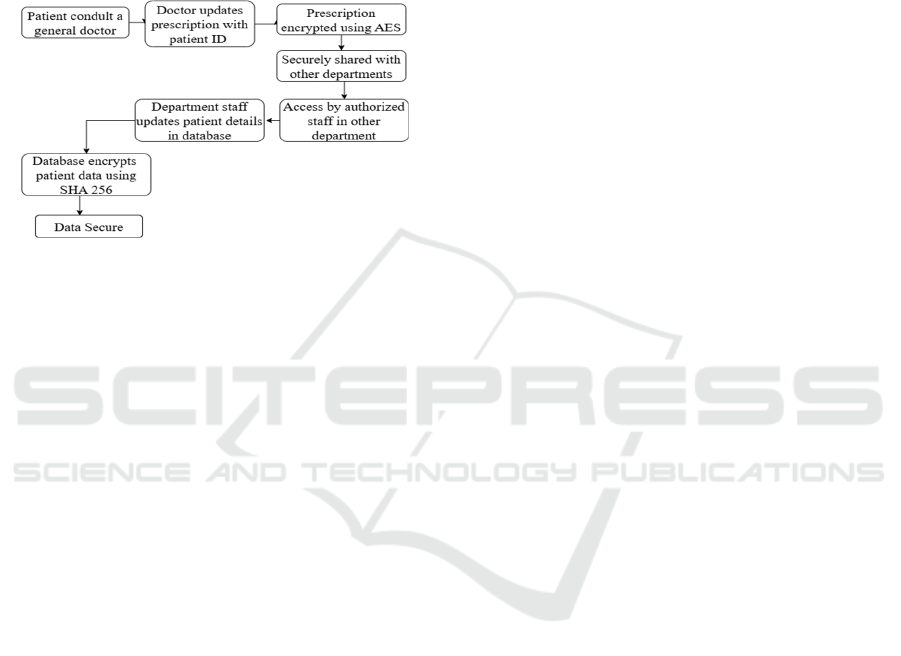
unchangeable records as shown in Figure 1. Using
open-source implementations and spring boot suite
for backend and for data storage using MySQL, this
Priya, E. S. S., K., A., C., L. and S., A.
Analysis and Implementation of Security Algorithm for Healthcare Application.
DOI: 10.5220/0013891200004919
Paper published under CC license (CC BY-NC-ND 4.0)
In Proceedings of the 1st International Conference on Research and Development in Information, Communication, and Computing Technologies (ICRDICCT‘25 2025) - Volume 3, pages
31-43
ISBN: 978-989-758-777-1
Proceedings Copyright © 2025 by SCITEPRESS – Science and Technology Publications, Lda.
31
system saves on cost and takes advantage of the
collective knowledge and continued improvement
through the community (Aljoahni , et al. 2023). This
paper introduces AES and SHA-256 as integrated to
give an all-round secure framework in handling
sensitive health data. The solution proposed will meet
the needs of the health care industry while meeting
the ever-growing demands for health data security
(Mahadik et al. 2024).
Figure 1: Block Diagram of System.
2 RELATED WORKS
There has been a lot of research done in integrating
blockchain technology, encryption, and access
control mechanisms into the management of
healthcare data to overcome problems of data
security, privacy, and interoperability in medical
systems. It has been suggested that blockchain would
be an effective means of securing medical records and
ensuring data integrity in preventing unauthorized
alterations and tampering, thereby making record
management transparent (C. -L. Feng et al. 2023).
Blockchain-based healthcare data sharing systems
have been explored for the secure transmission of
sensitive patient data across different healthcare
providers while decentralizing and minimizing the
risks of centralized storage (M. Abaoud et al. 2023).
AES encryption has also been highly researched as a
security technique for securing health information.
This means that patient data will be secure and private
between healthcare providers, as well as while storing
sensitive medical records (M.A. Sahi , et al. 2017).
In a variety of applications, encryption will play a
major role in securing medical data when sensitive
patient information is being sent between parties.
Role-based access control (RBAC) models are
commonly used to ensure that only authorized
personnel can access sensitive medical information.
These models control access to patient data based on
the roles and responsibilities of individuals within
healthcare organizations. Implementing strict access
control policies is critical to preventing unauthorized
access to critical healthcare data (Jeyabose, et al.
2022). Other techniques considered are privacy-
preserving techniques with blockchain, such as
homomorphic encryption and zero-knowledge
proofs, ensuring patient data will not be easily
breached (Mahadik et al. 2024). All these techniques
contribute to the realization of patient information
security while safely transferring health records
across various service providers. Finally,
decentralized management through blockchain
eliminates any single point failure, thus promoting
safety by keeping away unauthorized people from
manipulating health care records (Alzubaidy, et al.
2023). Blockchain-based approaches improve the
Electronic Health Record interoperability so that
information between the providers is exchangeable in
an integrative and reliable way to ensure the integrity
of medical records. This is set to be conducive to
interoperability across the health entities as well as
uniformity of the data between various systems
(Aouedi, et al. 2022).
Blockchain has also been proposed to track the
provenance of healthcare data, offering a transparent
and auditable trail that enhances accountability in
healthcare data management (Mahadik et al. 2024).
Secure health information exchange via blockchain
ensures the protection of patient privacy while
guaranteeing data integrity and reducing the risk of
data breaches. Smart contracts have high hopes
toward the automation of the healthcare processes
involved in data management. The system allows
secure and efficient data sharing between healthcare
providers while enforcing various privacy regulations
with improvement in administrative tasks and
showing stern security protocols (Tertulino et al.
2023). Recent research has illustrated the efficiency
of Spring Boot and Java frameworks to develop
secure, scalable, and high-performance health
applications. The inherent security attributes of
Spring Boot, support for RESTful API, and
interoperability with MySQL have made Spring Boot
a popular option for encrypting patient data (J. Wei,
et al. 2022).
In addition, the Spring Security's RBAC pattern
has also been widely researched to provide role-based
access to medical information, maintaining HIPAA
and GDPR compliance. Beyond this, Java-based
applications provide asynchronous processing
capabilities, which facilitate rapid encryption and
decryption processes for real-time access to secured
medical information without hitting system
performance (Shraddha Dadhich, et al. 2016).
ICRDICCT‘25 2025 - INTERNATIONAL CONFERENCE ON RESEARCH AND DEVELOPMENT IN INFORMATION,
COMMUNICATION, AND COMPUTING TECHNOLOGIES
32

Research further shows that advanced indexing
strategies in MySQL, for example, B-Tree and Hash
Indexing, enhance the retrieval rate of encrypted
patient information. Further, caching platforms like
Redis and Earache have been incorporated in Spring
Boot applications to improve performance with
repeated database queries (Narasimha Rao, et al.
2024). Such studies indicate an increased interest and
successful applications in using blockchain,
encryption, and access controls in the management of
healthcare data complexities. Therefore, such efforts
toward making healthcare data decentralized yet
transparent will be reflected in the proposed system
(Nduma, et al. 2022).
3 PROBLEM STATEMENT
The healthcare sector has been aggressively
digitalizing by the increased deployment of
Electronic Health Records (EHR) as well as
connecting various medical data management
systems into one platform. Despite all of these
technological advancements, critical challenges still
surround the management and sharing of healthcare
data, especially considering data security and patient
privacy concerns as well as system interoperability
(M.A. Sahi, et al. 2017).
The use of centralized systems in traditional
health data systems poses high risks for breach,
unauthorized access, and manipulation of private
patient information. Such weaknesses can lead to
large risks against both healthcare organizations and
patients in the form of monetary losses, identity theft,
and loss of reputation. Besides that, decentralization
and isolation of health care systems pose the
challenge of the secure exchange of patient data
across different health providers and institutions (E.S.
Selvapriya , et al. 2023).
It seeks to address all the above challenges using
blockchain technology as the basis of a definitely
safe, transparent, and interoperable system for the
sharing, storing, and managing patient data. This is in
relation to patient data security improvement using
blockchain decentralized mechanisms and its
cryptographical one. The immeasurability of data
means that their integrity is always assured (Elmisery
et al. 2016). The proposed idea combines blockchain,
advanced encryption, and role-based access control
models to achieve secure, patient-centered healthcare
data management, with ultimate empowerment of the
patient through rights over health records and
unhindered, secured data exchange between health-
care systems.
4 SYSTEM DESIGN
This paper provides the patient data protection system
design for healthcare via AES-128 and SHA-256
encryption. The system protects patient prescriptions
and medical records via secure storage, encryption,
and access control by authorized staff in various
hospital departments (J. Boddy et al. 2023). The
system design has a front-end user interface written
with HTML5, CSS, and JavaScript through which
doctors and medical staff can access patients' records.
The Java and Spring Boot-based back-end application
performs the requests and handles the encryption
process (S. Fugkeaw, et al. 2024). A MySQL
database stores an encrypted patient record.
Prescription data is AES-128 encrypted, and patient
identifiers are SHA-256 hashed and secured against
unauthorized tampering (Naresh, et al. 2023). Data
flow starts from a patient visit general physician, and
the physician will upload their prescription with an ID
and medical notes. The prescription is then AES-128
encrypted and stored in the database. The prescription
is then provided to authorized hospital staff from
Surgery, Radiology, and Pharmacy departments
depending on their role (M. Abaoud et al. 2023).
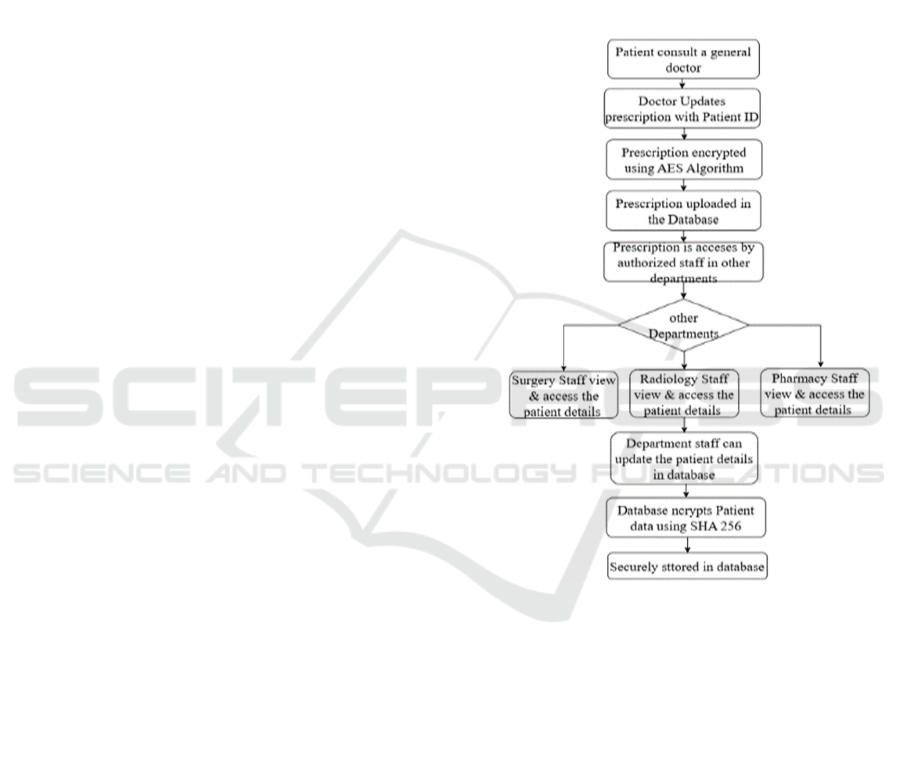
Patient information is updated when modified and
further secured using SHA-256 encryption prior to
storage shown in Figure 2. The role- based
authentication ensures that only approved medical
staff are able to see and modify records, thus
preserving data integrity and confidentiality. This
system improves the protection of health data by
incorporating AES-128 and SHA-256 encryption to
protect sensitive patient information from
unauthorized reading and modification and enable
crucial medical personnel access to required
information in a timely fashion (S. Fugkeaw , et al.
2024).
Software Integration: The software system is
essentially an integration of multiple components
functioning in consonance with each other to deliver
efficient functionality and robust security. From a
front-end point of view, the client application is
communicating with back-end services using
RESTful APIs, which present effective data transfer
between the two sides, that of the client-side and
server-side components. The responsive design
ensures access on various devices while offering a
friendly user experience on any platform. The system
design is on top of the Java Spring Boot framework
which brings in the power of all AES encryption and
role-based access control, thus blockchain
synchronization happening behind key business logic
(Tertulino et al. 2023). As a result of this, this Spring
Analysis and Implementation of Security Algorithm for Healthcare Application
33
Boot has always taken great care to work on scalable
maintainable architecture concerning sensitive data
(Mahadik et al. 2024).
Applying SHA-256 integrates the blockchain,
creating cryptographic hashes that help in building a
decentralized and immutable ledger in which every
transaction is written (Semantha et al. 2021). Data
integrity is achieved through this because each
blockchain entry validates corresponding database
records, thus stopping tampering and modification of
the record without authorization (C. -L. Feng et al.
2023). The layer that will be involved with the
database will include participating in the storage of
AES-encrypted records and blockchain hashes that
accompany every entry to ensure data integrity
remains sound.
These two technologies integrated into the system
imply that data in the database are always
synchronized with blockchain to reinforce security
and authenticity within the system (Alzubaidy, et al.
2023). Two of them in combination help achieve a
secure, efficient, and reliable solution in the
management of sensitive information (M. Abaoud et
al. 2023).
Existing Method: The modern healthcare system
uses cloud computing for processing and storage of
patient information. Though it facilitates remote
diagnosis and easy access, it involves serious privacy
concerns. Cloud servers are not absolutely secure,
exposing patient information to hacking or
misappropriation. Patients also have no direct
authority over their health records, with cloud
providers controlling access. The system relies
mainly on k-Nearest Neighbor (kNN) and
Mahalanobis Distance (MD) for pre-diagnosis,
providing linear complexity without robust security
mechanisms (Jeyabose , et al. 2022). While cloud
systems are less energy-intensive than blockchain
frameworks, they have the drawback of inefficient
data exchange and distrusted, as patients and
healthcare organizations are unable to completely
trust cloud service providers with confidential
medical data (S. Fugkeaw , et al. 2024).
Proposed Method
:
To solve this issue of privacy
and security, the proposed system merges edge
computing with blockchain technology. Instead of
trusting cloud servers, patient data is processed
locally at edge devices such as hospital PCs or
personal devices, which ensures greater privacy
(Tertulino et al. 2023). Blockchain technology
provides an open and decentralized ledger for secure
management of data access. Thus, Patients have
complete control over their encrypted medical
records and can grant access to only the authorized
departments of healthcare (C. -L. Feng et al. 2023).
The system employs AES encryption and SHA-256
hashing for providing enhanced security. Although
blockchain is more energy-intensive, it significantly
improves data trustworthiness, transparency, and
resistance to illegal modifications (M. Abaoud et al.
2023). The approach eliminates the dependency on
cloud storage, providing a more secure and
dependable system of healthcare data management.
Figure 2: System Architecture.
5 METHODOLOGY
Data protection is a significant factor in contemporary
healthcare systems to maintain the privacy, integrity,
and authenticity of medical records. Sophisticated
cryptographic methods like AES-128 (Advanced
Encryption Standard - 128 bit) and SHA-256 (Secure
Hash Algorithm - 256 bit) are used extensively to
safeguard confidential medical data against
unauthorized viewing and cyber attacks (Elmisery et
al. 2016). AES-128 is a symmetric-key encryption
algorithm for ensuring data confidentiality, whereas
SHA-256 is a cryptographic hash function employed
in ensuring data integrity. These crypto mechanisms
complement each other to bolster the security of
ICRDICCT‘25 2025 - INTERNATIONAL CONFERENCE ON RESEARCH AND DEVELOPMENT IN INFORMATION,
COMMUNICATION, AND COMPUTING TECHNOLOGIES
34
healthcare applications through the encryption of
patient data and the creation of immutable hash
values for verification purposes (Aouedi, et al. 2022).
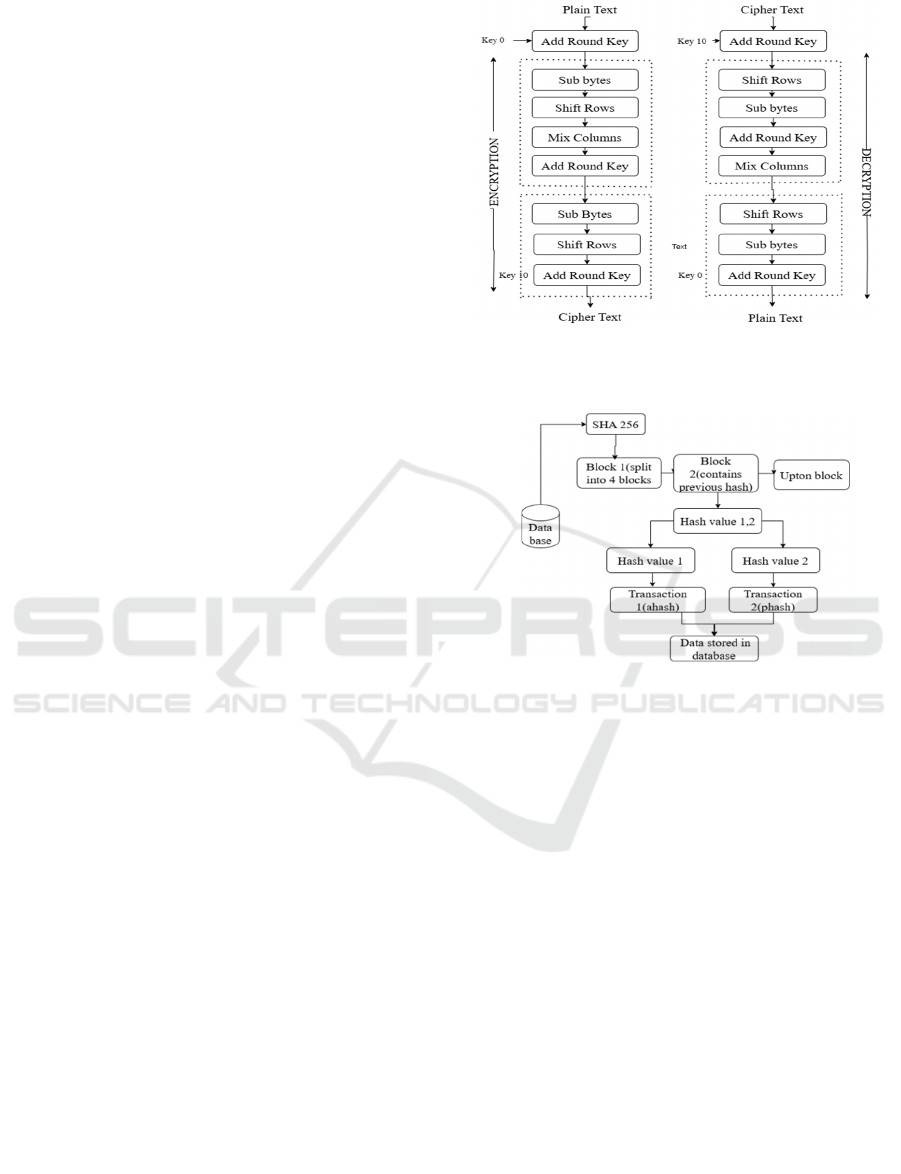
Advanced Encryption Standard (AES)
Algorithm: The Advanced Encryption Standard
(AES) algorithm encrypts data in blocks of 128 bits
with the keys of lengths 128, 192, or 256 bits. AES
starts with an Initial Round during which the plaintext
is combined with the encryption key using the step
Add RoundKey (J. Boddy et al. 2023). This is
followed by a number of Main Rounds, each with
four phases: SubBytes (byte substitution using an S-
box), ShiftRows (cyclical shift of the rows for
diffusion), MixColumns (mixing columns with
matrix multiplication for further diffusion), and
AddRoundKey (mixing of the state with a round-
key). The number of rounds depends on the key size:
10 rounds for keys with size 128 bits, 12 rounds for
keys with size 192 bits, and 14 rounds for keys of size
256 bits as shown in Figure 3. In the Final Round, the
MixColumns operation is omitted, thereby leaving
the ciphertext still 128-bit block-sized (Nduma , et al.
2022). The layered implementation of AES provides
outstanding security against cryptographic attacks
without sacrificing high performance (M.A. Sahi , et
al. 2017).
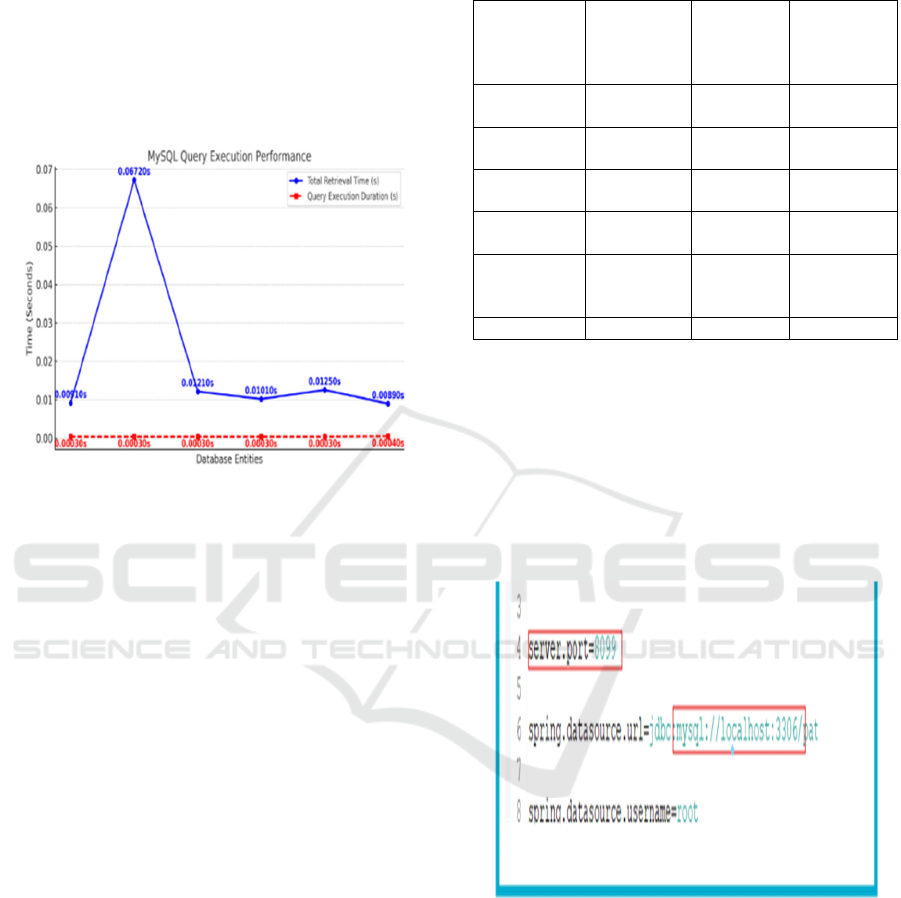
Secure Hash Algorithm-256(SHA-256): SHA-
256, ahash, and phash are hash algorithms employed
for many applications. SHA-256 is a cryptographic
hash function that minimizes input data to a fixed
256-bit hash value, providing data integrity and
security through intricate mathematical processes
such as bitwise shifts, rotations, and modular
additions (Semantha et al. 2021). SHA-256 finds
extensive application in digital signatures,
certificates, and block chain because it is resistant to
collision and pre-image attacks ((L.Suganthi et al.).
Conversely, ahash (Average Hash) and phash
(Perceptual Hash) are intended for image matching.
Ahash scales down an image, converts it to grayscale,
and creates a binary hash based on average pixel
values, and hence is sensitive to small variations (M.
Abaoud et al. 2023). Phash uses the Discrete Cosine
Transform (DCT) to detect low-frequency
components that define the overall shape of the
image, offering greater resistance to rotation and
scaling as shown in Figure 4. Although SHA-256
provides cryptographic security, ahash and phash are
good at identifying perceptual similarities and are
hence applicable in digital forensics as well as image
deduplication (J. Boddy et al. 2023).
Figure 3: AES Flowchart for Encrytion and Decryption in
128 Bites.
Figure 4: SHA 256 for Encryption.
6 RESULT AND DISCUSSIONS
The website setup is in place to validate both the
security and functionality and performance of a six-
module website-based system, namely Admin, User,
Doctor, Surgeon, Radiologist, and Pharmacist as
shown in Figure 7. The Admin module can access
directly with login functionality as shown in Figure 8.
All other modules require approval from the Admin
before the use of login entry to the system as shown
in Figure 9. This strictly integrates role-based access
control. The data is encrypted by AES-128 with
symmetric keys, creating the ciphertext for preserving
the confidentiality of the data stored and transmitted.
In addition to this, the blockchain based on SHA-
256 will be added in order to create a decentralized
and immutable layer of security and protect the
integrity of the data by preventing tampering. MySQL
has been used for the database storing encrypted
records by AES and their hashes in the blockchain
The encryption workflow was validated with tests
on generation and handling of symmetric keys and
Analysis and Implementation of Security Algorithm for Healthcare Application
35
ciphertext. The blockchain nodes were deployed on
distributed servers for redundancy, during which
synchronization tests were executed under simulated
partition of the network and concurrent transactions.
Scheduled audits would cross-check the blockchain
hashes with MySQL database records and presented
tampering scenarios that validated the system's
capability to detect any unauthorized modifications.
Figure 5: MySQL query execution time for fetched data
across all departments, including total time taken and
entities (departments).
Table 1 illustrates the comparison between
retrieval time and query execution time for various
database entities. The six database entities specified
in the table are Doctor Entity, Patient Entity,
Pharmacy Entity, Radiologist Entity, S-Doc Request
Table, and User Table. Number of Records Retrieved
refers to the number of records returned for each of
the tables in the retrieval process. Total Retrieval
Time (seconds) is the time it takes for the respective
records to be retrieved in the data-base, while the
Query Execution Duration (seconds) is the time it
takes for the respective query to be processed by the
data-base as shown in Figure 5.We can observe the
highest retrieval time of 0.0672 seconds taken by the
Patient Entity due to the relatively higher number of
records (15) in comparison to the other entities. The
Doctor Entity and User Table take retrieval times of
0.0091 seconds and 0.0089 seconds respectively due
to the fewer records. The retrieval time of the S-Doc
Request Table is merely 0.0125 seconds despite the
higher number of records (29). This is good
performance of the database for large data sets. Query
execution time for each of the tables is the same at
approximately 0.0003 seconds with the User Table
timing a bit higher at 0.0004 seconds.
Table 1: Query execution performance for healthcare of
each database entities.
Database
Table
Number of
Records
Retrieved
Total
Retrieval
Time (s)
Query
Execution
Duration
(
s
)
Doctor
Entit
y
8 0.0091 0.0003
Patient
Entit
y
15 0.0672 0.0003
Pharmacy
Entit
y
2 0.0121 0.0003
Radiologist
Entit
y
2 0.0101 0.0003
S-Doc
Request
Table
29 0.0125 0.0003
User Table 12 0.0089 0.0004
The difference can be due to the indexing or query
optimization internally for different tables. Table 1
performance result illustrates the performance of the
database in retrieving varying amounts of data for
various entities with minimal query execution time.
The efficient data retrieval ensures quick data
accessibility for the respective healthcare
management modules, thereby ensuring effective
performance operations with minimal response time.
Figure 6: Local server setup.
Figure 6 shows the local server setup using Spring
Boot. The server.port=8099 configures the
application to run on port 8099, accessible via
http://localhost:8099. The database connection is
established using a MySQL database named at on port
3306.
ICRDICCT‘25 2025 - INTERNATIONAL CONFERENCE ON RESEARCH AND DEVELOPMENT IN INFORMATION,
COMMUNICATION, AND COMPUTING TECHNOLOGIES
36
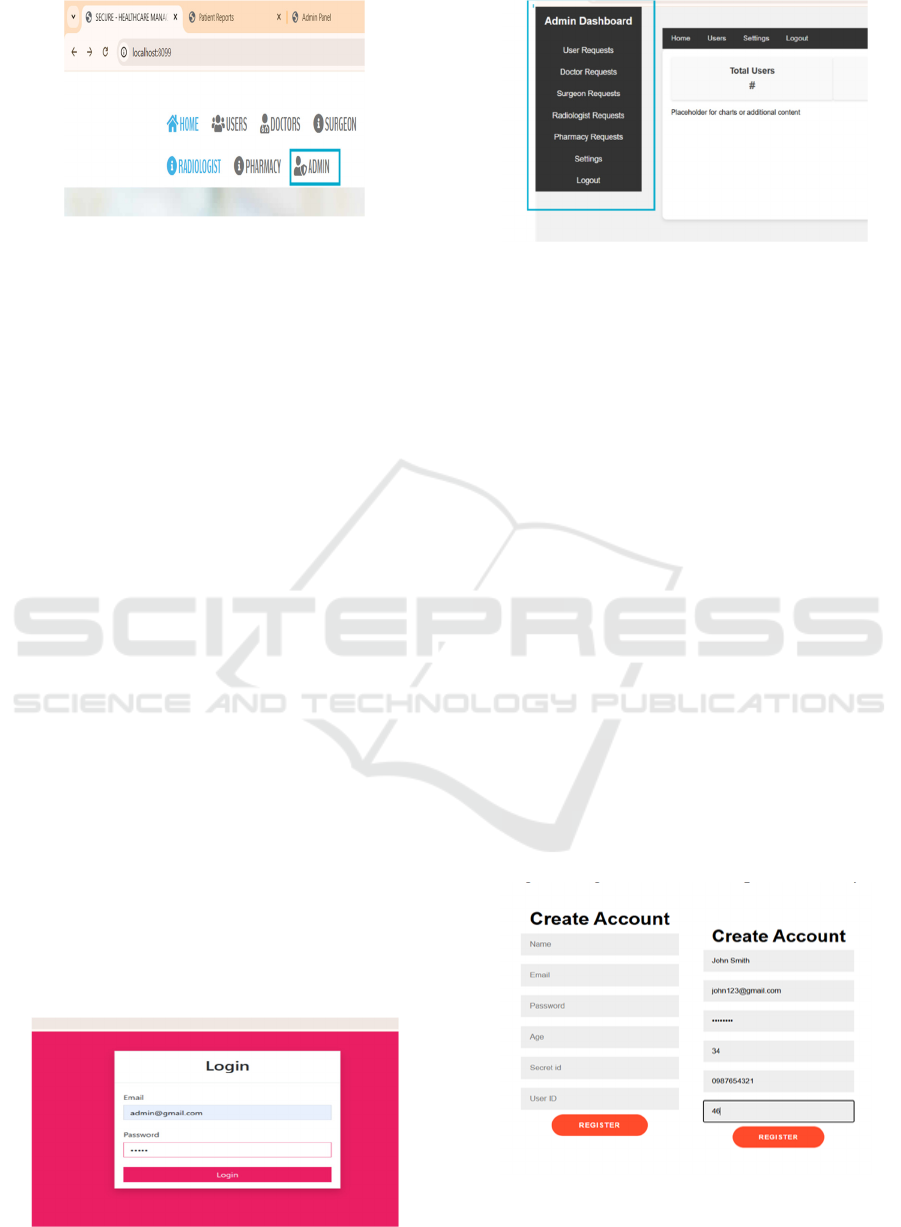
Figure 7: Functional modules of the system.
The system has six major modules, and they are
as shown in Figure 7
• User: This module is for users or patients. User
when comes to the hospital they will Register &
Login in the hospital website.
• Doctors: This module is for medical specialists or
general physicians. Doctors provide a
consultation to users and they will upload the
patient details and it will be saved in the database.
• Surgeon: Surgeons can use this module with the
features such as scheduling surgery, viewing pre
and post-surgery reports, interacting with
radiologists and doctors, and changing patient
recovery status.
• Radiologist: Radiologist Module is designed for
the radiology specialists to deal with medical
images. It allows them to upload and arrange
reports, interpret the outcome of the scan, and give
the result to doctors and surgeons. It helps in more
proper diagnoses and treatments.
• Pharmacy: This module facilitates the
management of medicines and prescriptions, such
as inventory control, prescription processing,
medicine expiry dates tracking, and prescription
coordination with doctors.
• Admin: Admin has complete authority over the
system and can directly log into any module.
Handling Users, Doctors, Surgeons and
Radiologists. Admin will give the permissions to
the other departments for further treatment to the
user.
Figure 8: Admin user interface.
Figure 9: Admin dashboard with modules.
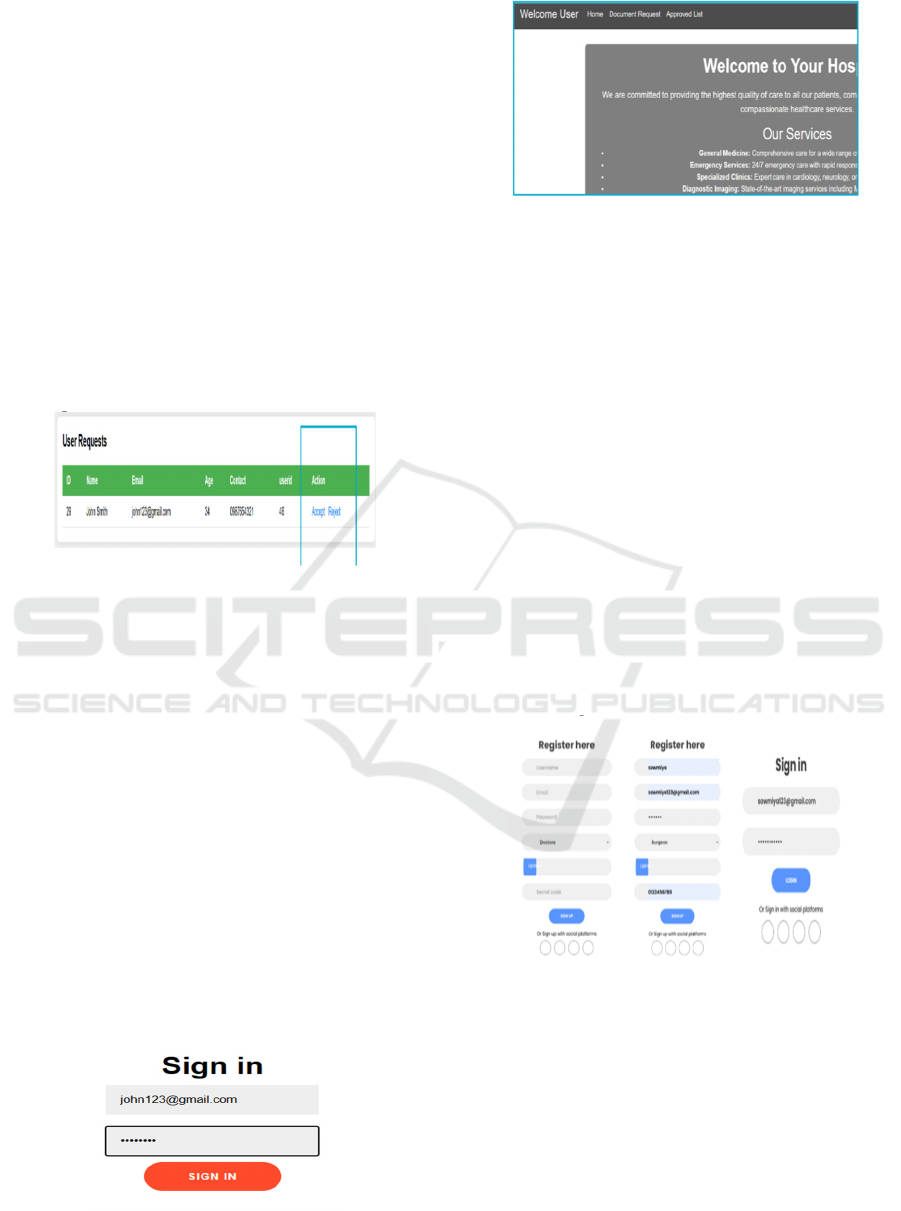
Admin login: The admin should enter their
registered email (e.g., admin@gmail.com and
respective password as shown in Figure 8. Admin will
be having direct hospital portal and give access to the
other departments and this allows admin doesn’t need
separate login for each department and can take the
control of all department functionality into single
account.
The Admin Dashboard is the main interface from
which the administrator can manage and monitor all
the system activities as shown in Figure 9. The
dashboard grants access to various modules and
enables the admin to process user requests
effectively.
• User Request: Display and manage requests from
general users.
• Doctor Request: Process requests from doctors.
• Surgeon Requests: Process surgeon-related
requests.
• Radiologist Request: Monitor requests from
radiologists.
• Pharmacy Request: Monitor pharmacy-related
requests.
• Settings: Set up system settings.
• Logout: Log out of the admin portal securely
Figure 10: Step-1: User account create page and step 2: user
registration.
Analysis and Implementation of Security Algorithm for Healthcare Application
37
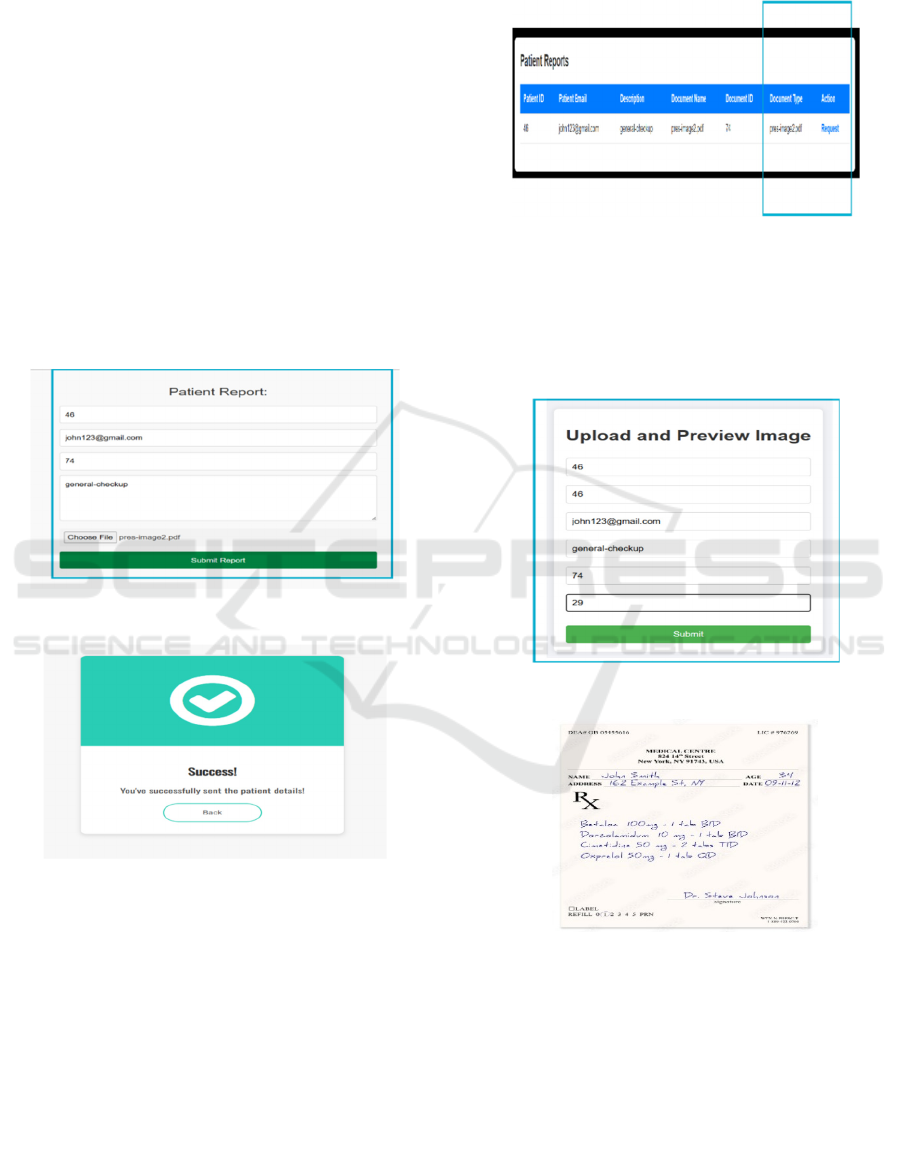
The User Registration page will allow new users
to create an account in the hospital website as shown
in Figure 10. This process will ensure secure access
and authentication for all modules. The steps for
registration are shown in Figure 10.
Steps in the User Registration Process:
• Name: Full name of the user.
• Email: A valid email address for account
verification.
• Password: A secure password for login
authentication.
• Age: The user's age, used for profile
identification.
• Secret ID: Users contact number for any
verification.
• User ID: A system-generated or manually entered
unique identifier for the user.
Figure 11: User request to admin.
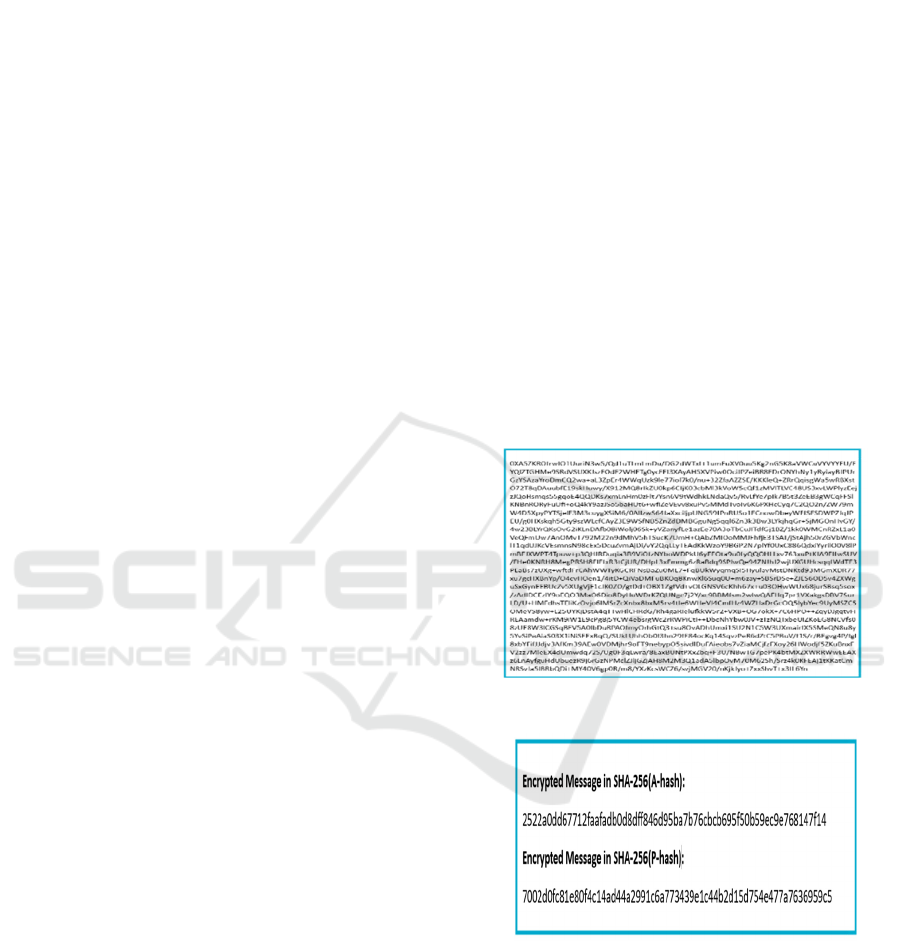
The request is received by the admin under the
User Requests section. The admin has two choices:
Accept the request (provide Access to the ssystem).
Deny the request (deny access). The decision is
reflected in the system, updating the user's status as
shown in Figure 11. When the admin checks the
request, the information is saved in the database. If
granted, the user information is stored for good. If
refused, the request may be logged but denied
authorization. The database is used to keep a record
of all the requests made by the users to provide
security and convenience. If the request is granted,
the user is issued credentials to access as shown in
Figure 12. If denied, the user has to reapply with
correct information. The admin validates that only
rightful users receive access. This procedure allows
for safe management of users within the hospital
portal system.
Figure 12: User login.
Figure 13: User dashboard with document request and user
authentication.
The system verifies the data that is stored in
database. if the data are matching the user will
successfully be logged in and redirect to their
dashboard.
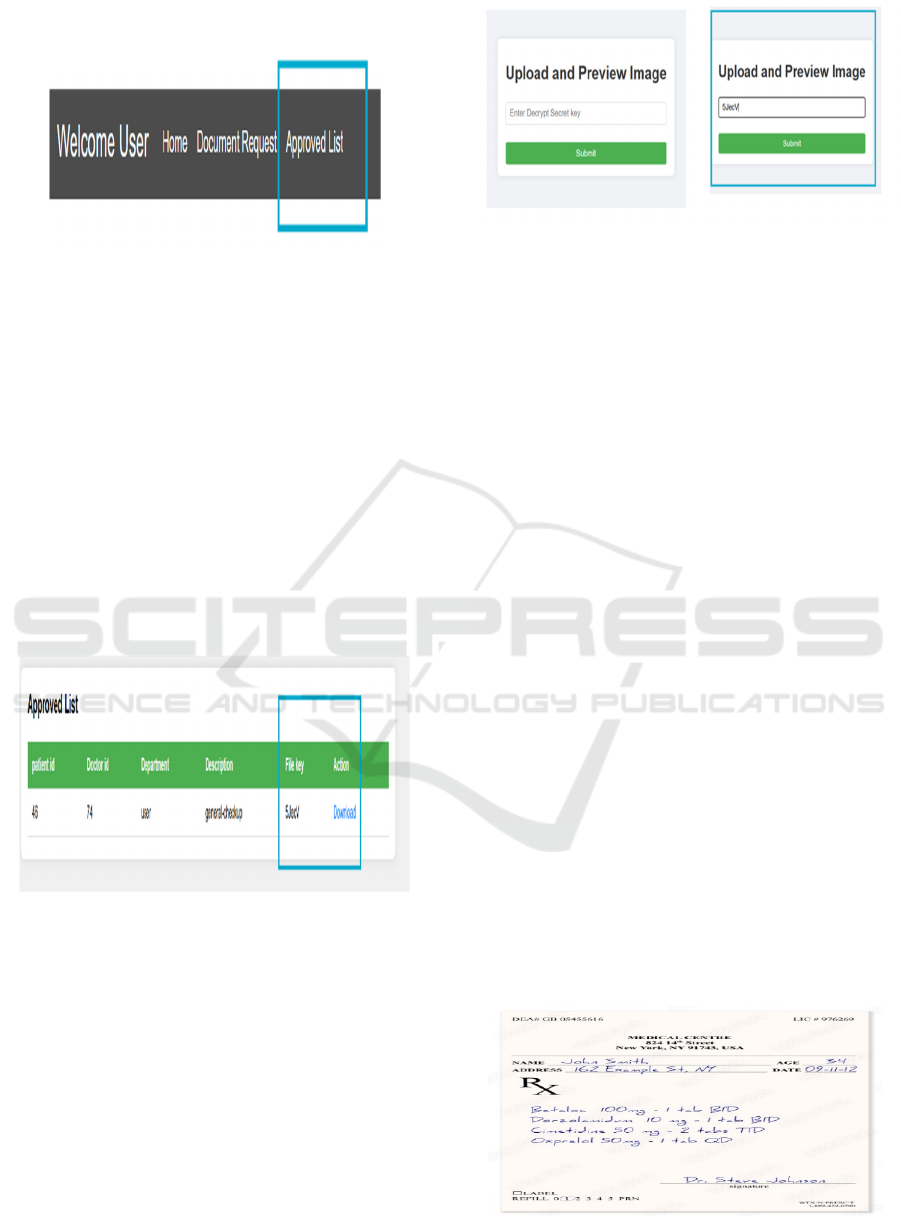
• User Dashboard contains three part as shown in
Figure 13.
• Home Section: Displays general information
about related to hospital services.
• Document Request: Allows users to request their
specific document/files related to medical history
and submit the request to the related departments
those who uploaded.
• Approval List: Displays the status of pending or
approved document requests by the respective
department. The user can view the status of their
requests. The admin reviews the request and either
approves or rejects it. Approved documents
become available for download or further
processing.
Figure 14: Step 1-Doctor register page and Step 2-Doctor
sign up and Step 3- Doctor login after admin approval.
The doctor will register and submit request to the
admin, providing their details such as name, email,
password, specialty, proof and contact information as
shown in Figure14 (a) and Figure (b). The admin
reviews the request and either approves or rejects it.
If approved, the doctor can sign in using their
registered email and password as shown in Figure
14(c). Once logged in, the doctor can view patient
ICRDICCT‘25 2025 - INTERNATIONAL CONFERENCE ON RESEARCH AND DEVELOPMENT IN INFORMATION,
COMMUNICATION, AND COMPUTING TECHNOLOGIES
38
requests for medical consultations, prescriptions, or
reports. The doctor can choose to accept or reject a
request. If accepted, the details are stored in the
database, and the user gets access to the approved
documents or services. This ensured robust
encryption and proper treatment of data while
ensuring operational dependability, thus allowing for
a user-friendly yet secure system for all the modules.
The system meets the requirements for
confidentiality, integrity, and security of data, with the
incorporation of AES-128 encryption, SHA-256
block chain, MySQL for data storage, and access
control mechanisms, and yet remains scalable and
high in performance. The system was tested on
performance, security, and functionality; results
indicate that it can indeed handle real-world
operational environments in managing sensitive
healthcare data.
Figure 15: Doctors will upload the patient details.
Figure 16: Patient report submission confirmation.
After approving a user's request, the doctor fills in the
patient details and report description in the system.
The doctor can also attach necessary medical files
(e.g., prescriptions, lab results, or scanned
documents) as shown in Figure 15 and sample file as
shown in Figure 19. Once all required information is
entered, the doctor submits the report by clicking the
"Submit Report" button. After successful submission,
the system processes the report and stores it in the
database.
A confirmation message is displayed, indicating
that the patient details have been successfully sent.
The user (patient) can now access the uploaded report
through their dashboard as shown in Figure 16.
Figure 17: Patient report in their dashboard asking for a
request to see the document.
After prescription uploaded by the respective
doctor, the user should request to view and download
the document, which will be displayed in the user
dashboard as shown in Figure 17.
Figure 18: After request enter the specific key value.
Figure 19: Sample prescription (input).
After the request has been approved, the system
prompts the patient to enter his or her own distinct ID
and key value. These are employed as an
authentication factor to make certain that only the
respective patient gains access to his or her report.
Upon correct entry of ID and ke value, the patient can
proceed to safely view or download his or her medical
report as shown in Figure 18. The uploaded document
Analysis and Implementation of Security Algorithm for Healthcare Application
39
serves as input data that will later be used to verify as
shown in Figure 19 and check decryption results.
The Advanced Encryption Standard (AES-128) is
utilized to encrypt sensitive data before it is stored in
the database. Encrypting confidential patient
information in this way makes it accessible only to
authorized individuals with the correct decryption
key. This aspect made it possible for information to
be transmitted securely between various modules,
including Admin, Doctor, Surgeon, Radiologist, and
Pharmacist, without compromising the
responsiveness of the system as a whole.AES-128
encryption provided the level of security needed
without burdening the system with computational
overhead and therefore was the ideal solution to
encrypt health information.SHA-256 (Secure Hash
Algorithm) is used to generate a fixed-size hash of
information. It aids in data integrity verification to
ascertain that data stored is not compromised or
altered. Unlike AES, SHA-256 is a one-way function
that implies the hashed data cannot be decrypted back
to its original form. The encrypted messages (AES-
128) and hashed values (SHA-256) are stored in the
database, which is a secure way of protecting patient
records against unauthorized access.
Blockchain integration via SHA-256 hashing
algorithm improved the security with greater
transparency and openness. It would generate, with
each change, a cryptocurrency hash that the node
would attach to the blockchain. The system utilized
blockchain to guarantee data immutability for
ensuring resistance against data tampering and
alterations. As demonstrated in testing with load
scenarios, blockchain can sync seamlessly at
distributed nodes, without introducing additional
delay in validations and recording the transaction.
This featured decentralized storage and ensured
availability of data while preventing single points of
failure. Any attempt to modify or manipulate
blockchain records would be immediately detectable,
thus securing the integrity of healthcare information
and providing transparency into all actions performed
within the system. MySQL was used as the database
management system, therefore storing encrypted
healthcare records secure as shown in Figure 20. This
ensured a very smooth interface of encrypted data
with blockchain hashes, thus making it efficiently
handle huge amounts of data. The database was kept
synchronized with the blockchain records, which
were bound to the entries in MySQL. Therefore, the
system guaranteed easy verification of authenticity of
health records. Performance of MySQL in terms of a
high load was good. Data retrieval or storage did not
introduce noticeable delays in the operations.
Scalability would allow this system to be scaled to
very large volumes of health care data when users and
health care records became many in numbers.
Encryption Process: The input data as shown in
Figure 19 (likely an image, as mentioned) has been
encrypted using AES-128 (Advanced Encryption
Standard - 128-bit). AES-128 is a symmetric
encryption algorithm that ensures data confidentiality
by converting readable data into an unreadable
format. The encrypted message appears as a
randomized string of characters, making it
incomprehensible without the correct decryption key.
Access control mechanisms were established and
only permitted approval users to access the system.
There existed a procedure for admin approval prior to
the issue of access to a user on the platform; thus,
limited entry by access granted to Doctors, Surgeons,
Radiologists, and Pharmacists, therefore not allowing
unauthorized users to access sensitive information of
health care by preventing them from getting into the
system.
Figure 20: Encrypted message of input (image) in AES 12.
Figure 21: Encrypted Message in Sha 256 in A-Hash and P-
Hash.
SHA-256 (Secure Hash Algorithm - 256 bit) is a one-
way cryptographic hashing function encrypted
message as shown in Figure 21, meaning it cannot be
decrypted back into its original form. Access logs
were also maintained and blockchain recorded the
same, hence transparency and accountability of user
activities in the system were ensured. The system
ICRDICCT‘25 2025 - INTERNATIONAL CONFERENCE ON RESEARCH AND DEVELOPMENT IN INFORMATION,
COMMUNICATION, AND COMPUTING TECHNOLOGIES
40
proved strong scalability regarding performance
under load.
Figure 22: The approved list section shows the document
requests that have been approved by the doctor.
The Approved List Section in the healthcare system
with approved document requests from the doctor as
shown in Figure 22. The table has important data such
as Patient ID, Doctor ID, Department, Description,
File Key, and Action. After the approval of a request,
a File Key (decryption key) is created, enabling
authorized users to view the document. Action in the
column consists of a Download option, as shown in
Figure 23 and users can acquire the approved
document securely. In this process, only
authenticated and authorized users access patient-
related details, thereby authorized users access
patient-related details, thereby augmenting data
confidentiality.
Figure 23: Once approved, the File Key (decryption key) is
generated randomly.
The automatic creation of a File Key (decryption
key) after the document request has been authorized.
The key is created randomly and serves as a security
token, with only authorized users being able to
decrypt and view the document as shown in Figure
23. This feature improves data privacy by limiting
unauthorized users and protecting sensitive medical
records. Both key-based access and document
authorization provide a safe and managed document-
sharing environment within the system.
Figure 24: After clicking download a pop-up box will and
after entering the decrypt key (file Key) and submit it will
show the decrypted file open for View the file and for
decrypt key.
The File Decryption Interface, which is in the
form of a pop-up box when the user selects the
download option. The interface asks for a Decrypt
Secret Key from the user in order to open the file. The
key is generated beforehand at the document approval
process and is kept safe in the database. When the
decryption key is entered, the system authenticates it
by comparing it with the key stored in the database as
shown Figure 24 (a) and Figure 24 (b). If the key is
correct, the system decrypts the file using the AES-
128 decryption algorithm and displays it. This
approach provides a secure mechanism where the
confidential information can be made available only
to authorized users with the correct decryption key,
thus improving data security and privacy. In the event
of an invalid key, the system prompts for an error
message to avoid unauthorized access. The correct
decryption key needs to be re-entered by the user in
order to access the file. This strategy enforces data
security using AES-128 encryption to maintain safe
and controlled access to the sensitive data the
decrypted medical prescription upon successful
decryption with the AES-128 algorithm as shown in
Figure 25. When the decryption key is entered
correctly, the system displays the patient's details,
medical reports. This protects sensitive medical data
from unauthorized access while ensuring only
legitimate users access the information at the same
time
Figure 25: Decryption file (output).
Analysis and Implementation of Security Algorithm for Healthcare Application
41
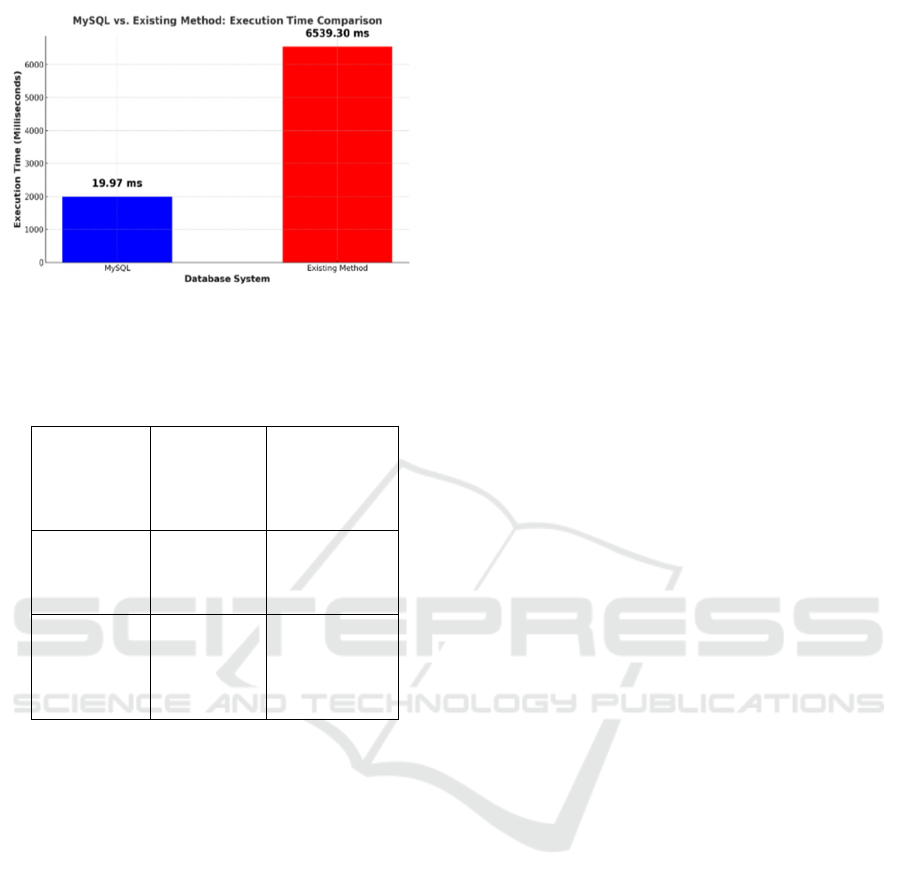
Figure 26: Comparison of MySQL execution time Vs
Existing method execution time (Avg execution time)
Table 2: MySQL vs. Existing Method Query Execution
Time Comparison.
System
Average
Execution
Time
(Seconds)
Performance
Observation
MySQL (Avg
Execution
Time)
0.01997s
Extremely Fast
Existing
Method (Avg
Execution
Time)
6.5393s
Significantly
Slower
The table 2 shows that MySQL (0.01997s) is faster
than the existing method (6.5393s), making it ideal
for real-time applications. The existing method’s
slower execution suggests inefficient queries or
indexing, requiring optimization to improve
performance. Overall, MySQL is the better choice for
speed and efficiency A comparision graph for this is
as shown in Figure 26. It easily supported hundreds
of concurrent users with a minimal decrease in
response time or system performance. The database,
encryption operations, and blockchain
synchronization all scaled effectively without much
loss of performance. It was possible to process
hundreds of thousands of encrypted healthcare
records at a very low response time. The
decentralized nature of the blockchain network did
not cause bottlenecks; transactions were validated
properly even under heavy loads. This ensures the
system can achieve large healthcare networks where
multiple users are accessing and updating records in
real time.
7 CONCLUSIONS
The current research was capable of developing a
secure healthcare management system based on AES-
128 encryption, SHA-256 blockchain technology,
and MySQL for storage. The design of the system
offers robust security for sensitive health information
through stressing confidentiality, integrity, and
transparency. AES-128 encryption covers the data
when stored and transferred, while blockchain offers
an irreversible record of transactions, thus rendering
the system's data integrity secure. MySQL was used
to store the encrypted data securely with consistency,
as well as facilitating easier verification. Comparing
performance between the MySQL database and the
existing method demonstrated a vast difference in
execution time. The MySQL database executed
queries in just 19.97 ms execution time, which was
significantly lower compared to the 6539.30 ms by
the existing method. This performance gap clearly
demonstrates the higher efficiency of MySQL in
handling and processing data queries. The steep drop
in execution time reflects MySQL's ability to provide
faster access to data, which is totally required by real-
time healthcare applications.
The outcome is that the proposed system not only
satisfies healthcare data security requirements but
also optimizes system performance by a considerable
extent. With MySQL's improved execution times, the
solution is now ideal for real-time applications and
offers quick, secure access to healthcare records. In
conclusion, the use of AES-128 encryption, SHA-256
blockchain, and MySQL is an efficient and scalable
method for secure and effective healthcare data
management.
REFERENCES
A. J. Boddy, W. Hurst, M. Mackay and A. e. Rhalibi,
"Density-Based Outlier Detection for Safeguarding
Electronic Patient Record Systems," in IEEE Access,
vol. 7, pp. 40285-40294, 2019, doi:
10.1109/ACCESS.2019.2906503.
Aljoahni, Tahani & Zhang, Ning. (2023). Secure, ID
Privacy and Inference Threat Prevention Mechanisms
for Distributed Systems. IEEE Access. PP. 1-1.
10.1109/ACCESS.2023.3234932.
Alzubaidy, Hussein & Al-Shammary, Dhiah & Abed,
Mohammed & Ibaida, A. & Ahmed, Khandakar.
(2023). Hilbert Convex Similarity for Highly Secure
Random Distribution of Patient Privacy
Steganography. IEEE Access. PP. 1-1.
10.1109/ACCESS.2023.3325754.
ICRDICCT‘25 2025 - INTERNATIONAL CONFERENCE ON RESEARCH AND DEVELOPMENT IN INFORMATION,
COMMUNICATION, AND COMPUTING TECHNOLOGIES
42

Aouedi, Ons & Sacco, Alessio & Piamrat, Kandaraj &
Marchetto, G. (2022). Handling Privacy-Sensitive
Medical Data with Federated Learning: Challenges and
Future Directions. IEEE Journal of Biomedical and
Health Informatics. PP. 1- 14. 10.1109/JBHI.2022.
3185673.
C. -L. Feng, Z. -C. Cheng and L. -J. Huang, "An
Investigation into Patient Privacy Disclosure in Online
E.S. Selvapriya and L. Suganthi. 2023. Design and
implementation of low power Advanced Encryption
Standard cryptocore utilizing dynamic pipelined
asynchronous model. Integr. VLSI J. 93, C (Nov 2023).
https://doi.org/10.1016/j.vlsi.2023.102057
Elmisery, Ahmed & Rho, Seungmin & Botvich, Dmitri.
(2016). A Fog Based Middleware for Automated
Compliance with OECD Privacy Principles in Internet
of Healthcare Things. IEEE Access. 4. 8418-8441.
10.1109/ACCESS.2016.2631546.
J. Wei, X. Chen, J. Wang, X. Hu and J. Ma, "Enabling (End-
to-End) Encrypted Cloud Emails with Practical
Forward Secrecy," in IEEE Transactions on
Dependable and Secure Computing, vol. 19, no. 4, pp.
2318- 2332, 1 July- Aug. 2022, doi: 10.1109/TDSC.2
021.3055495.
Jeyabose, Andrew & Karthikeyan, J. & Andrew, Jennifer &
Pomplun, Marc & Dang, Hien. (2022). Privacy
Preserving Attribute-Focused Anonymization Scheme
for Healthcare Data Publishing. IEEE Access. PP. 1-1.
10.1109/ACCESS.2022.3199433.
L.Suganthi, R.Anandha Praba , E.S.Selva Priya. “Enhanced
Arrhythmia Detection Through Wavelet Scattering and
Deep Learning Techniques”, Journal of University of
Shanghai for Science and Technology, ISSN: 1007-673
M. Abaoud, M. A. Almuqrin and M. F. Khan, "Advancing
Federated Learning Through Novel Mechanism for
Privacy Preservation in Healthcare Applications," in
IEEE Access, vol. 11, pp. 83562-83579, 2023, doi:
10.1109/ACCESS.2023.3301162.
M.A. Sahi et al., "Privacy Preservation in e-Healthcare
Environments: State of the Art and Future Directions,"
in IEEE Access, vol. 6, pp. 464-478, 2018, doi:
10.1109/ACCESS.2017.2767561.
Mahadik, Shalaka & Pawar, Pranav & Muthalagu, Raja &
Prasad, Neeli & Hawkins, Sin-Kuen & Stripelis,
Dimitris & Rao, Sreedhar & Ejim, Peter & Hecht,
Bruce. (2024). Digital Privacy in Healthcare: State-of-
the Art and Future Vision. IEEE Access. PP. 1-1.
10.1109/ACCESS.2024.3410035.
Medical Platforms," in IEEE Access, vol. 7, pp. 29085-
29095, 2019, doi: 10.1109/ACCESS.2019.2899343.
Narasimha Rao, K. P., & Chinnaiyan, S. (2024).
Blockchain-Powered Patient-Centric Access Control
with MIDC AES-256 Encryption for Enhanced
Healthcare Data Security. Acta Informatica
Pragensia, 13(3), 374-394.
Naresh Sammeta,Latha Parthiban, "Blockchain-based
Scalable and Secure EHR Data Sharing using Proxy
Re-Encryption", The International Arab Journal of
Information Technology (IAJIT) ,Volume 20, Number
05, pp. 702 - 710, September 2023, doi:
10.34028/iajit/20/5/2.
Nduma, Basil & Ambe, Solomon & Ekhator, Chukwuyem
& Fonkem, Ekokobe. (2022). Health Records Database
and Inherent Security Concerns: A Review of the
Literature. Cureus. 14. 10.7759/cureus.30168.
S. Srilaya and S. Velampalli, "Performance Evaluation for
DES and AES Algorithms- A Comprehensive
Overview," 2018 3rd IEEE International Conference on
Recent Trends in Electronics, Information &
Communication Technology (RTEICT), Bangalore,
India,2018, pp. 1264- 1270, doi: 10.1109/RTEICT42
901.2018.9012536.
S. Fugkeaw, L. Hak and T. Theeramunkong, "Achieving
Secure, Verifiable, and Efficient Boolean Keyword
Searchable Encryption for Cloud Data Warehouse," in
IEEE Access, vol. 12, pp. 49848-49864, 2024, doi:
10.1109/ACCESS.2024.3383320.
Semantha, Farida Habib & Azam, Sami & Shanmugam,
Bharanidharan & Yeo, Kheng Cher & Beeravolu,
Abhijith. (2021). A Conceptual Framework to Ensure
Privacy in Patient Record Management System. IEEE
Access. PP. 1-1. 10.1109/ACCESS.2021.3134873.
Shraddha Dadhich "Performance Analysis of AES and DES
Cryptographic Algorithms on Windows & Ubuntu
using Java". International Journal of Computer Trends
and Technology (IJCTT) V35(4):179-183, May 2016.
ISSN:2231-2803. www.ijcttjournal.org. Published by
Seventh Sense Research Group.
Tertulino, Rodrigo & Ivaki, Naghmeh & Morais, Higor.
(2024). Design a Software Reference Architecture to
Enhance Privacy and Secu in Electronic Health
Records. IEEE Access. 12. 112157. 10.1109/ACCE
SS.2024.3441751.
Wahyudi, R., & Romli, M. A. Android-based Patient
Medical Record Data Security Application using AES
and RSA Method Cryptography. International Journal
of Computer Applications, 975, 8887.
Analysis and Implementation of Security Algorithm for Healthcare Application
43
