
Device for Solar Powered Mobile Charging and Water Purification in
Bus Terminus with AI Monitoring
R. Senthilmurugan, B. Pradeep Kumar, K. Yokeshwaran and C. Parthiban
Department of Mechatronics, K.S.Rangasamy College of Technology, KSR Kalvi Nagar, Tiruchengode, Namakkal‑637215,
Tamil Nadu, India
Keywords: Smart Solar Street Lamp, Simulation‑Based Approach, Rainwater Harvesting, AI‑Based Monitoring, Energy
Efficiency, Sustainability.
Abstract: This article demonstrates the simulation model for a smart solar street lamp, using a rainwater collection
module and an AI monitoring module for enhanced energy usage and sustainability. Well, they show that they
are able to simulate the maximum output that solar panels can deliver in terms of power, while at the same
time they are able to gather the water that falls on the panels and direct it towards a virtual storage system –
making it sustainable for human use (drinking) and also environmental use (irrigation). Under different
environmental conditions, simulation tools are used to validate the energy efficiency of the system, the
effectiveness of water collection, and the operation reliability. An AI-based simulation model is used to
monitor the best way of solar energy output, battery health, water levels, and environmental parameters.
Machine learning algorithms which are used by the AI system to emulate anomaly detection, energy efficiency
prediction and maintenance predictions to ensure the reliability and decision-making. The research conducted
to simulate this assessment is a critical case study that shows valid data for the practicality of the technology
and efficiency of a modular solar-water-smart streetlight. These preliminary findings are conducted toward
future applications in real life, in particular for green energy and smart infrastructure projects.
1 INTRODUCTION
Due to the growing demand for green energy
sources, solar-powered streetlights have emerged as
one of the most widely implemented technologies
today (Sutopo et al., 2020; Hossain et al., 2022). But
the system is inefficient due to limitations such as
dust settle on solar panels and improper energy
storage (Cheng et al., 2020; Anguraj et al., 2022).
This project provides a simulated model for an AI-
based solar powered streetlight with a rainwater
harvesting system to mitigate these disadvantages
(Ahmed et al., 2024; Anitha Vijayalakshmi et al.,
2025). The structure on the roof aims for unlimited
exposure to solar radiation and at the same time
transport rainwater in a harvesting system for both
modeled storage and filtration. For that, the
technique provides the best possible energy
utilization and saved water and thus provides a
multifunctional and a sustainable technology, both
urban and agronomics. You are powered by an AI-
enabled monitoring system that provides real-time
insights into solar generation, battery health, water
levels, and weather conditions (Ganvir et al., 2024;
Mehta & Bhalla, 2024). The system is programmed
to leverage machine learning programs to identify
anomalies, then predict energy consumption, and
through these predictions to autodetect system
performance without the cost of installation
(Mohanty et al., 2024; PK & KRS, 2024). Simulation
also confirms the efficacy of excess solar energy in
secondary applications like charging mobility and
small auxiliary power load and proves that smart
energy management can be a reality (Michail, 2021;
Tran et al., 2021). The simulation study provided here
validates the proposed urban smart solar streetlight
infrastructure and demonstrates to provide
compelling insights on system feasibility,
sustainability, and relevancy towards real-life
implementation. The innovation specially focuses on
improving the reliability and functionality of the
accumulated solar-based infrastructure by using AI-
assisted performance improvement resource
planning; and the milestone is indeed an important
step towards the facilitation of green energy
10
Senthilmurugan, R., Kumar, B. P., Yokeshwaran, K. and Parthiban, C.
Device for Solar Powered Mobile Charging and Water Purification in Bus Terminus with AI Monitoring.
DOI: 10.5220/0013890900004919
Paper published under CC license (CC BY-NC-ND 4.0)
In Proceedings of the 1st International Conference on Research and Development in Information, Communication, and Computing Technologies (ICRDICCT‘25 2025) - Volume 3, pages
10-18
ISBN: 978-989-758-777-1
Proceedings Copyright © 2025 by SCITEPRESS – Science and Technology Publications, Lda.
technology leading to sustainable energy systems
(Meem, 2023; Shanmugasundaram et al., 2025).
2 PROBLEM IDENTIFICATION
Traditional solar streetlight systems never achieved
maximum energy potential of the solar panels as their
main objective is light (Cheng et al., 2020; Sutopo et
al., 2020). As these systems lack an effective energy
management system, surplus solar energy generated
throughout the day is wasted (Archibong et al., 2020;
Chaudhary et al., 2022). Overall efficiency of the
system is reduced since the surplus energy is wasted
instead of channeling or storing it for future use. This
solar underemployment makes available a core
lacuna in utilizing the utmost potential of solar
energy, which could otherwise be diverted towards
different public benefits. The inefficiency of
traditional solar streetlights on cloudy and foggy days
is a core weakness (Hao et al., 2022; Islam et al.,
2021). Solar panels need direct sunlight to transfer
energy, but sunlight that falls on the panels falls
immensely short under overcast, fog, or rainy
weather. Since there is not enough penetration of light
because of thick cloud cover, power generation is
significantly decreased. The underlying cause of
wasteful utilization of solar energy has not been
resolved even after implementing innovations such as
IoT integration and smart monitoring systems for the
improvement of solar street lights (Dwiyaniti et al.,
2022; Khemakhem & Krichen, 2024).
3 METHODOLOGY
3.1 Design
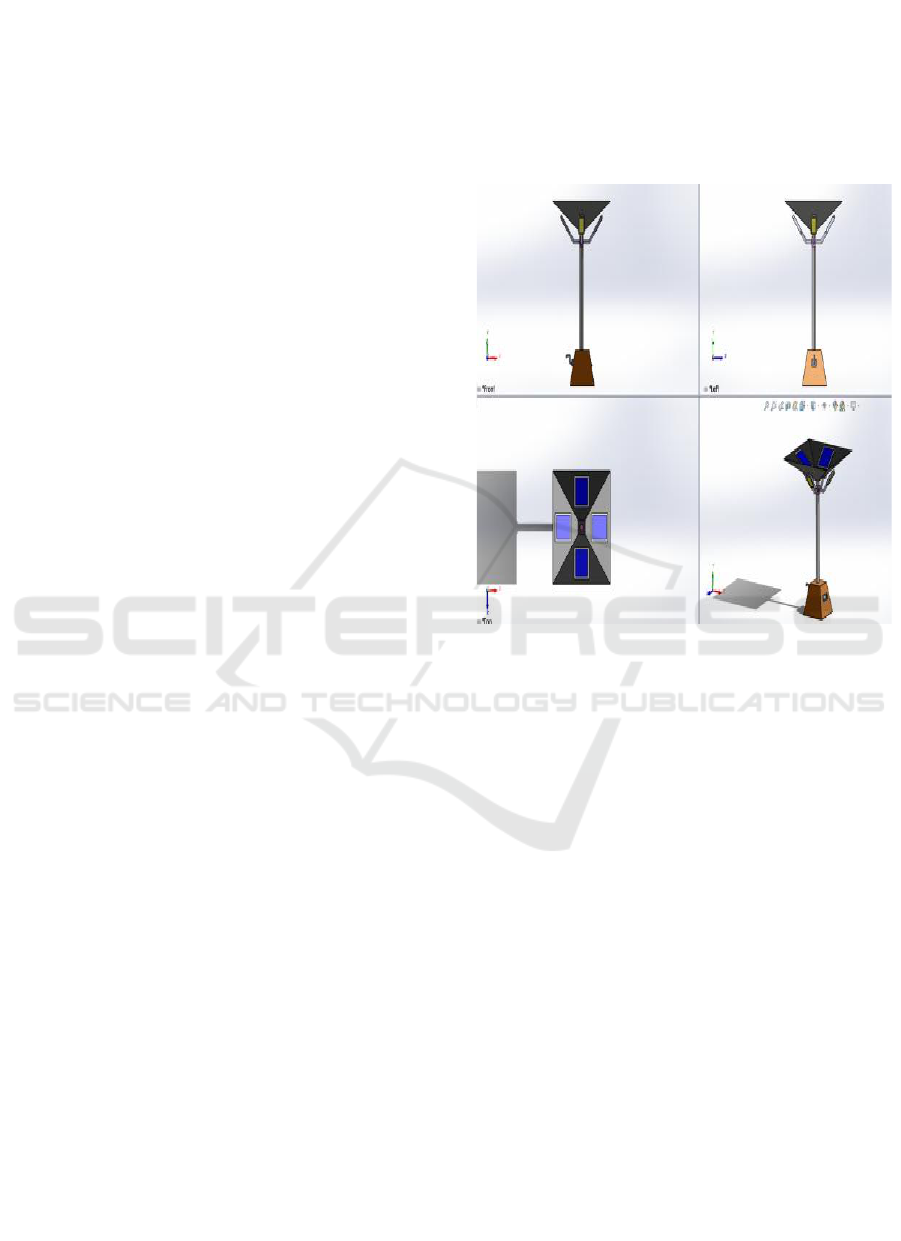
The designed multi-purpose rainwater harvesting
solar streetlight that will overcome the drawbacks of
traditional solar streetlights by efficient use of sun
rays and creative water management. Conical roof of
the building has a two-way advantage: it allows
efficient collection of rainwater and minimizes the
slope of solar panels for improved energy absorption.
Compared to traditional flat-panel designs, the cone's
inclined plane allows the solar panels to be installed
at angles, optimizing sunlight captured throughout the
day. Particularly in regions with fluctuating solar
conditions, the design greatly improves energy
harvests by minimizing losses and maximizing
system efficiency. With the water collection routed to
a central storage tank beneath the pole, the cone is a
rainwater harvesting device. As a reservoir for water,
the bottom ensures that water is collected and stored
in such a way that it is suitable for public sanitation,
irrigation, or consumption. A filter system can be
provided to enhance performance and have the
collected rainwater ready for different uses by the
community.
Figure 1: Design.
3.2 Components
3.2.1 Solar Panel
The project discusses the four-piece 12V, 25W solar
panel which is proposed for use in this multi-purpose
solar streetlight with rainwater harvesting to provide
maximum power output, thereby improving energy
efficiency and sustainability. The solar panels are
positioned on top of a cone structure enabling
maximum sun absorption during the day. It can even
use solar power efficiently to produce electricity
when it is stored in a battery pack and used at night.
The entire system has a capacity of around 100W A
combination of solar power and enables a 247
operation of an outdoor street light even in cloudy
weather. Incorporating a rainwater collector
mechanism, the cone structure performs two jobs in
one, channelling the rainwater that settles into a
vessel at the bottom of the pole. To make that water
pressurized and can be used at the place of drinking
or public hygiene, you need to set up a filtration plant.
Device for Solar Powered Mobile Charging and Water Purification in Bus Terminus with AI Monitoring
11

3.2.2 Solar Charge Controller
In order to have effective control and use of power
produced by four 12V, 25W solar panels, a 12V solar
charge controller must be there. In order to make the
energy storage system long-lasting and work
effectively, the solar charge controller avoids deep
draining, overcharging, and voltage fluctuation in the
battery. With a bid to reduce energy wastage and
maintain a continuous power supply of electricity to
the LED streetlamp as well as other establishments
like water treatment facilities or charging facilities, it
controls the supply of electricity from the solar panels
into the battery storing facility. By delivering the
maximum power output by the solar panels, the PWM
(Pulse Width Modulation) or MPPT (Maximum
Power Point Tracking) technology of the solar charge
controller delivers maximum energy conversion
efficiency. As it enables the maximum energy to be
stored and harvested, the feature proves useful on
rainy and cloudy days when there is little or no sun
exposure. In order to avoid draining back of battery
to the panels at night, the controller further
deactivates the reverse flow of current. For smooth
and uninterrupted operation of the streetlight system,
it can also have a digital display for real-time
measurement of battery voltage, charging condition,
and load current. The system is highly sustainable and
dependable streetlighting solution because it
possesses a good solar charge controller that is also
energy efficient, prolongs the battery lifespan, and
provides a steady power supply.
3.2.3 Charger Converter
12V charger converter to take advantage of excess
energy offered by four 12V, 25W solar panels to
charge cell phones. The solar panels collect the
energy from the sun during the daytime and charge a
battery unit. A solar charge controller controls the
battery unit not to overcharge and to deliver
maximum transfer of power. For the purpose of
converting 12V DC voltage of the battery into the
required charging voltage of cellular phones and other
low-voltage electrical appliances (usually 5V DC),
the charger converter is required. The unit is equipped
with an onboard DC-DC step-down converter, i.e.,
12V to 5V USB charger module, that supplies stable
and consistent power output to enable safe and
efficient charging of the devices. For application in
sparsely populated towns with poor power supply,
rural areas, and spaces, the function is quite useful. It
facilitates smooth functioning in the supply of energy
being provided by solar panels to mobile use charging
points to drive the supply of electricity and
facilitation of use of renewable energy. Through its
integration of energy storage, cell phone charging,
and road lighting, the building optimizes the
harvesting of solar energy and is an exemplar of a
larger functional system that provides intelligent and
sustainable infrastructural services.
3.2.4 Battery
To provide efficient storage and utilization of energy,
the proposed multi-purpose solar streetlight with
rainwater collection system is equipped with a 12V,
100Ah deep-cycle battery. The system requires a
strong and reliable battery to save excess solar power
during the day since the system is comprised of four
12V, 25W solar panels. Even during rainy and cloudy
days when the solar power is low, the stored solar
energy in the battery gives an uninterrupted supply of
power to the LED streetlight and mobile charging
system. The best battery for this application is a deep-
cycle lead-acid or lithium-ion battery since it can be
recharged and discharged time and again without any
loss of efficiency and without causing any damage to
the battery, yielding long-term reliability and life.
With proper regulation of power input to prevent deep
discharge and overcharging, the solar charge
controller (12V, 10A) prolongs battery life. The
chosen 12V, 100Ah battery can provide power to
further accessories such as public charging stations
and powering the streetlight day and night.
3.3 Sensors
3.3.1 ACS712 Sensor
The major component of this AI-based monitoring
mechanism in simulated solar streetlight, defines as
ACS712 current sensor. Figure 1 shows a real-time
data connection with a meter sensor that will read the
flow of current towards the load/battery from the
solar inverter. The ACS712 is based on Hall-effect
sensing principles, in which the passage of an
electrical current produces an associated magnetic
field that is translated into a voltage signal that we
can measure. Staying updated on active output from
the solar panels, the setup can analyze solar
efficiency, battery capacity, and consumption trends.
The AI surveillance system employed machine
learning algorithms to analyze the unprocessed data
collected from the ACS712 sensors and detect power
flow anomalies, overcurrent conditions, and
inefficiencies in the system. Abnormal drops in
current are detected, which could be due to solar
panel aging, wire failure, or deteriorating battery
ICRDICCT‘25 2025 - INTERNATIONAL CONFERENCE ON RESEARCH AND DEVELOPMENT IN INFORMATION,
COMMUNICATION, AND COMPUTING TECHNOLOGIES
12

performance. In another example, the AI system can
send warnings and predictive maintenance tasks upon
overcurrent or short circuiting to avoid risk of system
failure. The integration of the ACS712 sensor also
adds intelligence to the solar streetlight with
intelligent monitoring, real-time diagnostics,
improved energy usage and more reliable systems.
The simulation also allows us to experiment with the
performance of the sensor in tracking solar energy
flow and power management under different
environmental and operational conditions, and
therefore it is an essential tool for optimizing
sustainable urban and rural lighting systems.
3.3.2 State of Charge (SOC) Sensor
SOC (State of Charge) sensor is the main component
of the AI-based monitoring system of the solar
streetlight simulation and accurately measures the
charge and health of the battery. SOC sensor
estimates how much battery capacity is left in time,
making sure energy can be used, also prevents
overcharging or deep discharge that may shorten the
battery life. It does this either through voltage-based
estimation or coulomb counting or machine learning
algorithms to accurately estimate the cycles of
charge-discharge of the battery. Its SOC monitoring
integration optimizes energy management for a
longer battery life and safer operation of solar-
powered lights. The SOC sensor data is monitored by
predictive models in detecting charging
inefficiencies, unexpected drop-offs, and impending
battery failure in an AI-based monitoring system. It
can foresee battery performance patterns and
identify their deterioration or maintenance indicators
based on the AI platform. Moreover, the smart power
distribution algorithms use the SOC information to
evenly distribute power so that the solar power stored
can be used efficiently for street lights, mobile
charging and the rain water filtering system. Various
aspects of solar-powered infrastructure can be
simulated through simulation-based analysis, such as
varying weather conditions, varying energy loads,
and varying patterns of charging → SOC status
becomes an important factor towards establishing
sustainable, intelligent and autonomous solar-
powered infrastructure.
3.3.3 Ultrasonic Water Level Sensor (HC-
SR04)
One of the important sensors of the artificial
intelligence-based monitoring system of simulated
rainwater harvesting solar streetlight is the Ultrasonic
Water Level Sensor (HC-SR04). To use the
harvested water for drinking water purification,
irrigation, and public use, the module is used to sense
and monitor the water level that is stored in the
rainwater storage tank. The HC-SR04 works based
on the ultrasonic waves, which sends out a high-
frequency sound wave through the air, which reflects
off of the water level and back to the sensor. By
processing the time of echo return, it can monitor
storage capacity and water level in real time. The
water level is continuously checked against the HC-
SR04 sensor in identification of low levels of water,
overflow hazards and outsider usage with an
integrated AI powered IP cloud based surveillance
system. AI systems are used to analyze past history
of water level movement as per trends for analyzing
likely consumption in future so that water is fitfully
controlled without any wastage. Moreover, the
system also can generate alerts and performing
automated control actions like turning on a water
pump when a water level drops below a defined
threshold or closing an inlet valve when the tank
nears-to-full. Simulation is used to model and
optimize the performance of the rainwater harvesting
system for different weather, rainy patterns and water
use conditions. The system is therefore not only
sustainable, resource conserving and independent,
but it is also a smart choice for urban as well as rural
infrastructure with the incorporation of HC-SR04
sensor and AI surveillance.
3.3.4 TDS (Total Dissolved Solids) Sensor
One of the key sensors in the AI-based monitoring
system of the simulated solar streetlight rainwater
harvesting, monitoring the quality of water stored for
drinking, irrigation and other public use is that of the
TDS (Total Dissolved Solids) sensor. The sensor
measures total dissolved solids, a measure of
minerals, salts, and impurities, in harvested
rainwater. It operates on the principle of the
conductivity of water, which increases with increased
dissolved material. Continuously monitored TDS is
maintained by the system to ensure its drinking water
is safe and complies with quality. As soon as TDS
sensor readings are available in an AI system,
machine learning algorithms are utilized to
recognize trends of contaminants in the water,
predicting filter schedule maintenance, and
generating real-time water quality reading. The AI
system may be programmed to provide automatic
alerts in case TDS levels go beyond safety limits,
which may activate warning or filtration or
purification systems. It can also scan historical trends
to determine the expected changes in water quality as
Device for Solar Powered Mobile Charging and Water Purification in Bus Terminus with AI Monitoring
13

a function of climate variables including rainfall
trends, and storage periods. Using simulation testing,
the various scenarios of contamination and the
models of filtration efficiency can be analysed and the
most sustainable rainwater harvesting system
designed and optimised for self-sufficient water
management. The incorporation of the TDS sensor
with AI-based monitoring ensures that the solar
streetlight system not only promotes public health but
also water conservation and better ecological
conditions, distinguishing it as unique and adaptable
infrastructure for cities.
3.3.5 DHT22 (Digital Temperature &
Humidity Sensor)
The DHT22 (Digital Temperature & Humidity
Sensor) is an important part in the AI monitoring
system of simulated solar streetlight with rainwater
harvesting to provide real-time reading of
environmental conditions. This sensor can provide
accurate temperature and humidity measurements
which is important for measuring solar energy
generation and rainwater harvesting efficiency. Using
high-accuracy digital outputs, DHT22 works on
principles of a capacitive humidity sensor, and a
thermistor. By continuously measuring temperature
changes and humidity in the air, the system could
assess how weather acted on the efficiency of its
solar panels and its ability to collect water. This is
where the AI-monitoring system comes on board and
the DHT22 sensor data is filtered through ML
algorithms to check the performance of the system on
varying weather conditions. Solar Panels Efficiency
Management: The AI system can detect efficiency
losses in solar power panels due to high temperature
and adapt energy management to optimize the
battery usage. Similarly, humidity levels help analyze
if it will rain, so rainwater collection systems are not
out of service. By utilizing both historical weather
data and real-time sensor data, the AI model is able to
forecast trends in solar energy generation as well as
water storage capacity, ultimately leading to
enhanced reliability and sustainability of the system.
As such, through simulation analysis, different
climate conditions can be modelled, creating a more
robust smart solar streetlight under changing
environmental conditions. It creates a good
infrastructure tool for monitoring climate with
renewable energy optimization, resource
minimization through AI based user friendly
platform integrated with DHT22 sensor for sense
detection and monitoring.
3.4 Raspberry Pi 4
The AI-based monitoring system of the rainwater-
harvesting solar streetlight simulator has a Raspberry
Pi 4 Model B as the central processing unit. Being a
key element in system performance improvement, it
is responsible for sensor data collection, AI-based
anomaly detection, and cloud remote monitoring.
Need the calculation power to handle real-time sensor
data from the ACS712 current sensor, battery SOC
sensor, HC-SR04 water level sensor, DHT22
temperature sensor, PIR motion sensor, TDS water
quality sensor, quad-core ARM Cortex-A72
processor (1.5 GHz)+4GB/8GB LPDDR4 RAM. The
Raspberry Pi’s 40-pin GPIO interface makes it easy
to connect a variety of sensors to ensure monitoring
of solar generation, battery performance, water levels
and weather. Raspberry Pi 4 supports built-in Wi-Fi
(802.11ac) and Gigabit Ethernet that allows
streaming of data to cloud interfaces in real-time like
firebase, thingspeak or AWS IoT for remote
monitoring and predictive analysis. Other features
like USB 3.0 ports and microSD or SSD expandable
storage make it suitable for efficient data logging and
AI model execution. Machine learning libraries such
as TensorFlow and OpenCV also support Raspberry
Pi 4 for anomaly detection and predictive
maintenance to ensure system reliability. Raspberry
Pi 4 can handle real-time conditions though
simulation-based analysis in an optimized manner
promotes to system performance, energy
management, and looks after the sustainability of the
smart solar streetlight system. Thus, all these with
the integration of edge computing, AI monitoring,
along with IoT connectivity make Raspberry Pi 4
Model B a powerful and efficient monitoring system
that is highly scalable, and provides smart
infrastructure for urban and rural amenities to
generate a strong infrastructure.
3.5 Circuit Diagram
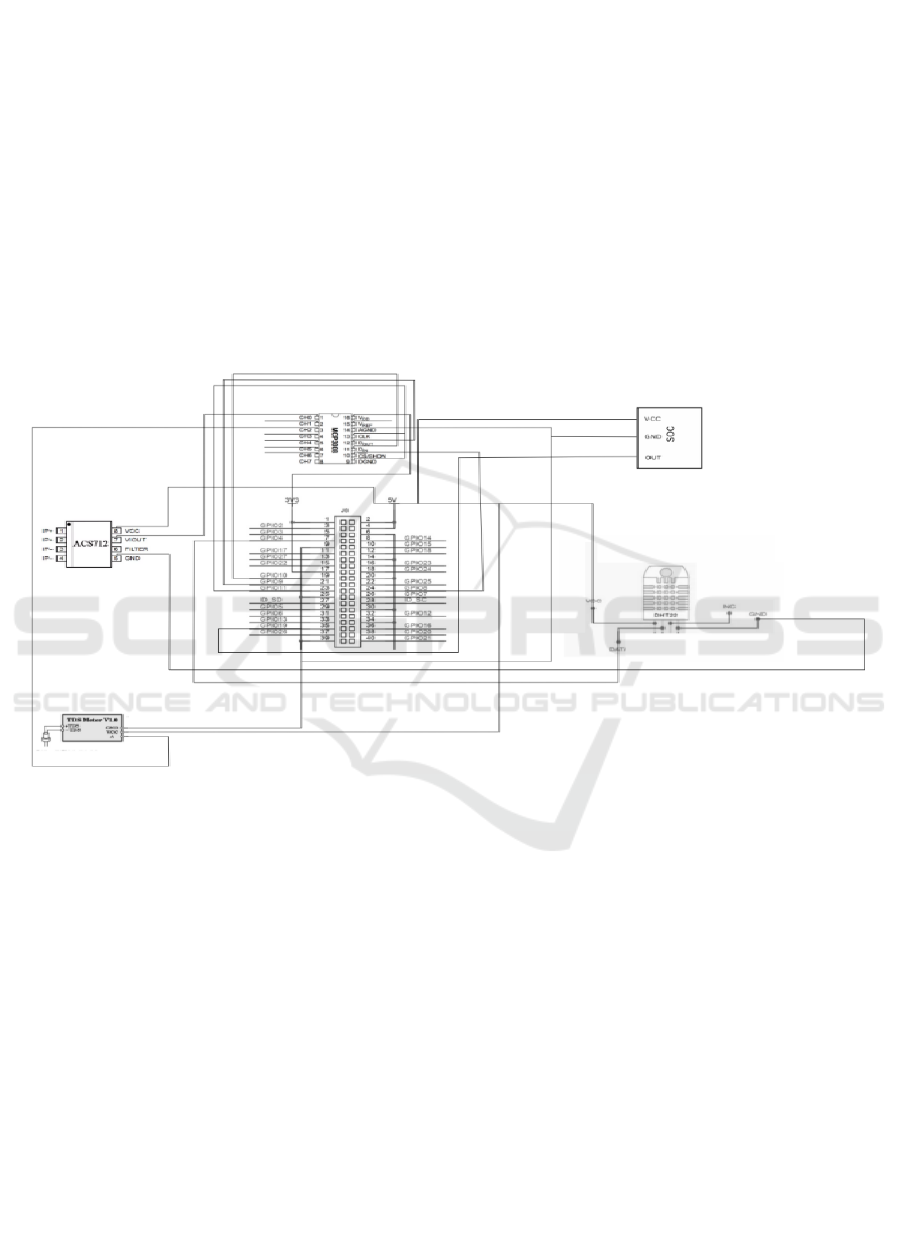
Below Figure 2 is a circuit diagram of how a
monitoring system is set up in a rainwater harvesting
solar streetlight based on AI using Raspberry Pi 4
Model B as the processor. The system incorporates
ACS712 (current sensor), Battery SOC sensor,
DHT22 (temperature and humidity sensor), and TDS
water quality sensor, along with an MCP3008
analog-to-digital converter (ADC) that offers an easy
interface to the components with Raspberry Pi. The
current taken from the load and battery to the solar
panel is measured using ACS712 current sensor
where best energy management is well catered for.
ICRDICCT‘25 2025 - INTERNATIONAL CONFERENCE ON RESEARCH AND DEVELOPMENT IN INFORMATION,
COMMUNICATION, AND COMPUTING TECHNOLOGIES
14
SOC sensor is designed to monitor and measure the
state of charge which helps the system compute the
battery life and performance. DHT22 sensor offers
real time temperature and humidity that are extremely
important for the process of environmental
monitoring and how they contribute in solar energy
generation. Also, TDS sensor aids in judging how
pure the rainwater collected is so one can determine
if it can be used for irrigation and drinking.
There is no on-board analog input in Raspberry Pi
4; therefore, MCP3008 ADC helps in the conversion
of analog sensor outputs into digital values in order to
make it easy for interfacing with the Raspberry Pi
GPIO pins. SPI protocol is used for Raspberry Pi to
talk to MCP3008 in an effort to move data effectively
and at high speed. The system also includes real-time
cloud monitoring and data logging, realized through
ESP8266/ESP32 Wi-Fi module uploading sensor
data to IoT platforms such as Firebase or Thingspeak
for remote processing and AI-driven predictive
analysis. This smart circuit design is enabled to
facilitate smart street lighting, smart energy metering,
and water quality monitoring, thereby making it an
immensely useful and sustainable smart
infrastructure solution. Leveraging the AI-driven
insights, the platform is enabled to identify power
instability, predict battery ageing, maximize energy
from solar panels, and track water resource planning,
thereby leading the green and sustainable city
infrastructure.
Figure 2: Circuit Diagram.
3.6 Proposed Solution
This design aims to create a multi-purpose solar
streetlight that combines rainwater harvesting, AI-
based monitoring, and increased solar energy output
using simulation-based analysis. The system includes
four solar panels, each with a 12V, 25W rating,
placed in four disparate directions on a cone-shaped
tip atop the pole. This innovative design has two
functions by providing optimum light absorption for
energy production while, at the same time, harvesting
rainwater into a storage tank. The rainwater stored
can be employed for business use in public spaces,
and in urban and rural areas, an intrinsic filtration unit
renders it fit for human consumption. To guarantee
effective system operation and resource utilization, an
AI-powered monitoring system is integrated to
monitor solar energy generation, battery condition,
water levels, and weather conditions. The AI platform
uses virtual sensor data from modules like the
ACS712 current sensor (solar panel and battery
monitoring), battery SOC sensor (charge level
monitoring), HC-SR04 ultrasonic sensor (water level
sensing), TDS sensor (water quality analysis), and
DHT22 temperature & humidity sensor (environment
monitoring). The data is processed through machine
learning algorithms to identify anomalies, project
power consumption patterns, and enhance system
efficiency in a simulated environment.
The double-chambered pole, one for water
passage and another for electrical cable, provides
appropriate storing, filtering, and secure energy
transfer. A 12V solar charge controller is emulated to
manage power flow between the solar panels, 12V
battery, and the loads. The controller limits
overcharging, deep discharge, and voltage
Device for Solar Powered Mobile Charging and Water Purification in Bus Terminus with AI Monitoring
15
fluctuations, and offers real-time power status
indicators for AI-based performance analysis. The
accumulated solar power is thereafter diverted for
mobile charging and street lighting by a DC-to-DC
converter for stepping down the voltage from 12V to
5V to facilitate the charging of mobile phones and
other small electronic equipment through USB
interfaces. Through simulation tests, AI-based
models evaluate energy efficiency, environmental
adaptability, and power optimization and enable
performance checks under varying weather
conditions and load conditions. This makes the
system scalable, sustainable, and optimized prior to
actual implementation in the real world. By
integrating AI monitoring with renewable energy and
water resource management, this smart solar
streetlight system provides a smart, green, and
community-focused infrastructure solution.
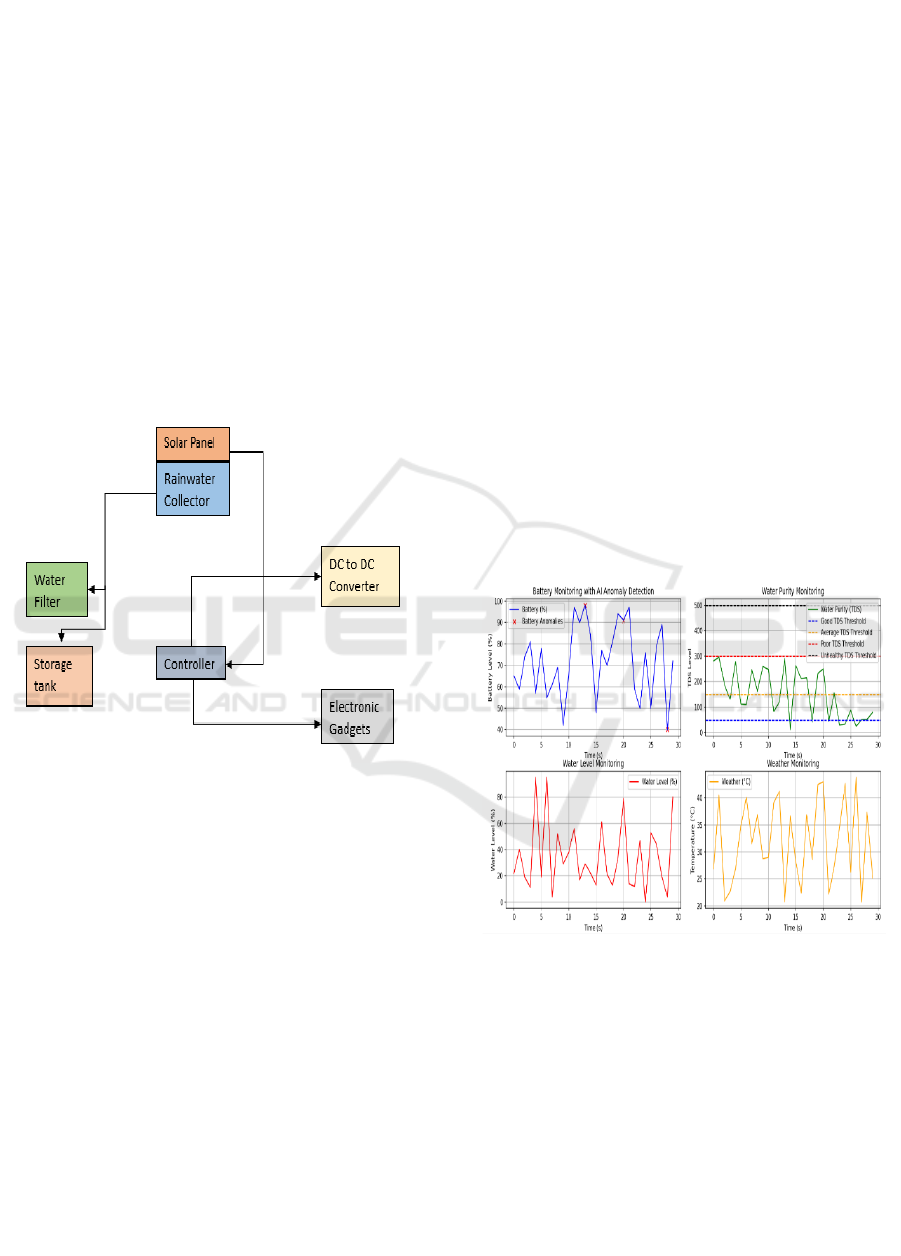
Figure 3: Block Diagram.
A hybrid simulation-based arrangement of
utilizing solar energy and rainwater with AI based
monitoring that helps in effective utilization of
resources is depicted in form of a Figure 3 block
diagram. A solar panel generates electricity, with a
controller that regulates power to prevent excess
variation, while a rainwater collector directs water
from a filtration unit into a storage unit. Electronic
appliances and lighting are supplied with stable
power by means of a DC-to-DC converter. The AI
monitoring system use real-time analytical data to
test energy efficiency, battery levels, water levels,
and power consumption to improve energy flow,
detect abnormalities, and predict maintenance needs,
Guide. To implement the support of the system, I
constructed the system you can see now with the help
of some specific data. This approach enhances
sustainability and efficiency before actual
implementation.
4 RESULTS AND EVALUATION
The solar streetlight system with integrated AI was
simulated and tested successfully, showcasing
immense energy efficiency, reliability, and
sustainability. Simulation-based methodology
proved the system effective in maximizing the use of
solar energy, managing power distribution, and
effectively handling water resources. The system
comprising four 12V, 25W solar panels captured and
converted solar energy efficiently under changing
environmental conditions and provided continuous
power supply even at low light. The 12V battery
storage system, regulated by a solar charge
controller, held the optimal charges, avoiding deep
discharge and overcharging. Simulation of the DC-
DC converter ensured that the surplus energy was
effectively diverted to mobile charging use,
promoting multi-functionality to the system. The
rainwater harvesting system, simulated through the
use of HC-SR04 ultrasonic sensors for monitoring
the water level and TDS sensors for water purity
monitoring, accurately proved efficient collection
and purification procedures.
Figure 4: Simulated Graph.
The AI monitoring system with the aid of
machine learning algorithms successfully processed
sensor readings from ACS712 (current), SOC
(charge of the battery), HC-SR04 (level of water),
and TDS (purity of water). The AI model
successfully identified anomalies in performance,
regulated the flow of energy, and scheduled
maintenance, thus providing reliability and long-term
functionality to the system. The successful
simulation outputs in Figure 4 ensure that this AI-
driven solar streetlight system is scalable and
ICRDICCT‘25 2025 - INTERNATIONAL CONFERENCE ON RESEARCH AND DEVELOPMENT IN INFORMATION,
COMMUNICATION, AND COMPUTING TECHNOLOGIES
16

applicable to smart urban and rural infrastructure
projects.
5 DISCUSSION
Results of these simulations show that, due to the
high technology usage of the proposed IoT-enabled
solar streetlight system, an efficient, smart,
specialized, and sustainable solution in comparison
with the existing solar streetlights can be realized.
With AI-based monitoring in real time, the system
effectively optimizes energy consumption while
improving power management, guaranteeing that
resources are used optimally. Unlike traditional
models with merely basic lighting application, the
proposed system adopted multi-functional features
such as mobile charging, rave water collection and
predictive analytics, therefore a self-supported and
intelligent infrastructure solution. Incorporation of
machine learning algorithms enables the system with
a much larger coverage area for inefficient
generation of solar energy, predictive maintenance
for battery deterioration and optimizing water
availability.
Conducting AI-based analysis is for simulation
validation to show that system can deployed for real-
time applications allowing reduced usage of fossil
fuels and espoused solar energy. More renewable
energy and use of sustainable resources would
increase while providing a true alternative using AI-
tech simulation in solar systems. The simulated
validated AI-enabled solar streetlight system is thus
a more efficient, reliable and sustainable scalable &
future-proof solution for smart city developments and
rural electrification ventures.
6 CONCLUSIONS
The suggested AI-integrated solar streetlight system
promotes energy efficiency, dependability, and
multifunctionality using simulation-based analysis.
Using four 12V, 25W solar panels mounted on a
cone-shaped design, the system offers maximum
solar absorption with the integration of rainwater
harvesting for public and commercial applications.
The monitoring system powered by AI ensures
optimized flow of energy, battery storage, and water
management, providing real-time performance
observation and predictive maintenance. A 12V solar
charge controller and storage battery ensure a
continuous power supply, even during cloudy
weather. The DC-DC converter allows maximum
utilization of excess solar power for mobile charging,
and hence the system is ideal for urban as well as
rural applications. The double-compartment pole
design enhances functionality and maintenance by
ensuring effective electrical wiring and water
storage.
The AI platform detects anomalies, controls
power distribution, and predicts maintenance needs,
thus achieving sustainability and resource-efficient
use. Simulation results confirm that the system
effectively reduces energy wastage, optimizes
renewable energy utilization, and enables smart
infrastructure development. Equipped with lighting,
mobile charging, and water conservation features,
this AI-powered solar streetlight is an innovative and
scalable solution for sustainable urban and rural
development.
REFERENCES
Ahmed, S.R., Taha, T.A., Karim, S.M., Shah, P., Hussain,
A.S.T., Itankar, N., Tawfeq, J.F. and Ahmed, O.K.,
2024, January. Solar Street Lighting Revolution: A
Sustainable Approach Enabled by AIoT and Smart
Systems. In International Conference on Forthcoming
Networks and Sustainability in the AIoT Era (pp. 378-
390). Cham: Springer Nature Switzerland.
Anguraj, D.K., Balasubramaniyan, S., Saravana Kumar, E.,
Vakula Rani, J. and Ashwin, M., 2022. Internet of
things (IoT)-based unmanned intelligent street light
using renewable energy. International Journal of
Intelligent Unmanned Systems, 10(1), pp.34-47
Anitha Vijayalakshmi, B., Gokulkannan, K., Jeyalakshmi,
M.S. and Arokiya Prasad, P., 2025. IoT Based
Sustainable Smart City Lighting And Data
Transmission Through Integration Of Solar-Powered
LED Streetlights With VLC Technology. Journal of
Optics, pp.1-8.
Archibong, E.I., Ozuomba, S. and Ekott, E., 2020, March.
Internet of things (IoT)-based, solar powered street
light system with anti-vandalisation mechanism. In
2020 International Conference in Mathematics,
Computer Engineering and Computer Science
(ICMCECS) (pp. 1-6). IEEE.
Chaudhary, P., Singh, V., Karjee, A., Singal, G. and Tomar,
A., 2022, December. Design of Energy Efficient IoT-
Based Smart Street Light System. In International
Conference on Advanced Network Technologies and
Intelligent Computing (pp. 250-262). Cham: Springer
Nature Switzerland.
Chen, Z., Sivaparthipan, C.B. and Muthu, B., 2022. IoT
based smart and intelligent smart city energy
optimization. Sustainable Energy Technologies and
Assessments, 49, p.101724.
Device for Solar Powered Mobile Charging and Water Purification in Bus Terminus with AI Monitoring
17

Cheng, B., Chen, Z., Yu, B., Li, Q., Wang, C., Li, B., Wu,
B., Li, Y. and Wu, J., 2020. Automated extraction of
street lights from JL1-3B nighttime light data and
assessment of their solar energy potential. IEEE Journal
of Selected Topics in Applied Earth Observations and
Remote Sensing, 13, pp.675-684.
Divyapriya, S., Amudha, A. and Vijayakumar, R., 2021.
Design of solar Smart Street light powered plug-in
electric vehicle charging station by using internet of
things. Journal of The Institution of Engineers (India):
Series B, 102, pp.477-486.
Dwiyaniti, M., Kusumaningtyas, A.B., Wardono, S. and
Lestari, K.S., 2022, November. A Real-time
Performance Monitoring of IoT based on Integrated
Smart Streetlight. In 2022 6th International Conference
on Electrical, Telecommunication and Computer
Engineering (ELTICOM) (pp. 131-135). IEEE.
Gagliardi, G., Lupia, M., Cario, G., Tedesco, F., Cicchello
Gaccio, F., Lo Scudo, F. and Casavola, A., 2020.
Advanced adaptive street lighting systems for smart
cities. Smart Cities, 3(4), pp.1495-1512.
Ganvir, P.H., Patil, W.V. and Sonaskar, S.R., 2024,
December. Smart Solar Street Light Using IoT: An
Energy-Efficient Approach to Urban Lighting. In 2024
4th International Conference on Ubiquitous Computing
and Intelligent Information Systems (ICUIS) (pp. 1745-
1749). IEEE.
Hans, M.R. and Tamhane, M.A., 2020, October. IoT based
hybrid green energy driven street lighting system. In
2020 Fourth International Conference on I-SMAC (IoT
in Social, Mobile, Analytics and Cloud)(I-SMAC) (pp.
35-41). IEEE.
Hao, D., Qi, L., Tairab, A.M., Ahmed, A., Azam, A., Luo,
D., Pan, Y., Zhang, Z. and Yan, J., 2022. Solar energy
harvesting technologies for PV self-powered
applications: A comprehensive review. Renewable
energy, 188, pp.678-697.
Hossain, J., Algeelani, N.A., Al-Masoodi, A.H. and Kadir,
A.F.A., 2022. Solar-wind power generation system for
street lighting using internet of things. Indonesian
Journal of Electrical Engineering and Computer
Science, 26(2), p.639.
Islam, M.H., Fariya, K.Y., Talukder, T.I., Khandoker, A.A.
and Chisty, N.A., 2021, August. IoT based smart self
power generating street light and road safety system
design: a review. In 2021 IEEE Region 10 Symposium
(TENSYMP) (pp. 1-5). IEEE.
Istiak Rahman, F., Zannatul Mawya, F., Tashfia, F. and
Parvez, M.S., 2023. SMART STREET LIGHT BY
USING SOLAR SYSTEM AND GRID CONNECTI-
ON (Doctoral dissertation, Faculty of Engineering,
American International University–Bangladesh).
Khemakhem, S. and Krichen, L., 2024. A comprehensive
survey on an IoT-based smart public street lighting
system application for smart cities. Franklin Open,
p.100142.
Meem, S.S., 2023. Solar-Powered Smart Street Light and
Surveillance System Using IoT. In Applied Informatics
for Industry 4.0 (pp. 74-82). Chapman and Hall/CRC.
Mehta, S. and Bhalla, A., 2024, August. IoT-Driven
Solutions for Sustainable Street Lighting: A Hybrid
Renewable Energy Approach. In 2024 4th Asian
Conference on Innovation in Technology
(ASIANCON) (pp. 1-5). IEEE.
Michail, C.S., 2021, February. An Innovative Way of
Implementing Efficient Mobile Charger Powered By
Solar Energy. In IOP Conference Series: Materials
Science and Engineering (Vol. 1070, No. 1, p. 012091).
IOP Publishing.
Mohanty, P., Pati, U.C., Mahapatra, K. and Mohanty, S.P.,
2024. bSlight 2.0: Battery-free Sustainable Smart Street
Light Management System. IEEE Transactions on
Sustainable Computing.
PK, L.J. and KRS, R.V.A., 2024, December. Design and
Implementation of an Intelligent Solar-Powered Street
Lighting System with IoT Integration for Enhanced
Energy Efficiency and Adaptive Control. In 2024 9th
International Conference on Communication and
Electronics Systems (ICCES) (pp. 191-196). IEEE.
Shanmugasundaram, S., Ramaiah, A., Dhiraviyam, A.S.,
Ethirajan, M., PaperAnathaMurugesan, R., Pathalave-
eran, G., Subbiah, B. and Kasipandian, K., 2025. Next
Generation Smart Street Light Monitoring and
Controlling System Using IoT. In Open AI and
Computational Intelligence for Society 5.0 (pp. 393-
418). IGI Global Scientific Publishing.
Sutopo, W., Mardikaningsih, I.S., Zakaria, R. and Ali, A.,
2020. A model to improve the implementation
standards of street lighting based on solar energy: A
case study. Energies, 13(3), p.630.
Tran, B., Ovalle, J., Molina, K., Molina, R. and Le, H.T.,
2021. Solar-powered convenient charging station for
mobile devices with wireless charging capability.
WSEAS Transactions on Systems, 20, pp.260-271.
ICRDICCT‘25 2025 - INTERNATIONAL CONFERENCE ON RESEARCH AND DEVELOPMENT IN INFORMATION,
COMMUNICATION, AND COMPUTING TECHNOLOGIES
18
