
Forecasting Flight Delays Using Machine Learning
Hari Chandana B.
1
, Harshitha N.
2
, Anwar D.
2
, Harshitha T.
2
and Harshavardhan Reddy G.
2
1
Department of CSE, Srinivasa Ramanujan Institute of Technology, Rotarypuram Village, BK Samudram Mandal,
Anantapur District, Andhra Pradesh, India
2
Department of CSE - Artificial Intelligence & Machine Learning, Srinivasa Ramanujan Institute of Technology,
Rotarypuram Village, BK Samudram Mandal, Anantapur District, Andhra Pradesh, India
Keywords: Choice Tree Relapse, Bayesian Edge Relapse, Arbitrary Woodland Relapse, Slope Helping Relapse, Backing
Vector Machines, CatBoost Regressor, AdaBoost Regressor, Straight Relapse, KClosest Neighbors.
Abstract: Flight delay prediction plays a vital role in improving operational efficiency of transportation companies while
achieving better customer satisfaction. Flight delays caused by weather conditions and technical difficulties
and past flight disruptions result in intense schedule disruptions. This project constructs an advance prediction
system which analyzes flight data together with meteorological information to forecast delays. Executive
Decision Trees together with Bayesian Edge Regression together with Totally Random Forests together with
Gradient Boosting Algorithm and Cat Boost Regressor together with AdaBoost Regressor together with Direct
Regression and KClosest Neighbors form the set of AI computations which reach this objective. The
implementation of Support Vector Machines (SVM) manages execution through alterations made to the
hyperparameters. The main objective stands to refine these models since they require better predictive
precision. This model aims to improve operational efficiency and enhance flight delays by delivering accurate
prediction forecasts to airlines.
1 1 INTRODUCTION
Because delivers the growing movement needs of
consumers across great ranges, the trip sector acts as
a basic backbone for world wide networking. Delays
in flying represent a significant operational problem
for airline companies, and their effect is financial and
consequential to passengers in every situation. These
delays are the result of several uncontrolled factors,
including adverse weather conditions, technical
issues, traffic congestion and knock-on effects from
previous traffic jams. However, the domino effects
are far-reaching both in terms of the causes of these
outcomes, from increased aircraft operating costs to
reduced customer satisfaction. Advanced AI
technology based on ML algorithms has proven to be
an effective solution for predicting as well as
minimizing flight delays in the aviation industry
today. It enables airline companies to improve their
operations planning and resource allocation, and
provides accurate travel information to passengers.
The integration of ML-based AI technologies offer
voyagers three important benefits including lesser
interruptions and a smoother scheduling process and
much more convenient travel experience.
By analyzing flight data together with weather
conditions, the research methodology provides a
useful insight for the formulation of an accurate
predictive model for flight delay prediction
capabilities. In AI, unique processing techniques
apply to numerous big data sets processed
simultaneously, yielding intricate interrelationships
between calculating contributing variables. We have,
Decision Tree Regression, Bayesian Ridge
Regression, Random Forest Regression, Gradient
Boosting Regression, Catboost Regressor, AdaBoost
Regressor, Linear Regression, KClosest Neighbors
and Support Vector Machines (SVM) as predictive
models. Based on the super performance of SVM in
the classification among high-layered dataset and
borrowed the concept of resilience in identify
complex patterns which fortifies the stability of the
system. A hyperparameter tuning optimization
technique derives each configuration of factors in
models to perform the global improvements in
performance. The algorithm selection is an important
work between interpretability and computational
B., H. C., N., H., D., A., T., H. and G., H. R.
Forecasting Flight Delays Using Machine Learning.
DOI: 10.5220/0013889300004919
Paper published under CC license (CC BY-NC-ND 4.0)
In Proceedings of the 1st Inter national Conference on Research and Development in Information, Communication, and Computing Technologies (ICRDICCT‘25 2025) - Volume 2, pages
735-743
ISBN: 978-989-758-777-1
Proceedings Copyright © 2025 by SCITEPRESS – Science and Technology Publications, Lda.
735

efficiency and predictive power. Choice Tree Relapse
depict flight delays along with their explicit causes
making it easier to analyse. Border Assessment
Limitation Solution Bayesian Edge Relapse: Used
probabilistic modeling methods to cover border
limitation of assessment. We identify the nonlinear
systems through outfitting procedures in the
Irregular Woods Relapse and avoid overfitting by
appointing the predictions of numerous choice trees.
The forecasting system Inclination Supporting
Relapse implements two branches - CatBoost and
AdaBoost, both of which improve estimates in
sequential iterations, correlating with errors from
previous steps. The Direct Relapse model acts as a
prediction metric unlike KClosest Neighbors which
relies on distance computations to produce estimates.
SVM performs the enhanced system frame by
applying binary approaches, detecting progressive
examples in multilayer space. The most fundamental
part of this work is coordination of weather data in
our applications, since wetter conditions have a large
influence on the flight operation schedules. Airports
are affected with operational disruptions due to
extreme precipitation along with haze and snowfields
and as well as high wind speed, which changes the
schedule of flights and also affects the performance
characteristics of the planes. Its capacity to process
both historical and real-time climatic data enables
the model to better predict natural external elements
delays. Why to do so? Because this information about
delayed flight about departure timing, arrival timing,
air carrier information, reliever information and
directional information only should provide full
interpret in delay trigger. Hyperparameter Tuning is
the very base of this project which ensures the
selected AI algorithms are working fine. The fine-
tuning of hyperparameters ensures that the models
provide predictions that swings between bias and
diversity yielding better predictions of unseen data.
By using the lattice search and randomized scan
approach, designers can identify optimal design
settings for the calculations, allowing them to
improve their presentation in the delay forecasts.
The primary aim behind this project focuses on
developing an extremely accurate predictive model
which enables carriers to make decisions supported
by data and minimize delays. The review ensures
interpretability of models to produce significant
experiences that identify the actual reasons behind
delays. Through understanding key indicators and
their importance levels the model enables decision-
makers to take specific intercessions such as flight
rescheduling or asset redistribution or traveler
service improvement. This project also recognizes
the need for continuous model enhancement because
of its focus on aviation-exclusive characteristics. The
prescient structure can receive improvement from
new information which enables it to adjust to
developing flight delay patterns. The model
maintains its power to adapt and become applicable
because of its wide versatility which addresses the
constantly evolving challenges in the aviation sector.
1.1 Objective of the Study
Within this Research project, one central focus is to
design a predictive modelling underlying AI
algorithm, accurate real-time flight delay predictions
are proposed through the platform, and input datasets.
Specialized weaknesses and weather adversities-
related flight delays or ensuing response chains after
past disruptions generate broad effects on operations
and passenger experience both individually and
cumulatively airspace effectiveness. The study
employs advanced forecasting techniques, such as
Selection Tree Relapse, Bayesian Edge Relapse,
Independent Backwoods Relapse, Slant Relapse,
CatBoost Regress Train, AdaBoost Regress Train,
Direct Regress Train and KClosest Neighbors to öto
understand flight and climate information examples.
Support Vector the Machines (SVM) work with
model precision updates since they use
hyperparameter tuning methods. Our goal is to
generate a predictive system Within its framework,
tools for exact delay estmims being given while
informative insights to the carriers are being enabled.
reactions and increases, both bookings and
operational efficiency. This paper investigates
problems with the goal of helping the airline industry
shorten delays and improve passenger experience
while minimizing financial losses.
1.2 Scope of the Study
The paper provides an overall perspective of the
short- and long-term problems of the airline industry
and summarizes the current state-of-the-art of AI-
powered flight delay prediction. The review
encompasses numerous databases, such as those on
flight timetables, global warming, and stoppage
records to authenticate, evaluate all areas effecting a
delay in the flight. Different AI techniques are used
in this analysis: Choice Tree Relapse and Bayesian
Edge Relapse and Irregular Backwoods Relapse and
Slope Helping Relapse and also with the group of
models: CatBoost and AdaBoost. Implemented
Algorithms to Carry Out Equivalent Performance
Evaluation: Support Vector Machines (SVM) + K
ICRDICCT‘25 2025 - INTERNATIONAL CONFERENCE ON RESEARCH AND DEVELOPMENT IN INFORMATION,
COMMUNICATION, AND COMPUTING TECHNOLOGIES
736

Nearest Neighbors. This is beyond hyperparameter
tuning, building the error assessment guideline can
also help to increase the level of model accuracy and
reliability feature. Deployed among air carriers (who
benefit from operational success and optimal resource
distribution, in addition to service quality based on
predicted systems) in addition to airport professionals
and governmental authorities. Through a study of
the continuous blend of information and
postponement of outer experts and global thought, the
exploration permits analysts to build foreseeing
investigation at future stages.
1.3 Problem Statement
The challenge of flight delays creates significant
impact on airline operations through their negative
effects on numerous passengers and carriers
experience major financial and operational losses.
These deferrals Earthly and technological factors
together with past disaster impact damage make
accurate delay predictions really challenging.
Modern flight delay management systems show
inadequate responsiveness by failing to produce
sufficient solutions to time shifts that affect
following flight operations together with passenger
itinerary adjustments. Thanks to the lack of reliable
delay prediction systems carriers cannot take
proactive protective measures thus they face service
shortfalls and unhappy customers in addition to
financial losses. The existing prescient models
struggle with processing the complex extensive
datasets because AI provides assurance. The research
aims to solve obstacles in prediction systems through
the development of an adaptable accurate predictive
model which integrates advanced AI techniques like
Choice Tree Regression and Irregular Forest
Regression and Slope Helper and Backing Vector
Machines. The proposed exploration method
combines different datasets with optimized
hyperparameter tuning to develop effective
forecasting accuracy while providing better practical
convenience that tackles the core issues within
aviation operations.
2 RELATED WORKS
The analysis of flight delay prediction has received
extensive research attention through multiple
datasets and modeling methods for better model
performance stability. In the early stages of this field
predominant statistical techniques included both
linear regression and time series models. The simple
data-driven approaches were inadequate in capturing
multiple factors which affect flight delays since they
failed to account for the diverse weather conditions
and traffic control elements and pre-flight
disruptions. The advancement of Artificial
Intelligence created three newer prediction methods
known as choice trees and irregular forests and
inclination supporting models which improve the
handling of complex nonlinear relationships in high-
layered datasets. The combination of Help Vector
Machines (SVM) together with KClosest Neighbors
(KNN) shows effective capabilities in detecting
relations between atmospheric conditions and flight
delays according to. Their operational performance
relies entirely on finding perfect parameters and
requires thorough hyperparameter tuning. The family
of algorithms AdaBoost, CatBoost and Inclination
Helping Regressor has gained unending fame mainly
because they merge different weak models into a
single robust indicator. This method handles datasets
which show unfavorable class imbalance between
ontime flights and flight delays due to decreased
delay frequency. Simultaneously Bayesian Edge
Regression demonstrates promising results primarily
because it understands probability assessments and
collects preexisting data for uncertain datasets. Half
and half approaches which merge conventional
relapse models with outfit learning procedures have
successfully increased forecasting precision through
the benefit systems of multiple computing
approaches. The advancement of enhanced feature
engineering led to better flight delay prediction by
merging relevant elements like departure times and
day of operation and airport capacity levels alongside
flight distances into the analysis. The combination of
advanced highlight designing with predictive
modeling turned out to be more practical because
computational expense and explainable nature
limited its application. Old fashioned AI models have
received frequent updates from scientific research
teams who optimize their settings using procedures
such as network search alongside randomized search.
Preventive modeling has become more accurate and
valuable after integrating climate data with air traffic
data and relevant system information including
operating schedules and maintenance records. Issues
like information quality, missing qualities, and the
unique idea of aeronautics frameworks. Procedures
like information attribution, hearty preprocessing,
and ongoing information incorporation have been
proposed to alleviate these issues. Examinations near
the annual examination period focus on outfit
Forecasting Flight Delays Using Machine Learning
737

technique effectiveness regarding arbitrary forests
and angle support methods to handle complex
situations while managing overfitting. The
continuous development of modern AI approaches
with aircraft-specific data enhances the predictive
accuracy and materialness of flight delay forecasts.
The combination of improved model structures and
united datasets with calculated optimization supports
analysts in developing reliable predictions which
help carriers and passengers simultaneously. The
research enhances past studies by applying SVM
combined with CatBoost and AdaBoost and
Bayesian Edge Relapse methods to create better
predictive outcomes and handle the complexities of
flight delay estimation.
3 PROPOSED SYSTEM
WORKFLOWS
With that in mind, a call flight delay prediction
system requires a general workflow involving data
processing followed by a system which integrates
feature engineering and mathematical modeling,
along with model evaluation and deployment. It starts
with a solid base of data acquisition where relevant
flight and weather information is processed per
various variables from flight schedules and delay
records to conditions of the atmosphere. In data
preparation step value replacement for missing data
and outlier correction and inconsistency handling
occurs, which is used to use feature extraction
methods to determine those predictors that affect
delays. Various machine learning algorithms such as
Decision Tree Regression, Bayesian Ridge
Regression, Random Forest Regression, Gradient
Boosting Regression, CatBoost Regressor, AdaBoost
Regressor, Linear Regression, and KNearest
Neighbors test and train the processed data. SVM
assumes the role of an enhancement approach while
all models are subjected to hyperparameter tuning for
optimized predictive accuracy. The system uses error
metrics like Mean Absolute Error (MAE), Mean
Squared Error (MSE), and Rsquared scores to
evaluate the models until the right algorithm is
picked. The best-performing model chosen from
them is deployed to operate under real-time
conditions to provide reliable flight delay forecasts.
The last system allows airlines to obtain relevant data
that assist in improving operations and enhancing
passenger satisfaction.
3.1 Loading Dataset
A flight delay prediction model becomes possible
because of stacking the dataset. Detailed information
about flights should be included in the dataset through
specifics including flight numbers together with
departure and arrival times as well as actual time,
weather data, aircraft information and historical delay
records. Sales to acquire flight data from trustworthy
weather agencies and flight operators should span a
sufficient time frame to ensure the collection of
various case variations across different seasons. The
data processing uses Python Pandas libraries to create
proficient control and data analysis systems. The
imported dataset undergoes quality assessment
through absent passage detection and duplicate
handling procedures after being read from CSV,
Succeed, or JSON files. Machinedreamable data
transformation of both date and time fields usually
becomes essential for high-quality analysis readiness.
A dataset must be free of errors and logically
organized because it establishes both accurate
prediction and stable AI model operation.
3.2 Preprocessing
Pre-processing measures are a prerequisite to
building a strong prescient contender for the flight
defer end. Raw datasets on flights and climate need
to undergo extensive cleaning to remove noise,
outliers and missing values in order to increase the
accuracy and reliability of the model. Refers to clean
the data in the split case pre-processing in: it relate in
filling attribute space that is missing value space with
function: similar (e.g: mean attribution for numerical
data types, mode attribution on categorical data
types). Skip if might also be used to prevent the
dataset corruption if the segments where specific
information focuses are too small or incurrent on the
edges of the line/section to the best of the valid
guesses. Another fundamental reason is Feature
designing, where some raw data is converted to
important features that can enhance the predictive
ability of the model. Time sensitive features like take
off time, day of week and rare events can also affect
flight delays and needs to be decouples from stamp
data. Climate factors such as temperature, wind speed
and visibility can be viewed as discrete or immersive
components that feed into consideration. For
absolute factors for example airplane identifiers or air
terminal codes we should do one hot encoding or
name encoding to compare with the AI calculations)
all that we must do to streamline both the
ICRDICCT‘25 2025 - INTERNATIONAL CONFERENCE ON RESEARCH AND DEVELOPMENT IN INFORMATION,
COMMUNICATION, AND COMPUTING TECHNOLOGIES
738
mathematical highlights (for example flight distance,
wind speed, airplane age and so forth) to a similar
reach, limiting one component to skew the model
learning procedure this activity is said to as highlight
scaling. Additionally, exception identification seeks
to find and resolve extreme values or outliers, which
would have an impact on predictions. Finally,
partitioning of this dataset produces the training and
testing sub-datasets to measure the preformance of
the model on untrained data for the robustness of
performance. Performing data cleaning on this
extraordinary stage is completed with a view to the
information is genuine, properly configured and
properly prepared for the remainder of the modeling
process and the subsequent validation.
3.3 Model Training and Classification
Systems are built and identified primarily by
collating full data sets relating to the flight plans and
patterns of weather and verified delay records. The
preprocessed data undergoes a lot preprocessing
treatment which solves uncompleted data points and
applies different encoding methods and
normalization techniques to become compatible with
AI model. Various modeling Techniques including
Choice Tree Relapse, Bayesian Edge Relapse,
Irregular Backwoods Relapse, Inclination Supporting
Relapse, CatBoost Regressor, AdaBoost Regressor,
Straight Relapse, and KClosest Neighbors are utilized
in the modeling. Support Vector Machines (SVM) are
sensitive to hyperparameter tuning for improving
their accuracy and cross-validation techniques are
adopted to yield robust solutions.
The execution metrics consist of Mean Outright
Blunder (MAE), Mean Squared Mistake (MSE) and
Root Mean Squared Mistake (RMSE) for assessment.
The predictive accuracy of models improves
successively through repetitive development which
includes highlighting selection combined with
parameter modification and ensemble approach
implementation. Through this method viable flight
classification becomes possible because it correctly
identifies predictable on-time flights and operations
that frequently experience delays. These following
pieces of information provide aircrafts with insights
to improve operational efficiency and respond better.
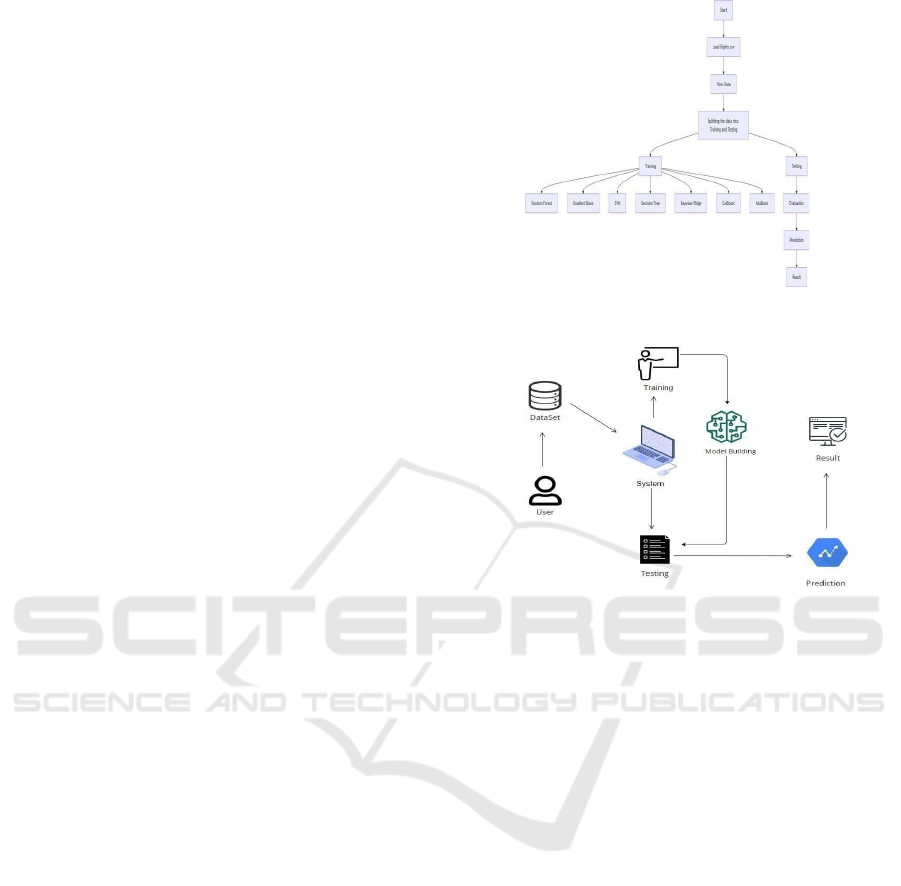
Figure 1 and 2 shows the block flow chart of flight
delay calculations and System Architecture of Flight
delay calculations.
Figure 1: Block Flow Chart of Flight Delay Calculations.
Figure 2: System Architecture of Flight Delay Calculations.
4 METHODOLOGY
4.1 Random Forest Regressor
• Definition: A general flat out regressor is a
group calculation that, during preparing,
assembles multiple choice trees. It improves
accuracy of the predictions and reduces
overfitting by combining the predictions of these
trees, and taking average.
• Inner Working: Information Sampling:
Randomly selects subsets of data and features
using bootstrap sampling to train each tree.
• Tree Construction: Every tree is created by
recursively splitting the data based on a metric
such as Mean Squared Error (MSE).
• Forecast Aggregation: All trees are estimated
at halfway point to produce the final result.
Forecasting Flight Delays Using Machine Learning
739
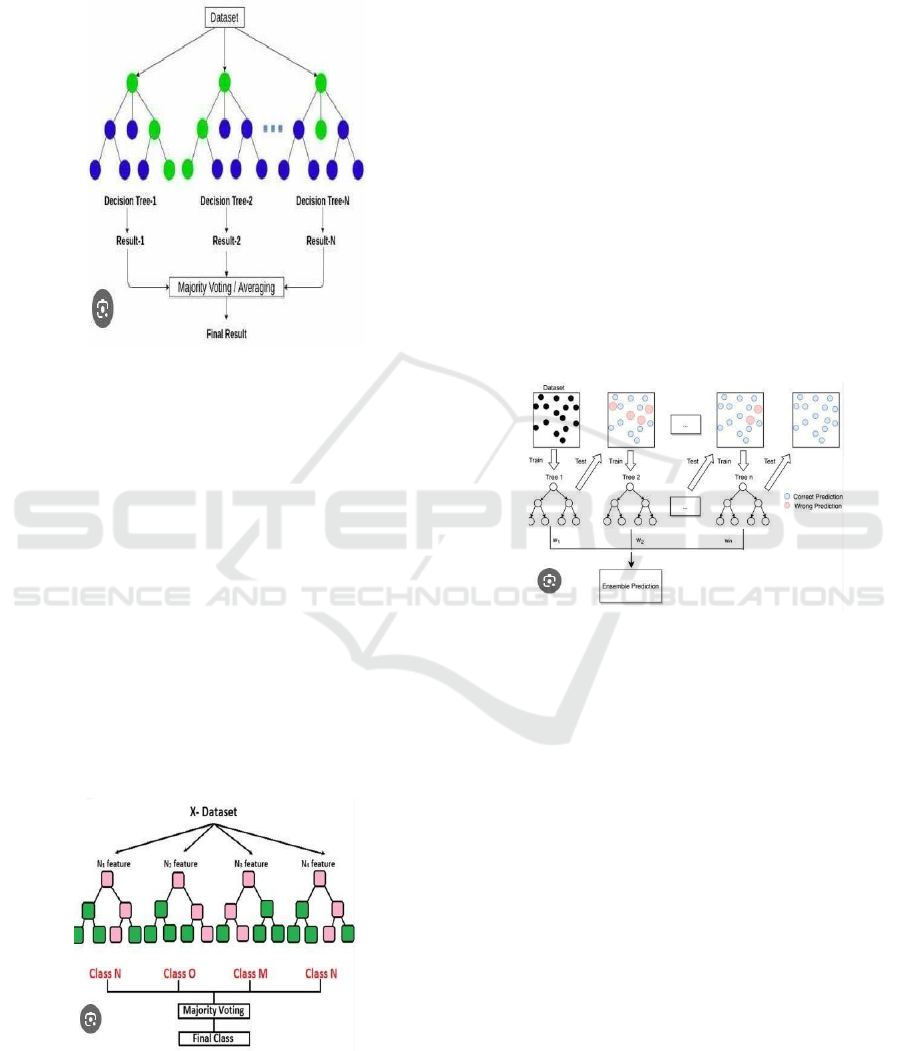
• Highlight Importance: Provides up a
ranking of feature importance, reflecting
their impact on the model predictions.
Figure 3 shows the random forest regressor.
Figure 3: Random Forest Regressor.
4.2 Decision Tree Regressor
• Definition: Choice Tree Regressor is a
nondirect model that partitions the information
into areas by applying choice rules gained from
the information highlights.
• Inside Working:
• Hub Splitting: Selects the optimal component
and tuning point by optimizing a cost function
(i.e., transformation or MSE).
• Expectations at Leaves: Results forecasts as the
mean value of the target variable in each leaf.
• Overfitting Control: Boundaries such as max
depth, min samples split and min samples leaf
are acclimated to ISO forestall overfitting. Figure
4 shows the decision tree regressor.
Figure 4: Decision Tree Regressor.
4.3 Gradient Boosting Regressor
• Definition: Slope Supporting Regressor creates
an arrangement of feeble (typically choice trees)
models in succession, with each one
concentrating on learning the blunders of the
previous one.
• Inside Working: A supervised learning model
is constructed, typically predicting the mean
target value.
• Leftover Calculation: Calculates residuals by
subtracting current forecasts from actual values
• Frail Model Training: Model with power zero
(fitting on the residuals to reduce the errors)
• Model Update: Multiplies the past expectations
and new models by a learning rate and adds it.
• Iteration: Trains the cycle until the specified
number of models is constructed or residuals are
limited.
Figure 5 shows the gradient boosting regressor.
Figure 5: Gradient Boosting Regressor.
4.4 Bayesian Ridge Regression
• Definition: Bayesian Edge Relapse a direct
model that applies Bayesian methods to inject
penalization into the model parameters to prevent
overfit by dropping earlier distributions.
• Interior Working: For the Gaussian before the
model's coefficients
• Back Estimation: Blend the before propagation
with the chance to adjust back circulations for
the coefficients.
• Prediction: Uses Bayesian to Hertz to estimates
coefficients and will variance estimates for
predictions. Figure 6 shows the Bayesian ridge
regression.
ICRDICCT‘25 2025 - INTERNATIONAL CONFERENCE ON RESEARCH AND DEVELOPMENT IN INFORMATION,
COMMUNICATION, AND COMPUTING TECHNOLOGIES
740
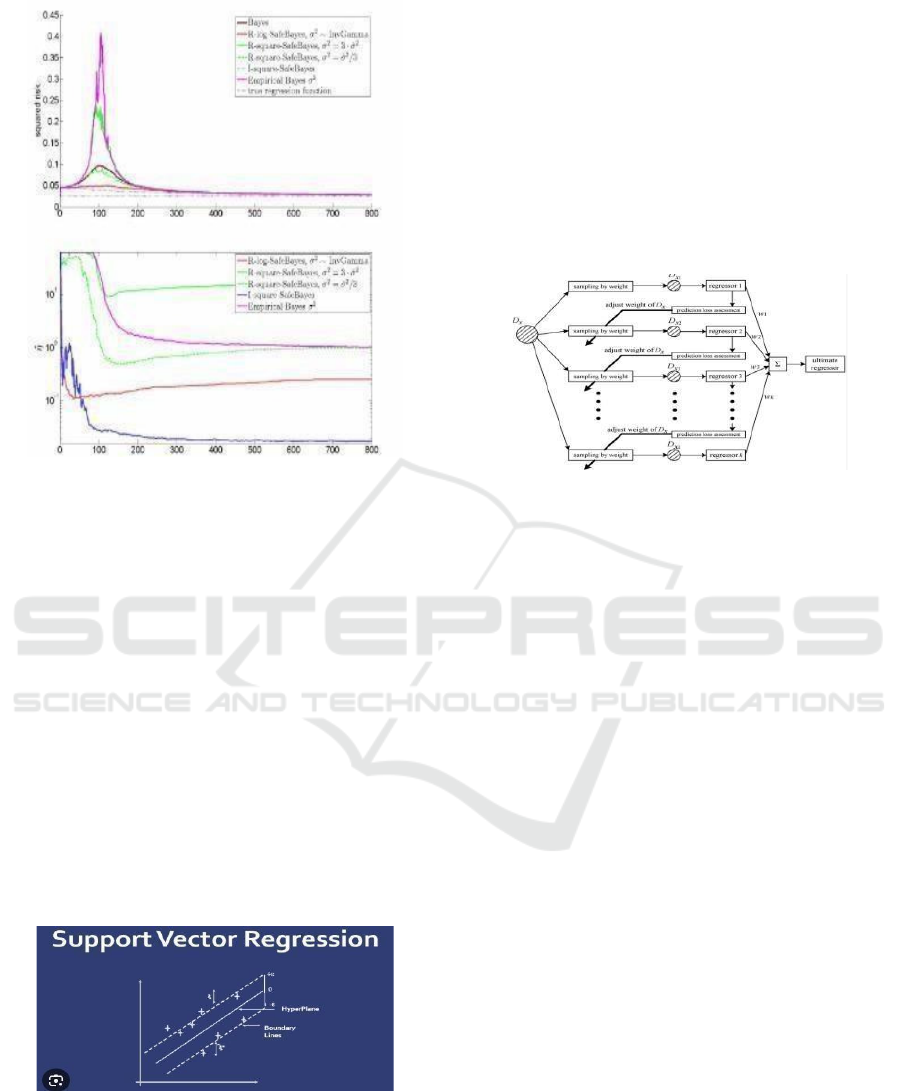
Figure 6: Bayesian Ridge Regression.
4.5 Support Vector Regressor (SVR)
• Definition: SVR generalizes Backing Vector
Machines to relapse tasks by finding a
hyperplane that fits the information inside a
predetermined resilience limit.
• Inward Working:
• Part Transformation: Offers input information
situations to a higherlayered space using piece
capacities (e.g., direct, polynomial, RBF).
• Epsilon Margin: Defines an edge (epsilonharsh
cylinder) around the hyperplane, where no
punishment is applied for deviations.
• Optimization: Restricts a misfortune ability to
convey on the intricacy of the model as well as
the forecast blunders outside the edge. Figure 7
shows the support vector regression.
Figure 7: Support Vector Regression.
4.6 AdaBoost Regressor
• Definition: The AdaBoost Regressor is an
ensemble learning method that builds weak
learners, commonly decision trees, one by one
focusing on the errors of previous models.
• Initialization: Initially assigns the same load to
all information tests.
• Model Training: You train a weak learner and
calculate its error.
• Weight Adjustment: Compiles the loads of
poorly predicted samples for the next iteration.
• Last Output: Replicates the expectations of all
the weak students, scaled by their accuracy.
Figure 8 shows the adaboost regressor.
Figure 8: Adaboost Regressor.
4.7 CatBoost Regressor
• Definition: CatBoost is an inclination supporting
model, tuned for working with unmitigated
information in an effective way, with less
approaching of the information.
• Inside Working:
• Requested Boosting: Cycle through the
information regularly to reduce the error during
overfitting.
• Include Transformation: Therefore, converts
all aggregate features into numerical
representations using cardinal numbers and
feature combinations.
• Misfortune Capability Optimization: Adds an
already ill-suited loss function (e.g., MSE) to
include gradient boosting principles.
• Efficiency: Utilize techniques such as negligent
trees for rapid Christian Rosy Cross, and
improved count performance. Figure 9 shows the
catboost regressor and table 1 shows the result of
departure delay.
Forecasting Flight Delays Using Machine Learning
741
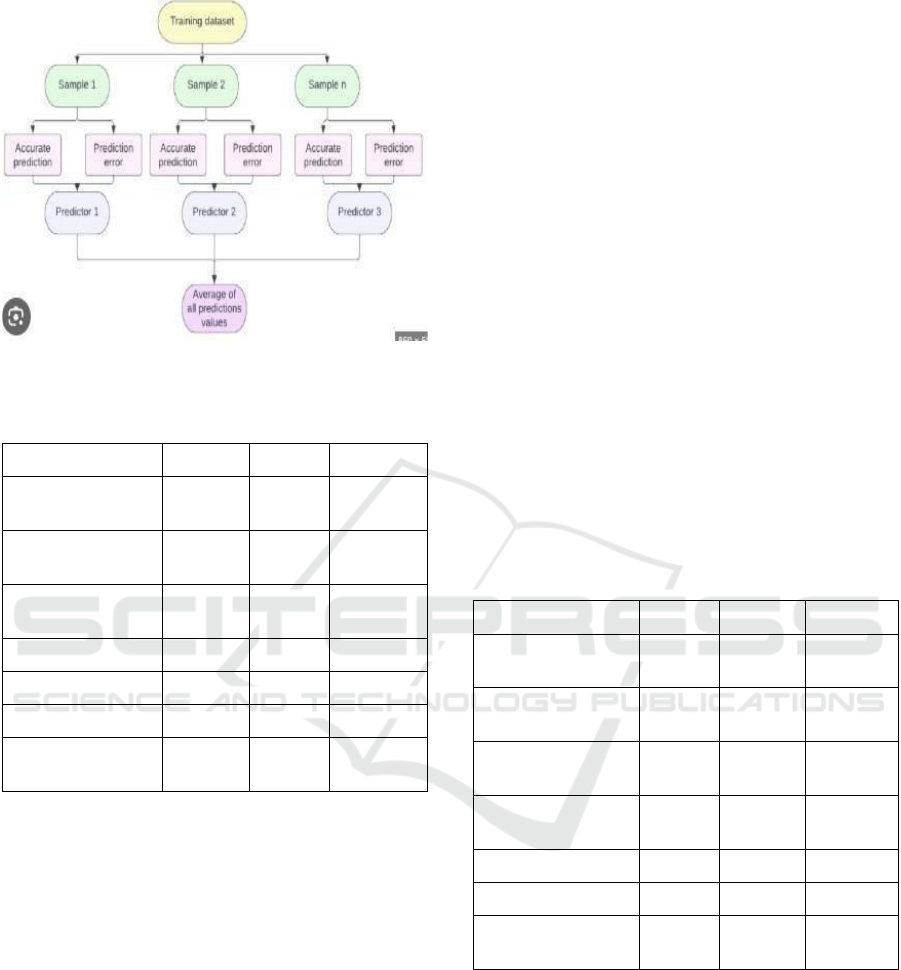
Figure 9: Catboost Regressor.
Table 1: Results of Departure Delay.
Model R2_score MAE MSE
Gradient Boosting
Re
g
resso
r
0.8421 8.2462 210.039
Decision Tree
Re
g
resso
r
3.9949 151.191
Bayesian Ridge
Regression
0.09026 16.70231 1210.263
Vector Regression 0.17340 12.529 1127.3576
Adaboost Re
g
ressor -0.4301 30.2345 1902.52894
CatBoost Re
g
resso
r
0.9769 2.5227 0.6698
Random Forest
Re
g
resso
r
0.9341 2.9177 87.64282
4.8 Departure Delay
The flight interruptions at departure create substantial
clothes hindrance delay from books relating to their
aircraft such as flights waiting for the rain to clear up
or backlogging substances for transit. The ensuing
delays cascaded through the airport system to impact
operations in connecting terminals and the overall
flight network. Investigating the root causes of the
departure delays helps airlines with refining their
scheduling approach including resource allocation
and raising their operational performance level.
Decision Tree Regression as well as Random Forest
Regression and CatBoost Regressor and Support
Vector Machines business make prediction of lady
shooting delay chance via evaluation of flight and
climate statistics over the years. These predictive
analytics are enabling airlines to proactively move
their operations, enabling them to contact passengers
and which reduces delays.
4.9 Arrival Delay
Flight arrival delays happen later than scheduled
times because of the departure delay duration and
weather limitations at arrival and destination
congestion combined with technical flight
maintenance issues. Delayed aircraft landings
produce major inconveniences to passengers who
need connecting flights in addition to negatively
affecting scheduled flight operations throughout the
airport facility. Airline staff receive early warnings
about arrival delays thus they can put into effect
preemptive actions including ticket rescheduling and
extended transfer time allocation. mực học
regressive models including AdaBoost Regressor,
CatBoost Regressor and KNearest Neighbors
function to forecast arrival delay chances facilitating
airlines to optimize operational workflows and
improve passenger journeys. Table 2 shows the
result of arrival delay.
Table 2: Results of Arrival Delay.
Model R2
_
score MAE MSE
Gradient Boosting
Regresso
r
0.7446 11.5599 383.8669
Decision
Tree Regresso
r
0.87218 2.70224 192.1487
Bayesian Ridge
Re
g
ression
0.19784 16.64080 1205.933
Support Vector
Regression
0.16423 16.8041 1286.53
Adaboost Re
g
ressor -0.2728 31.2286 1913.54
Cat Boost Re
g
ressor 0.9771 2.6559 34.2956
Random Forest
Re
g
resso
r
0.95021 1.43371 74.8435
5 CONCLUSIONS
Scientists utilized state-of-the-art AI approaches to
develop exact predictive models of flight delays
through this study. The analysis evaluates complete
aviation data consisting of flight plans alongside
weather patterns along with genuine flight deferrals
to present the revolutionary prediction capabilities
within the aviation field. The outfit models including
ICRDICCT‘25 2025 - INTERNATIONAL CONFERENCE ON RESEARCH AND DEVELOPMENT IN INFORMATION,
COMMUNICATION, AND COMPUTING TECHNOLOGIES
742

Angle Helping Regressor, Arbitrary Woods
Regressor and CatBoost Regressor showed special
proficiency in handling complex delay indicators.
The research established that the result from
hyperparameter optimization increased these models'
performance above standard technique Straight
Relapse with higher precision and reliability levels.
The analysis of SVM and Bayesian Edge Regressor
together enriched the study with insights about
precision and interpretability tradeoffs. Future
predictions should combine real-time data and
outside events including air authority statements and
worldwide events to enhance their prediction
accuracy. The results indicate promise but data
inconsistency together with computational challenges
need additional research so that solutions can be
developed. The investigation contributes new
knowledge to flight delay prediction research through
its development of innovative data-based solutions
for operational efficiency and passenger journey
improvement in aviation.
6 FUTURE ENHANCEMENT
Additional worthwhile avenues exist for developing
the findings of this study. The next phase of work
should integrate current information such as weather
reports and flight regulations and unexpected events
like labor strikes and emergency situations for
enhancing prediction accuracy. The evaluation of
complex deep learning techniques consisting of
Transformer models and Long Transient Memory
(LSTM) organizations would enhance pattern
evaluation in flight data through its analysis of
temporal and sequential behaviors. The inclusion of
passenger loads with carrier personnel data in the
data collection would result in a richer
comprehension of causes behind delays. Moreover,
implementing XAI systems will enhance model
understanding and trust from stakeholders. Data
irregularity can be managed by applying Engineered
Minority Over-testing Method (Destroyed) or
through flexible inspection methods to improve
performance. Cloud-based model hosting with
continuous processing functionality would provide
essential organization and flexibility benefits that
enhance their suitability for world-wide airline
operations. Partnership between administrative
specialists and air terminals for standardizing
information collection procedures will help maintain
data quality at a higher level. Future research focused
on enhancing these attributes will strengthen the
usefulness of prescient methods to change both
operational efficiency and customer experiences
within the aviation industry.
REFERENCES
Baumann, S., & Klingauf, U. (2020). Modeling of aircraft
fuel consumption using machine learning algorithms.
CEAS Aeronautical Journal, 11(1), 277-
287.https://doi.org/10.1007/S13272-019-00422-
0/METRICS
Beniwal, D., Roy, A., Yadav, H., & Chauhan, A. (2021).
Detection of pulsars by classical machine learning
algorithms. 2021 2nd International Conference for
Emerging Technology, INCET 2021.
https://doi.org/10.1109/INCET51464.2021.9456250
Dand, A. (2020). Airline Delay Prediction Using
Machine Learning Algorithms A Dissertation by.
Fadhil, H. M., Abdullah, M. N., & Younis, M. I. (2022). A
Framework for Predicting Airfare Prices Using
Machine Learning. Iraqi Journal of Computers, 22(3).
https://doi.org/10.33103/uot.ijccce.22.3.8
Huang, M., & Bagheri, M. (2019). Predicting Deviation in
Supplier Lead Time and Truck Arrival Time Using
Machine Learning - A Data Mining Project at Volvo
Group. https://hdl.handle.net/20.500.12380/257041
Lakshmi, K., Arshad, K., Harsha, D., Khan, J., Jaswanth,
K., & In, D. A. (n.d.). Predicting Flight Delays With
Error Calculation Using Machine Learnedclassifiers.
https://doi.org/10.1016/S0167
Le Clainche, S., Ferrer, E., Gibson, S., Cross, E., Parente,
A., & Vinuesa, R. (2023). Improving aircraft
performance using machine learning: A review.
Aerospace Science and Technology, 138, 108354.
https://doi.org/10.1016/J.AST.2023.108354
Ningthoukhongjam, J., Mahesh, G., Alam, M. S., Kumar,
P., & Kiran Kumar, T. (2024). Feature Engineering and
Hybrid Machine Learning Approach for Flight Delay
Prediction. 2nd IEEE International Conference on Data
Science and Network Security, ICDSNS 2024.
https://doi.org/10.1109/ICDSNS62112.2024.10690998
Sharma, K., Eliganti, R. L., Meghana, B. S. K., & Gayatri,
G. (2022). Error Calculation of Flight Delay Prediction
using Various Machine Learning Approaches.
Proceedings of 2022 IEEE International Conference on
Current Development in Engineering and Technology,
CCET2022https://doi.org/10.1109/CCET56606.2022.
10080011
Yogita Borse, Dhruvin Jain, Shreyash Sharma, & Viral
Vora, Aakash Zaveri. (2020). Flight Delay Prediction
System. International Journal of Engineering
Research and, V9(03).https://doi.org/10.17577/IJERT
V9IS030148
Forecasting Flight Delays Using Machine Learning
743
