
Enhancing Paddy Production Forecasts with Artificial Neural
Networks Models and Weather Data
M. Arjun, Eshwar Guntuka, M. Vara Prasad and Madhavi Devi B.
Department of Computer Science and Engineering, Institute of Aeronautical Engineering, Hyderabad, Telangana, India
Keywords: Rice Crop Yield Prediction, Artificial Neural Networks (ANN), Climate Data, Machine Learning, Multilayer
Perceptron, Agricultural Forecasting, Climatic Variability, Data Mining, Crop Modelling.
Abstract: Rice yield have a major role in ensuring no shortage of food, especially in countries like India, where a
significant portion of the population relies on rice as a staple food. However, rice yield is highly sensitive to
climatic variations, making accurate predictions essential to have effective- planning and making the
decisions. This paper presents an Artificial-Neural-Network (ANN) based model to predict rice crop yields,
using climatic data such as area, temperature (minimum, average, maximum), and Rainfall-of particular area.
The study focuses on 34 districts of Maharashtra, India, covering the Kharif season (between June and
November) for the years 1998 to 2019. The data was processed using the python libraries like numpy and
pandas’ tool, and a Multilayer Perceptron ANN model was developed with a feedforward training algorithm.
The ANN model demonstrated high prediction accuracy, achieving 97.54%, with sensitivity and specificity
of 96.33% and 98.12%, respectively. Additionally, performance metrics such as Mean-Absolute-Error (MAE)
(0.0526) and Root-Mean-Squared (RMS) Error (0.1527) indicate the robustness of the model. Compared to
traditional regression-based models, the ANN approach provided more accurate yield forecasts by effectively
capturing the nonlinear relationships between climatic variables and crop yield. This research contributes to
the ongoing efforts to enhance agricultural forecasting using AI techniques and offers a tool that can assist
farmers and policymakers in making informed decisions under variable climatic conditions. Future work aims
to expand the model by incorporating additional factors like soil quality and pest infestations, as well as real-
time data for dynamic predictions.
1 INTRODUCTION
Rice is an important and major food for a large part
of the global population and particularly in India,
where it is a major component of the diet. The
agricultural sector in India is highly dependent on rice
production, and the livelihoods of millions of farmers
are directly tied to the success of their crops.
However, due to the unpredictable and changing
nature of the climate, rice crop yields have shown
significant variability in recent years. This variability
poses a serious challenge to farmers, policymakers,
and the overall food supply chain.
Traditional crop yield prediction models, often
based on statistical methods like linear regression, are
limited in their ability to capture the intricate,
nonlinear relationship among climate variables (such
as rainfall, temperatures, and evapotranspiration) and
crop yields. These methods tend to oversimplify the
complex interactions that significantly impact crop
production as Ji et al., 2007 and Liu et al., 2001 have
demonstrated.
Artificial-Neural-Networks (ANNs), on a new
scenario, are well-suited to address this challenge.
With their ability to learn from data and capture
nonlinear relationships, ANNs offer a more accurate
and robust approach to predicting crop yields. This
paper introduces an ANN-based model developed for
predicting the rice crop yields in Maharashtra (state
of) India. By leveraging multiple climatic factors, the
model aims to provide more reliable predictions, will
be used assist farmers and stakeholders in making
informed decisions and mitigating the impacts of
climate change on agricultural productivity.
2 RELATED WORK
Various researches have explored the application of
machine learning methods to make crop yield
Arjun, M., Guntuka, E., Prasad, M. V. and B., M. D.
Enhancing Paddy Production Forecasts with Artificial Neural Networks Models and Weather Data.
DOI: 10.5220/0013889100004919
Paper published under CC license (CC BY-NC-ND 4.0)
In Proceedings of the 1st International Conference on Research and Development in Information, Communication, and Computing Technologies (ICRDICCT‘25 2025) - Volume 2, pages
731-734
ISBN: 978-989-758-777-1
Proceedings Copyright © 2025 by SCITEPRESS – Science and Technology Publications, Lda.
731
prediction, having a particular focus on Artificial
Neural Networks (ANNs) as their ability includes to
model complex, nonlinear relationships. Often used
statistical techniques, such as linear regression, often
struggle to accurately predict crop yields, as they
oversimplify the interactions between climatic
variables like temperature, rainfall, and
evapotranspiration. These models are less effective in
handling the dynamic and nonlinear nature of
agricultural environments.
Recent advancements in ANN models have
demonstrated their superiority in predicting crop
yields over traditional regression methods. Ji et al.
(2007) highlighted the effectiveness of ANNs in
predicting rice yield, noting their ability to handle
complex environmental interactions, which
regression models often miss. Similarly, Smith et al.
(2009) applied ANN models to predict crop yields,
concluding that ANNs consistently outperformed
statistical models in diverse and fluctuating climatic
conditions. Their findings underscore the advantages
of neural networks in capturing the intricate
relationships between multiple climatic factors and
crop yields.
This research builds on the work of these studies
by applying ANNs to predict rice yields in
Maharashtra, India, using historical climatic data. By
focusing on variables such as temperature,
precipitation, and evapotranspiration, this study
focuses to further validate the accuracy of ANNs in
agricultural forecasting, particularly in regions with
variable climatic conditions. The proposed model is
designed to enhance prediction accuracy, supporting
better decision making for farmers and stakeholders.
3 PROPOSED METHODOLOGY
Using climatic and agronomic data, the work
estimates rice crop yield predicting with Levenberg-
Marquardt, Bayesian Regularization and Scaled
Conjugate Gradient algorithms. Features are of crop
year, area, rainfall, temperature, district and season
codes. The purposes of data normalization with
Standard-Scaler is to achieve mean and variance are
centered at zero, which improves the performance
and prediction results by the neural network.
3.1 Neural Network Architecture
This neural network used consists of an input layer
with six neurons (representing the six features),
single hidden layer with eight neurons, and a resultant
layer with a single neuron, which predicts the rice
production. The neurons in the network use the
Sigmoid-activation-function. The network is trained
using the LevenbergMarquardt (LM) algorithm,
which is ideal for nonlinear optimization problems
and converges faster than standard backpropagation
methods.
3.2 Flowchart for of ANN Algorithms
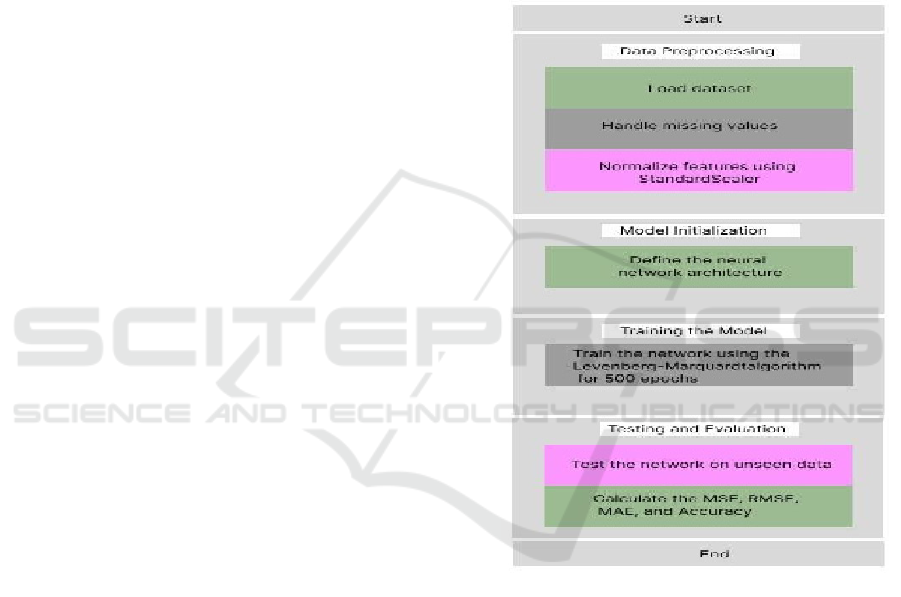
This following figure 1 flow-chart illustrates an
overall process for ANN algorithms for rice crop
yield prediction.
Figure 1: Flowchart of Overall for ANN Algorithm.
The training process for the network involves
minimizing the error among values of the predicted
and actual rice production using the ANN algorithms.
The LM algorithm is a combination of the Gauss-
Newton method and Gradient Descent, offering a
balance between speed and stability when converging
towards an optimal solution. The models were trained
with 500 epochs, ensuring that the network learns the
complex nonlinear relationships among the input
features, middle layers and rice production.
During testing phase, trained networks are used
for make predictions on the test data. Various metrics,
such as Mean-Squared-Error (MSE), Root-Mean-
Squared-Error (RMSE), Mean -Absolute-Error
ICRDICCT‘25 2025 - INTERNATIONAL CONFERENCE ON RESEARCH AND DEVELOPMENT IN INFORMATION,
COMMUNICATION, AND COMPUTING TECHNOLOGIES
732
(MAE), and Accuracy, are calculated for testing the
accuracy of the model. These metrics provide insights
into how well the model generalizes to new
information and its ability to predict rice yields
accurately.
This methodology provides a robust and efficient
way to predict rice crop yield, leveraging the LM
algorithm to capture the nonlinear relationships
among the input features middle layers and the target
variable. The neural networks architecture and
optimization ensure high accuracy and low error
rates, making this approach suitable for large-scale
crop yield prediction.
4 PRELIMINARY DATA
The dataset used to develop the Artificial- Neural-
Network (ANN) models consisted of climate and
agricultural data from Maharashtra, India, during the
Kharif season between 1998 and 2002. The features
included critical factors such as rainfall, minimum-
temperatures, average- temperatures, maximum-
temperatures, reference crop, area, and yield. The
data was pre-processed using the WEKA tool, where
missing values were handled, and features were
normalized to ensure a balanced input to the ANN
model. A multilayer perceptron architecture was
employed, with six input neurons corresponding to
the input variables, a hidden layer of three neurons,
and a single output neuron for predicting rice yield.
Dataset was divided for training and testing data, and
10-fold-cross validation was used for ensuring the
models generalizability and reliability among
different datasets of the data. Table 1 gives the
confusion matrix.
Table 1: A Confusion Matrix.
Predicted /
Observed
True False
True
True Positive
(
TP
)
False Positive
(
FP
)
False
False Negative
(FN)
True Negative
(TN)
5 EXPERIMENTAL RESULTS
The ANN model achieved remarkable prediction
performance with an overall accuracy of 97.54% This
research aligns with previous studies, such as those
conducted by Ye et al.2011, signifying its ability to
accurately forecast rice yields. The model's
sensitivity was 96.33%, meaning it correctly
predicted most positive cases, and its specificity was
98.12%, indicating that it effectively identified
negative cases. Performance metrics such as the
Mean -Absolute-Error (MAE), which stood at
0.0526, and the Root-Mean-Squared-Error (RMSE)
of 0.1527 further reinforced the model’s precision
and effectiveness. These findings show that the
ANN models highly reduced prediction errors when
comparing with traditional regression models,
making it a robust tool for rice yield forecasting in
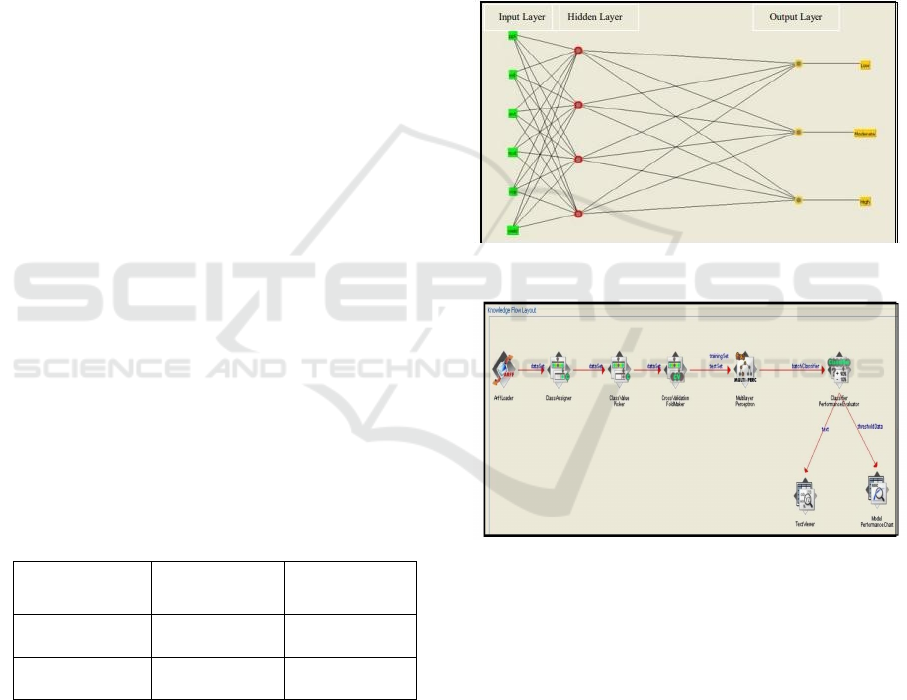
Maharashtra. Figure 2 gives the neural network
diagram and Figure 3 gives the knowledge flow
layout.
Figure 2: Neural Network Diagram.
Figure 3: Knowledge Flow Layout.
6 DISCUSSION
Our model's high accuracy demonstrates the ANN's
ability to model nonlinear relationships between
climatic factors and rice yields. The results suggest
that climatic variables such as precipitation and
temperature are critical in determining crop yields,
and ANNs are well-suited to capture these
relationships. The model's success indicates the
potential for expanding its use to other regions and
crops. However, the model's dependence on historical
Enhancing Paddy Production Forecasts with Artificial Neural Networks Models and Weather Data
733

data highlights the need for updated, real-time
climatic data for more dynamic predictions.
7 CONCLUSIONS
This research helps finding the importance of ANN
models in predicting rice crop yields. By effectively
capturing the nonlinear interactions between climatic
variables, our model offers a robust alternative to
traditional prediction methods. The findings can
assist policymakers and farmers in making informed
decisions to mitigate the impacts of climatic
variability on rice production. Further work should
explore the integration of additional variables and
real-time data for more dynamic and precise
predictions.
REFERENCES
713–720, 1997.
Agricultural Science, 2016.
Anderson, R., Stenger, B., Cipolla, R., "Expressive Shape
Modeling Using Neural Networks," Artificial
Intelligence Review, vol. 43, pp. 155–177, 2012.
Batchelor, W.D., Yang, X.B., Tshanz, A.T., "Development
of a neural network for soybean rust epidemics,"
Transactions of the ASAE, vol. 40, pp. 247–252, 1997.
Dahikar, S., Rode, S., "Agricultural crop yield prediction
using artificial neural network approach," International
Journal of Innovative Research in Electrical,
Electronics, Instrumentation and Control Engineering,
vol. 2(1), pp. 683-686, 2014.
Elizondo, D.A., McClendon, R.W., Hoogenboom, G.,
"Neural network models for predicting flowering and
physiological maturity of soybean," Transactions of the
ASAE, vol. 37, pp. 981–988, 1994.
Gandhi, N., Armstrong, L., Petkar, O., "Predicting Rice
Crop Yield Using Bayesian Networks," Journal of
Gandhi, N., Petkar, O., Armstrong, L.J., "Rice Crop Yield
Prediction Using Artificial Neural Networks," IEEE
Govind, A., et al., "Machine learning-based rice yield
prediction model using remote sensing data," IEEE
Transactions on Geoscience and Remote Sensing,
2017.
International Conference on Technological Innovations in
ICT for Agriculture and Rural Development, 2016.
Jabjone, S., Wannasang, S., "Decision Support System
Using Artificial Neural Network to Predict Rice
Production in Phimai District, Thailand," International
Journal of Computer and Electrical Engineering, vol.
6(2), pp. 162-166, 2014.
Ji, B., et al., "Predicting rice yield based on environmental
factors using artificial neural networks," Journal of
Agricultural Science, vol. 145, pp. 249–261, 2007.
Ji, B., "Artificial neural networks for rice yield prediction
in mountainous regions," Journal of Agricultural
Science, vol. 145, pp. 249–261, 2007.
Ji, W., Cui, J., "Application of Geographical Information
System in Agricultural Land Classification and
Grading," Advances in Biomedical Engineering, vol.
3(5), pp. 201-205, 2011.
Kaul, M., Hill, R.L., Walthall, C., "Artificial neural
network for corn and soybean prediction," Agricultural
Systems, vol. 85(1), pp. 1-18, 2005.
Kaul, M., Hill, R.L., Walthall, C., "Artificial neural
network for corn and soybean prediction," Agricultural
Systems, vol. 85, pp. 1-18, 2005.
Liu, J., Goering, C., Tian, L., "A neural network for setting
target corn yields," Transactions of the ASAE, vol.
44(3), pp. 705-713, 2001.
Mohammadi, K., "Application of artificial neural networks
for predicting crop yield," Environmental Modeling &
Software, vol. 30, pp. 61-67, 2011.
O’Neal, M.R., Engel, B.A., Frankenberger, J., "Neural
network prediction of maize yield using alternative data
coding algorithms," Biosystems Engineering, vol.
83(1), pp. 31-45, 2002.
Pachepsky, Y.A., Timlin, D., Varallyay, G., "Artificial
neural networks to estimate soil water retention from
easily measurable data," Soil Science Society of
America Journal, vol. 60(3), pp. 727-733, 1996.
Puteh, S., et al., "Back propagation algorithm for rice yield
prediction," Ninth International Symposium on
Artificial Life and Robotics, Beppu, Japan, pp. 586-
589, 2004.
Ranjeet, T., Armstrong, L., "An architecture of a decision
support system for Western Australian Agriculture
Industry," 9th Conference of the Asian Federation for
Information Technology in Agriculture, Perth,
Australia, 2014.
Schaap, M.G., Bouten, W., "Modeling water retention
curves of sandy soils using neural networks," Water
Resources Research, vol. 32, pp. 3033–3040, 1996.
Smith, B.A., Hoogenboom, G., McClendon, R.W.,
"Artificial Neural Networks for Automated Year-
Round Temperature Prediction," Computers and
Electronics in Agriculture, vol. 68, pp. 52–6, 2009.
Starrett, S.K., Adams, G.L., "Using artificial neural
networks and regression to predict percentage of
applied nitrogen leached under turfgrass," Communica
tions in Soil Science and Plant Analysis, vol. 28, pp.
497–507, 1997.
Thomas, G.A., Taylor, G., Wood, J.C., "Mapping yield
potential with remote sensing," Precision Agriculture,
vol. 1, pp.
Yang, C.C., et al., "An artificial neural network model for
simulating pesticide concentrations in soil," Transactio
ns of the ASAE, vol. 40, pp. 1285–1294, 1997.
Ye, J., et al., "Neural network-based crop yield prediction
models for different agricultural systems," Computers
and Electronics in Agriculture, vol. 78, pp. 38– 50,
2011.
ICRDICCT‘25 2025 - INTERNATIONAL CONFERENCE ON RESEARCH AND DEVELOPMENT IN INFORMATION,
COMMUNICATION, AND COMPUTING TECHNOLOGIES
734
