
Design and Development of an Industrial Safety Mechanism Device to
Track and Monitor Fire Extinguishers via QR Code Scanning
Procedure
S. P. Gowtham and P. Siva
K.S.R. College of Engineering, Tiruchengode, Tamil Nadu, India
Keywords: Industrial Safety, Device Tracking, Fire Extinguisher, QR Code, Fire Protection, IFPS, Fire Control System,
CFCS.
Abstract: Fire extinguishers are mandated to undergo monthly inspections due to their indispensable function in the
event of an emergency, which involves the suppression or suppression of fires. We verify the pressure, verify
that the orifice is unobstructed, and examine for any indications of damage as part of the inspection. The data
is documented after the examination using an aluminum badge and an inspection checklist. The paper
introduces a novel ideology known as the Intelligent Fire Protection Strategy (IFPS) and conducts experiments
with the appropriate infrastructure to evaluate its effectiveness. In order to evaluate its functionality, it is
cross-validated with the conventional detection mechanism known as the Classical Fire Control System
(CFCS). In order to enhance the accessibility of data and reduce the likelihood of errors in the recording of
inspection findings, this proposed method, QR-based monitoring, was implemented by IFPS. The QR code
that is included with each fire extinguisher provides crucial information regarding its type, pressure, propellant
condition, expiration date, and next service month. The system will transmit an email or push message to the
mobile app after the first month of service has elapsed. The fire extinguisher system adheres to standards such
as IS15683, NFPA 10, and IS2190.
1 INTRODUCTION
A substance, generally a fuel, combined with gaseous
oxygen, under the influence of heat, generates a rapid
chemical reaction called fire. This phenomenon is
known as combustion. In case the flaming, heating,
and fuming characteristics of fire and flames are not
controlled, the extent of damage thus caused may
overwhelm its extreme limits (B Siregar, et al., 2017)
(Gerard Goggin, et al., 2024) ( Arkan Aslam Sanadi,
et al.,2020). In summary, fire is a self-sustaining
reaction in which a fuel source combusts rapidly with
oxygen and which gives off heat, light, and a variety
of chemical products (Sumitha C, et al., 2023). The
following are the four things required for to start the
fire:
•
Fuel that which is combustible.
•
Oxygen - to enable burning
•
Heat to burn the gasoline
•
Chemical reaction that is, the mechanism
of combustion itself.
Among the several forms fire can manifest itself as
flames, smoldering, spontaneous combustion, and
electrical fires (Songkran Kantawong, 2022) (Devesh
A. Patil, et al., 2022) (Sen Li, et al., 2023). Below are
the stages of fire development being:
•
The first development stage of a fire is
defined by a little, isolated fire with
minimum smoke and heat.
•
As it spreads and uses the combustibles
surrounding it to maintain its development,
the fire generates rising amounts of heat
and smoke during the stage of growth.
•
Fully developed, is characterized by
extreme heat, thick smoke, and the
possibility of a flashover or back draft
when the fire reaches its peak size and
intensity.
•
As the fire burns out or is put out, the heat
and smoke output decrease, marking the
beginning of the decay stage.
Depending on the fuel source and other fire-
related factors, many types of fires can be
Gowtham, S. P. and Siva, P.
Design and Development of an Industrial Safety Mechanism Device to Track and Monitor Fire Extinguishers via QR Code Scanning Procedure.
DOI: 10.5220/0013888800004919
Paper published under CC license (CC BY-NC-ND 4.0)
In Proceedings of the 1st International Conference on Research and Development in Information, Communication, and Computing Technologies (ICRDICCT‘25 2025) - Volume 2, pages
707-715
ISBN: 978-989-758-777-1
Proceedings Copyright © 2025 by SCITEPRESS – Science and Technology Publications, Lda.
707

distinguished (Mohsen Foroughi Sabzevar, et al.,
2023) (Loay M. Aboud, et al., 2023) (Javier Pisonero,
et al., 2023). Most fires fall into the following
categories:
•
Class A fires indicate for common
combustible objects such fabrics, paper,
wood, and trash.
•
Class B flames need flammable gases or
liquids such gasoline, oil, paint, propane.
•
Class C flames demand wiring, circuit
breakers, and electrical equipment
including appliances.
•
Class D flames need flammable metals
including magnesium, titanium, and
potassium.
•
Class K fires use cooking oils and
greases among other commercial tools.
The types of extinguishing are:
•
Cooling: Reducing the fuel's and
surrounding area's temperature will help to
prevent re- ignition. This is the process
used in water, foam, and dry chemical
extinguishers.
•
Smothering: This is used in foam, dry
chemical, and carbon dioxide extinguishers
as well as in oxygen deprivation to
inhibit combustion.
•
Starvation: Eliminating the fuel supply
stops ongoing combustion, stopping the
gas or flammable liquid flow.
There is a list of related works in Section 2. In Section
3, the recommended methods are presented. The
findings are presented in Section 4. The conclusion is
presented in section 5. The references are presented
in further section.
2 RELATED WORKS
A fire extinguisher is a tool for putting out fires or
controlling their spread in the event of an emergency.
On a monthly basis, it is examined (NITHISH, et
al.,2024). Verify that the pressure extinguisher is in
good working order and that the nozzle is not blocked
or broken. Please ensure that the data is recorded on
the associated aluminum tag and inspection checklist
after the inspection is finished. By using this QR-
based monitoring system, officers will be less likely
to make mistakes while collecting, locating, and
viewing data on the results of fire extinguisher
checks. Along with the kind of extinguisher, pressure
condition, powder condition, expiration date, and
next service month, every fire extinguisher has a QR
code attached to it. The online application is set to
automatically activate when the service month is up.
The following fire extinguisher standards are in place:
NFPA 10, IS15683, and IS2190.
A company's use of automatic portable fire
extinguishers (APAR) is crucial for both fire
prevention and suppression (Hasanusi Pane, et
al.,2023). The procedure of inspecting fire
extinguishers has recently been made easier with the
use of digital solutions, such as the use of barcodes
and android applications. The Waterfall model has
been used in this research as a technical design model
for software development. This study proposes an
approach similar to tagging fire extinguishers with
Andorite-based barcodes readable anywhere in the
world via the Internet. With this barcode-based
monitoring system, officers are less likely to make
mistakes while recording data on fire extinguisher
checks, searching for that data, and making it easy to
read and retrieve. Barcodes are coded descriptions
given to each fire extinguisher based on the specific
conditions, which holds information of the type of
extinguisher, weight, officer name, expiration date,
and type. Given that this implementation of the
method is slowly or gradually carried into effect, it
may then be perceived that the resultant system will
have a higher quality.
By improving catastrophe preventive capacities
via the use of building technology, this study (Tzu-
Wen Kuo, et al., 2025) sought to reduce the amount
of time it took for firefighters to seek for survivors
during interior fires. Tragically, firemen frequently
fail to rescue persons in time from domestic flames,
leading to fatalities. Thorough investigation and
analysis are required to address the subject of how to
maximize the likelihood of survival while concealed
from rescuers. So, it's critical to find a way to make
building door panels that can activate an emergency
call system so that people may live in secure
conditions. We identified the main challenges and
limits of current search-and-rescue tactics by
conducting a thorough literature study using the
PRISMA approach. Afterwards, a notification
system was developed to tackle this problem after the
discovered major components were studied using the
TRIZ technique to identify the essential aspects that
impact the success of rescuing imprisoned persons.
In order to provide the fire department with precise
position information, we used a smartphone to scan a
QR code, based on the idea that it is best to wait for
rescue during a fire. We created a rescue notification
door panel and got a patent for it after receiving a lot
of input from firemen. Just imagine the search-and-
rescue having been done quicker with the help of this
particular technology in case of a fire. The test results
ICRDICCT‘25 2025 - INTERNATIONAL CONFERENCE ON RESEARCH AND DEVELOPMENT IN INFORMATION,
COMMUNICATION, AND COMPUTING TECHNOLOGIES
708
estimated that they managed one-third less of time of
searching.
Flashovers cause fires to spread quickly, which
can cause human deaths and substantial economic
damage (Hyuk Lee, et al.,2024). In the midst of
personnel shortages, the shipping industry is
recognizing the importance of unmanned fire
detection systems to streamline operations while
decreasing staff. There is currently no dedicated
AFDSS for unmanned autonomous ships, despite its
importance in reducing false alarms and guaranteeing
accurate fire suppression in the face of variable wave
conditions. This is in contrast to the AFDSS that have
found use in tunnels and building infrastructure. In
this study, we provide a novel AFDSS that uses a
reinforcement learning algorithm to optimize water
spray in marine environments and incorporates RGB,
IR, and UV sensors to decrease false alarms. We will
present the system's design, integration, and trials of
fire extinguishing, showcasing the improvements in
fire safety in autonomous ships set in a simulated sea-
state environment.
Fire modeling is often used, at great expense, to
support analyses of building fire safety (Yanfu Zeng,
et al.,2022). This Intelligent Fire Engineering Tool
(IFE Tool) is an AI program developed in this study
to accelerate building fire safety analyses, particularly
to swiftly identify design limitations. Initially, a
thorough analysis of the important building and fire
factors to create a large numerical event atrium-fire
database is conducted. Next, a model with an
accuracy of 97% is fitted to perform a 9-year forecast
of tenability with regard to smoke visibility,
temperature, and CO concentration. Then the
tenability decline profile is further considered when
assessing the fire safety and available safe egress time
(ASET) in atriums with geometrically complex roof
designs and slab extensions. In a short amount of
time, our AI design program can evaluate the planned
atrium fire engineering design and provide helpful
recommendations for possible enhancements.
Atrium fire safety typical design chores are finally
covered in the offered operation guidelines of IFE
Tool.
3 METHODOLOGY
Due to developments in equipment inspection
technology, digital tools such barcodes and Android
applications may now help to test fire extinguishers.
The advancement of technology has made all relevant
to human action feasible. Using modern technology
will enable one to finish those tasks faster and more
readily than manual completion. The present fast
expansion of mobile phone technology has made their
requirement far more important in the process of
finding information or seeking data. Though human
work is still mostly done by hand, an organized
system may speed up and ease it. Comparatively to
the current approach called Classical Fire Control
System (CFCS), the proposed way called Intelligent
Fire Protection Strategy (IFPS) readily find out the
pending and finished of fire extinguisher and decrease
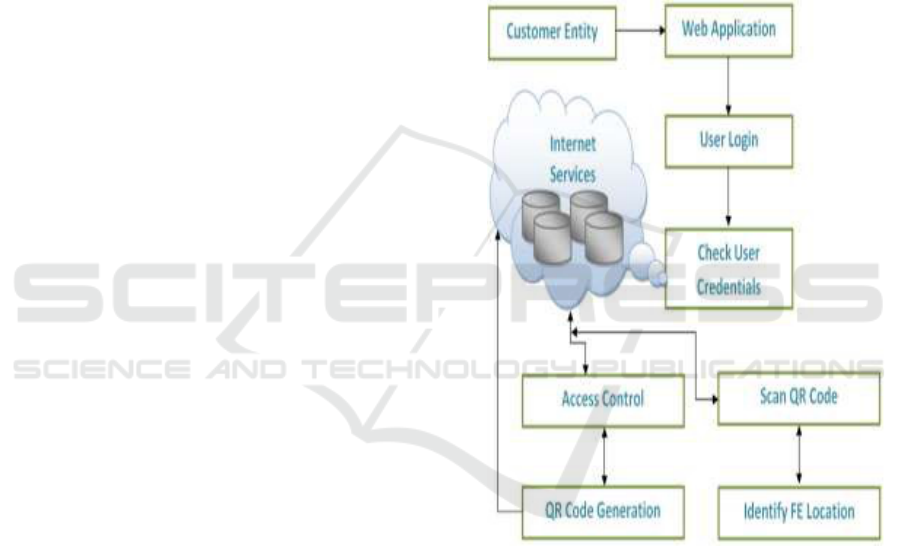
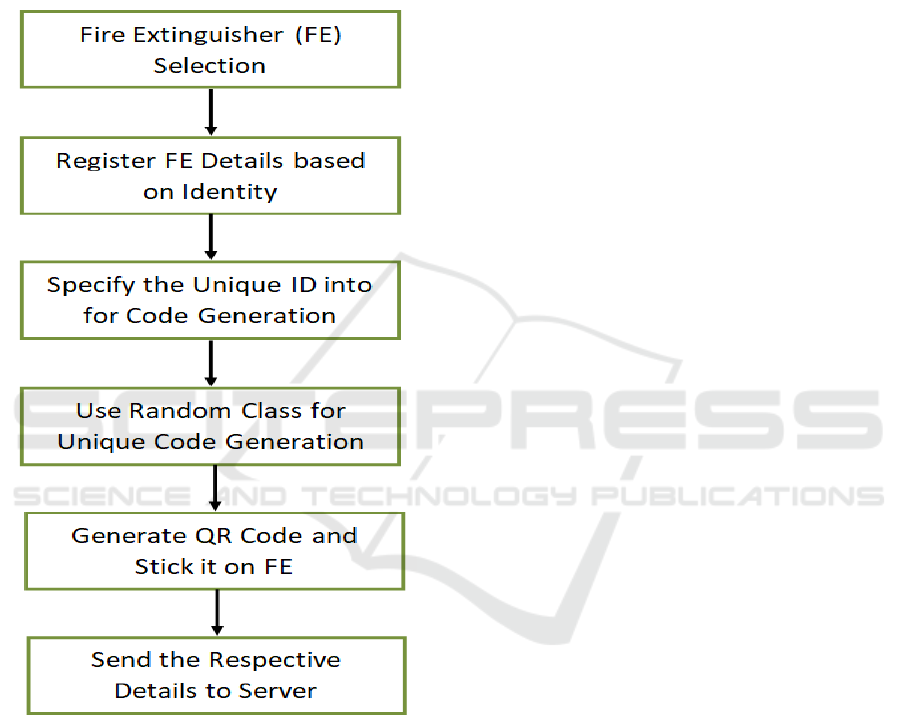
the mistake of fire extinguisher. The following figure
Figure 1 shows the system architecture and the
following figure Figure 2 shows the system flow
diagram.
Figure 1: System Architecture.
Amongst other techniques, heat ascends
transporting embers and sparks to distant regions
facilitate fire spread.
(a) While in motion in the air, heat waves ignite
adjacent combustibles.
(b) Condensed heat ignites encircling materials as
it travels over solid structures.
(c) New fires may begin on surfaces or in the air
by incandescent particles.
(d) Burning items like branches or trash that start
new fires can be carried by wind or water.
(e) Fire can begin accidentally, through negligence
or arson.
(f) Gusty winds help carry embers and sparks to
Design and Development of an Industrial Safety Mechanism Device to Track and Monitor Fire Extinguishers via QR Code Scanning
Procedure
709
new areas and fan the flames.
(g) Fire can move very fast up slope or even
across canyons and valleys.
(h) Like combustible materials or plant life, intact
fuel supply might cause fire to spread.
(i) New fires may be started by many ignition
sources, including lightning or electrical faults.
The following summary shows different forms of Fire
Extinguishers in detail.
Figure 2: System Flow Diagram.
3.1 Water Extinguisher
The simplest and least costly are water extinguishers.
Against Class A flames, which contain common fuels
like paper and wood, they are efficient. Common
types of fire extinguishers useful against Class A fires
which contain regular flammable items such paper,
wood, fabric, rubbish, plastics are water type
extinguishers.
3.2 Foam Extinguishers
Against Class A and B flames, foam extinguishers are
rather successful. For liquid-based flames, they work
well; unfortunately, they are inappropriate for
electrical fires. Common places where flammable
liquids are present gas stations, garages, industrial
environments, chemical plants, aviation rescue and
firefighting (ARFF) operations are where foam
extinguishers find application.
3.2.1 Carbon Dioxide Extinguishers
Against flammable liquid and electrical fires, carbon
dioxide extinguishers are quite successful. They have
a limited cooling impact; nevertheless, hence one
should use prudence in restricted areas. Class C fires
deal with electrical equipment including appliances,
wiring, circuit breakers, and electrical panels.CO2
extinguishers cool the area with a temperature drop of
up to -70°F (-57°C) by displacing oxygen, therefore
starving the fire of fuel.
3.2.2 Dry Chemical Powder Extinguishers
Against Class A, B, and C flames they are efficient.
The residue, nevertheless, may damage delicate
machinery. DCP fire extinguishers are a kind of fire
extinguisher whereby dry chemical powder (DCP) is
used to suppress flames.
3.2.3 Wet Chemical Fire Extinguishers
Kitchen fires are generally handled with them.
Designed to extinguish flames involving cooking oils
and greases, a K type fire extinguisher is one type of
fire extinguisher. First aid measurements in
inhalation: Get sufferer moving toward fresh air. Get
seen right away for any trouble breathing. Eye
Contact: Keeping lids open, immediately flush eyes
with plenty of water for 15 minutes. See a doctor if
burning, redness, or itching develops. Wash
everything off skin for at least 15 minutes using lots
of water and soap. See a doctor if redness, itching, or
burning results. Ingestion: Get medical treatment and
dilute by drinking lots of water. Advice for doctors:
Treat with symptoms. Usually regarded as harmless
for the environment when applied sensibly in
agricultural environments, MAP is not believed to be
detrimental to aquatic life. Commonly used in
fertilizers and fire extinguishers, mono-ammonium
phosphates are white crystalline powders. It is a good
supply of nitrogen and phosphorous, two vital
minerals for plant development, and helps to put out
fires very well. A fire hydrants main role is to give
ICRDICCT‘25 2025 - INTERNATIONAL CONFERENCE ON RESEARCH AND DEVELOPMENT IN INFORMATION,
COMMUNICATION, AND COMPUTING TECHNOLOGIES
710

firefighters rapid and easy access to water should a
fire break out. Connected to a public water system,
hydrants let firemen connect hoses to them, therefore
supplying the required water to quell flames and stop
their spread.
•
Fire hydrants should always be easily seen
and reachable. Clear the surrounding area
of hazards such automobiles, trash, or
overgrown plants.
•
Open or close a fire hydrant only if you are
a qualified professional or fireman else you
risk tampering. Using a hydrant improperly
could cause harm and lower its efficacy
during an emergency.
•
Fire hydrants should be easily found in
an emergency by suitable marking with
paint or placards.
•
Safety Around Water Flow: operation
caution around a hydrant in operation about
water pressure. Dangerous high-pressure
water streams released by fire hoses can
cause injury.
3.3 Inspections
•
Regular inspections of fire hydrants by
municipal authorities or maintenance
teams help to guarantee their
functionality. Inspections ought to look for
corrosion, obstructions, and damage.
•
Hydrants should be checked for water
pressure to guarantee they offer enough
flow during a fire.
•
The area surrounding fire hydrants should
be evaluated to guarantee that there are
no impediments and that firemen have
easy access.
•
Periodically doing flow tests will
guarantee that the hydrant is connected to a
trustworthy water supply and provides the
right amount of water.
4 RESULTS AND EVALUATION
Quickly put out the fire with the help of the fire
extinguisher. But these days, not all businesses check
the cylinders thoroughly. Because he failed to
adequately maintain the fire extinguisher inspection
document. We are unable to locate the fire
extinguisher on the factory floor in the event that the
checklist is overlooked. In order to address this
problem, a fresh approach is needed. This paper
presents a new methodology called Intelligent Fire
Protection Strategy (IFPS). To test its efficacy and
performance, it is cross-validated with the traditional
Classical Fire Control System (CFCS). On the other
hand, fire extinguishers with QR codes can quickly
locate a checklist that can be downloaded several
times, and the data is stored on a server and updated
monthly. We need to download a check-in form
online in case we forget to bring one with us. This is
a brief overview of the planned scheme's design,
which calls for extinguishers to be stationed at every
potential danger spot.
The fire extinguisher should be located so that the
user doesn't have to walk more than 15 meters away
from the fire. It is recommended to stay in the same
spot on every floor. Additionally, fire extinguishers
should not be left in one location for an extended
period of time; if one becomes too hot or overused, it
is imperative that the location immediately replaces it
with a fresh one. There should never be anything in
the way of a fire extinguishers access.
•
Verify that the fire extinguisher is readily
available and in its proper location.
•
Verify that the pressure gauge is set to an
operable range.
•
Make sure the extinguisher is free of dents
or rust before continuing.
•
Fourth, make sure the tamper seal and pin
are both intact.
•
Make sure the fire extinguisher is full. 5.
•
Look for indications of damage, corrosion,
or manipulation when examining the
extinguisher's overall physical condition.
•
Make sure you sign and date the yearly
maintenance tag.
4.1 QR-Code Fire Extinguisher
Inspection
The QR code label is securely attached to the fire
extinguisher and is equipped with a distinctive
identifier that corresponds to the digital record of the
extinguisher. The digital record must include the
following information: User Manuals and respective
Instructions, Extinguisher Type and Capacity,
Location, Maintenance History, Inspection Records,
Expiration Dates, Photos, and Videos. The following
information must be included in the inspection
process: Scan the QR code using a smartphone or
tablet. To access the digital record, confirm the model
and location of the extinguisher. Verify that the
extinguisher is situated in the appropriate location.
Review the inspection records and maintenance
history. Confirm the expiration dates (e.g., recharge,
hydrostatic test). Examine user manuals and
Design and Development of an Industrial Safety Mechanism Device to Track and Monitor Fire Extinguishers via QR Code Scanning
Procedure
711
instructions. Add new inspection records, update the
digital record, and capture photos or videos of the
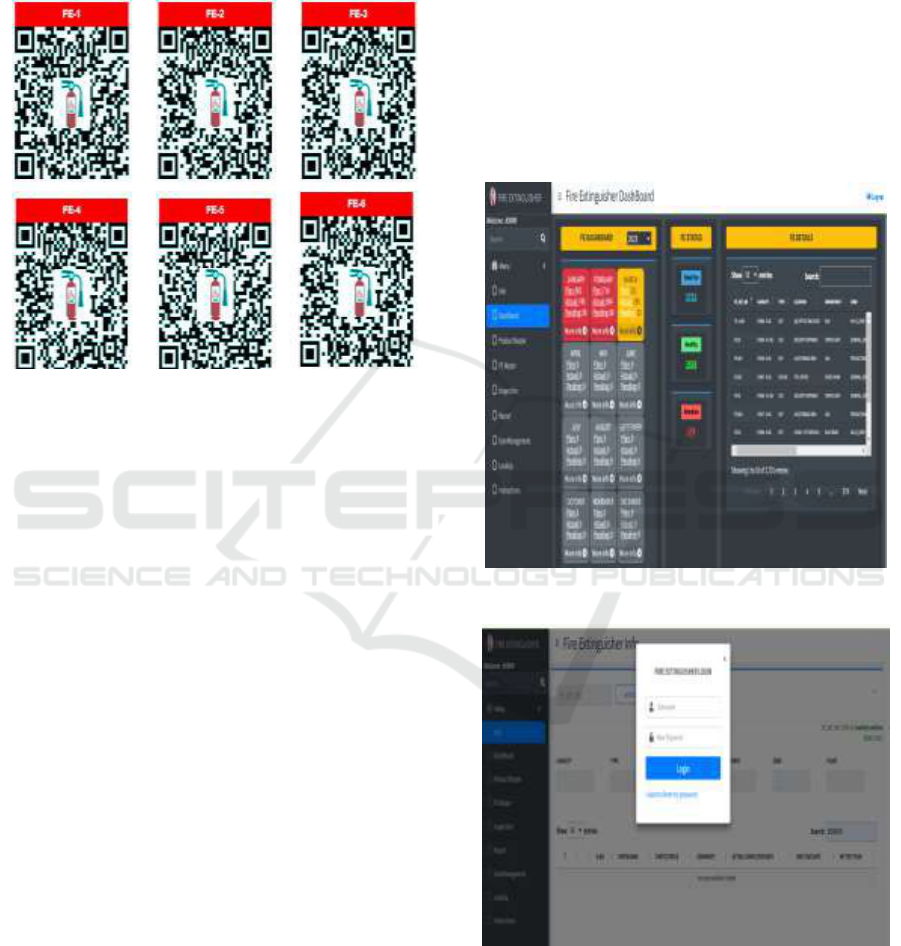
extinguisher. The QR Codes for the scanning and
identification of the respective fire extinguishers are
depicted in the following Figure -3.
Figure 3: QR Codes.
The benefits that can be obtained from the proposed
model design include following:
•
Rapid and effortless access to essential
information
•
Data precision preserved
•
Increased precision and decreased errors
•
Improved audit preparedness and
compliance
•
Improved maintenance and inspection
scheduling
•
Risk reduction and enhanced safety
•
Errors are easily identifiable.
•
Easily prevent the expiration of the cylinder
on time
•
To facilitate the communication of the issue
to the user department
•
Data can be readily surveyed online.
4.1.1 Web Application
A distinct web application is developed for the
proposed approach, and the website's operation is
user-friendly. The procedure is as follows:
•
Access the website or application via the
internet
•
Provide the appropriate credentials, such
as your username and password.
•
Access the fire extinguisher portal by
logging in.
•
The Dashboard, which provides a
comprehensive overview of the availability
of extinguishers and their respective
locations, can be readily accessed from
there.
•
A user-friendly interface that enables users
to readily verify reports, fire extinguisher
management details, and check the
availability and count of extinguishers.
This includes the ability to add or remove
extinguishers.
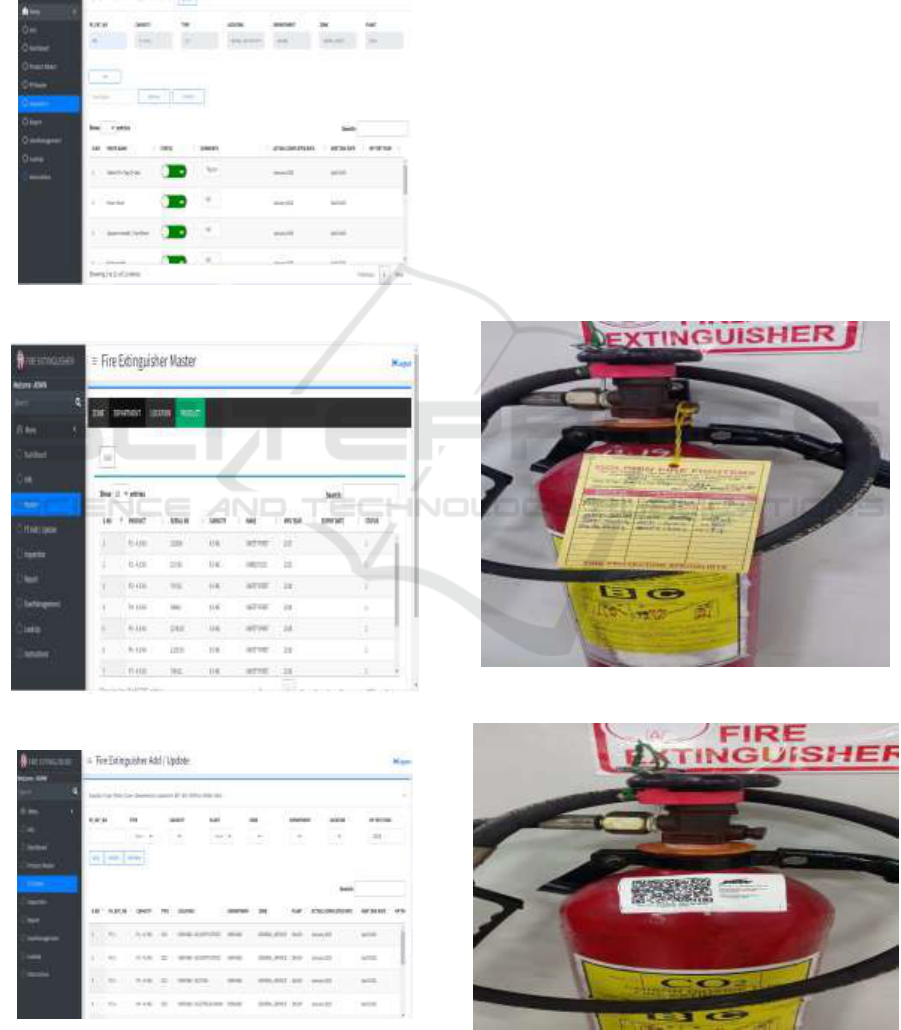
The Dashboard with all available menus and the
Login Page of the proposed web application are
depicted in the following figures: Figure 4 and Figure
5.
Figure 4: Dashboard.
Figure 5: Login Page.
4.1.2 Details of the Fire Extinguisher Menu
Locate the fire extinguisher that was installed in the
designated department and verify that it is still
pending inspection. This menu is used to address any
ICRDICCT‘25 2025 - INTERNATIONAL CONFERENCE ON RESEARCH AND DEVELOPMENT IN INFORMATION,
COMMUNICATION, AND COMPUTING TECHNOLOGIES
712
overlooked or unresolved complaints, including the
number, type, capacity, plant, and location of the fire
extinguisher. The master page of the fire extinguisher
web application, as well as the availability of the
primary menus, is depicted in the following figures:
Figure 6, Figure 7, and Figure 8. The subsequent
page displays the available options for adding or
removing fire extinguishers from the portal.
Figure 6: Master Page.
Figure 7: Availability of Main Menus in the Web Page.
Figure 8: Option to Add or Remove the Fire Extinguishers.
4.1.3 Inspection of Fire Extinguishers Prior
to and Following Their Use
Before the inspection, we have a card or aluminum
identifier that must be punched every three months.
Occasionally, the card may be overlooked. In that
event, we are faced with the challenge of determining
the date and month of the inspection. In the event that
a check document is overlooked, the fire extinguisher
is not promptly located. Additionally, a manual
inspection of the workplace is conducted. Upon
completion of the applicable fire extinguisher
inspection, it is necessary to affix the QR scanner to
each fire extinguisher in order to facilitate inspection
and expedite maintenance through inspection
scheduling. This will enhance safety and mitigate
risks. This is the most straightforward method for
identifying the errors. The fire extinguishers before
and after inspection views, as well as the Reporter
Issue Page view of the proposed web application, are
illustrated in the following figures: Figure 9, Figure
10, and Figure 11.
Figure 9: Before Inspection.
Figure 10: After Inspection.
Design and Development of an Industrial Safety Mechanism Device to Track and Monitor Fire Extinguishers via QR Code Scanning
Procedure
713
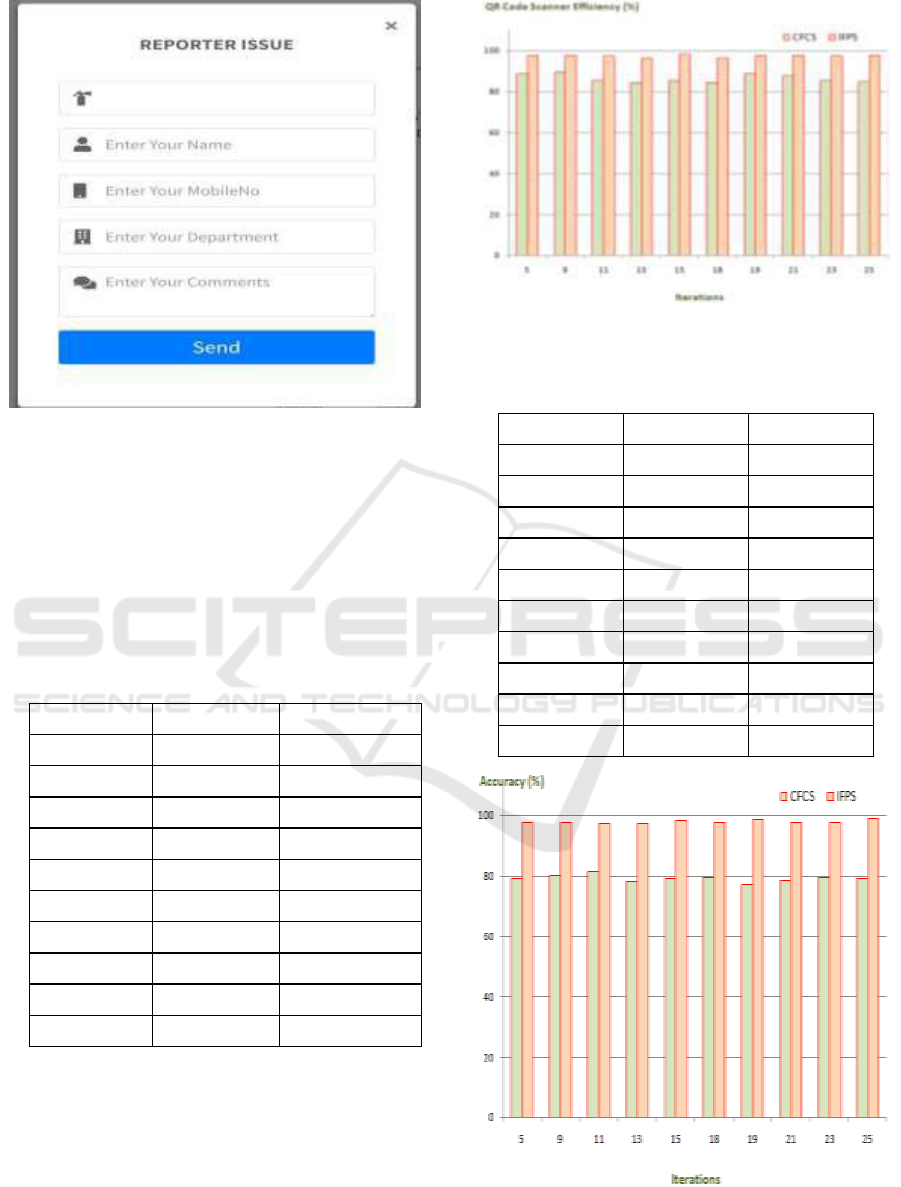
Figure 11: Reporter Issue.
The QR code scanner efficiency of the proposed
scheme, IFPS, is illustrated in the accompanying
figure, Figure 12. This figure is cross-validated with
the conventional detection mechanism, CFCS, to
assess the QR code scanner efficiency of the proposed
scheme. Table-1 is a descriptive representation of the
aforementioned.
Table 1: QR Code Scanner Efficiency Evaluation between
IFPS and CFCS.
Iterations CFCS (%) IFPS (%)
5 88.52 97.62
9 89.47 97.44
11 85.34 97.28
13 84.27 96.39
15 85.26 97.82
18 84.47 96.34
19 88.45 97.46
21 87.45 97.57
23 85.36 97.37
25 84.52 97.59
The fire extinguisher detection accuracy ratio of the
proposed scheme, IFPS, is illustrated in Figure 13.
This ratio is cross-validated with the conventional
detection mechanism, CFCS, to assess the proposed
scheme's accuracy. Table-2 is a descriptive
representation of the same.
Figure 12: Analysis of QR Code Scanner Efficiency.
Table 2: Comparison of Accuracy Ratio between IFPS and
CFCS.
Iterations CFCS (%) IFPS (%)
5 79.19 97.63
9 80.21 97.45
11 81.26 97.34
13 78.17 97.24
15 79.12 98.39
18 79.59 97.63
19 77.23 98.54
21 78.36 97.47
23 79.49 97.53
25 79.01 98.72
Figure 13: Accuracy Analysis.
ICRDICCT‘25 2025 - INTERNATIONAL CONFERENCE ON RESEARCH AND DEVELOPMENT IN INFORMATION,
COMMUNICATION, AND COMPUTING TECHNOLOGIES
714

5 CONCLUSIONS
The pending and completed fire extinguisher status
can be readily determined using this QR code scanner
method. To reduce the likelihood of fire extinguisher
errors and the decal can be affixed to each fire
extinguisher. Furthermore, to prevent the creation of
review sheet data and in the event of a fire
extinguisher malfunction, all individuals are required
to utilize a mobile application to access the QR
scanner and promptly notify the relevant department.
Mail can be received by a fire or safety department,
which can promptly replace the fire extinguisher and
take corrective action. The implementation of QR
code systems also enables improved compliance with
safety regulations by guaranteeing that all
maintenance and inspection activities are accurately
documented and readily accessible. Furthermore, QR
codes facilitate real-time communication and updates
among safety personnel, thereby improving the
overall level of safety preparedness.
REFERENCES
A. Nithish, et al., "QR Code for Portable Fire
Extinguisher with Monitoring of Online Application
In Industry", Journal of Emerging Technologies and
Innovative Research, 2024.
Arkan Aslam Sanadi, et al., "Android Based Automated
Guided Vehicle for Fire Fighting", International
Journal of Innovative Research in Science, Engineering
and Technology, 2020.
B Siregar, et al., "Fire Extinguisher Robot Using Ultrasonic
Camera and Wi-Fi Network Controlled with Android
Smartphone", IOP Conference Series: Materials
Science and Engineering, 2017.
Devesh A. Patil, et al., "Research On “Smart Automatic
CO2 Fire Extinguisher Operating Mechanism",
International Journal of Creative Research Thoughts,
2022.
Gerard Goggin, et al., "QR codes and automated decision-
making in the COVID-19 pandemic", Sage Journals,
2024.
Hasanusi Pane, et al., "Barcode-Based Light Fire
Extinguisher (Apar) Monitoring with the Waterfall
Case Study Method of PT. PLN (Persero) UPK", Jurnal
Inovasi Teknologi dan Rekayasa, 2023.
Hyuk Lee, et al., "AI-enhanced fire detection and
suppression system for autonomous ships",
International Journal of Naval Architecture and Ocean
Engineering, 2024.
Javier Pisonero, et al., "Smartvessel: A New Extinguisher
Prototype Based on New Materials and IoT Sensors",
Sensors, 2023.
Loay M. Aboud, et al., "A proposed design for 5-G fire
detecting and extinguishing system: ultra-large
container ship case study", Journal of International
Maritime Safety, Environmental Affairs, and Shipping,
2023.
Mohsen Foroughi Sabzevar, et al., "AR-QR code for
improving crew access to design and construction
information", Automation in Construction, 2023.
Sen Li, et al., "An Indoor Autonomous Inspection and
Firefighting Robot Based on SLAM and Flame Image
Recognition", Fire, 2023.
Songkran Kantawong, "Indoor Fire Evacuation Guidance
Using QR Code Vision-based combine with an
Adaptive Routing Localization", International
Electrical Engineering Congress, 2022.
Sumitha C, et al., "Smart Drone Fire Extinguisher",
International Journal of Creative Research Thoughts,
2023.
Tzu-Wen Kuo, et al., "Smart Building Technologies for
Fire Rescue: A QR Code Enabled Notification System",
Prerpints.org, 2025.
Yanfu Zeng, et al., "Artificial Intelligence tool for fire
safety design (IFETool): Demonstration in large open
spaces", Case Studies in Thermal Engineering, 2022.
Design and Development of an Industrial Safety Mechanism Device to Track and Monitor Fire Extinguishers via QR Code Scanning
Procedure
715
