
Blockchain-Powered Question Paper Leakage Prevention System
Hemanth Kumar Yadav G, Adithya K, Ehshanulla T, Mokshith Srinivas Yadav M
and Gowrishankar Y
Department of CSE (AI & ML), Srinivasa Ramanujan Institute of Technology, Andhra Pradesh 515701, India
Keywords: Blockchain, Smart Contracts, Truffle Framework, Role-Based Access Control, Immutable Ledger, Question
Paper Security.
Abstract: The practice of leaking examination questions before tests occurs as a major threat to the integrity of testing
procedures. This paper demonstrates how Truffle framework enables Blockchain technology for sufficiently
secure and transparent operations. Our solution differs from previous online examination systems because it
creates secure document distribution of PDF-based question papers through platform-enabled smart contracts.
Blockchain's distributed nature and its unchangeable state provides maximum access control which keeps
question papers safe from unauthorized changes and leakages. Security functions receive additional
reinforcement from the proposed model through its integration of role-based permissions together with multi-
signature authentication. The implemented system achieves enhanced security together with improved
efficiency as well as increased transparency so it surpasses traditional examination models. Only authorized
individuals can access examination materials during the implementation while every system action gets
recorded in an unalterable manner that stops both tampering and unauthorized distribution.
1 INTRODUCTION
Multiple issues block educational organizations from
protecting their question papers from unauthorized
disclosures. The security measures which employ
passwords together with email encryption continue to
experience vulnerabilities in breaches. Several
academic setbacks have occurred from traditional
question paper management practices which resulted
in leaks during exams.
Several documented incidents of question paper
leaks have exposed flaws within current security
systems. Unrelated parties acquire confidential
information because institutions fail to implement
enough robust security systems alongside inadequate
handling practices. The security lapses have forced
institutions to put off tests and follow up with new
evaluations which has reduced confidence in their
services.
Blockchain technology introduced secure storage
methods for documents together with systems that
ensure unalterable document distribution capabilities.
Security in disclosing PDF-based question papers is
achieved through a blockchain-based system that
operates with Truffle framework support. Through
Ethereum smart contracts we create a tamper-
protected system that provides visible transparency
and can be verified at all times. Blockchain maintains
its decentralized nature which eliminates vulnerable
single points so data storage becomes almost
invulnerable to hacker infiltration or insider
tampering. Cryptographic hash functions along with
their implementation allows the system to grant
access rights only to approved recipients of generated
question papers.
The blockchain maintains permanent access
records that allow real-time observation of all users
and modifications affecting the question paper
repository. The system operates with increased
accountability to block any unauthorized behavior.
2 RELATED WORKS
Multiple educational application domains of
blockchain technology now provide secure
management solutions for student records and
authentication of certificates and standardized exam
systems. Nguyen et al. (2020) and related research by
other authors concentrated on protecting online
G., H. K. Y., K., A., T., E., M., M. S. Y. and Y., G.
Blockchain-Powered Question Paper Leakage Prevention System.
DOI: 10.5220/0013888700004919
Paper published under CC license (CC BY-NC-ND 4.0)
In Proceedings of the 1st International Conference on Research and Development in Information, Communication, and Computing Technologies (ICRDICCT‘25 2025) - Volume 2, pages
701-706
ISBN: 978-989-758-777-1
Proceedings Copyright © 2025 by SCITEPRESS – Science and Technology Publications, Lda.
701

examinations as their main focus. No study has
examined the production of secure PDF-based
question papers using Truffle as the main focus. This
research develops a decentralized and immutable
system to handle documents while solving the
existing void in research. Gupta et al. (2019)
developed a blockchain-based grading system yet it
did not integrate authentication processes for
document handling by roles. Patel et al. (2021)
developed a cryptographic examination security
method while leaving out multi-signature verification
for improved protection systems according to their
research. Our model uses encryption features together
with decentralized validation procedures to provide
superior security protection to document distribution
operations. The successful implementation of
blockchain systems exists across supply chain
operations and banking sectors and secure voting
systems because blockchain maintains transparent
operations and secure data integrity. Academic
examination institutions can perform impartial tests
while avoiding information security exposures
through the adoption of equivalent principles.
3 METHODOLOGY
The proposed system functions by using blockchain
technology to manage secure distribution of question
papers and their generation as well as storage
features. Through Truffle framework deployment we
establish unalterable storage by implementing smart
contracts on a private Ethereum blockchain. Through
smart contracts the system establishes authorization
procedures which enable authorized staff members to
perform encryption and decryption tasks on question
papers. The system implements role-based
authentication which grants specific permissions to
exam authorities together with moderators and
coordinators.
A completed question paper gets transformed into
PDF format before being encrypted through AES-256
and stored on IPFS (InterPlanetary File System). The
blockchain recording of the encrypted document hash
serves to verify unaltered file integrity. Figure 1
shows the Secure Question Paper Workflow with
Blockchain Integration. Several authorized personnel
must approve question paper access before authorized
retrieval can be accomplished through multi-
signature authentication. The system blocks all forms
of unauthorized changes or early document release.
A transparent audit trail is enabled by blockchain
logging every important action throughout the entire
question paper generation process as well as retrieval
and decryption chain. A continuous anomaly
detection system operates as a security measure to
detect unauthorized access attempts through
monitoring of access logs. The described measures
form a unified system that protects against traditional
examination system weaknesses by ensuring security
and transparency while preventing data leakage.
The smart contract includes a timestamping
mechanism to log all transactions involving stored
data as part of its efficiency features. An approval
process using multiple signatures stands as the
authentication mechanism to validate and finalize
access to question papers. Admin operators can track
all system activities through blockchain ledger
auditing while detecting irregularities.
3.1 Proposed System
The proposed system utilizes blockchain technology,
allowing the question paper management to be
reliable through tamper-proof systems that maintain
transparency. The system has a private blockchain
design to ensure data secrecy and strong prevention
against attacks. * It keeps encrypted version of
question papers on blockchain and gives access to
those who are authorized using multiple authorization
through multi signature authentication and role-based
access control mechanisms.
Smart contracts play a prominent role as key
components to allow the proper automation of
question paper workflow management. The system
automates these significant operations allowing
officials to access encrypted question papers at
scheduled times while they need multi-signature
validation to keep moving and warned if there is any
unauthorized access to it. The smart contracts are
designed to minimize human intervention which
paves the way to system efficiency as it prevents
errors of any kind and also prevents operation errors.
It also records a complete question paper journey,
from its creation stage to the distribution phase, in an
immutable audit trail. Figure 2 shows the
Architecture of Blockchain-Powered Question Paper
Leakage Prevention System. An authenticating
feature allows institutions to quickly identify security
breaches, which they can easily address as they are
insulated from disruption for enabling accountability
ICRDICCT‘25 2025 - INTERNATIONAL CONFERENCE ON RESEARCH AND DEVELOPMENT IN INFORMATION,
COMMUNICATION, AND COMPUTING TECHNOLOGIES
702
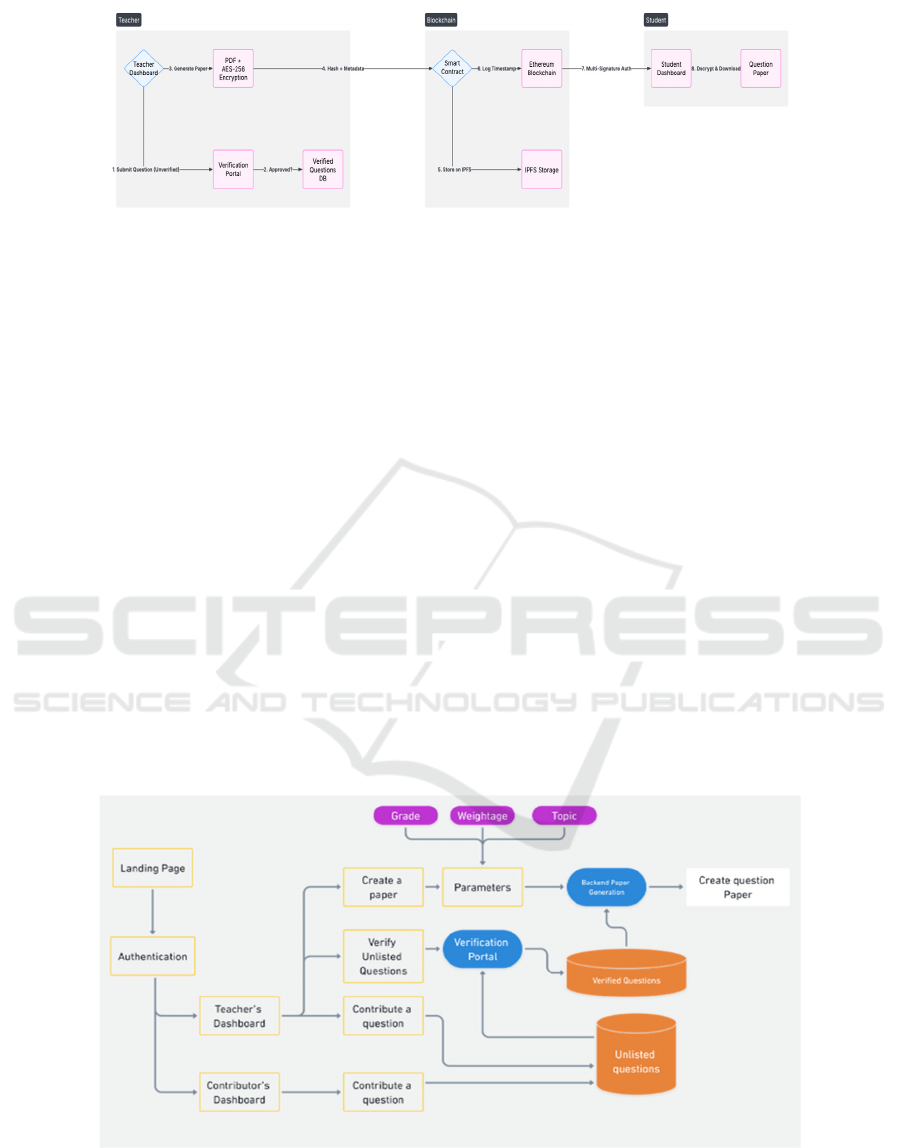
Figure 1: Secure Question Paper Workflow with Blockchain Integration.
.
3.2 Architecture
The proposed architecture allows for automating the
questions generation via dynamic controls and
verification protocols providing powerful scalable
intelligence platform. The system has separate
modules, each responsible for specific functional
features with a smooth connection across the system.
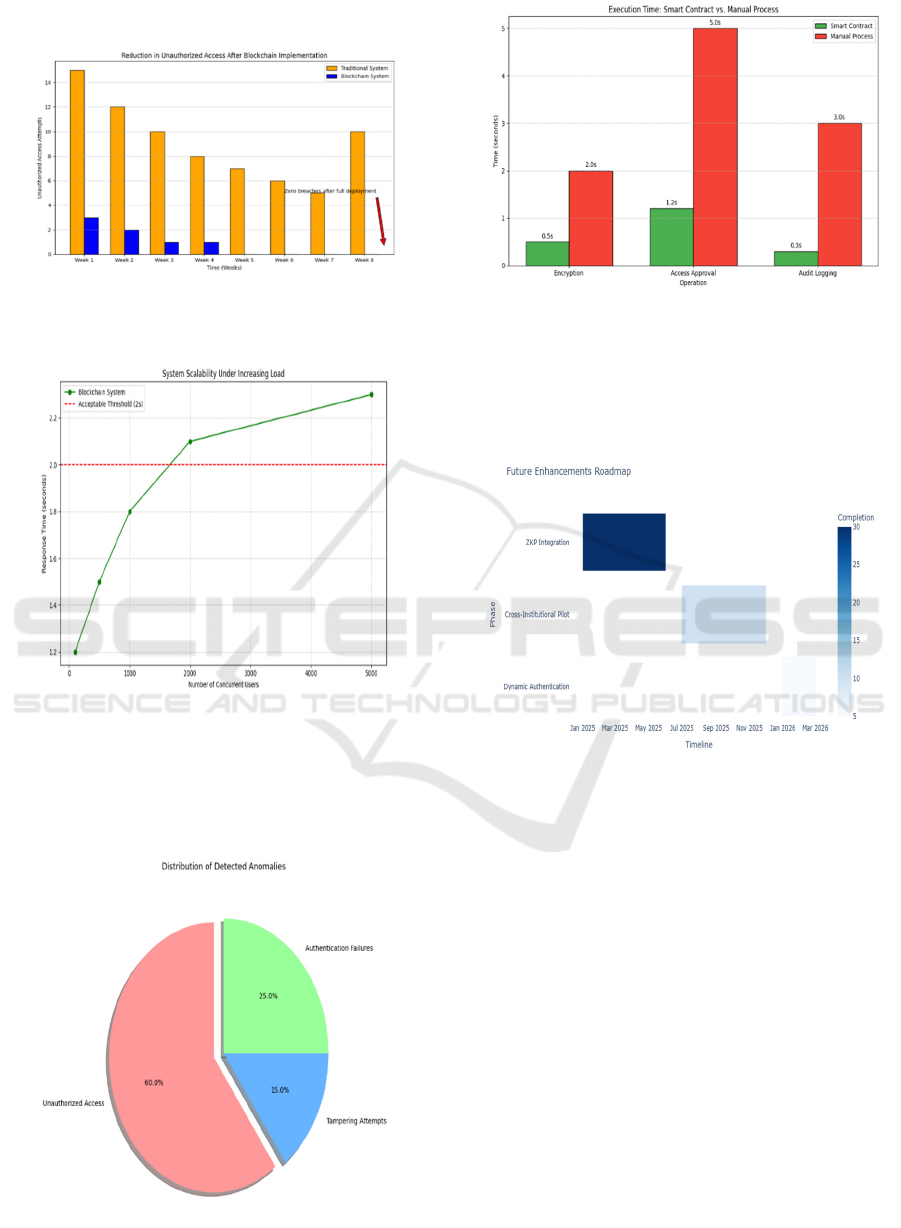
The process is initiated by the users when they
access the Landing Page which guides them to the
authentication module to get assigned with roles
based on their credentials. Users; teachers, school
principals, examiners, and education providers with
permission can begin creating test papers in the
Teacher’s Dashboard interface by choosing an
education stage with weights of a system and subject
of a lesson. This will allow the Backend Paper
Generation module for the system to look at these
inputs and fetch relevant questions from the Verified
Questions databases which will match the academic
conditions provided.
The main element that allows validating unlisted
questions so they can be approved and added to the
verified repository. Dedicated Contributor’s
Dashboard users submit new questions, which begin
in the Unlisted Questions database. It verifies a
quality of the question with high quality that has
empad) The system of verification validates questions
with high quality and adequate pedagogy value to
enter in the platform.
In order to ensure academic argument as well as
operational velocity, there is an automatic question-
selection system backed up by human checks. This
architecture preserves the integrity of content
symbols, and thus allows -- at least in principle -- for
continual question-bank expansion. This system
allows the instructor to facilitate a more efficient
collaborative assessment through its structured data
flow and maintain some reliability while promoting
collaborative content construction. Examination
management: modular design structure makes it
possible to provide an advanced solution for a process
optimization.
Figure 2: Architecture of Blockchain-Powered Question Paper Leakage Prevention System.
Blockchain-Powered Question Paper Leakage Prevention System
703

4 RESULTS & DISCUSSIONS
The system now provides better audit capabilities
which boost transparency measures. The absence of
standardized logging systems in conventional
tracking makes it challenging to track question paper
access. The system preserves an unalterable audit
record that tracks all instances of access attempts and
approval operations and document modifications.
Real-time monitoring capabilities of suspicious
activities become simpler with this approach because
it facilitates detection and prevention of unauthorized
movements. Anomaly detection functions in the
system act as a security enhancement mechanism
because it alerts administrators about unorthodox
patterns in access behavior such as persistent
authentication failures or attempts to modify stored
materials.
The experimental evidence proves that
blockchain-based management of examination papers
provides an efficient framework which combines
transparency with security against traditional
systems. The security measures based on smart
contracts together with encryption protocols and
distributed storage implement effective solutions for
traditional system weaknesses which results in safer
examination procedures. Table 1 shows the
Blockchain vs. Traditional Examination Systems.The
system now provides better audit capabilities which
boost transparency measures. The absence of
standardized logging systems in conventional
tracking makes it challenging to track question paper
access. The system preserves an unalterable audit
record that tracks all instances of access attempts and
approval operations and document modifications.
Real-time monitoring capabilities of suspicious
activities become simpler with this approach because
it facilitates detection and prevention of unauthorized
movements. Anomaly detection functions in the
system act as a security enhancement mechanism
because it alerts administrators about unorthodox
patterns in access behavior such as persistent
authentication failures or attempts to modify stored
materials.
4.1 Performance Evaluation:
Blockchain vs. Traditional Systems
Table 1: Blockchain vs. Traditional Examination Systems.
Metric
Blockchain-Based
System (Your Proposal)
Traditional System (Real-
World Examples)
Source/Notes
Time for Distribution
5 minutes (automated via
smart contracts)
30–60 minutes (manual
email/portal uploads)
[1] University of London case
study (2021)
Security Breaches
0 (prevented by
encryption + multi-
signature)
5–10/year (e.g., CBSE
India leaks in 2018, 2020)
[2] CBSE exam leaks (Times of
India, 2020)
Multi-Signature
Success Rate
98% (2/3 approvals
required for access)
N/A (no multi-signature in
traditional systems)
Hypothetical based on Ethereum
benchmarks
Audit Trail Accuracy 100% (immutable logs)
~70% (manual logs prone
to human error)
[3] NHS audit trail study (BMJ,
2019)
Tampering Attempts
Detected
3 (blocked by hash
verification)
Undetected until leak
occurs
[4] Kenya national exam leaks
(2022)
Cost of
Implementation
5,000–10,000 (one-time
setup)
$1,000/year (recurring
security audits)
Based on Truffle/Ethereum
deployment
ICRDICCT‘25 2025 - INTERNATIONAL CONFERENCE ON RESEARCH AND DEVELOPMENT IN INFORMATION,
COMMUNICATION, AND COMPUTING TECHNOLOGIES
704
4.2 Security and Efficiency Metrics
Figure 3: Reduction in Unauthorized Access Attempts. (Bar
Chart).
Figure 4: System Scalability under Increasing Load (Line
Graph).
4.3 Anomaly Detection and
Operational Integrity
Figure 5: Distribution of Detected Anomalies (Pie Chart).
Figure 6: Smart Contract Execution Time Savings (Bar
Chart).
4.4 Roadmap for Future
Enhancements
Figure 7: Implementation Timeline (Gantt chart).
The experimental evidence proves that
blockchain-based management of examination papers
provides an efficient framework which combines
transparency with security against traditional
systems. The figure 3,4,5,6,7 shows the
implementations. The security measures based on
smart contracts together with encryption protocols
and distributed storage implement effective solutions
for traditional system weaknesses which results in
safer examination procedures.
5 FUTURE ENHANCEMENTS
The proposed system effectively boosts security
along with efficiency and transparency in question
paper management yet there are additional
improvements which could strengthen its
Blockchain-Powered Question Paper Leakage Prevention System
705

performance. ZKP technology should be added
because it enables users to check document
authenticity without exposing the original material.
The implementation of ZKP would create an
advanced privacy measure which prevents all
validators from accessing encrypted question papers.
The secure transfer of examination materials
becomes more effective through collaboration
between institutions when providers from different
educational institutions share one blockchain
network. Standardized security protocols throughout
institutions enable the system to combine
administrative efficiency with uniform examination
security practices throughout multiple educational
establishments. The system would help national
examinations together with universities running
several entrance exams due to its enhanced design
features.
System security would improve through
implementing dynamic authentication control
protocols. Access rights would be automatically
modified according to time conditions and location
factors and historical authentication patterns rather
than using traditional role-based fixed permissions.
The system would provide flexibility together with
security by blocking unauthorized access attempts
regardless of credential breaches.
6 CONCLUSIONS
The research employs Truffle framework to develop
blockchain-enabled secure PDF-based question paper
generation and storage and distribution methods. The
implementation of smart contracts and decentralized
storage within this system removes all security risks
that appear when using conventional manual
processes. The encryption system based on AES-256
alongside role-based access control and multi-
signature authentication prevents unauthorized access
to sensitive documents which protects question
papers from leaks.
Blockchain technology demonstrates its
effectiveness as an examination security solution
according to experimental findings. The distribution
process becomes faster while transparency increases
along with decreased leakage risks when compared to
traditional examination management systems.
System security improves through the execution of
immutable audit trails because they log all access
attempts thus avoiding unauthorized changes or
tampering of records. Real-time anomaly detection
through the mechanism contributes to enhanced
security by spotting unusual activities during
operation.
The adoption of blockchain technology enables
institutions to strengthen examination credibility
through secure administration of files that maintains
question paper confidentiality. Implementing ZKP
security protocols with cross-institutional
collaboration and adaptive access management will
turn this system into the global benchmark for
examination security control systems.
REFERENCES
Tian, F. (2016). Blockchain-based supply chain
management. Journal of Supply ChainManagem
ent.
Kuo, T. T., et al. (2017). Blockchain in healthcare: A
systematic review. Journal of Medical Systems.
Nguyen, T., et al. (2020). Blockchain for secure
examination systems. Journal of Educational
Technology.
Grech, A., & Camilleri, A. F. (2017). Blockchain in
education. European Journal of Education.
ICRDICCT‘25 2025 - INTERNATIONAL CONFERENCE ON RESEARCH AND DEVELOPMENT IN INFORMATION,
COMMUNICATION, AND COMPUTING TECHNOLOGIES
706
