
AI‑Enhanced Smart Helmet for Navigation, AR Integration and
Road Safety
K. Karthika, Logeshwari A., Akkash Raj S. and Abinaya M. V.
Department of Electronics and Communication Engineering, KCG College of Technology, Chennai, Tamil Nadu, India
Keywords: Navigation, AI‑generation, AR Integration, Optimal Visibility, Road Security.
Abstract: The evolution of digital technology in the automotive sector has raised concerns about driver distraction
caused by navigation screens. To address this challenge, an advanced system using augmented reality is
proposed, ensuring that navigation instructions are integrated directly into the driver’s line of sight,
minimizing the need to look away. The system’s primary innovation involves gatherings. AI-generated
navigation data, processing it through a main controller, and displaying it on an AR-based unit positioned for
optimal visibility. This method allows for effortless navigation without diverting the driver’s focus from the
road. Thereby enhancing both safety and convenience. Additionally, an accident notification system is
incorporated to further improve road security. By utilizing artificial intelligence and cutting-edge
technological advancements, this project seeks to revolutionize how navigation information is presented,
ultimately creating a more secure and efficient driving environment.
1 INTRODUCTION
Sure enough, as automakers are the espouse of
technological advancement, there is a new project in
their hands nearly ready to hit the market: This
system takes route guidance to the next level,
combining augmented reality with AI-sourced data
from the ChatGPT server. Real-time navigation
prompts improving security and convenience. This
high-tech AR navigation system includes a built-in
accident detection feature and aims to raise the bar for
safety standards in the pursuit of a more aware and
secure drive. This provides a comprehensive review
of intelligent helmet for systematic management of
worker safety in construction areas. It describes how
integrated sensors, communication protocols, and
real-time tracking can help prevent accidents. A
detailed description is given for an IoT-based smart
helmet and fitted with sensors to monitor
environmental conditions and worker wellness.
Various safety features including fall detection, gas
hazard identification, and live location tracking, are
built into the platform to provide better security on-
site. Researchers have developed an ultra-low-power
smart helmet using high technology for industrial
safety; it is integrated into the helmet through sensors
to monitor vital signs and detect risks and inform
workers and their supervisors. This article presents
research on the integration of augmented reality
(AR) into a smart helmet, with the aim of maximizing
worker safety. Analyzing the project from its prospect
based on advancements in technology, the intelligent
helmet provides real-time information overlays,
helps identify hazards, and assists with navigation in
the works environment. This paper proposes an AI
smart helmet with real-time hazard detection and
alerting systems. The helmet applies machine
learning to sensor data to produce alerts and provide
actionable safety guidance.
2 LITERATURE REVIEW
M. Li and A. I. Mourikis (2013), Smart Helmet has
a GPS module for location acquisition and a
navigation system that displays navigation
information on the screen to get the driving route.
Users can stay focused on the road with step-by-
step navigation and critical notifications without
having to look away from the road. The helmet's
built-in camera uses computer vision algorithms
to enhance safety with obstacle recognition and
collision warnings. The helmet is made of impact-
resistant material. The visor works as a heads-up
Karthika, K., A., L., S., A. R. and V., A. M.
AI-Enhanced Smart Helmet for Navigation, AR Integration and Road Safety.
DOI: 10.5220/0013888100004919
Paper published under CC license (CC BY-NC-ND 4.0)
In Proceedings of the 1st International Conference on Research and Development in Information, Communication, and Computing Technologies (ICRDICCT‘25 2025) - Volume 2, pages
663-668
ISBN: 978-989-758-777-1
Proceedings Copyright © 2025 by SCITEPRESS – Science and Technology Publications, Lda.
663

display (HUD), providing visual and audio cues to
keep the driver safe at all times. It continuously
assesses user input, and the entire surrounding
environment to keep everyone safe while
traveling. Additionally, the other safety teatures
are implanted to improve the protection of the
rider.
L. Chang proposes Smart Helmet is designed
with Bluetooth connectivity, enabling effortless
synchronization with a rider’s smartphones. This
functionality allows hands- free interactions, such
as call management, receiving message alerts, and
accessing mobile applications, eliminating the
need to remove the helmet or use external devices.
By integrating these advanced capabilities, the
project seeks to transform the riding experience,
emphasizing both safety and convenience.
Leveraging state-of-the-art technology, the helmet
enhances awareness and streamlines
communication, ultimately improving the security
and comfort of motorcyclists.
H. Min proposes primary aim of this research is
to
develop an IoT-enabled smart helmet that enhances
safety for
motorcyclists. The proposed system
includes advanced features such as alcohol
detection, pothole and speed breaker recognition,
and fall detection. If the alcohol level exceeds the
permissible limit, the ignition system prevents the
rider from starting the bike. Using an MQ3 alcohol
sensor, the system can detect alcohol levels from
0.05 mg/L to 10 mg/L. It also identifies potholes
and speed bumps within a range of 2 cm to 400 cm.
Additionally, the helmet utilizes GSM and GPS
technology to notify a registered contact in case of
an accident.
H. Ko proposes Integrating modern
technologies, the Smart Helmet offers a holistic
safety solution for motorcyclists. Key features
include intelligent navigation support, easy call
handling, real-time accident detection, alcohol
level monitoring, fog elimination, and backlight
indicators. These functionalities boost visibility,
minimize risks, and promote adherence to safety
standards. A built-in safety mechanism prevents
the bike from starting unless the rider follows the
necessary safety measures. Additionally, an LED
strip in the visor aids in clearing fog, and a
backlight at the rear improves visibility for other
riders. Comprehensive testing validates the
reliability and efficiency of the helmet in real-world
conditions, while future improvements focus on
advanced sensor integration, AI applications,
better connectivity, and improved energy
efficiency.
X. Chen proposes helmet enhances rider safety
by providing alerts about potential road hazards,
verifying helmet usage, and implementing wireless
bike authentication to deter theft. Given the
extensive use of motorcycles in India compared to
cars, ensuring safety is paramount. This security
mechanism aims to establish a robust vehicle
protection system by modifying and integrating
existing technologies. The system consists of three
primary components: gas sensing, obstacle
detection, and an anti-theft alarm, all linked to an
ATmega16 microcontroller. This research outlines
a Smart Helmet equipped with various safety and
security features for enhanced rider protection.
J. Raquet paper introduces a 3D point-cloud
mapping approach for dynamic environments
using a LiDAR sensor attached to a Smart Helmet
worn by micro-mobility riders.
The scan data
obtained from the LiDAR undergoes correction by
estimating the helmet’s 3D position and orientation
using
an NDT-based SLAM system combined with
an IMU. The refined data is then projected onto an
elevation map. The system categorizes scan data
from static and dynamic objects using an
occupancy grid method, ensuring that only static
object data contributes to point-cloud mapping.
Z. M. Kassas study presents an intelligent
motorcycle helmet assistance system designed to
provide riders with critical information. The
system displays speed, navigation
directions from
smartphones to the Heads-up Display (HUD),
and
messages using an OLED screen. Additionally,
an inertial sensor monitors the rider’s posture, issuing
an alert if
prolonged downward head movement is
detected. The system
also detects traffic collisions
through acceleration monitoring and triggers
emergency notifications when needed. These
enhancements ensure that riders remain focused on
the road, improving safety and overall riding
experience.
S.-H. Fang proposes Smart Helmet system
extends its functionality by monitoring crucial
vehicle parameters such as tire pressure and fuel
levels. In case of an accident, a vibration sensor
detects the impact and promptly activates an alert
system through GSM communication, ensuring
rapid emergency response. Wireless connectivity
plays a key role, linking the helmet to an Arduino
Mega via the ESP protocol for real-time data
exchange. An LCD screen presents live status
updates, and the GPS module allows real-time
location sharing for improved navigation and
security. This system prioritizes rider safety while
also addressing authentication challenges, setting
ICRDICCT‘25 2025 - INTERNATIONAL CONFERENCE ON RESEARCH AND DEVELOPMENT IN INFORMATION,
COMMUNICATION, AND COMPUTING TECHNOLOGIES
664

new standards for vehicle monitoring in modern
transportation.
P. Thevenon et al. proposes Advanced
technologies
enable rapid prototyping and testing of
novel safety solutions. Virtual and mixed reality
environments help evaluate systems
in hazardous
conditions. This paper explores a suite of
motorcycle safety gadgets, including a Smart
Helmet, a haptic jacket, and haptic gloves. The
helmet features smart glasses and a communication
headset, while the jacket incorporates vibration
motors and LED signals. The gloves contain
individual vibration motors to enhance sensory
feedback. The system was tested in a simulated
environment, and findings demonstrate its
potential to improve safety, comfort, and user
experience for motorcyclists.
P. Thevenon et al. proposes system employs a
Smart Helmet as the primary user interface to
gather motion and location data, transmitting it to
a 3D visualization platform. The platform offers
real-time tracking of user movement and
positioning in a three-dimensional space,
delivering instant feedback. To refine sequential
signal classification, the study proposes SFETNet,
which enhances network learning by addressing
limitations caused by simplistic feature sets.
Compared to conventional classification
networks, SFETNet delivers superior accuracy and
performance. This system holds great promise for
applications in industries such as smart
manufacturing and healthcare, where real-time
movement tracking is essential.
3 EXISTING SYSTEM
Traditional vehicle navigation relies heavily on
GPS technology, with most systems delivering
guidance through in-car monitors or mobile
devices that provide auditory and visual directions.
While these solutions are widely used, they often
require drivers to glance away from the road,
increasing the risk of distractions and accidents.
The current interface design does not always align
with a driver’s line of sight,
making it difficult to
integrate navigation assistance naturally into the
driving process. Constantly checking a separate
device for directions can reduce focus on the road,
elevating safety concerns. Additionally,
conventional navigation systems may not respond
efficiently to live traffic updates, sudden road
hazards, or changes in route conditions. Many of
these tools also feature user interfaces that are not
intuitive, with cluttered menus and small displays
that complicate interaction while driving.
4 PROPOSED SYSTEM
To reduce the risk of distractions, navigation
guidance should be directly projected into the driver’s
natural line of sight, removing the need to look away
from the road. A streamlined, intuitive interface must
be developed to align seamlessly with
the driver’s
field of vision, ensuring smooth and immediate
absorption of navigation cues. AI-powered data
from the ChatGPT server will enable real-time
traffic updates, road closure alerts, and adaptive
routing for an optimized driving experience.
Furthermore, the system should be designed for
seamless integration with existing vehicle
infrastructure, ensuring broad compatibility across
various makes and models.
5 ARCHITECTURE
The AI-Enhanced Smart Helmet is designed to
improve rider safety, streamline navigation, and
provide real-time hazard detection using Artificial
Intelligence (AI), Augmented Reality (AR), and
IoT-enabled sensors. The system consists of
multiple interconnected components that work
together to ensure a safer and more efficient riding
experience. At the core, the AI GEMINI Kit
functions as the brain, processing navigation
inputs, recognizing voice commands, and detecting
potential hazards through advanced AI algorithms.
The helmet is equipped with a transparent OLED
or AR- based display embedded into the visor,
which overlays turn- by-turn navigation, traffic
warnings, and road alerts directly onto the rider’s
line of sight, ensuring better focus and reducing
distractions. To enhance safety, the helmet
integrates a variety of sensors. Figure 1 shows the
system architecture.
A MEMS sensor detects sudden changes in
movement, falls, or collisions and immediately
activates emergency measures. The GPS module
continuously tracks real-time location data for
navigation and accident response, while the GSM
module instantly sends distress alerts to emergency
contacts when an accident is detected. An infrared
(IR) sensor ensures the helmet is worn correctly
before allowing the vehicle to start. Additionally,
an MQ-3 gas sensor monitors alcohol consumption
AI-Enhanced Smart Helmet for Navigation, AR Integration and Road Safety
665
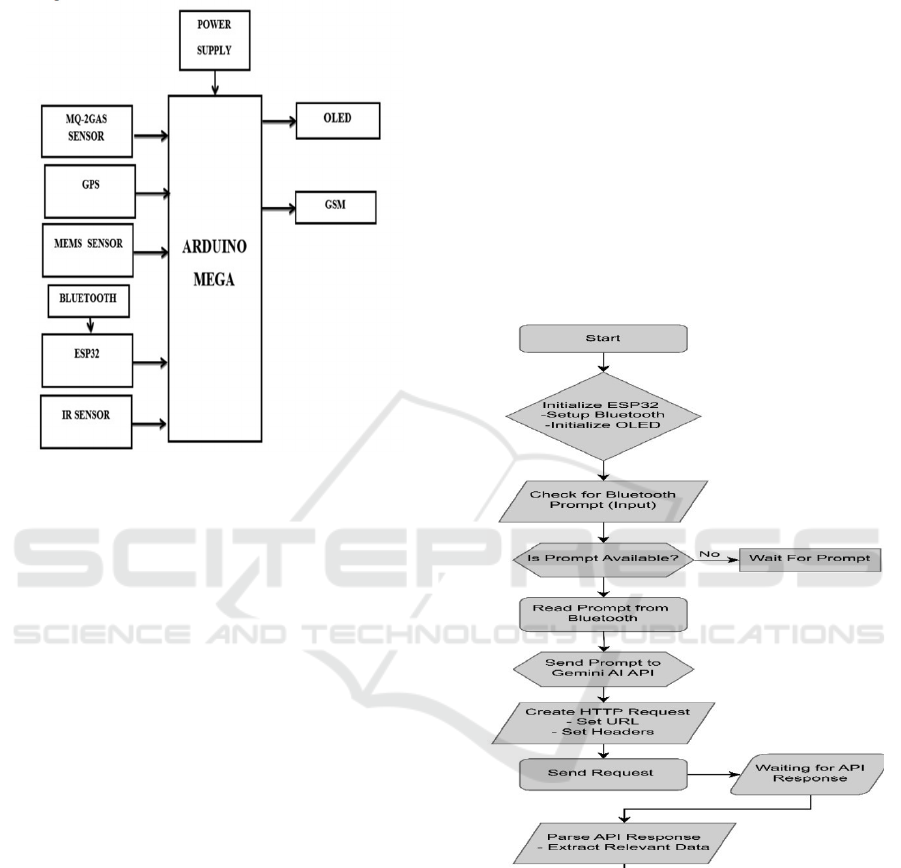
by analyzing the rider’s breath, sending alerts if
intoxication is detected to discourage impaired
driving.
Figure 1: System Architecture.
The system also features Bluetooth for wireless
smartphone connectivity, Wi-Fi for cloud-based AI
communication, and V2X (Vehicle-to-Everything)
integration to facilitate data exchange with smart
traffic infrastructure and nearby vehicles, enabling
proactive hazard avoidance. The system operates
seamlessly through an automated workflow. When
the rider puts on the helmet, the IR sensor verifies
compliance
and activates the system. The rider
inputs the destination
using voice commands or a
mobile app, allowing AI GEMINI
to retrieve live
navigation data. The AR display then projects real-
time directions onto the visor. Throughout the ride,
the system continuously monitors safety
parameters, issuing alerts for helmet non-
compliance or alcohol detection. In the event of an
accident, the MEMS sensor detects the impact,
triggering the GPS module to acquire location
coordinates and automatically send an emergency
alert via the GSM module. The helmet also syncs
with traffic networks for live updates and supports
hands-free calls and navigation through Bluetooth.
To optimize power usage, an automatic shutdown
feature deactivates the system when the helmet is
removed. This AI-driven smart helmet architecture
offers hands-free navigation, proactive hazard
detection, intelligent connectivity with smart road
systems, automated emergency response, and an
intuitive A R -assisted
interface.
By integrating
state-of-the-art sensors, wireless communication,
and artificial intelligence, this system
revolutionizes road safety, significantly reducing
accident risks and making two- wheeler travel safer
and more efficient.
5.1 AI Gemini Server
Figure 2 shows an ESP32-based mechanism is
designed to interact with the Gemini AI API. The
process begins with setting up the ESP32,
activating Bluetooth, and turning on an OLED
display. The system listens for Bluetooth signals
and, upon detecting a prompt, captures the input,
forwards it to the Gemini AI API through an HTTP
request with appropriate headers and URL, and
awaits a response.
Figure 2: AI Gemini Sever.
After receiving the reply, it parses the data to
extract the required details. This cycle operates
continuously, ensuring real-time processing of
Bluetooth commands.
5.2 AI Gemini Server to Display
The flowchart showcases the working mechanism
of an ESP32-powered system that engages with the
Gemini AI API. It initiates by booting up the
ESP32 microcontroller, setting up Bluetooth
ICRDICCT‘25 2025 - INTERNATIONAL CONFERENCE ON RESEARCH AND DEVELOPMENT IN INFORMATION,
COMMUNICATION, AND COMPUTING TECHNOLOGIES
666
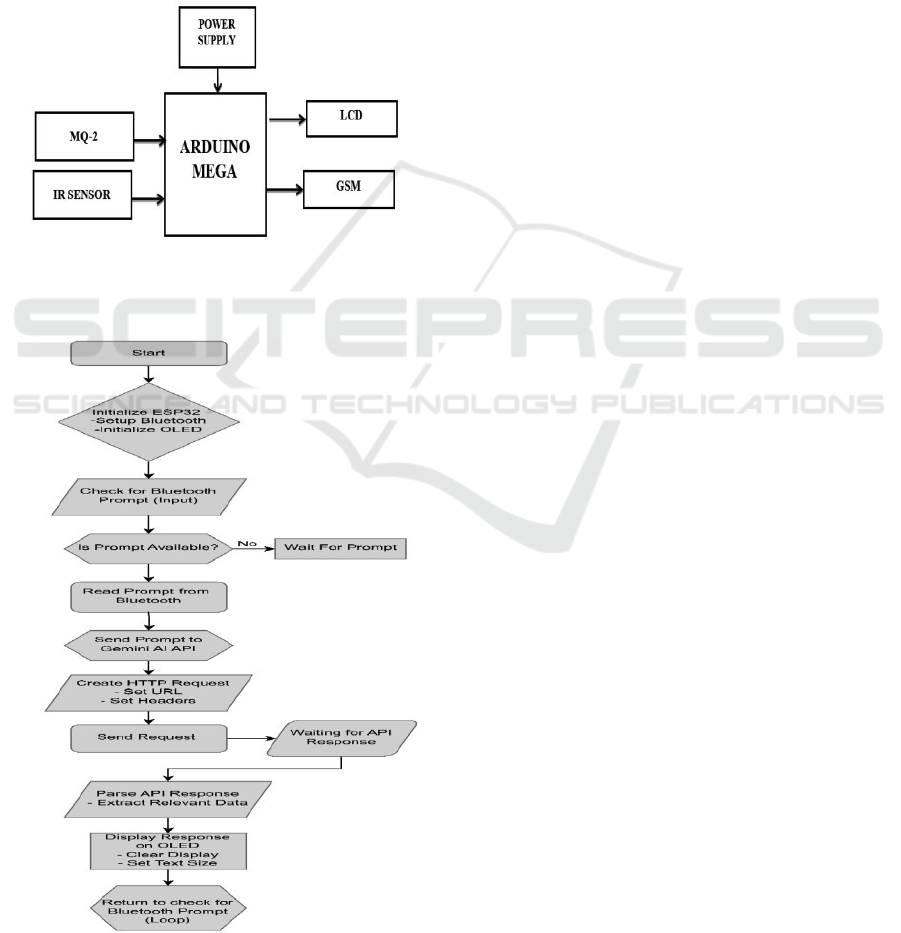
connections, and configuring an OLED display.
The system persistently scans for Bluetooth signals
and, upon detecting a promptreads its content and
forwards it
to the Gemini AI API. An HTTP request
is generated with the
necessary headers and URL,
then sent to the API. After receiving the API’s
response, the system processes the data,
extracts
relevant details, and displays them on the OLED
screen. The display is cleared, and text settings are
adjusted before the system returns to scanning for
new prompts, ensuring a continuous cycle of
communication with the Gemini AI API. Figure 3
shows the AI gemini server to display.
Figure 3: AI Gemini Server to Display.
5.3 Alcohol and Proximity Sensor Working
Figure 4: Alcohol and Proximity Sensor Working.
Utilizing an Arduino Mega microcontroller,
this system integrates sensors to promote safer
driving conditions. The MQ-2 gas sensor identifies
alcohol
intake in the driver, while the IR sensor
checks for proper
helmet usage. If any safety
violations occur, the GSM module
sends instant
warnings to the user. This setup strengthens road
safety by enforcing crucial driving regulations.
Figure 4 shows the Alcohol and Proximity Sensor
Working.
5.4 Accident Detection and Alert
An Arduino Mega-based system utilizes sensors,
including a MEMS sensor, to identify accidents.
Upon detection, the gyroscope signals the GPS to
acquire location data, and the Arduino relays an
alert through GSM to emergency contacts. By
enabling rapid response in critical situations, this
technology significantly enhances accident
management and safety.
6 WORKING PRINCIPLE
The Arduino Mega acts as the central intelligence
of this project, coordinating key functions.
Working alongside the AI GEMINI kit, it
processes and transfers navigation data. This
information is relayed to the main controller, which
then wirelessly sends it to a designated display unit
for the driver's convenience. A MEMS sensor is
linked to the main controller, detecting angular
shifts and serving as a critical safety feature. When
an accident is detected, the system recognizes the
change in position and automatically retrieves GPS
coordinates, sending them via GSM to emergency
contacts for immediate assistance. To prevent
reckless driving, an alcohol detection sensor is
integrated. If alcohol consumption is identified, an
automatic alert is dispatched to designated contacts
via SMS, enhancing precautionary measures. An
IR sensor is also employed to check for helmet
usage. If the driver is not wearing a helmet
properly, the system promptly notifies them. The
OLED display provides real-time updates,
ensuring the user has constant access to necessary
information. Through the fusion of sensor
technologies, artificial intelligence, and wireless
connectivity, this system serves as an innovative
solution to boost road safety, lower accident risks,
and enforce responsible driving behavior.
AI-Enhanced Smart Helmet for Navigation, AR Integration and Road Safety
667
7 RESULTS
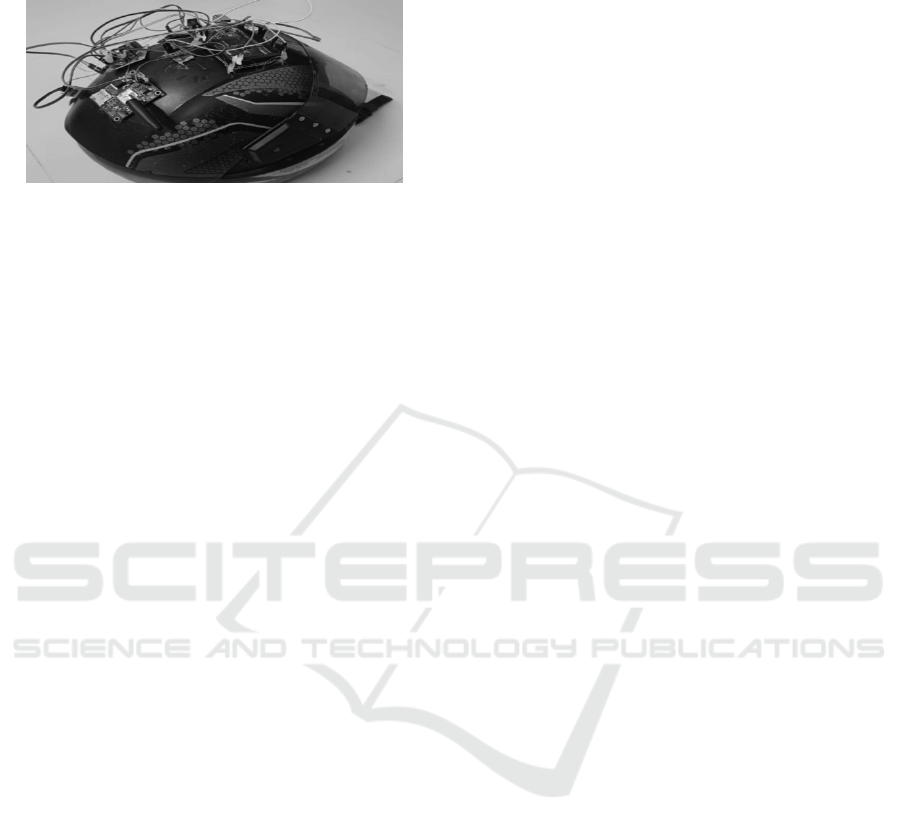
Figure 5: Hardware Implementation.
Figure 5 shows the hardware implementation.
8 FUTURE SCOPE
By leveraging machine learning advancements, the
system can refine its ability to analyze driver
behavior, enabling a highly personalized and
adaptive navigation experience. The integration of
Vehicle-to-Everything (V2X) technology will
allow vehicles to communicate with their
surroundings, offering real-time traffic updates,
hazard alerts, and collaboratively optimized routes
for greater efficiency and
safety. Future
developments could also introduce holographic
display technology or wearable AR devices,
eliminating the need for fixed screens and reducing
driver distractions. As autonomous vehicle
technology continues to progress, the system can
seamlessly integrate with self-driving cars,
providing an intuitive interface for passenger
interaction. Additionally, collaboration with smart
city infrastructure
such as AI-driven traffic signals,
connected road signage, and
automated parking
systems will further enhance navigation, road
safety, and transportation efficiency, ultimately
fostering a smarter and more connected mobility
ecosystem.
9 CONCLUSIONS
The automotive industry is increasingly reliant on
advanced digital technologies, yet navigation
advancements have raised concerns about driver
distraction. To resolve this issue, an innovative
project leverages augmented reality (AR) to
provide real-time navigation assistance. The
system gathers navigational inputs from the AI
GEMINI server, processes them through the main
controller, and displays relevant guidance within
the driver’s immediate view. By directly integrating
navigation overlays into the diver’s visual field.
AR
minimizes distractions and enhances road
awareness. This improvement not only elevates
driving convenience but also plays a key role in
reducing accident rates. Additionally, the inclusion
of an accident alert system further strengthens road
safety, redefining how drivers interact with
navigation for a more secure journey.
REFERENCES
H. Ko, B. Kim, and S.-H. Kong, “GNSS multipath- resistant
cooperative navigation in urban vehicular network,
“IEEE Trans. Veh. Technol., vol.64, no. 12, pp. 5450-
5463.2015.
H. Min, X. Wu, C. Cheng, and X. Zhao, “Kinematic and
dynamic vehicle model-assisted global positioning
method for autonomous vehicles with low-cost
GPS/camera/in-Vechicle sensors,’ IEEE Sensors J.,
vol.19, no. 24, pp. 1/24, Jan. 2019.
J. Raquet and R. K. Martin, “Non-GNSS radio frequency
navigation,” in Proc. IEEE Int. Conf. Acoust., Speech
Signal Process., Mar. 2008, pp. 5308–5311.
L. Chang, X. Niu, T. Liu, J. Tang, and C. Qian,
“GNSS/INS/LiDARSLAM integrated navigation
system based on graph optimization, “Remote Sens.,
vol. 11, no, 9, p. 1009, Apr. 2019.
M. Li and A. I. Mourikis, “High -precision, consistent EKF-
based visualinertial odometry,” Int. J. Robot. Res., vol.
32, no. 6, pp. 690/711, May 2013.
P. Thevenon et al., “Positioning using mobile TV based on
the DVB-SH standard,” Navigation, vol. 58, no. 2, pp.
71–90, Jun. 2011
S.-H. Fang, J.-C. Chen, H.-R. Huang, and T.-N. Lin, “Is FM
a RF-based positioning solution in a metropolitan- scale
environment? A probabilistic approach with radio
measurements analysis,” IEEE Trans. Broadcast.,vol.
55, no. 3, pp. 577–588, Sep. 2009.
X. Chen and Y. Mortan, “Iterative subspace alternating
projection method for GNSS multipath DOA
estimation,” IET Radar, Sonar Navigat., vol. 10, no. 7,
pp. 1260/1269, Aug. 2016.
Z. M. Kassas, “Collaborative opportunistic navigation,”
IEEE Aerosp. Electron. Syst. Mag., vol. 28, no. 6, pp.
38–41, Jun. 2013.
Z. M. Kassas, “Analysis and synthesis of collaborative
opportunistic navigation systems,” Ph.D. dissertation,
Dept. Elect. Comput. Eng., Univ. Texas Austin, Austin,
TX, USA, 2014.
ICRDICCT‘25 2025 - INTERNATIONAL CONFERENCE ON RESEARCH AND DEVELOPMENT IN INFORMATION,
COMMUNICATION, AND COMPUTING TECHNOLOGIES
668
