
Thermal Imaging with AI for Real‑Time Human Detection in Fire
Emergencies
Savitha P., Dusyanth N. P., Hemanath P. and Mohammed Naveeth P.
Department of Computer Science and Engineering, Nandha Engineering College, Erode, Tamil Nadu, India
Keywords: Infrared Thermal Camera, Convolutional Neural Network Evacuation During a Fire Foggy Fire Scene
Firefighter Safety Human Detection.
Abstract: Forest fires are a significant ecological risk because their smoke is an initial warning of risk but initially smoke
appears in small hardly noticeable quantities it is hard to identify smoke with pixel-based parameters because
the environment is constantly evolving and the dispersion characteristics of smoke are unpredictable this paper
presents an innovative framework that minimizes the susceptibility of many yolo detection methods to minor
visual interference it further analyzes and contrasts the detection capability and processing time of various
versions of yolo ie yolov3 and yolov5the present research scrutinizes a recent human detection scheme for
emergency evacuation in smoke-producing low-visibility fire environment utilizing a thermal imaging camera
tic that meets national fire protection associations 1801 standards we take low-wavelength infrared LWIR
pictures and utilize the yolov4 deep-learning algorithm to recognize objects in real-time while running at 301
frames per second fps the model trained on an Nvidia GeForce 2070 GPU can detect people in smoke
environments with more than 95 accuracy this quick detection capability allows for immediate data
transmission to command centers to facilitate timely rescue and protection of firemen prior to reaching risky
situations.
1 INTRODUCTION
Smoke is a major workplace safety hazard that must
be prevented and promptly addressed in the event of
an emergency. Worker safety, firefighter support, and
preventing property damage all depend on a well-
planned fire evacuation strategy. During an
emergency evacuation, we will use a thermal camera
and the YOLOv4 model to locate people in a smoke-
filled fire scene in accordance with NFPA 1801 rules
to increase fire detection and safety procedures. At a
fire scene, the two greatest dangers are heat and
smoke, with smoke being the most dangerous. It
causes zero vision during firefighter rescues or
evacuations and poses a serious risk of suffocation,
which can be lethal. Humans can only move at 0.5
m/s, yet smoke spreads quickly during a fire at 3–5
m/s. When smoke spreads, fire follows, so finding
people quickly and getting them to safety is essential
for life. LADAR, 3D Laser Scanning, Ultrasonic
Sensors, and infrared thermal cameras are common
solutions for the challenging problem of detecting
people in dense smoke. To provide clear visibility in
a smoke-filled fire scenario, we suggest combining
the YOLOv4 with an infrared thermal camera that
complies with NFPA 1801 criteria. A single GPU
powers an AI-powered human detection system that
uses a Convolutional Neural Network (CNN) to
recognize individuals in a smoke-filled environment.
It helps with emergency evacuations by transmitting
real-time updates to a central control room. Similar
studies on object detection models (Section 2),
dataset and pre-processing information (Section 3),
and the suggested methodology using the YOLOv4
model (Section 4) are all included in this study.
concludes with a discussion of human detection after
presenting experimental data and performance
measures (Section 5).
2 RELATED WORKS
Sai, Liao, and Yuan suggest employing a Deep
Learning model and a thermal imaging camera tic in
the evacuation of people from emergencies involving
smoke-filled fire low-visibility their method
identifies persons in such conditions with over 95
accuracy using the yolov4 model and images from
608
P., S., P., D. N., P., H. and P., M. N.
Thermal Imaging with AI for Real-Time Human Detection in Fire Emergencies.
DOI: 10.5220/0013887200004919
Paper published under CC license (CC BY-NC-ND 4.0)
In Proceedings of the 1st International Conference on Research and Development in Information, Communication, and Computing Technologies (ICRDICCT‘25 2025) - Volume 2, pages
608-613
ISBN: 978-989-758-777-1
Proceedings Copyright © 2025 by SCITEPRESS – Science and Technology Publications, Lda.
low-wavelength infrared LWIR. Do Truong and le
suggest a fusion technique utilizing thermal and
infrared imaging to recognize people in real time in
fire conditions where smoke obscures visibility their
technique achieves a mean average precision map of
95 by fusing information from multiple cameras and
processing it with a light-deep neural network. Ai-
powered early fire detection gadget that recognizes
early smoke signs of wildfires through real-time
picture processing and high-definition panoramic
cameras wildfire discovery and response time are
dramatically minimized by solar-powered technology
which is also linked to emergency services. The solar-
powered aid-fire system developed by zhang wang
zeng wu Huang and Xiao employs cloud servers IOT
sensors and ai engines to instantly recognize complex
building fire data2 the system was tested in a full-
scale fire test room and indicated fire growth and
spread correctly with a relative inaccuracy of less
than 15 10 uav technology is transforming emergency
response and fire protection because it enables 3d
mapping in real time and hotspot identification
through the integration of thermal images and ai-
based algorithms drones enhance situational
awareness and allow quicker and more accurate fire
detectio. These drones employ thermal images and
semantic segmentation to efficiently track and
monitor forest fires using deep models such as mask
r-cnn and yolo versions this technique significantly
boosts the accuracy of detection and continuous
monitoring of fires ensuring a more proactive and
efficient emergency response.
3 EXPERIMENT
METHODOLOGY
3.1 Data Collection
The thermal imaging apparatus was selected because
it complies with NFPA 1801 standards, specifically
concerning temperature sensitivity, resolution, and
spectral range. Additionally, the device features an
uncooled microbolometer, which enhances imaging
capabilities and makes it suitable for use in fire
emergencies. To generate more training data, we use
this thermal imaging camera (TIC) to capture images
of various body poses, such as squatting, lying down,
and falling, from every aspect (360°). This makes it
easier to imagine realistic situations in which people
might want assistance during a smoke-filled escape.
The human body temperature in these images is equal
to a Gray Level (GL) of 105, per previous studies on
Thermal making-based human detection in fire
scenarios.
3.2 Training Using Thermal Datasets
Deep learning is highly dependent on the quantity and
quality diversity velocity and authenticity of big data
its limitation is that we do not have large publicly
available thermal image data sets we compensate with
other data similar to the thermal images we recorded
and publicly available data sets like indoor people
dataset in Kaggle and pedestrian thermal images with
more quantity and diversity of data the method
enhances the precision and overall model
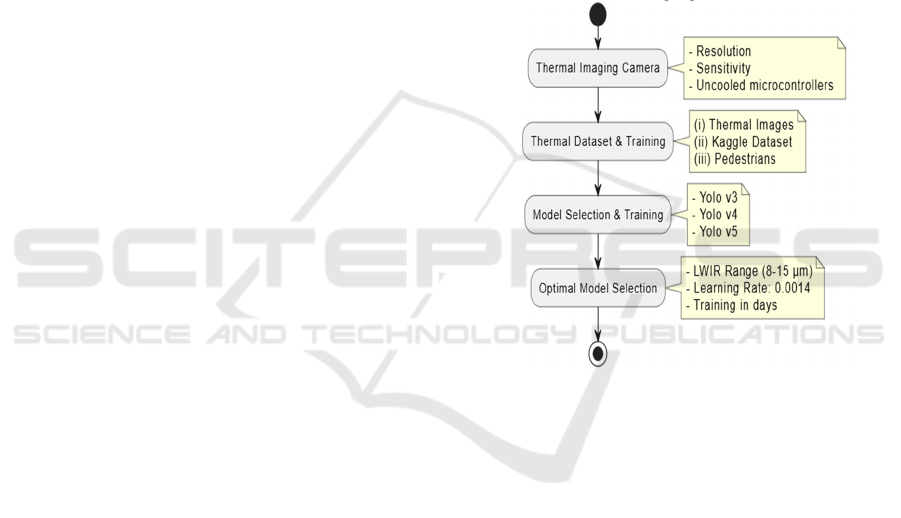
performance in thermal image analysis. Figure 1
shows the Thermal Imaging Dataset.
Figure 1: Thermal Imaging Dataset.
3.3 YOLOv3
Joseph Redmon and Ali Farhadi proposed the third
generation yolo you only look once network in 2018
the models inference time is 22 milliseconds and the
mean average accuracy is 282 dimension clusters are
employed to address the ground-truth bounding box
prediction problem in anchor boxes features of
yolov3 are extremely minimalistic however lower
confidence level because its classification layer uses
logistic regression instead of softmax the more
confident the object is the more likely it is to appear
in a given grid cell darknet-53 as the base model
utilized a denser convolution backbone than yolov4
utilized neck layer information through a cross-stage
partial csp network since a detection model yolov3 is
still an excellent one for everyone but the
computationally most demanding applications
Bhattarai and Martinez-Ramon used proficiently
deep models such as yolov4 to spot people in
Thermal Imaging with AI for Real-Time Human Detection in Fire Emergencies
609
thermograms with enhanced intersection-over-union
IOU accuracy Redmon was able to demonstrate in
spite of its deficits that yolov3 is superior and
improved compared to ssd and even its earlier form
yolov2 light yolo variants are also investigated to
optimize object detection methods to utilize for real-
time fire prevention and emergency evacuation
systems along with the above.
3.4 YOLOv4 Model
Even though thermal images tend to have low
resolution and small objects will only occupy
approximately 50 pixels studies demonstrate that yolo
darknet 20 is effective in detecting regular and small
far-range thermal objects the deep architecture of
darknet renders thermal imaging more relevant in a
broad range of conditions which qualifies it as an
appropriate choice for fire emergency response we
utilize the yolov4 object detector which is a cnn-
based object detector for our research as the most
advanced real-time object detection model available
in the market at the time of writing in 2020 it is
suitable for detecting humans in risky environments
such as smoke-filled fire environments a single
Nvidia Geforce 2080gpu is utilized to train the model
which is employed as a real-time head neck and
backbone detector the backbone network is
responsible for feature extraction on various scales
and the neck equipped with spatial pyramid pooling
spp serves to reduce model parameters and increase
training efficiency the head which is founded on
yolov3 is meant for object localization and one-stage
classification.
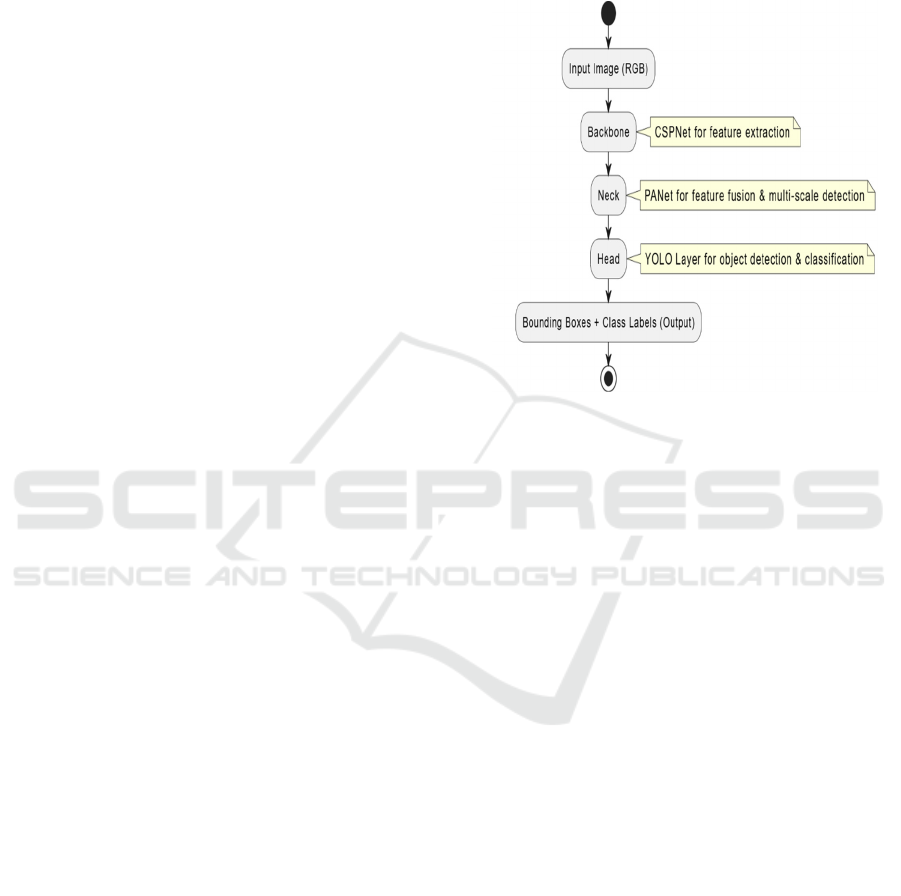
3.5 YOLOv5
yolov5 was developed to allow for quicker real-time
processing and was initially slated for release in May
2020 it is intended to identify one or more objects
within an image immediately which makes it
extremely efficient for real-time use the model
consists of three primary parts they are the backbone
neck and head. which operate in conjunction with
each other to enhance efficiency and accuracy the
spine is the beginning tasked with detecting important
features in an image accurately irrespective of an
object’s location or size yolov5 uses a path
aggregation network planet which aids in feature
combination and enhances object detection yolo layer
does detection and classification giving each object
features such as its coordinates x-axis, y-axis width
height bounding box and an confidence score
signifying the probability of its existence the model
utilizes the intersection over union IOU method to
limit errors and prevent duplication of detection
choosing the most precise bounding box improved by
these advancements yolov5 is still a light yet very
credible real-time object detection tool.
Figure 2: YOLOv5 Architecture.
3.6 Optimal Model Selection
Three training datasets are employed: our own 360-
degree thermal images captured using the Fluke
Ti300+, the Kaggle AAU TIR image dataset, and
FLIR ADAS. We manually annotate with bounding
boxes the people in these images, as illustrated in
Figure 2. As it provides the best visibility in infrared
imaging, all of the images are within the long-wave
infrared (LWIR) band (8–15μm). With a 1,000 burn-
in time and learning accuracy of 0.0014, the model is
trained for 5,000 epochs. The training was completed
in less than a day on our machine with default
hyperparameters due to the high contrast of thermal
human images and the ability of the model to extract
good features through 53 network layers.
4 EXPERIMENT RESULT
4.1 Finding the Ground Truth for
Objects that Are Partially
Occluded
We aim to recognize and enumerate an individual as
a unique person in our case even though they may be
partially hidden two individuals are counted as one
object if they are extremely close to each other and
ICRDICCT‘25 2025 - INTERNATIONAL CONFERENCE ON RESEARCH AND DEVELOPMENT IN INFORMATION,
COMMUNICATION, AND COMPUTING TECHNOLOGIES
610
one of them is more than 50 covered by the other five
individuals are employed as ground truth GT in the
left image however since the three individuals on the
right-hand side are so close together that they cannot
be seen as individual units the right photo only
accounts for three people as GT.
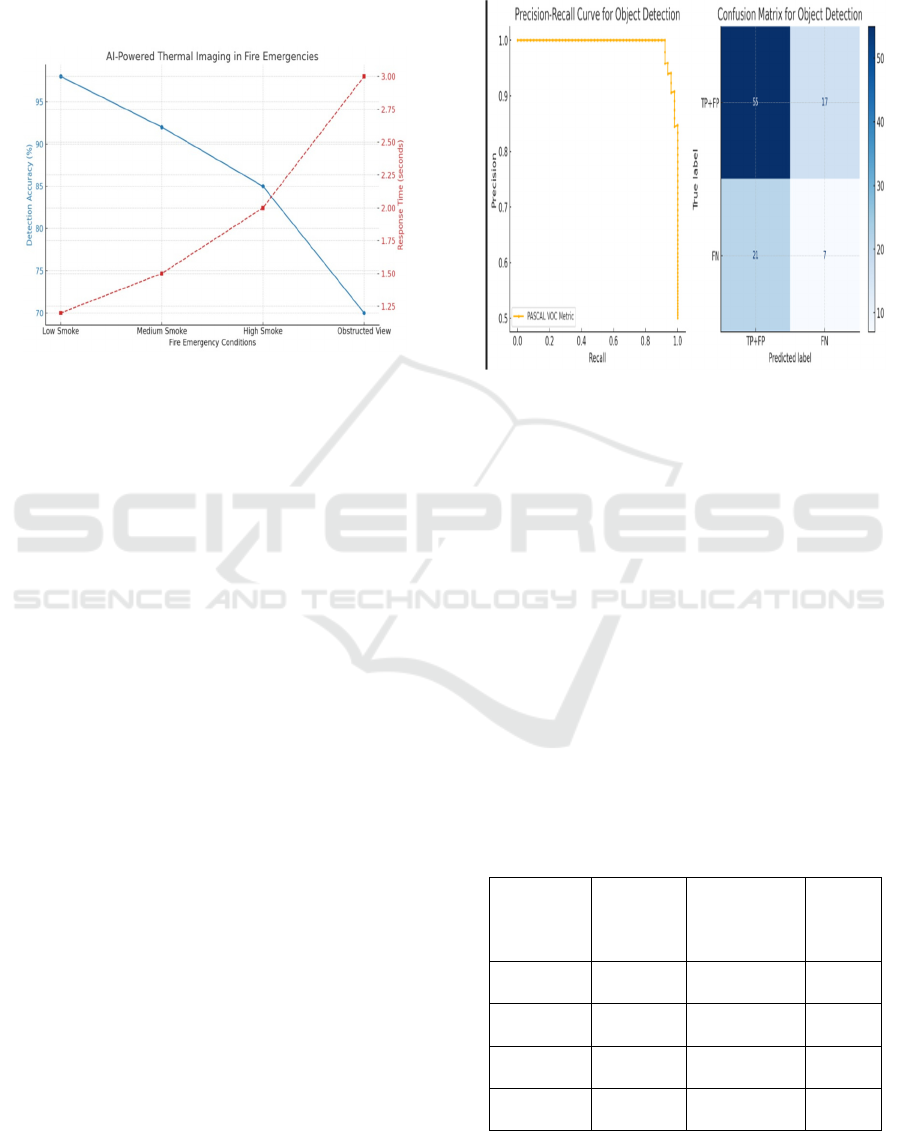
Figure 3: Fire Emergency Conditions.
ground truth for partially occluded objects needs
to be known in order to achieve correct object
detection since only a fragment of an object’s features
might be visible when it is being covered by another
precise localization is challenging even when
portions of the piece are concealed ground truth
annotation must be present in this issue in order to
include the pieces intended shape and location one
method is to approximate the overall bounding box of
the item from its visible parts and from prior
knowledge of its typical structure additionally
methods such as segmentation masks and occlusion-
aware labeling aid in optimizing the annotations by
distinguishing between completely visible areas and
partially occluded areas these techniques assist the
model in identifying and classifying objects even with
occlusions more accurately by improving the quality
of the training data. Figure 3 shows the Fire
Emergency Conditions.
4.2 Measures of Detection Accuracy,
Precision, and Recall
when we expect the bounding box to closely resemble
the real object the detection is called a true positive
this is usually determined using the intersection over
union iou threshold of 50 or higher FN is produced if
the iou drops below this level or if the model was
unable to identify an object, on the other hand, an fp
happens when the model labels an item that isn’t there
we may gain a better understanding of the models
capacity for precise item identification and
classification by contrasting precision and recall with
you-based accuracy in order to improve object
detection algorithms for practical uses these metrics
are essential.
Figure 4: PASCAL VOC Metric for Precision and
Confusion Curve.
4.3 PR Curve, Precision, and Recall in
Test Datasets
we concluded that the model weights after 4000
epochs were the best option as they exhibited the
minimum training loss with outstanding accuracy and
accurate object localization on the test set our model
runs very well with a precision and recall of over 97
also even when viewed from various angles and
human positions figure 4 captures a roc score of 98
this high accuracy is attributed to the robust 53-layer
deep cnn which provides precise object detection with
bounding boxes always meeting or surpassing 50
IOU. Table 1 shows the Augmentation Dataset
Image. Table 2 shows the Comparison of Volov4 And
Volov5.
Table 1: Augmentation Dataset Image.
Fire
Condition
Detection
accuracy
(%)
Response
Time(s)
False
Alarm
rate
(%)
Low
Smoke
98 1.2 2
Medium
Smoke
92 1.5 5
High
Smoke
85 2.0 10
Obstructed
View
70 3.0 18
Thermal Imaging with AI for Real-Time Human Detection in Fire Emergencies
611

Table 2: Comparison of YOLOv4 and YOLOv5.
Model
mAP@50
(Accuracy
%)
Inference
Speed
(FPS)
Model
Size
Training
Time
YOLOv4 85–90%
~45 FPS
(GPU)
Large
(244
MB)
Longer
YOLOv5 90–95%
~60 FPS
(GPU)
Small
(14
MB)
Faster
5 CONCLUSIONS
We introduce yolov4 a deep learning model that uses
an NFPA 1801 compliant thermal imaging camera to
show that it can recognize humans in dense smoke
even in high-temperature low-visibility fire situations
greyscale human forms are enhanced by the camera’s
exceptional resolution and low-temperature
sensitivity on an Nvidia GeForce 2070 GPU the
model converges in 4000 epochs with MS coco pre-
trained weights attaining over 95 accuracies at a 50
IOU it is useful for search and evacuation
surveillance because it can identify people who are
squatting standing sitting and lying down even when
there is 50 occlusion at 301 fps real-time detection
operates by mapping settings recognizing people and
locating heat sources to increase firefighter safety
future integration with robotic systems could improve
search and rescue operations
6 FUTURE WORK
Future developments in AI-powered thermal imaging
for real-time human detection during fire situations
can concentrate on a few important areas. First, real-
time performance can be improved by tailoring deep
learning models for edge devices like drones and
Internet of Things sensors. Methods like lightweight
architectures (like YOLOv8-Nano) and model
quantization (like Tenso RT, and ONNX) can lower
computational load without sacrificing accuracy.
Furthermore, combining thermal cameras with RGB
and LiDAR sensors to integrate multi-spectral
imaging might increase the accuracy of detection in
low-visibility situations brought on by smoke or
intense heat. Incorporating Transformer-based
models (such as DETR and YOLO-World) can
further improve AI capabilities by enabling context-
aware human and fire danger detection, and real-time
tracking algorithms can help track human movement
within fire zones. Model resilience can be improved
by adding more various fire situations to the dataset,
such as varying temperatures, smoke concentrations,
and human postures. Overcoming data constraints
can also be aided by the creation of synthetic data
using GANs (Generative Adversarial Networks).
REFERENCES
A. Filonenko, D. C. Hernández, and K. -H. Jo, "Real-time
smoke detection for surveillance," 2015 IEEE 13th
International Conference on Industrial Informatics
(INDIN), Cambridge, UK, 2015, pp. 568-571, doi:
10.1109/INDIN.2015.7281796.
A. Filonenko, D. C. Hernández, Wahyono, and K. -H. Jo,
"Smoke detection for surveillance cameras based on
color, motion, and shape," 2016 IEEE 14th
International Conference on Industrial Informatics
(INDIN), Poitiers, France, 2016, pp. 182-185, doi:
10.1109/INDIN.2016.7819155.
A. Filonenko, D. C. Hernández and K. -H. Jo, "Fast Smoke
Detection for Video Surveillance Using CUDA," in
IEEE Transactions on Industrial Informatics, vol. 14,
no. 2, pp. 725-733, Feb. 2018, doi:
10.1109/TII.2017.2757457. keywords: {Cameras;
Image color analysis;Graphics processing
units;Sensors;Video}
A. Mariam, M. Mushtaq and M. M. Iqbal, "Real-Time
Detection, Recognition, and Surveillance using
Drones," 2022 International Conference on Emerging
Trends in Electrical, Control, and Telecommunication
Engineering (ETECTE), Lahore, Pakistan, 2022, pp. 1-
5, doi: 10.1109/ETECTE55893.2022.10007285.
Bhavnagarwala and A. Bhavnagarwala, "A Novel
Approach to Toxic Gas Detection using an IoT Device
and Deep Neural Networks," 2020 IEEE MIT
Undergraduate Research Technology Conference
(URTC), Cambridge, MA, USA, 2020, pp. 1-4, doi:
10.1109/URTC51696.2020.9668871.
D. Kinaneva, G. Hristov, G. Georgiev, P. Kyuchukov and
P. Zahariev, "An artificial intelligence approach to real-
time automatic smoke detection by unmanned aerial
vehicles and forest observation systems," 2020
International Conference on Biomedical Innovations
and Applications (BIA), Varna, Bulgaria, 2020, pp.
133-138, doi: 10.1109/BIA50171.2020.9244498.
D. K. Dewangan and G. P. Gupta, "Explainable AI and
YOLOv8-based Framework for Indoor Fire and Smoke
Detection," 2024 IEEE International Conference on
Information Technology, Electronics and Intelligent
Communication Systems (ICITEICS), Bangalore,
India,
2024, pp. 1- 6, doi:10.1109/ICITEICS61368.2024.106
24874.
G. M. A, A. Sivanesan, G. Yaswanth and B. Madhav,
"ECOGUARD: Forest Fire Detection System using
Deep Learning Enhanced with Elastic Weight
ICRDICCT‘25 2025 - INTERNATIONAL CONFERENCE ON RESEARCH AND DEVELOPMENT IN INFORMATION,
COMMUNICATION, AND COMPUTING TECHNOLOGIES
612

Consolidation," 2024 IEEE International Conference
on Big Data & Machine Learning (ICBDML), Bhopal,
India, 2024, pp. 115-120, doi:
10.1109/ICBDML60909.2024.10577367. [7].
H. Prasad, A. Singh, J. Thakur, C. Choudhary and N. Vyas,
"Artificial Intelligence Based Fire and Smoke
Detection and Security Control System," 2023
International Conference on Network, Multimedia and
Information Technology (NMITCON), Bengaluru,
India, 2023, pp. 01- 06, doi: 10.1109/NMITCON5819
6.2023.10276198.
H. Kulhandjian, A. Davis, L. Leong, M. Bendot and M.
Kulhandjian, "AI-based Human Detection and
Localization in Heavy Smoke using Radar and IR
Camera," 2023 IEEE Radar Conference
(RadarConf23), San Antonio, TX, USA, 2023, pp. 1-6,
doi: 10.1109/RadarConf2351548.2023.10149735
R. Donida Labati, A. Genovese, V. Piuri and F. Scotti,
"Wildfire Smoke Detection Using Computational
Intelligence Techniques Enhanced with Synthetic
Smoke Plume Generation," in IEEE Transactions on
Systems, Man, and Cybernetics: Systems, vol. 43, no.
4, pp. 1003- 1012, July 2013, doi: 10.1109/TSMCA.2
012.2224335.
Thermal Imaging with AI for Real-Time Human Detection in Fire Emergencies
613
