
Enhancing Energy Efficiency and Data Rate in MIMO‑NOMA
Systems Based on Communication Deep Neural Networks for 6G
Communications
R. Poornima, S. Jayachitra, Ajay A., Dhivakar S., Indra Kumar U. and Jayasakthi S P
Department of ECE, K.S.R. College of Engineering, Tiruchengode, Namakkal, Tamil Nadu, India
Keywords: MIMO, Deep Learning, NOMA, Data Rate, Energy Efficiency.
Abstract: The emergence of 6G communication networks requires novel techniques to deliver massive connectivity
with high data rate, and enhanced energy efficiency, driving the future of communication systems. The
integration of Non-Orthogonal Multiple Access (NOMA) with Multiple-Input Multiple-Output (MIMO)
systems, offers a promising solution to enhance system energy efficiency and data rate. Rapidly changing
channel conditions and complex spatial structures degrade system performance and limit its applicability. To
address these restrictions, this article proposes a deep learning-based MIMO-NOMA framework that
maximizes data rate and energy efficiency. Specifically, we develop a novel Communication Deep Neural
Network (CDNN) architecture comprising multiple hidden layers and convolution layers. The deep learning
techniques such as, the CDNN framework uses training algorithms to solve the power allocation problem and
increase MIMO-NOMA's energy efficiency and data rate. Furthermore, simulation results demonstrate that
the suggested CDNN framework has better data rate and energy efficiency than the Secondary BS-aided
scheme, ᾳ- fairness aided based scheme, LSTM-NOMA based scheme and basic deep learning scheme. The
Secondary BS-aided scheme data rate mean is 2.4586, fairness aided based scheme mean is 2.4986, LSTM-
NOMA based scheme mean is 2.5343, deep learning scheme mean is 2.6571 and proposed CDNN scheme
data rate mean is 2.8514. So that proposed CDNN framework has higher energy efficiency and data rate than
compared to other regular methodologies.
1 INTRODUCTION
6G boasts significantly higher data rates, lower
latency, and massive connectivity compared to 5G
and 4G. Key technologies driving these
advancements include MIMO and millimeter-wave
communication, which also enhance capacity,
reliability, and scalability (Andrews et al. 2024).
MIMO employs multiple antennas at base stations to
improve cellular network uplink and downlink
performance. The MIMONOMA system further
boosts efficiency and data rates (Hoydis et al. 2024).
NOMA enables multiple clients to share the same
frequency resources using power domain
multiplexing. Combining NOMA with Orthogonal
Multiple Access (OMA) techniques yields enhanced
spectrum efficiency and high reliability, supporting
massive connectivity and outperforming OFDMA
(Chiu et al. 2025). For millimeter-wave massive
systems, a novel beam space concept for MIMO
minimizes the number of required frequency chains
without compromising performance (Wang et al.
2024). To enhance channel and signal estimation in
orthogonal frequency division multiplexing systems,
deep learning techniques are applied (Ye et al. 2024).
By incorporating Machine Learning (ML) concepts
into the wireless core and edge infrastructure, next-
generation wireless communication systems can
provide IoT devices with ultra-reliable, low-latency
interactions and ubiquitous connectivity, driven by
intelligent, data-driven capabilities (Chen et al. 2025).
600
Poornima, R., Jayachitra, S., A., A., S., D., U., I. K. and S P, J.
Enhancing Energy Efficiency and Data Rate in MIMO-NOMA Systems Based on Communication Deep Neural Networks for 6G Communications.
DOI: 10.5220/0013887100004919
Paper published under CC license (CC BY-NC-ND 4.0)
In Proceedings of the 1st International Conference on Research and Development in Information, Communication, and Computing Technologies (ICRDICCT‘25 2025) - Volume 2, pages
600-607
ISBN: 978-989-758-777-1
Proceedings Copyright © 2025 by SCITEPRESS – Science and Technology Publications, Lda.

2 RELATED WORKS
Over 200 articles in IEEE Xplore and 95 in
academia.edu have been published on MIMO-
NOMA system in past four years. To provide a deep
learning framework and optimize the MIMO-NOMA
system's energy efficiency and data rate after
thorough investigation. To achieve improved power
allocation performance for energy efficiency and data
rate optimization, the initial step is to merge deep
learning with MIMO-NOMA systems (Ding et al.
2024). The capacity gains achievable by MIMO-
NOMA over MIMO-OMA, showing that NOMA can
provide higher spectral efficiency and greater system
capacity than OMA (Zeng et al. 2024). To optimize
and enhance the performance of NOMA systems. By
applying deep learning, the paper aims to improve
key tasks such as signal detection, interference
cancellation, and channel estimation, ultimately
enhancing spectral efficiency and reducing bit error
rates (BER) in NOMA systems (Gui et al. 2024).
Downlink multiuser MIMO systems' NOMA, along
with improvements in beamforming, power
allocation, and user clustering, all of which are crucial
for enhancing system performance. The suggested
CDNN scheme's data rate cluster has a learning rate
of 0.002, 0.001, 0.01, 0.1 (Ali et al.2024). Maximum
data rate and energy efficiency are provided by a deep
learning-based NOMA system with MIMO (Huang et
al. 2024). LSTM based NOMA further develops
aggregate rate, diminishes idleness, and improves
power assignment. The framework accomplishes
total rate: 2.8 Gbps (17% higher than customary
NOMA) Inactivity decrease: 90% and Better
reasonableness for clients with powerless channels
(Huang et al. 2025). It is understood that NOMA is
important the contrast between two channel gains is
exceptionally huge. A crafty lattice precoding
calculation defeats the constraints of customary
NOMA in non-distinct channels by: Adjusting power
assignment in view of channel relationship.
Upgrading the aggregate rate by 13% contrasted with
regular NOMA. Further developing decency by
expanding major areas of strength for the rate (Saito
et al. 2024). The proposed calculation for force and
sub-transporter designation is gotten from the non-
raised power minimization under rate and sub-
transporter reservations, for which an ideal
arrangement is NP-hard. The proposed MIMO-
NOMA accomplishes 35% power productivity
improvement over OMA, 51% better range
productivity, 41% higher total rate than OMA (Tweed
et al. 2025).
From previous findings, it is concluded that
energy efficiency and data rate is increased. The aim
of the study is to further develop the data rate and
energy efficiency between CDNN and deep learning
approaches.
3 METHODOLOGY
Consider a standard downlink MIMO-NOMA system
consisting of a single base station with a uniform,
linear array of M antennas and D multi-antenna users.
Assume Rayleigh fading in the downlink channel.
Each user is equipped with Nr receiving antennas, and
it is assumed that the base station has no knowledge
of each user's individual channel. To adopt NOMA
principles in the MIMO system, users are randomly
grouped into M clusters, each containing N clients
(i.e., D = MN). The transmitted signals at the base
station can be represented by the equation (1)
Y = H s (1)
where H is a M × K precoding matrix, then s is further
formulated in equation (2) as
𝑠 =
𝛽1,1 𝑠1,1 + ⋯ 𝛽1,𝐾𝑠1,𝐾
⋮ ⋱ ⋮
𝛽𝐾,1𝑠𝐾,1 ⋯ 𝛽𝑀,𝐾𝑠𝑀,𝐾
𝑆1⋯
𝑆𝑀
(2)
Here, sM,K is the information carrying signal that
is received by the N-th client of the M-th cluster,
Where βi,j is a power allocation coefficient of
NOMA.
3.1 MIMO-NOMA System
A deep learning-based MIMO-NOMA system
integrates MIMO-NOMA system with Deep Neural
Network (DNN), leveraging cutting-edge deep
learning techniques to develop a method that
optimizes the sum of energy efficiency and data rate.
To enhance performance, a kernel-based
Communication Deep Neural Network (CDNN) is
designed to approximate the MIMO-NOMA system's
power allocation optimization problem. The base
station implements the trained CDNN, which assigns
a distinct power to each user. The characteristics of
the channel links and clients are used as input
features, without physically modeling the users in the
CDNN architecture. As a result, the training examples
incorporate information about client and channel
conditions, improving efficiency.
A proposed CDNN framework is used to estimate
the system, using different convolutional and well-
Enhancing Energy Efficiency and Data Rate in MIMO-NOMA Systems Based on Communication Deep Neural Networks for 6G
Communications
601
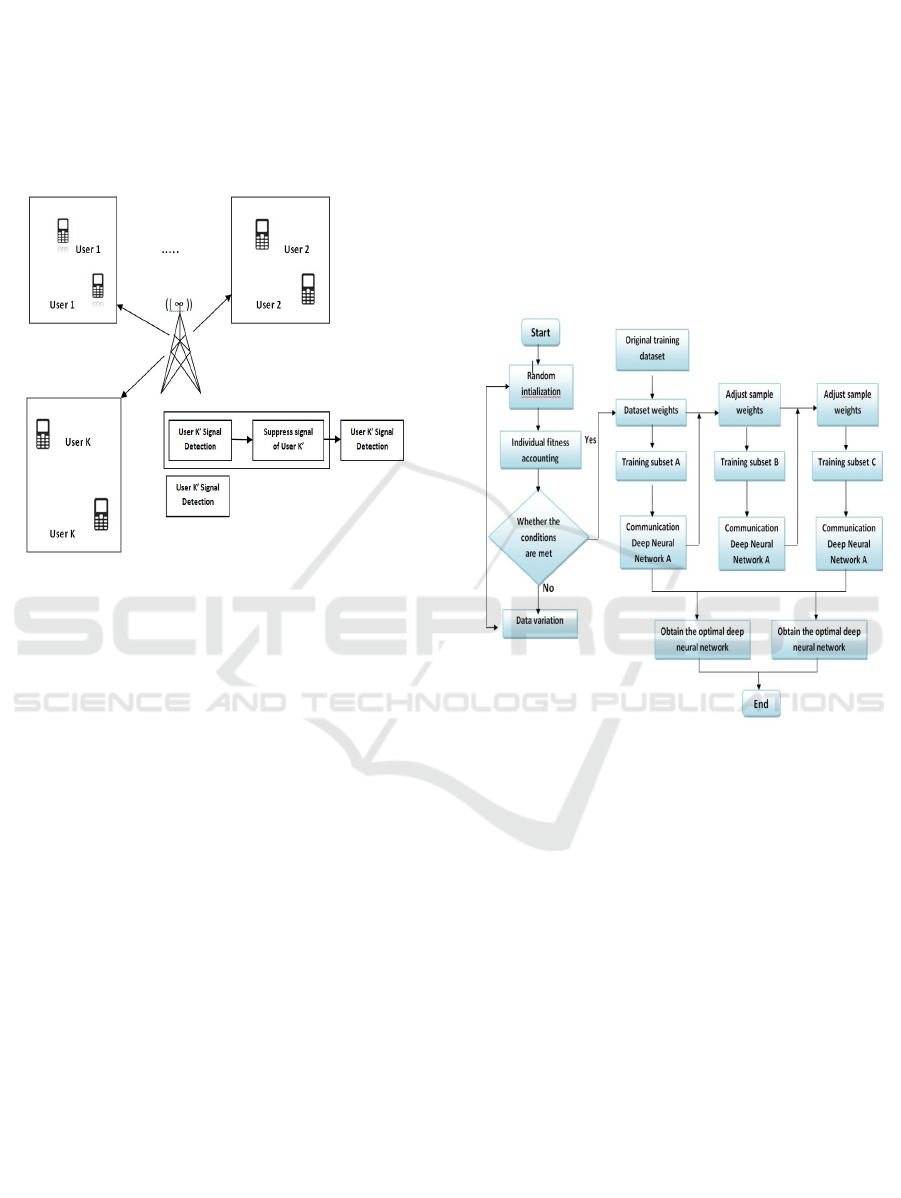
designed hidden layers (Fig.1.) that use certain
activation functions to compute. Moreover, from the
proposed CDNN structure, a new power distribution
strategy is presented for enhancing the energy
efficiency and data rate performance. The technique
can improve energy efficiency and data rate. Figure 1
shows the Multiple clusters of MIMO-NOMA
system.
Figure 1: Multiple Clusters of MIMO-NOMA System.
3.2 MIMO-NOMA System with Deep
Learning
The goal is to optimize the data rate and energy
efficiency of the MIMO-NOMA system. The data
rate of the N-th user in the first cluster is obtained in
this equation (3) and is represented by
𝐾1,𝑀= log
(1 +𝛾𝑁1,𝑀) (3)
The Figure 2 represents the workflow for
optimizing deep neural networks involves a multi-
step process data sampling, training subsets, and
fitness evaluation.
The process begins with the initialization step,
where random values are assigned to represent the
starting conditions of the algorithm. The fitness or
effectiveness of the current configuration is evaluated
based on specific criteria, such as model accuracy or
other performance metrics. A decision is made based
on whether predefined conditions are met. If these
conditions are not met, the system proceeds the data
for variation step, where adjustments are made to the
dataset or sampling method to improve performance.
If the conditions are met, the system progresses to the
next step.
The process starts with the original database,
which serves as the basis for creating subsets and
adjusting weights. The weights of the dataset are
adjusted to emphasize or de-emphasize specific
samples, allowing for better training of models on
critical data points. The dataset is split into multiple
subsets (e.g., A, B, C) with adjusted sample weights
to ensure diverse training. Each subset is used to train
separate deep neural networks. It evaluates each
trained network and identifies the optimal one based
on predefined criteria, such as accuracy, loss, or
generalization performance.
Figure 2: Flowchart of Deep Neural Network Optimization.
3.3 CDNN Based MIMO-NOMA
System Architecture
This framework (Figure 3) comprises 11
convolutional layers and a max-pooling layer along
with fully connected layers, the architecture is
denoted as (Conv, FC, MaxPool, S), where the
architecture comprises convolutional layers (Conv),
fully connected layers (FC), and max-pooling
operations (MaxPool) with specified strides (S).
Furthermore, the precoding matrix P is composed of
individual precoders for each antenna. The output
precoder, denoted as p
̄
m, along with its associated
power allocation factors, produces the optimal power
allocation results.
ICRDICCT‘25 2025 - INTERNATIONAL CONFERENCE ON RESEARCH AND DEVELOPMENT IN INFORMATION,
COMMUNICATION, AND COMPUTING TECHNOLOGIES
602
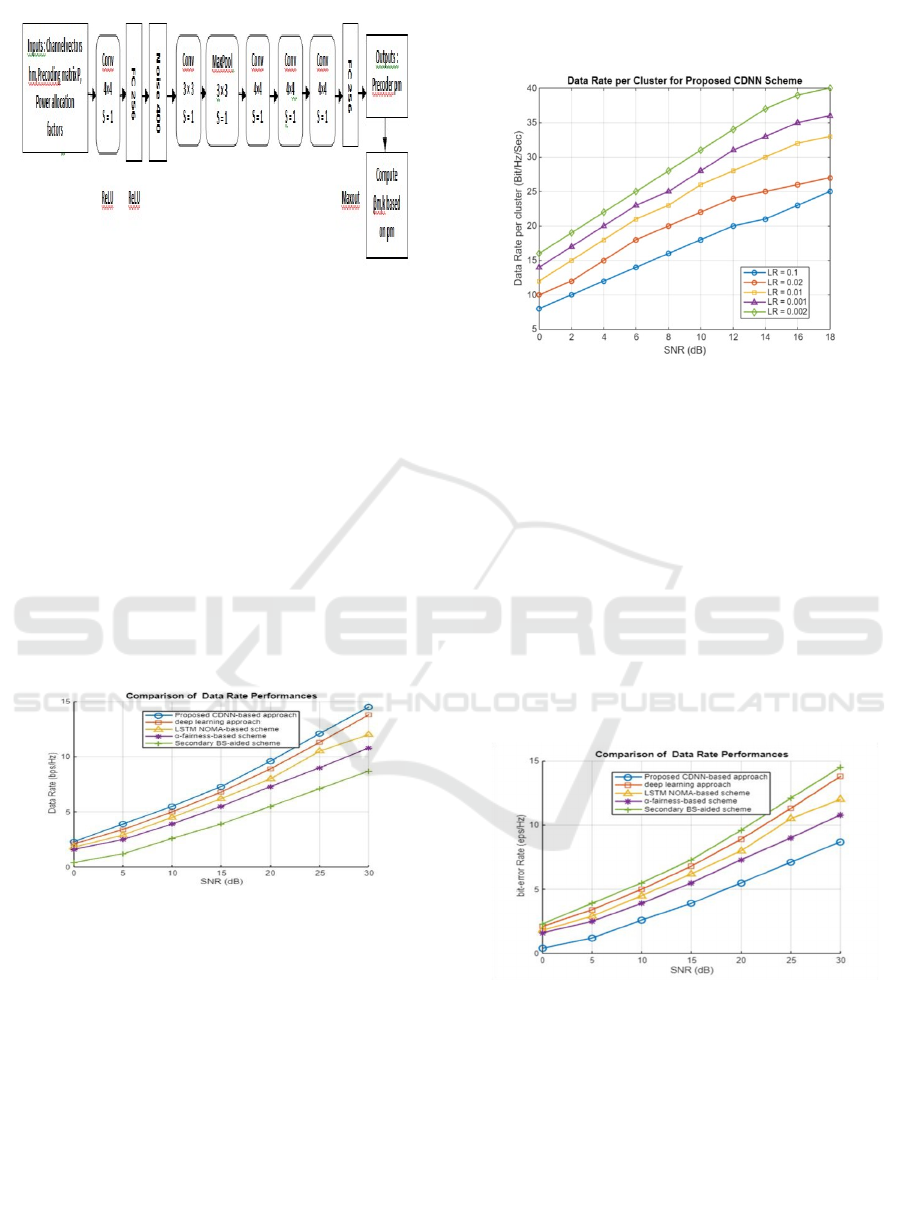
Figure 3: CDNN Based Deep Learning for Mimo- Noma
System.
4 SIMULATION RESULTS AND
ANALYSIS
The simulation was based on improving energy
efficiency and data rate using the communication
deep neural network method, and using
Communication toolbox includes simulink blocks in
MATLAB to plot the efficiency and data rate. The
Sample data was established based on previous study
results (Huang, Yang, et al., n.d.).
4.1 Comparison Data Rate with SNR
Figure 4: A Comparative Analysis of the Data Rate
Performances Is Presented, Evaluating the Proposed CDNN
Scheme Against Existing Approaches, Including the
LSTM-NOMA Based Scheme, Α-Fairness Based Scheme,
and Secondary Bs-Aided Scheme.
The Figure 4, compares data rate performances of
different approaches next to SNR (dB). The proposed
CDNN-based approach achieves the highest data rate,
followed by the deep learning approach and NOMA-
based LSTM scheme. The α-fairness based scheme
performs moderately, while the Secondary BS-aided
scheme has the lowest data rate.
4.2 Comparison Data Rate per Cluster
with SNR
Figure 5: Comparative Analysis of the Data Rate Per
Cluster with Different Learning Rates.
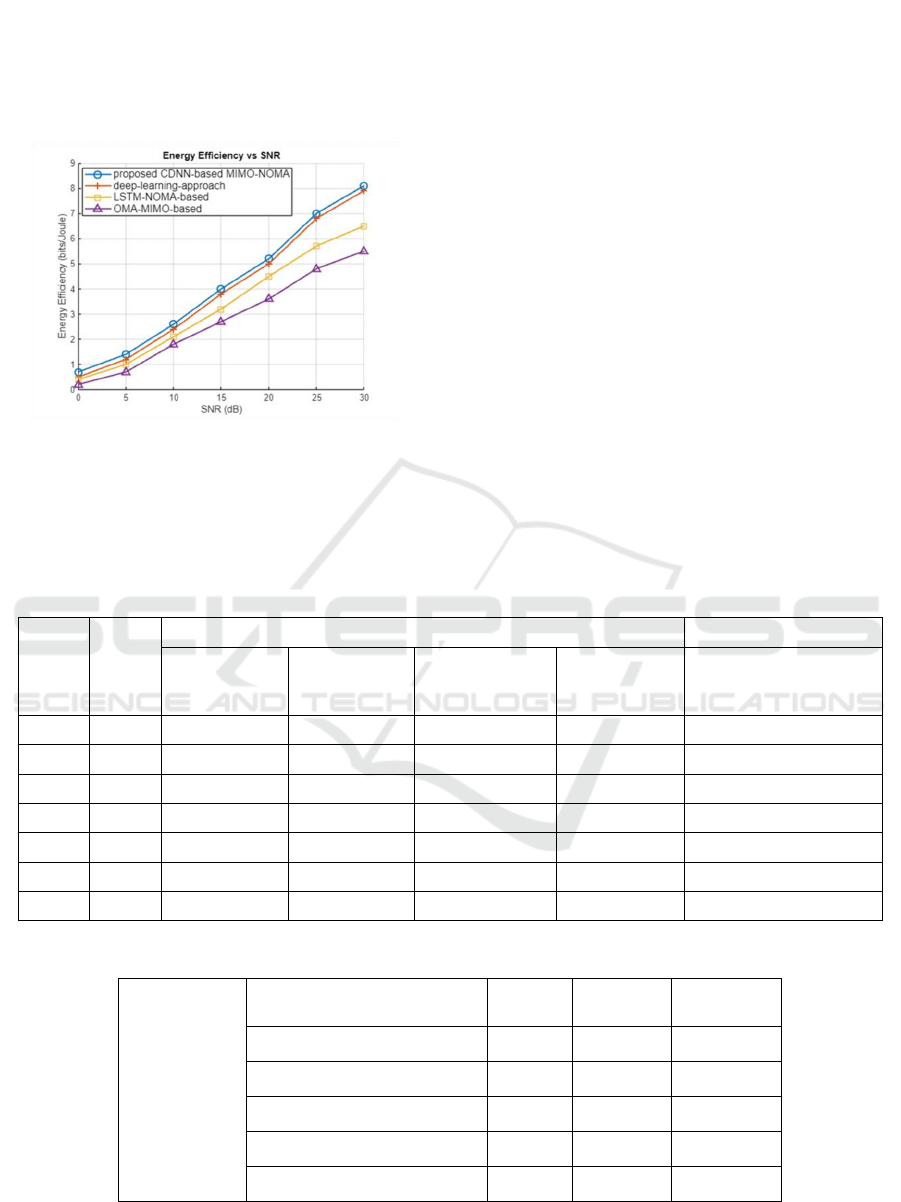
The Figure 5, Illustrates the data rate/cluster for
the future CDNN scheme with different learning rates
(LR). As SNR increases, the data rate also improves
for all learning rates. A lower learning rate (LR =
0.002) achieves the highest data rate, while a higher
learning rate (LR = 0.1) results in the lowest
performance. This suggests that smaller learning rates
enhance the model's efficiency in optimizing data
rate.
4.3 Comparison of BER with Signal to
Noise Ratio (SNR)
Figure 6: A Comparative Analysis of BER for Different
Snr.
The Figure 6 compares the data rate performance
of different approaches against SNR (dB) in terms of
bit-error rate (eps/Hz). The proposed CDNN-based
approach shows the lowest bit-error rate, indicating
superior performance. Other methods, such as deep
learning, LSTM-NOMA, αfairness, and Secondary
BS-aided schemes, have higher error rates. This
Enhancing Energy Efficiency and Data Rate in MIMO-NOMA Systems Based on Communication Deep Neural Networks for 6G
Communications
603
suggests that CDNN-based optimization is more
efficient in improving data rate performance.
4.4 Comparison Energy Efficiency with
SNR
Figure 7: A Comparison of Energy Efficiency Versus
Signal-To-Noise Ratio (SNR) Is Presented for the Proposed
CDNN-Based MIMO-NOMA Scheme, the LSTM-NOMA
Based Scheme, and the Conventional OMA-MIMO Based
Scheme.
The Figure 7 compares energy efficiency
(bits/Joule) versus SNR (dB) for different
approaches. The proposed method (blue line)
achieves the highest energy efficiency, followed
closely by the deep-learning approach. NOMA based
LSTM and MIMO-based OMA methods perform
worse, with OMA-MIMO being the least efficient.
This indicates that CDNN-based optimization
enhances energy efficiency in wireless
communication.
5 STATISTICAL ANALYSIS
Data obtained from parameters such as SNR (dB) for
secondary BS-aided scheme, fairness-based scheme,
LSTM-NOMA based scheme, deep learning scheme,
and proposed CDNN scheme are analyzed using
SPSS version 26.0 in Table 1. SPSS software is used
to calculate the group statistics and the independent
samples (Gui et al., n.d.). Independent variables for
the study are the number of Schemes while SNR
(dB)are dependent variables.
Table 1: Date Rate for Different Schemes.
S.
No
SNR
(dB)
Data Rate (Bits/Hertz)
Secondary BS
aided scheme
ᾳ-
-
fairness based
scheme
LSTM-
NOMA based
scheme
Deep learning
approach
Proposed
CDNN-based approach
1 0 0.4 1.6 1.8 2.1 2.3
2 5 1.2 2.5 2.9 3.4 3.9
3 10 2.6 3.9 4.5 5 5.5
4 15 3.9 5.5 6.2 6.8 7.3
5 20 5.5 7.3 8 8.9 9.6
6 25 7.1 9 10.5 11.3 12.1
7 30 8.7 10.8 12 13.8 14.5
Table 2: T-Test Comparison Means Data Rate Improvement of Proposed CDNN Scheme Approaches Other Schemes.
Data
rate
Scheme Mean
Std.
Dev
Std. Error of
Mean
Secondary BS-aided scheme 2.4586 0.32526 1.3433
ᾳ-fairness based scheme 2.4986 0.35569 1.3444
LSTM-NOMA based scheme 2.5343 0.38883 1.4696
Deep learning approach 2.6571 0.41097 1.5533
Proposed CDNN based scheme 2.8514 0.45481 1.7190
ICRDICCT‘25 2025 - INTERNATIONAL CONFERENCE ON RESEARCH AND DEVELOPMENT IN INFORMATION,
COMMUNICATION, AND COMPUTING TECHNOLOGIES
604

In Proposed CDNN based scheme the N is 7 and
mean value is 2.8514 and Std. deviation is 0.45481
and the Std.error mean is 1. 7190.It shows that
proposed CDNN has high data rate compared to
another scheme. Table 2 shows the T-Test
comparison means data rate improvement of
proposed CDNN scheme approaches other schemes.
Table 3 shows the Independent samples test. T-Test
comparison of, secondary BS-aided scheme, LSTM-
NOMA based
scheme, the fairness-based scheme and deep learning
with proposed CDNN based scheme. (p<0.05).
Table 3: Independent samples test. T-Test comparison of, secondary BS-aided scheme, LSTM-NOMA based scheme, the
fairness-based scheme and deep learning with proposed CDNN based scheme. (p<0.05).
Scheme Levene’s
Test F
Sig t df Sig
(2-
tailed)
Mean
Difference
Std. Error
Difference
95%
Confidence
Interval
(Lower)
95%
Confidence
Interval
(Upper)
Fairness
based
scheme
0.313 0.586 -
1.617
12 0.032 -0.35286 0.21823 -0.82833 0.12262
Equal
variances
not
assume
d
-
1.617
11.341 0.033 -0.35286 0.83141 -0.83141 0.12570
Secondary
based
scheme
0.014 0.907 -
1.287
12 0.022 -0.30286 0.23534 -0.81562 0.20991
Equal
variances
not
assume
d
-
1.287
11.946 0.023 -0.30286 0.23534 -0.81588 0.21016
LSTM-
NOMA
based
scheme
0.059 0.812 -
1.369
12 0.019 -0.31714 0.23168 -0.82194 0.18765
Equal
variances
not
assume
d
-
1.369
11.879 0.019 -0.31714 0.23168 -0.82251 0.18823
Deep
learning
rate
0.114 0.741 -
0.859
12 0.047 -0.19429 0.22616 -0.68705 0.29847
Equal
variances
not
assume
d
-
0.859
11.717 0.048 -0.19429 0.22616 -0.68837 0.29980
6 DISCUSSION
The proposed CDNN based scheme has better energy
efficiency and data rate than the Secondary BS-aided
scheme, fairness aided based scheme, NOMA based
LSTM scheme, deep learning-based scheme. The
corresponding changes in Std.error mean from 1.3433
to 1. 7190.The result obtained in the research are
having a high data rate compared to previous studies.
In cellular networks, MIMO technology employs
multiple antennas at the base station to enhance
communication in both the uplink and downlink
directions. The method increases the energy
efficiency and enhanced spectral (Hoydis, ten Brink,
and Debbah, n.d.). Through power domain
multiplexing, the non-orthogonal multiple access
enables several clients to share the similar frequency
resources. (Saito et al., n.d.). That 6G won't be a
straightforward examination of more reach at high-
Enhancing Energy Efficiency and Data Rate in MIMO-NOMA Systems Based on Communication Deep Neural Networks for 6G
Communications
605

repeat gatherings, but it will rather be a mix of
impending creative examples driven by empowering,
essential organizations.6G will coordinate quantum
technologies, and blockchain to make a secure,
insightful, and sustainable worldwide organization
(Saad et al. 2025).
By applying deep learning, the paper aims to
improve key tasks such as signal detection,
interference cancellation, and channel estimation,
ultimately enhancing spectral efficiency and reducing
bit error rates (BER) in NOMA systems (Gui et al.,
n.d.). Data rate per cluster of the proposed scheme for
the learning rate is set as 0.002, 0.001, 0.01, 0.1 (Ali,
Hossain,and Kim, n.d.).The calculation meets from
any beginning stage, and it arrives at inside 1/2 rates
per client for each result aspect from the aggregate
limit after only one cycle. Sum Limit Estimation:
Scopes inside 0.5 rates/client/yield aspect after one
iteration. Convergence Rate: The calculation
accomplishes 95% of the ideal limit inside 5 emphasis
(Yu et al. 2025). Remote frameworks where the hubs
work on batteries with the goal that energy utilization
should be limited while fulfilling given throughput
and postpone prerequisites are thought of. In this
unique situation, the best regulation methodology to
limit the complete energy utilization expected to send
a given number of pieces is broken down (Cui et al.
2025).
7 CONCLUSIONS
To enhance energy efficiency and data rate of the
MIMO- NOMA system using a communication deep
neural network was designed. The proposed CDNN
based scheme is better than the Secondary BS-aided
scheme, fairness aided based scheme, NOMA based
LSTM scheme, deep learning scheme. In Secondary
BS-aided based scheme the data rate mean is 2.4586,
fairness aided based scheme mean is 2.4986, LSTM-
NOMA based scheme mean is 2.5343, deep learning
scheme mean is 2.6571 and proposed CDNN scheme
mean is 2.8514. For the secondary BS-aided scheme,
the standard deviation is 0.32526; for the fairness-
based scheme, it is 0.35569; for the LSTM-NOMA, it
is 0.41097; for the deep learning approach, it is
0.41097; and for the proposed CDNN scheme, it
represents 0.45481.
8 SCOPE FOR FUTURE WORKS
In future, our focus will be directed towards
thoroughly analyzing and addressing security
challenges to safeguard the system against potential
threats. At the same time, we will work on enhancing
system capacity to improve performance, scalability,
and overall efficiency, ensuring that it meets current
and future demands effectively.
REFERENCES
Ali, Shipon, Ekram Hossain, and Dong in Kim. n.d. “Non-
Orthogonal Multiple Access (NOMA) for Downlink
Multiuser MIMO Systems: User Clustering,
Beamforming, and Power Allocation.” Accessed
December 25, 2024. https://ieeexplore.ieee.org/abstrac
t/document/7802615.
Andrews, Jeffrey G., Stefano Buzzi, Wan Choi, Stephen V.
Hanly, Angel Lozano, Anthony C. K. Soong,and
Jianzhong Charlie Zhang. n.d. “What Will 5G Be?”
Accessed, December 24,2024.https://ieeexplore.ieee.or
g/abstract/document/6824752/.
Chen, Mingzhe, Ursula Challita, Walid Saad,Changchuan
Yin, and Mérouane Debbah. n.d. “Artificial Neural
Networks-Based Machine Learning for Wireless
Networks: A Tutorial.” Accessed February 1, 2025.
https://ieeexplore.ieee.org/abstract/document/8755300.
Chiu, Hsiao-Ting, and Rung-Hung Gau.n.d. “Opportunistic
Matrix Precoding for Non-Separable Wireless MIMO-
NOMA Networks.” Accessed February 1, 2025.
https://ieeexplore.ieee.org/abstract/document/8417599.
Cui, Shuguang, A. J. Goldsmith, and A. Bahai. n.d.
“Energy-Constrained Modulation Optimization.”
Accessed February1,2025. https://ieeexplore.ieee.org/a
bstract/document/1532220.
Ding, Zhiguo, Fumiyuki Adachi, and H. Vincent Poor.n.d.
“The Application of MIMO to Non-Orthogonal
Multiple Access.” Accessed December 25,
2024.https://ieeexplore.ieee.org/abstract/document/723
6924/.
Gui, Guan, Hongji Huang, Yiwei Song, and Hikmet Sari.
n.d. “Deep Learning for an Effective Non- Orthogonal
Multiple Access Scheme.” Accessed December 25,
2024.
https://ieeexplore.ieee.org/abstract/document/8387468.
Hoydis, Jakob, Stephan ten Brink, and Merouane Debbah.
n.d. “Massive MIMO in the UL/DL of Cellular
Networks: How Many Antennas Do We Need?”
Accessed December-24,2024.
https://ieeexplore.ieee.org/abstract/document/6415388.
Huang, Hongji, Yuchun Yang, Zhiguo Ding, Hong Wang,
Hikmet Sari, and Fumiyuki Adachi. n.d.“Deep
Learning-Based Sum Data Rate and Energy Efficiency
Optimization for MIMO-NOMA Systems.” Accessed
ICRDICCT‘25 2025 - INTERNATIONAL CONFERENCE ON RESEARCH AND DEVELOPMENT IN INFORMATION,
COMMUNICATION, AND COMPUTING TECHNOLOGIES
606

December-25,2024.
https://ieeexplore.ieee.org/abstract/document/9093213.
Huang, Hongji, Yiwei Song, Jie Yang, Guan Gui, and
Fumiyuki Adachi. n.d. “Deep Learning Based Millime
ter Wave Massive MIMO for Hybrid Precoding.” Acc
essed February-1,2025.
https://ieeexplore.ieee.org/abstract/document/8618345.
R. Poornima and A. Mahabub Basha, “Efficient Detection
of Signal in MIMO System Using Modified Memetic
Algorithm with Higher Order QAM Constellations”
Appl. Math. Inf. Sci. 12, No. 3, 665-671 (2018).
Saad, Walid, Mehdi Bennis, and Mingzhe Chen. n.d. “A
Vision of 6G Wireless Systems: Applications, Trends,
Technologies, and Open Research Problems.”
Accessed February 1,2025.https://ieeexplore.ieee.org/a
bstract/document/8869705.
Saito, Yuya, Anass Benjebbour, Yoshihisa Kishiyama, and
Takehiro Nakamura. n.d. “System-Level Performance
Evaluation of Downlink Non-Orthogonal Multiple
Access (NOMA).” AccessedDecember-24,2024,
https://ieeexplore.ieee.org/abstract/document/6666209.
Tapas Bapu B.R., S. Sivakumar, R. Subhashini and
R.Poornima “Evolutionary gravitational Neocognitron
neural network based differential spatial modulation
detection scheme for uplink multiple user huge MIMO
systems”Dec-2022,(258),
https://doi.org/10.1016/j.knosys.2022.109993.
Tweed, Daniel, and Tho Le-Ngoc. n.d. “Dynamic Resource
Allocation for Uplink MIMO NOMA VWN with
Imperfect SIC.” Accessed February 1,
2025.https://ieeexplore.ieee.org/abstract/document/842
2363.
Wang, Bichai, Linglong Dai, Zhaocheng Wang, Ning Ge,
and Shidong Zhou. n.d. “Spectrum and Energy-
Efficient Beamspace MIMO-NOMA for Millimeter-
Wave Communications Using Lens Antenna Array.”
Accessed December 24,2024.https://ieeexplore.ieee.or
g/abstract/document/7974749/.
Ye, Hao, Geoffrey Ye Li, and Biing-Hwang Juang. n.d.
“Power of Deep Learning for Channel Estimation and
Signal Detection in OFDM Systems.” Accessed
December 24, 2024.https://ieeexplore.ieee.org/abstract
/document/8052521.
Yu, Wei, Wonjong Rhee, S. Boyd, and J. M. Cioffi. n.d.
“Iterative Water-Filling for Gaussian Vector
MultipleAccess Channels.” Accessed February 1, 2025.
https://ieeexplore.ieee.org/abstract/document/1262622.
Zeng, Ming, Animesh Yadav, Octavia A. Dobre, Georgios
I. Tsiropoulos, and H. Vincent Poor. n.d. “Capacity
Comparison Between MIMO-NOMA andMIMO-
OMA with Multiple Users in a Cluster.” Accessed
December25,2024.https://ieeexplore.ieee.org/abstract/
document/7974731.
Enhancing Energy Efficiency and Data Rate in MIMO-NOMA Systems Based on Communication Deep Neural Networks for 6G
Communications
607
