
AcciAid: IoT-Driven Real-Time Accident Detection and Emergency
Alert System
Balaji Morasa
1
, Pavan Kumar Naik M
2
, Hemalatha K
2
, Murali Naik K
2
, Santhosh Kumar M
2
and Yasmin Begum A
1
1
Department of ECE, Mohan Babu University, Tirupati, Andhra Pradesh, India
2
Department of ECE, Sree Vidyanikethan Engineering College, Tirupati, Andhra Pradesh, India
Keywords: Safety, Alert, Accident, Nodemcu, GSM.
Abstract: The "AcciAid: IoT-Driven Real-Time Accident Detection and Emergency Alert System"offers a life-saving
solution for real-time accident detection and quick communication with emergency services. The system
integrates various sensors, including MEMS, force, and vibration sensors, with an Arduino microcontroller
to detect accidents. The GPS module tracks the exact location (longitude and latitude), while the GSM
module sends SMS alerts to emergency contacts and hospitals. The data is uploaded to ThingSpeak web
server, which is then accessed by an Android application to fetch real-time data. This enables automatic
notifications and emergency calls, ensuring timely intervention. The system is designed with IoT
connectivity, using a NodeMCU Wi-Fi module for efficient data transmission, providing an integrated,
reliable, and cost-effective solution for accident detection and immediate response in emergencies.
1 INTRODUCTION
In modern transportation systems, real-time accident
detection and monitoring play a crucial role in
enhancing road safety and reducing response times
for emergency services. This system utilizes a MEMS
accelerometer to detect sudden impacts or collisions,
triggering an immediate alert. Integrated with GPS
tracking, it ensures precise location identification,
enabling rapid assistance in the event of an accident.
The wireless communication module transmits
critical data, including impact intensity and location,
to relevant authorities or emergency contacts. By
providing real-time accident monitoring and data
logging, this approach enhances post-accident
analysis, improves emergency response efficiency,
and contributes to overall road safety (
Gunadal A et al.,
2015)
Enhancing road safety through proactive accident
prevention is a critical advancement in modern
transportation. This system integrates IoT technology
with machine learning to analyze real-time data from
various sensors, identifying potential hazards before
they lead to accidents. By continuously monitoring
parameters such as vehicle speed, environmental
conditions, and driver behavior, the system predicts
risks and provides timely alerts to prevent collisions.
With intelligent data processing and adaptive
learning, it improves decision-making for both
drivers and automated safety mechanisms. This
approach not only minimizes accidents but also
contributes to a more efficient and secure
transportation ecosystem (
Alnashwan Raghad A., et al.,
2023)
Road safety and accident response are critical
concerns in modern transportation. This system
utilizes advanced sensors to continuously monitor
vehicle parameters, detecting sudden impacts or
collisions in real time. By integrating GPS tracking, it
ensures accurate location reporting, enabling swift
emergency response. The collected data, including
speed, impact force, and environmental conditions, is
stored for post-accident analysis, helping authorities
and insurance agencies determine the cause of
incidents. With its ability to provide real-time alerts
and comprehensive accident documentation, this
technology enhances road safety, improves
emergency response times, and supports effective
incident investigation (
Josephinshermila P., Priya S.
Sharon, et al., 2023)
570
Morasa, B., M., P. K. N., Hemalatha, K., K., M. N., M., S. K. and A., Y. B.
AcciAid: IoTâ
˘
A
´
SDriven Realâ
˘
A
´
STime Accident Detection and Emergency Alert System.
DOI: 10.5220/0013886600004919
Paper published under CC license (CC BY-NC-ND 4.0)
In Proceedings of the 1st International Conference on Research and Development in Information, Communication, and Computing Technologies (ICRDICCT‘25 2025) - Volume 2, pages
570-578
ISBN: 978-989-758-777-1
Proceedings Copyright © 2025 by SCITEPRESS – Science and Technology Publications, Lda.

Efficient vehicle monitoring is essential for
enhancing security and operational management.
This system integrates GPS, GSM, and Arduino
technology to provide real-time tracking and
communication. The GPS module accurately
determines the vehicle’s location, while the GSM
module enables wireless data transmission to
designated recipients. Arduino serves as the central
controller, processing location data and transmitting
alerts in case of unauthorized movement or
emergencies. This approach ensures continuous
monitoring, enhances security measures, and enables
prompt responses through remote tracking and
communication capabilities (
Mahmood Firas M. Z et al.,
2022)
Ensuring rapid emergency response is critical in
modern transportation. This system leverages IoT
technology to detect accidents in real time and
securely transmit essential driver information.
Equipped with smart sensors, it identifies collisions
and collects vital data, including impact force and
location. The integrated communication module
ensures that emergency contacts and relevant
authorities receive immediate alerts, enabling swift
assistance. By prioritizing data security and
reliability, this approach enhances accident detection,
improves response efficiency, and contributes to safer
transportation through real-time monitoring and
automated reporting (
Alkhaiwani A. Hussain., 2023)
2 LITERATURE SURVEY
In today's fast-paced world, road safety remains a
major concern due to increasing traffic incidents
caused by human error and negligence. This paper
introduces an IoT-based system designed for real-
time vehicle tracking, accident detection, and
prevention. By utilizing GPS, accelerometers, and
various IoT sensors, the system continuously
monitors vehicle movement and driving patterns to
detect potential hazards. If an abnormal event such as
a sudden impact or erratic driving behavior is
identified, the system processes the data and
determines the likelihood of an accident. Once an
accident is detected, the IoT framework enables
instant communication with emergency services by
transmitting the precise location coordinates via a
GSM module. Additionally, the system can send
automated alerts to nearby vehicles and traffic
management centers, allowing for swift intervention
and traffic regulation. By integrating cloud-based
storage, accident data is logged and analyzed to
improve predictive analytics, helping authorities
identify high-risk areas and implement preventive
measures. This intelligent system not only enhances
road safety but also contributes to smart city
initiatives by reducing emergency response time and
minimizing accident-related congestion. The
automation of accident detection and reporting
eliminates the reliance on bystanders, ensuring that
critical incidents are addressed without delays.
Through continuous monitoring and real-time data
transmission, this IoT-powered solution offers a
proactive approach to accident prevention and
enhances overall vehicular safety (
K. Poorani et al.,
2017)
Ensuring road safety and minimizing accident
response time are crucial in modern transportation
systems. This paper introduces an IoT-based
approach for detecting, reporting, and navigating
vehicle collisions in real time. The system integrates
various sensors, including accelerometers and GPS,
to continuously monitor vehicle dynamics and
identify sudden impacts. Upon detecting a collision,
the system processes sensor data and determines the
severity of the accident using predefined algorithms.
This minimizes false alarms while ensuring accurate
detection of critical incidents. Once an accident is
confirmed, the system automatically transmits alert
messages to emergency responders and nearby
vehicles. The notification includes real-time location
details, allowing rescue teams to navigate efficiently
to the accident site. Additionally, the system
leverages IoT connectivity to communicate with
traffic management centers, helping to reduce
congestion by rerouting vehicles away from affected
areas. By ensuring rapid and precise accident
reporting, this approach enhances emergency
response efficiency. Furthermore, the system utilizes
cloud-based data storage and analysis to identify
accident-prone zones and improve road safety
strategies. Historical data can be analyzed to predict
high-risk areas and develop preventive measures. By
integrating IoT with intelligent navigation and
accident reporting, this solution contributes to
building a smarter and safer transportation ecosystem
(
Nasr E et al., 2016)
In modern smart cities IoT and deep learning-
powered AI system designed for real-time accident
detection and automated alert generation. The system
integrates multiple sensors, including accelerometers,
GPS, and cameras, to monitor vehicular movements
and detect collisions. Upon detecting an anomaly, the
system processes data using deep learning algorithms
to confirm an accident, minimizing false alerts. The
IoT framework enables seamless data transmission,
ensuring that emergency responders receive instant
AcciAid: IoTâ
˘
A
´
SDriven Realâ
˘
A
´
STime Accident Detection and Emergency Alert System
571

notifications with precise accident location details,
improving response efficiency. By leveraging AI and
deep learning, the proposed system can analyze
accident patterns, predict high-risk zones, and
enhance overall urban traffic safety. The integration
of cloud computing and IoT networks facilitates real-
time data sharing across smart city infrastructures,
aiding traffic management systems in reducing
congestion caused by accidents. The automated alert
system reduces human intervention, ensuring swift
medical assistance and potentially saving lives. This
research demonstrates how AI-driven IoT solutions
can revolutionize accident detection and emergency
response in smart city environments (
Pathik Nikhlesh
Y., Gupta Rajeev K., et al., 2022)
IoT-based accident detection and alert system
designed to improve response times and enhance road
safety. The system utilizes sensors such as
accelerometers and GPS modules to monitor vehicle
movement and detect sudden impacts. Upon detecting
an accident, the system automatically sends real-time
alerts, including the precise location coordinates, to
emergency responders and predefined contacts
through a GSM module. This rapid notification
system ensures timely medical assistance, potentially
reducing casualties. The system's ability to operate
without human intervention enhances efficiency,
particularly in remote or low-surveillance areas.
Additionally, the collected data can be analyzed to
identify accident-prone zones, helping authorities
implement preventive measures. This research
highlights the potential of IoT solutions in creating
safer road networks and improving emergency
response mechanisms (
B. M. Nandish, R. J. Ekanth
Babu, S. S. Ganeshanaik, et al., 2022) With a focus on
cutting-edge developments, the journal publishes
high-quality research articles, reviews, and case
studies that address challenges in modern intelligent
systems. Topics such as smart healthcare,
environmental monitoring, autonomous systems, and
industrial automation are explored through novel
sensor networks and AI-driven solutions. The journal
aims to contribute to technological advancements by
bridging the gap between theoretical research and
practical implementations, making it a valuable
resource for academics and practitioners alike (
Ezil S.
L. and Dhanlakshmi., 2017)
IoT-enabled system for real-time vehicle crash
detection and automated alert generation. The system
integrates sensors such as accelerometers and GPS to
monitor vehicle motion and identify sudden impacts.
Upon detecting a crash, the system processes the data
and immediately sends an alert message containing
the accident's exact location to emergency responders
and relevant authorities. By leveraging IoT
connectivity, the system ensures seamless
communication, reducing response time and
increasing the chances of saving lives. Additionally,
the proposed mechanism enhances road safety by
minimizing human intervention in accident reporting.
The system's real-time monitoring and automated
notifications enable faster decision-making and
improve emergency response efficiency. Integration
with cloud-based platforms allows for data storage
and analysis, helping to identify accident-prone areas
and develop preventive measures. This IoT-driven
solution contributes to smarter and safer
transportation networks by providing a reliable,
efficient, and scalable approach to accident detection
and response (
Sharma S., 2019) An automated accident
detection and alert system that leverages IoT and
sensor-based technology to improve accident
response time. The system integrates an
accelerometer, GPS, and GSM module to detect
sudden vehicle impacts and immediately transmit
accident location details to emergency contacts. By
utilizing real-time data processing, the system
minimizes response delays, ensuring timely medical
assistance and potentially saving lives. The proposed
solution is designed to operate efficiently in various
environments, providing accurate accident detection
while reducing false alarms. When a collision occurs,
the system automatically sends an alert message
containing the GPS coordinates of the accident site,
allowing emergency services to respond quickly. This
approach enhances road safety by streamlining
communication between vehicles and rescue teams,
making it a valuable addition to intelligent
transportation systems (
C.k.Gomathy et al., 2022)
Road accidents remain a significant global
concern, often resulting in severe injuries or fatalities
due to delayed emergency response. This paper
presents a crash identification and alert system that
leverages GSM, GPS, and GPRS technologies to
ensure timely accident detection and notification. The
system integrates an accelerometer to detect sudden
vehicle impacts and immediately triggers an alert
mechanism. Upon detecting a crash, the GPS module
captures the exact location coordinates, while the
GSM module sends automated alerts to predefined
emergency contacts, including medical services and
authorities. By utilizing GPRS, the system enables
real-time data transmission, allowing continuous
monitoring and instant updates on accident scenarios.
This technology ensures that emergency responders
receive accurate crash location details, improving
response efficiency. Additionally, the system
minimizes false alerts through sensor calibration and
ICRDICCT‘25 2025 - INTERNATIONAL CONFERENCE ON RESEARCH AND DEVELOPMENT IN INFORMATION,
COMMUNICATION, AND COMPUTING TECHNOLOGIES
572

threshold-based accident detection, enhancing
itsreliability in real-world conditions. The integration
of multiple communication technologies ensures
seamless connectivity, even in remote areas, where
immediate assistance is often critical.
This research highlights the importance of intelligent
crash detection systems in reducing accident-related
fatalities. By providing an automated and efficient
alert mechanism, the proposed system enhances road
safety and emergency response effectiveness. The
combination of GSM, GPS, and GPRS enables a cost-
effective and scalable solution that can be
implemented across various transportation
infrastructures, contributing to smarter and safer road
networks (
Jalil J et al.,)
3 EXISTING METHOD
Traditional accident detection and emergency
response systems primarily rely on manual reporting
methods, which can be slow and inefficient. In
conventional systems, accidents are usually reported
by eyewitnesses or by the driver themselves, which
may not be possible if the driver is unconscious or in
critical condition. Some vehicles are equipped with
basic airbag deployment sensors that trigger alerts,
but these systems lack precise accident detection
capabilities and do not provide real-time location
tracking. Additionally, older emergency response
methods depend on centralized call centers, which
may delay the dispatch of medical assistance due to
miscommunication or a lack of accurate location
details. The absence of automation in these methods
results in longer response times, reducing the chances
of timely medical intervention. Another common
limitation of existing systems is the lack of
integration with IoT and mobile applications. Many
traditional systems do not store accident data for
future analysis, making it difficult to improve road
safety measures. Additionally, emergency contacts
are not always automatically notified, requiring
manual calls that may be delayed or missed. Without
real-time GPS tracking and automated messaging,
responders struggle to locate accident sites quickly,
especially in remote areas. Furthermore, most
conventional methods do not offer features like live
monitoring or cloud-based data storage, limiting
accessibility and real-time decision-making. These
drawbacks highlight the need for a more advanced,
IoT-enabled accident detection system that integrates
GPS, GSM, and an Android application to ensure
immediate and effective emergency response.
4 PROPOSED METHOD
The proposed system integrates IoT and mobile
technology to enable real-time accident detection and
emergency response. It consists of various hardware
components, an Android application, and a cloud-
based data management system to ensure seamless
communication and rapid assistance in critical
situations.
4.1 Hardware Implementation
4.1.1 Sensor Integration
● MEMS Sensor: Detects sudden vehicle tilts
and impacts.
● Vibration Sensor: Identifies abnormal
vibrations caused by collisions.
● Force Sensor: Measures force impact to
assess accident severity.
● GPS Module: Provides real-time location
coordinates (latitude & longitude).
● GSM Module: Sends SMS alerts to
emergency contacts.
4.1.2 Microcontroller & Communication
● Arduino Microcontroller: Processes sensor
data and detects accidents.
● NodeMCU (Wi-Fi Module): Transmits
collected sensor data to the ThingSpeak cloud.
4.1.3 Alert Mechanism
● Buzzer: Generates an alert sound upon
accident detection.
● LED Indicator: Provides a visual alert signal.
● GSM Notifications: Sends emergency
messages with location details.
4.2 Cloud & Data Management5
4.2.1 Data Transmission to ThingSpeak
● Sensor values are continuously sent to the
ThingSpeak server for real-time monitoring.
● The stored data can be accessed for analysis
and system performance evaluation.
4.2.2 Data Processing & Analysis
● The system analyzes sensor thresholds to
distinguish between normal vibrations and
actual accidents.
AcciAid: IoTâ
˘
A
´
SDriven Realâ
˘
A
´
STime Accident Detection and Emergency Alert System
573
● If an accident is detected, an automatic alert is
generated.
4.3 Android Application Integration
4.3.1 Real-Time Data Monitoring
● The Android app fetches live sensor data from
the cloud.
● Users can view vehicle status, accident alerts,
and historical data.
4.3.2 Emergency Contact Management
● Users can pre-configure emergency contacts
and favorite numbers in the app.
● Contacts include family, friends, and medical
responders.
4.3.3 Automated Emergency Notification
● When an accident is detected, the app
automatically sends messages with GPS
coordinates to stored contacts.
● Push notifications alert the user about
abnormal conditions.
4.3.4 SOS Feature
● The app includes an SOS button for manual
emergency alerts.
● Voice command integration can trigger
emergency messages.
4.4 System Workflow
• Data Collection: Sensors continuously
monitor vehicle conditions.
• Accident Detection: The microcontroller
analyzes sensor values and determines
accident severity.
• Data Transmission: Sensor readings are
sent to ThingSpeak for cloud storage.
• Android App Alert: The application
retrieves data and informs the user.
• Emergency Notification: If an accident is
detected, the app automatically notifies pre-
stored contacts with location details.
• Assistance Activation: Emergency
responders and nearby contacts receive
alerts and respond accordingly.
This method ensures efficient accident detection,
rapid emergency response, and real-time monitoring,
ultimately enhancing road safety and reducing
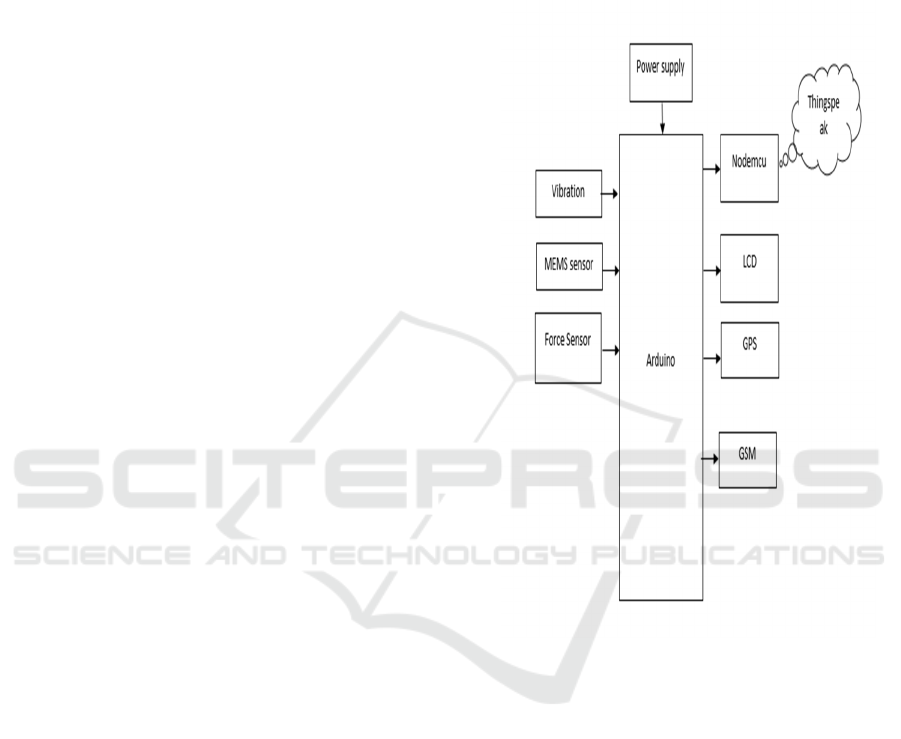
fatalities. Figure 1 shows the block diagram
representing embedded design.
5 BLOCK DIAGRAMS
Figure 1: Block Diagram representing embedded
design.
6 METHODOLOGY
6.1 System Overview
The proposed accident detection and emergency alert
system aims to improve road safety by identifying
accidents in real-time and immediately notifying
emergency contacts. It integrates IoT technology,
embedded systems, cloud computing, and an Android
application to ensure effective monitoring and rapid
response.
The system consists of multiple sensors, including
MEMS, vibration, and force sensors, which detect
accidents with high accuracy. An Arduino
microcontroller processes sensor data, while a GPS
ICRDICCT‘25 2025 - INTERNATIONAL CONFERENCE ON RESEARCH AND DEVELOPMENT IN INFORMATION,
COMMUNICATION, AND COMPUTING TECHNOLOGIES
574

module determines the exact accident location. A
GSM module sends SMS alerts to emergency
contacts and nearby hospitals. The NodeMCU Wi-Fi
module uploads real-time data to the ThingSpeak
cloud, enabling remote monitoring.
An Android application fetches real-time accident
information from ThingSpeak and automatically
sends emergency notifications to pre-configured
contacts. This multi-layered approach ensures rapid
emergency response and increases the chances of
survival for accident victims.
6.2 Working Principle
The system functions in three key stages:
• Data acquisition using sensors and the
microcontroller
• Data processing and communication using
embedded systems and cloud storage
• User interaction through the Android
application and emergency notification
system.
6.2.1 Data Acquisition
Sensors for accident detection: The system uses
multiple sensors to accurately detect accidents:
● MEMS accelerometer sensor detects sudden
motion changes, acceleration, or tilting of the
vehicle, which indicates a possible crash.
● Vibration sensor detects abnormal vibrations
or shocks caused by a collision.
● Force sensor measures impact force to confirm
the severity of an accident.
These sensors are connected to an Arduino
microcontroller, which continuously monitors their
output and applies threshold values to determine if an
accident has occurred.
GPS module for location tracking: Once an
accident is detected, the GPS module retrieves the
vehicle’s precise latitude and longitude. This location
data is then included in the emergency alert message
to enable faster rescue operations.
GSM module for emergency alerts: The GSM
module sends SMS alerts containing accident details,
including the location, to emergency contacts. The
alert is also sent to hospitals and emergency response
teams to facilitate a quick response.
6.2.2 Data Processing and Transmission
Role of the arduino microcontroller
The Arduino microcontroller continuously processes
sensor inputs and determines whether an accident has
occurred based on predefined thresholds. When an
accident is detected, it triggers the GPS and GSM
modules to send emergency alerts.
Nodemcu and thingspeak cloud integration: The
NodeMCU Wi-Fi module transmits all collected
sensor data to the ThingSpeak cloud server. This
ensures real-time data visualization and remote
monitoring of the vehicle’s status.
6.2.3 Android Application Integration
1) How the android application works
• The Android application fetches real-time
sensor values from the ThingSpeak cloud.
• It displays accident information, including
the location and vehicle status.
• In case of an accident, the application
automatically notifies emergency contacts
stored within it.
• The app includes an SOS button that allows
users to manually trigger an emergency
alert.
6.3 Flowchart Explanation
The flowchart represents the overall functioning of
the system:
• The sensors continuously monitor the
vehicle’s movement and impact force.
• The microcontroller processes the data and
determines if an accident has occurred.
• If an accident is detected, the GPS module
retrieves the exact location.
• The GSM module sends an emergency SMS
to pre-stored contacts.
• The NodeMCU Wi-Fi module uploads the
accident data to the cloud.
• The Android application fetches real-time
data and notifies emergency contacts.
• Users can manually trigger an SOS alert if
needed.
AcciAid: IoTâ
˘
A
´
SDriven Realâ
˘
A
´
STime Accident Detection and Emergency Alert System
575
6.4 Embedded System and Python
Integration
1) Embedded system components
The embedded system consists of an Arduino
microcontroller and a NodeMCU Wi-Fi module.
• The Arduino acts as the central processing
unit, continuously analyzing sensor inputs
and triggering alerts when necessary.
• The NodeMCU module ensures seamless
cloud integration by uploading accident data
to ThingSpeak.
• The GSM module is responsible for sending
emergency SMS alerts.
2) Role of python
• Python is used for data processing and
integration with the ThingSpeak API.
• It enables real-time data visualization and
ensures seamless communication between
the cloud and the Android application.
• Python is also used to enhance the accuracy
of accident detection algorithms.
6.5 Android Application
1) Features of the android app
• Displays real-time sensor data and accident
alerts
• Sends automatic notifications to emergency
contacts
• Tracks accident location using Google Maps
• Allows users to store and manage
emergency contacts
• Includes an SOS button for manual
emergency alerts
2) Working of the android app
• The application retrieves real-time sensor
data from ThingSpeak.
• It displays sensor readings and accident
alerts on the dashboard.
• When an accident is detected, it
automatically sends notifications to
emergency contacts.
• The accident location is displayed on a map
for tracking.
• Users can manually send an SOS alert if
needed.
7 RESULTS AND DISCUSSION
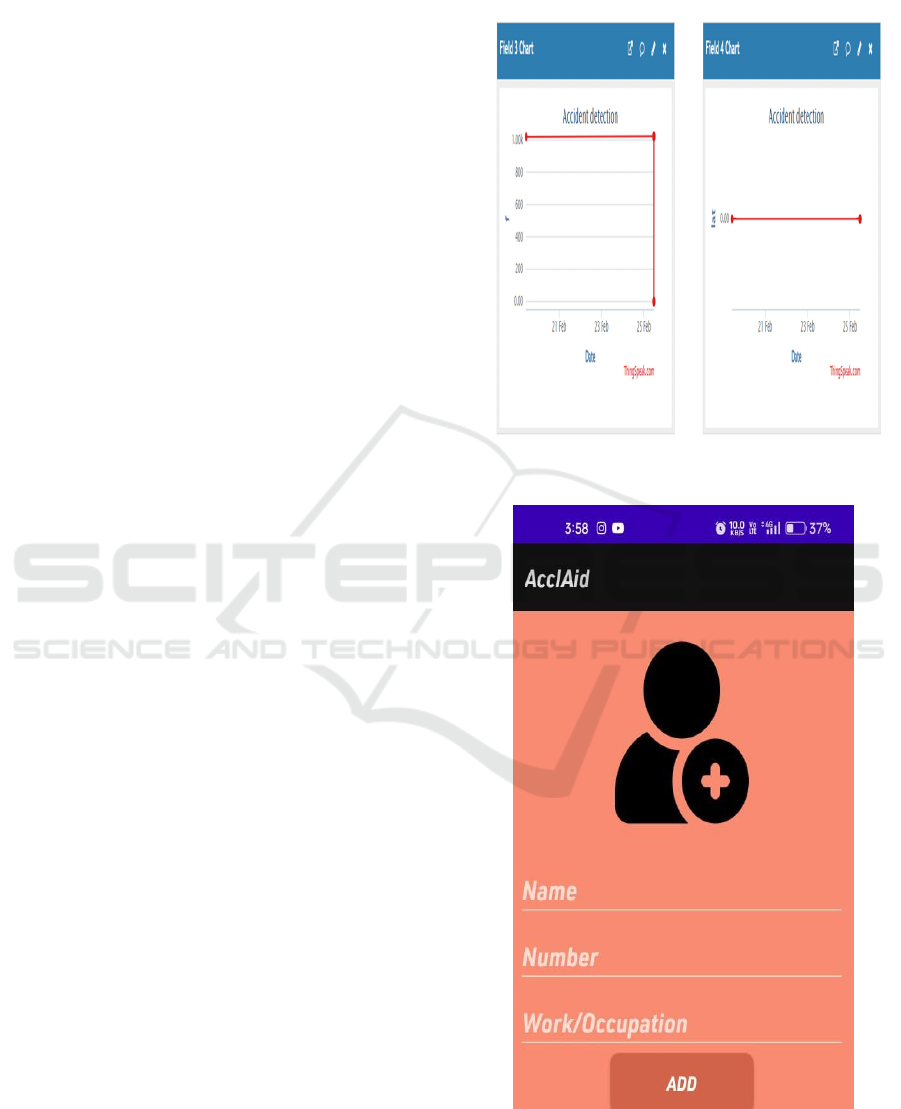
Figure 1: Data Plots in Thingspeak for analysis.
Figure 2: Addition of Zonal details in software.
ICRDICCT‘25 2025 - INTERNATIONAL CONFERENCE ON RESEARCH AND DEVELOPMENT IN INFORMATION,
COMMUNICATION, AND COMPUTING TECHNOLOGIES
576
Sensor data from MEMS, force, and vibration
sensors, along with latitude and longitude coordinates
from the GPS module, are uploaded to ThingSpeak as
shown in Figure 1. The data is stored in designated
fields and displayed in a graphical format for real-
time monitoring and analysis.
Figure 2 displays the user's name and essential
details. It also provides a section to add family
members and favorite contacts for quick access in
case of emergencies.
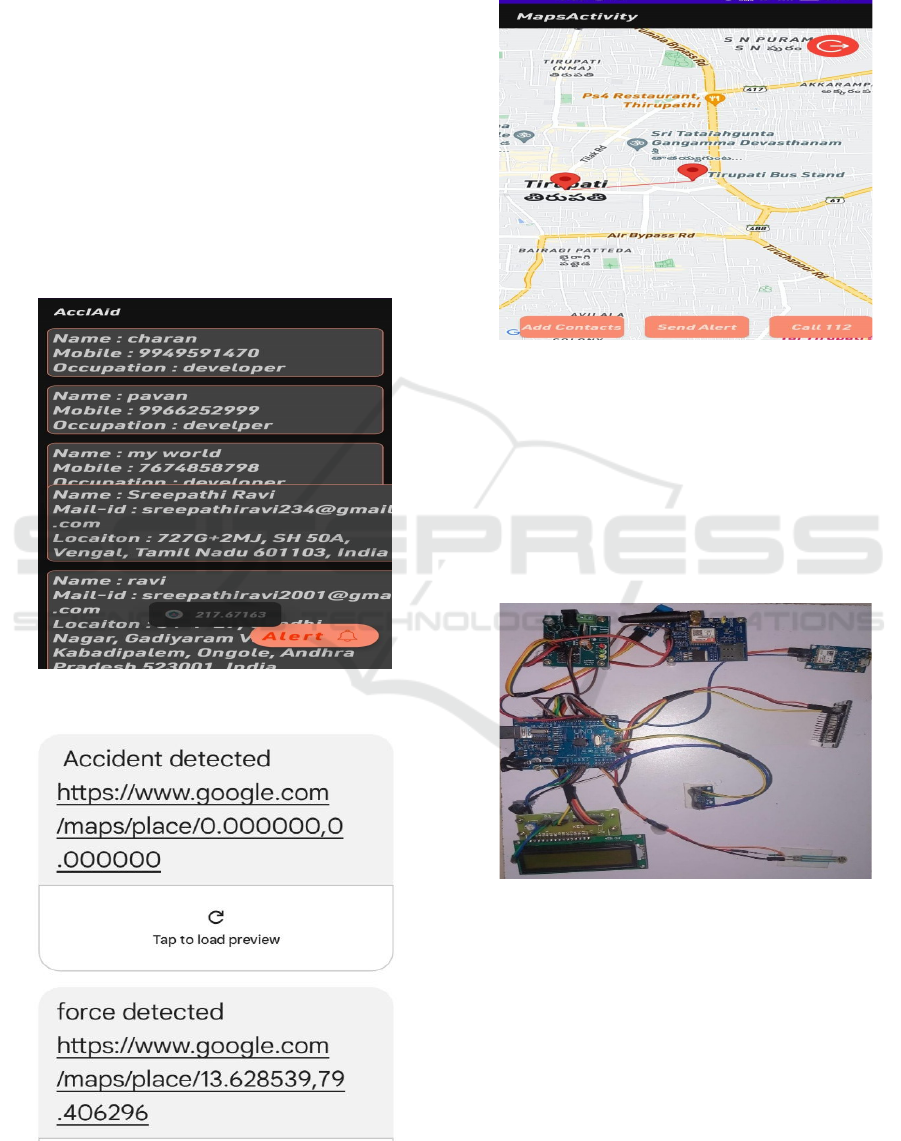
In Figure 4 We have integrated phone numbers
along with location details and other relevant
information into the application. This ensures that in
case of an accident, emergency contacts receive
accurate location data and necessary details for a
quick response.
Figure 4: Displying details of added contacts.
Figure 5: Message alert when accident is detected.
Figure 5 shows the message sent to registered
mobile numbers, including the GPS location for
accurate tracking and emergency response.
Figure 6: Tracked accident location.
Figure 6 displays the Google Maps location
within the application, allowing users to view real-
time positioning seamlessly. This Figure 7 displays
the complete hardware setup of the system,
showcasing all integrated components and their
connections. It provides a clear overview of the
assembled kit used for accident detection and
emergency response.
Figure 7: Hardware setup.
8 CONCLUSIONS
In conclusion, the proposed accident detection and
emergency alert system offers an effective solution
for enhancing road safety through real-time
monitoring and rapid communication. By integrating
various sensors with the Arduino microcontroller, the
system accurately detects accidents and unusual
impacts. The combination of GPS and GSM modules
AcciAid: IoTâ
˘
A
´
SDriven Realâ
˘
A
´
STime Accident Detection and Emergency Alert System
577

ensures that emergency contacts receive immediate
notifications along with the precise location of the
incident. The incorporation of IoT technology
through the NodeMCU Wi-Fi module enables
seamless data transmission to the ThingSpeak web
server, allowing for continuous monitoring and quick
decision-making. With its automated functionality,
cost-effectiveness, and reliability, the system
provides a practical and efficient approach to
minimizing response times, ultimately increasing the
chances of saving lives in emergency situations.
REFERENCES
Gunadal A., Koujalagi A., Karavade S., and Konnuri S.,
“MEMS Accelerometer-Based Wireless Black Box
with GPS Tracking for Vehicle Accident Monitoring,”
Project Reference No.: 37S0430, S.G. Balekundri
Institute of Technology, Belgaum, 2015.
Alnashwan Raghad A., et al., “Machine Learning-Based
IoT System for Accident Prevention,” College of
Computer and Information Sciences, King Saud
University, February 2023.
Josephinshermila P., Priya S. Sharon, et al., “Smart
Automotive Black-Box Monitoring System for
Accident Detection,” ELSEVIER, Measurement:
Sensors, Vol. 27, 100721, 2023, pp. 1-8.
Alkhaiwani A. Hussain, Alsamani B. Soliman, “An IoT-
Enabled Framework for Secure Accident Detection and
Driver Information Reporting,” Sustainability, Vol. 15,
pp. 01-26, 2023.
Mahmood Firas M. Z., “GPS, GSM, and Arduino-Based
Vehicle Monitoring System,” CIC-COCOS 2022:
International Conferences on Communication Engineering
and Computer Science, pp. 157-161.
Belhadi A., Djenouri Y., et al., “Enhanced Regional
Convolutional Neural Network for Vehicle Detection in
Smart Road Accident Prevention,” Pattern Recognition
Letters, ELSEVIER, Vol. 158, 2022, pp. 42-47.
Pathik Nikhlesh Y., Gupta Rajeev K., et al., “IoT and Deep
Learning-Based AI System for Smart City Accident
Detection and Alerts,” Sustainability, 2022, Vol. 14,
Issue 7701, pp. 1-24.
B. M. Nandish, R. J. Ekanth Babu, S. S. Ganeshanaik, et al.,
“IoT-Based System for Accident Detection and
Emergency Response,” International Journal of
Engineering Research & Technology (IJERT), Vol. 10,
Issue 11, ICEI - 2022 Conference Proceedings, ISSN:
2278-0181, pp. 636-640.
Sharma S., “IoT-Enabled Vehicle Crash Identification and
Alert Mechanism for Common Road Incidents,”
*International Journal of Computer and Electrical
Engineering*, vol. 5, Oct. 2019.
Dr. C.k.Gomathy, K Rohan, Bandi Mani Kiran Reddy,
Dr.V Geetha“ Accident Detection And Alert
System.May 2022.
Ezil S. L. and Dhanlakshmi, “Real-Time Vehicle Tracking
and Surveillance Utilizing IoT with Arduino,”
*International Journal of Intelligent Systems and Smart
Sensing*, Sept. 2017
K. Poorani et al., “Real-Time Vehicle Tracking, Crash
Detection, and Prevention Using IoT,” *International
Journal of Engineering Research and Recent Trends*,
March 2017.
Nasr E., Kfoury E., and Khoury D., “IoT-Based Method for
Detecting, Reporting, and Navigating Vehicle
Collisions,” *IEEE International Conference on
Multidisciplinary Engineering and Technology*, 2016.
Jalil J., Amin M. S., and Reaz M. B. I., “Crash Identification
and Alert System Utilizing GSM, GPS, and GPRS
Technologies,” *IEEE/OSAIAPR International
Conference on Vision, Electronics, and Informatics*.
S. Akriti et al., “IoT and Cloud-Based Smart Accident
Detection and Response System,” *Proceedings of the
2nd International Conference on Emerging Next-Gen
Computing Technologies*, October 2016.
Patel A., Kumar B., and Gupta C., “IoT-Enabled Smart
Helmet for Instant Crash Detection,” *IEEE Sensors
Journal*, vol. 15, no. 6, pp. 2900-2910, 2019.
S. Singh, K. Verma, and R. Sharma, “Development and
Deployment of an Intelligent Helmet for Ensuring
Worker Safety in Industrial Settings,” *IEEE Access*,
vol. 7, pp. 102550-102562, 2019.
H. Kim and M. Lee, “Smart Helmet Utilizing IoT for
Enhancing Construction Worker Safety,” *IEEE
Journal of Internet of Things*, vol. 5, no. 2, pp. 1234-
1245, 2020.
S. Das, A. Ghosh, R. Dutta, M. Lee, and H. Kim, “Smart
Helmet System for Motorcycle Safety Using IoT,”
*IEEE Transactions on Intelligent Transportation
Systems*, vol. 20, no. 5, pp. 2000–2012, 2021.
Gupta N., Kumar P., and Sharma S., “Comparative
Analysis of Wireless Communication Protocols for
IoT-Enabled Smart Helmets,” *IEEE Wireless
Communications Letters*, vol. 9, no. pp. 456-468, 202.
Tiwari A., Choudhary S., and Singh P., “IoT-Integrated
Smart Helmet for Accident Detection Utilizing
Machine Learning,” *IEEE Transactions on Intelligent
Systems*, vol. 25, no. 1, pp. 50-62, 2022.
ICRDICCT‘25 2025 - INTERNATIONAL CONFERENCE ON RESEARCH AND DEVELOPMENT IN INFORMATION,
COMMUNICATION, AND COMPUTING TECHNOLOGIES
578
