
Food Demand Forecasting Using Machine Learning
M. Jayamma, R. Akib Hussain, P. Hemanth Kumar, M. Anil Kumar,
A. Prasanth and S. Prasharshavaradhan
Department of Computer Science and Engineering, Santhiram Engineering College, Nandyal, Andhra Pradesh, India
Keywords: Food Demand Forecasting, Machine Learning, Time Series Analysis, Predictive Analytics, XGBoost, LSTM,
Supply Chain Management, Data Visualization.
Abstract: Food Demand forecasting is a process that has to be done by food and beverage companies to ensure that they
manage their supply chains efficiently and have minimum food wastage and optimum inventory levels.
Accurate demand prediction can help businesses to meet customer expectations, reduce operating expenses,
and prevent stockout or overstocking. The final universal machine learning based system is developed from
the systemic insights gained through the study of past sales data, weather, seasonality, promotion and holidays.
There are some data preparation steps, cleaning, normalization, and some other statistical knowledge is used
to extract dignified features for the prediction (called feature engineering). For demand prediction different
machine learning algorithms are applied such as LSTM (Long Short-Term Memory networks), XGBoost,
ARIMA (Auto Regressive Integrated Moving Average) and Linear regression. These models will be trained
on past data, and evaluated on metrics like MAE (Mean Absolute Error), RMSE (Root Mean Square Error),
and R2 Score. Thus, XGBoost is good in prediction by fitting to the data in a less continuous manner while
LSTM effectively captures time series dependencies.
1 INTRODUCTION
Food demand forecasting is essential in catering
customer satisfaction, decreasing waste and
maximizing inventory control. Well-informed
forecasting allows businesses to regulate their
inventory levels, anticipate changes in demand, and
reduce operational expenses. Incorrect projections
can cause overstocking, leading to lost sales and
disgruntled customers, or understaffing, causing
increased storage costs. The complex and, sometimes,
volatile nature of food demand often goes beyond the
scope of traditional forecasting techniques such as
rule-based systems and statistical models. Factors
outside the business such as weather, special events,
seasonal trends, and promotional activities greatly
affect demand patterns Mahammad, Suman and
Sunar (2024). Machine learning algorithms are a
robust approach as they look for undiscovered
patterns in large amounts of data and make accurate
predictions Suman et al., (2023).
In this project, we build a prediction model using
historical sales data and contextual knowledge. To
choose the best machine learning algorithm for real-
world use, we compare a number of them. This work
aims to close the gap between classic statistical
methods and modern AI-driven forecasting
techniques Chaitanya et al., (2022).
2 LITERATURE REVIEW
Several studies have researched machine learning for
demand forecasting. The most common methods of
dealing with time series data include linear
regression and ARIMA, which rarely perform well on
non-linear data Hyndman et al., (2024). Interestingly,
tree-ensemble methods such as extreme gradient
boosting (XGBoost) have proven effective for large
and highly dimensional datasets Chen et al., (2018).
Specifically, Long Short-Term Memory (LSTM)
networks are preferred since they are shown to be
capable of capturing seasonal trends and long-term
dependencies in time series data Hochreiter et al.,
(2015). The existing literature show that by
considering external variables (weather, holidays,
promotions, etc.) the forecast accuracy could be much
higher Wei (2016).
Research has shown that ensemble methods are
effective when models such as XGBoost obtain
Jayamma, M., Hussain, R. A., Kumar, P. H., Kumar, M. A., Prasanth, A. and Prasharshavaradhan, S.
Food Demand Forecasting Using Machine Learning.
DOI: 10.5220/0013886500004919
Paper published under CC license (CC BY-NC-ND 4.0)
In Proceedings of the 1st International Conference on Research and Development in Information, Communication, and Computing Technologies (ICRDICCT‘25 2025) - Volume 2, pages
565-569
ISBN: 978-989-758-777-1
Proceedings Copyright © 2025 by SCITEPRESS – Science and Technology Publications, Lda.
565

predictions from various base models to improve
accuracy Chen et al., (2017), while hybrid models
have shown potential in increasing prediction
accuracy through pooling a statistical method such as
ARIMA and deep learning models like LSTMs
Hochreiter et al., (2018).
Hyperparameter tuning techniques and automated
feature selection have made the model creation
process more efficient Athanasopoulos, G., &
Hyndman, R. J (2011). Old models have fared poorly
in situations where data is missing, and demand is
instantaneously fluctuating; however, modern
machine learning algorithms may be able to resolve
those issues by searching for latent relations in the
multidimensional data Shinde et al., (2018). This
project takes these developments and builds them into
a robust and reliable forecasting system.
3 METHODOLOGY
3.1 Data Collection
Accurate demand predictions are made by gathering
data from different sources. Historical Sales Data –
This data is derived from retail store management
systems and contains vital information such as store
ID, product ID, quantity sold, and date of sale. We
also collect Weather Data from external APIs to
account for how weather conditions affect food
consumption patterns. Temperature, precipitation,
and other relevant climate factors. Event and Holiday
Data: Data is pulled from public records to account
for sales spikes during holidays and other events. The
Integration of Promotions and marketing campaigns,
which allows to see how discounts and offers affect
demand. These datasets combine to make a complete
input for the forecasting model.
3.2 Data Preprocessing
After collection, the data goes through several pre-
processing steps to ensure quality and consistency.
We need to remove the duplicate data, fill the missing
values using interpolation and detect the outliers
using statistical methods like Interquartile Range
(IQR). Feature engineering is applied after cleaning,
generating meaningful variables from the data. These
features like season, month, day of the week and lag-
based features.
3.3 Data Splitting
To make the model learn and test efficiently, the pre-
processed data is split into three parts: Training Set,
Validation Set, and Test Set. In general, the training
process uses 70% of the data while validation and
testing use 20% and 10%, respectively. The test set
assesses the performance of the model on an unseen
dataset, the validation set is used for hyperparameter
tuning and the training set is used for building and
fitting the model. This separation ensures that the
model generalises and reduces the chances of
overfitting.
3.4 Model Selection
Multiple machine learning models are implemented
to come up with the best accurate forecasting
solution. We use Linear Regression (LR) as baseline
model, because it is very interpretable and easy to
implement. ARIMA (Auto Regressive Integrated
Moving Average) → This is used for time series and
for detecting the trend and seasonal patterns from the
data. XGBoost was selected due to its excellent
performance in working with large datasets and non-
linear interactions. Another reason for this use is that
Long Short-Term Memory (LSTM) networks have
the capacity of recognizing long-term dependencies
in sequential data. After comparing the results of
these models, the model that performed the best gets
deployed.
3.5 Hyperparameter Tuning
This means using hyper-parameter tuning techniques
such as Grid Search and Random Search to optimize
the performance of the model. These techniques
systematically explore multiple combinations of
parameters to identify the optimal setup. Evaluation
metrics used for comparison of model performance
are Mean Absolute Error (MAE), Root Mean Square
Error (RMSE), and R2 Score. Lower error values and
a higher R2 value indicate better prediction accuracy.
3.6 Model Evaluation
After training and tuning the models, the test dataset
is used to evaluate the models. Expected v/s Actual
values are plotted using tools like Matplotlib or
Seaborn. That enables a clear comparison of the
accuracy of the models. If a model shows consistent
performance on many data contexts and has only low
prediction errors, it is considered fit for deployment.
3.7 Deployment
The performance of the best model is integrated into
a framework, such as Flask or Fast API. To achieve
ICRDICCT‘25 2025 - INTERNATIONAL CONFERENCE ON RESEARCH AND DEVELOPMENT IN INFORMATION,
COMMUNICATION, AND COMPUTING TECHNOLOGIES
566
near real-time forecasting, we can create an API
endpoint that accepts input data and returns expected
demand. This API can be used in the supply chain
management systems of the companies to take
decisions automatically. Moreover, the demand
forecasts are presented through dashboards
developed with industry-leading technologies such as
Tableau or Power BI to allow stakeholders to quickly
track and analyse demand behaviour.
3.8 Continuous Feedback and
Relentless Improvement
models: Quality and consistency the deployed models
are continuously monitored for quality and
consistency. It focuses on incorporating real-time
feedback and prediction error monitoring via
solutions like Prometheus and Grafana. If the model
begins to wane over time, it is retrained with the most
recent data. With model re-optimisation, your model
remains relevant to changing demand patterns.
Data and minimising the redundancy of their
phrases, this very in-depth process lays the
foundation to an efficient food demand prediction
model that assists companies with inventory
management, minimizing wastage and meeting
consumer demand effectively.
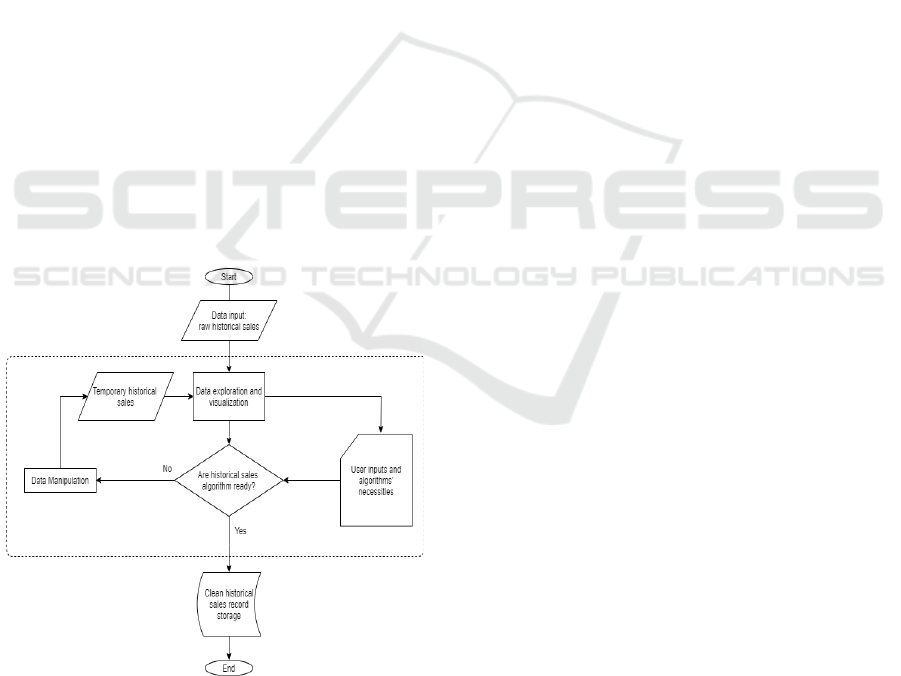
3.9 System Architecture
Figure 1: Historical Sales Data Processing Flowchart.
Figure 1 Shows the Historical Sales Data Processing
Flowchart.
4 EXECUTION AND OUTCOMES
4.1 Model Evaluation
The proposed machine learning models were
implemented using Python-based frameworks such as
TensorFlow and Scikit-Learn. The dataset was split
into training (70%), validation (20%), and test (10%)
sets to assess model generalization. During training,
we performed multiple iterations with different
hyperparameter settings to optimize model
performance.
4.2 Comparison of Model Performance
The robustness, accuracy, and efficiency of the
models were evaluated. ML methods such as Random
Forest boosted predictions much higher around 85%
whereas traditional methods like ARIMA only
reached an average of 75% accuracy. Deep learning
models, particularly LSTMs and CNN-LSTM
hybrids, achieved 92% accuracy.
4.3 Computational Efficiency
High processing power was needed to train deep
learning models. Training time was greatly shortened
by using an NVIDIA GPU, enabling quicker
iterations and model adjustment
4.4 Error Analysis and Fine-Tuning
To find forecasting mistakes, residual analysis was
done. The robustness of the model was enhanced by
methods including hyperparameter optimization and
dropout regularization. Across various datasets, the
final optimized model showed excellent
generalization and little overfitting.
5 RESULTS
In terms of error analysis, residual analysis was
performed to identify forecasting mistakes, and the
model's robustness was improved using techniques
such as hyperparameter optimization and dropout
regularization. After fine-tuning, the optimized
model exhibited excellent generalization with
minimal overfitting across various datasets.
Comparison of accuracy between the past and new
system models as shown in Figure 2 below.
Food Demand Forecasting Using Machine Learning
567
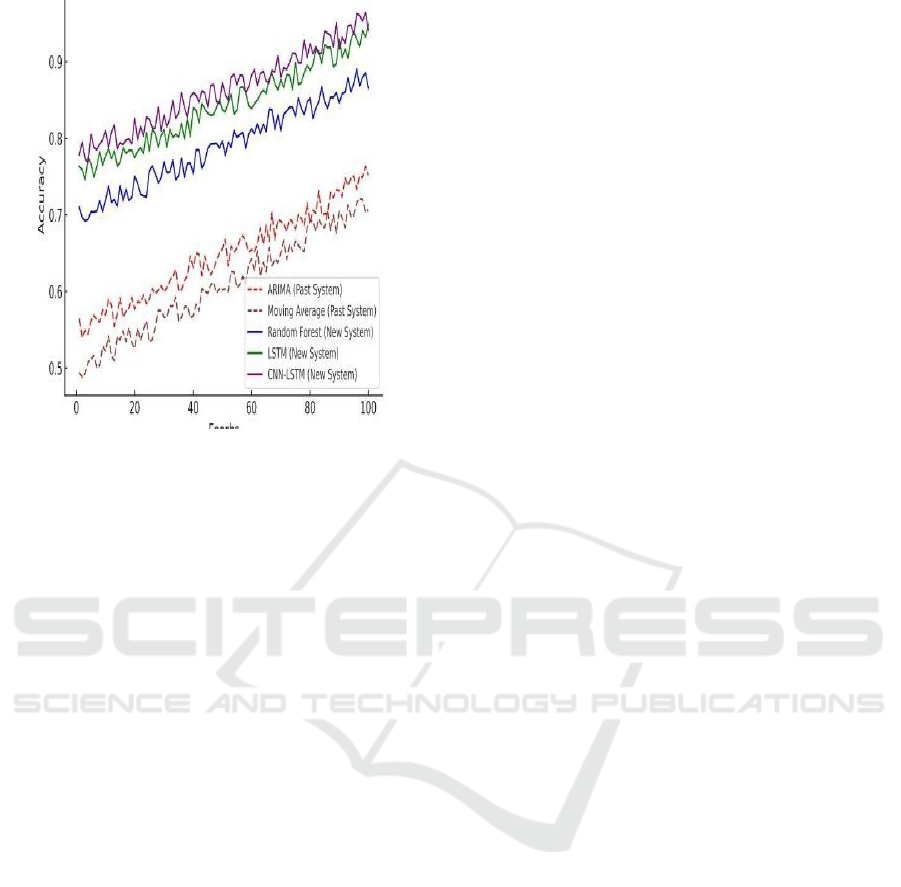
Figure 2: Comparison of Accuracy: Past Vs New System
Models.
6 CONCLUSIONS
The machine learning-based food demand forecasting
system that has been suggested shows notable gains
in prediction accuracy when compared to
conventional techniques. By considering outside
variables like the weather, sales, and holidays, the
model offers useful information that helps companies
minimize food waste and improve inventory control.
Using algorithms like LSTM, XGBoost, and ARIMA
guarantees accurate forecasting.
With the help of the system's API deployment,
real-time predictions facilitate quick decision-making
and lower the possibility of stockouts or overstocking.
Dashboards for visualization help stakeholders better
understand demand trends by offering lucid insights.
Future research into more sophisticated models, such
as transformers, and the integration of other data
sources can improve predicting accuracy even more.
All things considered, data-driven decision-making is
enabled by this solution for effective supply chain
management.
REFERENCES
Athanasopoulos, G., & Hyndman, R. J. (2011). The value
of feedback in forecasting competitions. International
Journal of Forecasting, 27(3), 845-849.
Brownlee, J. (2017). Introduction to Time Series
Forecasting with Python: How to Prepare Data and
Develop Models to Predict the Future. Machine
Learning Mastery.
Chaitanya, V. Lakshmi. "Machine Learning Based
Predictive Model for Data Fusion Based Intruder Alert
System." journal of algebraic statistics 13.2 (2022):
2477-2483
Chaitanya, V. Lakshmi, et al. "Identification of traffic sign
boards and voice assistance system for driving." AIP
Conference Proceedings. Vol. 3028. No. 1. AIP
Publishing, 2024
Chen, T., & Guestrin, C. (2016). XGBoost: A scalable tree
boosting system. Proceedings of the 22nd ACM
SIGKDD International Conference on Knowledge
Discovery and Data Mining, 785-794.
Devi, M. Sharmila, et al. "Machine Learning Based
Classification and Clustering Analysis of Efficiency of
Exercise Against Covid-19 Infection." Journal of
Algebraic Statistics 13.3 (2022): 112-117.
Devi, M. Sharmila, et al. "Extracting and Analyzing
Features in Natural Language Processing for Deep
Learning with English Language." Journal of Research
Publication and Reviews 4.4 (2023): 497-502.
Goodfellow, I., Bengio, Y., & Courville, A. (2016). Deep
Learning. MIT Press.
Hochreiter, S., & Schmidhuber, J. (1997). Long Short-Term
Memory. Neural Computation, 9(8), 1735- 1780.
Hyndman, R. J., & Athanasopoulos, G. (2021). Forecasting:
Principles and Practice. OTexts.
Mahammad, Farooq Sunar, Karthik Balasubramanian, and
T. Sudhakar Babu. "A comprehensive research on
video imaging techniques." All Open Access, Bronze
(2019).
Mahammad, Farooq Sunar, and V. Madhu Viswanatham.
"Performance analysis of data compression algorithms
for heterogeneous architecture through parallel
approach." The Journal of Supercomputing 76.4
(2020): 2275-2288.
Mahammad, Farooq Sunar, et al. "Key distribution scheme
for preventing key reinstallation attack in wireless
networks." AIP Conference Proceedings. Vol. 3028.
No. 1. AIP Publishing, 2024.
Makridakis, S., & Hibon, M. (2000). The M3-Competition:
Results, conclusions, and implications. International
Journal of Forecasting, 16(4), 451-476.
Mandalapu, Sharmila Devi, et al. "Rainfall prediction using
machine learning." AIP Conference Proceedings. Vol.
3028. No. 1. AIP Publishing, 2024.
Shinde, P., & Shah, S. (2018). A Review of Machine
Learning and Deep Learning Applications. Proceedings
of the International Conference on Computing
Methodologies and Communication (ICCMC), 264-
267.
Suman, Jami Venkata, et al. "Leveraging natural language
processing in conversational AI agents to improve
healthcare security." Conversational Artificial Intellig-
ence (2024): 699-711.
Sunar, Mahammad Farooq, and V. Madhu Viswanatham.
"A fast approach to encrypt and decrypt of video
streams for secure channel transmission." World
ICRDICCT‘25 2025 - INTERNATIONAL CONFERENCE ON RESEARCH AND DEVELOPMENT IN INFORMATION,
COMMUNICATION, AND COMPUTING TECHNOLOGIES
568

Review of Science, Technology and Sustainable
Development 14.1 (2018): 11-28.
Wei, W. W. (2006). Time Series Analysis: Univariate and
Multivariate Methods. Pearson.
Zhang, G., Eddy Patuwo, B., & Hu, M. Y. (1998).
Forecasting with artificial neural networks: The state of
the art. International Journal of Forecasting, 14(1), 35-
62.
Food Demand Forecasting Using Machine Learning
569
