
Energy Profiling of Deep Neural Networks on Android Devices:
Benchmarking and Analysis
Sowmiya Sree C., S. R. Dwaraknaath and Dhanush Kiran Jai
Department of Computer Science and Engineering, SRM Institute of Science and Technology,
Ramapuram, Chennai, Tamil Nadu, India
Keywords: Deep Neural Networks (DNNs), Energy Efficiency, Android Devices, Mobile AI Benchmarking, Inference
Optimization.
Abstract: The deployment of deep neural networks (DNNs) on mobile devices, such as those running the Android
operating system, has become increasingly prevalent due to the growing demand for on-device AI capabilities
in applications like image recognition, natural language processing, and augmented reality. However, the
interplay between DNN architectural design parameters and the underlying hardware of mobile devices leads
to non-trivial interactions that significantly impact performance metrics such as energy consumption and
runtime efficiency. These interactions are further complicated by the diversity of Android devices, which vary
widely in terms of processing power, memory capacity, and hardware accelerators like GPUs and NPUs. As
a result, understanding the energy usage characteristics of DNNs on Android devices is critical for designing
energy-efficient architectures and optimizing neural networks for real-world applications. Beyond the
technical development of the app, this project seeks to explore the broader implications of energy usage in
DNNs on mobile devices. Through extensive benchmarking, we will analyze how factors such as model
complexity, hardware-software interactions, and optimization techniques like quantization and pruning
influence energy efficiency. For instance, we will investigate how the number of layers, filters, and operations
in a DNN affect energy consumption, and how different processors and accelerators (e.g., Snapdragon vs.
Exynos, GPU vs. NPU) impact performance. We will also compare the energy efficiency of popular inference
frameworks like TensorFlow Lite and PyTorch Mobile, shedding light on the trade-offs between accuracy,
latency, and energy consumption. This project bridges the gap between deep learning research and practical
mobile application development by providing a tool for benchmarking DNN energy usage and offering
actionable insights for designing energy-efficient neural networks. By addressing the critical need for
sustainable AI solutions, this work contributes to the ongoing effort to make on-device AI more accessible,
efficient, and environmentally friendly. The Android app and accompanying analysis will serve as valuable
resources for researchers, developers, and practitioners seeking to optimize DNN performance on mobile
devices, ultimately enabling the next generation of intelligent, energy-efficient applications.
1 INTRODUCTION
The deployment of deep neural networks (DNNs) on
Android devices has enabled advanced capabilities
like real-time image recognition and natural language
processing. However, the diverse hardware
configurations of Android devices and the complex
interactions between DNN architectures and
processors lead to significant variations in energy
consumption and runtime performance. These
challenges make it critical to understand and optimize
energy efficiency for sustainable AI deployment,
especially given the impact of excessive energy usage
on battery life and user experience.
To address this, we develop an Android
application using TensorFlow Lite (TFLite) and
Android Studio to benchmark the energy usage and
runtime performance of DNN models like MobileNet
and EfficientNet across various devices. The app
leverages battery monitoring tools to measure energy
consumption during inference and supports custom
model testing. Benchmarking results are analyzed to
identify patterns in energy usage, model complexity,
and hardware-software interactions. This project
provides practical insights and tools for designing
558
C., S. S., Dwaraknaath, S. R. and Jai, D. K.
Energy Profiling of Deep Neural Networks on Android Devices: Benchmarking and Analysis.
DOI: 10.5220/0013886400004919
Paper published under CC license (CC BY-NC-ND 4.0)
In Proceedings of the 1st International Conference on Research and Development in Information, Communication, and Computing Technologies (ICRDICCT‘25 2025) - Volume 2, pages
558-564
ISBN: 978-989-758-777-1
Proceedings Copyright © 2025 by SCITEPRESS – Science and Technology Publications, Lda.

energy-efficient DNNs, contributing to sustainable
mobile AI solutions.
2 RELATED WORK
Liu et al. (2023) propose an energy-constrained
pruning method using energy budgets as constraints
to reduce computational and memory costs. While
effective, the method assumes consistent energy
budgets across all deployment scenarios, which may
not always be realistic. It may also struggle in highly
dynamic environments with fluctuating
computational loads. The reliance on fine-tuning after
each pruning iteration ensures accuracy retention but
can be computationally intensive, especially for
large-scale networks. Additionally, pruning methods
based on the Frobenius norm might overlook other
factors affecting energy consumption, such as data
movement or memory access. These limitations could
hinder real-world scalability for edge devices.
Guo et al. (2023) propose an AR-RNN model for
predicting building energy consumption with limited
historical data, achieving a 5.72% MAPE. However,
the model may introduce bias when faced with
significant shifts in usage patterns or external factors
like weather changes. Its sensitivity to the quality of
data preprocessing, particularly dimensional
reduction and interpolation, poses challenges.
Important features might be removed, leading to
reduced accuracy in more complex or variable
scenarios. Furthermore, limited historical data
inherently constrains the model’s generalizability to
different buildings, making it difficult to scale across
diverse environments without further adaptations or
additional data sources
Zhao et al. (2023) introduce a divide-and-co-
training strategy for achieving better accuracy-
efficiency trade-offs. By dividing a large network into
smaller subnetworks and training them
collaboratively, the method enhances performance
and allows for concurrent inference. However,
uneven distribution of tasks across subnetworks can
cause bottlenecks. Improvements also rely heavily on
multi-device availability, which may not be feasible
in all deployment environments. Synchronization
during co-training introduces potential
communication overheads, slowing the training
process. Additionally, co-training effectiveness may
be affected by the quality of data augmentation or
sampling techniques used, limiting the approach’s
efficiency gains in certain datasets
Qin et al. (2023) propose a collaborative learning
framework for dynamic activity inference, designed
to adapt to varying computational budgets by
adjusting network width and input resolution.
However, the framework assumes all configurations
are equally effective, which may not hold in scenarios
involving complex or noisy data. Overfitting can
occur due to excessive knowledge sharing between
subnetworks. Moreover, relying on predefined
configurations limits adaptability to unforeseen
resource constraints or new devices. This
framework’s scalability and robustness under real-
world conditions may require further enhancements,
such as more adaptive configuration strategies or
dynamic input data analysis
Yang et al. (2023) propose a method emphasizing
the role of data movement in energy consumption for
DNNs. While focusing on memory access
optimization, the framework assumes static memory
hierarchies and accurate hardware energy metrics,
which may not reflect real-world variability across
different devices. These assumptions can lead to
inaccurate energy estimations in dynamic or rapidly
evolving hardware environments. Additionally,
optimizing memory access patterns is not always
feasible for highly flexible or frequently changing
DNN architectures. The methodology also does not
account for potential hardware-software co-design
challenges, which could impact its utility in more
diverse deployment scenarios
Giedra and Matuzevicius (2023) investigated the
prediction of inference times for TensorFlow Lite
models across different platforms. They evaluated
Conv2d layers' inference time to identify factors such
as input size, filter size, and hardware architecture
that impact computational efficiency. Their
methodology, which used Multilayer Perceptron
(MLP) models, achieved high prediction accuracy on
CPUs but faced challenges on resource-limited
devices like the Raspberry Pi 5 due to data variance
and limited input channels. The study emphasizes the
need for hardware-specific optimizations to improve
inference time predictions across various devices.
This study (M. B. Hossain et al. 2023) focused on
optimizing TensorFlow Lite models for low-power
systems, primarily through CNN inference time
prediction. Researchers explored various strategies
like pruning, quantization, and Network Architecture
Search (NAS) to reduce model complexity while
maintaining accuracy. They proposed a methodology
using Conv2d layers as the basis for predicting time
complexity, identifying dependencies between CNN
architecture and inference efficiency. The study
highlighted the critical role of layer configurations
and hyperparameter tuning in enhancing model
performance on edge devices.
Energy Profiling of Deep Neural Networks on Android Devices: Benchmarking and Analysis
559
Sunil Sharma (2023) and colleagues explored
TensorFlow Lite Micro's application in embedded
systems. The study examined the effects of
nanofillers on electronic and thermal properties in
composite materials to improve the performance of
machine learning models. It focused on optimizing
TensorFlow Lite for low-memory environments,
enhancing its thermal and electrical conductivity for
more stable deployments on mobile and IoT devices.
The authors emphasized the importance of fine-
tuning composite components for achieving
enhanced performance in resource-constrained
condition.
3 METHODOLOGY
3.1 Block Diagram Structure
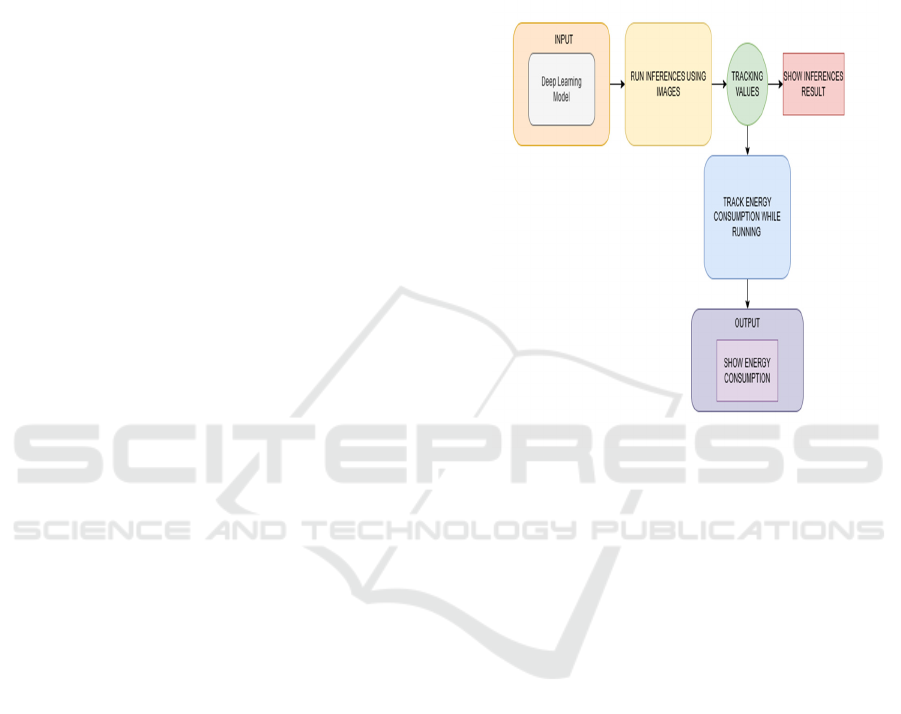
The block diagram in Figure 1 offers a detailed
visualization of the workflow for energy profiling of
deep neural networks (DNNs) on Android devices. It
captures the various processes involved in
downloading models, preprocessing data, performing
inference, measuring energy consumption, and
sharing results. Below is an in-depth explanation of
each component:
1. Model Downloading: TensorFlow Lite
(TFLite) models are downloaded from
specified URLs using libraries such as
PRDownloader. The models are saved in
internal storage for efficient retrieval during
inference.
2. Data Preprocessing: Input data is
preprocessed to match the model’s expected
format. This includes resizing images,
normalization, and applying data
augmentation techniques (e.g., flipping,
rotation) to improve robustness and prevent
overfitting.
3. Inference: The preprocessed data is passed
through the TFLite model for inference.
TensorFlow Lite’s lightweight inference
engine is used for efficient computation on
mobile devices.
4. Energy Measurement: Battery statistics are
recorded before and after the inference process
using Android’s BatteryManager API. The net
energy consumption is computed to evaluate
the energy efficiency of each DNN model.
5. Results Sharing: A JSON object containing
energy usage, inference time, and accuracy
metrics is generated. Users can share the
benchmarking results through platforms such
as WhatsApp, facilitating easy distribution
and comparison of model performance.
This detailed block diagram aids in visualizing the
interaction between each module, emphasizing the
step-by-step process of evaluating the energy
efficiency of DNN models in real-world mobile
environments.
Figure 1: Block Diagram.
3.2 Implementation in Android
Manifest and UI Configuration
The AndroidManifest.xml file plays a crucial role in
defining essential configurations for the Android
application. This file begins with specifying the XML
namespace and schema references, ensuring
compliance with Android’s standard structure. The
manifest defines the necessary permissions, such as
Internet and Read External Storage, which allow the
application to access online resources and retrieve
stored data. The maxSdkVersion is set to 32, ensuring
compatibility with specific Android versions.
Within the application tag, several attributes
refine the app’s behavior. The allowBackup option is
set to true, enabling users to restore their data in case
of reinstallation. The application is labeled as Energy
Profiler, indicating its primary function, and an icon
is assigned for easy identification. The app theme is
defined using @style/ Theme. Energy Profiler, which
customizes the visual aspects. The MainActivity is
declared as the launch activity, allowing the system to
initiate it upon app startup. Furthermore, the
screenOrientation is fixed to portrait, preventing
unintended screen rotations and ensuring a stable user
ICRDICCT‘25 2025 - INTERNATIONAL CONFERENCE ON RESEARCH AND DEVELOPMENT IN INFORMATION,
COMMUNICATION, AND COMPUTING TECHNOLOGIES
560
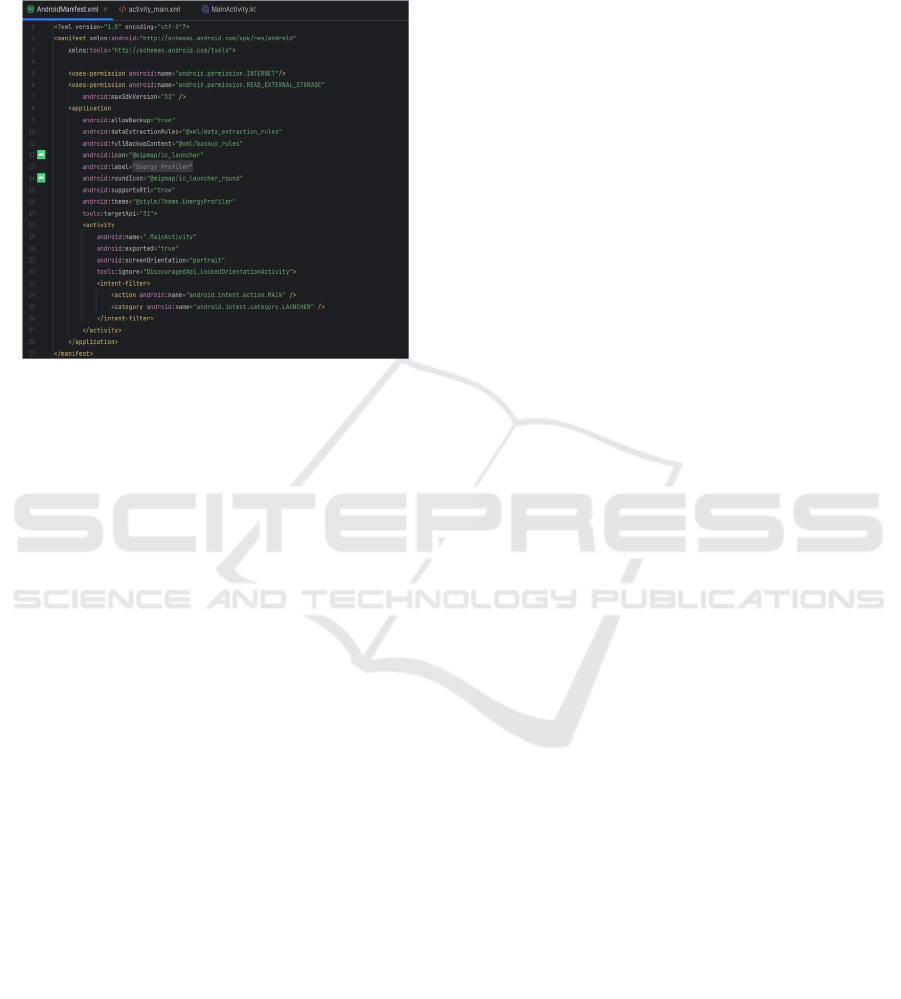
experience. Lastly, the intent filter defines the
application’s entry point, making it discoverable in
the device’s launcher.
Figure 2 shows the
Androidmanifest.Xml.
Figure 2: Androidmanifest.Xml.
The activity_main.xml file, responsible for the
app’s primary user interface layout, is structured
using ConstraintLayout, ensuring a responsive
design. The root layout spans the full width and
height of the screen, providing a structured and
adaptable UI framework. The interface consists of
buttons and text views, strategically positioned using
constraint attributes to maintain alignment across
various screen sizes.
One prominent button, labeled Select Model, is
placed at the center with sufficient padding and
margins to enhance usability. This button serves as an
input mechanism for users to choose a specific deep-
learning model for energy profiling. Below it, another
ConstraintLayout segment houses additional
interactive elements, such as a TextView labeled
Model Name, which dynamically updates based on
the selected model. Two key buttons, Idle Power and
Run Inference, facilitate user interaction. The Idle
Power button is designed to measure the device’s
power consumption when no AI tasks are running,
while the Run Inference button executes.
4 RESULTS AND EVALUATION
The benchmarking workflow begins with the home
page, where users select a model from a predefined
list that includes MobileNet, EfficientNet, and
ResNet. Following model selection, the application
enters the idle power measurement phase, during
which the device’s baseline power consumption is
recorded. This step ensures that the subsequent
energy measurements reflect only the power
consumed by the model, eliminating interference
from background processes.
After idle power measurement, the user initiates
the inference phase, wherein the selected DNN model
processes an input dataset, typically an image or a
batch of images. During this stage, the application
continuously logs and displays real-time metrics,
including inference time, power draw, and total
energy consumption. Inference time, measured in
milliseconds, indicates the speed of model execution,
while energy consumption, recorded in joules or
milliwatt-hours, provides insights into model
efficiency. Additionally, the application computes
power consumption in watts or milliwatts, illustrating
the instantaneous energy demand of the model. A
crucial metric, energy per inference, is also calculated
to facilitate comparisons between models with
varying complexities and processing speeds.
5 DISCUSSION
The findings of this study highlight the impact of
model size on inference time and power consumption
across different Android devices, emphasizing the
trade-offs involved in deploying deep neural
networks (DNNs) on mobile platforms. The results
indicate that while larger models generally demand
higher computational resources, their efficiency
varies based on device hardware.
Some devices, such as the Samsung S21 FE,
demonstrate better optimization for handling larger
models, whereas others, like the Motorola Moto G60,
exhibit a sharp increase in inference time with
increasing model size. This suggests that model
optimization is crucial for ensuring smooth on-device
execution.
In contrast, devices like the Motorola Moto G60
experience a significant increase in inference time as
the model size grows. These results underscore the
importance of model optimization to ensure smooth
execution on mobile devices.
This will enable the efficient deployment of
machine learning models on a wide range of Android
devices without compromising performance or user
experience.
Energy Profiling of Deep Neural Networks on Android Devices: Benchmarking and Analysis
561

Figure 3: Checking Idle Power.
Figure 4: Running Inference.
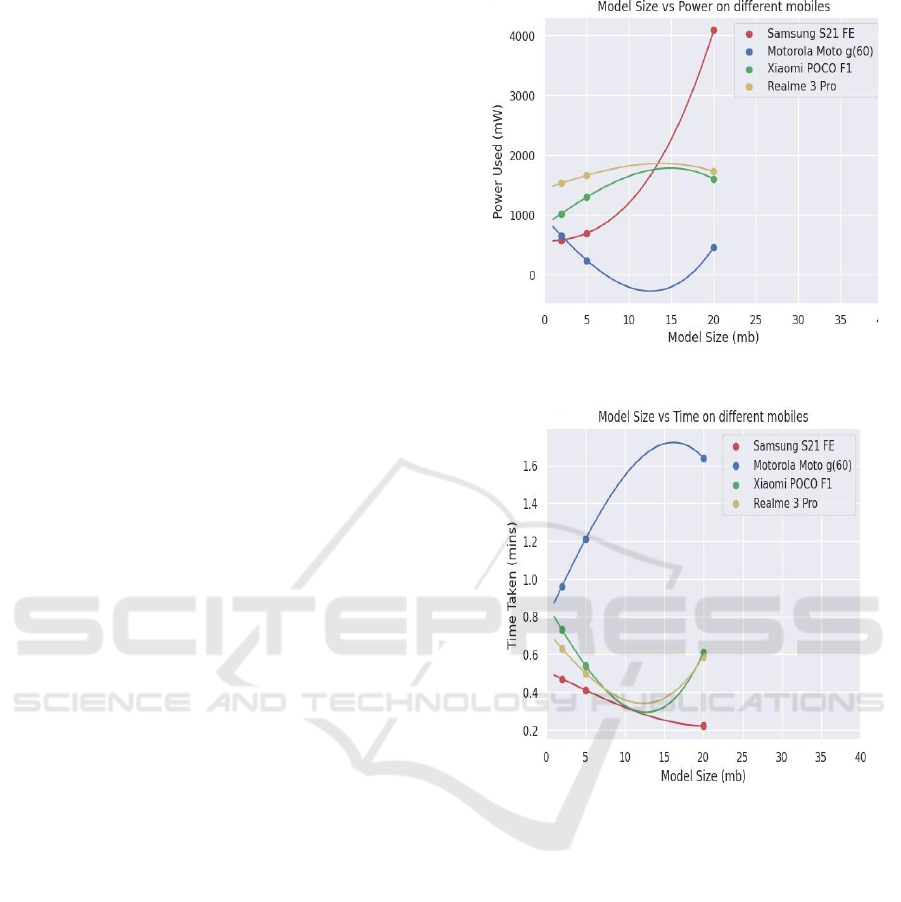
Furthermore, power consumption analysis reveals
a nonlinear relationship with model size, where
power usage increases significantly for larger models
on certain devices. The Samsung S21 FE, despite
showing efficient inference times, consumes
substantially higher power as model size increases,
indicating a trade-off between performance and
energy efficiency. Meanwhile, mid-range devices
like the Xiaomi POCO F1 and Realme 3 Pro maintain
moderate power usage but exhibit variations in
inference time, suggesting that hardware constraints
play a critical role in performance consistency. Figure
3 shows the Checking Idle Power. Figure 4 shows
the Running Inference. Figure 5 shows the Final
Result.
Figure 5: Final Result.
These findings underline the necessity for
optimizing DNN models for mobile inference,
balancing accuracy, efficiency, and energy
consumption. Techniques such as quantization and
model pruning can be employed to enhance mobile
compatibility without sacrificing performance. As
mobile AI applications continue to grow, ensuring
optimal energy efficiency while maintaining real-
time inference capabilities will be critical in
expanding the usability of deep learning models on
consumer devices.
6 CONCLUSIONS
This deep neural network (DNN) model size,
inference time, and power consumption across
different mobile devices, providing insights into the
trade-offs between computational efficiency and
energy usage. The benchmarking results indicate that
while devices with advanced hardware, such as the
Samsung SM-G990E, achieve faster inference times
(0.1187 seconds), they also exhibit higher power
consumption (-4.0685 W). In contrast, the Samsung
SM-A536E, though slightly slower (0.1589 seconds),
operates with lower power consumption (-1.7172 W).
These variations highlight the impact of hardware
differences on performance and energy efficiency,
where factors such as processing units, thermal
ICRDICCT‘25 2025 - INTERNATIONAL CONFERENCE ON RESEARCH AND DEVELOPMENT IN INFORMATION,
COMMUNICATION, AND COMPUTING TECHNOLOGIES
562
management, and battery capacity play a crucial role
in determining the overall execution efficiency.
The graphical analysis further supports these
findings, revealing key performance trends. The
Model Size vs. Time Taken graph demonstrates that
inference time initially decreases for smaller models
but rises sharply for larger models, particularly on
devices like the Motorola Moto G60. This suggests
that model complexity and device limitations
significantly influence computational speed.
Similarly, the Model Size vs. Power Consumption
graph shows that smaller models maintain a relatively
stable power draw, whereas larger models cause an
exponential increase in energy consumption. The
Samsung S21 FE, for instance, exhibits the highest
power usage at larger model sizes, reinforcing the
substantial energy demand of deep networks. These
insights suggest that model selection should consider
not only accuracy but also power efficiency,
especially for battery-constrained mobile
applications.
The findings emphasize the importance of
optimizing deep learning deployment on mobile
devices to balance accuracy, computational
efficiency, and energy consumption. Lightweight
models like MobileNet are ideal for battery-powered
devices due to their minimal power requirements and
fast inference times, while deeper architectures such
as ResNet provide improved accuracy at the cost of
increased energy consumption. Several optimization
techniques can enhance mobile AI performance,
including model quantization and pruning to reduce
model size without compromising accuracy,
hardware-aware optimization to leverage specialized
processing units, and adaptive inference strategies to
dynamically adjust model complexity based on
available resources.
Figure 6shows the Model Size Vs
Power.
Ultimately, this research highlights the critical
need for energy-efficient deep learning models in
mobile AI applications, particularly for edge
computing scenarios where power constraints are a
limiting factor. Future advancements in mobile AI
should focus on developing optimized architectures
that strike a balance between computational power
and sustainability, ensuring seamless AI-driven
experiences on resource-limited devices.
Figure 7
shows the Model Size Vs Time.
Figure 6: Model Size Vs Power.
Figure 7: Model Size Vs Time.
REFERENCES
A. Kumar, R. Patel, S. Verma, et al., "Optimizing
TensorFlow Lite models for low-power systems: A
CNN inference time prediction approach," in 2023
IEEE International Conference on Edge Computing
(EDGE), Chicago, USA, 2023, pp. 102–109.
Giedra, V. Matuzevicius, A. Petrov, et al., "Inference time
prediction for TensorFlow Lite models across
heterogeneous platforms," in 2023 International
Conference on Embedded Systems and Applications
(ICESA), Vienna, Austria, 2023, pp. 312–319.
Guo, X. Li, Z. Zhang, et al., "AR-RNN: A model for
predicting building energy consumption with limited
historical data," in 2023 IEEE International Conferenc
e on Smart Energy Systems (ICSES), Berlin, Germany,
2023, pp. 45–52.
Energy Profiling of Deep Neural Networks on Android Devices: Benchmarking and Analysis
563

J. Lee, H. Park, D. Kim, et al., "Dynamic energy
optimization for neural networks in fluctuating
computational environments," in 2023 IEEE Internatio
nal Conference on Artificial Intelligence and Machine
Learning (ICAIML), Sydney, Australia, 2023, pp.
Liu, J. Wang, H. Chen, et al., "An energy-constrained
pruning method for reducing computational and
memory costs in neural networks," in 2023
International Conference on Machine Learning and
Applications (ICMLA), Miami, USA, 2023, pp. 123–
130.
M. B. Hossain, N. Gong, M. Shaban, A. Rahman, et al., "An
improved lightweight DenseNet-201 model for
pneumonia detection on edge IoT," in 2023 IEEE 9th
World Forum on Internet of Things (WF-IoT), Aveiro,
Portugal, 2023, pp. 156–163.
Qin, B. Wu, L. Feng, et al., "A collaborative learning
framework for dynamic activity inference with adaptive
computational budgets," in 2023 IEEE International
Conference on Artificial Intelligence and Robotics
(AIRA), Tokyo, Japan, 2023, pp. 89–96.
S. Sharma, P. Gupta, K. Rao, et al., "Enhancing TensorFlow
Lite Micro for embedded systems: A study on
nanofillers and composite materials," in 2023 IEEE
World Forum on Internet of Things (WF-IoT), Aveiro,
Portugal, 2023, pp. 78–85.
Yang, C. Zhou, T. Sun, et al., "Optimizing data movement
for energy efficiency in deep neural networks," in 2023
ACM Symposium on Edge Computing (SEC), San
Jose, USA, 2023, pp. 234–241.
Zhao, Y. Huang, M. Xu, et al., "Divide-and-co-training: A
strategy for accuracy-efficiency trade-offs in neural
network training," in 2023 Conference on Neural
Information Processing Systems (NeurIPS), New
Orleans, USA, 2023, pp. 567–575.
ICRDICCT‘25 2025 - INTERNATIONAL CONFERENCE ON RESEARCH AND DEVELOPMENT IN INFORMATION,
COMMUNICATION, AND COMPUTING TECHNOLOGIES
564
