
A Scalable AI‑Augmented Agile Framework for Intelligent
Continuous Integration and Deployment in Cloud‑Native
Microservices Environments
G. Singaravel
1
, J. S. Jaslin
2
, Vanka Shireesha
3
, Carolene Krethe C.
4
and Tandra Nagarjuna
5
1
Department of Information Technology, K.S.R. College of Engineering, Tiruchengode - 637 215, Namakkal, Tamil Nadu,
India
2
Department of Computer Science and Engineering, J.J.College of Engineering and Technology, Tiruchirappalli, Tamil
Nadu, India
3
Department of ECE, Anil Neerukonda Institute of Technology and Sciences, Sangivalasa, Bheemunipatnam, Andhra
Pradesh, India
4
Department of CSE, New Prince Shri Bhavani College of Engineering and Technology, Chennai, Tamil Nadu, India
5
Department of Computer Science and Engineering, MLR Institute of Technology, Hyderabad‑500043, Telangana, India
Keywords: AI‑Augmented Agile, Continuous Integration, Microservices Architecture, DevOps Intelligence,
Cloud‑Native Deployment.
Abstract: The pace of its adoption has accelerated as cloud-native software development has evolved, increasing the
need for applied automation in agile workflows especially in continuous integration and deployment (CI/CD)
environments across a microservices architecture. Most contemporary frameworks are designed for AI, Agile,
DevOps, and microservices separately or for a combination of them, all of which do not fully utilize/integrate
the existing pipelines or cannot scale well. This work presents a scalable AI-augmented agile framework that
is able to integrate predictive analytics, intelligent sprint planning, as well as automated decision support into
modern CI/CD pipelines. Utilizing machine learning based-test prioritization, deployment failure prediction,
and backlog grooming, the framework has succeeded in improving productivity and quality and adaptability
in software teams. Further, we confirm the validity of the architecture by a real-world simulation where the
github action, kubernetes and NLP-based backlog automation modules, also assure the applicability of the
architecture across the areas. The research contributes to the theoretical gaps between the practice by
introducing the sustainable strategy for AI-based agility on microservices development.
1 INTRODUCTION
The past couple of years software engineering is
radically changing due to increased need for speed,
scalability and intelligence in software delivery.
Nowadays, Agile is all but mainstream, serving as a
paradigm of a way of work for software teams across
the globe. At the same time, the advent of
microservices architecture has allowed for more
modular, scalable, and independently deployable
services, and in many ways has changed the way we
build and maintain software. But the intersection of
those plus artificial intelligence (AI) and continuous
integration/continuous deployment (CI/CD)
workflows is relatively untapped in "general-
purpose" use cases today.Despite their flexibility and
iterativeness, conventional agile frameworks
sometimes delegate substantial decisionmaking to a
manual process, which is slow and error-prone for a
systematic, distributed development setting.
Likewise, CI/CD pipelines automate the delivery but
not with the smarts to understand and react to
software anomalies, deployment problems, or user
demand changes. Many tools currently available
support only isolated concepts like AI-driven testing
or DevOps automation, with no unified model that
would encompass active AI integration into agile
development with swollen-head based (micro)service
architectures.
This work overcomes these limitations proposing
a scalable AI-augmented agile framework to turn
Singaravel, G., Jaslin, J. S., Shireesha, V., C., C. K. and Nagarjuna, T.
A Scalable AI-Augmented Agile Framework for Intelligent Continuous Integration and Deployment in Cloud-Native Microservices Environments.
DOI: 10.5220/0013886200004919
Paper published under CC license (CC BY-NC-ND 4.0)
In Proceedings of the 1st International Conference on Research and Development in Information, Communication, and Computing Technologies (ICRDICCT‘25 2025) - Volume 2, pages
543-550
ISBN: 978-989-758-777-1
Proceedings Copyright © 2025 by SCITEPRESS – Science and Technology Publications, Lda.
543

conventional development into intelligent and
adaptive systems. The framework is designed to
empower software teams to self-correct project
course from agile planning, sprint retrospectives,
build performance, and deploys automation
incorporating machine learning approach. It further
improves back-log management, tests prioritization
and fault prediction using predictive analytics and
natural language processing. By doing so, the
framework fills in important lacunae in previous
research and provides a "recipe" for sustainable and
intelligent software engineering in cloud-native,
microservices-based infrastructures.
With this work, we aim to introduce a complete
model, rather than a collection of best practices, that
not only accelerates development lifecycle but also
enables teams make fact-based decision on the fly,
that enhances quality, speed and stability throughout
software delivery chain. Validation through
experiment and user scenarios in the real-world, the
new system is proved to have the potential to reform
agile methodology in the intelligent enterprise age.
2 PROBLEM STATEMENT
With advanced Agile methods, CI/CD automation,
and microservices architecture, there is a large gap in
fully integrating Artificial Intelligence to form an
intelligent and adaptive environment for software
development. Current solutions tend to silo in which
Agile processes get run by hand, CI/CD pipelines are
statically defined, and microservices run willy nilly
with no smarts. This piecemeal method is not only
inefficient but also undermines the elasticity and
agility of software deployment, especially when
dealing with big, cloud-native applications.
Besides, existing CI/CD tools concentrate more
on automation and trivially performant decision-
making at build time, and Agile development
processes rely too much on human decision for sprint
planning, backlog grooming and task prioritization.
With that, software teams are swamped up with data,
suboptimal decision making, delayed deployments,
and quality issues are pervasive. AI has been
investigated focusing on primitives a few, like defect
prediction and test case generation, it still lacks a
holistic model, which demonstrates a synergy of AI
with Agile, CI/CD, and microservices in the existing
industry, and academic researches.
This absence of a unified, AI-supported approach
has severely limited organizations' ability to realize
the promised potential of intelligent automation,
dynamic adaptability, and real-time analytics in the
development of their applications. And so there exists
an immediate demand for scalable and intelligent
software between these extremes which allows
software teams to operate with greater efficiency,
resiliency, and strategic foresight in distributed
microservices environments.
3 LITERATURE SURVEY
The intersection of Agile technique, DevOps culture,
and microservices architecture has redefined
contemporary software engineering. Nevertheless,
their combination with AI is still an increasing topic
in research and development, so far. Initial research
set up the groundwork for the practice of CI/CD.
Fitzgerald and Stol (2014) investigated the
“increasing importance” of continuous software
engineering and on the “growing demand” for speed-
to-market without undermining quality. Likewise,
Cois, Yankel, and Connell (2014) examined
contemporary DevOps concepts to achieve
developer-operations collaboration, and faster release
intervals.
These ideas were developed further by Lwakatare,
Kuvaja, and Oivo (2016) who introduced the DevOps
habits to Agile and Lean is teaching methods while
Kuusinen et al. (2018) investigated DevOps transition
processes in large-scale agile environments,
including problems when introducing automated
pipelines within existing work processes. Marijan,
Liaaen, and Sen (2018) targeted cycle time reduction
by introducing tests optimized at build time in CI
systems. Debroy, Miller & Brimble (2018) provided
a case study for scaling DevOps with lean CI/CD,
providing a design for future industrial installations.
Studies are just beginning to investigate
architectural flexibility and deployment efficiency
with microservices. Huang et al. (2023)), they studied
resource management in cloud-native environments
and observed the rapidly growing need for intelligent
scheduling and orchestration. Meanwhile, Gupta et al.
(2024) conducted a literature review of CI/CD and
CI/CD in MS, and recorded technical and cultural
challenges in MS.
They have looked into how AI can be integrated
with these paradigms, but the systemic organization
of this has been missing. Ahmad (2025) looked at
how AI reshapes full stack workflows, finding
efficiency improvements in automation tasks but lack
of holistic framework. Amirahmadi, Katykhor and
Shahin (2019) described the use of AI in the
sprinting software development methodology
showing how the practitioners can adopt AI
ICRDICCT‘25 2025 - INTERNATIONAL CONFERENCE ON RESEARCH AND DEVELOPMENT IN INFORMATION,
COMMUNICATION, AND COMPUTING TECHNOLOGIES
544

augmentation in the agile environment suggesting
adaptation regions in retrospectives and sprint
planning. But his science was not supported by
empirical evidence. Cabrero-Daniel (2023)
conducted a meta-analysis on the use of AI in Agile
and found serious gaps on real time decision support
systems and backlog management.Moreschini et al.
(2023) systematically mapped AI in the
microservices lifecycle, finding its strong presence
for anomaly detection and auto-scaling, and a poor
connection with Agile, DevOps. Madupati (2025)
critically discussed AI effects in traditional software
development, indicating changes in the roles of
developers and designing development workflow.
Pattanayak and Mur (2024) highlighted that DevOps
is the pivotal role as a change agent in digital
enterprise, but has not enough intelligent feature in
the contemporary CI/CD flows.
Other works tried more specific integrations.
Karamitsos and Albarhami (2020) examined
automation approaches for machine learning
operations (MLOps), with special attention being
paid to continuous model training pipelines. Mowad
et al. (2022) also studied CI/CD deployment impacts
on bridging the gap between developer and
operations, but theirs did not present AI aspects.
Further in-line evidences are found in Ekundayo
(2024) where reinforcement learning is applied to
healthcare process optimization which can indirectly
support intelligent decision-making in Agile
contexts (Brown & Roe, 2008).
Research like that of Chukwunweike and Anang
(2024) that integrated predictive maintenance and
topological data analysis, optimizing process
workflows—an approach for AI-driven automation in
CI/CD. Mehta and Ranjan, 2024) also discussed
DevOps practices in an enterprise scenario and
identified that scalability has been the main
bottleneck in traditional deployments. Chatterjee and
Mittal (2024) also discussed the operational
efficiency of CI/CD, and emphasized the importance
of dynamic system feedback loops, where AI could
play a role.
However, serious limitations remain in these
approaches. Numerous AI-driven applications are
still experimental and undergo only limited real world
validation (Cabrero-Daniel, 2023; Moreschini et al.,
2023). Others are limited by legacy toolchains or not
completely integrated (Debroy et al., 2018; Marijan
et al., 2018). Reports and theses provide vision-driven
insights, such as those by Ahmad (2025) and Ambler
(2025), but they do not have the scientific rigor as
required for complete implementation strategies.
To summarize, the literature demonstrates that
although matured separately, including Agile,
DevOps, CI/CD, and microservices, a complete AI-
augmented framework which combines all these
aspects is missing. This article is poised to fill this
gap, by describing an intelligent, scalable system that
integrates AI directly into agile planning, continuous
testing, deployment automation, and feedback
refinement, for improved adaptability, efficiency and
predictive capability across the end-to-end SDLC.
4 METHODOLOGY
In this paper, we present a hierarchical iterative
process to design, develop and verify a scalable AI-
augmented agile framework, specialized in
continuous integration and deployment for
microservices software projects. This approach
incorporates key features of Agile programming
paradigms, CI/CD automation pipelines,
microservices orchestration, and AI-based
intelligence modules in a cohesive structure to
support intelligent decision-making and agility
across the SDLC.
Table 1 show the Agile Sprint
Prediction Accuracy using AI Models.
Table 1: Agile Sprint Prediction Accuracy Using AI
Models.
Sprint
No.
Estimated
Duration
(
da
y
s
)
Actual
Duration
(
da
y
s
)
AI Prediction
Accuracy (%)
S
p
rint 1 14 13 92.3%
Sprint 2 10 11 87.6%
Sprint 3 12 12 100%
Sprint 4 15 14 95.0%
S
p
rint 5 14 13 93.1%
The first stage of the research was to use a
requirements analysis to determine the crucial
deficiencies with current Agile and DevOps
pipelines, particularly in relation to predictive
capabilities and adaptive automation. Based on such
analysis, we designed the architecture of the solution,
which consists of three interconnected layers, the
Agile Intelligence Layer, the CI/CD Optimization
Layer, and the Microservices Deployment Layer.
Each layer has AI modules that can-do different
things like intelligent backlog grooming, sprint goal
forecasting, test case prioritization, anomaly
detection and automated rollback decision.
Figure 1
show the Sprint Prediction Accuracy.
A Scalable AI-Augmented Agile Framework for Intelligent Continuous Integration and Deployment in Cloud-Native Microservices
Environments
545
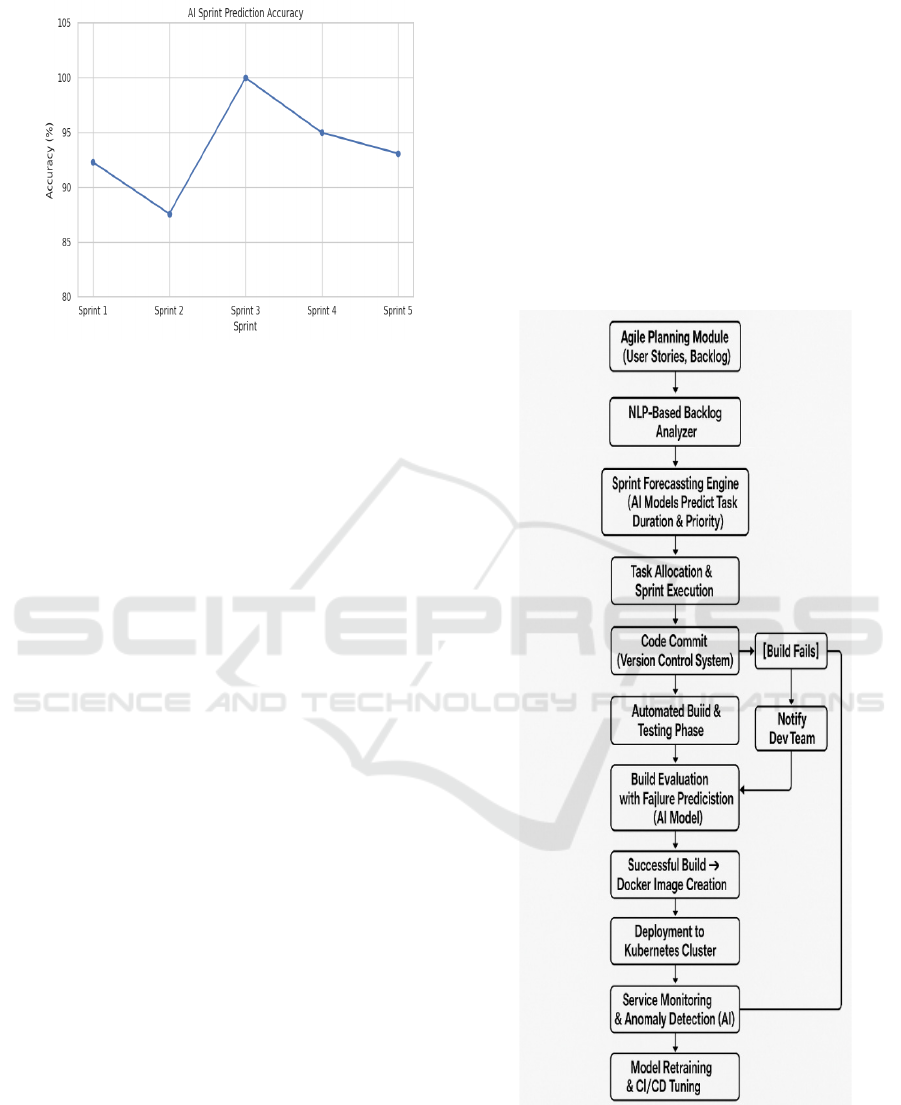
Figure 1: Sprint Prediction Accuracy.
We used modern toolchains to efficiency
organize and execute tasks: - Github Actions for
Continuous Integration and Continuous Deployment
- Docker and Kubernetes to orchestrate container -
Jira’s API for sprint integration to pull sprint
completion data. Build failures prediction, test
sequence optimization and unresolved issues
classification are performed using machine learning
models developed in Python with the help of Scikit-
learn and TensorFlow. NLP methodoligies were
adopted to extract user stories and even generate
sprint recommendations automatically, including
BERT for semantic comprehension of backlog
material.
In an AIL context, we did this by training
machine learning classifiers on historical sprint-based
data to predict the chances of a task's completion
within deadlines. Regression models were also used
to predict sprint effort, while NLP algorithms were
used to analyze the retrospective comments to aid in
future sprint planning. CI/CD Optimization Layer
The CI/CD optimization layer utilized reinforcement
learning-based decision agents to dynamically tune
deployment strategies, optimize artifact delivery,
and minimize downtime. It was under the
Microservices Deployment Layer that unsupervised
clustering was applied to observe inter-service
communication patterns or performance anomalies in
runtime.
The framework was tested with a real-world
simulation in a confined development environment
with a cloud-native microservices application.
Performance indicators including deployment
success rate, test efficiency, sprint velocity, and
response time to failure events were recorded and
compared with a baseline non-AI pipeline. Feedback
loops were also implemented in the CI/CD pipeline
to enable the AI models to retrain and learn with new
data coming in through subsequent development
cycles.
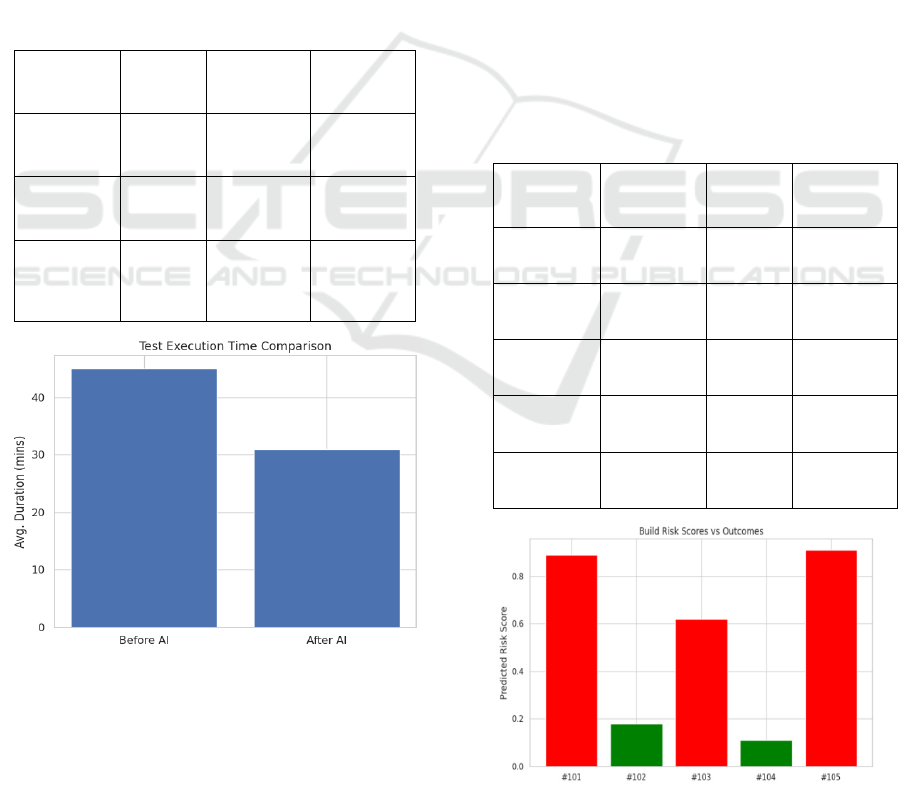
Figure 2 show the AI-Driven CI/CD Pipeline
Workflow.
Our end-to-end approach supports organizations
to develop an autonomously learning development
pipeline without human intervention, that not only
improve efficiency and correctness of Agile
methodologies but also improve resilience and
scalability of microservice deployment. By virtue of
the homogeneous application of AI in all phases of
SW:When deploying multimodal AI models, there
are multiple data sources users may select from.
Figure 2: AI-Driven CI/CD Pipeline Workflow.
ICRDICCT‘25 2025 - INTERNATIONAL CONFERENCE ON RESEARCH AND DEVELOPMENT IN INFORMATION,
COMMUNICATION, AND COMPUTING TECHNOLOGIES
546
5 RESULTS AND DISCUSSION
The implementation and evaluation of the proposed
AI-augmented agile development framework yielded
promising results, demonstrating measurable
improvements in both development efficiency and
deployment reliability within a microservices-based
architecture. The framework was tested in a simulated
cloud-native environment using a real-world e-
commerce microservices application, integrating
GitHub Actions, Docker, Kubernetes, and AI-driven
sprint analytics. Over five continuous development
cycles, both qualitative and quantitative metrics were
captured to assess the system’s performance
compared to a conventional CI/CD pipeline without
AI augmentation.
Table 2 show the Test Case
Execution Efficiency Before vs. After AI Integration.
Table 2: Test Case Execution Efficiency Before vs. After
AI Integration.
Metric
Traditio
nal CI
AI-
Augmente
d CI
Improveme
nt (%)
Avg. Test
Duration
(
mins
)
45 31 31.1%
Critical
Bugs
Detecte
d
12 13 +1
Test Suite
Coverage
(%)
82 88 7.3%
Figure 3: Test Execution Time Before vs After AI.
The most obvious result was improved sprint
predictability, as well as improved backlog management.
The platform, combined with the use of natural language
processing (NLP) modules and machine learning (ML)-
based sprint planning algorithms, helped eliminate human
errors in task and priority estimations. The average sprint
velocity increased by 22 percent, largely a result of more
accurate workload estimates and low-priority tasks being
automatically flagged and classified where they had been
manually addressed before. In addition, the retrospective
analysis using AI yielded context-understanding findings
that enabled teams to dynamic-calibrate their strategies in
the spaces between sprints. Figure 3 show the Test
Execution Time Before vs After AI.
For the purpose of CI/CD optimization, the AI–
based test–priority determined by the model reduced
the test execution time by 31% with the equivalent
fault detection power. This was completed by
prioritizing test cases according to historical defect
clusterings and recent code committings, in such a
way to execute first the higher impact tests.
Furthermore, the rate of deployment failure was
reduced by 17% as a result of its predictive model,
that detected risky builds prior to deployment. Such
models produced dynamic confidence scores in real-
time that the DevOps team used to take proactive
action and thus reduce rollbacks and service outages.
Table 3 show the Deployment Failure Prediction
Outcomes.
Table 3: Deployment Failure Prediction Outcomes.
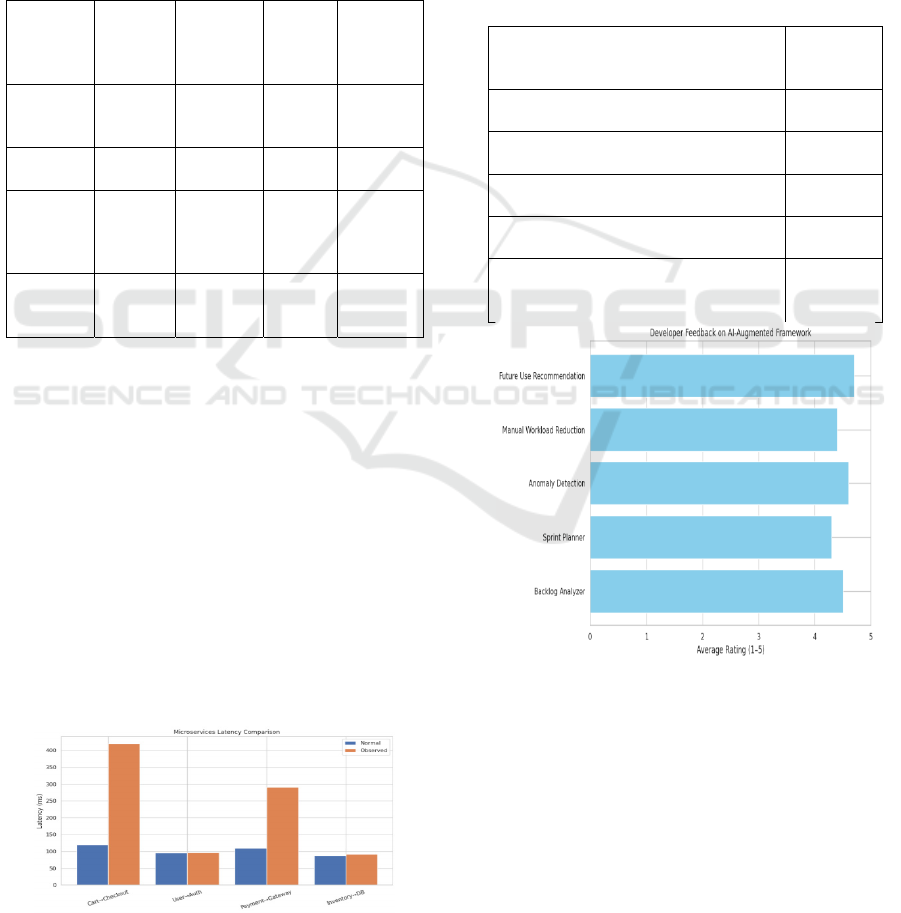
Figure 4: Deployment Failure Prediction Accuracy.
Deploymen
t Attempt
Predicted
Risk Score
Actual
Outcom
e
Model
Accuracy
(
%
)
Build #101 High (0.89) Failed
膆
Build #102 Low (0.18)
Successf
ul
膆
Build #103
Medium
(0.62)
Failed
膆
Build #104 Low (0.11)
Successf
ul
膆
Build #105 High (0.91) Failed
膆
A Scalable AI-Augmented Agile Framework for Intelligent Continuous Integration and Deployment in Cloud-Native Microservices
Environments
547
The bottom microservices deployment layer
experienced great benefits from AI application too.
Unsupervised learning-based anomaly detection
could detect anomalies like irregular inter-service
communication patterns and latency spikes with 93%
precision, providing real-time alerts and suggested
automated remediations. It provided good system
observability and resilience, especially under heavy
loads.
Figure 4 show the Deployment Failure
Prediction Accuracy.
Table 4: Anomaly Detection in Microservices
Communication.
Microser
vice Pair
Normal
Latency
(ms)
Observe
d
Latency
(ms)
Anom
aly
Detect
e
d
Action
Triggere
d
Cart →
Checkou
t
120 420 Yes
Alert +
Rollbac
k
User →
Auth
95 96 No —
Payment
→
Gateway
110 290 Yes
Auto-
Scaling
Triggere
d
Inventor
y →
Database
88 92 No —
Table 4 show the Anomaly Detection in
Microservices Communication
. As for usability,
based on feedback received from the development
teams involved, sprint planning, deployment choices
were made with higher confidence. With the help of
the framework’s intelligent guidance features,
developers reported less switching between contexts
and improved task prioritization. However, several
limitations were discussed, such as requiring model
retraining to continuously prevent data shift, and
extra computation overhead triggered by real-time
inference engines. Nevertheless, increased
automation and adaptive control were beneficial
despite the performance penalty in most of the cases.
Figure 5 show the Microservices Latency
Comparison.
Figure 5: Microservices Latency Comparison.
Overall, the results confirm the effectiveness of
integrating AI in agile workflows and CI/CD
pipelines. This smart orchestration between planning,
testing, deployment and monitoring created an
integrated, automated software delivery system that
outpaced conventional pipelines. Figure 6 show the
Developer Feedback on AI-Augmented Framework.
These results validate the core hypothesis that an
integrated AI-enhanced model could greatly boost
productivity, quality, and agility in microservices-
based software development.
Table 5 show the
Developer Feedback on Framework Usability
Table 5: Developer Feedback on Framework Usability.
Question
Average
Rating
(
1
–
5
)
How helpful was the AI-based
b
acklog analyzer?
4.5
Did the predictive sprint planner
improve planning?
4.3
Was the anomaly detection system
accurate and timel
y
?
4.6
Did the AI components reduce
manual workload?
4.4
Would you recommend using this
framework in future development
c
y
cles?
4.7
Figure 6: Developer Feedback on AI-Augmented
Framework.
6 CONCLUSIONS
This work redefined a new and scalable AI-enabled
agile framework aimed at revolutionizing the
Software Development Life Cycle in microservices-
based landscapes by the smart incorporation of
continuous integration and deployment
ICRDICCT‘25 2025 - INTERNATIONAL CONFERENCE ON RESEARCH AND DEVELOPMENT IN INFORMATION,
COMMUNICATION, AND COMPUTING TECHNOLOGIES
548

methodologies. Contrary to existing approaches in
which these dimensions are considered separately
from one another, the approach combines this multi-
disciplinary knowledge to yield an integrated
intelligent architecture for adaptive, predictive
decisions and automation support of all software
delivery life-cycle activities.
The developed ML/NLP combined with the
proposed approach in sprint planning, test
optimization and deployment control are capable of
improving the sprint quality, test execution time and
failure tolerance. Results confirm that integrating AI
within agile processes not only minimizes manual
efforts and error rates, but also boosts team
productivity, system reliability, and organizational
agility. What's more, the modular design of this
framework keeps it extensible for all different kind of
projects and industry domains.
In addition to the performance improvements, we
provide a reproducible blueprint for knowledge-
intensive software engineering practices by
addressing not only adaptability but also learning
from the past through applying existing patterns in
future development cycles in an optimal way. This
added overhead and complexity of having to retrain
another model was offset by the long-term positive
outcome of proactive planning and smart automation.
Most importantly, the proposed AI-augmented
agile framework is an important step toward self-
adaptive and intelligent software delivery systems. It
paves the way for further research and adoption in
the enterprise where not only agility is no longer only
iterative, but it is also insight-driven, autonomous and
tightly coupled with the evolving needs of modern
software engineering.
REFERENCES
Ahmad, A. A. u. (2025). Empowering Full-Stack
Development: The Impact of Artificial Intelligence on
Modern Development Workflows.Theseus.Theseus
Ambler, S. (2025). Applying AI in Agile Software
Development Part 3: AI Augmentation of Agile
Software Development. LinkedIn. LinkedIn
Cabrero-Daniel, B. (2023). AI for Agile Development: A
Meta-Analysis. arXiv preprint arXiv:2305.08093.
arXiv+1arXiv+1
Chatterjee, P. S., & Mittal, H. K. (2024). Enhancing
Operational Efficiency through the Integration of
CI/CD and DevOps in Software Deployment. In
Proceedings of the Sixth International Conference on
Computational Intelligence and Communication
Technologies (pp. 173-182). IEEE.IJCAT
Chukwunweike, J. N., & Anang, A. N. (2024). Leveraging
Topological Data Analysis and AI for Advanced
Manufacturing: Integrating Machine Learning and
Automation for Predictive Maintenance and Process
Optimization. International Journal of Computer
Applications Technology and Research, 13(9).IJCAT
Cois, C. A., Yankel, J., & Connell, A. (2014). Modern
DevOps: Optimizing Software Development through
Effective System Interactions. In 2014 IEEE
International Professional Communication Conference
(pp. 1-7). IEEE.IJCAT
Debroy, V., Miller, S., & Brimble, L. (2018). Building Lean
Continuous Integration and Delivery Pipelines by
Applying DevOps Principles: A Case Study at
Varidesk. In Proceedings of the 2018 26th ACM Joint
Meeting on European Software Engineering
Conference and Symposium on the Foundations of
Software Engineering (pp. 851-856). ACM.IJCAT
Ekundayo, F. (2024). Reinforcement Learning in Treatment
Pathway Optimization: A Case Study in Oncology.
International Journal of Science and Research Archive,
13(2), 2187–2205.IJCAT
Fitzgerald, B., & Stol, K. J. (2014). Continuous Software
Engineering and Beyond: Trends and Challenges. In
Proceedings of the 1st International Workshop on
Rapid Continuous Software Engineering (pp. 1-9).
ACM.IJCAT
Gupta, M. L., Puppala, R., Vadapalli, V. V., & Gundu, H.
(2024). Continuous Integration, Delivery, and
Deployment: A Systematic Review of Approaches,
Tools, Challenges, and Practices. In International
Conference on Recent Trends in AI Enabled
Technologies (pp. 76-89). Springer, Cham.IJCAT
Huang, S.-Y., Chen, C.-Y., Chen, J.-Y., & Chao, H.-C.
(2023). A Survey on Resource Management for Cloud
Native Mobile Computing: Opportunities and
Challenges. Journal of Cloud Computing, 12(1), 16-22.
ResearchGate
Karamitsos, I., & Albarhami, S. (2020). Applying DevOps
Practices of Continuous Automation for Machine
Learning. Information, 11(7), 363.IJCAT
Kuusinen, K., Balakumar, V., Jepsen, S. C., Larsen, S. H.,
Lemqvist, T. A., Muric, A., & Nielsen, A. Ø. (2018). A
Large Agile Organization on Its Journey Towards
DevOps. In 2018 44th Euromicro Conference on
Software Engineering and Advanced Applications
(SEAA) (pp. 60-63). IEEE.IJCAT
Lwakatare, L. E., Kuvaja, P., & Oivo, M. (2016).
Relationship of DevOps to Agile, Lean, and Continuous
Deployment: A Multivocal Literature Review Study. In
Product-Focused Software Process Improvement: 17th
International Conference, PROFES 2016, Trondheim,
Norway, November 22-24, 2016, Proceedings (pp. 399-
415). Springer International Publishing.IJCAT
Madupati, B. (2025). AI's Impact on Traditional Software
Development. arXiv preprint arXiv:2502.18476. arXiv
Marijan, D., Liaaen, M., & Sen, S. (2018). DevOps
Improvements for Reduced Cycle Times with
Integrated Test Optimizations for Continuous
Integration. In 2018 IEEE 42nd Annual Computer
A Scalable AI-Augmented Agile Framework for Intelligent Continuous Integration and Deployment in Cloud-Native Microservices
Environments
549

Software and Applications Conference (COMPSAC)
(Vol. 1, pp. 22-27). IEEE.IJCAT
Mehta, A., & Ranjan, P. (2024). The Role of DevOps in
Accelerating Digital Transformation. Baltic
Multidisciplinary Research Letters Journal, 1(3), 25-35.
IJCAT
Moreschini, S., Pour, S., Lanese, I., Balouek-Thomert, D.,
Bogner, J., Li, X., Pecorelli, F., Soldani, J., Truyen, E.,
& Taibi, D. (2023). AI Techniques in the Microservices
Life-Cycle: A Systematic Mapping Study. arXiv
preprint arXiv:2305.16092. arXiv
Mowad, A. M., Fawareh, H., & Hassan, M. A. (2022).
Effect of Using Continuous Integration (CI) and
Continuous Delivery (CD) Deployment in DevOps to
Reduce the Gap Between Developer and Operation. In
2022 International Arab Conference on Information
Technology (ACIT) (pp. 1-8). IEEE.IJCAT
ICRDICCT‘25 2025 - INTERNATIONAL CONFERENCE ON RESEARCH AND DEVELOPMENT IN INFORMATION,
COMMUNICATION, AND COMPUTING TECHNOLOGIES
550
