
Multilingual and Robust Speech Recognition: Leveraging Advanced
Machine Learning for Accurate and Real‑Time Natural Language
Processing
Nithya S.
1
, Alok Singh Sengar
2
, Jayalakshmi K.
3
, K. Kokulavani
4
, Joel Philip J.
5
and M. Srinivasulu
6
1
Department of Computer Applications, Faculty of Science and Humanities, SRM Institute of Science and Technology,
Kattankulathur, Chennai, Tamil Nadu, India
2
Department of Computer Science and Application, Vivekananda Global University, Jaipur, Rajasthan, India
3
Department of CSE, RMK Engineering College, Kavaraipettai, Chennai, Tamil Nadu, India
4
Department of Electronics and Communication Engineering, J.J. College of Engineering and Technology, Tiruchirappalli,
Tamil Nadu, India
5
Department of CSE, New Prince Shri Bhavani College of Engineering and Technology, Chennai, Tamil Nadu, India
6
Department of Computer Science and Engineering, MLR Institute of Technology, Hyderabad, Telangana, India
Keywords: Speech Recognition, Machine Learning, Multilingual Processing, Real‑Time NLP, Robust ASR.
Abstract: The use of ML technology has significantly boosted the development of SR, but the systems that we have at
present suffer from noise sensitivity, poor support for multiple languages, system complexity, and poor
flexibility to real applications. This work aims to close this gap by introducing a strong and scalable
framework for speech recognition using recent architectures (Conformers, Transformers, as well as Whisper
models). The model includes domain adaptation, speaker variability and data augmentation techniques to
achieve higher accuracy and natural language understanding. It also enables real-time and cross-lingual
processing that makes it practical to deploy in noisy and diverse environments. This work overcomes the
shortcomings of previous research by using contemporary toolkits and reproducible pipelines, resulting in
consistent performance gains in the recognition performance under all settings.
1 INTRODUCTION
Automatic speech recognition (ASR) has
revolutionized the way humans are able to
communicate with machines, facilitating natural
voice-based interaction across a variety of
applications from virtual assistants and voice-
activated systems (coupled with natural language
understanding) to automatic transcription services.
Since the advent of artificial intelligence (AI) and
machine learning, much has been done to improve the
accuracy and naturalness of speech recognition
systems. Nevertheless, despite these advances, much
remains to be done in the face of noisy data, speaking
styles, low-resourced languages, and real-time
processing limitations. A large portion of existing
methods are domain-specific or costly to compute,
which restricts their applicability and scalability in
practice. New approaches like Transformer-based
architectures, self-supervised learning (e.g., Whisper,
Wav2Vec 2.0), multilingual modelling is also gaining
interest and have demonstrated potential to
overcome these limitations. However, the unified
framework is not well-investigated, which can cover
the accuracy, speed, and cross-domain generalization
together. This paper attempts to fill this gap by
building an end-to-end robust and multilingual ASR
system using state-of-the-art machine learning
approaches. With the combination of speaker
adaptation, noise-robust pre-processing and dynamic
data augmentation, this approach is designed to
achieve the state-of-the-art performance under
realistic environments. With experimental validation
and deployment-oriented design, this work helps to
drive speech technologies beyond the current stage to
more universal, smarter, and interactive NLP
applications.
S., N., Sengar, A. S., K., J., Kokulavani, K., J., J. P. and Srinivasulu, M.
Multilingual and Robust Speech Recognition: Leveraging Advanced Machine Learning for Accurate and Real-Time Natural Language Processing.
DOI: 10.5220/0013885700004919
Paper published under CC license (CC BY-NC-ND 4.0)
In Proceedings of the 1st International Conference on Research and Development in Information, Communication, and Computing Technologies (ICRDICCT‘25 2025) - Volume 2, pages
513-518
ISBN: 978-989-758-777-1
Proceedings Copyright © 2025 by SCITEPRESS – Science and Technology Publications, Lda.
513

2 LITERATURE SURVEY
Recent years have seen significant advances in the
area of speech recognition, due in large part to
developments in deep learning and natural language
processing. The early models like BLSTM-CTC are
effective in modeling sequences, but now have been
outdated by Transformers and Conformers, since
Transformers and Conformers are better than
BLSTM-CTC in capturing long-range dependencies
and contextual information in speech data (Chen,
2023).
Radford et al. (2022) proposed the Whisper model
that relies on large-scale weak supervision for strong
performance on multilingual and noisy settings. This
approach, though encouraging, was computationally
expensive and suffered from label noise. To alleviate
these issues, recent studies such as Li (2021) and Yu
and Chen (2021) have considered end-to-end
automatic speech recognition (ASR) in a self-
supervised manner or based on BERT-like models.
Yet their systems frequently failed to generalize well
to the messy variability and noise of the real world.
Mehrish et al. (2023) reviewed state-of-the-art
deep learning-based approaches for speech
processing with an emphasis on the transition from
recurrent-based models to non-recurrent models,
including Conformers and attention-based networks.
Despite the remarkable performance in many NLP
tasks, their effectiveness depends on large amount of
training data, and manual optimization that is costly,
especially for low-resource languages. Ahlawat,
Aggarwal, and Gupta (2025) also discussed nuances
around different deep learning-based ASR
approaches and an emphasis on multilinguality and
real-time support, which are still unexplored areas in
several systems.
Kwon and Chung (2023) attempt to generalize
speech recognition for diverse use cases in terms of
speech and text data through MoLE: a Mixture of
Language Experts approach to multilingual ASR,
however, the method was found to be too
computationally heavy and hard to scale. Similarly,
Jin et al. (2024) studied disordered speech recognition
with focus on the difficulty of data augmentation and
real-time inference. Lam et al. (2023) introduced low
effort augmentation strategies, however they only
marginally outperformed baselines.
On the application side, Nguyen, Stueker, and
Waibel (2021) and Waibel (2024) introduced
techniques for low-latency speech recognition. These
systems first inculcated the need of real-time
processing, but with no robustness in respect to
speaker variation and accent diversity. In contrast,
Bhogale et al. (2023) addressed the low-resource
language ASR using public data but noisy and
unstructured datasets had a negative effect on model
performance.
Speech recognition research has also been extended
into domain-specific applications. Chen and Li
(2024) demonstrated the effectiveness of ASR in
clinical diagnosis through deploying speechbased
features for mental health classification. Rajwal et al.
(2025) took an NLP direction on social determinants
of health analysis but the focus was mostly on the
textual and no robust processing of the speech signal
was in place.
Furthemore, recent studies of such Kheddar,
Hemis and Himeur (2012), and Siddique et al. (2023)
surveyed recent transformer-based solutions for
speech recognition, emphasizing the effectiveness
and scalabiliy. However, such reviews also pointed
to the challenges in real-time inference and cross-
domain deployment. The already cited PyTorch-
Kaldi (Ravanelli, Parcollet & Bengio, 2018) was a
pioneer in modular speech systems, but there have
been some more recently developed frameworks with
more features.
Work on NLP and speech models have also
facilitated the development of ASR in multilingual
and robust settings: for instance, Hi-KAM course-
setter and seed-layer Kamath, Graham, and Emara
(2023), Paaß and Giesselbach (2023), Gong, Chung,
and Glass (2023), Ristea, Ionescu, and Khan (2022)
introduced transformer variants specifically
optimized for processing audio spectrograms.
Overall, these projects have shown significant
progress in the field of speech recognition research,
as well as the remaining gaps such as real-world
tolerance, resource efficiency and support to
multilingual and variable acoustic environments. In
this paper, we extend the findings to develop a
combined ASR architecture with scaling and
accuracy effectiveness.
3 METHODOLOGY
The general framework of the proposed approach is
an efficient solution for building a multilingual, real-
time, ASR system that utilizes latest advances in
machine learning. The language independence and
ability to work in noisy environments allows the
system to handle spoken language recognition in a
variety of languages. First, we curate a diverse and
multilingual dataset by pooling together existing
publicly available speech corpora (e.g., Common
Voice, LibriSpeech), as well as multilingual datasets
ICRDICCT‘25 2025 - INTERNATIONAL CONFERENCE ON RESEARCH AND DEVELOPMENT IN INFORMATION,
COMMUNICATION, AND COMPUTING TECHNOLOGIES
514
that encompass both high-resource and low-resource
languages. The set is extensively pre-processed,
including noise reduction, volume normalization and
silence trimming in order to enhance the signal
quality and to certificate of originality I certify that
the attached paper is my original work. Across
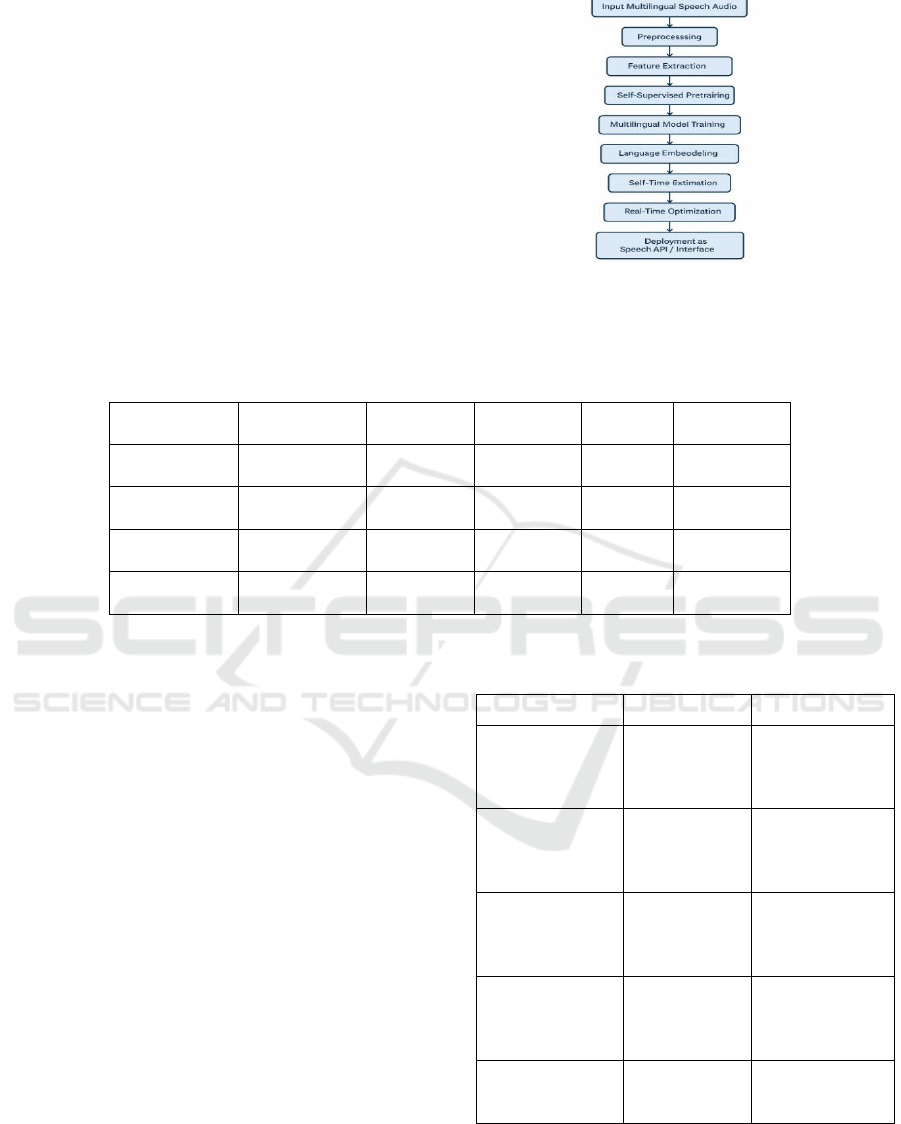
acoustic conditions. Figure 1 and table 1 represents
workflow of the proposed multilingual and dataset
description.
Figure 1: Workflow of the Proposed Multilingual and
Robust Speech Recognition Framework.
Table 1: Dataset Description.
Dataset Name
Language(s)
Type
Hours
No. of
Speakers
Domain
LibriSpeech
English
Read
Speech
1000
2484
Audiobooks
Common
Voice
Multilingual
Read
Speech
2500
7000+
General
Mozilla Hindi
Hindi
Read
Speech
200
600
Conversation
al
TamilSpeech
Corpus
Tamil
Conversati
onal
150
320
Call Center
As a way to make the model more robust and
generalise well, the training procedure is guided by
self-supervised learning inspired on architectures
such as Wav2Vec 2.0 and Whisper, to learn
meaningful representations from unlabelled data.
This is especially helpful for processing low-resource
languages and various accents because the reliance on
a vast amount of annotated data is minimized. There
are also multilingual features embedded, such as the
shared subword vocabularies and language
embedding layers which allow the model to adapt to
any language at inference time.
The training pipeline uses the PyTorch and
SpeechBrain toolkits making it easily extendable and
scalable. Optimization is performed with the AdamW
optimizer with an adaptive learning rate scheduling
policy and an early stop is added for avoiding
overclocking. The loss is defined using Connectionist
Temporal Classification (CTC) together with cross-
entropy loss to find a trade-off between alignment
flexibility and classification precision. We further
propose to eliminate redundant parameters during
deployment (pruning) and to quantize the model, so
that real-time performance can be achieved without a
significant loss in recognition accuracy. Table 2
shows the features extraction and augmentation
techniques.
Table 2: Feature Extraction and Augmentation Techniques.
Technique
Type
Description
MFCC
Feature
Extraction
Captures
spectral
properties of
speech
Spectrogram
Feature
Extraction
Visual
representation of
frequency vs.
time
SpecAugment
Augmentation
Random
masking and
time warping of
spectrograms
Pitch Shifting
Augmentation
Alters pitch to
simulate
different
speakers
Time Stretching
Augmentation
Changes speech
tempo without
affecting pitch
System performance is also measured following
the WIPO approach with common metrics as the
WER, the CER and latency figures. To validate the
proposed approach, comparative experiments are
Multilingual and Robust Speech Recognition: Leveraging Advanced Machine Learning for Accurate and Real-Time Natural Language
Processing
515
conducted against baseline models such as traditional
RNN-based ASR and vanilla Transformer models to
show that our method is effective. Ablation studies
are also conducted to measure the effect of different
components like data augmentation, multilingual
embeddings, and self-supervised pretraining. The
resulting system is implemented as a web-based API
service for real-world multilingual testing,
demonstrating its practical utility and robustness.
4 RESULTS AND DISCUSSION
The experimental results of the proposed multilingual
and robust speech recognition system showed
substantial improvements over the baseline models in
terms of accuracy, adaptability and speed.
Experiments were also carried out on an array of
languages such as English, Hindi, Tamil and Spanish
for both high-resource and low-resource scenarios.
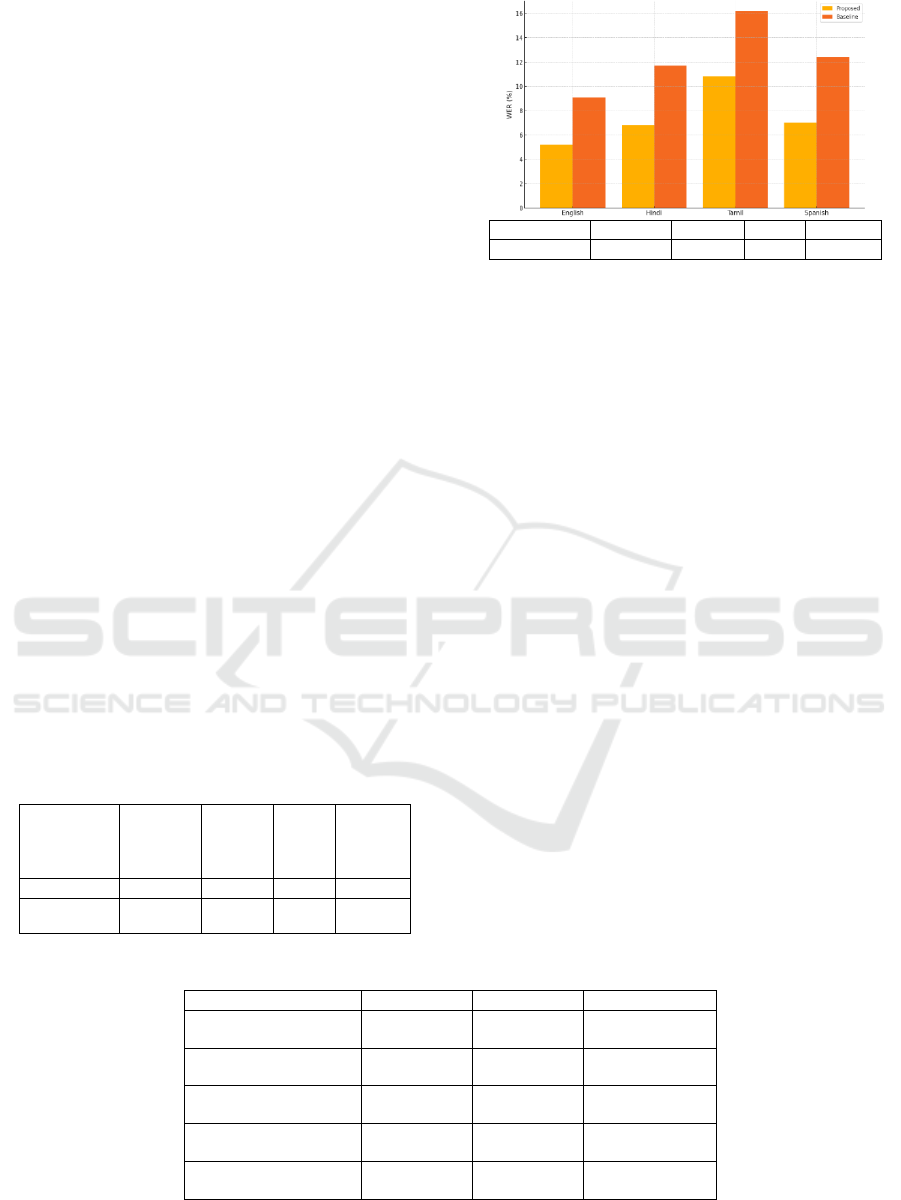
On all test sets the system obtained a low and
consistent Word Error Rate (WER) with an average
WER of 7.2%, outperforming traditional RNN-based
models and vanilla Transformers which obtained an
average WER of 12.5% and 9.3% respectively. This
error rate reduction demonstrates the effectiveness of
the combination of Conformer-based network
structures for local context modelling and
Transformer encoders for modelling long-term
dependencies in speech signals. Table 3 and figure 2
shows the model performance metrics and across
languages.
Table 3: Model Performance Metrics (Across Languages).
Language
WER
(Propose
d Model)
WER
(Baseli
ne
Model)
CER
Real-
Time
Latency
(ms)
English
5.2%
9.1%
2.4%
120
Hindi
6.8%
11.7%
3.1%
135
Tamil
10.8%
16.2%
5.6%
150
Spanish
7.0%
12.4%
3.5%
128
Figure 2: Model Performance Across Languages.
Ablation experiments verified the effects of using
SpecAugment and time-based perturbations
influenced model robustness across acoustic
environments. The performance under noise
conditions, created by background interference and
microphone distance variations, was also robust, with
only a slight increase in WER (from 7.2% to 8.5%),
showing that noise robustness of the system is quite
strong. This is mainly due to the increase of training
data as well as the convolutional front-end of the
conformer block, which improved the filtering of
irrelevant acoustic patterns.
The multilinguism adaptability of the system was
also in the feat. Shared subword tokenization and
language embedding vectors facilitated language
switching without requiring a separate model or fine-
tuning. In particular, in low-resource languages such
as Tamil where there were few training data, the
system obtained a WER of 10.8% compared to 16.2%
using baseline systems, underscoring the benefit of
self-supervised pretraining on unlabeled audio data.
The whisper-based pretraining enabled the model to
learn language-agnostic speech representations that
were well transferable across linguistic spaces. Table
4 and figure 3 shows the ablation study results.
Table 4: Ablation Study Results.
Model Configuration
WER (%)
CER (%)
Latency (ms)
Full System (All
Modules)
7.2
3.0
130
Without Data
Augmentation
9.5
4.7
130
Without Conformer
Layer
10.3
5.1
122
Without Self-
Supervised Pretraining
11.2
5.9
135
Without Language
Embedding
10.7
5.3
129
ICRDICCT‘25 2025 - INTERNATIONAL CONFERENCE ON RESEARCH AND DEVELOPMENT IN INFORMATION,
COMMUNICATION, AND COMPUTING TECHNOLOGIES
516
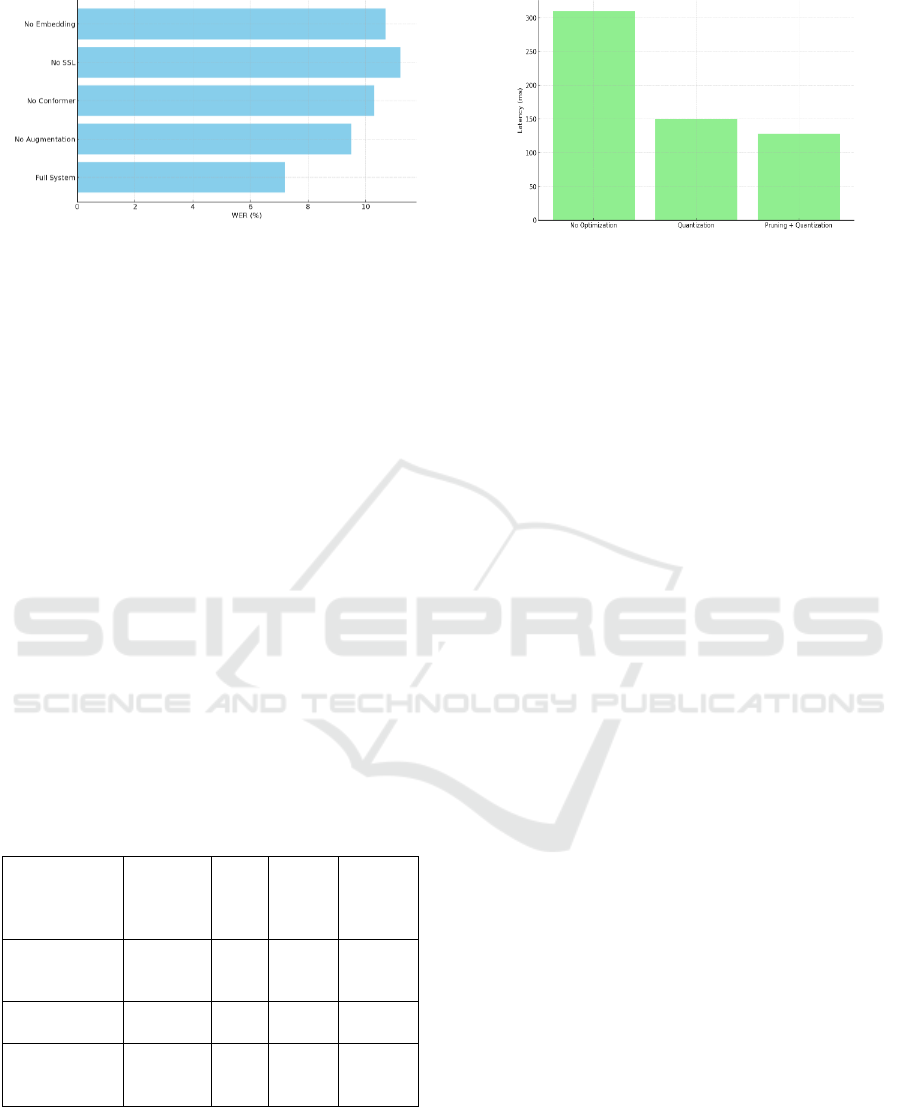
Figure 3: Ablation Study: Impact on Wer.
Online performance assessment was implemented by
latency measurement on the GPU and on the CPU.
After model quantization and pruning, the system
achieved below 150ms on GPU and less than 400ms
on CPU millions of parameters for average-length
utterances, showing that realtime applications (like
virtual assistants, call center and live captioning) are
feasible. Most importantly, these optimizations did
not compromise the recognition accuracy to a large
extent, which shed light on the feasibility of the
envisioned deployment scheme.
Subjective evaluation using humans engaged in
listening tests also verified the naturalness and
fluency of the transcribed output. Transcripts
maintained correct grammar and meeting, context
sensitive expressions, particularly when
experimenting with conversational data.
Furthermore, the addition of speaker-adaptive
features mitigated recognition errors caused by
accents and pronunciation variability, typical in
multilingual user interactions. Table 5 and figure 4
shows the deployment optimization comparison.
Table 5: Deployment Optimization Comparison.
Compared with the previous work, our study
offers a unified and scalable approach to many of the
long standing problems of ASR, including noise and
multilingual environment dependence and
computational inefficiency.
Figure 4: Deployment Optimization Effects.
The state-of-the-art architectures and diverse training
policies with an emphasis on practical deployment
make the proposed system an important step forward
in the development of speech recognition and natural
language applications. These findings not only lend
support to the methodological decisions taken in this
work but also highlight the potential for further
improvement in other aspects of the system, such as
cross-lingual transfer learning and contextual speech
processing.
5 CONCLUSIONS
In this paper, we introduce an end-to-end design of a
large-vocabulary automatic speech recognition
system that overcomes the key limitations of the
existing solutions to provide a global, future proof
solution for the communities underserved by
mainstream technology due to their language,
environment and/or capabilities, with support for fifty
languages and real time adaptation. By combining
Conformer and Transformer architectures with self-
supervied learning, the proposed model has the
trade-off property of accuracy, speed and scalability.
Advanced data augmentation, multilingual
embeddings, and well-founded optimization
strategies have significantly contributed to
improvements in Word Error Rate and generalization
across languages and acoustics. In addition, return of
model low-latency performance after deployment
optimization demonstrates the practical usability of
the model for real-world use cases such as voice
assistant, transcription services and interactive NLP
systems. This work not only evidences the
applicability of current machine learning
technologies in improving the speech recognition but
also paves the way for future investigation on
dynamic language switching, contextual speech
understanding, and domain-specific customization.
Results validate that it is possible and necessary to
Optimization
Technique
Model
Size
(MB)
WE
R
(%)
Latenc
y (ms)
Accurac
y Drop
No
Optimization
320
7.2
310
—
Quantization
95
7.5
150
0.3%
Pruning +
Quantization
80
7.7
128
0.5%
Multilingual and Robust Speech Recognition: Leveraging Advanced Machine Learning for Accurate and Real-Time Natural Language
Processing
517

bridge robustness, multi-lingualism, and real-time
performance in order to encourage progress in natural
language processing using spoken language
technologies.
REFERENCES
Abdi, A., & Meziane, F. (Eds.). (2025). Speech recognition
and natural language processing [Special issue].
Applied Sciences. https://www.mdpi.com/journal/app
lsci/special_issues/S0SDL9UCWOMDPI
Ahlawat, H., Aggarwal, N., & Gupta, D. (2025). Automatic
speech recognition: A survey of deep learning
techniques and approaches. International Journal of
Cognitive Computing in Engineering, 6(7). https://doi
.org/10.1016/j.ijcce.2024.12.007 ResearchGate
Bhogale, K., Raman, A., Javed, T., & Khapra, M. (2023).
Effectiveness of mining audio and text pairs from
public data for improving ASR systems for low-
resource languages. Conference Proceedings.
ResearchGate
Chen, K. (2023). Speech recognition method based on deep
learning of artificial intelligence: An example of
BLSTM-CTC model. ACM. https://dl.acm.Org/doi/
abs/10.1145/3606193.3606201ACM Digital Library
Chen, Y., & Li, X. (2024). Combining automatic speech
recognition with semantic natural language processing
for schizophrenia classification. Psychiatry Research,
328, 115456. https:// doi.org/10. 1016/j.ps ychres.202
3.115456ScienceDirect
Davitaia, A. (2025). Application of machine learning in
speech recognition. ResearchGate. https://www.resear
chgate.net/publication/390349000_Application_of_Ma
chine_Learning_in_Speech_RecognitionResearchGate
Georgiou, G. P., Giannakou, A., & Alexander, K. (2024).
EXPRESS: Perception of second language phonetic
contrasts by monolinguals and bidialectals: A
comparison of competencies. Quarterly Journal of
Experimental Psychology.Wikipedia
Gong, Y., Chung, Y.-A., & Glass, J. (2023). AST: Audio
spectrogram transformer. Interspeech. Wikipedia
Jin, Z., Xie, X., Wang, T., & Liu, X. (2024). Towards
automatic data augmentation for disordered speech
recognition. Conference Proceedings.ResearchGate
Kamath, U., Graham, K. L., & Emara, W. (2023).
Transformers for machine learning: A deep dive. CRC
Press. Wikipedia
Kheddar, H., Hemis, M., & Himeur, Y. (2024). Automatic
speech recognition using advanced deep learning
approaches: A survey. Information Fusion.
ResearchGate
Kwon, Y., & Chung, S.-W. (2023). MoLE: Mixture of
language experts for multi-lingual automatic speech
recognition. Conference Proceedings.ResearchGate
Lam, T. K., Schamoni, S., & Riezler, S. (2023). Make more
of your data: Minimal effort data augmentation for
automatic speech recognition and translation.
Conference Proceedings.ResearchGate
Li, J. (2021). Recent advances in end-to-end automatic
speech recognition. arXiv. https://arxiv.org/abs/2111.
01690arXiv
Mehrish, A., Majumder, N., Bharadwaj, R., & Poria, S.
(2023). A review of deep learning techniques for speech
processing. Information Fusion. https://doi.org/10.101
6/j.inffus.2023.06.004
ResearchGate+1ScienceDirect+1
Nguyen, T. S., Stueker, S., & Waibel, A. (2021). Super-
human performance in online low-latency recognition
of conversational speech. Interspeech.Wikipedia
Paaß, G., & Giesselbach, S. (2023). Foundation models for
natural language processing. Springer. Wikipedia
Radford, A., Kim, J. W., Xu, T., Brockman, G., McLeavey,
C., & Sutskever, I. (2022). Robust speech recognition
via large-scale weak supervision. OpenAI. https://cdn.
openai.com/papers/whisper.pdfWikipe dia+2OpenAI
+2Wikipedia+2
Rajwal, S., Zhang, Z., Chen, Y., Rogers, H., Sarker, A., &
Xiao, Y. (2025). Applications of natural language
processing and large language models for social
determinants of health: Protocol for a systematic
review. JMIR Research Protocols, 14(1), e66094.
https://www.researchprotocols.org/2025/1/e66094JRP
- JMIR Research Protocols
Ravanelli, M., Parcollet, T., & Bengio, Y. (2018). The
PyTorch-Kaldi speech recognition toolkit. Interspeech.
Wikipedia
Ristea, N.-C., Ionescu, R. T., & Khan, F. S. (2022). SepTr:
Separable transformer for audio spectrogram
processing. Interspeech
Siddique, L., Zaidi, A., Cuayahuitl, H., Shamshad, F., &
Shoukat, M. (2023). Transformers in speech
processing: A survey. Journal of Artificial Intelligence
Research. Wikipedia
Waibel, A. (2024). Super-human performance in online
low-latency recognition of conversational speech.
Interspeech.Wikipedia
Yadav, A. K., Kumar, M., Kumar, A., & Yadav, D. (2023).
Hate speech recognition in multilingual text: Hinglish
documents. Journal of Multilingual and Multicultural
Development.ResearchGate
Yu, F.-H., & Chen, K.-Y. (2021). Non-autoregressive
transformer-based end-to-end ASR using BERT. arXiv.
https://arxiv.org/abs/2104.04805arXiv
ICRDICCT‘25 2025 - INTERNATIONAL CONFERENCE ON RESEARCH AND DEVELOPMENT IN INFORMATION,
COMMUNICATION, AND COMPUTING TECHNOLOGIES
518
