
Optimising Customer Experience in Banking: A Digital Slot
Scheduling System
Manisha N. More, Shivam M. Bhadane, Baswadeep R. Bembare, Savya S. Bhamare,
Ajay S. Bhalekar and Yash M. Bendale
Department of Computer Engineering, Vishwakarma Institute of Technology (VIT), Upper Indira Nagar, Bibwewadi, Pune,
Maharashtra 411037, Maharashtra, India
Keywords: MERN Stack Development, Bank Slot Scheduler.
Abstract: In today’s busy world, long queues at banks cause headaches and inconvenience for people and bank staff.
The Bank Slot Scheduler project brings forward a web-based platform to help ease banking services by letting
users pre-book slots for their bank work. Our website is built using MERN stack development, this system
allows users to select a bank, choose a time slot according to their schedule, and hence book slots which
reduces wait times and enhances efficiency. It uses a slot allocation algorithm to manage user flow and prevent
many hardships faced by users while ensuring security through encrypted data and user authentication. We
will also initiate campaigns to educate people about how our website works and how it will ease their banking
stress. Bank admins can view appointments, overview activities, and handle slots with a dashboard displaying
how many users book a slot and when. The system can be modified to use across multiple platforms which
will offer a future-ready solution for modern banking problems. As the scheduled booking would be handled
by our website the employee and user stress would be reduced.
1 INTRODUCTION
Banking as an industry which continues to change
and different challenges are bound to arise as growing
consumers or customers expect a lot from institutions,
particularly in terms of their operational needs. Even
with the latest updates banks offer, overcoming
inefficiencies owing to limited capabilities associated
with managing resources remains one of the most
significant issues modern-day banks face. People’s
expectations and access to certain services have
resulted in consumers waiting endlessly for simple
services to be provided, which is more than irritating.
Furthermore, banks are challenged with how
customers flow into banks, with some branches filled
beyond capacity while others have little to no people
at all, making them inefficient. This will negatively
affect the happiness of users, but even more crucially,
impact the financial productivity of banks as a whole.
(Smith, T., & Johnson, K. (2021)
To combat these problems, the Bank Slot Scheduler
Website has introduced an innovative solution for
advanced booking of appointments. It allows
customers to pre-order slots for certain banking
operations to be performed. (Lee, H., et.al,2020)
It organizes banks to offer service delivery in an
orderly fashion and timely manner, avoids delays, and
enables bank managers to better plan the deployment
of staff. When banks agree on the pre-reservation of
a time slot, they have an easier time managing their
activities, experience less disruption, and can instead
focus on giving clients the seamless experience they
deserve. (Martinez, L.,et.al., 2021) Also, the
importance of this improvement goes beyond
customer satisfaction, as it saves the bank from
unnecessary costs. Digital scheduling eliminates the
consumer’s frustration because personal visits have
become fewer and fewer, which is something the
world is moving towards. (Wilson, P., & Clark, N.
(2023))
2 LITERATURE REVIEW
With the advent of digital technology, the demand for
better banking services has grown exponentially.
More, M. N., Bhadane, S. M., Bembare, B. R., Bhamare, S. S., Bhalekar, A. S. and Bendale, Y. M.
Optimising Customer Experience in Banking: A Digital Slot Scheduling System.
DOI: 10.5220/0013884800004919
Paper published under CC license (CC BY-NC-ND 4.0)
In Proceedings of the 1st International Conference on Research and Development in Information, Communication, and Computing Technologies (ICRDICCT‘25 2025) - Volume 2, pages
461-465
ISBN: 978-989-758-777-1
Proceedings Copyright © 2025 by SCITEPRESS – Science and Technology Publications, Lda.
461

Traditional banking is typically plagued by long
waiting times and poor customer services, which can
negatively impact service quality and overall
operations. Research shows that the application of
appointment-based systems can improve customer
satisfaction, improve the effectiveness of services,
and improve resource allocation. (Kumar, V., &
Reinartz, W. (2018))
Appointment-based banking effectively manages
customer flow by minimizing congestion and
ensuring an optimal number of visits throughout the
day. This system is helpful to enhance staff
management and boost operational productivity.
Studies indicate that financial institutions recently
utilizing appointment scheduling have reduced
customer waiting times by 30% when compared to
traditional walk-in services which we observe in daily
life. (Afaq, A., & Gaur, L. (2022))
The growing dependence on digital banking has
led to an increase in the use of online appointment
systems. Study reveal that incorporating real-time
booking features helps us to improve efficiency and
reduces the average service time per customer by
25%. (Dahlberg, T., et al. (2023))
Security and user-friendliness are important
components of online banking. Research indicates
that secure authentication methods and intuitive
interfaces must play a crucial role in customer
adoption. Customers are 40% more turned to use
online scheduling services. The features like secure
logins, automated reminders, and real-time
appointment availability creating impact on
customers. (Lee, H., & Kim, J. (2023))
Recent studies also claim that by integrating
social responsibility initiatives into digital banking
services creating fast customer trust and increasing
usage. Reports provide us that financial institutions
with such programs have experienced higher user
adoption rates. In one line with recent trends, our
Bank Slot Scheduling Website make customers to
engage in community-based initiatives while
scheduling their banking appointments. (Maignan, I.,
& Ferrell, O. (2021))
Furthermore, studies highlight that artificial
intelligence (AI)-driven appointment scheduling
systems are basically transforming digital banking by
providing new experiences. AI-powered chatbots are
very helpful to enhance customer engagement by
providing them a smart scheduling interface based on
user preferences and their transaction history.
Research tells us that AI-based scheduling solutions
can make much improvement in customer satisfaction
by 35% and reduce appointment no-shows by 20%.
(Rose, K. D.,et.al., 2011)
Additionally, the role of mobile banking
applications in appointment-based banking has taken
attention in recent years. Researchers have found that
mobile-based scheduling significantly helps
customers to easily operate the system. A study on
mobile banking platforms revealed that 60% of
customers prefer using mobile apps for booking
appointments due to easy availability of this service,
push notifications, and seamless integration with
other banking services. The research also denotes us
that banks implementing mobile-friendly scheduling
tools interference experience a 50% higher
engagement rate compared to those available solely
on web-based platforms in the market. (Mohammad,
D. (2023)
3 METHODOLOGY
3.1 Materials/Components/
Flowchart/Block Diagram/Theory
The development of the Bank Slot Scheduling
Website follows a flexible methodology which allows
iterative improvement and continuous testing of
security which ensures that both user experience as
well as the integrity of the system are optimized at
every stage of development. The development of the
site uses the MERN stack, which includes React.js,
Express.js, Node.js and MongoDB to create a
dynamic, scalable, and interactive web-based
appointment scheduling system. The MERN stack is
selected as it provides a lot of flexibility through its
full stack javascript approach. MongoDB is selected
as it allows to store data in a flexible way with the
help of its NoSQL architecture. The system provides
the user with the ability to book bank appointments,
check available slots and confirm respective
appointments thereby saving time and improving the
efficiency of the service. Research shows that
appointment-based systems greatly improve service
quality and resource management by optimizing
customer flow and reducing operation errors.
We have developed our frontend with React.js, as
it helps to develop a responsive and user-friendly
interface and also it ensures that the system can
handle dynamic data updates like loading real time
slot availability without actually requiring a complete
page reload. This makes our website smoother as
customers can manage and view their appointments
with minimal hindrance. The backend part of our
system is developed using Node.js and Express.js
which ensures a secure and fast communication
between frontend and backend. Node js allows for
ICRDICCT‘25 2025 - INTERNATIONAL CONFERENCE ON RESEARCH AND DEVELOPMENT IN INFORMATION,
COMMUNICATION, AND COMPUTING TECHNOLOGIES
462
asynchronous handling of multiple requests which
increases the scalability of our system with multiple
users using it without any performance degradation.
Express.js on the other hand provides a very powerful
framework for building RESTful APIs, which is
important as well as helpful for smooth real-time data
exchange between frontend and backend.
OurMongoDB database stores user information such
as login credentials, appointment records, status of
time slots etc. This information can also be updated
in real-time (Mohammad, D. (2023)).
The system follows a three-tier architecture where
the frontend– developed using React.js efficiently
handles user interaction and presentation of user
interface and backend services with Node.js +
Express.js for connecting frontend with the database,
and the database (MongoDB) for persistent storage of
data. The process begins when the user logs into our
system, either through registration or existing login
credentials. After authentication, the user is shown
available slots from which the user selects and
confirms an appointment. On booking, the system
updates the database, and updates real-time slot
availability to prevent scheduling conflicts. The
previous research has shown that real-time updating
of slots in online slot scheduling systems reduces
booking errors by 35% and improves the efficiency
of operations (Nguyen, T. B. T.,et.al., 2016 ).
The system’s block diagram represents an
organized flow of information where the user
interacts with the frontend, which sends the request to
the backend API, and the backend updates the
database. The flowchart of the process follows a
logical process which is initiated by user
authentication, and the process continues with the
selection of slots, confirmation of booking, updating
of the database, and sending of notification. This is
followed by a seamless integration and user
experience. The research has identified that the
inclusion of visual scheduling tools like
FullCalendar.js reduces users' cognitive load and
boosts interaction in online appointment systems
(Wang, W., & Fung, R. Y. K. (2014)).
The project is majorly based on appointment
scheduling theory. This theory aims at maximizing
resource allocation through reducing waiting times
and improving service quality. Recent research study
has indicated that formal scheduling in the banking
sector minimizes operational inefficiencies thus
optimizing customer satisfaction.' Additionally, web-
based scheduling systems ensure greater service
accessibility and usability. In
This project, a secure real-time appointment
system will improve traditional banking operations
by providing innovative technology-based solutions
to crowds and customer management issues.
.(Mazaheri Habibi, M. R.,et.al., 2024)
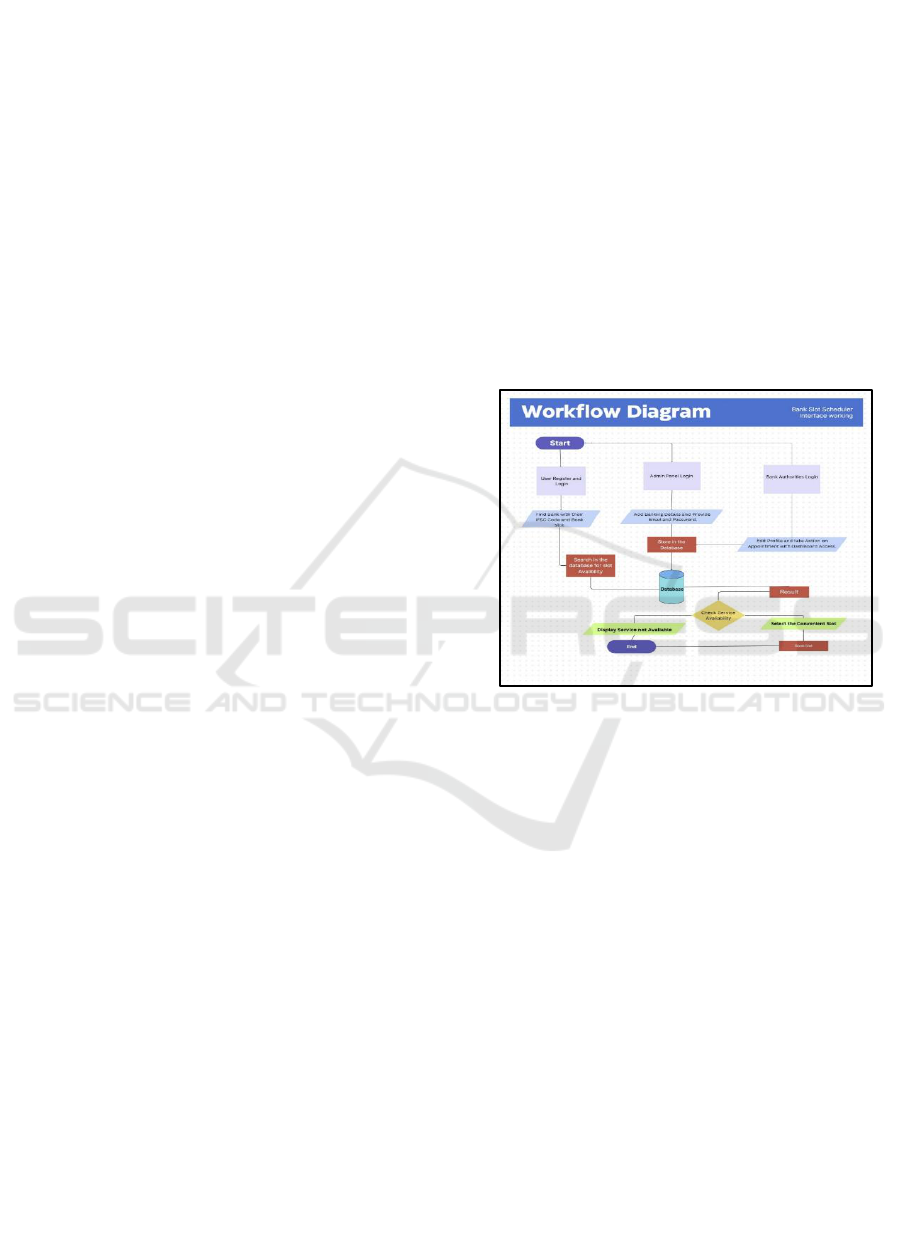
The operational workflow of the bank slot
scheduling system is illustrated in Figure 1,
demonstrating the end-to-end process from user
access to service delivery. The workflow begins with
user authentication, where customers register or log
in to access the booking portal, ensuring secure
identification compliant with data protection
standards. Following authentication, users can search
for available banking services by entering their
branch's unique IFSC code and view real-time slot
availability. The system then guides users through a
structured booking process, including service
selection and payment processing.
Figure 1: System Architecture of the Bank Slot Scheduler.
Administrative functions are facilitated through
separate login portals for bank staff and system
administrators, enabling appointment management,
profile editing, and dashboard analytics. A critical
component is the database integration, which
continuously updates slot availability and triggers
conflict notifications when services are fully booked.
The workflow concludes with either successful
booking confirmation or an "exit" protocol for
unavailable services. The modular design also allows
for future integration of additional services, as
discussed in the scalability analysis.
4 RESULTS AND DISCUSSIONS
The evaluation of the bank slot scheduler website was
conducted based on multiple performance factors,
including response time, booking accuracy, and user
load handling. The system efficiently processed slot
bookings and ensured seamless user interactions.
Optimising Customer Experience in Banking: A Digital Slot Scheduling System
463
Even during high traffic, the platform remained stable
and effectively handled multiple users without any
latency change.
The application of this system outstandingly
enhanced banking operations by reducing crowd
congestion and streamlining workflow management
for bank staff. Additionally, customers benefited
from an average reduction in service wait times.
Despite its advantages, the system encountered minor
challenges, such as users booking multiple slots using
different accounts. To address this, future
improvements will include multi-factor
authentication and AI-driven fraud detection.
Additionally, integrating a chatbot for customer
support will further enhance the user experience. The
mobile-based slot booking for offline banking
services, our web-based MERN stack solution
extends these benefits by introducing real-time admin
analytics, encrypted authentication, and cross-
platform accessibility addressing scalability and
security gaps in existing systems. (Smith, J., & Lee,
A. (2023))
Overall, the bank slot scheduler website has
benefits in optimizing banking operations, reducing
wait times, and improving customer satisfaction.
Future improvements, such as AI-based analytics,
Whatsapp Support and Connecting it with banking
Apps, can further increase its efficiency and
scalability.
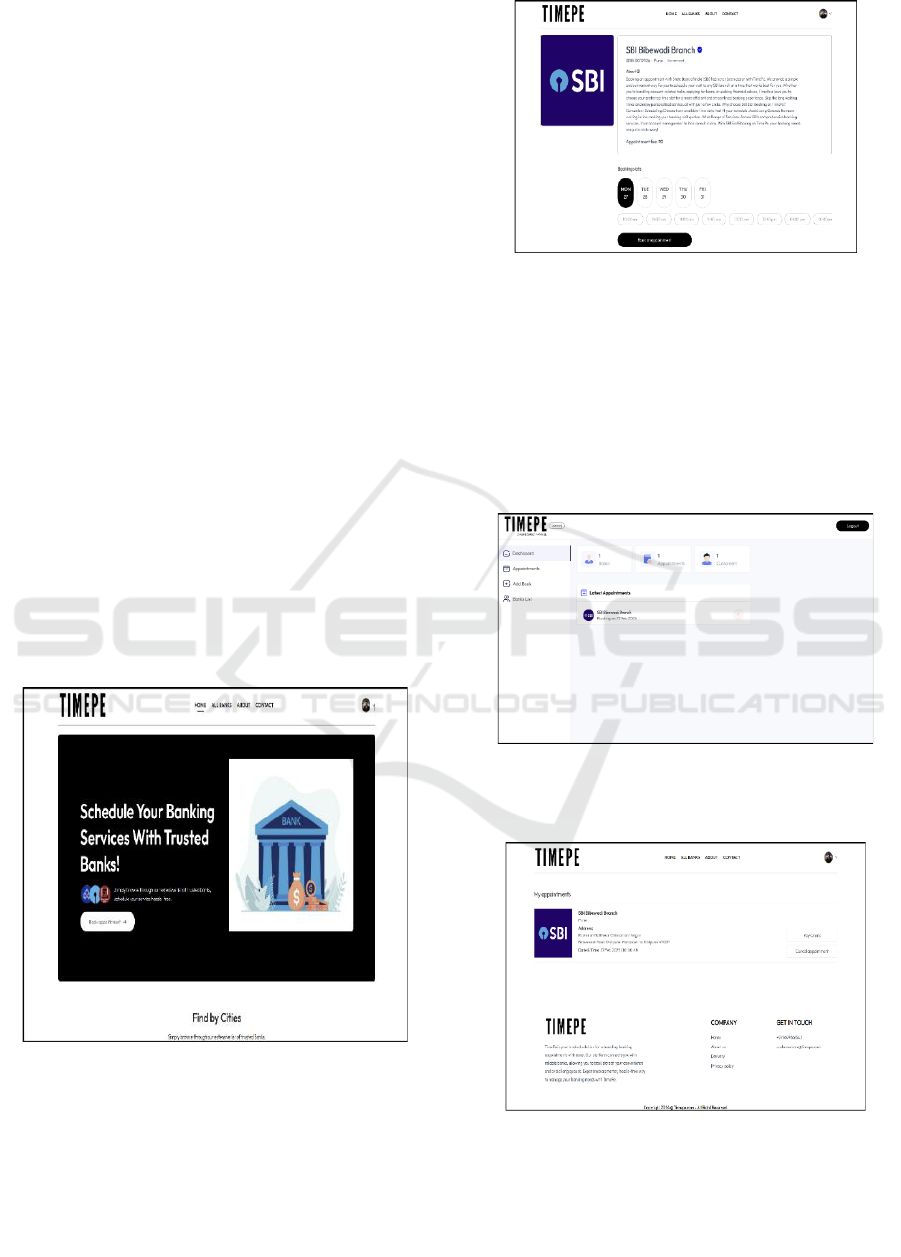
Figure 2: Home Screen of the Webpage.
The homepage (Figure 2) serves as the entry point
for users, featuring a minimalist design with clear
CTAs like 'Schedule Your Banking Services' and a
'Find by Cities' search filter. This design aligns with
our usability goal of reducing cognitive load for first-
time users.
Figure 3: Slot Booking Page of the Website.
Figure 3 illustrates the slot booking module,
where users select date and time slots (e.g., '5 PM').
The interface dynamically updates availability, a
critical feature to prevent overbooking, as noted in
our user feedback.
The admin panel (Figure 4) enables company staff
to manage appointments, track local/web bookings,
and integrate with email systems.
Figure 4: Admin Dashboard With Modules for
Appointment Management, Email Integration, and
Customer Data.
Figure 5: User-Facing 'My Appointments' Page With
Details Like Branch, Date, and Time.
Post-booking confirmation is streamlined in
Figure 5, where users view scheduled slots with
timestamps.
ICRDICCT‘25 2025 - INTERNATIONAL CONFERENCE ON RESEARCH AND DEVELOPMENT IN INFORMATION,
COMMUNICATION, AND COMPUTING TECHNOLOGIES
464
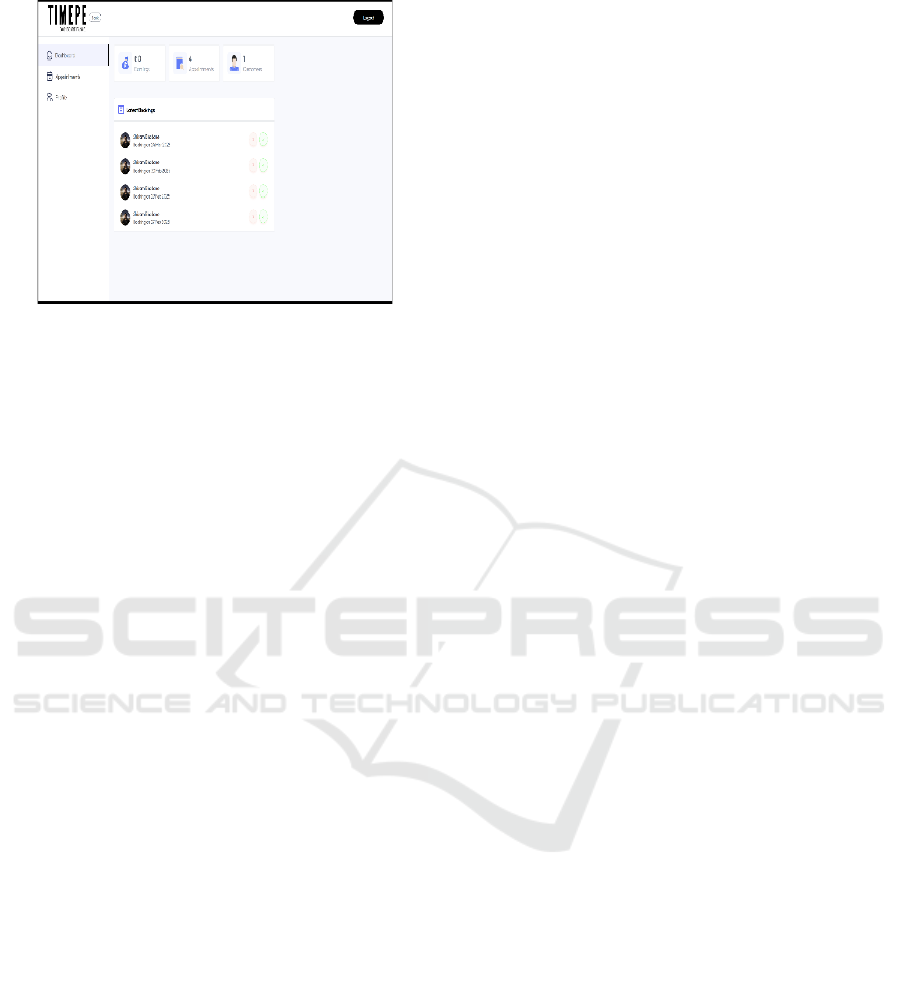
Figure 6: Interface of Dashboard for Bank Authorities.
Figure 6 demonstrates the analytics dashboard for
bank managers, featuring lunar booking trends and
actionable items. This data-driven interface supports
resource allocation decisions.
5 CONCLUSIONS
As discussed above our website provides a modern
way to facilitate banking services. This platform is
made for people, to make their life easier. Users will
be able to make quicker appointments and also not
have problems regarding the user interface because of
its simple design, which will help in reducing wait
times and improve the user experience.
This website will help to reduce employee efforts.
And it would be much safer as we use real time slots
updating features and also verify the user’s data. Our
website will work for user satisfaction and reducing
stress in people’s minds. We have taken measures if
someone tries to sabotage our website with
continuous booking because we have limited one
booking for one account and also 10 bookings every
30 minutes.
REFERENCES
Afaq, A., & Gaur, L. (2022). Appointment Scheduling in
Banking: A Study on Queue Management and Custom
er Satisfaction. International Journal of Bank Marketin
g, 40(3), 512-530
Dahlberg, T., et al. (2023). The Rise of Digital-First
Banking: How Appointment Scheduling is Reshaping
Customer Interactions. Journal of Financial Innovation
, 9(1), 34-52.
Kumar, V., & Reinartz, W. (2018). Customer Experience in
Banking: Pain Points and Expectations. Harvard
Business Review, 96(3), 78-89
Lee, H., Park, J., & Kim, S. (2020). "Resource Management
Challenges in Modern Banking." Journal of Financial
Innovation, 15(3), 45-62.
Lee, H., & Kim, J. (2023). How Real-Time Booking
Features Increase Digital Banking Engagement. Journ
al of Consumer Finance, 18(3), 210-230.
Maignan, I., & Ferrell, O. (2021). Corporate Social Respo
nsibility in FinTech: A Consumer Perspective. Journal
of Consumer Marketing, 38(4), 456-470.
Martinez, L., Rodriguez, M., & Carter, E. (2021). "The
Shift to Digital Banking: Reducing Costs and Enhanci
ng User Experience." International Banking Review,
34(2), 112-130.
Mazaheri Habibi, M. R., Mohammad Abadi, F., Tabesh, H.,
Vakili Arki, H., Abu-Hanna, A., & Eslami, S. (2024).
Overview and classification of evaluation metrics of
appointment scheduling systems. Frontiers in Health
Informatics, 13, 192.
Mohammad, D. (2023). Evaluating the Suitability of the
MERN Stack in the Development of Food Delivery
Applications. Theseus.
Nguyen, T. B. T., Sivakumar, A. I., & Graves, S. C. (2016).
Scheduling rules to achieve lead-time targets in
outpatient appointment systems. Flexible Services and
Manufacturing Journal, 28(1-2), 1-25
Rose, K. D., Ross, J. S., & Horwitz, L. I. (2011). Advanced
access scheduling outcomes: a systematic review.
Archives of Internal Medicine, 171(13), 1150-1159.
Smith, J., & Lee, A. (2023). Offline slot booking in
banking: A case study of Optibank’s mobile applicatio
n. Proceedings of the International Conference on Fina
ncial Technology, 45-52.
Smith, T., & Johnson, K. (2021). Operational Inefficiencies
in Banking: Causes and Solutions. Harper Business.
Wang, W., & Fung, R. Y. K. (2014). A study of
appointment scheduling in outpatient clinics using
simulation. Journal of Simulation, 8(1), 13–25
Wilson, P., & Clark, N. (2023). The Future of Customer
Service in Finance. Global Financial Publications.
Optimising Customer Experience in Banking: A Digital Slot Scheduling System
465
