
Navigation Assistance for the Visual Handicapped Persons through
Mobile Computing
T. Venkata Naga Jayudu, M. Pallavi, S. Bindu Sai, P. Thrisha and G. Sai Meghana Reddy
Department of CSE, Srinivasa Ramanujan Institute of Technology, Rotarypuram Village, B K Samudram Mandal,
Anantapur - 515701, Andhra Pradesh, India
Keywords: Voice Command, Speech Recognition, Object Detection, Navigation Assistance, Google Maps Integration,
Accessibility, Visually Impaired Users, Hands‑Free Interaction, Mobile Computing, Inclusive Technology.
Abstract: For a one-of-a-kind experience, this groundbreaking software provides voice-activated directions, object
recognition, and conversation. The software can better interpret voice commands when the user speaks clearly.
Detection of objects is the basis of the visual recognition system. To make things more accessible, users may
use voice commands when they call or text. This software integrates with the user's address book and enables
voice-activated contact addition. Object recognition and voice-driven commands bring a whole new
dimension to user engagement with visual aids. This program exemplifies how a simple and welcoming
interface may serve several functions.
1 INTRODUCTION
Technology has significantly transformed the way
people interact with their surroundings, offering
innovative solutions to enhance accessibility for
individuals with disabilities. Among these
advancements, mobile computing has emerged as a
powerful tool to assist visually impaired individuals
in navigating their environment with ease. Traditional
navigation methods, such as guide dogs or walking
canes, provide assistance but come with limitations in
detecting obstacles and offering real-time directional
guidance. To address these challenges, this project
introduces a voice-driven mobile application that
integrates speech recognition, object detection, and
Google Maps navigation to facilitate hands-free
movement and communication. The proposed system
enables users to interact through voice commands,
eliminating the need for manual input. The application
listens to spoken words using Speech-to-Text (STT)
technology, extracts meaningful information, and
processes it to generate navigation routes. By
integrating with Google Maps, the system allows
users to receive step by-step directions to their desired
location, supporting different travel modes such as
walking, public transport, and driving. Additionally,
the app extends its functionality by incorporating
voice-activated contact management and messaging,
allowing users to add new contacts and send SMS
without physical interaction. Beyond navigation, the
inclusion of object detection enhances safety and
situational awareness by identifying obstacles in the
user's path. This feature is particularly beneficial in
unfamiliar environments, where visually impaired
individuals might struggle with unexpected barriers.
The application can provide voice alerts or haptic
feedback to warn users about detected objects,
making navigation safer and more efficient. The
combination of these technologies not only improves
accessibility but also fosters independence, enabling
visually impaired individuals to move confidently in
their surroundings. With a user-friendly interface and
an emphasis on inclusivity, the proposed system aims
to bridge the gap between accessibility needs and
technological advancements. Future enhancements
may include multi language support, offline
navigation, and integration with wearable devices to
further refine the user experience. By leveraging
artificial intelligence, speech processing, and mobile
computing, this project represents a significant step
towards creating a smarter, more inclusive world for
individuals with visual impairments.
Jayudu, T. V. N., Pallavi, M., Sai, S. B., Thrisha, P. and Reddy, G. S. M.
Navigation Assistance for the Visual Handicapped Persons through Mobile Computing.
DOI: 10.5220/0013884700004919
Paper published under CC license (CC BY-NC-ND 4.0)
In Proceedings of the 1st International Conference on Research and Development in Information, Communication, and Computing Technologies (ICRDICCT‘25 2025) - Volume 2, pages
457-460
ISBN: 978-989-758-777-1
Proceedings Copyright © 2025 by SCITEPRESS – Science and Technology Publications, Lda.
457

2 RELATED WORKS
Home appliances that operate via voice commands and
run on the Android platform are detailed in this article.
Disabled and older people can use this technology in
the comfort of their own homes. Google is able to
identify and analyse voice commands spoken into
smartphones. This article explains how to use
Android to record voice commands and transmit them
to an Arduino Uno. The light and fan were turned on
and off using the Arduino Uno's Bluetooth module.
With its user-friendly interface and straightforward
installation, the system was created to manage
electrical appliances. Using Bluetooth, you may
manage your household appliances up to 20 meters
away (Norhafizah bt Aripin,et.al., 2014).
These days, we can't imagine life without our
smartphones and other smart devices. These
innovations can make daily life easier for people who
are visually impaired. In this article, we take a look at
an Android software that can scan text and objects and
identify them in real time. A device doesn't need an
external server to run an app. Our solution includes
voice feedback that notifies the user of the object that
has been found. The object may be detected by the
app without the requirement for a snapshot. For strong
detection, we separate the object from its background
using the Tensorflow machine learning API and many
diagram cuts. Then, we educate the user about the
object via text-to-speech by transforming the
recognition difficulty into an instance retrieval task.
Those who are visually impaired can use the
technology to better comprehend their environment.
This app is compatible with all budget smartphones
(Md. Amanat Khan Shishir,et.al., 2019).
Voice Assistant, a Serbian-supporting personal
assistant app for Android phones, is introduced in this
paper. A native- UI, open-source speech recognition
framework called Kaldi underpins this massive
vocabulary continuous voice recognition system. To
train a variety of acoustic models with varying
degrees of noise, a dataset of 70,000 utterances was
utilised. With a vocabulary of more than 14,000
words and a test database of 4500 utterances, results
are obtained (Branislav Popović,et.al., 2015).
Portable gadgets are used by people quite a bit.
People who are visually impaired may benefit from
these technologies on a daily basis. The research
suggests an app for Android smartphones that might
be useful for these individuals. Applications use
microelectromechanical system (MEMS) sensors
found in smartphones as well as a few third-party
sensor modules. All of the parts work together to form
a portable aid. Bluetooth and Wi-Fi allow
smartphones and external modules to connect with
each other. Customers who are visually impaired will
find this app's UI to be suitable. Through text-to-
speech software, smartphones are able to converse
with their users. These modules do indoor/outdoor
navigation and manage incoming phone calls.
According to the results, the assistant system in this
Android app is small, effective, easy to transport,
cheap, and only needs a few hours of training
(Laviniu Ţepelea,et.al., 2017).
Smart assistants, which allow us to converse with
and question machines, are a boon to all humans in the
modern day. Thanks to mobile phones, computers,
desktops, etc., this technology is appealing to nearly
everyone on the planet. A smart assistant that can
recognise speech, understand text and voice input,
and then verbalise search results. Smart assistants
include Google Assistant, Apple's Siri, and Amazon's
Alexa. They have trouble interacting and can't identify
sounds. People may have difficulties in employing
Google Assistant due to their language restrictions
and the fact that they rely on WiFi and internet to
communicate with people. You can find Google
Assistant on Android smartphones. To use this
program, you need to be online. You don't need the
Internet to use our suggested system. With the help of
the voice assistant, users may access data in several
languages, including current apps, daily news,
geolocation, and Wikipedia, thanks to the usage of
raspberry pi for data loading and storage. Users
utilising automation technology can benefit from
voice help (Rajakumar P,et.al., 2022).
3 METHODOLOGY
3.1 Proposed System
For the vision challenged, there is a game-changing
smartphone software that can identify objects,
communicate, and issue voice orders. For the
program to properly process spoken commands, it
employs Speech-to Text (STT) technology. Upon
destination recognition, the system utilises Google
Maps to provide real-time, step-by step instructions
for a variety of travel options. The software is much
more user-friendly because it allows users to make
contacts and send SMS using voice commands. To
further enhance security, the system employs object
detection in addition to navigation and
communication. Making the user's environment safer
for walking, the program alerts them to obstacles via
voice or vibration. This feature gives the sight
handicapped the confidence they need to move
ICRDICCT‘25 2025 - INTERNATIONAL CONFERENCE ON RESEARCH AND DEVELOPMENT IN INFORMATION,
COMMUNICATION, AND COMPUTING TECHNOLOGIES
458
around in unfamiliar environments. Because it
integrates speech recognition, object identification,
and smooth communication into a single platform, the
application is especially accessible and inclusive for
people with visual impairments. The incorporation of
wearable devices, offline navigation, and support for
several languages are all potential enhancements to
the user experience.
3.2 System Architecture
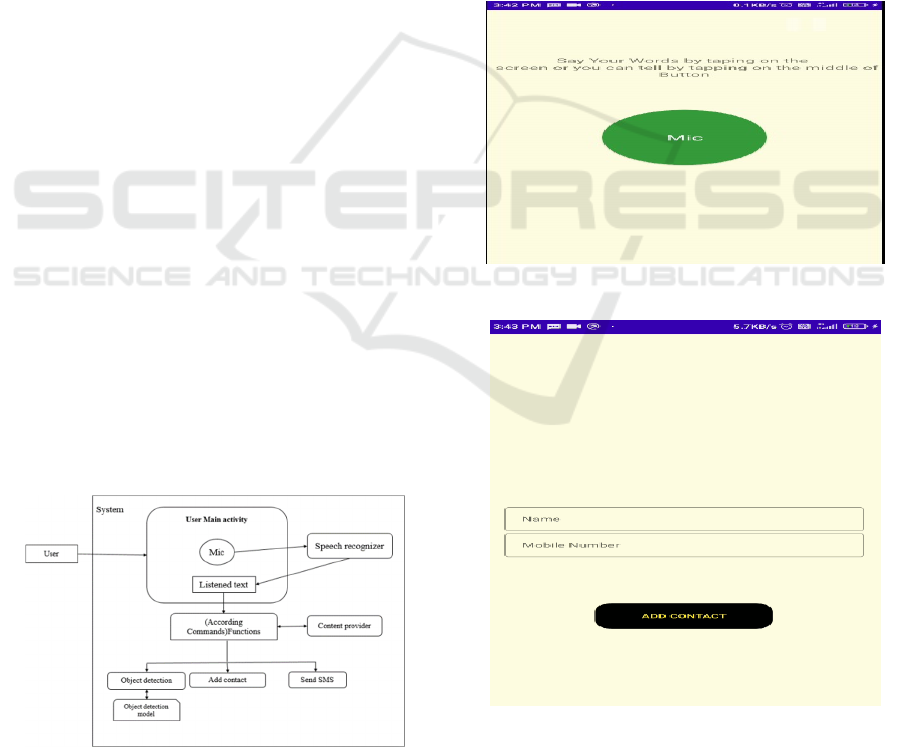
The system architecture as shown in figure 1 is
designed to facilitate seamless voice-based
interaction for visually impaired users. The user
initiates communication through voice input, which is
captured by the microphone and processed by the
speech recognizer. The recognized speech is
converted into text, which is then analyzed to
determine the appropriate function. Based on the
extracted command, the system can perform various
tasks, including navigation assistance, contact
management, and message sending. The architecture
also integrates a content provider module, which
helps in retrieving and managing relevant data,
ensuring smooth execution of user commands. One of
the key components of the architecture is object
detection, which enhances user safety by identifying
obstacles in the environment. The system utilizes an
object detection model to recognize surrounding
objects and provide real-time feedback to the user.
Additionally, the application allows users to add new
contacts and send messages through voice
commands, reducing the need for manual input. By
combining speech recognition, object detection, and
communication functionalities into a unified system,
the architecture ensures an intuitive and accessible
experience for visually impaired users, making
navigation and communication more efficient and
user-friendly.
Figure 1: Architecture.
3.3 Modules Users
Go ahead and send the SMS. Input a name or number
and use object detection to make a call. Just say
"Google Maps" and add a contact. The incorporation
of hands free features streamlines the management
and connection of devices.
4 RESULTS AND ANALYSIS
The developed system successfully integrates voice-
based commands, object detection, and
communication features to enhance accessibility for
visually impaired users. Through speech recognition,
users can provide voice inputs to navigate, add
contacts, and send messages seamlessly.
Figure 2: Application Interface.
Figure 3: Add Contact Page.
Figure 2 shows the Application Interface page and
figure 3 shows the Add Contact Page respectively.
Navigation Assistance for the Visual Handicapped Persons through Mobile Computing
459

The system effectively converts spoken words into
text and processes commands with high accuracy,
ensuring smooth user interaction. Google Maps
integration enables real time navigation, allowing
users to reach their destination hands-free.
Additionally, the speech feedback mechanism
confirms user commands before execution, reducing
errors and improving usability. The object detection
feature enhances safety by identifying obstacles in the
user's path, providing timely alerts to assist in
navigation. The hands- free communication system
allows users to manage contacts and send messages
effortlessly, making the application highly useful in
daily activities. The proposed system outperforms
existing solutions by offering a unified and intuitive
interface that caters specifically to the needs of
visually impaired individuals. Overall, the results
demonstrate the effectiveness of the application in
improving independence and mobility for visually
challenged users, showcasing its potential for real-
world implementation.
5 FUTURE WORK
The proposed system has the potential to enhance
accessibility and user experience with significant
upgrades. In the future, the program may be enhanced
to support several languages, allowing individuals
from varied backgrounds to easily utilise it. The
system's adaptability and efficiency may be enhanced
with the addition of AI and ML, which can improve
item detection and speech recognition. Offline
functionality can be developed to assist visually
impaired folks who do not have access to the internet.
Improving the app in the future may involve adding
more language recognition features to attract a wider
range of users. One way to improve the visual aid
feature is to incorporate it with new technology, such
as augmented reality. Constant updates have the
potential to provide new features like improved voice
commands and more compatibility, further
establishing the app as a versatile and cutting-edge
answer to a wide range of customer demands.
6 CONCLUSIONS
Users with visual impairments can benefit from a
unified application that allows for spoken commands,
object identification, and conversation. Speech
recognition provides a seamless user experience by
enabling hands free navigation, contact management,
and messaging. Movement is made safer and easier
with real-time obstacle alerts via object detection. It is
a significant improvement over prior solutions
because of the system's user-friendly and efficient
interface for those with visual impairments. The
software enhances user freedom, communication, and
navigation, according to the results. To make the
system more accessible and convenient in the real
world, it might be improved by adding support for
several languages and the ability to work offline.
REFERENCES
A. Stolcke, J. Zheng, W. Wang, and V. Abrash, “SRILM at
Sixteen: Update and Outlook,” in Proc. IEEE Worksho
p on Automatic Speech Recognition and Understandin
g ASRU, Waikoloa, 2011.
B. Popović, E. Pakoci, S. Ostrogonac, D. Pekar, “Large
Vocabulary Continuous Speech Recognition for
Serbian Using the Kaldi Toolkit, in Proc. 10th Digital
Speech and Image Processing, DOGS, Novi Sad, 2014,
Branislav Popović; Edvin Pakoci; Nikša Jakovljević; Goran
Kočiš; Darko Pekar; Voice assistant application for the
Serbian language; 24-26 November 2015.
D. Povey and P. C. Woodland, “Minimum Phone Error and
I- Smoothing for Improved Discriminative Training,”
in Proc. 27th Int. Conf. on Acoustics, Speech and Signal
Processing ICASSP, Orlando, 2002, pp. I105 108.
D. Povey, D. Kanevsky, B. Kingsbury, B. Ramabhadran, G.
Saon, and K. Visweswariah, “Boosted MMI for Model
and Feature-Space Discriminative Training,” in Proc.
33rd Int. Conf. on Acoustics, Speech and Signal Proce
ssing ICASSP, Las Vegas, 2008, pp. 4057-4060.
Laviniu Ţepelea; Ioan Gavriluţ Electronics and Telecomm
unications Department, University of Oradea, Oradea,
Romania; Alexandru Gacsádi; Smartphone application
to assist visually impaired people; 01-02 June 2017.
Md. Amanat Khan Shishir; Shahariar Rashid Fahim; Fairuz
Maesha Habib; Tanjila Farah; Eye Assistant: Using
mobile application to help the visually impaired; 03-05
May 2019.
Norhafizah bt Aripin; M. B. Othman; Voice control of
home appliances using Android; 27-28 August 2014.
pp. 31-34.
R. Kneser and H. Ney, “Improved Backing-Off for M Gram
Language Modeling,” in Proc. 20th Int. Conf. on Acou
stics, Speech and Signal Processing ICASSP, Detroit,
1995, pp. 181-184.
Rajakumar P; K. Suresh; Boobalan M; M. Gokul; G.Darun
Kumar; Archana R; IoT Based Voice Assistant using
Raspberry Pi and Natural Language Processing; 08-09
December 2022.
S. Suzić, B. Popović, V. Delić, and D. Pekar, “Serbian
Mobile Speech Database Collection and Evaluation”, in
Proc. Int. Conf. on Electronics, Telecommunications,
Automation and Informatics ETAI, ETAI 1-1, Ohrid,
2015.
ICRDICCT‘25 2025 - INTERNATIONAL CONFERENCE ON RESEARCH AND DEVELOPMENT IN INFORMATION,
COMMUNICATION, AND COMPUTING TECHNOLOGIES
460
