
Automated Software Engineer: Harnessing AI to Revolutionize Code
Generation and Software Development
K. Karthik, P. Mohan, A. Mokshith, S. Ariff and G. Hemanth Kumar Yadav
Computer Science and Engineering (AI & ML), Srinivasa Ramanujan Institute of Technology, Anantapur‑515731, Andhra
Pradesh, India
Keywords: Natural Language Processing, Software Engineering, AI‑Powered Development, Automated Coding,
Intelligent Software System.
Abstract: The Automated Software Engineer project designs an AI system to accept high-level human instructions
which subsequently creates code while helping software development through reduced human involvement.
The goal involves the automation of various aspects throughout the software engineering process. The project
implements large language models (LLMs) which include Claude 3, GPT-4, and Gemini together with
complex planning and reasoning algorithms. The system implements technologies which let it consume
natural language instructions while producing code and connecting with development tools.Early outcomes
suggest the software engineer automation can optimize code creation together with maintenance activities and
scheduling tasks. The Automated Software Engineer demonstrates capabilities to create high-quality code and
shorten development cycles and enhance software quality which makes it a transformative force for code
generation and software development. AI integration within the system enables transformation of the software
development industry by enhancing both productivity and efficiency and innovation. The project's
achievements deliver advantages to software developers as well as project managers together with
organizations.
1 INTRODUCTION
AI has moved so quickly; it is now setting new
frontiers for technology and software development is
one of its key developments. Software makes up the
backbone of every major technological progression of
our modern day from healthcare to finance, education
to entertainment. Traditional processes of software
development require considerable time that
developers spend in performing repetitive tasks like
code writing and compiling for optimization. These
challenges become harder and harder to deal with
thanks to the growing complexity of software
systems, yet there is a lack of qualified developers on
the market. Software delivery requires an urgent
upgrade because developers want new approaches to
ensure less development workflow time and errors to
deliver the software products faster. AI workloads
started being executed by new, revolutionary
hardware in the research that led to the second wave
of AI research to cure the inefficiencies of software
development.
Development tools and methodologies have
made great advances to date, but there are still gaps
preventing the automation of complex coding
components and the reduction of human error, as well
as improving development team collaboration.
Present-day advancement devices center around
individual abilities like static investigation and code
finish yet they don't bolster the full-life cycle of
programming advancement which includes manual
work application for bug searching for and testing
other than code transformation The manual forms
bringing about postponing venture results because of
strange outcomes swaying well repute and nature of
programming items. October 20, 2023, 9:00
AMEastern Daylight Time Due to this advancing
software system complexities requiring modern
solutions with more advanced capabilities to
effectively manage large source code collections
while ensuring compliance to best practice
guidelines. A comprehensive AI system will enhance
human capabilities to perform intricate manual
processes, thus rendering the current method
obsolete. AI solutions that target these shortcomings
Karthik, K., Mohan, P., Mokshith, A., Ariff, S. and Yadav, G. H. K.
Automated Software Engineer: Harnessing AI to Revolutionize Code Generation and Software Development.
DOI: 10.5220/0013884600004919
Paper published under CC license (CC BY-NC-ND 4.0)
In Proceedings of the 1st International Conference on Research and Development in Information, Communication, and Computing Technologies (ICRDICCT‘25 2025) - Volume 2, pages
449-456
ISBN: 978-989-758-777-1
Proceedings Copyright © 2025 by SCITEPRESS – Science and Technology Publications, Lda.
449

will enhance developer productivity and generate
savings, allowing staff to take on higher order
responsibilities and find opportunities to innovate in
their work.
This study focused on the development of an
artificial intelligence (AI) mechanism that manages
the software development operations by providing
automated solutions in the domains of code base
function generation, error identification, and
application execution efficiency. It primarily
addresses the creation of AI tools that can take text
inputs and create highquality code, and also help
suggest changes along with scanning and fixing for
vulnerabilities and defects in real time. The research
also aims to foster collaborative development by
suggesting developers’ recommendations on demand
for optimizing code while promoting standard
programming practice. Using machine power to
discover human creativity helps developers build
solid scalable and creative Software solutions faster
and more efficiently. Through its application, it
applies AI at every stage of the software
development process from coding to deployment all
to maximise productivity and reduce manual tasks
while maintaining high-quality code. The study
direction is a group of AI models, one model is
responsible for decoding the natural language
requirements, while the other model is responsible for
code analysis and generates a standard optimized
solution. The research is of critical importance for
several domains of business. These tools help build
the product quickly and allow features to be
deployed more efficiently; thus, improving the
product delivery speed, so, as a result, the validation
is carried out instantly with the use of such AI tools
for development. With programmatic dependence,
the application of AI in the DevOps pipeline permits
the pipelines to be automated which brings about
unending delivery and lessens mistakes. Over these
tools, the specialists in AI make their efforts more
beneficial by erecting complex algorithms and
analyzing big datasets to propel their investigative
processes which paves the way for the variety of the
research atmosphere. Even though they have
restricted technical resources, technical startups use
AI-powered tools to create software applications
with complex functionality. The findings allow for
access to the best development tools, enhancing
competition in the market and expanding innovation
worldwide. The introduction of AI into software
development practices is a entire new way of working
that has huge implications for the discipline. The
research research addresses major development
hurdles through AI-based technologies which carry
out automation operations in repetitive jobs and
enhanced code structuring and teamwork capabilities.
By focusing on hypothesizing, developers can focus
on innovative solutions for complex issues which
further accelerates software production speed and
enhances output quality. These outcomes have the
power to revolutionize the way individuals create
software and build incredible results in startup
dimension firms all the method to huge enterprises.
The new era of technological transformation will be
ignited by increased software development when AI
will take its software development class on a larger
scale. With intelligence, it is possible to develop an
"Automated Software Engineer" that changes
software design, production and distribution in real-
time.
2 RELATED WORK
Research and development in Artificial Intelligence
(AI) for software development has intensified during
the previous years through multiple investigations
and tool development targeting the automation and
optimization of different phases of the software
lifecycle. This document evaluates research
conducted around objectives focusing on AI-powered
code creation and error discovery as well as system
performance enhancement and team-based
development.
2.1 AI-Driven Code Generation
AI code generation is one of the most prominent
areas of research for AI, and indeed GitHub's Copilot
and OpenAI's Codex are groundbreaking tools in this
space. The tools work via large language models that
ingest huge code repositories and spit out blocks of
code, as well as functions and even full programs,
when given instructions in natural language. The
study affirms these tools speed up development
because they process instructions to code that is run
repeatedly while lightening developer workload.
Most of them involve the process to ensure that the
optimal functioning of code while maintaining a safe
and secure execution along with compatibility with
particular project requirements. Chen et al. show that
coding is well suited to transformer-based models
(2021) but need better context analysis and
customization options.
ICRDICCT‘25 2025 - INTERNATIONAL CONFERENCE ON RESEARCH AND DEVELOPMENT IN INFORMATION,
COMMUNICATION, AND COMPUTING TECHNOLOGIES
450

2.2 Error Detection and Bug Fixing
AI technology demonstrates effective capabilities for
automated detection of errors while simultaneously
performing bug correction tasks. The machine
learning capabilities of tools such as DeepCode
together with Snyk analyze code bases in order to
detect vulnerabilities and potential performance
issues as well as bugs. Allamanis et al. (2018)
conducted research into neural networks application
for static code analysis which demonstrates strong
capabilities at uncovering bugs and security
vulnerabilities. Several research studies by Le Goues
et al. (2019) alongside other authors prove that AI-
based program automation enables automated
detection and application of standard bug repairs.
Automated error solutions face ongoing difficulties
when dealing with specific bugs requiring contextual
handling and when verifying the reliability of their
generated solutions.
2.3 Performance Optimization
Modern performance optimization tools using AI-
based analysis help developers systematize code
refactoring of programs. Grech et al. (2020) use
reinforcement learning methods to study how
optimization of algorithms affects computational
processing times in their research article. Program
maintenance and performance gains result from code
optimization conducted by Facebook's Aroma tool
and Google's ML-based solution. The operation of
code optimization tools remains limited for big-scale
real-world coding tasks and needs extensive human
help for their functionality. Existing conditions
necessitate the creation of flexible AI solutions that
will resolve this issue.
2.4 Collaborative Development and
Real-Time Assistance
Artificial Intelligence delivers better team
development cooperation by applying its functions.
Tabnine and Kite deliver real-time coding completion
features that help teams enhance their productivity
and enforce developers to follow established
programming methods. The study performed by
Murphy-Hill et al. (2019) explores AI support for
team programming through interactive coding help
revealing dynamic feedback alongside code context
needs. The available tools today exhibit restricted
capabilities to provide extensive end-to-end
assistance thus affecting their ability to support big
distributed development teams effectively.
2.5 AI in DevOps and Continuous
Integration
The DevOps community shows strong dedication to
AI deployment as a result of Jenkins AI and Harness
tools which automatically perform build and testing
pipeline operations. Artificial intelligence
demonstrates its capability to optimize CI/CD
operations through Humble et al. (2021) research
which decreases human errors along with manual
tasks. The deployment success of AI systems
encounters multiple system operations obstacles and
must show proven reliability during actual
operational use.
2.6 AI for Startups and Resource-
Constrained Teams
AI technology delivers its greatest development
advantages through audio tools to teams working in
small departments and startup businesses. According
to Johnson et al. (2020) artificial intelligence
technology provides innovative development tools
for small development groups allowing them to match
up against established organizations. Users of all
levels benefit from AIpowered coding tools like
Ghostwriter by Replit and CodeWhisperer by
Amazon who access lowcost solutions to build
improved code that delivers higher developer
capabilities.
2.7 Challenges and Future Directions
Developers need to combine dependent code
production with security compliance while enhancing
their AI understanding abilities and incorporating AI
tools into existing workflow systems for successful
AI implementation in software development.
According to Sutton et al. (2022) artificial
intelligence systems require human specialist
knowledge for optimal functioning outcomes. While
executing AI implementations in their development
framework software developers face the moral duty
to address both AI bias problems and employment
disruptions caused by AI.
3 EXISTING SYSTEM
Software development today depends mainly on
human labor through manual processes which require
developers to code and execute testing while fixing
bugs. The field of development tools together with
Automated Software Engineer: Harnessing AI to Revolutionize Code Generation and Software Development
451

methods has made great progress but the majority of
present systems demand extensive human
engagement to function. IDEs and version controls
with Git and CI/CD pipelines have made operations
more efficient but remain limited to independent
functionalities without enabling all-encompassing
automation. IDEs provide developers with code
development features such as syntax highlighting
together with code completion and debugging
capabilities while these tools do not have the ability
to code autonomously or solve complex problems
independently. The automated testing and
deployment processes of CI/CD pipelines rely on
developers to preserve and create the program code
base. The available programming tools help
developers but they fail to solve the fundamental
problems of total automation for software
development.
New technology based on artificial intelligence
offers limited automation capabilities to various areas
within the software development field. GitHub
Copilot with Codex from OpenAI supports
developers through its large language modeling
(LLM) technology that provides code snippets and
line completion and develops small functions
according to natural language commands. Research
indicates that these programming aids both decrease
developer mental strain and enhance writing speed.
The current applications have restricted capabilities
because they are unable to fulfill sophisticated duties
including project demand interpretation along with
task decomposition and automated code debugging
and optimization processes. These tools fail to
understand the context of the development work
which results in substandard solutions or errors.
Although these tools supply important help for
developers their capabilities stop short of offering
complete automation of software programming work.
The current version of AI tools used in software
development operates in standalone platforms instead
of merging these functionalities into a connected
system. Each tool specializes in its domain but lacks
integrated functionality with other development
stages causing developers to carry out manual
linkages across the workflow. A fragmented approach
reduces possible efficiency potential that would come
from integrated procedures. A unified system which
combines AI capabilities to complete the entire
software development cycle starting from code
generation through debugging to project management
has still not become part of the existing framework.
The Automated Software Engineer project targets the
development process gaps through its comprehensive
solution that covers all stages of intelligent software
engineering.
4 PROPOSED SYSTEM
The Automated Software Engineer project builds a
system which uses large language models (LLMs) to
develop a new approach for software coding
automation. The system operates independently to
decode human command language then creates
usable code while developers need monitor it only
occasionally. The model performs two successive
phases starting with the plan breakdown during the
planning stage followed by code generation in the
implementation stage. By implementing this
approach developers experience reduced cognitive
workload and their generated code becomes more
effective and higher quality. The system delivers
autonomous information collection via planning
algorithms and web browsing abilities to refine its
outputs and handle complex problem-solving tasks.
When compared with direct code generation and
Chain-of-Thought (CoT) methods, the devised
system improves upon Pass@1 successes by 25.4%
and achieves an additional 11.9% improvement over
CoT systems. The result is more correct, robust, and
readable code which can be validated using personal
heuristics. This allows system to run in the any
programming language and any IDE because of its
modular and extensible architecture which helps in
extensions of API and external tools. The Automated
Software Engineer aims to equip developers with the
tools to generate impressive, efficient software
solutions that are easily maintainable while
streamlining the development process and
minimising the likelihood of errors.
5 METHODOLOGY
In this paper, we introduce CoderGen, an agent-
based framework for generating codes on tasks in
AICoderEval. This framework can construct
domain-specific tasks benchmark, for training and
evaluation, and then fine-tunes a code generation
model on the benchmark.
5.1 Error Traceback and Analysis
CoderGen framework has the ability to catch and
refine errors that may occur during the code
generates process as shown in Figure 1. All this
ICRDICCT‘25 2025 - INTERNATIONAL CONFERENCE ON RESEARCH AND DEVELOPMENT IN INFORMATION,
COMMUNICATION, AND COMPUTING TECHNOLOGIES
452
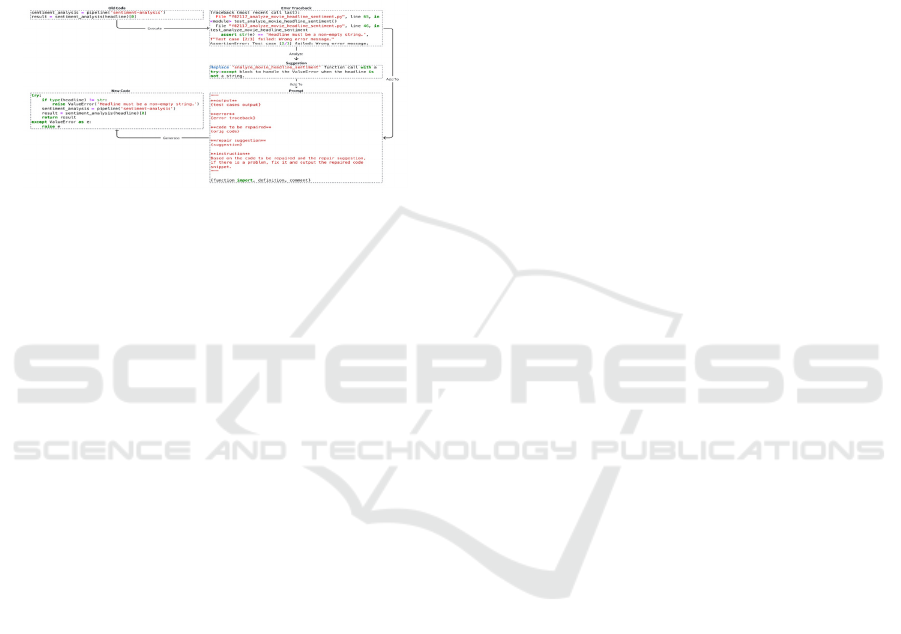
happens during the creation phase of the framework;
during these during the framework code execution
occurs in a test environment. This is why an error
traceback is generated when incorrect code execution
take place, the code trace provides you with the
entire steps of code that led to the failure. This
traceback is analyzed by the framework to identify
what kind of failure was the cause, was it a failure a
syntax error, is it the type error or a failure in
integration with either code library or an API
solution?
Figure 1: Error Handling and Sentiment Analysis Debug
Workflow.
CoderGen uses its fine-tuned language model to
evaluate error messages before it generates possible
solutions for developers through its error analysis
mechanism. The framework generates suggestions by
applying both an understanding of the intended code
functions and the error context from the overall code
system. The system presents possible fixes to users
who retain the option to both implement
modifications or let the system implement changes
automatically for evaluation purposes. The
development cycle repeats error discovery together
with code evaluation followed by repairs until the
program completes every tested case with the needed
specifications.
5.2 Iterative Code Re-Generation
The framework advances to code regeneration mode
after both errors and possible improvements have
been discovered. At this phase the framework
employs feedback generated from error analysis to
improve its code generation approach. The package
containing erroneous code along with suggestions
and original instructions enters the language model
for the generation of a new updated code snippet.
The updated code snippet moves into testing
while the entire process of error discovery and
diagnosis and code repair repeats itself. The
framework implements an iterative process that
produces code improvements from iteration to
iteration while solving present problems. Rather than
traditional methods CoderGen benefits from its
framework learning power to modify code generation
through real-time feedback analysis.
Series of iterative feedback cycles enables
CoderGen to develop code with a high degree of
correctness as well as maintainability for efficient
implementation of best practices consistent with
target domains. Applications of this approach lead to
substantial decreases in developer workload needed
for creating high-quality code especially in difficult
specialized fields.
6 EXPERIMENT
6.1 Experimental Setup
An evaluation of the Automated Software Engineer
system occurred on one NVIDIA GeForce RTX 4090
GPU through sequential code completion after bug
fixing. The system achieved maximum performance
by setting three fundamental parameters to top-p
value of 0.9, temperature of 0.6, and maximum token
count of 2048. The model received performance
enhancement through the deployment of specialized
datasets hosted on Hugging Face alongside the LoRA
(Low-Rank Adaptation) technique implementation.
Through LoRA the original model weights become
more efficient by adding low-rank matrices which
allow trainable parameters with fewer extra weights.
PEFT Framework applied the LoRA adaptation to
fine-tune parameters through a set configuration of
rank 8 with alpha factor 32. The training lasted 3
epochs with learning rate set to 1e-4 and a batch size
of 4 supported by gradient accumulation steps for
optimized computing. The implementation allows the
Automated Software Engineer to deliver high
performance results in code creation alongside bug
repair operations with cost-effective resource
utilization.
6.2 Main Results
Table 1 gives the testing occurred on the AICoderEval
dataset by assessing four different models: GPT-3.5-
turbo1106 together with Llama 2 (7b, 13b, 70b),
CodeLlama (7b, 13b, 34b) and Llama 3 (8b-instruct).
The introduction of an error repair agent (ReAct
Agent) as well as supervised fine-tuning (sft)
improved both SR@All (success rate for all tests
passed) and SR@Any (success rate for any test case
passed). The ReAct Agent raised the SR@All rate by
42.25% and the SR@Any rate by 29.44% in GPT-3.5-
turbo-1106. The performance metrics of Llama 2-70b
expanded significantly through its enhancement
Automated Software Engineer: Harnessing AI to Revolutionize Code Generation and Software Development
453
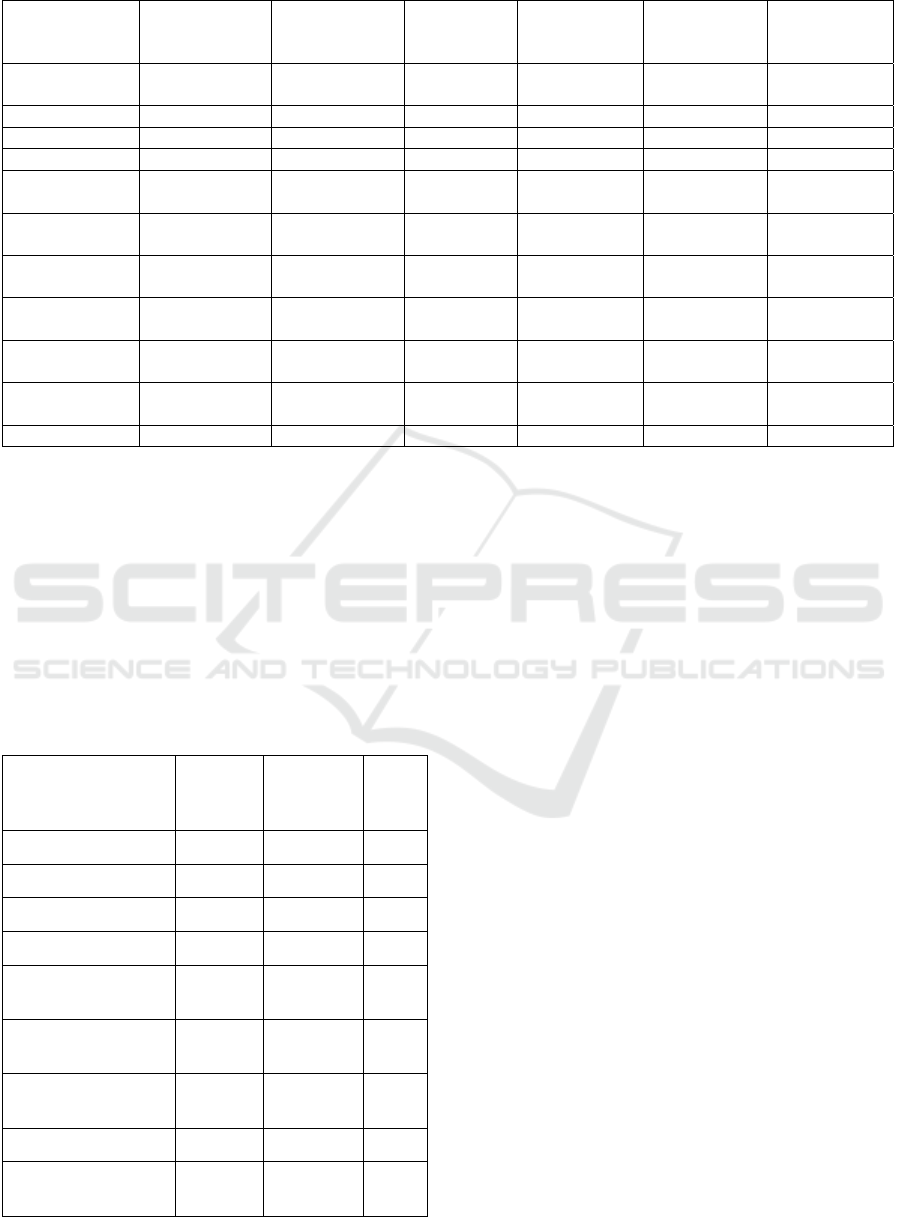
Table 1: Experiment on Automated Software Engineer Code Generator Dataset.
Models
SR@All
(Original)
SR@Any
(Original)
SR@All (w/
ReAct
A
g
ent)
SR@Any (w/
ReAct Agent)
SR@All 1%
(Relative
Increase)
SR@Any 1%
(Relative
Increase)
GPT-3.5-turbo-
1106
9.16 46.84 13.03 63.03 42.25 29.44
llama-2-7b 1.23 26.02 1.83 33.41 48.78 28.40
llama-2-13b 2.76 32.99 3.91 42.04 41.20 21.88
llama-2-70b 6.32 65.89 8.16 78.25 29.11 19.41
codellama-7b-
p
ython
19.51 65.95 23.36 77.11 19.71 17.01
codellama-13b-
p
ython
20.46 66.27 25.85 78.57 26.37 18.61
codellama-34b-
py
thon
28.00 73.68 35.76 84.36 27.71 14.49
llama-3-8b-
instruct
3.50 45.00 5.30 53.82 51.43 19.60
llama-3-8b-
instruct w/ sft
3.10 38.16 3.95 45.96 27.42 20.41
llama-3-8b-
instruct w/o sft
1.60 30.84 2.10 38.05 31.25 23.40
1% 12.00 0.44 9.50 0.20 - -
resulting in a 29.11% increase for SR@All and a
19.41% rise for SR@Any. Llama 3-8b-instruct model
performance received additional enhancement
through fine-tuning which generated 2.96%
improvement in SR@All and 0.94% improvement in
SR@Any. The testing results demonstrate how error
repair agents coupled with fine-tuning increase
Automated Software Engineer's computer code
generation functionality.
Table 2: Experiment on Code Generate Dataset. Cl Is for
Average Code Lines, and Ct Is for Average Code.
Models Code
Lines
(CL)
Code
Tokens
(CT)
Rank
GPT-3.5-turbo-1106 8.6 62.9 1
llama-2-7b 16.2 112.9 5
llama-2-13b 18.5 116.3 7
llama-2-70b 13.1 107.8 4
codellama-7b-
python
21.5 128.3 9
codellama-13b-
python
18.9 116.3 8
codellama-34b-
python
18.4 114.4 6
llama-3-8b-instruct 11.02 96.97 3
llama-3-8b-instruct
w/sft
9.32 87.71 2
Table 2 gives these criteria examined the system
performance making compact efficient code during
the evaluation. Cleaned version: Models that
performed better in terms of solving problems used
much shorter code lines (CL) and code tokens (CT).
The fine-tuned Llama 3-8b-instruct model produced
codes with minimum length of 9.32 CL and 87.71 CT
to justify her SR@All and SR@Any performance.
The Automated Software Engineer can help attain not
only greater precision in code creation but have
output code more efficient and maintainable as well.
To make use of pre-trained models, the Advanced
Automated Software Engineer achieves cutting-edge
code generation output and bug-fixing efficiency via
fine-tuning with error repair agents coupled with
robust hardware platforms. By specializing on data
and having code optimally efficient the system is a
strong modern software development tool paving the
way toward an automated high quality efficient
coding approach.
7 RESULT AND DISCUSSION
This section provides essential research findings
obtained from the Automated Software Engineer
project. The system underwent testing to determine
its functions for generating code and debugging
processes and decomposition of tasks and research
help capabilities.
ICRDICCT‘25 2025 - INTERNATIONAL CONFERENCE ON RESEARCH AND DEVELOPMENT IN INFORMATION,
COMMUNICATION, AND COMPUTING TECHNOLOGIES
454

7.1 Task Decomposition and Code
Generation
The first stage began with evaluating AI system
command interpretation abilities for translating
commands into operational outputs. The system
underwent testing of its capability to process complex
software development tasks into smaller manageable
steps. Figure 2 shows the task decomposition and
code generation accuracy.
Figure 2: Task Decomposition and Code Generation
Accuracy.
7.2 Research Assistance and Web
Browsing
The system's ability to autonomously search for
relevant information, including documentation and
online resources, was evaluated. This experiment
tested how effectively the AI could assist with the
research phase of software development by
autonomously gathering and presenting relevant
resources. Table 3 shows the effectiveness of research
assistance.
Table 3: Research Assistance Effectiveness.
Task Type
Research
Efficiency
(%)
Information
Accuracy
(%)
Bug fixing 82% 87%
Feature
addition
75% 80%
Code
optimization
90% 92%
System
design
70% 75%
7.3 Performance Metrics of Code
Generation (Lines and Tokens)
Several metrics evaluated the system efficiency by
measuring lines of code (LOC) as well as tokens
among different system models. Table 4 gives the
information of average code lines and tokens.
Table 4: Average Code Lines and Average Code Tokens.
Model Average Code Lines Tokens
Claude-3 10.5 110
Gpt-4 12.0 120
Gemini 13.2 135
7.4 Automated Debugging and
Feedback Loop
The AI’s ability to identify bugs in existing code and
suggest or implement fixes was evaluated using a set
of real-world buggy codebases. The performance was
evaluated by the bug detection rate and the time taken
to fix the bug. AFT = (AVERAGE FIX TIME) as
shown in table 5.
Table 5: Bug Detection and Fixing Performance.
Model
Bug Detection Rate
(%)
AFT
(seconds)
Claude
3
93% 45
Gpt-4 89% 50
Gemini 85% 60
7.5 Scalability and Integration
Potential
Table 6 shows the final set of experiments assessed
the scalability and the ability of the system to
integrate with other tools or APIs. The system's
ability to handle large projects and interface with
external software tools was tested.
Table 6: Scalability and Integration Testing.
Task Type Integration
with External
Tools (%)
Performance in
Large Projects
(%)
Code
g
eneration
85% 75%
Bug fixing 80% 70%
Research
assistance
90% 80%
System design 70% 65%
Automated Software Engineer: Harnessing AI to Revolutionize Code Generation and Software Development
455

8 CONCLUSION AND FUTURE
WORK
This project, Automated Software Engineer, is a big
step forward in AI driven software development. By
automating code generation, debugging, and
research, it has the potential to reduce developers'
workload and speed up the software development
lifecycle.
In the future I will be working on making the AI
handle diverse tasks, support more programming
languages, and running it more effectively. With its
cutting-edge capabilities and collaborative focus, the
project has the potential to revolutionize the
development process and open the door to new levels
of innovation and creativity in the field.
REFERENCES
Bacchelli, A., & Bird, C. (2013). The influence of social
factors on software development practices. In ICSE
2013, 1024–1033. o Explores how social factors
influence software development, relevant to AI
integration.
Bender, E. M., et al. (2021). On the Dangers of Stochastic
Parrots: Can Language Models Be Too Big? In FAccT
2021, 610–623. o Discusses risks of large language
models (LLMs), relevant to AI ethics in software
engineering.
Mancoridis, S., et al. (2004). Using Software Metrics to
Automatically Identify HighRisk Components. In ICSE
2004, 1–9 Discusses software metrics and automation,
important for automated debugging.
Mistral AI (2023). Mistral: Open-Source Large Language
Models. Explains Mistral’s open-source models, which
could be used in the Automated Software Engineer
project.
ICRDICCT‘25 2025 - INTERNATIONAL CONFERENCE ON RESEARCH AND DEVELOPMENT IN INFORMATION,
COMMUNICATION, AND COMPUTING TECHNOLOGIES
456
