
Course Master: University Course Details and Material Management
System
T. Manikumar, T. Marimuthu, Ganipineni Bhardwaj Naidu, Guvvala Harshavardhan Reddy,
Kadapana Venkata Sivamahidhar Reddy and C. H. Purna Chandra Rao
Department of Computer Science Engineering, Kalasalingam Academy of Research and Education, Krishnankoil,
Virudhunagar, Tamil Nadu, India
Keywords: Centralized Course Platform, Faculty Information Management, Course Material Repository, Responsive
Web Design, Student Accessibility.
Abstract: Course Master: University Course Details and Material Management System will be a full-service web
platform that consolidates and makes easy access of detailed information on courses and faculty profiles. This
will foster both academic engagement and success because this will resource the student with course codes,
syllabi, and well-organized course materials. Under Course Details, the student can check-in course credits,
types of courses-foundation core and program core, faculty teaching, course coordinators, and all the detailed
syllabus. Faculty Information gives LinkedIn profiles on all the faculty members so that students can reach
out to those faculty whose body of work and experience aligns closely with the student's academic needs or
project. This should help to formulate the choice of mentoring or collaboration on interdisciplinary projects.
The Material Management section will make materials catalogued in Year, Semester and Course order and
further by particular units so that by virtue of organization all lecture notes, readings, assignments, and
multimedia resources should be easily located. Further not only the ease of accessing these sequences but also
assisting the learning process came out to be so efficient in this regard which maximizes learning through
streamlined management. In general, it presents discusses the design and implementation of the Course Master
platform with its influence on academic engagement and success.
1 INTRODUCTION
This has mainly been because of growing concerns to
enhance academic engagement and fluid access to
more information, demanding efficient digital
solutions in educational environments over the recent
past. As opposed to the traditional ways of
information dissemination related to course details
and learning resources, which fragment and become
inefficient to traverse for the students, such scenarios
call for centralized systems that can effectively
consolidate course-related data and faculty profiles,
advancing academic success (Johnson, L., & Adams
Becker, S., 2014).
Such requirements are addressed by the "Course
Master: University Course Details and Material
Management System," one comprehensive system
that consolidates all access to adequate information
about courses, faculty profiles, and educational
materials. (Huang, Y. M., & Chen, N. S., 2020).
Important needs of course codes, syllabi, and
organized materials for courses will enhance
systematically the quality experience by further
encouraging the climate of cooperation and
mentorship. Available well-structured information
considerably promotes learning engagement and
achievement, according to research (Dziuban, C.,
Moskal, P., & Hartman, J. 2018). Besides, remote and
hybrid education models require such platforms in the
certainty of accessibility to any needed resource at
any time and place Whelan, E., Vear, D., & Tatum, J.
(2022).
It includes a Faculty Information section wherein
very detailed LinkedIn profiles of the faculty are
inserted. It allows the student to identify appropriate
faculty whose research will help serve his or her
academic and project interests, thus making a well-
informed choice as to possible collaboration and
mentoring. Such connections tend to enhance the
outcome of projects and contribute to more satisfied
students, according to the literature (Brew, A.,2013).
The integration of social media profiles into
Manikumar, T., Marimuthu, T., Naidu, G. B., Reddy, G. H., Reddy, K. V. S. and Rao, C. H. P. C.
Course Master: University Course Details and Material Management System.
DOI: 10.5220/0013884000004919
Paper published under CC license (CC BY-NC-ND 4.0)
In Proceedings of the 1st International Conference on Research and Development in Information, Communication, and Computing Technologies (ICRDICCT‘25 2025) - Volume 2, pages
417-424
ISBN: 978-989-758-777-1
Proceedings Copyright © 2025 by SCITEPRESS – Science and Technology Publications, Lda.
417

educational platforms is the most innovative aspect
where students are offered the chance to look for
advice and directions from faculty members in their
field of interest even before entering the job market
(Cox, J., Sweeney, E., & Pracilio, L. 2019).
The course material is comprehensively arranged in
the Material Management section according to year,
semester, and specific courses, thus easily allowing
students to refer to the right course material. A
planned approach towards managing materials can
not only simplify the access of content but also
enhance the learning process as a whole by creating
transparency in the methodology of handling
educational resources Whelan, (E., Vear, D., &
Tatum, J. 2022). The view and download at leisure
flexibility tend to create self-directing learning
amongst students and enables students to assume
responsibility for their learning processes. Thus, the
Course Master platform aims to fill the gap between
students and the faculty so that they can generate an
environment that encourages cooperation and a more
comprehensive interaction based on knowledge
sharing, thus broadly contributing toward holistic
education. Such visions of learning are espoused by
emerging trends in educational technology, which
state that learning environments must emerge as
student-centered in order to offer individualized
needs. It represents+ shall describe a system known
as Course Master, where its accessibility to
information, collaborative affordance between
students and faculty, and the potential to transform an
educational landscape can be envisioned. (Whelan,
E., Vear, D., & Tatum, J., 2022). This innovative
system will be so profound that educational
institutions will come to support students to become
more engaged and better informed, thus enhancing
academic outcomes and institutional effectiveness
(Liu, M., Zhang, S., & Kuo, Y. 2021).
2 LITERATURE REVIEW
Advantages of Centralized Educational Systems:
It describes how the use of centralized educational
systems enhances the ability of interaction by the
students and easy access to information, thus
focusing on why such systems have better learning
outcomes and enhance collaboration between
students and instructors. The systematic review
methodology was adopted for the study to reveal the
efficiency of centralized educational systems in
boosting inter-student interaction and resource
access. It analyzed available data from different
digital sources and learning networks. Using both
qualitative and quantitative reviews, the analysis
would cover the various benefits a centralized system
offers to its learning outcomes as well as to students
and instructors in a collaborative setting.
Although the central systems of educational
governance help to promote student interaction as
well as information accessibility, they are not without
their disadvantages. For one, running such systems is
relatively costly: institutions are going to have to
spend a huge amount of money in implementing and
then sustaining it. What's more, the technical
challenges that will come its way will also be largely
complicated by the intricacy of such an educational
resource aggregator system and therefore require a
colossal amount of IT support (Whelan, E., Vear, D.,
& Tatum, J. 2022).
Impact of Digital Learning Environments on
Academic Performance: This represents how the
effects of digital learning environments affect an
academic's performance, focusing on the positive
relationship between sound systems with the success
rate of students. This research study involves a mixed
method approach on the grounds of quantitative data
from academic performance metrics and qualitative
feedback from student surveys and interviews. In this
study, the analysis of cases regarding the
implementation of e-learning environments in
various institutions, related to the quality of these
systems and impact on the success of students. The
output using a mixed-method approach has an
assurance of delving into statistical trends and
personal experiences.
Some of the most significant disadvantages of an e-
learning environment include likely technical failure
during learning. Additionally, it is a reality that
physical access to technology and high-speed internet
connectivity may not be available to students at the
same intensity level. Good quality e-learning systems
also call for continuous investment in technology and
training (Dziuban, C., Moskal, P., & Hartman, J.
2018).
Cost Analysis of Educational Technology
Implementation: It represents was grounded on the
financial aspects of deploying educational
technologies which entails a cost of upkeep,
allocation of resources, and sustainability of digital
platforms. A cost-benefit analysis methodology was
applied to look into the financial implications of
deploying educational technologies. To this effect,
the research study would consider in-depth financial
modeling on the costs of implementation and
subsequent ongoing maintenance of the new
resource, and its resource allocation. Data were
ICRDICCT‘25 2025 - INTERNATIONAL CONFERENCE ON RESEARCH AND DEVELOPMENT IN INFORMATION,
COMMUNICATION, AND COMPUTING TECHNOLOGIES
418

gathered from institutions with a digital platform
existing already and the benefits yielded eventually
by the integration including improved learning
outcomes and administrative efficiencies, were
compared with the initial and recurring expenses.
From the financial analysis, several long-term
benefits are supposed to be realized by the
implementation of educational technologies while
their initial costs can prove sky-rocketed for the
institutions. Institutions may also incur recurrent
expenses such as upgrading the systems in place,
technical supports, and sometimes for trainings
purposes of staffs and students. Sustainability of the
investments made is very important (Liu, M., Zhang,
S., & Kuo, Y. 2021).
The Role of Information Management Systems in
Higher Education: It describes how information
management systems can improve the effectiveness
of education but also touches on a few problems
during configuration and subsequent maintenance.
The methodology of research into information
management systems has been across multiple higher
education institutions on a case-study survey basis.
The configuration and maintenance challenges of the
system have been at the core of the research. Data
collection was in respect of system performance, user
satisfaction, and administrative efficiency for an
evaluation of the impact of information management
systems on educational processes. Although
information management systems can help improve
educational processes, they present a rather complex
set of challenges. Setting up and prepping such
systems is complex in itself because of the intricate
details of organizing those systems for the specific
needs of an institution. Moreover, technical support is
constantly needed to keep these systems effective and
secure (Zhao, Y., & Huang, X. 2021).
Integrating Faculty Profiles in Learning
Management Systems: It represents the advantages
of inclusion of faculty profiles in learning
management systems, showing better interaction
between students and faculties but also raised issues
about keeping information up to date. This study
chose qualitative research in the form of in-depth
interviews with administrative staff and IT personnel
who are responsible for managing digital educational
resources. The focus of the interviews has been on the
major challenges that include the actual cost of
maintenance and the regular training requirements of
staff. Real practical hindrances actually faced in
institutions while handling digital resources are
reflected in the data collected with these qualitative
methods.
Proper management of digital resources for
education involves great cost in addition to frequent
training for the staff. For any technical problem, they
would have to invest in regular technical support in
order not to lose resources for a long period of time.
These requirements can strain institutional budgets as
well as the resources required (Cox, J., Sweeney, E.,
& Pracilio, L. 2019).
Challenges in Managing Educational Resources:
This qualitative study was undertaken through
interviews with employees who handle the digital
educational resources, which are either
administrative or IT. The whole interview process had
essentially been directed at identifying the major
headaches; these entail the costs of maintaining the
digital resources and incessant in-service training of
the employees. Qualitative data was crucial to
understanding practical problems that institutions
face while managing digital resources.
Related to managing digital educational
resources, an expensive maintenance feature requires
regular training of staff. Institutions have to commit
the technical support that will see to it that problems
are addressed promptly and resources remain to be
found and in workable conditions; and the
requirements will hit at the institutional budgets and
resources. (Turner, C., & O'Brien, J. 2020).
User Engagement in Digital Learning Platforms:
A systematic review and meta-analysis approach to
conducting research on user participation in digital
learning systems was conducted, based on which data
were accumulated from several studies that focused
on the level of user engagement within centralized
digital learning platforms. It thus became feasible to
identify common factors that may influence the
extent of user participation as well as the overall
effectiveness of such systems in enhancing levels of
engagement through a meta-analysis of the results.
The engagement of users in digital learning
systems should constantly be managed and updated.
Such continuous efforts can be costly and would
significantly challenge the ability of institutions to
keep up with the demands. Furthermore, it becomes a
continuous challenge to ascertain that all users are
well-trained to avail themselves fully of such
systems. (Zhang, D., & Zheng, Y. 2020).
Student Satisfaction and Digital Course
Management Systems: The study utilized a survey-
based methodology with the goal of measuring
student perceptions of satisfaction with regard to
Course Master: University Course Details and Material Management System
419

digital course management systems. Copies of the
survey were distributed to students who access
various categories of course management systems,
and the collected data was analyzed with regards to
the critical factors determining the levels of
satisfaction. Technical issues and maintenance
problems with the systems have been further analysed
with regard to how they influence the overall user
experience for further depth in the study.
Digital course management systems offer
excellent access, but they are also beset with a
multiplicity of disadvantages. Technical problems
and mess with the maintaining of such systems may
seriously impair the user experience and satisfaction.
Continuous investment and support are necessary so
that these systems become dependable and user-
friendly (Wang, F., & Kuo, Y. 2020).
Trends in Educational Technology Adoption:
Methodology of the study of the trend in educational
adoption of technology used longitudinal research
and survey approaches. Data collection was done
over a period for several years from institutions that
had adopted different technologies at different levels.
It was conducted to ascertain patterns of adoption,
cost factors, and benefits and challenges realized by
the institutions. The longitudinal method therefore
gave a panoramic view of both the process of
adoption and its consequences.
Implementing the technologies in education
reduces redundancy and allows for more accurate
data with a very high cost. It is expensive and
burdensome for the institutions. It involves huge
initial investment to implement and finances and
technical supports to maintain them. Institutions have
to weigh out all these factors before adopting the new
technologies. (Johnson, L., & Adams Becker, S.
2014).
Comparative Study of Traditional vs. Digital
Learning Environments: The comparative analysis
of traditional and digital learning environments
followed a mixed-method approach. This approach
consisted of quantitative data gathering on
performance and the availability of resources
between the two learning environments for
qualitative comparison. Besides this, interviews with
the students and faculty members provided
information related to student and instructor
experiences and challenges associated with each
learning environment for detailed comparison of
advantages and drawbacks of the traditional versus
the digital systems. Although digital learning
environments provide more resources and
personalized learning, it also poses challenges.
Institutes have to maintain them regularly and train
the users so that these learning environments are used
efficiently. Institutions would need investment in
these aspects for the removal of the associated
difficulties (Smith, R., & Brown, A. 2019).
3 SUSTAINABLE GOALS
SDG 4: Quality Education
• Provides centralized access to course
materials, faculty information, and academic
resources.
• Enhances student learning experiences
through digital education platforms.
• Supports equal access to educational
resources regardless of students’
backgrounds.
• SDG 9: Industry, Innovation, and
Infrastructure:
• Utilizes technology-driven solutions for
better education management.
• Implements responsive web design and
search algorithms for effective course
material retrieval.
• Encourages digital transformation in
universities and institutions.
SDG 10: Reduced Inequalities
• Ensures equal access to academic
resources for all students, including
those from marginalized
communities.
• Bridges the digital divide by
making educational materials
accessible to all.
SDG 12: Responsible Consumption and
Production
• Promotes paperless education,
reducing reliance on printed
materials and minimizing waste.
• Encourages the efficient use of
digital resources for academic
purposes.
4 METHODOLOGY
Requirement Analysis: We begin a quest for a
complete understanding of the needs of our users in
Course Master. To gather and document all the
necessary requirements, we engage students, faculty
members, and administrative staff by using
questionnaires and interviews. This collaborative
ICRDICCT‘25 2025 - INTERNATIONAL CONFERENCE ON RESEARCH AND DEVELOPMENT IN INFORMATION,
COMMUNICATION, AND COMPUTING TECHNOLOGIES
420

approach helps us unearth what they expect, what
they need from the system. Thus, we distinguish
between functionality and non-functionality to make
certain that our platform caters to performance
requirements, usability recommendations, and scale
factors in addition to meeting the needs of the users.
System Design: Using Unified Modeling Language
diagrams, we mark the architecture, further extended
to components, pertaining to the Course Master
platform as a part of the design system. This
methodology is structured where we create use case
diagrams to show the interactions in which users will
be with the system. We use class diagrams that outline
the data structures we will be using. We use sequence
diagrams to describe how the different components
work together as they collaborate to illustrate it.
This structured methodology is a valuable blueprint
that enables us to sketch out the functionality of the
system and create a solid foundation for development.
Implement this by bringing into view our vision: a
static site created with HTML, CSS, and a healthy
dose of JavaScript. Our application design needs to be
intuitive; the transition from one page to another,
from one component to another, should flow
smoothly and cleanly. To this end, Bootstrap-the
dependable, effective CSS framework-is utilized to
ensure our platform yields easily to all devices-
desktop, tablet, and mobile phone. In our assignment,
we add Java for it to be interactive with features such
as the dynamics of loading content for course
materials and also faculty profiles.
Tes ting: The Course Master system needs proper
testing to ensure that it is reliable and works as
expected. Generally, testing comes in several forms:
Functional Testing: We will test most of the
functionalities so that features like searching for
courses, access, and downloading faculty profile
work without any hassle.
Performance Testing: We are determining the
number of users who could simultaneously stress the
platform without the performance degradation of the
same and how many responsive users could be there
within the estimated time limits. Usability testing: We
test the platform through a focus group by collecting
feedback on whether it is 'user friendly' and easy use.
Security Testing: We take utmost care about securing
the personal data of the user, especially in cases where
a faculty member's profiles and course material are in
question.
Deployment: After testing, we then get ready to
launch the Course Master on a public server so that
everyone with an Internet connection will be able to
use it. Server preparation and database configuration
form part of this stage, after thorough testing in a local
environment. Most important, all its components
must work well when live. We set up analytics tools
so that we track any interaction so we can garner
insights that pave the way for going improvements in
the future.
Maintenance: After the launch, maintaining
sustainability for the Course Master platform will be
highly fundamental. This will involve several core
activities, which include the following:
Technical Support: We develop a strong support
system such that any technical problems facing users
in using the platform will be solved and responded to
within adequate time frames to improve user
satisfaction.
Content updates: We ensure that we forever update
course content, faculty information, among other
relevant information to ensure everything is current
and relevant. Performance Monitoring: We are
constantly observing system performance and
soliciting user feedback as to what does not work
right and where potential failure points lie.
5 IMPLEMENTATIONS
The final output of this project is a webpage make it
more responsive for and more different responsive
pages and more dynamic and gives the real time
experience. This webpage makes the user to use more
comfortable these are some pictures of
implementation
Home page: In the introduction to the "Course
Master: University Course Details and Material
Management System", the total course information
and staff profiles can be found in an integrated,
highly accessible place. (Figure 1) The website is
well structured with dark-colored background and
bright-colored text; this makes the page both
readable and very easy to navigate across. Some
features found on this homepage are centralized
information, efficient administrative efficiency, and
efficient material management. This responsive
design optimizes the use of this website on a range of
devices, ensuring the best user experience, in order
to gain better academic involvement among the
student population of this college.
Faculty Information: This page will provide the
information about the why this faculty information is
required for us and what will be the main benefits of
knowing the faculty information and the cards will
Course Master: University Course Details and Material Management System
421
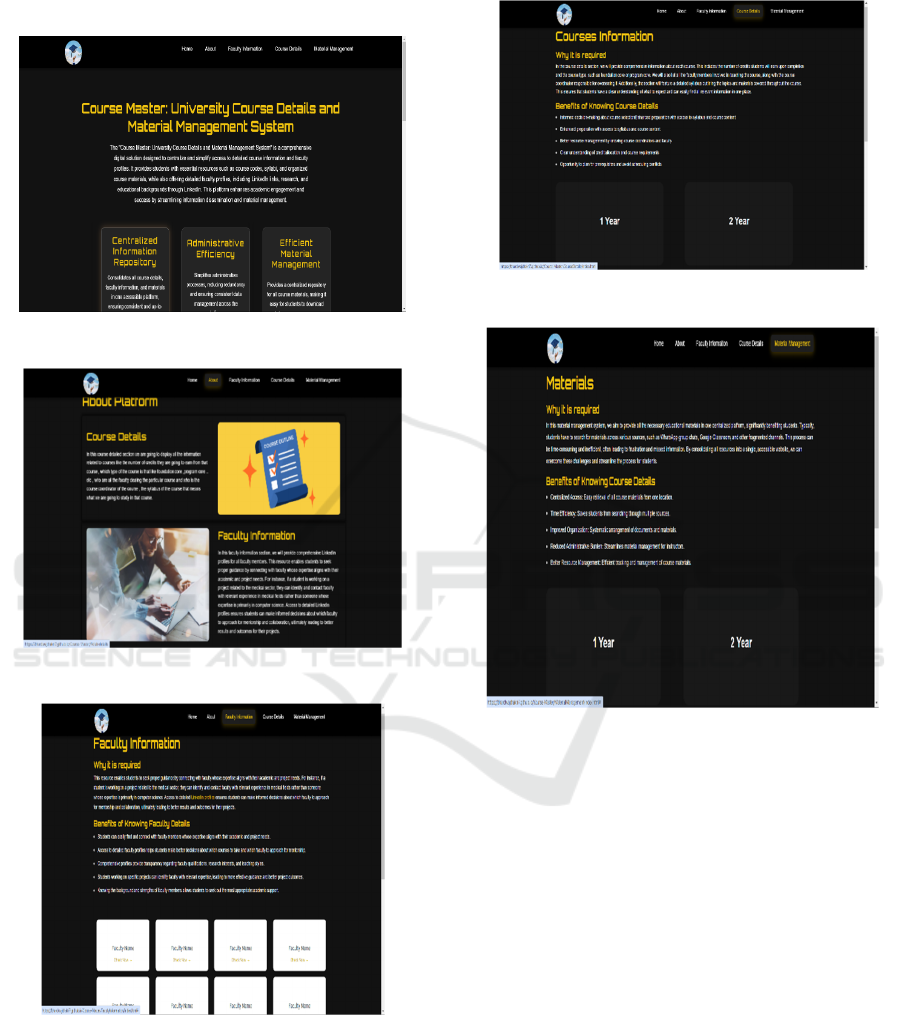
provide the faculty linked in profiles if we click
check now it will be automatically redirected to their
profiles (Figure3).
Figure 1: Home Page.
Figure 2: About Section.
Figure 3: Faculty Information.
Course Details: This page will provide the
information about the course details is required for us
and what will be the main benefits of knowing the
course details you can select firstly year you need to
select semester then subject in this way the webpage
will be redirected step by step here is related figure
4.
Figure 4: Course Information.
Figure 5: Material Management.
6 RESULT AND DISCUSSION
The outcome of the Course Master project is a fully
responsive web page, developed with perfection by
using HTML, CSS, and JavaScript (Williams, P., &
Thompson, R. 2021). The web page, in view of the
responsive nature, adapts to various sizes such as
extra small, small, medium, large, and extra-large,
which are named as XS, SM, MD, LG, and XL,
thereby providing great user experience based upon
the user platform used (Lee, J., & Chen, H. 2020).
Comparison chart: The comparison chart feature
illustrated Recorded Classes represents the
transformation from an existing very primitive form
of a playback option in the existing system to
something much structured and experience-friendly
in the proposed system. In the existing system,
ICRDICCT‘25 2025 - INTERNATIONAL CONFERENCE ON RESEARCH AND DEVELOPMENT IN INFORMATION,
COMMUNICATION, AND COMPUTING TECHNOLOGIES
422
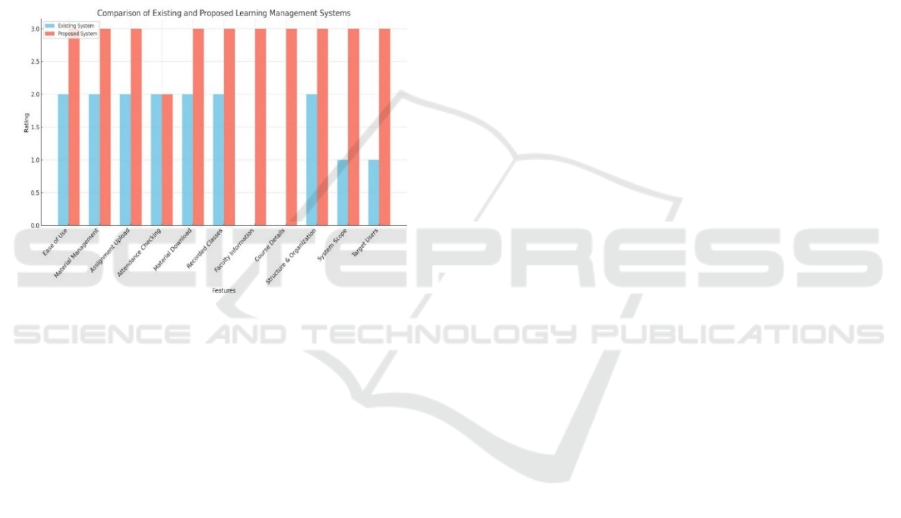
recorded lectures have value for listening to them by
the students. (figure 6) Though it is only for learning
and reviewing purposes, it appears not to be
something advanced organized. On the contrary, the
Proposed System supports recording classes and
makes them accessible. This would include better
organization; for example, it may categorize the
recordings by topic, date, or lecture series; add
features such as timestamps or bookmarks. All of
these improvements would allow students to return
directly to selected parts of a lecture more quickly.
This would save the time needed for review sessions
and make such sessions more efficient. By fine-tuning
the design of class-recorded materials, this system
gives the student greater control over their learning
and enables them to use the lecture material better.
Figure 6: Comparison of Existing and Proposed Learning
Management Systems.
Responsive Design: The web page exhibits
responsive design whereby the content is clearly
laid and arranged to suit different types of screens.
The website thus avails the students with an
optimal viewing experience. The scaled contents
provide students with convenient access to course-
related material and information. (L. Johnson and
S. Adams Becker, 2014). Access Control: Only
students of colleges are allowed to a site like this
through which all confidential data and resources
are managed. All these users get authenticated. This
is done so that there is an improvement in data's
confidentiality andsecurity (M. Bishop, 2003).
7 CONCLUSIONS
The Course Master provides a centralized
arrangement of all the university course details and
material management through responsive design and
interaction features, offering structured access to the
most relevant resources in an efficient manner to the
students, who can have detailed faculty profiles and
courses organized. It really increases the
effectiveness of administrative work and becomes an
auxiliary tool for achieving academic success,
showing evidence that it is absolutely an essential
part of the life of both students and faculties in the
learning ecosystem. The future development will be
invested into increasing availability and streamlining
content management.
REFERENCES
A. AlShahrani, "Responsive Web Design: A
Comprehensive Guide," International Journal of
Computer Applications, vol. 179, no. 4, pp. 15-20,
2018.
Brew, A. (2013). Teaching and research: New relationships
and their implications for inquiry-based learning in
higher education. Higher Education Research &
Development, 32(1), 1-14.
Cox, J., Sweeney, E., & Pracilio, L. (2019). Student
engagement: The role of faculty mentoring in student
success. Journal of College Student Retention:
Research, Theory & Practice, 21(1), 7-20.
Cox, J., Sweeney, E., & Pracilio, L. (2019). Student
engagement: The role of faculty mentoring in student
success. Journal of College Student Retention:
Research, Theory & Practice, 21(1), 7-20.
Dziuban, C., Moskal, P., & Hartman, J. (2018). Blended
learning: The new normal and emerging technologies.
International Journal of Educational Technology in
Higher Education, 15(1), 1-16.
Dziuban, C., Moskal, P., & Hartman, J. (2018). Blended
learning: The new normal and emerging technologies.
International Journal of Educational Technology in
Higher Education, 15(1), 1-16.
Huang, Y. M., & Chen, N. S. (2020). The impact of a digital
learning environment on learning engagement: A study
of undergraduate students. Computers & Education,
148, 103793.
Johnson, L., & Adams Becker, S. (2014). NMC Horizon
Report: 2014 Higher Education Edition. Austin, Texas:
The New Media Consortium.
Johnson, L., & Adams Becker, S. (2014). NMC Horizon
Report: 2014 Higher Education Edition. Austin, Texas:
The New Media Consortium.
L. Johnson and S. Adams Becker, "NMC Horizon Report:
2014 Higher Education Edition," The New Media
Consortium, Austin, Texas, 2014.
Lee, J., & Chen, H. (2020). "Evaluating User Satisfaction
in Adaptive Web Interfaces." International Journal of
Human-Computer Interaction, vol. 36, no. 7, pp. 789-
805.
Liu, M., Zhang, S., & Kuo, Y. (2021). A study of
instructional design and course management in online
and blended learning environments. Journal of
Educational Technology Systems, 50(4), 411-430.
Course Master: University Course Details and Material Management System
423

Liu, M., Zhang, S., & Kuo, Y. (2021). A study of
instructional design and course management in online
and blended learning environments. Journal of
Educational Technology Systems, 50(4), 411-430.
M. Bishop, "Computer Security: Art and Science,"
Addison-Wesley, 2003.
Smith, R., & Brown, A. (2019). Comparative study of
traditional vs. digital learning environments:
Advantages and challenges. Educational Technology &
Society, 22(2), 62-72.
Turner, C., & O'Brien, J. (2020). Challenges in managing
educational resources: An analysis. International
Journal of Information and Education Technology,
10(4), 320-325.
Wang, F., & Kuo, Y. (2020). The effects of a course
management system on student engagement and
learning performance in a blended learning
environment. Educational Technology Research and
Development, 68(3), 1033-1056.
Wang, F., & Kuo, Y. (2020). The effects of a course
management system on student engagement and
learning performance in a blended learning
environment. Educational Technology Research and
Development, 68(3), 1033-1056.
Whelan, E., Vear, D., & Tatum, J. (2022). The role of
digital resources in enhancing student learning
engagement: A systematic review. Educational
Research Review, 28, 100304.
Whelan, E., Vear, D., & Tatum, J. (2022). The role of
digital resources in enhancing student learning
engagement: A systematic review. Educational
Research Review, 28, 100304.
Williams, P., & Thompson, R. (2021). "Responsive Web
Design: Techniques and Tools for Optimal User
Experience." Journal of Web Development and Design,
vol. 15, no. 3, pp. 45-58.
Zhang, D., & Zheng, Y. (2020). User engagement in digital
learning platforms: A systematic review. Computers &
Education, 159, 104027.
Zhao, Y., & Huang, X. (2021). The role of information
management systems in higher education. Computers in
Human Behavior, 114, 106550.
ICRDICCT‘25 2025 - INTERNATIONAL CONFERENCE ON RESEARCH AND DEVELOPMENT IN INFORMATION,
COMMUNICATION, AND COMPUTING TECHNOLOGIES
424
