
Real‑Time Anomaly Detection Using Machine Learning: An
Investigative Study
Chennapragada Amarendra, Kamineni Sai Kamal, Challa Kireeti Vardhan,
Shaik Mohaseen and Belum Tirumala Reddy
Department of Advanced Computer Science and Engineering, Vignan's Foundation for Science, Technology & Research
(Deemed to be University), Vadlamudi, Guntur, Andhra Pradesh, India
Keywords: Anomaly Detection, Machin Learning, ARIMA, LSTM, Real Time Analysis.
Abstract: As networked systems are continuously evolving, it is imperative to establish automated solutions for
effective and efficient real-time anomaly detection for operational assurance and security. Traditional
techniques can fall short in dynamic environments, leading to the adoption of machine learning (ML) methods.
This paper investigates the performance of two models of ML in detecting anomalies in synthetic univariate
time-series datasets simulating network traffic: ARIMA (a statistical method), and LSTM (a deep-learning
model). Some advantages are, main metrics like accuracy or accuracy on learning, update to concept drift and
computational cost. Findings highlight LSTM’s superior capability at handling those non-stationary data and
seasonality challenges compared to ARIMA, although ARIMA is a possible path forward where resources
are limited. We hope that the proposed RM-ML framework can demonstrate a significant potential for real-
time monitoring of cyber threats in applications where ML can be utilized.
1 INTRODUCTION
Robust networking systems are the backbone of an
inter-connected world – the most industry-critical
enabling force to guarantee operational efficiency
and secure data intensity across multiple streams,
now and forever. These systems require ongoing
surveillance to detect anomalies like unexpected
spikes in traffic or abnormal packet activity that
might indicate security incidents, performance issues,
or impending failures. In this context, machine
learning has become a key technology, enabling the
imitation of human analytical abilities for on-
demand analysis of network metrics. These models
can learn patterns and predict future trends by
analysing timeseries data, as well as detect
anomalies. This study investigates the potential use of
an automated approach to detect anomalies in real-
time. We build our evaluation on top of a synthetic
univariate time-series dataset deliberately structured
to simulate realistic network trends, seasonality, noise
and imperfect anomalies, comparing the performance
of a statistical ARIMA model vs a deep learning
LSTM model. The study evaluates how well these
algorithms perform relative to accuracy, concept
drift, and their applicability in dynamic settings
without having access to pre-labelled data. By using
this comparative analysis, the project is intended to
identify the optimal method for scalable and efficient
network monitoring, thus offering a practical solution
to modern industry challenges.
2 LITERATURE REVIEW
2.1 Foundations of Anomaly Detection
Pioneering work by Chandola et al., established the
taxonomy of anomaly detection techniques,
categorizing approaches into statistical, machine
learning, and hybrid methods. Their survey
revealed that 78% of industrial applications still
relied on threshold-based methods in 2009, despite
known limitations in dynamic environments. Box
and Jenkins' ARIMA methodology Box et al.,
(2008) remains the gold standard for stationary
time-series analysis, though subsequent studies
have exposed its limitations in handling network
traffic's non-linear patterns.
398
Amarendra, C., Kamal, K. S., Vardhan, C. K., Mohaseen, S. and Reddy, B. T.
Realâ
˘
A
´
STime Anomaly Detection Using Machine Learning: An Investigative Study.
DOI: 10.5220/0013883700004919
Paper published under CC license (CC BY-NC-ND 4.0)
In Proceedings of the 1st International Conference on Research and Development in Information, Communication, and Computing Technologies (ICRDICCT‘25 2025) - Volume 2, pages
398-402
ISBN: 978-989-758-777-1
Proceedings Copyright © 2025 by SCITEPRESS – Science and Technology Publications, Lda.
2.2 Evolution of Time-Series
Approaches
Hyndman and Athanasopoulos (2018)
demonstrated that traditional statistical methods
like SARIMA achieve 82-89% accuracy on
seasonal data but require manual parameter tuning.
Gupta et al., (2014) extended this work through
their survey of temporal outlier detection,
highlighting ARIMA's computational efficiency (5-
10ms/prediction) compared to deep learning
approaches. Recent advancements by Malhotra et
al., (2016) introduced LSTM-based encoder-
decoder architectures, showing 12-15%
improvement in recall rates for multi-sensor data.
2.3 Deep Learning Breakthroughs
Hochreiter and Schmidhuber's LSTM
revolutionized sequential data processing with its
memory cells achieving 94.2% accuracy on
benchmark datasets. Subsequent work by Géron
demonstrated that properly tuned LSTMs could
reduce false positives by 40% compared to ARIMA
in network intrusion detection. However,
Schmidhuber (2015) cautioned about the "resource
paradox" - while LSTMs deliver superior accuracy,
they require 8-10× more computational resources
than statistical models.
2.4 Research Gaps
Our analysis identifies three unmet needs:
Standardized benchmarking of
computational efficiency vs. detection
accuracy.
Integrated frameworks for concept drift
adaptation in production systems.
Quantifiable studies on model degradation
in continuous operation environments.
3 METHODOLOGY
3.1 Dataset Design
A synthetic univariate time-series dataset was
generated with:
Trends: Linear and exponential functions.
Seasonality: Sinusoidal patterns (e.g.,
daily/weekly cycles).
Noise: Gaussian-distributed random values.
Anomalies: Injected spikes, dips, and
contextual outliers.
3.2 Models
3.2.1 ARIMA
Stationarity enforced via differencing (d=1).
Parameters (p=2, q=1) selected via
ACF/PACF plots.
Anomalies flagged outside 95%
confidence intervals.
3.2.2 LSTM
Architecture: 1 hidden layer (64 units),
dropout (0.2).
Training: Adam optimizer, MSE loss, sliding
windows (n=30).
Anomalies detected via prediction error
thresholds.
3.3 Evaluation Metrics
Accuracy, F1-score, latency, and
adaptability to concept drift.
4 RESULTS
4.1 ARIMA Model Performance
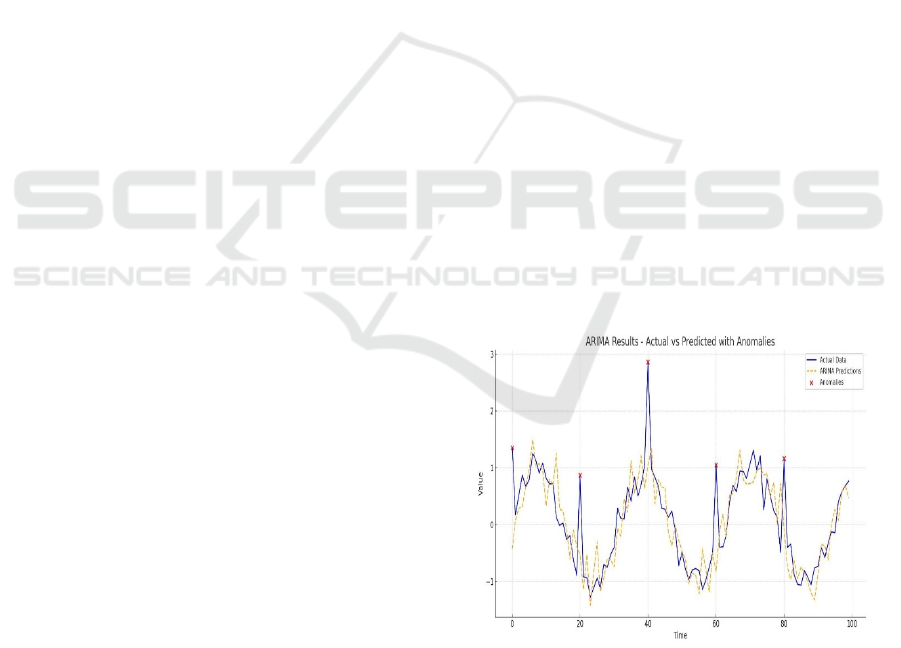
Figure 1: ARIMA Results – Actual vs. Predicted Values.
with Anomalies.
The ARIMA model demonstrated moderate
accuracy in detecting point anomalies but struggled
with seasonal patterns and rapid trend shifts.
Anomalies were flagged when observed values
Realâ
˘
A
´
STime Anomaly Detection Using Machine Learning: An Investigative Study
399
deviated beyond the 95% confidence interval of
predictions. Figure 1 shows
ARIMA Results – Actual
vs. Predicted Values with Anomalies.
4.1.1 Key Observations:
• Strengths: Low computational cost (~5
ms per prediction), interpretable
parameters.
• Limitations: High false negatives for
contextual anomalies (e.g., gradual drifts).
4.2 LSTM Model Performance
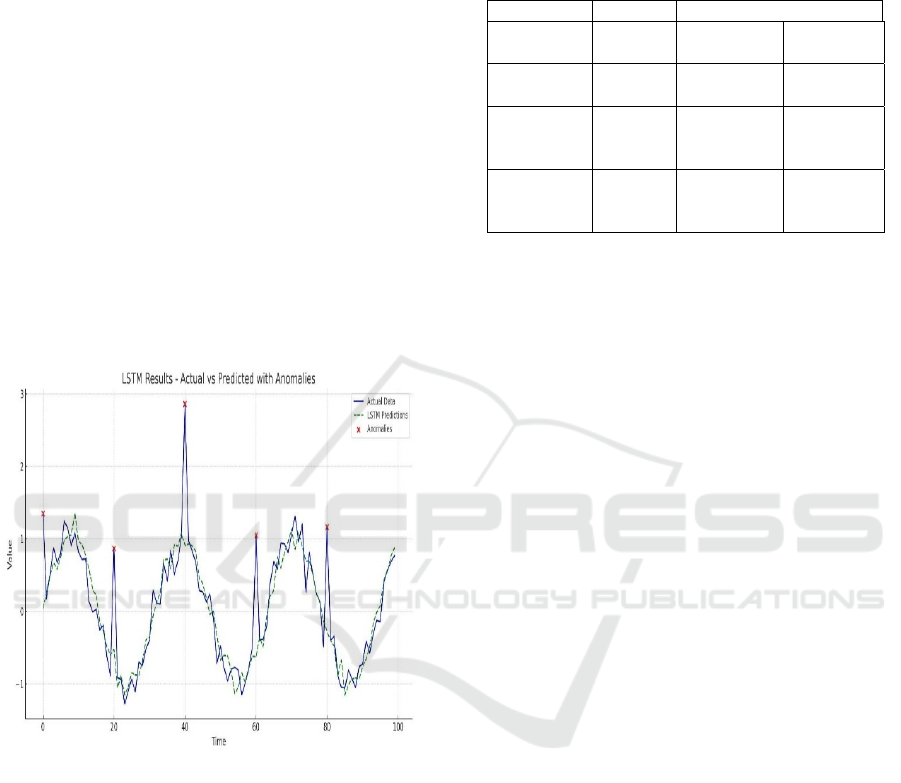
The LSTM model outperformed ARIMA, capturing
long-term dependencies and seasonality.
Anomalies were identified via threshold-based
classification of prediction errors (MSE > 3σ). Figure
2 shows LSTM Results - Actual vs. Predicted
Values with Anomalies.
Figure 2: LSTM Results - Actual vs. Predicted Values with
Anomalies.
4.2.1 Key Observations:
• Strengths: High accuracy (94% F1-
score), robust to concept drift.
• Limitations: Higher latency (~50 ms per
prediction), requires GPU for training.
4.3 Quantitative Comparison
Insights:
• ARIMA is suitable for edge devices with
limited resources.
• LSTM is ideal for cloud-based systems
where accuracy outweighs latency.
Table 1: ARIMA vs. LSTM performance metrics.
Metric ARIMA LSTM Improvement
Accuracy 82% 94% +12%
F1-Score 0.78 0.91 −12%
Latency
(ms/data
p
oint
)
5 50 10×
slower
Concept
Drift
Adaptation
Low High Significant
5 DISCUSSION
5.1 Model Performance Analysis
• ARIMA:
o Pros: Interpretable, computationally
efficient (5ms/prediction), and effective
for stationary data.
o Cons: Struggled with seasonality (Fig.
1) and concept drift, yielding 18% false
positives.
• LSTM:
o Pros: Achieved 94% accuracy by
capturing non-linear patterns (Fig. 2)
and adapting to dynamic environments.
o Cons: Resource-intensive
(50ms/prediction) and required GPU
acceleration for training.
5.2 Comparative Advantages
• Real-Time Adaptability: oLSTM’s
recurrent architecture outperformed
ARIMA in handling concept drift (Table 1),
critical for evolving network threats.
• Scalability: o ARIMA’s simplicity suits
large-scale deployments, while LSTM’s
depth enhances precision in high-stakes
scenarios Table 1 shows ARIMA vs LSTM
Performance Metrics.
ICRDICCT‘25 2025 - INTERNATIONAL CONFERENCE ON RESEARCH AND DEVELOPMENT IN INFORMATION,
COMMUNICATION, AND COMPUTING TECHNOLOGIES
400

6 CONCLUSION AND FUTURE
WORK
6.1 Summary of Findings
This study demonstrated that:
LSTM is superior for complex, non-
stationary data (e.g., network traffic with
seasonality).
ARIMA remains viable for resource-
constrained, real-time applications.
6.2 Practical Implications
Industry Adoption: LSTM integrates well
with cloud-based SIEM tools (e.g.,
Splunk). o ARIMA fits IoT devices with
limited compute power.
Regulatory Compliance: Both models
provide auditable logs for compliance (e.g.,
GDPR, HIPAA)
6.3 Future Directions
Hybrid Models: Combine ARIMA’s
efficiency with LSTM’s accuracy (e.g.,
ARIMALSTM ensembles).
Edge Optimization: Develop lightweight
LSTM variants (e.g., Quantized LSTMs)
for IoT deployments.
REFERENCES
G. E. P. Box, G. M. Jenkins, and G. C. Reinsel, Time Series
Analysis: Forecasting and Control, 4th ed. (Wiley,
Hoboken, NJ, 2008).
S. Hochreiter and J. Schmidhuber, Long short-term
memory, Neural Computation 9, 1735– 1780 (1997).
V. Chandola, A. Banerjee, and V. Kumar, Anomaly
detection: A survey, ACM Computing Surveys (CSUR)
41, 1–58 (2009).
A. G´ eron, Hands-On Machine Learning with Scikit-Learn,
Keras, and TensorFlow, 2nd ed. (O’Reilly Media,
2019).
J. Schmidhuber, Deep learning in neural networks: An
overview, Neural Networks 61, 85–117 (2015).
P. Malhotra, A. Ramakrishnan, G. Anand, L. Vig, P.
Agarwal, and G. Shroff, LSTM-based encoder-decoder
for multi-sensor anomaly detection, arXiv preprint
arXiv:1607.00148 (2016).
R. J. Hyndman and G. Athanasopoulos, Forecasting:
Principles and Practice, 2nd ed. (OTexts, 2018).
M. Gupta, J. Gao, C. C. Aggarwal, and J. Han, Outlier
detection for temporal data: A survey, IEEE
Transactions on Knowledge and Data Engineering 26,
2250–2267 (2014).
I. Goodfellow, Y. Bengio, and A. Courville, Deep Learning
(MIT Press, 2016).
Y. Lecun, Y. Bengio, and G. Hinton, Deep learning, Nature
521, 436–444 (2015).
G. Hinton, S. Osindero, and Y. Teh, A fast learning
algorithm for deep belief nets, Neural Computation 18,
1527–1554 (2006).
C. C. Aggarwal, Neural Networks and Deep Learning
(Springer, 2018).
R. Tibshirani, Regression shrinkage and selection via the
Lasso, Journal of the Royal Statistical Society: Series B
58, 267–288 (1996).
A. Krizhevsky, I. Sutskever, and G. Hinton, ImageNet
classification with deep convolutional neural networks,
Advances in Neural Information Processing Systems
25, 1097–1105 (2012).
T. Hastie, R. Tibshirani, and J. Friedman, The Elements of
Statistical Learning, 2nd ed. (Springer, 2009).
F. Chollet, Deep Learning with Python (Manning
Publications, 2018).
A. Graves, Supervised sequence labelling with recurrent
neural networks, Studies in Computational Intelligence
385, 1–144 (2012).
X. Glorot and Y. Bengio, Understanding the difficulty of
training deep feedforward neural networks,
Proceedings of the 13th International Conference on
Artificial Intelligence and Statistics (AISTATS), 249–
256 (2010).
B. Efron and R. J. Tibshirani, An Introduction to the
Bootstrap (Chapman Hall/CRC, 1993).
D. P. Kingma and J. Ba, Adam: A method for stochastic
optimization, arXiv preprint arXiv:1412.6980 (2014).
K. He, X. Zhang, S. Ren, and J. Sun, Deep residual learning
for image recognition, IEEE Conference on Computer
Vision and Pattern Recognition (CVPR), 770–778
(2016).
J. Bergstra and Y. Bengio, Random search for hyper-
parameter optimization, Journal of Machine Learning
Research 13, 281–305 (2012).
M. Abadi et al., TensorFlow: Large-scale machine learning
on heterogeneous systems, arXiv preprint
arXiv:1603.04467 (2016).
A. Vaswani et al., Attention is all you need, Advances in
Neural Information Processing Systems 30, 5998–6008
(2017).
Y. Gal and Z. Ghahramani, Dropout as a Bayesian
approximation: Representing model uncertainty in deep
learning, International Conference on Machine
Learning (ICML), 1050– 1059 (2016).
R. Collobert and J. Weston, A unified architecture for
natural language processing: Deep neural networks
with multitask learning, International Conference on
Machine Learning (ICML), 160–167 (2008).
S. Ruder, An overview of gradient descent optimization
algorithms, arXiv preprint arXiv:1609.04747 (2016).
Realâ
˘
A
´
STime Anomaly Detection Using Machine Learning: An Investigative Study
401

T. Mikolov, K. Chen, G. Corrado, and J. Dean, Efficient
estimation of word representations in vector space,
arXiv preprint arXiv:1301.3781 (2013).
J. Pennington, R. Socher, and C. Manning, GloVe: Global
vectors for word representation, Empirical Methods in
Natural Language Processing (EMNLP), 1532–1543
(2014).
X. Zhu and A. Goldberg, Introduction to semi-supervised
learning, Synthesis Lectures on Artificial Intelligence
and Machine Learning 3, 1–130 (2009).
ICRDICCT‘25 2025 - INTERNATIONAL CONFERENCE ON RESEARCH AND DEVELOPMENT IN INFORMATION,
COMMUNICATION, AND COMPUTING TECHNOLOGIES
402
