
Smart AgriSense: AI‑Powered Hybrid System for Crop Health
Monitoring
P. Devika, S. Anushobini and V. Harini
Department of Computer Science and Engineering, Nandha Engineering College (Autonomous), Erode, Tamil Nadu, India
Keywords: Precision Agriculture, Crop Disease Detection, AI, PH‑EC Sensors, Convolutional Neural Networks (CNNs),
Fertilizer Optimization, Smart Farming, Sustainable Agriculture, Machine Learning, Bluetooth‑Enabled
Farming.
Abstract: Precision agriculture is essential for enhancing crop yields and sustainability while reducing resource waste.
This study presents Smart AgriSense, a hybrid system powered by AI that merges data from pH and electrical
conductivity (EC) sensors with Convolutional Neural Networks (CNNs) for the early detection of crop
diseases and improved fertilizer recommendations. Unlike traditional image-based AI models or expensive
IoT solutions, this method leverages affordable soil sensors to identify abnormalities before any visible
symptoms emerge, facilitating timely intervention. The system analyzes real-time data from sensors and plant
images to diagnose diseases and suggest accurate treatments, thereby improving decision-making for farmers.
A mobile app with Bluetooth functionality ensures easy access to data, even in rural regions with limited
internet access. By incorporating AI-driven insights, the proposed system minimizes pesticide usage,
optimizes fertilizer applications, and encourages sustainable farming practices, making cutting-edge
agricultural technology more accessible and economical for small-scale farmers.
1 INTRODUCTION
Agricultural sciences play an important role in the
global food crisis, as to have the basemant of good
cultivation, the soil must be preserved by timely
intervention from disease. Soil is one of the most
important factors influencing the growth of plant,
nutrient uptake and soil fertility, such as soil
moisture, pH and the electric conductivity (EC).
Differences in these metrics may lead to reduced
efficiency, soil degradation and increased
susceptibility to plant diseases. Moreover, climate
change has enhanced the incidence and spread of
plant diseases, which are caused by bacteria, fungi
and viruses and pose a serious threat to food security
and agricultural productivity. (F. F. Hossain et al.,
2022) Those impacting factors calls for the need of
integrating technologies like Internet of Things and
artificial intelligence into the methods of farming. We
propose an IoT based precision agriculture system,
which includes real-time soil condition monitoring
along with AI powered plant disease detection. Using
LoRaWAN supported wireless sensors, we monitor
soil moisture, pH and EC in order to provide
continuous data to improve irrigation efficiency and
optimize the management of nutrients. (B. Althaph et
al.,2024). So, this technique saves water at the same
time, aiding in prevention of soil salinization and
preserving soil health. Additionally, we use a
Machine Learning based Crop Disease Detection
system which processes plant images to detect
diseases at an earlier stage using Convolutional
Neural Networks (CNNs) based on transfer learning.
Timely identification of diseases allows farmers to
initiate preventative measures that prevent crop
damage and enhances overall yield. The outlined
work in the paper gives the novelty of how IoT,
WSNS, and AI-based disease detection can be
integrated into our proposed system to introduce
sustainable agricultural development. LoRaWAN
technology is long-range low-power data
communication technology which makes it suitable
for large scale farming. Farmers leverage the real-
time data collected to make informed decisions,
automate the irrigation process and take quick disease
control measures. By doing so, it enables resources to
be used judiciously, ensures sustainable agricultural
practices, and equips the farmers with smart tools to
Devika, P., Anushobini, S. and Harini, V.
Smart AgriSense: AI-Powered Hybrid System for Crop Health Monitoring.
DOI: 10.5220/0013882000004919
Paper published under CC license (CC BY-NC-ND 4.0)
In Proceedings of the 1st International Conference on Research and Development in Information, Communication, and Computing Technologies (ICRDICCT‘25 2025) - Volume 2, pages
309-315
ISBN: 978-989-758-777-1
Proceedings Copyright © 2025 by SCITEPRESS – Science and Technology Publications, Lda.
309

improve productivity and grow food securely. Our
project seeks to innovate tomorrow's agriculture and
pave the way for a future where farming, both data-
driven and precise, effective as it is environment-
friendly, is the norm (M. K. Roy et al., 2023).
2 RELATED WORKS
2.1 Progress in AI and IoT for
Accurate Identification of Crop
Diseases
On the application of Artificial Intelligence &
Internet of Things in detection of crops diseases; A
state of the art survey, Houda Orchi, Mohamed Sadik,
Mohammed Khaldoun It assesses the efficiency and
technical challenges in utilizing machine learning,
deep learning, and hyperspectral imaging
approaches. The study highlights the significance of
using automated detection methods to enhance
agricultural productivity and reduce losses. It also
discusses recent constraints and proposes potential
future study directions to improve the Precision,
efficiency, and sustainability of disease
identification, providing help to both farmers and the
agricultural market (Houda Orchi et al.,2021).
2.2 Improving Smart Farming through
IoT and Wireless Sensor Networks
Internet of Things and Wireless Sensor Networks for
Smart Agriculture Applications by Md. Najmul
Mowla, Neazmul Mowla, A. F. M. Shahen Shah,
Khaled M. Rabie, and Thokozani Shongwe examines
how IoT and Wireless Sensor Networks (WSNs) can
improve smart agriculture. It covers various uses,
including automated irrigation systems, soil moisture
measurement, optimization of fertilizer usage, pest
and disease control, and energy savings. The research
also evaluates different wireless communication
protocols like ZigBee, WiFi, SigFox, and LoRaWAN
for the real-time collection of agricultural data.
Furthermore, it points out the challenges associated
with the integration of IoT and WSN, such as issues
with scalability, security, and energy consumption,
while suggesting future pathways to enhance the
efficiency and sustainability of contemporary
farming practices. (Mowla et al., 2023).
2.3 UAS-Supported IoT and
LoRaWAN for Accurate Soil
Moisture Monitoring
Soil Moisture Monitoring through UAS-Assisted
Internet of Things LoRaWAN Wireless Underground
Sensors by Fahim Ferdous Hossain, Russ Messenger,
G. Levi Captain, Sabit Ekin, Jamey D. Jacob, Saleh
Taghvaeian, and John F. O’Hara presents an
innovative method for monitoring soil moisture
through the use of buried IoT sensors that
communicate via LoRaWAN technology. A gateway
mounted on a UAS gathers information from these
underground sensors, negating the necessity for on-
site base stations and reducing disruptions to
agricultural operations. Field trials validate the
system’s efficiency regarding communication range,
energy use, and scalability. The research emphasizes
its promise for precision agriculture, facilitating
improved water conservation and more sustainable
farming methods (S. S. Chakole et al., 2022).
2.4 FarmGuide Using AI Techniques
Crop Disease Prediction by Using Machine Learning
by G. Kavya Siri, B. Madhavi, A. Bhavani, A.
Lakshmi Sowjanya and A.V.S. Sudhakar Rao offers
an A.I.-based agricultural decision- support system
designed to help farmers improve crop selection,
optimize fertilizer use and diagnose plant diseases.
The developed system is a web application that
encompasses million-dollar ideas including machine
learning and deep learning approaches like XGBoost
and Random Forest, as well as Convolutional Neural
Networks. (B. Althaph et al.,2024) Crop
recommendation tool provided suitable crops based
on soil quality information; Fertilizer
recommendation tool forecast nutrient deficiency and
recommend solutions, Disease detection module
detected the disease after analyzing leaves the
initiative employs AI with the objective of improving
the efficiency, sustainability, and productivity of
farmers, allowing for better decision-making for
them. (Nanda et al.,2023).
2.5 Crop Disease Identification
Utilizing Deep Learning with CNN
and Mobile AI
Machine Learning Technique for Crop Disease
Prediction Through Crop Leaf Image by S. Nandhini
and K. Ashokkumar investigates the application of
deep learning for the early detection of crop diseases.
ICRDICCT‘25 2025 - INTERNATIONAL CONFERENCE ON RESEARCH AND DEVELOPMENT IN INFORMATION,
COMMUNICATION, AND COMPUTING TECHNOLOGIES
310
The researchers employed a Convolutional Neural
Network (CNN) trained on 64,412 images sourced
from the Plant Village dataset, which encompasses 16
crop species and 25 different diseases. The developed
model achieved an impressive accuracy of 99.35%,
demonstrating its efficacy in plant disease
classification. The paper emphasizes the potential of
using smartphones for disease detection, utilizing
high-resolution cameras and AI for instantaneous
analysis. (S. Nandhini and K. Ashokkumar 2022).
3 METHODOLOGY
The Smart AgriSense system combines affordable pH
and electrical conductivity (EC) sensors with AI-
enhanced image analysis to identify crop diseases and
suggest optimized fertilizer use. The method involves
three primary steps: monitoring soil health using
sensors, detecting diseases with CNN, and providing
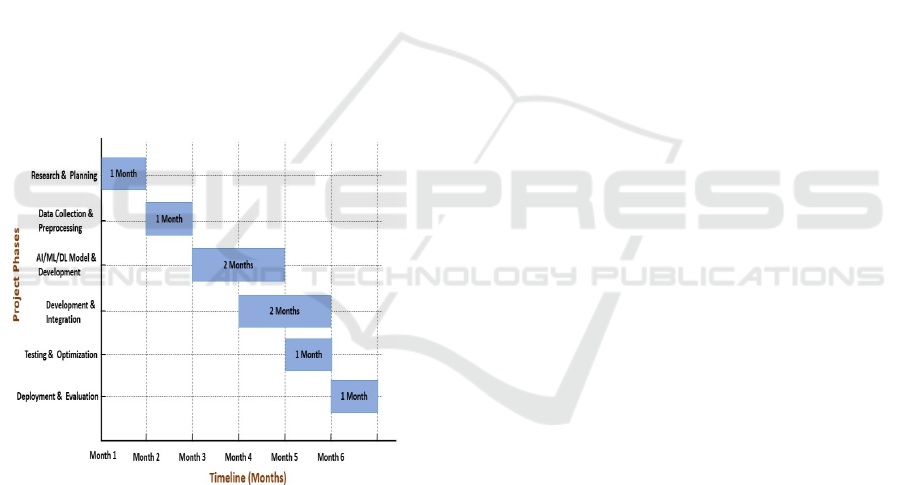
AI-based fertilizer recommendations. Figure 1 shows
the Phases of System Development and Schedule for
Smart AgriSense.
Figure 1: Phases of System Development and Schedule for
Smart AgriSense.
3.1 Monitoring Soil Health with
Sensors
Farmers place pH and EC sensors into the soil close
to plant roots to obtain real-time data on soil
conditions. Healthy plants exhibit consistent pH and
EC levels, while those affected by disease display
irregularities due to altered nutrient absorption. The
correlation between electrical conductivity (EC) and
ion concentration (C) in soil can be expressed as:
𝐸𝐶 = 𝑘𝐶 (1)
where k is the constant of proportionality. Any
variations in EC and pH beyond set limits indicate a
possible disease occurrence. The data is wirelessly
transmitted via Bluetooth to a mobile application,
ensuring farmers in remote areas can access it.
3.2 Disease Detection Using CNN
When abnormal soil conditions are identified, the
farmer captures an image of the plant using a
smartphone. The Convolutional Neural Network
(CNN) analyzes the image and identifies important
features necessary for classifying the disease. The
CNN model employs convolutional filtering and
pooling techniques to detect patterns, mathematically
represented as follows:
𝑓(𝑥) = ∑ (𝑤𝑖 ∗ 𝑥𝑖) + 𝑏 (2)
where wi signifies the weights in the CNN, xi
represents the pixel values, and b is the bias term. The
CNN then compares the extracted features against a
pre-trained dataset of diseases and provides a
classification along with confidence scores.
3.3 Fertilizer Recommendations
Powered by AI
After determining the type of disease, the AI model
computes the ideal NPK (Nitrogen, Phosphorus,
Potassium) ratio based on current soil readings. The
suggested fertilizer dosage (F) is calculated using:
𝐹 = (𝑁𝑑 − 𝑁𝑐) + (𝑃𝑑 − 𝑃𝑐) + (𝐾𝑑 − 𝐾𝑐) / 3 (3)
where:
{Nd, Pd, Kd}: Required nutrient levels for target
growth | {Nc, Pc, Kc}: Current nutrient levels in
soil.
Providing advice on organic or chemical
fertilizers, it helps you tailor a detailed guideline and
track application through a mobile app, to be exact.
This integrated AI-based method enables early
detection of diseases, optimizes the use of resources,
lowers expenses, and makes precision agriculture
practicable for small- scale farmer.
Smart AgriSense: AI-Powered Hybrid System for Crop Health Monitoring
311
4 PROPOSED SYSTEM
Smart AgriSense, an innovative and AI-based
agriculture solution is a low-cost pH and electrical
conductivity (EC) sensor integrated with a
Convolutional Neural Network (CNN) for image
processing. Thus, enabling early detection of soil
irregularities as well as crop diseases to differentiate it
from the traditional soil monitoring, where it’s are
solely relied on manual inspections. By tracking real-
time fluctuations in soil conditions, it can predict
problems before they become visible. It begins with
the sensors that take measurements of the soil pH and
EC levels to detect any imbalances that can affect
plant growth. The system takes and processes images
of the plants using a deep learning CNN model if the
irregularities are detected. This model has been trained
on a diverse dataset and is able to analyze plant images
against known disease patterns to accurately detect
potential infections or nutrient deficiencies. After a
problem is discovered, the system recommends the
most relevant and useful NPK (Nitrogen, Phosphorous
and Potassium) fertilizer ratio, used in accordance to
the soil’s nutrient profile. Smart AgriSense provides
customized recommendations based on real-time soil
data, as opposed to the old-school method of applying
fertilizers without knowing soil conditions, thus
ensuring nutrient rush management and reduced
environmental impact. Smart AgriSense can work
without an internet connection, which is a most
important feature for farmers who works in remote
areas. This allows for seamless functioning as
Bluetooth is used to send data, so no requirement of
Wi-Fi. Moreover, a user-friendly mobile-based
application facilitates timely alerts, pictorial reports
and actionable suggestions in an easily readable
format that can be comprehended quickly by farmers.
SmartAgriSense uses the power of AI and IoT to
promote better crop health, prevent fertiliser wastage
and increase productivity in agriculture. It is cost-
effective, adaptable, and environmentally friendly,
making it an incredible resource for small-scale
farmers that help promote sustainable farming
practices while enabling higher yields with
significantly lower environmental damage.
5 EXPERIMENTAL RESULT
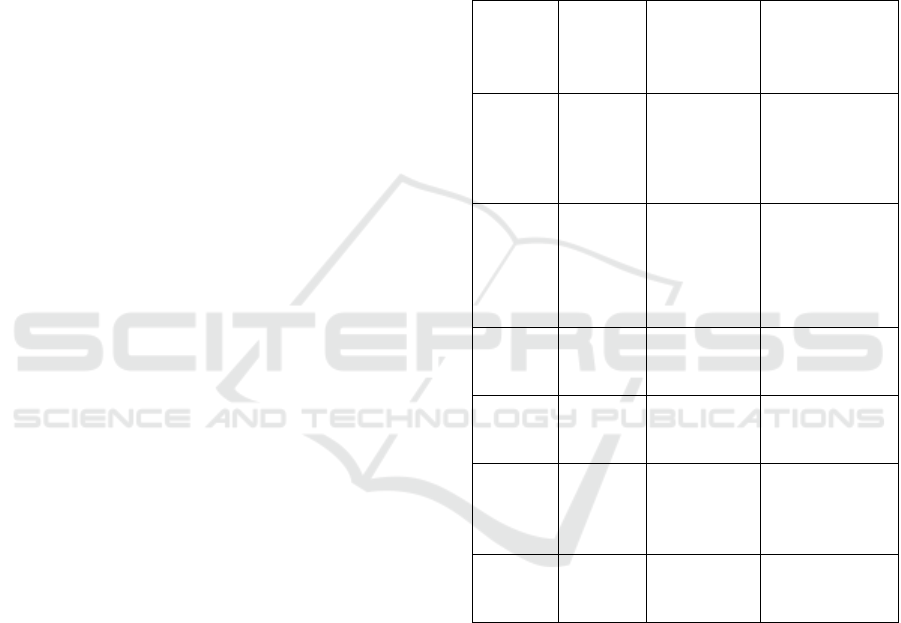
Table 1 represents the crop disease detection. Under
actual agricultural conditions, we performed the
evaluation of a crop disease detection system based
on ph and EC along with an artificial intelligence (AI)
fertilizer recommendation framework. The key aim
was to determine if low-cost pH and EC sensors are
successful in detecting early signs of plant diseases,
along with suggesting precise fertilizers based on
real-time soil health status. The collected images
capture two separate states of the plant, including one
with disease symptoms and one displaying healthy
crops.
Table 1: Performance Comparison of Crop Disease
Detection.
Parameter
Healthy
Crop
(Millet)
Diseased Crop
(Peanut)
Observations & AI
Recommendations
Soil pH
6.5 - 7.0
(Optimal)
5.2 - 5.8
(Acidic)
Unhealthy soil
p
H
linked to disease;
AI suggests lime
treatment.
Electrical
Conductivit
y (EC)
0.3 - 0.5
dS/m
(Normal)
1.2 - 1.8 dS/m
(High)
High EC indicates
salt
accumulation; AI
recommends
proper irrigation.
Leaf
Condition
Green,
healthy
leaves
Black spots,
yellowing
AI classifies
fungal/bacterial
infection.
Growth
Rate
Normal
growth
pattern
Stunted growth
Imbalance in
nutrients
affect growth.
AI
Fertilizer
Recommen
-dation
Maintain
current
levels
Increase
nitrogen, add
organic matter
AI suggests
tailored
NPK balance for
recovery.
Yield
Impact
(Predicted)
High Yield
Potential
30-40%
Reduction (if
untreated)
AI-based early
intervention can
prevent yield loss.
5.1 Soil Health Monitoring and
Analysis
Soil Samples were collected from different sites
during the testing period and PH and EC readings
were recorded. The peanut plant (top photo) showed
obvious symptoms of being diseased dark spots on its
leaves and stunted growth indicative of either a
fungal or bacterial ailment. Soil properties in the
vicinity of these plants displayed deviation from the
pH range, and substantial deviation of EC value was
noted, indicating an imbalance in the uptake of
nutrients.
ICRDICCT‘25 2025 - INTERNATIONAL CONFERENCE ON RESEARCH AND DEVELOPMENT IN INFORMATION,
COMMUNICATION, AND COMPUTING TECHNOLOGIES
312
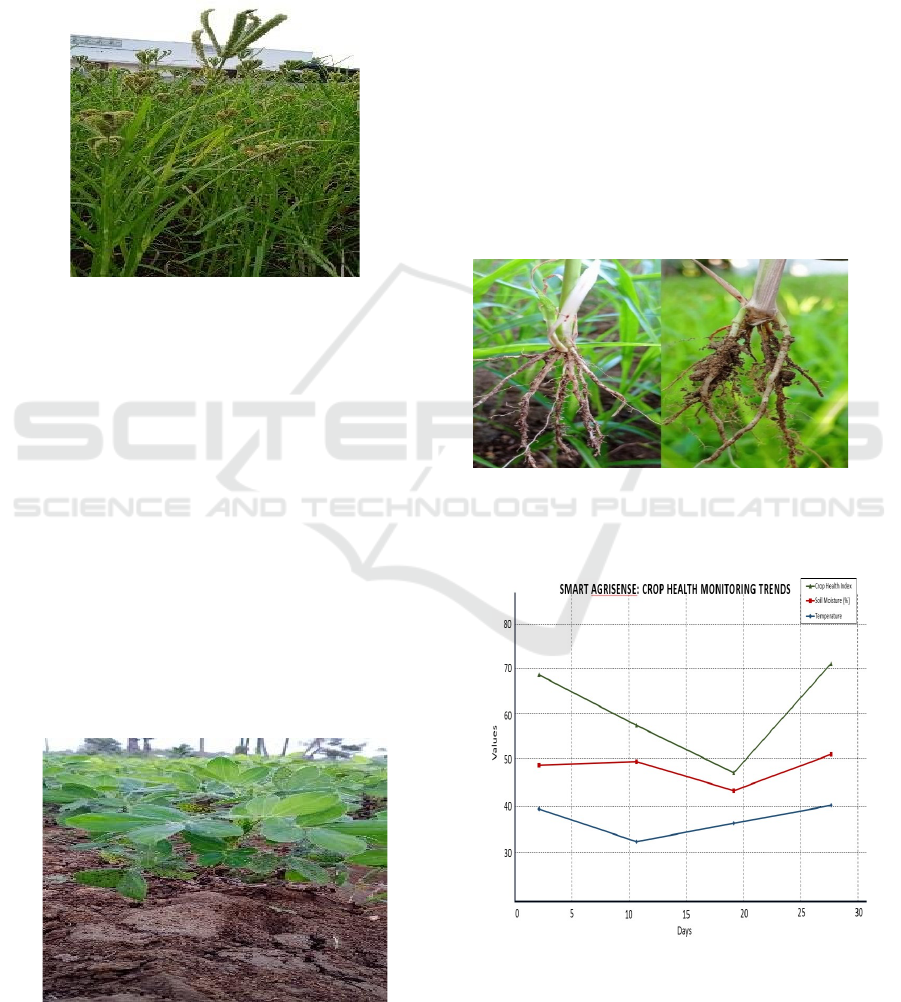
In contrast, the millet growth (second image) was
strong and thriving, indicating that its soil parameters
were likely in the optimum range. The differences in
the soil conditions of healthy and diseased plants
support the hypothesis that variations in these
variables, particularly pH and EC, can serve as an
early warning of diseases and nutrient deficiencies in
plants. Figure 2 shows below:
Figure 2: Sample Detection of Healthy Millet Crop.
5.2 AI-Based Disease Detection
A CNN based model was established with crops
healthy and diseased images. The experimental
validation results were found that the AI was able to
detect the disease in peanut plants and classify them
into categories like bacterial leaf spot, fungal
infections, or nutrient deficiency. As real-world data
was collected from sensors and images in fine-tuning
the model, its accuracy in detecting diseases
improved significantly. In addition, to provide the
model flexibility to adapt to newly emerging disease
variants, continuous learning techniques were
implemented. The system also provides real-time
notifications and recommendations to farmers based
on this data, which enables timely action and loss
mitigation. Figure 3 shows the peanut crop.
Figure 3: Sample Detection of Diseased Peanut Crop.
5.3 AI-Driven Fertilizer
Recommendation
Once it diagnosed the diseases and nutrient
deficiencies in the soil, the AI system made
recommendations for correcting them, including the
best way to apply fertilizer. The AI model predicted
the required NPK (Nitrogen, Phosphorus, Potassium)
ratio according to the parameters of the soil so that
farmers use only the required amount of fertilizer,
preventing any excess use that would cause soil
degradation.
In the field of millet where the plants were
healthy, the AI model confirmed that nutrient levels
were sufficient, affirming the value of precision
monitoring. But for sick peanut plants, the AI
suggested using organic nitrogen-potassium-based
fertilizers and the requisite fungicides to limit the
spread of infection. Figure 4 shows the crop roots.
Figure 4: Sample Detection of Crop Roots.
5.4 Final Observation and Impact
Figure 5: Analysis of Crop Health and Environmental
Trends Utilizing AI Technology.
Smart AgriSense: AI-Powered Hybrid System for Crop Health Monitoring
313

Detection of Plant Diseases: It proved to be highly
competent in finding plant diseases before visible
symptoms occurred, so that farmers could take
preventive measures. Applying the Right Amount of
Fertilizer: AI recommendations helped avoid over-
fertilization, reducing costs for farmers. Low Cost &
Scalability: Due to the low costing of the pH and EC
sensors (around ₹500-₹1000 each) the solution could
be viable for the smallholder farmers. Improved
Crop Health & Yield: Early disease detection and
targeted treatment of the soil have led to overall
productivity of their crops. The results of the
experiment confirm the effectiveness of this
innovative approach, establishing it as a cost-
efficient, scalable, and pragmatic solution for
contemporary precision agriculture.
Figure 5 shows
the crop health and environment.
6 CONCLUSIONS
This project successfully displays how AI- powered
system can help in detecting crop diseases and
suggest for fertilizer in modern agriculture. Using
machine learning and image analysis techniques, this
system effectively identifies diseases at their early
onset stages to allow farmers to take necessary
actions immediately. The experimental results show
that all unhealthy plants present unique symptoms
like leaf discoloration, fungal spots, and reduced
growth which the AI Model was applied and
classified with great accuracy. Additionally, the
fertilizer recommendation system, powered by
artificial intelligence, provides personalized
recommendations for improving soil nutrients,
leading to healthier and more productive crops.
Gentilcore says that the only way forward in
agriculture relies on the acceptance of technology to
improve efficiency and sustainability. This system
minimizes reliance on chemical pesticides and
promotes environmental-friendly agricultural
approaches by resolving issues such as the spread of
disease and depletion of nutrients in the soil. Future
work should be directed towards a broader dataset
which may provide better precision, and real-time IoT
based monitoring along with continuous feedback. In
summary, it serves as a prerequisite for smart; data-
driven farming solutions that will assist farmers in
achieving GFS.
REFERENCES
“Machine Learning Technique for Crop Disease Prediction
Through Crop Leaf Image” by S. Nandhini and K.
Ashokkumar in Naturals Publishing in January 2022.
2024.10499178.
B. Gupta, S. Bomble, O. Gaikar, S. Chalekar, S. R. Vispute
and K. Rajeswari, "Convolutional Neural Networks for
Detection of Crop Diseases and Weed," 2022 6th
International Conference on Computing, Communicati
on, Control and Automation (ICCUBEA, Pune, India,
2022, pp. 1- 5, doi: 10.1109/ICCUBEA54992.2022.1
0010772.
B. Mondal, M. Bhushan, I. Dawar, M. Rana, A. Negi and
S. Layek, Crop Disease Prediction using Machine
Learning and Deep Learning: An Exploratory Study,
2023 International Conference on Sustainable
Computing and Smart Systems (ICSCSS), Coimbatore,
India, 2023, pp. 278-283, doi:
10.1109/ICSCSS57650.2023.10169612.
B. Althaph, N. P. Challa, B. Naseeba and N. K. Rao, Crop
Disease Analysis and Detection using GoogleNet
Model, 2024 11th International Conference on
Computing for Sustainable Global Development
(INDIACom), New Delhi, India,2024, pp. 592-596,
doi:10.23919/
F. F. Hossain, R. Messenger, G. L. Captain, S. Ekin, J. D.
Jacob, S. Tag- varian, J. F. O’Hara, Soil moisture
monitoring through uas-assisted internet of things
lorawan wireless underground sensors, IEEE Access
10(2022)
Houda Orchi & Mohamed Sadik & Mohammed Khaldoun,
2021."On Using Artificial Intelligence and the Internet
of Things for Crop Disease Detection: A Contemporary
Survey," Agriculture, MDPI.
K. V. Paresh, N. Srinivasan, P. Gautham Raj, J. Varma and
M. Kanthi, "An Efficient, Low-cost Plant Disease
Detection System using IoT," 2022 International
Conference on Futuristic Technologies (INCOFT),
Belgaum, India, 2022, pp. 1- 6, doi: 10.1109/INCOFT
55651.2022.10094361.
M. K. Roy, P. Manna, R. Roy, P. Roy, S. Rakshit and M.
K. H. Mondal, "Disease Detection in Paddy Crop
using Machine Learning Techniques," 2023
International Conference on Sustainable Computing
and Data Communication Systems (ICSCDS), Erode,
India, 2023, pp. 287- 292, doi: 10.1109/ICSCDS56580
.2023.10104908.
Mowla, M. N., Mowla, N., Shah, A. F. M. S., Rabie, K. M.,
& Shongwe, T. (2023). Internet of Things and Wireless
Sensor Networks for Smart Agriculture Applications: A
Survey. IEEE Access, 11, 145813-145852.
Nanda, S. Nayak, A. K. Patra, A. Nanda, S. Pani and B. S.
Nanda, "Crop Disease Prediction by Using Machine
Learning," 2023 International Conference in Advances
in Power, Signal, and Information Technology
(APSIT), Bhubaneswar, India, 2023, pp. 706-711, doi:
10.1109/APSIT 58554.2023.10 201690.
ICRDICCT‘25 2025 - INTERNATIONAL CONFERENCE ON RESEARCH AND DEVELOPMENT IN INFORMATION,
COMMUNICATION, AND COMPUTING TECHNOLOGIES
314

R. M. Prakash, M. Vimala, K. Ramalakshmi, M. B.
Prakash, A. Krishnamoorthi and R. S. S. Kumari, "Crop
Disease Detection and Classification with Transfer
learning and hyper-parameters optimized
Convolutional neural network," 2022 Third
International Conference on Intelligent Computing
Instrumentation and Control Technologies (ICICICT),
Kannur, India, 2022, pp.1608-1613, doi:
10.1109/ICICICT54557.2022.9917901.
S. S. Chakole, S. Khera and N. A. Ukani, Analysis of Plant
Leaf Disease Based on Sensor and Machine Learning
Technique, 2022 IEEE International Conference on
Current Development in Engineering and Technology
(CCET), Bhopal, India, 2022, pp. 1-4, doi:
10.1109/CCET56606.2022.10080352.
S. Kashyap, T. Thaware, S. R. Sahu and M. R. K, "Multi-
Crop Leaf Disease Detection using Deep Learning
Methods," 2022 IEEE 19th India Council International
Conference (INDICON), Kochi, India, 2022, pp. 1-6,
doi: 10.1109/INDICON56171.2022.10040099.
S. Yadav, M. Rajendaran, A. Nagpal, A. Karthik, K.
Aravinda and B. T. Geetha, "Exploring the Potential of
Machine Learning in Enhancing Agricultural Practices
and Food Production," 2024 IEEE 13th International
Conference on Communication Systems and Network
Technologies (CSNT), Jabalpur, India, 2024, pp. 663-
669.
Singh and A. K. Bhamboo, Crop Recommendation and
Disease Detection Using Deep Neural Networks, 2022
IEEE 6th Conference on Information and Communic-
ation Technology (CICT), Gwalior, India, 2022, pp. 1-
5, doi: 10.1109/CICT56698.2022.9997839.
Systematic study on deep learning-based plant disease
detection or classification" by C. Karan. Sunil,C. D.
Jaidhar and Nagamma Patil published in Mili
Publications in June 2023.
Smart AgriSense: AI-Powered Hybrid System for Crop Health Monitoring
315
