
Enhancing Arithmetic Operations with HUB Posit: A Hardware Effi-
cient Approach
G. Charan Kumar, M. Anil Kumar, G. Charan Teja Naik and P. Vasanth
Department of Electronics and Communciation Engineering, Madanapalle Institute of Technology and Sciences, Mada-
napalli, Andhra Pradesh, India
Keywords: Posit Arithmetic, HUB Format, Adder, Multiplier.
Abstract: The responsivity was further improved with the posit™ format that replaced the IEEE 754 standard in 2017,
offering more accuracy and broader uniformity across different systems. However, it is still less competitive
than IEEE 754 in its functional units. HUB, introduced in 2016 to reduce the cost of hardware. This short
introduces a new format, referred to as HUB posit, which is proposed to help reduce the posit units' hardware
overhead. The results show that adders and multipliers are able to achieve area-delay product values lower
than those of previous works of up to 15% and 12%, respectively keeping the same accuracy. In addition, the
synthesis indicates that the operation of HUB posit units may be performed at higher frequencies than those
of classical one.
1 INTRODUCTION
The posit format, which was released in 2017, offers
benefits including repeatability and tapering preci-
sion, as an alternative to IEEE 754. IEEE 754 remains
more competitive in hardware implementations. In
2016, the HUB (Hardware Unit Block) concept was
introduced to combat this and reduce the components
price. To decrease hardware overhead, this short in-
troduces the HUB posit format, which unifies posit
arithmetic and the HUB methodology. The results
show that HUB posit units can increase area-delay
product by over 15% compared to adders and 12% to
multipliers, with similar precision. They are also bet-
ter for high-end applications because they operate at
higher frequencies.
2 LITERATURE SURVEY
Da Silva et al. proposed a chaos-based pseudo-ran-
dom number generator (PRNG), with a new hardware
design that uses the HUB fixed-point format. Over-
all, this research highlights the benefits of HUB for
achieving computation hardware efficiencies and
boosted performance for secure and high-rate imple-
mentations (S. S. Da Silva et al., 2023).
Murillo et al. explored various decoding strategies
for posit arithmetic with a focus on accuracy versus
efficiency. Their results offer guidance for future
arithmetic systems to optimize posit computation (R.
Murillo et al., 2022).
Crespo et al. proposed a combine posit/IEEE-754
vector MAC (multiply-accumulate) unit for trans pre-
cision computation (L. Crespo et al., 2022). Here,
they show how combining both posit and IEEE-754
floating point arithmetic has provided flexibility in
achieving precision and efficiency depending upon
the computational workload.
Ledoux and Casas used a specialized high-
throughput accelerator for batched general matrix
multiplications (GEMMs). They propose a scalable
solution to this problem, which retains high-perfor-
mance computing capabilities (L. Ledoux and M.
Casas, 2022).
Mallasen et al. presented PERCIVAL, an open-
source posit RISC-V core with quire support, as an
implementation of posit arithmetic in general-pur-
pose computing as an energy-efficient alternative to
existing floating-point architectures (D. Mallasén et
al., 2022).
304
Kumar, G. C., Kumar, M. A., Naik, G. C. T. and Vasanth, P.
Enhancing Arithmetic Operations with HUB Posit: A Hardware Efficient Approach.
DOI: 10.5220/0013881900004919
Paper published under CC license (CC BY-NC-ND 4.0)
In Proceedings of the 1st International Conference on Research and Development in Information, Communication, and Computing Technologies (ICRDICCT‘25 2025) - Volume 2, pages
304-308
ISBN: 978-989-758-777-1
Proceedings Copyright © 2026 by SCITEPRESS – Science and Technology Publications, Lda.
3 PROPOSED DESIGN
Realizing the fact that more hardware can greatly af-
fect the effectiveness of an algorithm while not sig-
nificantly affecting its accuracy, the study introduces
a new posit format which is a combination of posit
arithmetic and Half-Unit Biased (HUB) method
known as HUB posit format. The optimized number
of functional units reduces hardware overhead (i.e.,
area and delay) in this efficient design and improves
operating frequency considerably. Multipliers are im-
proved by up to 12% and adders by up to 15% at
higher clock frequencies. Significantly, HUB posit is
ideal for high performance and energy-efficient
computing because it solves key problems with posit
arithmetic and is enabling hardware integration with
state-of-the-art designs.
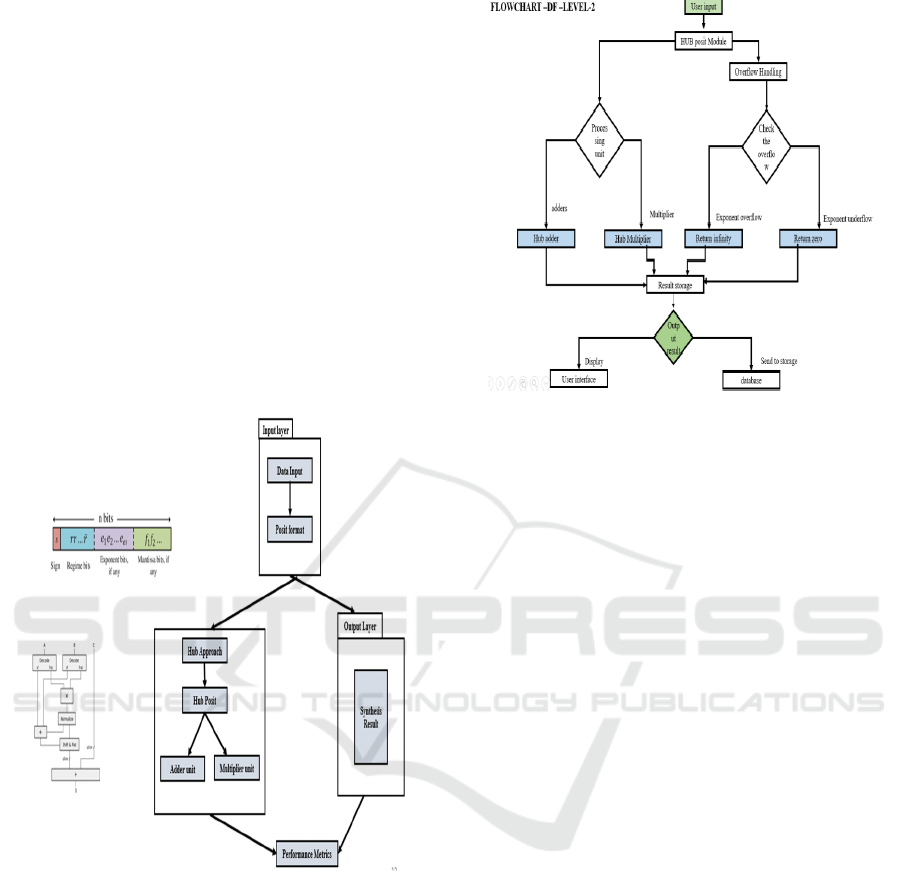
Figure 1: Architecture Design Proposed Design.
The system architecture for a computational sys-
tem that applies a Hub approach is depicted in the di-
agram. Data is entered into the system and processed
using the Hub Posit format. After that, an adder unit
and a multiplier unit that carry out arithmetic opera-
tions are applied to the Hub Posit data. The output
layer combines the outcomes of various activities and
applies a synthesis process to produce the final out-
put. Performance metrics are used to assess the sys-
tem's performance. This architecture implies that the
particular units (Adder, Multiplier) are in charge of
carrying out the actual computations, while the Hub
method serves as a framework for organizing and
processing data inside the system.
Figure 2: Flow Diagram of Proposed Design.
A computing unit's system architecture using the
Hub Posit format is shown in the flowchart. A HUB
posit module in the system processes user input be-
fore sending the information to a processing unit.,
Arithmetic functions are carried out by the processing
unit's multiplier and adder. In order to detect expo-
nent overflow and underflow situations, the system
additionally has overflow management techniques.
The system gives zero if there is an underflow and
infinity if there is an overflow. After that, the user is
shown the outcome which is subsequently saved in a
database.
4 RESULTS AND DISCUSSION
The HUB posit format shows 35% to 296% improve-
ment in hardware efficiency, 13% to 96% reduction
in area-delay product and up to 100% increase in op-
erating frequency compared to the best binarized neu-
ral network softmax with same bit-width (32-, 64-,
128- and 256-bit). Interleaved features preserve accu-
racy while significantly minimizing computing over-
head, achieving up to 12% and 15% improvements
for multipliers and adders respectively when com-
pared to standard posit units. The architecture enables
higher clock frequencies, allowing it to excel in deep
learning, embedded devices, scientific simulations,
and high-performance computing. The HUB posit de-
sign scales well at higher bit-widths, ensuring opti-
mal performance on data-heavy applications, and
maintaining a healthy balance between the speed of
computation, hardware/unit cost, and accuracy. These
advancements pave the way for HUB posit's
Enhancing Arithmetic Operations with HUB Posit: A Hardware Efficient Approach
305
inherently blendable nature into modern computer ar-
chitectures such as GPUs and machine learning plat-
forms as a theoretically powerful replacement for
both classical IEEE 745 and regular posit formats.
4.1 Schematic Diagrams
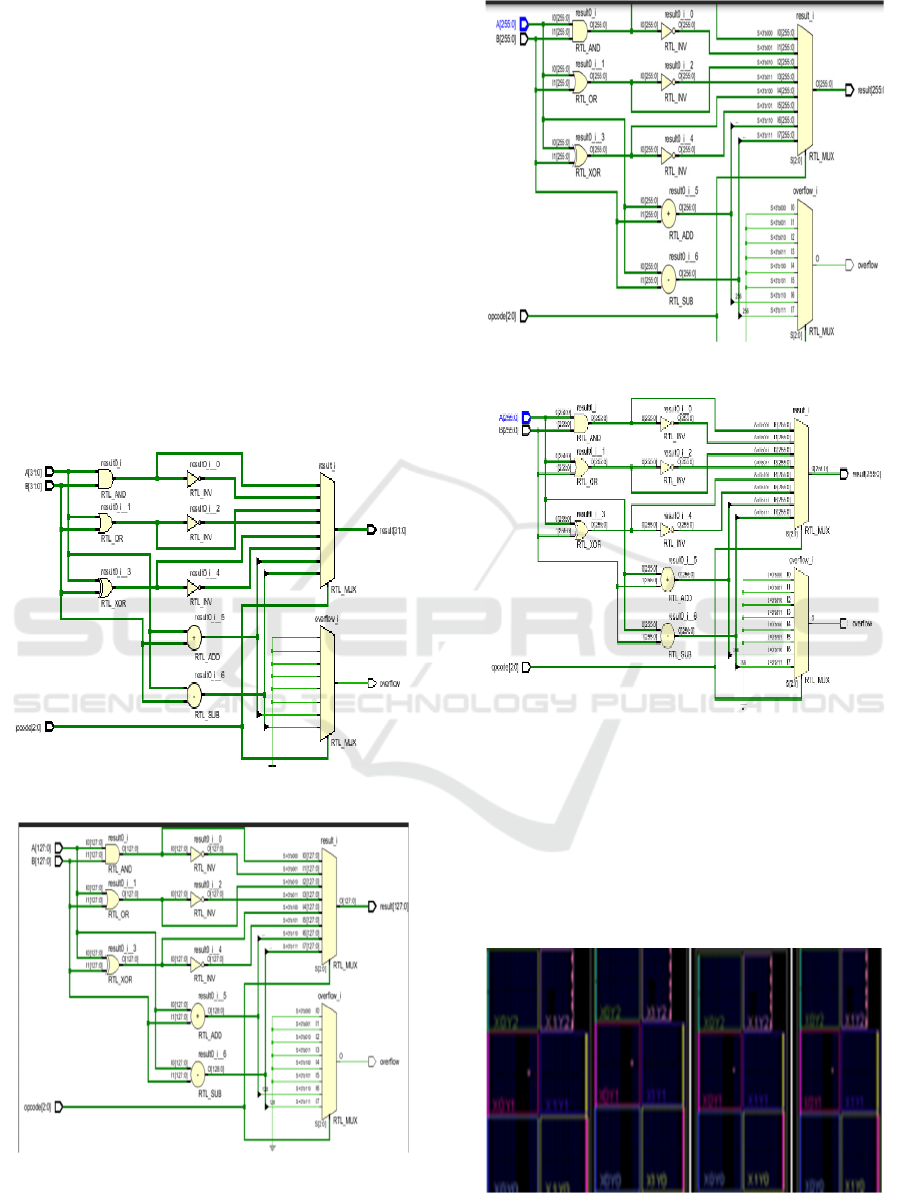
The Hub posit schematic results demonstrates an ef-
fective and scalable hardware architecture for 32-bit,
64-bit,128-bit, and 256-bit. The figure 3, 4, 5, 6
demonstrate that the accompanying data allows for
increased operating frequencies compared to tradi-
tional circuitry without sacrificing accuracy through
improved space utilization, minimalist circuits, and
tailored ALU frameworks. HUB offers a zero-point
energy and execution-efficient alternative to standard
floating-point architectures and its floor layout and
IO designs demonstrate seamless portability onto
FPGAs and ASICs.
Figure 3: 32 Bit.
Figure 4: 64 Bit.
Figure 5: 128 Bits.
Figure 6: 256 Bit.
4.2 Floor Planning
The floor design confirms effective hardware usage
in a well-arranged position that utilizes its next-fast-
est token result ability, leaving little room for 32-, 64-
, 128- and 256-bit shown in figure 7, HUB posit ar-
chitectures row span.
Figure 7: 32 Bit, 64 Bit, 128 Bit, 256 Bit.
ICRDICCT‘25 2025 - INTERNATIONAL CONFERENCE ON RESEARCH AND DEVELOPMENT IN INFORMATION,
COMMUNICATION, AND COMPUTING TECHNOLOGIES
306
The designs support higher clock frequencies and
deliver optimized routing, lower latency and im-
proved power distribution. The HUB posit format is
a compact, potent, and power-sensitive replacement
for floating point architectures, and accommodates a
range of implementations on FPGA and ASIC and
can be expanded accordingly.
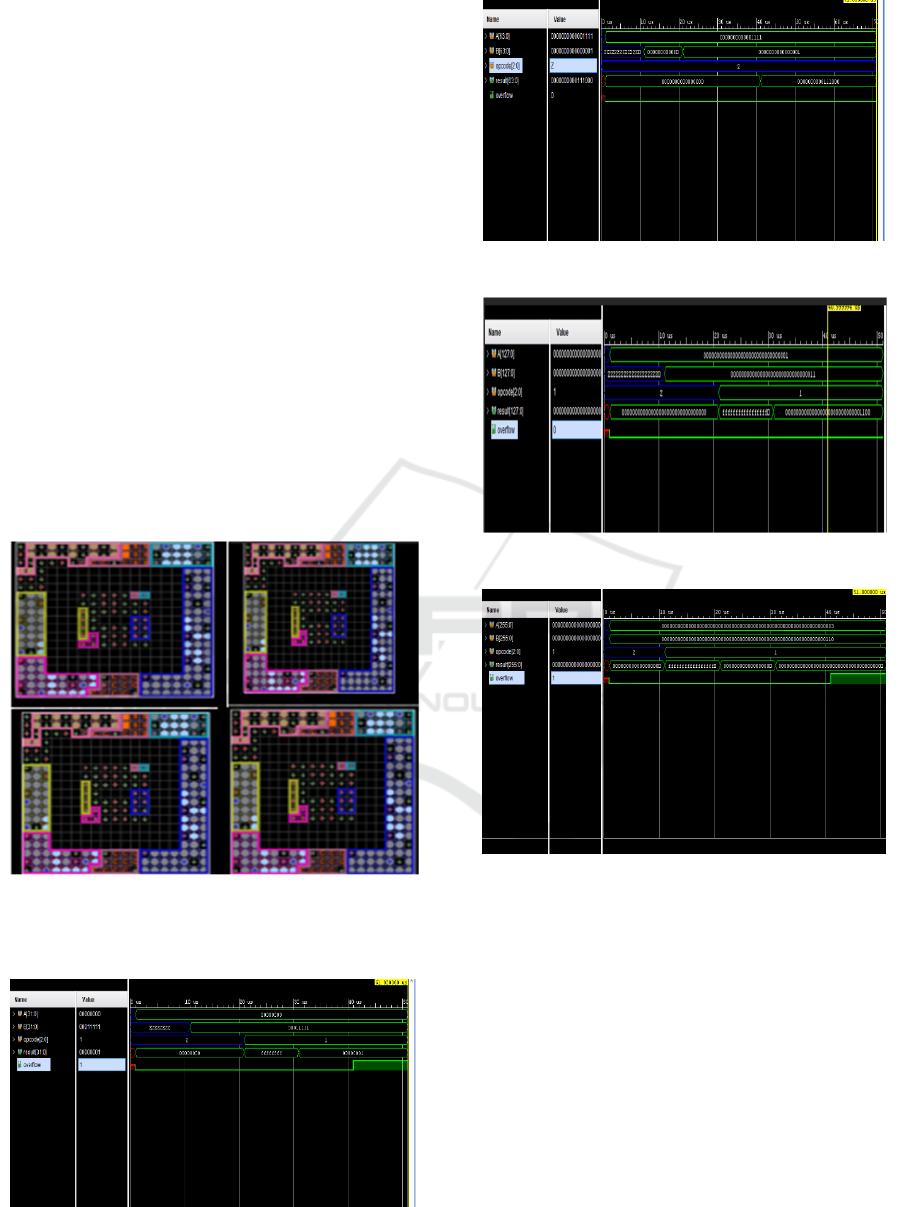
4.3 ALU I/O Planning
Assuring minimum latency and maximal computa-
tion efficiency, the ALU I/O designing is feasible in
these posit design to 32, 64, 128 and 256 bit shown in
figure 8, HUB posit. Structured architecture en-
hances input-output synchronization by reducing
turnaround time with no consequence on the accu-
racy. HUB posit ALU is a modern high-performance,
low-power level multiplication solution working at a
higher clock rate and a scaleable physical structure
with a fine network layout suitable for the current
computer overall architecture. Figure 9, 10, 11, 12
shows the ALU output of 32-bit, 64-bit, 128-bit, 256
bits.
Figure 8: 32 Bit, 64 Bit, 128 Bit, 256 Bit.
4.4 ALU Output
Figure 9: 32 Bit.
Figure 10: 64 Bit.
Figure 11: 128 Bit.
Figure 12: 256 Bit.
5 CONCLUSIONS
Despite the accuracy being maintained, the HUB
posit format will be encouraging operational fre-
quency, area-delay product, and thus hardware effi-
ciency. From a hardware perspective, due to the wide
bit-width operations, posit arithmetic and HUB tech-
nique are employed for improving scalability, saving
hardware overhead, and improving performance. The
results of the synthesis confirm the feasibility of em-
bedded systems, scientific simulations, and high-per-
formance computing, showing that HUB posit is a
Enhancing Arithmetic Operations with HUB Posit: A Hardware Efficient Approach
307

competitive alternative to standard IEEE 754 and
posit implementations.
REFERENCES
D. Mallasén, R. Murillo, A. A. Del Barrio, G. Botella, L.
Piñuel, and M. Prieto-Matias, “PERCIVAL: Open-
source posit RISC-V core with quire capability,” IEEE
Trans. Emerg. Topics Comput., vol. 10, no. 3, pp.
1241–1252, Jul.–Sep. 2022.
H. Zhang and S.-B. Ko, “Design of power efficient posit
multiplier,” IEEE Trans. Circuits Syst. II, Exp. Briefs,
vol. 67, no. 5, pp. 861–865, May 2023
L. Crespo, P. Tomás, N. Roma, and N. Neves, “Unified
posit/IEEE-754 vector MAC unit for transprecision
computing,” IEEE Trans. Circuits Syst. II, Exp. Briefs,
vol. 69, no. 5, May 2022.
L. Ledoux and M. Casas, “A generator of numerically-tai-
lored and high-throughput accelerators for batched
GEMMs,” in Proc. IEEE 30th Annu. Int. Symp. Field-
Program. Custom Comput. Mach. (FCCM), 2022.
R. Murillo, D. Mallasén, A. A. Del Barrio, and G. Botella,
“Comparing different decoding for posit arithmetic,” in
Proc. Conf. Next Generat. Arithm. (CoNGA), 2022.
S. S. Da Silva et al., “A new chaos-based PRNG hardware
architecture using the HUB fixed-point format,” IEEE
Trans. Instrum. Meas., vol. 72, 2023.
ICRDICCT‘25 2025 - INTERNATIONAL CONFERENCE ON RESEARCH AND DEVELOPMENT IN INFORMATION,
COMMUNICATION, AND COMPUTING TECHNOLOGIES
308
