
Innovative Solutions for EV Charging and Passenger Handling in
Public Transport
K. Karthika, Kishore Kumar D. and Lakshmikant Kanav
Department of Electronics and Communication Engineering, KCG College of Technology, Chennai, Tamil Nadu, India
Keywords: Electric Vehicles (EVs), Advanced Charging Infrastructure, Wireless Charging, Smart Grids.
Abstract: The rapid emergence and evolution of electric vehicles have created a need for new technologies that can help
improve the passenger handling and efficiency of public transport systems. An emphasis will be on the
development of new integrated solutions that involve advanced charging infrastructure and the optimization
of passenger handling procedures. The goal is to foster energy-efficient, time-efficient, and easier-to-use
systems that improve the overall experience for the end-user. Additionally, these steps include the
implementation of modern public transport network technologies that incorporate smart grid systems,
automated passenger handling systems, and wireless charging. This will make public transportation much
more efficient and better for the environment.
1 INTRODUCTION
Transport, the economy, and the individual itself are
key elements of modern life. Every day, it is not only
important, but also necessary for the physical
movement of people and property in profitable ways.
With the population and the number of urban
residents increasing rapidly, the impact of human
mobility behaviour and environmental impacts with a
variety of major challenges. The fatigue of finite
resources of fossil fuels, the global heating crisis due
to increased concentrations of greenhouse gases, and
the rise in air pollution in particularly large cities, are
serious issues that need to be addressed. As a result,
pressure on the sector will be transformed into
sustainable alternatives, increasing to reduce negative
environmental impacts and promote long-term
sustainability.
Perhaps the most attractive approach that has
attracted a huge amount of attention in recent years is
the use of battery types. Driven electric vehicles
(EVs). Vehicles with electric motors powered by
rechargeable batteries have proven to be a potential
replacement for traditional internal combustion
engines (ICVs). Compared to electronics/trolley cars,
electricity, for example B. electric vehicles and
vehicles, backup electrical networks, etc. are external
(and do not rely on excessive line wires). This
freedom offers a wide range of options in terms of
different applications of different modes of
transportation, different applications of vehicles
belonging to individual users (such as cars) or multi-
users (such as buses and vans). The greatest
advantage of EVS lies in the submission of local
contamination solutions. EVs cannot release
emissions from tail tubes, as electric vehicles do not
emit fossil fuels. Therefore, EVs can generally
significantly improve the air quality of urban cities
where pollution is worsened. This improvement in air
can then be used to significantly reduce the burden of
respiratory disease, improve public health, and ensure
a safe environment. Furthermore, the energy
efficiency of the EVS is much greater than that of
TEC vehicles. The EV shows the energy of the Rad
well. This indicates the total energy fertility that
begins from generating electricity to moving the
vehicle. EVs are ICVS competitors, and their
efficiency comparisons show that they have better
fountains than cycling metrics. This example is
particularly reflected in cars as EVs have internal
engines compared to IEVs. This allows for easier
mobility, cleaner air and increased energy efficiency.
EVs offer amazing benefits, but not without
environmental impact. The main drawback is your
life cycle, and in the case of the recycling reduction
stage, it is also known as a "cradle to grave" or a
critical cradle. This refers to such a life cycle,
including any level of the lifespan of a product that
begins or is recycled from extraction of raw materials
268
Karthika, K., D., K. K. and Kanav, L.
Innovative Solutions for EV Charging and Passenger Handling in Public Transport.
DOI: 10.5220/0013881300004919
Paper published under CC license (CC BY-NC-ND 4.0)
In Proceedings of the 1st International Conference on Research and Development in Information, Communication, and Computing Technologies (ICRDICCT‘25 2025) - Volume 2, pages
268-273
ISBN: 978-989-758-777-1
Proceedings Copyright © 2025 by SCITEPRESS – Science and Technology Publications, Lda.

(cradles) to discard or recycled (graves). The
production stage, particularly lithium-ion battery
production level, is a major EVS environmental issue.
Raw material extraction (such as lithium, cobalt,
nickel) has devastating environmental films in these
batteries. Recovery through use could lead to the
destruction of habitat, water diseases and human
rights violations in mining areas, mainly through an
increase in international violations. Furthermore,
battery production with electricity is hungry and
creates a large amount of carbon emissions. In other
words, the environmental benefits of electric motors
(EVs) have been partially neutralised. Additional
concerns regarding toxicity and environmental
damage during the period of disposal or recycling
strategies have priorities related to the use of heavy
metals in EV batteries. These demanding situations
need to be resolved with technology in a larger state,
primarily in terms of layout and battery shredding.
More efficient recycling technology will regain
valuable substances from used batteries, reduce the
desire to extract raw materials, and increase the
ability to minimize adverse environmental impacts to
dispose of waste batteries. In the same style,
improving battery consumption performance reduces
energy loss and can decorate the total environmental
balance of your EV. One of the most important drivers
for moving to an electric motor is the ability to limit
greenhouse gas emissions. EVs driven by energy
from renewable energy sources such as Sun, Wind,
and Hydropower have a near-zero CO2 footprint.
This makes for a perfectly ideal preference for
reducing climate change. Nevertheless, the
environmental benefits of EVS are immediately
related to the power generation resources provided. If
energy is taken from fossil fuel strength, especially
flowers from coal, the correct carbon emissions of
electric vehicles may be near traditional ICVs. This
makes it easier to take over EVs as it underscores the
need to migrate global energy networks to renewable
energy and transport electrification perfectly well for
Arena's decarbonisation target. And encourage your
use to promote your recordings. Such incentives
include subsidies, tax credits, gifts, and many
different systems that make EVs particularly
expensive for individuals and institutions. By using
EVs that can easily collect it, the government wants
to improve records and reduce reliance on fossil fuel
engines.
A lot of awful focus on EVS is on its use in
private transport, but there is a great ability for EVs
to trade public transport for good. Public transport is
an important part of urban mobility, offering
important offers to hundreds of thousands of people
every day. These include buses, trains and taxis that
limit traffic congestion, even if urban mobility is
much more achieved. However, at its greatest, public
transport has excellent environmental benefits,
especially in urban environments. Buses and taxis
release large-scale environmental pollution emissions
and CO2 footprints into the ecosystem via fossil fuels.
The involvement of electric engines in public
transport structures risks affecting the load on
emission discounts and operational performance.
Electric buses can offer a clean, quiet, energy efficient
alternative to conventional diesel engine buses. Other
benefits over time include lower operational costs,
along with much better air quality. Similarly,
electrified taxis may further lower urban mobility's
carbon footprint by giving cleaner and more
sustainable alternatives for short distances.
Yet integrating electric vehicles with public
transport is not without its challenges: the need to
provide widespread charging infrastructure to
supplement mass-scale electric bus and taxi use. It is
also essential to ensure that charging points are placed
where they are needed and can provide sufficient
electricity whenever there is a shortage of supply to
meet the high level of demand. The problem of
battery capacity is significant because public
transport vehicles must cover long distances and run
for long hours during the day. Batteries need to be
developed which have increased capacities with fast
charge time, so that, electric vehicles can meet the
demands of public transport.
The shift to battery electric vehicles is viewed as
a significant step forward in addressing
environmental issues related to the transportation
sector. Although EVs offer substantial advantages in
reducing local emissions and enhancing energy
efficiency, we must not ignore their environmental
impact during production and disposal. With ongoing
development in battery technology, recycling
technologies, and the penetration of renewable energy
into the grid, EVs can become a key part of creating
a more sustainable and environmentally friendly
transport future. Further, increasing the application of
EVs in public transport systems also presents a
chance to achieve maximum environmental gains of
electric mobility, lower emissions at a larger scale,
and provide more environmentally friendly urban
environments.
The integrated systems are oriented toward
bettering the greatest advancement, upgrading public
transport through introducing technologies like
Wireless Sensor Network ticket readers and Wireless
Power Transfer. Passenger flow is enhanced,
congestion is reduced, and energy efficiency is
Innovative Solutions for EV Charging and Passenger Handling in Public Transport
269

boosted. This system allows for real-time updates on
passenger counts and bus locations that enable
seamless travel. Future upgrades involve machine
learning for route optimization, cloud platforms
centralizing data management, and IoT-supported
safety features to ensure reliability and protection.
The system tackles existing utility limitations while
creating further grounds for smarter and sustainable
future public transit networks.
2 LITERATURE SURVEY
Integrating such wireless charging systems into
public transportation represents an innovative
approach in charging technologies for electric
vehicles (EVs). Central to this development is
dynamic wireless charging (DWC), which permits the
vehicle to charge while on the move, intervening to
correct some major issues such as range anxiety and
long periods of charging downtime by the user. The
demand-side management for EV charging, using
mobility-aware algorithms, is key to optimizing
utilization of such infrastructure, enabling balanced
load on grid and preventing overloads. It also has
optimization through online, spatial EV allocation
strategies, when applied to an Internet of Electric
Vehicles (IOEVs) network, as evidenced by case
studies for cities like Dubai and Sharjah, UAE, which
indicated noticeable load balancing and energy
efficiency improvements.
Moreover, Location-Based Social Network
Services (LBSNs) like Foursquare have been
explored to analyse urban mobility patterns and to
ameliorate destination choices, ultimately for
transportation planning purposes. The vast volumes
of data created through user check-ins allow for a
more precise prediction of travel behaviours,
especially for leisure and business trips, which is
opposed to traditional, manual data collection
methods. This methodology informs improved
modelling of long-distance travel and transportation
systems when more informational inputs such as
destination attractiveness are taken into consideration
based on user activity intensity. (R. SA, M. A. Karim
et al 2015).
With the incorporation of the IoT-based sensing
technology into public transport systems, crowd
management and passenger control have improved
multi-fold. The facilities allow on the spot survey and
forecasts into crowd congestion so that realization
may be afforded in the form of adaptive route
planning, real-time alerts, and indicative notifications
to passengers. The deployment of such technologies
does not only enhance the efficiency of the urban
transport system but also advances the comfort and
safety of passengers during heavy traffic situations or
emergencies, such as in COVID19. In addition,
mobile communication data, particularly anonymized
call detail records (CDRs), have been employed for
mapping urban dynamics and for shedding insights on
labour and recreational movements and citywide
activity patterns. With these insights in hand, urban
planners might make rational decisions on how to
optimize city layouts and transportation
infrastructure. (G. Sagl et al. 2014), (R. A. Becker et
al.,2011).
The development of wireless inductive power
transfer systems for charging while in motion has also
been a crucial area of research, especially regarding
power transfer efficiency and driving range
enhancement. Addressing the issues related to the
power pad designs and the magnetic resonance
coupling, researchers have identified that there are
several parameters to ensure the optimized
performance of dynamic wireless power transfer
systems. These proposed methods give great promise
in solving the issues associated with in-motion EV
charging.
Likewise, cloud-based frameworks, such as Cloud
Track, enhance the functioning of data-driven
intelligent transportation systems by monitoring real-
time logistical operations and supply chain
management. These frameworks make a mark by
utilizing cloud computing features to improve vehicle
routing and fleet management thus opening greater
avenues for transportation care operations
optimization on a larger format. (Bahga and V.
Madisetti,2013).
To enable developing and planning into the future
of EV charging infrastructure, analysis of the
charging profiles and waveforms, as recorded in the
EV-CPW dataset, would be paramount. Hazardous
events such as distortion in voltage, harmonic
content, and load behaviour significantly throw light
on power quality issues which can further assist
investigations in preparing for the burgeoning
expectation for EV charging that will ensure a stable
and robust power grid as more vehicles get integrated
into the system.
Finally, the study of commuting flexibility shows,
by means of GPS data, that commuting patterns are
much more variable than it has been traditionally
assumed. This flexibility allows further planning of
transportation services, such as dynamic route
changing to optimize travel time management,
improving the efficiency of and alleviating the strain
of daily commuting. (Y. Shen et al. 2013).
ICRDICCT‘25 2025 - INTERNATIONAL CONFERENCE ON RESEARCH AND DEVELOPMENT IN INFORMATION,
COMMUNICATION, AND COMPUTING TECHNOLOGIES
270
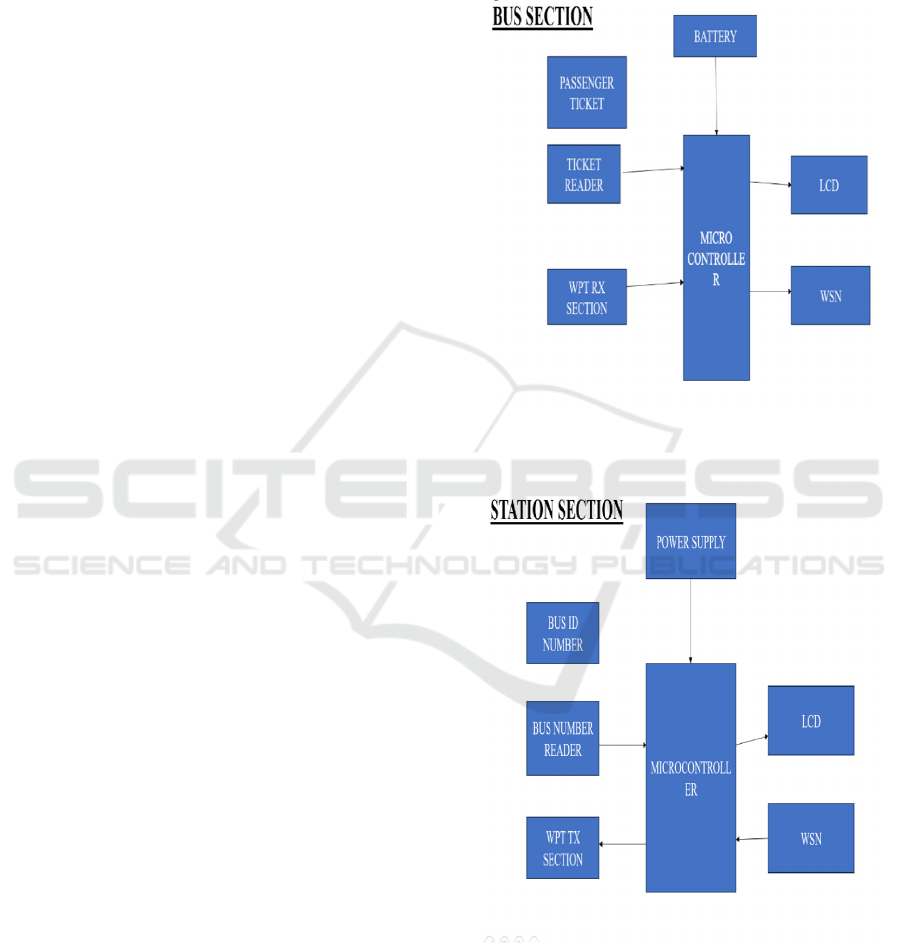
3 PROPOSED SYSTEM
The proposed system comprises of two sections
namely Bus section and Station section. In bus
section, ticket reader acts as a fundamental input. The
reader reads each passenger’s travelling ticket to
monitor entry and exit details of every passenger.
Micro controller which is implemented in bus
calculates passenger’s entry and exit details through
output of ticket reader. If a bus departs from a
particular bus stop, count of passengers is sent to next
bus stop through wireless sensor network (WSN).
This process will notify the number of passengers in
bus to the people waiting for that bus in second bus
stop. In station section, bus id reader is installed to
read each bus id number to verify which bus is arrived
to that bus stop. This information is also sent to next
bus stop via WSN and it is displayed for public
monitoring.
Wireless power transfer setup is installed in every
bus stop to supply electric charge to bus as it is
considered as an electric vehicle. Charging unit in bus
is covered by glass to protect passengers from any
shock effects. LCD is incorporated in both bus and
station sections to notify various live statuses. The
system data can be further integrated to web
application for better user convenience.
4 METHODOLOGY
The steps in the development and implementation of
the proposed system involve key fundamentals. Crux
to these steps is a detailed study of how to design and
install the wireless power transfer (WPT)
infrastructure in support of electric vehicle charging.
This involves choosing wireless power transfer
technology and light integration of this technology
with bus stops and depots, enabling the charging
process to be well-integrated into operating schedules
(figure 1).
At the same time, the real-time bus tracking will
be done employing RFID technology; RFID tags are
fixed on each bus and RFID readers are placed along
the route to get real-time tracking data. The passenger
management component will involve the RFID based
ticketing system on the bus’s onboard system to
facilitate smooth and quick ticket processing and
through the number of tickets it will calculate the
passenger count. After the successful pilot testing, the
system will be unveiled throughout the public
transport network, where it will undergo inspection
and maintenance to assure its reliability and
encourage more continuous improvements. The
integrated approach is toward improving the
efficiency of public transport while reducing
operational costs and ensuring comfort and seamless
experience for passengers without being a burden
(figure 2).
Figure 1: Block Diagram of Bus Section.
Figure 2: Station Section.
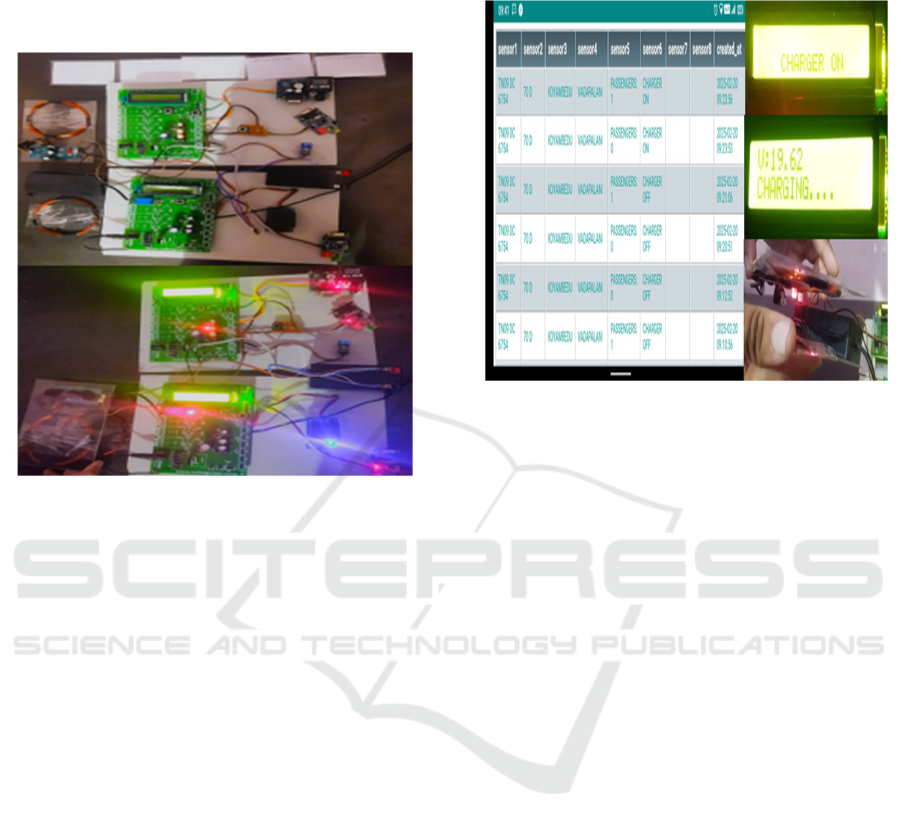
• HARDWARE REQIUREMENT (figure 3)
• MICROCONTROLLER
• RFID READER/TAG
• WPT MODULE
• WSN MODULE
Innovative Solutions for EV Charging and Passenger Handling in Public Transport
271
• POWER SUPPLY
• BATTERY
• LCD
• VOLTAGE SENSOR
Figure 3: Hardware Connection.
• SOFTWARE REQIREMENT
• EMBEDDED C
• ARDUINO IDE
5 RESULTS AND DISCUSSION
The prototype shows the successful communication
of two ESP32 devices based on the ESP-NOW
protocol. The sender device, monitoring the number
of passengers with the help of an RFID Reader, the
voltage, and charging status, sends this information to
the receiver in a precise format. The receiver displays
this information on an LCD in real-time and controls
the relay for charging based on the received status.
The system is resilient enough and offers clear serial
statistics for debugging the data
transmission/reception to establish the system is
functional. Although the implementation is
functioning and fairly low-latency, aspects that can be
improved are; the use of unused variables to carry
more information, error handling in the event of a
transmission failing, and energy conservation mode
improvements. Overall, this goes toward showcasing
a practical demonstration of real-time monitoring and
control with a simple/expandable design. Also, the
data of number of passenger, bus starting/next stop
along with its number and date will be displayed in
the web application (figure 4).
Figure 4: Software and Results Obtained.
6 CONCLUSIONS
Innovative solutions for EV charging processes and
passenger handling in public transport "focusing on
technology sectors to optimize energy efficiency,
passenger flow and environmentally friendly
alternatives in public transport Wireless Electricity
transmission, feature tickets and real-time passenger
tracking including RFID-based. For this project, the
rationale behind working on smart, green public
transport solutions was to decrease manual tasks,
increase bus occupancy, and therefore be capable of
conducting seamless charging for EBs to increase
operational efficiency. The project additionally aims
to advance wireless charging technology to enhance
charging speed, improve passenger data collection,
and allow for interoperability among other emerging
smart transport systems in the future work to be
undertaken. Focusing on pushing for innovation and
sustainability, this project will be a springboard to an
efficient, environmentally friendly, and customer-
oriented system in public transport; a huge leap
toward taking cognizance of global requests for
greener urban mobility solutions.
REFERENCES
A Comprehensive Review on Efficiency Enhancement of
Wireless Charging System for the Electric Vehicles
ICRDICCT‘25 2025 - INTERNATIONAL CONFERENCE ON RESEARCH AND DEVELOPMENT IN INFORMATION,
COMMUNICATION, AND COMPUTING TECHNOLOGIES
272

Applications, IEEE Access, vol. 12, pp. 46967 46994,
2024.
A. Bahga and V. Madisetti, “Cloud-based information
technology framework for data driven intelligent
transportation systems,” J. Transp.Technol., 2013.
An Empirical Survey on Wireless Inductive Power Pad and
Resonant Magnetic Field Coupling for In-Motion EV
Charging System January 2023.
EV Charging Profiles and Waveforms Dataset (EV-CPW)
and Associated Power Quality Analysis 5 December
2023.
G. Sagl, E. Delmelle, and E. Delmelle, “Mapping collective
human activity in an urban environment based on
mobile phone data,” Cartogr.Geogr. Inf. Sci., vol. 41,
no. 3, pp. 272 285, Feb. 2014.
On the Coordination of Charging Demand of Electric
Vehicles in a Network of Dynamic Wireless Charging
Systems, IEEE Access, vol. 10, pp. 62879-62892, June
2022.
R. A. Becker et al., “A tale of one city: Using cellular
network data for urban planning,” IEEE Pervasive
Comput., vol. 10, no. 4, pp. 18–26, Oct. 2011.
R. SA, M. A. Karim, T. Z. Qiu, and A. Kim, “Origin
destination trip estimation from anonymous cell phone
and foursquare data,” in Proc. 94th Transp. Res. Board
Annu. Meeting, Washington, DC, USA, Art. ID 15-
2379, 2015.
Sensing Technologies for Crowd Management, Adaptation,
and Information Dissemination in Public
Transportation Systems: A Review, IEEE sensors
journal, vol. 23, no. 1, 1 January 2023.
Y. Shen, M. P. Kwan, and Y. Chai, “Investigating
commuting flexibility with GPS data and 3D
geovisualization: A case study of Beijing, China,” J.
Transp. Geogr., vol. 32, pp. 1–11, Oct. 2013.
Innovative Solutions for EV Charging and Passenger Handling in Public Transport
273
