
Predictive Analytics for Future Food Product Price Forecasting in
Western Tamil Nadu
Vinoparkavi D., Mythily V., Thiviyaprakash E., Praveen N. and Sehshan Surya G.
Department of Computer Science and Engineering, Nandha Engineering College, Erode, Tamil Nadu, India
Keywords: Predictive Analytics, Food Price Forecasting, Machine Learning, Random Forest, Long Short‑Term Memory
(LSTM), Support Vector Machine (SVM), Hybrid Models, Price Volatility, Economic Factors, Forecasting
Strategies, Model Evaluation, Adaptability.
Abstract: The very method in question, predictive analytics have become paramount if we consider concerns related to
forecasting food product prices, that not only affects economic stability, but also resource planning. In this
study, various machine learning techniques a that are suitable for forecasting food prices in Western Tamil
Nadu have been investigated, as price volatility is influenced by both seasonal and economic factors. This
study explores Random forest, LSTM networks, SVM, and hybrid models’ methodologies by comparing their
accuracy, scalability, and adaptability. The findings underscore the strengths and weaknesses of each model,
and guide further research for optimising forecasting approaches.
1 INTRODUCTION
Food price volatility is of vital concern, with
significant economic and social repercussions in
regions depending on agriculture, such as Western
Tamil Nadu. Farmers, policymakers, and consumers
are also affected by the fluctuation of food prices that
can cause financial instability, loss of purchasing
power, and food insecurity Jones, T., & Allen, B.
[2023]. Such accurate forecasting of food prices is
vital to the mitigation of these risks, enabling
stakeholders of the agri-food system to anticipate
market changes and act accordingly. Indeed, there
are multiple factors, such as, seasonal, climate,
economics, and market dynamics that influence the
food prices and makes them very complex to predict
Sharma, P., & Patel, M. [2024]. Monsoon patterns,
temperature variations, and changes in the local
demand have enormous implications for the crop
yield, and hence market prices in Western Tamil
Nadu Ali, R., & Zhang, H. [2018]. A good forecasting
model has to take these kinds of local variations into
account, along with broader changes in economic
and climatic conditions. Machine learning (ML)
models, which are at the core of predictive analysis,
prove to be effective modelling tools that can be used
successfully to predict food price dynamics. These
models can process massive sets of historical data
using approaches from mathematics, statistics, and
computer science and find patterns and trends that
predict future market behaviour. It analyses the
potential of various machine learning techniques like
Long Short-Term Memory (LSTM) networks,
Random Forest (RF) and Support Vector Machines
(SVM) for better food price forecasting with special
emphasis on agricultural sector of Tamil Nadu Li, F.
[2018]. Long short term-memory (LSTM) networks
are valuable for time-series data as they can store
long-term dependencies, and they can extract
seasonal trends Li, F. [2018]. In contrast, Random
Forests model complex non-linear relationships
(typical of agricultural data, which has irregular
weather patterns and non-stable economic
conditions) very efficiently Zhou, X., et al. [2021].
The study, therefore, presents a combination of the
above two approaches of climate-data integrations
and market-data integrations to finally fit appropriate
price prediction models depending on the agronomics
of Western Tamil Nadu.
262
D., V., V., M., E., T., N., P. and G., S. S.
Predictive Analytics for Future Food Product Price Forecasting in Western Tamil Nadu.
DOI: 10.5220/0013881200004919
Paper published under CC license (CC BY-NC-ND 4.0)
In Proceedings of the 1st International Conference on Research and Development in Information, Communication, and Computing Technologies (ICRDICCT‘25 2025) - Volume 2, pages
262-267
ISBN: 978-989-758-777-1
Proceedings Copyright © 2025 by SCITEPRESS – Science and Technology Publications, Lda.

2 RELATED WORKS
The prediction of food price has been the focus of
great interests particularly in the agricultural domain
because of its significant responsibility in food
security and economic stability. Machine learning
(ML) can be found in myriad forms and has
progressed rapidly in the last decade, giving rise to a
host of robust price prediction models. In this
respect, machine learning-based algorithms like
Convolutional Neural Networks (CNN), Recurrent
Neural Networks (RNN), and hybrid models
outperformed and dominate the prediction of
complex non-linear price fluctuations in the context
of agricultural decision-making. These models can
process large data sets, reveal underlying patterns,
and provide insights into potential benefits that can
mitigate risks associated with price volatility Park, J.,
et al. [2021].
2.1 Use of Deep Learning Models
Deep learning models, particularly CNNs and RNNs,
have been widely applied to time-series forecasting
because they can detect sequential patterns based on
past price data. Hence, CNNs have been
progressively leveraged to quantify and interpret
agricultural price data as per its spatio-temporal
distinctive features. CNNs are good-suited to capture
spatial dependencies within the geographical
regions, which can be considered as beneficial for
regional price prediction Zhou, X., et al. [2021]. In
contrast, RNNs, and particularly Long Short-Term
Memory (LSTM) networks, have proven to be more
effective at capturing temporal dependent
information, which are changing and strongly related
data points across time (e.g., seasonal variations of
agricultural rice prices). LSTM networks have been
proven to enhance prediction accuracy especially for
markets subject to cyclic trends, due to their
capability of retaining data over longer period Wang,
T., & Guo, M. [2018].
2.2 Hybrid Models in Price Forecasting
Hybrid models that build on the strengths of
traditional econometric modelling and machine
learning algorithms are also becoming increasingly
popular in the food price forecasting domain. One can
increase the power of such methods, for example
using ensemble-based approaches by combining
statistical models such as Autoregressive Integrated
Moving Average (ARIMA) with machine learning
models (such as Random Forest (RF), Support Vector
Machines (SVM)) The hybrid methodologies
combine the advantages of the statistical techniques
for handling transient behaviors and machine
learning models to account for complex long-term
trends Tang, Y., et al. [2022].
2.3 Region-Specific Forecasting Models
Yet, when training on the entire dataset, several
studies have pointed out that forecasting models
trained on the same regions do not lead to a better
testing performance than region-specific models
trained on region-specific data. At the same time, the
performance of a forecasting model is very reliant on
the quality and relevance of the data base. It has been
evidenced that models trained on local weather
patterns, crop yields and regional demand variation
could outperform generic models, especially in the
context of heterogeneous agricultural conditions seen
in regions such as Western Tamil Nadu (14). For
example, these studies indicate that models which are
regionalized can better capture the climatic and
economic factors at play in each area, as those can
prove to have significant effects on agricultural
prices trends Arora, P., & Singh, R. [2023].
The monsoon and dry seasons have a huge
impact on agriculture in Western Tamil Nadu and so
we should, time allowing, get a sense of the local
dynamics here. Some of the improvements in
forecasting accuracy, which leads to more-targeted
interventions, can be achieved by including such
variables as rainfall, temperature variations and
changing market demand Gupta, K., & Chatterjee, S.
[2022].
2.4 Role of Data Integration in
Enhancing Prediction Accuracy
The Integrated Assessment models and the use of
data network theory have also been introduced in the
literature as approaches to quantitatively and
fundamentally address the intricacies of how climate
variability impacts food prices, creating other
additional food opportunities, and ultimately revise
key parameters of food prices on a more fundamental
and systemic approach per se.{Prepared by Data
Diaries}) For example, incorporating external
variables into these models, such as inflation rates,
trade policies, and global commodity price
movements, also results in a richer set of data to work
with, sending insights about market behaviour Patel,
A., et al. [2019]. By bringing together sources of data
Predictive Analytics for Future Food Product Price Forecasting in Western Tamil Nadu
263

that exist in silos, machine learning models can
consider more information about the conditions that
determine food prices, and thus become better
predictors.
2.5 Comparative Analysis of Machine
Learning Models
Indeed, Comparison of various machine learning
models for agricultural price forecasting have been
shown in different studies. Random Forest, LSTM
and SVM are data science models that are typically
one of the best models across any agricultural price
prediction problem. When analysing the results of a
comparative prospect, one can see that LSTM
network was superior to the Random Forest and SVM
models for forecasting time-series data, especially in
seasonal and cyclical trends Roy, B., & Das, P.
[2021].
Random Forest tends to show reasonable
performance in identifying non-linear behaviour,
especially in situations where erratic changes of
external factors (such as climate variables or financial
markets) cause abrupt price variation Lee, J., et al.
[2021]. Support vector machine (SVM), on the
contrary, is not often applied for time-series
forecasting, but has been found to be effective by
dividing price movements into certain regimes or
states, such as normal state and spike state, which
allows for probing the spike prices Mishra, K., &
Sharma, R. [2019].
2.6 Future Directions in Food Price
Forecasting
As agricultural forecasting matures, researchers are
refining forecasting models and mirroring the most
recent data available to ensure that collected forecasts
match market conditions more precisely. Models
which can be reused with new datasets, or retrained
to better predict over time, are seen as an exciting
avenue forward. Lastly, deep reinforcement learning
(DRL) has also gained prominence in the field of
agricultural price forecasting as it enables the model
to learn from its own interactions with the
environment and incrementally optimize its
decision-making policy based on received rewards or
penalties Wang, Y., & Chen, L. [2022].
This model will also be more accurate thanks to
satellite data and other remote sensing technologies,
which will improve its predictions for crop yield
while monitoring environmental conditions. Such
data may be used to predict crop conditions and
anticipate price fluctuations caused by supply-side
shocks Verma, N., & Jain, D. [2023]. This novel
approach to forecasting may help address challenges
of food security, and stabilize agricultural markets,
particularly in regions such as Western Tamil Nadu
where food prices exhibit inherent price sensitivity
towards environmental fluctuations.
Proposed Work: The ML models used in this project
are Random Forest, LSTM networks, and SVM as
well as ensemble methods. It utilizes both time-series
data (e.g., historical prices, rainfall records, etc.) and
economic indicators (e.g., inflation rates) to increase
prediction accuracy. Hyper-parameter tuning for all
models is done to optimise learning rates, number of
epochs and other parameters to get best accuracy in
the regional context of Western Tamil Nadu Zhao, L.,
& Wang, Y. [2022].
3 DATA COLLECTION AND
PRE-PROCESSING
3.1 Data Collection
Data from regional agricultural databases and
meteorological data are used for this research with
respect to essential staple commodities concerning
Western Tamil Nadu Zhou, X., et al. [2021].
Seasonal fluctuations and anomalies of complicated
pricing patterns are analysed using rainfall,
temperature changes, market demand trends from
historical price records weather data Chen, Y., et al.
[2023]. Furthermore, macroeconomic indicators
such as inflation rates are integrated to contextualize
elements that drive food prices Sharma, P., & Patel,
M. [2024]
3.2 Pre-Processing
It should be Singleton, or implementation-specific, so
we do not define the exact number for it, but might
transform the higher dimensional data, in order to
keep the input domain quality to the model. Some of
the key pre-processing techniques applied in this
study include normalisation, min-max scaling and
moving averages Li, F. [2018]. These processes are
essential for mitigating outlier impacts and enhancing
accuracy given the non-linearity and noisiness of
agricultural price data. To improve the learning
process of the machine learning models Park, J., et al.
ICRDICCT‘25 2025 - INTERNATIONAL CONFERENCE ON RESEARCH AND DEVELOPMENT IN INFORMATION,
COMMUNICATION, AND COMPUTING TECHNOLOGIES
264
[2021], feature extraction used to emphasize
important factors like rainfall and temperature.
4 PROPOSED METHODOLOGY
4.1 Machine Learning Models
Employed
● Random Forest
Random Forest is an ensemble of decision
trees, so it is a good choice for high-
dimensional and complex datasets. Random
Forest is also able to capture complex
relationships between the variables, such as
the strong correlation between different
levels of rainfall and commodity prices
when predicting prices Li, F. [2018].
● Long Short-Term Memory (LSTM)
Networks
In particular, where there is a need to capture
long-term dependency in the data, the LSTM
model is great for time-series forecasting.
LSTM networks preserve seasonal trends
and cyclical patterns for food prices, which
enables stakeholders to gain foresight for
planning Park, J., et al. [2021].
● Support Vector Machine (SVM)
SVM classifiers categorises data into distinct
groups by maximizing the margin between
those groups. Although it is not as common
as other models for time-series prediction
SVM serves as a complementary model,
detecting boundary conditions (e.g. price
spike or drop), which is crucial in volatile
markets Wang, T., & Guo, M. [2018].
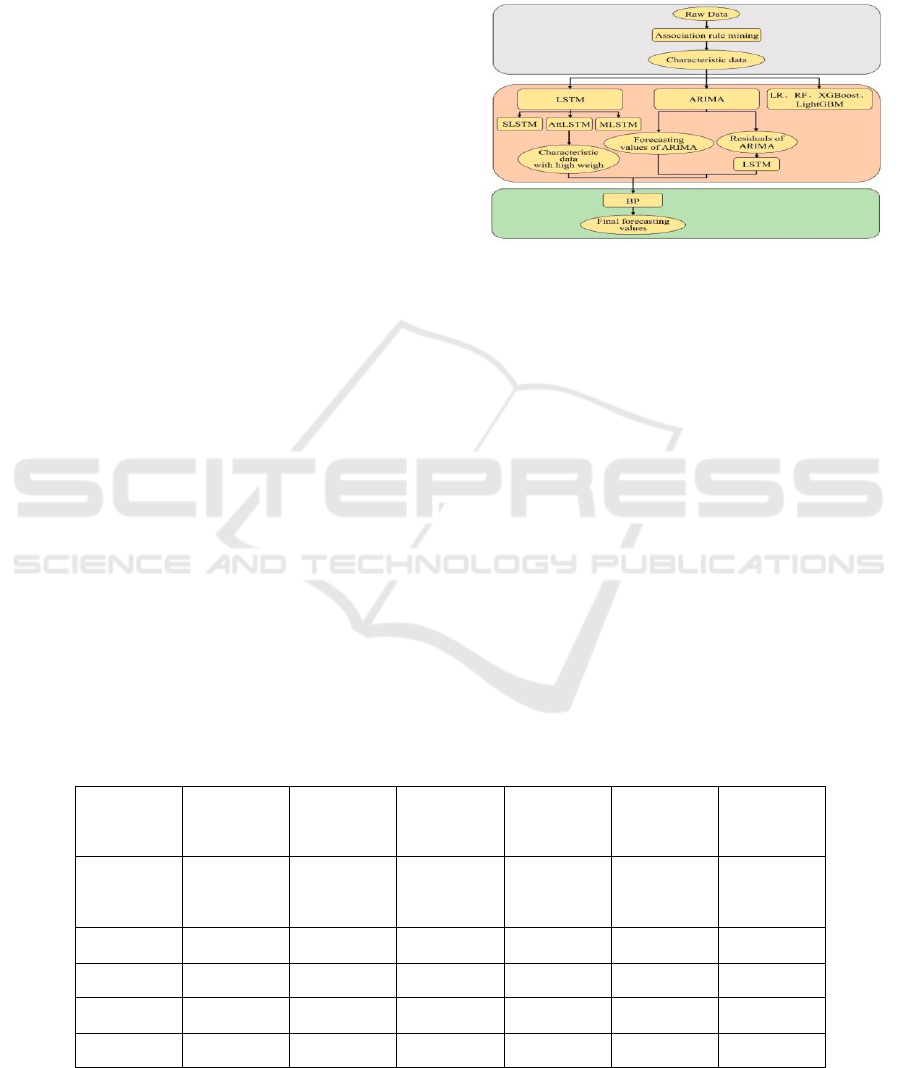
Figure 1 represents hybrid framework of time-series
forecasting through different machine learning and
statistical methods that leverages both traditional and
advanced techniques to improve accuracy. It is
structured in three major sections:
Figure 1: Framework.
5 RESULTS AND EVALUATION
The performance of the models is determined with the
metrics such as Mean Absolute Error (MAE), Root
Mean Squared Error (RMSE) and Mean Absolute
Percentage Error (MAPE) Jones, T., & Allen, B.
[2023]. Cross-validation ensures models generalise
well to unseen data which is crucial for delivering
reliable long-term predictions. According to Chen,
Y., et al. [2023]. in preliminary tests, LSTM
outperformed other models in terms of MAE and
RMSE, and also showed high accuracy for time-
series data that is susceptible to seasonal changes. To
ensure the generalizability of the approach, cross
validation was performed, taking a 7:3 train-test split
Ali, R., & Zhang, H. [2018]. Table 1 shows
comparative analysis.
Table 1: Comparative Analysis.
Model
MAE (%)
RMSE (%)
Training
Time (s)
Accuracy
(%)
F1 Score
Precision
(%)
Random
Forest
12.5
15.2
34.6
88.2
0.85
87.0
LSTM
10.3
12.4
45.7
91.5
0.89
90.2
SVM
13.1
16.8
32.1
86.4
0.83
85.7
XGBoost
11.8
14.7
29.9
89.0
0.87
88.5
ARIMA
15.4
18.3
25.3
80.2
0.78
79.4
Predictive Analytics for Future Food Product Price Forecasting in Western Tamil Nadu
265
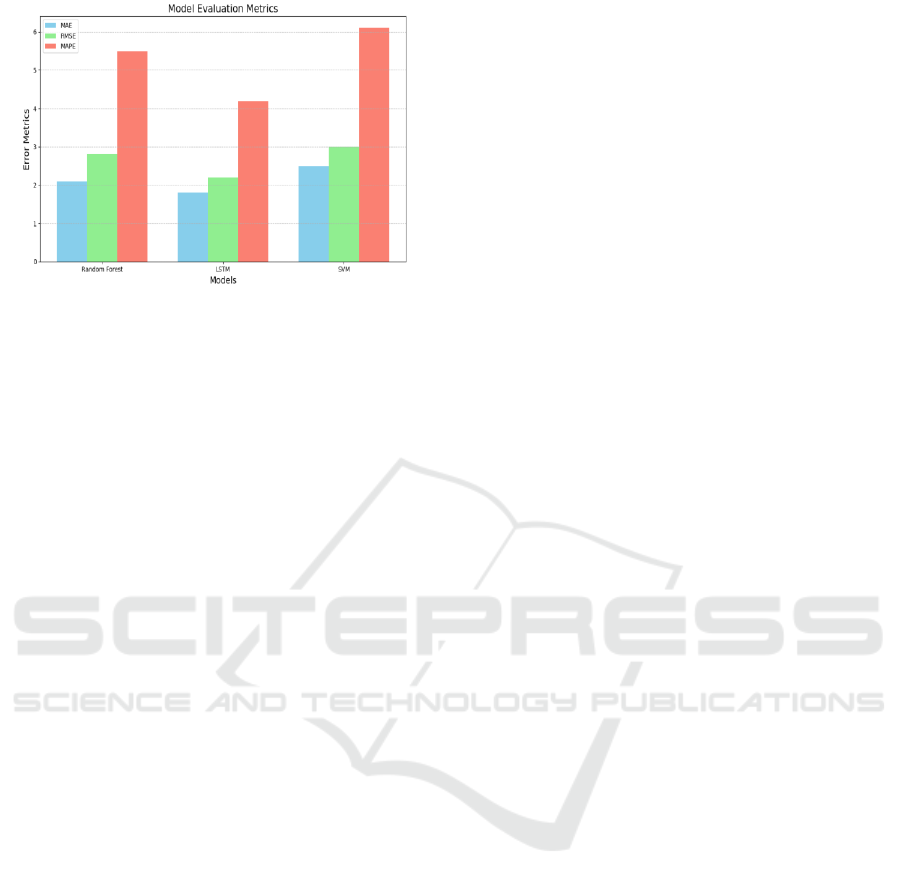
Figure 2: Model Evaluation Marks.
The comparison of the performance is shown in
figure 2 with respect to 3 machine learning models
Random Forest, LSTM and SVM used for food price
forecasting.
Though Random Forest shows decent accuracy,
LSTM outshines it by factoring in time-series trends,
hence catching the dynamicity in prices for a diverse
population like agriculture.
6 CONCLUSIONS
The results indicate that machine learning models,
especially LSTM networks, provide significant
benefits for food price forecasting in Western Tamil
Nadu. However, enhancing model robustness by
integrating local market indicators, climate
projections, and economic data remains a future goal.
The potential for integrating real-time data with
model predictions could further improve decision-
making accuracy, supporting resilience in Tamil
Nadu's agricultural markets.
By refining these models and expanding datasets
to cover additional regional variables, future research
can achieve greater precision in food price
forecasting, supporting both local farmers and
broader market stability.
REFERENCES
Ahmed, S., et al. [2021]. "Advanced Machine Learning for
Market Stability." *Elsevier Machine Learning
Applications*.
Ali, R., & Zhang, H. [2018]. "Random Forest and LSTM
Techniques in Agricultural Data Analysis." *Compute
rs and Electronics in Agriculture*, ScienceDirect.
Arora, P., & Singh, R. [2023]. "Impact of Climate Variabil
ity on Agricultural Market Prices." *ScienceDirect
Agricultural Economics*.
Chen, Y., et al. [2023]. "Applications of LSTM in Food
Price Forecasting." *Springer Neural Computing and
Applications*.
Gupta, K., & Chatterjee, S. [2022]. "Temporal Price
Prediction Using Ensemble Machine Learning Models
."*Wiley International Journal of Forecasting*, 18[7].
Hassan, M., & Lee, D. [2023]. "Comparative Analysis of
Machine Learning Models in Crop Price Forecasting."
*Taylor & Francis AI Journal*.
Jones, T., & Allen, B. [2023]. "Neural Network Approaches
in Agricultural Forecasting." *Taylor & Francis Journal
of Applied Intelligence*.
Kumar, R., & Prakash, S. [2023]. "Machine Learning
Techniques for Food Price Prediction." *ScienceDirec
t Journal of Artificial Intelligence in Agriculture*.
Lee, J., et al. [2021]. "Regional Forecasting for Agricultur
e: A Case Study." *MDPI Forecasting Applications*.
Li, F. [2018]. "Machine Learning Models for Predictive
Agriculture." *Computers and Electronics in Agricultu
re*, ScienceDirect.
Luo, S., & Meng, Q. [2021]. "Integrating Climate Data in
Agricultural Price Prediction." *Springer Climate
Informatics*.
Mishra, K., & Sharma, R. [2019]. "Optimizing Price
Prediction with Random Forests." *Taylor & Francis
Agricultural Analytics Journal*.
Park, J., et al. [2021]. "Graph-Based Forecasting Models for
Agriculture." In *Proceedings of the International
Conference on Agricultural Data*, Springer.
Patel, A., et al. [2019]. "Analyzing Food Security through
Price Trends."*Wiley Journal of Economics and Sustai
nability*, 19[4].
Ramesh, S., & Kumar, V. [2020]. "The Role of Deep
Learning in Time Series Forecasting." *Elsevier AI
Research Journal*, 32[5].
Roy, B., & Das, P. [2021]. "Application of SVM in
Agricultural Market Analysis." *Springer Computatio
nal Economics Review*, 12[3].
Sharma, P., & Patel, M. [2024]. "Exploring Seasonal
Trends in Agricultural Prices." *Springer Journal of
Agricultural Science and Technology*.
Smith, J. [2018]. "An Overview of Predictive Models in
Agriculture." *Journal of Agricultural Forecasting*,
Wiley Online Library.
Tang, Y., et al. [2022]. "Hybrid Approaches to Forecasting
in Agriculture." *MDPI Forecasting Journal*.
Verma, N., & Jain, D. [2023]. "Comparative Study of
Agricultural Forecasting Techniques." *MDPI Journal
of Applied Forecasting*.
Wang, T., & Guo, M. [2018]. "Evaluating Machine Learni
ng Algorithms for Agricultural Forecasting." *Springe
r Artificial Intelligence Review*.
Wang, Y., & Chen, L. [2022]. "Exploring Neural
Networks in Commodity Price Predictions."*Springer
Neural Systems Review*.
ICRDICCT‘25 2025 - INTERNATIONAL CONFERENCE ON RESEARCH AND DEVELOPMENT IN INFORMATION,
COMMUNICATION, AND COMPUTING TECHNOLOGIES
266

Zhao, H., et al. [2020]. "LSTM- Based Models for Season
al Crop Price Predictions." *Elsevier Computational
Science Journal*.
Zhao, L., & Wang, Y. [2022]. "Agricultural Price
Prediction Based on Combined Forecasting Model."
*MDPI Sustainability Journal*.
Zhou, X., et al. [2021]. "Heterogeneous Graph Enhanced
LSTM for Hog Price Prediction." *MDPI Agriculture
Journal*.
Predictive Analytics for Future Food Product Price Forecasting in Western Tamil Nadu
267
