
Tool Wear and Fault Prediction Systems Powered by AI
M. Amareswara Kumar, G. Jayasai Karthik, D. Hussain Basha, S. Ashraf,
P. Ramesh and O. Yogeeswar
Department of Computer Science and Engineering, Santhiram Engineering College, Nandyal, Andhra Pradesh, India
Keywords: Artificial Intelligence Techniques, Artificial Neural Networks (ANNs), Support Vector Machines (SVMs),
Convolutional Neural Networks (CNNs), Recurrent Neural Networks (RNNs), Random Forest.
Abstract: Tool wear and fault prediction to preserving the efficiency and productivity of the manufacturing process,
which ensure the quality of the product and reduce downtime. In recent years, the progress of Artificial
Intelligence (AI) has exposed new possibilities to develop future systems that can autonomously monitor and
analyse machine conditions. The project proposes the development of a tool wear and fault prediction systems
powered by AI, which takes advantage of the leveraging machine learning algorithm in real time to decline
and predict potential defects. During the system operation, to catch the dynamic behaviour of the tools will
collect data from various sensors embedded in the machinery, such as vibration, cutting force, temperature,
current and acoustic sensors, such as the dynamic behaviour of the tools. Using AI techniques, especially
supervised learning models such as neural networks and support vector machine (SVM) are monitored, the
system will be trained to identify patterns and correlations between sensor data and tool wear or fault position.
1 INTRODUCTION
In the current manufacturing processes, the
performance and reliability of tools have a direct
effect on the efficiency, quality and profitability of
production operations. Tool wear and sudden tool
failure are common problems that manufacturers
face, causing unplanned downtime, costly repairs
and product quality issues (Xu et al., 2021; Zhang et
al., 2024). In the manufacturing environment,
detecting tool wear or defects usually relies on
manual inspection or scheduled maintenance
(Gouarir et al., 2018). As a result, either the
continuous use of tools in premature replacement or
sub-avoidance conditions can occur, both of which
are expensive.
Well, the arrival of Artificial Intelligence (AI) is
a groundbreaking opportunity for solving these
problems (Chen et al., 2024). An AI-managed system
can analyze large volumes of sensor data from
equipment, such as vibrations, temperature changes,
and acoustic signals, generating useful information
for timely interventions and tailored production
maintenance schemes, helping to catch early signs of
wear or fault (Chehrehzad et al., 2024; Mohanta et al.,
2020). Our project focuses on developing AI-based
tool wear and fault prediction systems that can enable
manufacturers to shift from reactive to proactive
maintenance strategies (Oh et al., 2024). This system
will strengthen the assurance of manufacturing
processes, bolster productivity, while reducing the
environmental and economic cost triggered by
breakdowns and unknown preservation.
To achieve accurate predictions, machine learning
(ML) and deep learning (DL) approaches are applied
to train an AI model to predict tool wear and faults
(Zhang et al., 2024; Xu et al., 2021). Classification
and regression tasks using traditional ML models like
Decision Trees, Support Vector Machines (SVM),
Random Forest, and Gradient Boosting are also used
to find patterns in tool wear data (Gouarir et al., 2018;
Kumar, 2024a). Alternatively, deep learning models
such as Convolutional Neural Networks (CNNs) or
Recurrent Neural Networks (RNNs), are used for
complete autonomy of feature extraction from
complex sensor signals to provide a more detailed and
adaptable knowledge of wear progression (Xu et al.,
2021; Chehrehzad et al., 2024).
Moreover, surmounting generalization ability for
more powerful and precise predictions is also
achieved through hybrid approaches such as those
which integrate ML and DL models with simulation
through physics-based simulations (Chen et al.,
2024). A combination of multiple techniques leads to
226
Kumar, M. A., Karthik, G. J., Basha, D. H., Ashraf, S., Ramesh, P. and Yogeeswar, O.
Tool Wear and Fault Prediction Systems Powered by AI.
DOI: 10.5220/0013880500004919
Paper published under CC license (CC BY-NC-ND 4.0)
In Proceedings of the 1st International Conference on Research and Development in Information, Communication, and Computing Technologies (ICRDICCT‘25 2025) - Volume 2, pages
226-231
ISBN: 978-989-758-777-1
Proceedings Copyright © 2025 by SCITEPRESS – Science and Technology Publications, Lda.

higher fault detection, real-time monitoring, and
enhanced performance of a tool (Mohanta et al.,
2020; Oh et al., 2024). Techniques like those applied
in other domains—such as IoT-based monitoring
(Kumar et al., 2024a), traffic signal optimization
(Kumar et al., 2022), network security (Mahammad
et al., 2024), healthcare AI (Suman et al., 2024), and
heart disease prediction (Kumar, 2024b)—
demonstrate the versatility and applicability of AI-
assisted prediction systems across sectors, including
manufacturing.
2 LITERATURE REVIEW
Modern manufacturing processes involve key
characteristics such as tool wear and prediction of
faults. Predictive maintenance with Artificial
Intelligence (AI) enables increased efficiency,
decreased downtime, and financial savings
(Mahammad & Viswanatham, 2018; Bhaskar et al.,
2024a). This literature review aims to analyze the
most recent AI-based tool wear and fault prediction
systems including different variants of machine
learning (ML), deep learning (DL), and hybrid
techniques (Devi et al., 2022; Chaitanya, 2022).
2.1 Support Vector Machine (SVM)
Support Vector Machine (SVM) is an effective
algorithm used in this project since it classifies
different patterns of wear and could identify
anomalies in the machining operation. SVM models
are applied to identify abnormal (defective)
conditions from normal, based on sensor data that
enables proactive maintenance. This minimizes
downtime, enhances tool lifespan, and increases the
quality of overall production (Mahammad,
Balasubramanian, & Babu, 2019; Paradesi Subba
Rao, 2024a).
2.2 Convolutional Neural Network
(CNN)
Convolutional Neural Networks (CNN) is used for
reading in sensor data, images, and detecting small
changes in tool condition. This deep learning method
improves the predictive maintenance which helps in
minimizing downtime and hence the operation cost.
Overall, CNN-based models have given high
accuracy in detecting faults and predicting the
lifespan of the components, thanks to continual
learning through experience (Bhaskar et al., 2024b;
Devi et al., 2023; Chaitanya et al., 2024a).
2.3 Random Forest
Random Forest is a context in which you are provided
with sensor data with which to figure out for
abnormalities and trends of wear. It improves
accuracy and reduces overfitting through its
ensemble learning mechanism that makes it more
appropriate for real-time monitoring. With Random
Forest, companies can minimize downtimes,
automate processes and extend tool durability
(Chaitanya & Bhaskar, 2014; Mandalapu et al., 2024;
Paradesi Subba Rao, 2024b).
3 TOOL WEAR AND FAULT
PREDICTION SYSTEM
Wherein, identify the wear modes and predict the
failures during the machining, tool conditions and
manufacturing process for real-time monitoring of
sensor data in this system. The system uses machine
learning and predictive analytics to improve
efficiency, reduce downtime, and extend tool life.
They facilitate preventive upkeep, preventing
unexpected failures, and making production
scheduling more efficient. This leads to significant
cost savings, improved product quality and higher
overall reliability of operations. There are diverse
hardware limitations of fault prediction system
including sensors, data acquisition, storage and
memory limitations.
3.1 Sensors
Different sensors are crucial in gathering real-time
data in the fault prediction system where different
sensors are used for feeding machine learning for
better prediction:
Vibration sensors: Vibration sensor measures
vibrations or oscillations of the tools during operation
in the machines. Changes in vibration pattern may
represents the wearing, imbalance or defects in the
device. Machine learning models analyse these signs
to predict the fault condition of the tools.
Cutting force sensors: These sensors measure the
forces working on the tools during cutting or
machining processes. Variety in force may reveal
early signs of wearing tools or failure. By monitoring
the cutting forces, the future model tools may
estimate the decline.
Temperature sensors: The temperature variation is
another indicator of tool wear. As such tool wears,
friction increases, causing high temperatures.
Tool Wear and Fault Prediction Systems Powered by AI
227
Thermocouples or infrared sensors track temperature
sudden changes, providing the important data for
fault prediction algorithms.
Acoustic emission sensors: These sensors detect
high-existing sound waves generated by contact with
the tools in the machines. Captured data can identify
micro-cracks, material deformation, or other signs of
wear, which can help the AI systems predict adjacent
failures and sense the sound waves changes during
operation.
Current/Voltage Sensors: Electric consumption
pattern can be monitored to detect unusual energy
use, which can be caused by tool wear or defects.
Monitoring current or voltage diversity provides
insight into system performance and tools health.
3.2 Data Acquisition
Data acquisition plays a critical function in the design
of an AI-driven tool wear and fault predicting system,
because data quality along with quantity critically
affect model performance. Real-time sensor
measurements in the form of vibration signals via
accelerometers, acoustic emission signals via
microphones, force sensors via dynamometers, and
temperatures via thermocouples or infra-red sensors
play a crucial role in determining the conditions of a
tool. In addition to this, the machine parameters and
operating conditions of cutting speed, feed rate,
spindle speed, torque, and material characteristics
continue to enhance predictability. As a precursor for
the construction of a good ground truth, the failure
and wear annotations such as flank wear, crater wear,
chipping, fractures, and lifecycle must be annotated.
Furthermore, surface roughness measurements give a
critical quality indicator that not only foretells failures
but also guarantees that machining performance is
always optimal.
3.3 Storage & Memory Constraints
AI-based tool wear and defect prediction systems also
need effective storage of data as they handle lots of
sensor data, machine history, and log files. Sensing
data, especially high-frequency vibration,
temperature, and acoustic emission data, produce
huge amounts of data demanding intense data
compression, effective indexing, and near real-time
processing to keep the overhead low. While cloud-
based models like AWS, Azure, and Google Cloud
provide elastic storage for big data analysis, latency
and security requirements can make local or hybrid
models necessary, with SSDs or industrial-grade SD
cards providing offline predictions. AI models also
need ample RAM (8GB+ for edge nodes and 32GB+
for servers) to process big data, with embedded
devices having restricted RAM needing model
compression approaches like quantization and
pruning.
3.4 Architecture & Working System
A system that predicts tool wear and faults using AI
for increases manufacturing productivity by
monitoring cutting tools in real time and detecting
failures ahead of time. The system design includes
sensors, data acquisition, analytics based on AI,
decision support system and reporting system.
Accelerometers, vibration sensors, cutting force
sensors, acoustic emission sensors, and temperature
sensors are few sensors that gather real-time data
from condition of tools in machines. This information
is processed through the process of feature extraction
like shape and size, which screens and sends
important data to a cloud-based AI system. Machine
learning (ML) models such as deep learning and time-
series analysis methods evaluate trends in the
information to identify anomalies, categorize tool
wear stages, predict the condition of tools and
estimate remaining tool lifespan.
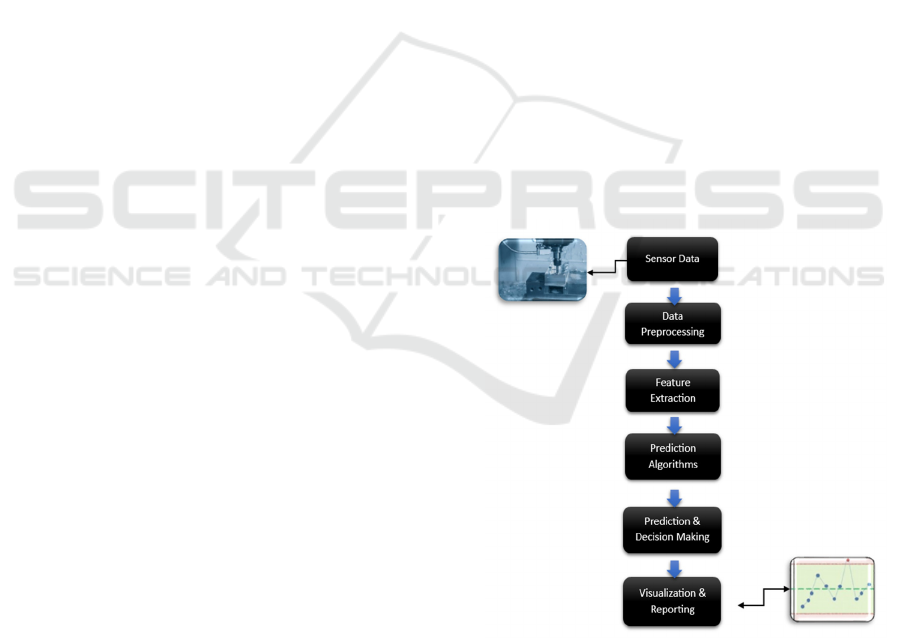
Figure 1 shows the
evolution of fault prediction system.
Figure 1: Evolution of Fault Prediction System.
Data pipeline facilitates smooth and clean transfer
data from sensors to the AI model by utilizing signal
processing and feature extraction and selection
methods. Historical data and real-time data, including
predictive maintenance algorithms like Random
Forest, CNNs, and SVMs are trained for the AI based
ICRDICCT‘25 2025 - INTERNATIONAL CONFERENCE ON RESEARCH AND DEVELOPMENT IN INFORMATION,
COMMUNICATION, AND COMPUTING TECHNOLOGIES
228
model. It has integration with a dashboard-based
interface, supplying operators with messages, alarms,
and notification of every condition of tools during the
operation and maintenance advisories. Feedback loop
continuously adjusts the AI model with improved
efficiency and accuracy. The decision support system
provides recommendations for perfect measures,
reducing downtime and improving productivity. Fault
prediction through AI reduces tool breakdowns, saves
costs, and increase the quality products, and hence it
is the most critical element in smart manufacturing.
3.5 Advantages
• Improved Maintenance and Reduced
Downtime.
• Cost savings on Repairs.
• Increased Tool Lifespan.
• Enhanced Product Quality.
4 RESULTS
Sensor data (e.g., vibration, temperature, acoustic
emissions) and machine learning are used in AI-based
tool wear and fault prediction systems to predict fault
or mistakes and optimize maintenance. The systems
increase productivity, reduce downtime, and optimize
tool life. The following is an example of outputs that
such a system may provide:
4.1 Tool Wear Prediction Results
(Table)
Table 1: Fault Detection Tools.
Tool
ID
Wear
Level
(%)
Predicted
Remaining
Life
(Hours)
Maintenance
Required?
Fault
Detected?
T001 20% 50 No No
T002 55% 20 Yes No
T003 75% 10 Yes Yes
T004 30% 40 No No
T005 90% 5 Yes Yes
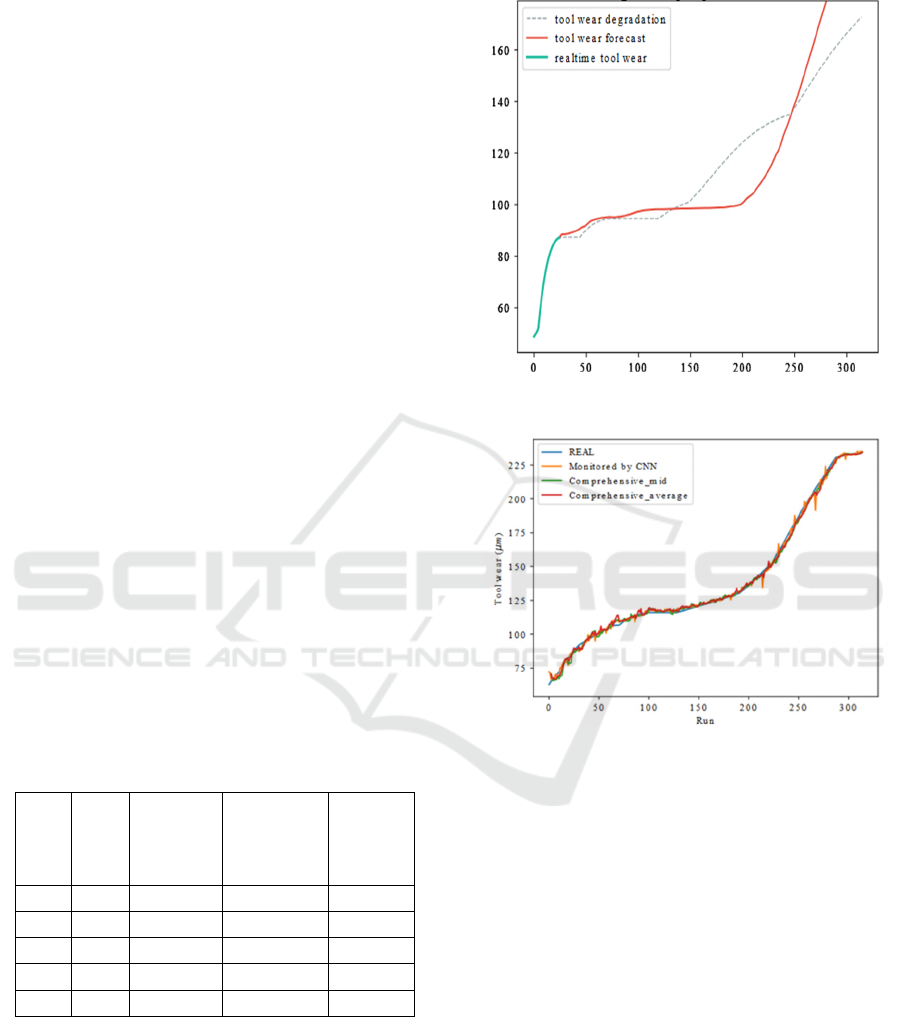
This result shown in table 1 and figure 2 & 3 can be
used in the development of real time monitoring of
the tools condition or positions while they are
working, by the use of Convolutional Neural Network
(CNN). This allows prediction of accurate results by
processing amazingly the sensors data and the
utilization of a feature extraction process is very
helpful in enhancing the system efficiency, reducing
the downtime and prolonging the tool life.
Figure 2: Experimental Result.
Figure 3: Using CNN with Median or Average Correction.
5 CONCLUSIONS
Therefore, the AI-Powered Intelligent tool wear and
fault prediction system designed and implemented as
part of this project holds great potential that can be
harnessed to improve manufacturing efficiency,
reduce tool downtime and life. By integrating
machine learning algorithms with real-time sensor
inputs, the system accurately predicted wear
behaviour and identified faults before they caused
significant damage. By enabling earlier intervention,
the system enables the minimization of production
loss along with reduced maintenance costs and
improved overall process reliability. Incorporating
predictive maintenance using AI techniques, such as
supervised learning models, increases the accuracy of
machining operations, which subsequently improves
Tool Wear and Fault Prediction Systems Powered by AI
229

both product quality and operational continuity.
Future technologies incorporating AI frameworks and
data analytics will be able to make the system even
more flexible and accurate by updating it in various
industrial applications.
REFERENCES
“Babycare warning system based on IoT and GSM to
prevent leaving a child in a parked car”, M.
Amareswara Kumar; Farooq Sunar Mahammad;
Parumanchala Bhaskar; G. Vani; B. Umamaheswari; B.
Dhanalakshmi; R. Pavani; U. Keerthi & AIP Conf.
Proc. 3028,020071(2024)https://doi.org/10.1063/5.021
2518
“Deep learning-based tool wear prediction and its
application for machining process using multi-scale
feature fusion and channel attention mechanism”,
Xingwei Xu, Jianwen Wang, Bingfu Zhong, Weiwei
Ming, Ming Chen & Measurement Volume 177, June
2021,109254https://doi.org/10.1016/j.measurement.20
21.109254
“In-process Tool Wear Prediction System Based on
Machine Learning Techniques and Force Analysis”, A.
Gouarir, G. Martínez-Arellano, G. Terrazas, P.
Benardos, S. Ratchev & Procedia CIRP Volume 77,
2018, Pages501504https://doi.org/
10.1016/j.procir.2018.08.253
“Key distribution scheme for preventing key reinstallation
attack in wireless networks”, Farooq Sunar
Mahammad; V. Madhu Viswanatham; Asma Tahseen;
M. Sharmila Devi; M. Amareswara Kumar & AIP
Conf.
Proc. 3028,020067(2024)https://doi.org/10.1063/5.021
2685
“M. Amareswara Kumar, “Effective Feature Engineering
Technique for Heart Disease Prediction with Machine
Learning”, In International Journal of Engineering &
Science Research, Volume 14, Issue 2, April-2024
with ISSN 2277-2685.
“Model-based tool wear detection and fault diagnosis for
end mill in various cutting conditions”, Jun-Young Oh,
Jae-Eun Kim, Wonkyun Lee & Manufacturing Letters
Volume 41, Supplement, October 2024, Pages 595-604
https://doi.org/10.1016/j.mfglet.2024.09.076
“Online Monitoring System for Tool Wear and Fault
Prediction Using Artificial Intelligence”, Neha
Mohanta; Rabesh Kumar Singh; Anuj Kumar Sharma
& Publisher is IEEE and published in: 2020
International Conference on Contemporary Computing
andApplications (IC3A) https:// ieeexplore.ieee.org /
document/9077155
“Tool Wear Feature Extraction and Result Prediction Based
on Machine Learning”, Xiyang Zhang; Rui Zhou;
Yongze Ma; Xusheng Lin; Yanqing Zhao & Publisher
is IEEE and published in 2024, 13th International
Conference of Information and Communication
Technology (ICTech)https://
ieeexplore.ieee.org/document/10900896
“Tool wear prediction through AI-assisted digital shadow
using industrial edge device”,
Mohammadreza Chehrehzad; Gamze Kecibas;
Cemile Besirova; Ugur Uresin; Mumin Irican;
Ismail Lazoglu & Journal of Manufacturing Processes
Volume 113, 15 March 2024, Pages 117-130
https://doi.org/10.1016/j.jmapro.2024.01.052
“Traffic Length Data Based Signal Timing Calculation for
Road Traffic Signals Employing Proportionality
Machine Learning”, M. Amareswara Kumar, Farooq
Sunar Mahammad, M Naga Dhanush, D Partha Rahul,
K L Sreedhara, B Azbin Rabi, A Kedarnath Reddy &
Journal of Algebraic Statistics, Issue Vol. 13 No. 3
(2022)https://www.publishoa.com/index.php/journal/a
rticle/view/540
Chaitanya, V. Lakshmi, and G. Vijaya Bhaskar. "Apriori vs
Genetic algorithms for Identifying Frequent Item Sets."
International journal of Innovative Research
&Development 3.6 (2014): 249-254.
Chaitanya, V. Lakshmi. "Machine Learning Based
Predictive Model for Data Fusion Based Intruder Alert
System." journal of algebraic statistics 13.2 (2022):
2477-2483
Chaitanya, V. Lakshmi, et al. "Identification of traffic sign
boards and voice assistance system for driving." AIP
Conference Proceedings. Vol. 3028. No. 1. AIP
Publishing, 2024.
Devi, M. Sharmila, et al. "Machine Learning Based
Classification and Clustering Analysis of Efficiency of
Exercise Against Covid-19 Infection." Journal of
Algebraic Statistics 13.3 (2022): 112-117.
Devi, M. Sharmila, et al. "Extracting and Analyzing
Features in Natural Language Processing for Deep
Learning with English Language." Journal of Research
Publication and Reviews 4.4 (2023): 497-502.
Jian Wen Chen, Meng Shiun Tsai, Che Lun Hung “Towards
an Effective Tool Wear Monitoring System with an AI
Model Management Platform” & Publisher is IEEE and
published in 2024, IEEE 22nd International Conference
on Industrial Informatics (INDIN)
https://ieeexplore.ieee.org/document/10774399
Mahammad, Farooq Sunar, Karthik Balasubramanian, and
T. Sudhakar Babu. "A comprehensive research on
video imaging techniques." All Open Access, Bronze
(2019).
Mahammad, Farooq Sunar, and V. Madhu Viswanatham.
"Performance analysis of data compression algorithms
for heterogeneous architecture through parallel
approach." The Journal of Supercomputing 76.4
(2020): 2275-2288.
Mandalapu, Sharmila Devi, et al. "Rainfall prediction using
machine learning." AIP Conference Proceedings. Vol.
3028. No. 1. AIP Publishing, 2024.
Paradesi Subba Rao,”Detecting malicious Twitter bots
using machine learning” AIP Conf. Proc. 3028, 020073
(2024) https://doi.org/10.1063/5.0212693
ICRDICCT‘25 2025 - INTERNATIONAL CONFERENCE ON RESEARCH AND DEVELOPMENT IN INFORMATION,
COMMUNICATION, AND COMPUTING TECHNOLOGIES
230

Paradesi SubbaRao,” Morphed Image Detection using
Structural Similarity Index Measure” M6 Volume 48
Issue 4 (December 2024)
Parumanchala Bhaskar, et al. "Machine Learning Based
Predictive Model for Closed Loop Air Filtering
System.", Journal of Algebraic Statistics 13.3 (2022):
416-423.
Parumanchala Bhaskar, et al. "Incorporating Deep Learning
Techniques to Estimate the Damage of Cars During the
Accidents" AIP Conference Proceedings. Vol. 3028.
No. 1. AIP Publishing, 2024.
Parumanchala Bhaskar, et al “Cloud Computing Network
in Remote Sensing-Based Climate Detection Using
Machine Learning Algorithms” remote sensing in earth
systems sciences(springer).
Suman, Jami Venkata, et al. "Leveraging natural language
processing in conversational AI agents to improve
healthcare security." Conversational Artificial
Intelligence (2024): 699-711.
Sunar, Mahammad Farooq, and V. Madhu Viswanatham.
"A fast approach to encrypt and decrypt of video
streams for secure channel transmission." World
Review of Science, Technology and Sustainable
Development 14.1 (2018): 11-28.
Tool Wear and Fault Prediction Systems Powered by AI
231
