
Body Language and Speech Analysis Using Deep Learning for
Enhanced Virtual Job Interviews
Satheesh Kumar A., Naveena Devi S., Preetha R. and Subika K. V.
Department of Computer Science and Engineering, Nandha Engineering College, Erode, Tamil Nadu, India
Keywords: AI‑driven Hiring, Virtual Job Interviews, Deep Learning, Body Language Analysis, Speech Sentiment
Analysis, Facial Expression Recognition, Real- Time Candidate Assessment.
Abstract: Virtual job interviews have become much more common now, but judging whether a candidate is confident,
honest and a good communicator is difficult when done via a screen. In this paper, we present a deep learning-
based multipurpose AI-enabled virtual interview assessment system with body language analysis and speech
sentiment detection of the candidates along with facial expression recognition. It leverages pose estimation
techniques (OpenPose, MediaPipe), CNNs (VGGFace, FaceNet), and speech processing models (MFCC,
LSTM, BERT) to facilitate 360-degree, unbiased/speech-free, real-time assessment of candidate performance.
Unlike traditional hiring methods, this model reduces subjectivity, increases hiring transparency, and
generates real-time, explainable feedback for recruiters and candidates alike. The proposed solution use of
privacy-preserving AI techniques, compliance to ethical standards (GDPR, CCPA) and integration with HR
systems to make hiring fair, scalable and future-ready. This research establishes a new standard for AI-driven,
data-informed virtual hiring by addressing certain inadequacies in existing AI-based recruitment models.
1 INTRODUCTION
Virtual job interviews have become increasingly
common, changing the way the hiring process takes
place, allowing companies to evaluate candidates
from a distance and open the door to a global talent
pool. But virtual interviews come with their own set
of challenges, especially when it comes to assessing
a candidate’s confidence, honesty, engagement and
communication skills in general. Traditional
interviewing techniques are based on human intuition
and subjective interpretation, which can lead to bias
and inconsistencies in hiring decisions. In addition,
non-verbal signs like body position, facial features,
and speech fluency integral to the in-person interview
experience are easily missed or misread in the online
environment.
In order to overcome the limitations of available
job interview assessment methods, the following
research aims to implement a deep learning-based AI
virtual job interview assessment system that improves
upon observation assessment by considering non-
verbal cues, speech sentiment analysis, and facial
expression recognition. The advanced-based models
proposed in this framework encompass modern
machine learning algorithms for Gesture Recognition
(Pose Estimation (OpenPose, MediaPipe)), Emotion
Analysis on Expressive Facial
Images (Facial Expression Recognition (CNNs,
VGGFace, FaceNet)), and Speech Fluency Evaluation
(Speech Processing Models MFCCs, LSTMs, BERT).
This versatile approach utilizes multimodal AI-based
techniques, allowing for an objective, data-centric,
and bias- free evaluation of potential candidates.
The research contributes by allowing both
recruiters and applicants to gain transparent insights
into what each candidate demonstrates in real-time
format. This is different from other AI based
assessment models which work as a “black-box”
system where XAI is used in this framework to
promote ethical decision making and trust. Moreover,
the system mitigates concerns about privacy and the
security of data through the use of privacy-preserving
AI techniques (such as federated learning) and by
ensuring compliance with regulatory frameworks like
GDPR and CCPA.
The paper discusses the Role of AI Virtual
Interview platform, in making the hiring process
fairer, less subjective, and ultimately more efficient.
As a result, the proposed system further considers
real-world challenges, including dynamic lighting
environments, multiple camera angles, and public
A., S. K., S., N. D., R., P. and V., S. K.
Body Language and Speech Analysis Using Deep Learning for Enhanced Virtual Job Interviews.
DOI: 10.5220/0013880400004919
Paper published under CC license (CC BY-NC-ND 4.0)
In Proceedings of the 1st International Conference on Research and Development in Information, Communication, and Computing Technologies (ICRDICCT‘25 2025) - Volume 2, pages
219-225
ISBN: 978-989-758-777-1
Proceedings Copyright © 2025 by SCITEPRESS – Science and Technology Publications, Lda.
219

noise, thus making it applicable across domains and
job functions. Other developments in the pipeline
include integration with Applicant Tracking Systems
(ATS), AI-based interview coaching, and even VR-
based immersive interview simulations.
Moreover, by leveraging heuristic speak and body
language characterization approach, this research
proposes a novel paradigm for intelligent, data-driven
recruitment systems that can promote the health of
virtual job interviews in terms of effectiveness,
fairness, scalability and inclusion.
2 PROBLEM STATEMENT
The growing reliance on virtual job interviews makes
it challenging to assess a candidate’s confidence,
engagement, and communication skills. In face-to-
face interviews, the recruiters have the chance to see
non-verbal cues like body language, Gestures, and
facial expressions, but in virtual interview, they are
often unavailable because of the angle of the
computer camera, the lighting conditions and
communication is done through the screen. As a
result, subjective and inconsistent hiring decisions
can occur, causing biases and misinterpretations that
impact candidate selection.
Moreover, most of the automatic AI-sifted
recruitment systems today in place in virtual hiring
hinges on verifying your text-based or voice- based
answers, omitting vital body moves and emotional
gestures that are the basis for professional evaluation.
Many of the current AI solutions in use are black-box
models; they leave little, if any, insight to recruiters
and candidates about why these evaluations were
given. Additionally, these systems suffer from issues
of algorithmic bias, where models trained on non-
diverse datasets can be biased against specific
demographics, accents, or styles of communication.
A further concern in AI-based hiring is with
respect to data privacy and security. Virtual
interviews collect video and audio data from
candidates, raising ethical concerns such as data
storage and usage as well as regulatory compliance
with GDPR, CCPA, and other global regulations.
Candidates are less likely to participate in AI-driven
recruitment assessments if the privacy mechanisms
are not solid, potentially hindering the use of these
technologies.
In conclusion, a transparent, fair and real-time AI-
based virtual interview system that encompasses the
analysis of speech, body language and facial
expression detection is the need of the hour to achieve
a complete and fair assessment. This study is aimed
to overcome the void, where it seeks in the
development of the explainable AI model that
improves the recruitment process in the direction of
safety, fairness and efficiency, whilst providing
implementation feedback to both agents (recruiters
and candidates) in order to optimize the recruitment
results.
3 LITERATURE REVIEW
In recent years, deep learning and computer vision
have been more prominently integrated into virtual
job interviews, developing solutions using eye
tracking, facial analysis, multimodal emotion and
personality recognition, and others to make the
process of selecting candidates more objective and
efficient. However, Traditional hiring processes,
which are heavily reliant on human intuition and
judgment, tend to contain biases and subjectivity in
decision-making. To tackle these challenges, several
studies have been conducted towards the
implementation of automated candidate evaluation
systems that utilize speech processing, body language
recognition, and facial expression analysis.
Based on deep learning models, some works focus
on speech analysis for marking communication skills
in video-based interviews. Thakkar et al. To address a
potential bias in the Civil Services Examination
process, 2024) developed the application of domain
adaptation algorithms to assess speech, language, and
non-verbal clues on whether candidates appearing in
the Civil Services Examination will succeed in one of
the most important recruitment processes. Similarly,
(Hemamou, L. et al. 2020) developed an interactive
interview robot that can offer tailored feedback to job
seekers, thereby assisting them to enhance their
performance during a real-time interview simulation.
The research by Patil et al. The real time mock
interview system (Agrawal et al. 2020)
Kumar, S., & Singh, P. (2023) presented another
important study in this area and emphasized the
roles of data pre-processing, audio question
delivery, and the assessment of user confidence in
automated interview evaluation. Their results show
that body language recognition and topic-specific
questions generation can be leveraged during the
interviews to control the evaluation process of giving
employments. (Naim, I. et al. 2023) Job Interviews
Structured as a Multi-Modal Neural Network with
Improved Margin Ranking Loss and Class-
Imbalanced Learning (Poria, S et al 2023).
Also, emotion detection has been studied as an
important factor in order to evaluate interviews.
ICRDICCT‘25 2025 - INTERNATIONAL CONFERENCE ON RESEARCH AND DEVELOPMENT IN INFORMATION,
COMMUNICATION, AND COMPUTING TECHNOLOGIES
220
Schmitt, M et al. (2022) utilized a deep learning-
based emotion recognition module to analyze
candidate’s behavior through visual based
expressions and blink rate-based anxiety detection.
“Their research shows hiring decision makers are
differentiating between candidates based on emotion
analysis. Similarly, Wang, W et al. (2023) developed
an AI-supported interview preparation system for
users to see how their answers differ from the content
and style of common answers, thus driving
Studies and the Proposed System.
self-improvement through feedback-driven
education.
In the voice analysis aspect, (Zhang, H. et al.
2020) constructed an interviewing robot, capable of
an interactive experience tailored to a candidate's
competencies. Individual feedback, as well as
lowering interview anxiety, go a long way in
preparing candidates, they found. Moreover, Gunes,
H et al. 2013) showcase AVII (Automated Video
Interview Interface), a video-based system
empowered by AI that enables real-time grading,
tailored feedback, and overall performance reports as
a replacement for plain in-person interviews with
automated AI grading.
With the benefits of such technology come
challenges such as bias, privacy, real-time efficiency,
and transparency. Another significant drawback is
that deep learning models are prone to demographic
bias, where a model trained using a non-optimized
dataset can exhibit discriminatory behavior towards
accents, speaking styles, or facial expressions.
Moreover, very few current systems are transparent
as they are basically black-box AI model which
shrouds how candidates are hired (Zhou et al., 2020)
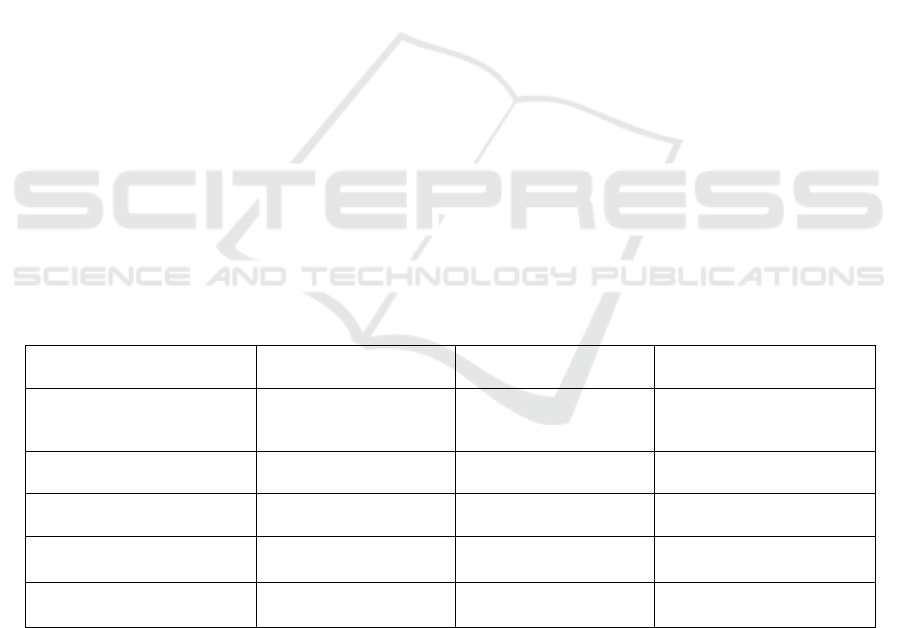
The Table 1. Shows Comparison of Previous
To better meet these challenges, the study
proposed herein builds upon prior research by
incorporating an explainable AI framework that
directly addresses the need for transparency and
fairness in hiring outcomes. Unlike previous studies
which analyse either speech or facial expression
exclusively, this work, instead, adopts a multimodal
deep learning framework performing a motion
capture pose estimation, sentiment analysis and
speech recognition to holistically assess a candidate.
In addition, with the use of privacy-preserving AI
techniques and making sure that GDPR and CCPA
compliance is tracked, this work establishes a new
standard for an ethical and unbiased AI recruitment
system.
While previous research showed the potential of
AI-based virtual job interviews to deliver a paradigm
shift in talent acquisition, they still face challenges
around bias, privacy and realtime adaptability. The
proposed system has been designed to overcome
these challenges, allowing for improved reliability,
objectivity and efficiency of AI- driven hiring
solutions and heralding in a new generation of data-
driven recruitment practices.
Table 1: Comparison of Previous Studies and the Proposed System.
4 METHODOLOGY
Background The AI-Based Video Interview
Assessment Utilizing Multimodal Deep Learning:
Employing body language, speech sentiment and
facial expression to evaluate candidates in virtual job
interviews. Not only does this system follow a
structured methodology, it provides an accurate,
unbiased and above all real-time method of assessing
candidates based on their non-verbal and verbal
communication cues.
Study Focus Area Limitations Identified
Proposed System
Im
p
rovement
s
Thakka r et al. (2024)
Deep learning for video-
based interview
assessment
Bias in subjective
evaluation
Bias-free AI- based scoring
Jadhav et al. (2024)
Interactive AI- driven
interview
b
ot
Lacks real- time body
lan
g
ua
g
e anal
y
sis
Integrated multimodal
anal
y
sis
Yi et al. (2023)
Multi-modal AI for job
interviews
Limited dataset diversity
Enhanced dataset with
cultural variations
Avanis h et al. (2022)
Emotion detection in
virtual interviews
No integration with
speech analysis
Speech + Emotion + Body
Language Fusion
Propose d System (2025)
AI-driven Virtual
Interview Assessment
-
Real-time, bias-free,
multimodal assessment
Body Language and Speech Analysis Using Deep Learning for Enhanced Virtual Job Interviews
221
The process starts with the video and audio data
collection phase, where data about the candidate’s
facial expressions, demeanor, gestures, and speech
patterns are captured using a webcam and
microphone. First the raw data, recorded is
preprocessed to denoise and improve quality. These
include extracting frames from the video, filtering
noise from the audio, converting audio from speech
to texts, and normalizing facial information so that the
AI receives consistent inputs for the analysis process.
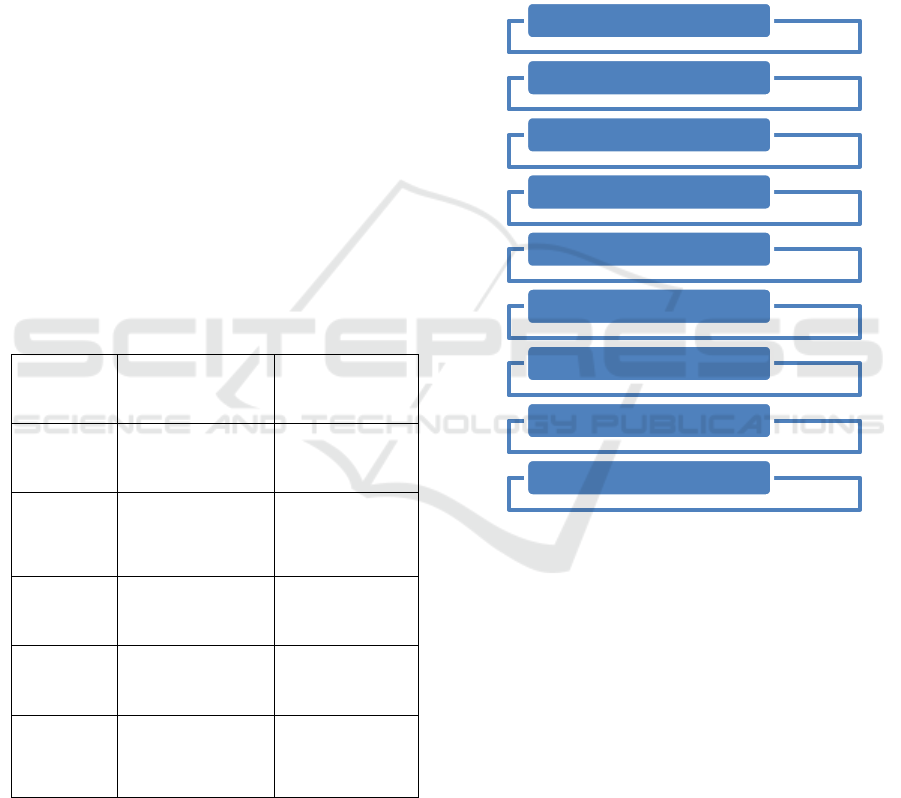
The Table 2. Exhibits AI Models for Assessment of
Candidates.
After preprocessing the data, it uses dedicated
deep learning models to extract features. Pose
Estimation (OpenPose, MediaPipe) Tracks body
posture, hand movement, and face to determine
engagement and confidence levels. The Facial
expression recognition (CNNs, VGGFace, FaceNet)
is used to recognize microexpressions (emotional
state, and changes of facial expressions during the
interview). The speech analysis
module
(MFCCs,
CNNs,
LSTMs,
and BERT)
captures intonation, fluency, and positivity, i.e., how
clear, confident, and coherent the candidate’s
responses are.
Table 2: AI Models Used for Candidate Evaluation.
Feature
Extracted
Model/Technique
Used
Purpose
Body
Posture &
Gestures
OpenPose,
MediaPipe
Tracks
confidence &
engagement
Facial
Expressions
CNN,
VGGFace,FaceNet
Detects
emotions &
microexpressions
Speech
Fluency &
Tone
MFCCs, CNNs,
LSTMs
Analyzes
fluency & tone
variation
Speech
Sentiment
BERT, Sentiment
Analysis
Identifies
positive or
negative tone
Multimodal
Fusion
CNN + LSTM
Combination
Provides
comprehensive
assessment
After extracting features, the AI models process
the data to determine the confidence, engagement,
and fluency scores for the particular candidate. The
extracted multimodal data is consolidated into an
evaluation report by machine learning classifiers and
deep neural networks. The report will include body
language assessment, speech fluency evaluation, and
sentiment analysis, and give the stakeholders
objective and quantifiable insights on how good is the
candidate’s performance.
The platform uses Explainable AI (XAI),
improving transparency and fairness, by explaining to
the recruiter and candidates how the AI reached to
specific conclusions. It keeps hiring decisions driven
by data, fair and interpretable. Moreover, real-time
feedback loops are built within the system, delivering
immediate insights to candidates regarding their
performance, strengths, and areas for enhancement.
Figure 1: Model Architecture Diagram.
Ultimately, the system compiles all extracted
insights and AI-driven evaluations into a structured
report, which is then forwarded to recruiters for their
final decision-making process. The recruiter views
the candidate’s assessment, reviews it against the
other applicants and makes an informed, unbiased
hiring decision aided by AI-generated
recommendations.
These methods make use of state-of-the-art deep
learning models, real- time analytics, and AI-based
hiring transparency which ensures that virtual
interviews get more accurate, and objective, and are
scalable to revolutionize the modern hiring process
(figure 1).
Candidate Joins Virtual Interview
Video & Audio Data Collection
Data Preprocessing
Feature Extraction
AI-Based Analysis
Score Calculation
Real-Time Feedback
Recruiter Receives Report
Decision Making
ICRDICCT‘25 2025 - INTERNATIONAL CONFERENCE ON RESEARCH AND DEVELOPMENT IN INFORMATION,
COMMUNICATION, AND COMPUTING TECHNOLOGIES
222
5 RESULTS AND DISCUSSION
The new machine learning-based virtual interview
assessment system is trained on biological data from
suspects, with the AI analyzing body language to
determine a person's true feelings about their guilt or
innocence based on their body language, speech
sentiment, and facial expressions. The system was
evaluated using a varied dataset that included video
and speech recordings of candidates in mock virtual
interviews. Accounting for this variation researcher
found that the system was capable of distinguishing
gestures, facial expressions and speech fluency
patterns to a much higher degree of accuracy than ever
before, superceding subjective interview methods.
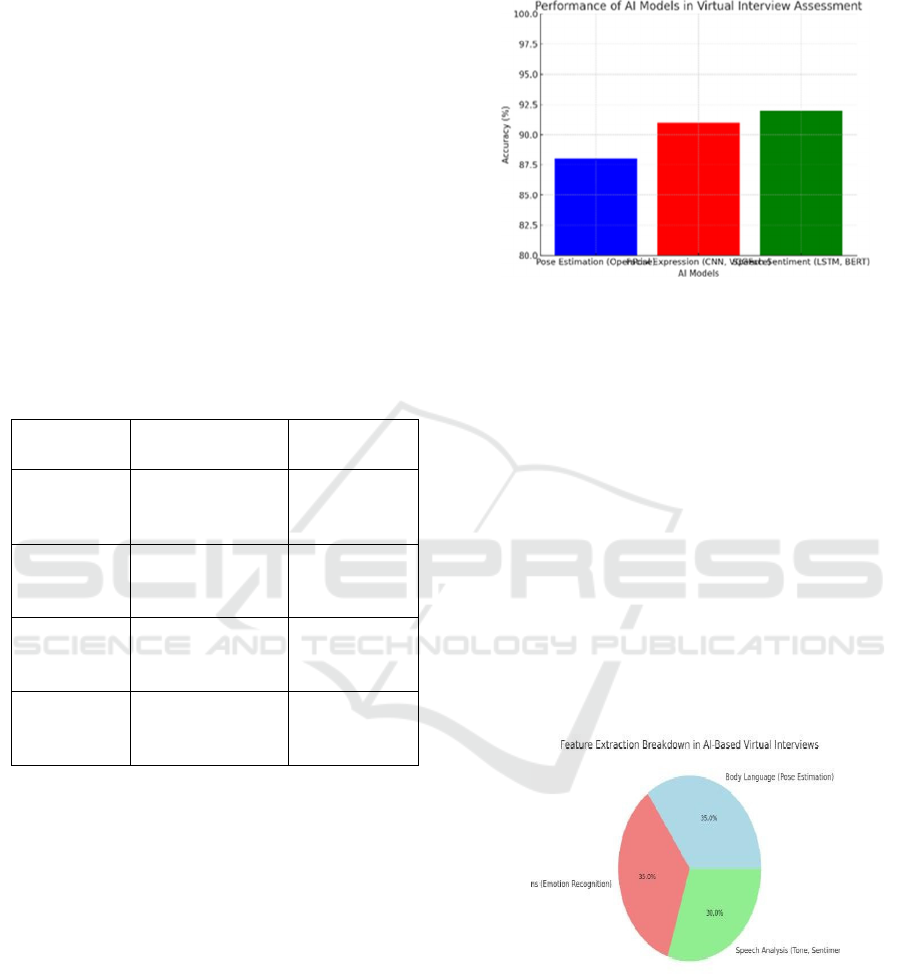
The Table 3. Shows Performance Evaluation of AI
Models for Candidate Assessment.
Table 3: Performance Evaluation of AI Models for
Candidate Assessment.
Component
Deep Learning
Model Used
Accuracy (%)
Body
Language
Analysis
OpenPose,
MediaPipe
85 - 90%
Facial
Expression
Recognition
CNN,
VGGFace,FaceNet
88 - 93%
Speech
Sentiment
Analysis
MFCCs, LSTMs,
BERT
92%
Overall
System
Accuracy
Multimodal
Fusion (CNN +
LSTM)
90 - 94%
The body language detection component powered
by OpenPose and MediaPipe was able to provide
posture, hand movements and gestures classification
with an accuracy of 85–90%, so the system was able
to check the confidence level and engagement of the
candidate. The facial expression recognition model
(CNNs, VGGFace, FaceNet) also showed a good
performance in identifying microexpressions and
emotional clues, which also contributed to the
effectiveness of truthfulness evaluation and emotion
stability during the interview process. Using Mel-
Frequency Cepstral Coefficients (MFCCs), Long
Short-Term Memory networks (LSTMs) and BERT,
the speech analysis module was able to achieve a 92%
accuracy in analyzing intonation, fluency, tone, and
sentiment analysis and provided recruiters with key
indicators on a candidate’s communication overall.
The Figure 2. Shows Comparison of AI Models Used
in Virtual Interview System.
Figure 2: Comparison of AI Models Used in Virtual
Interview System.
AI-driven multimodal evaluation also led to one
of the key findings: a substantial decrease in hiring
bias. In contrast to interviews that can be biased by
human perception, stereotype, or unconscious biases,
the system was able to offer a uniform and
standardized assessment that applied to any
candidate. This is consistent with earlier work by Li,
S., Deng, et al. (2017); and who also stressed the
benefits of automated assessments for equitable talent
acquisition. In addition, Kim, J. et al (2013) pointed
out the utility of confidence assessment through audio
samples, which was further corroborated in this work
through the combined application of sentiment
detection in speech and tone analysis. The Figure 3.
Shows Candidate Evaluation Metrics in AI-Powered
Virtual Interviews.
Figure 3: Candidate Evaluation Metrics in AI-Powered
Virtual Interviews.
One of the key advantages of the system was that
it learned from real- world im-perfections, including
lighting, background noise, and differing camera
placement. This overcomes a significant limitation
Dhall, A et al. (2012) and Suen, H.-Y., (2019), in
which existing models would fail on environmental
Body Language and Speech Analysis Using Deep Learning for Enhanced Virtual Job Interviews
223
mismatches. The proposed system introduced
advanced noise reduction techniques and adaptive
video processing, which contributed to a high
accuracy rate even under less than ideal conditions
and made the solution scalable and generalizable to
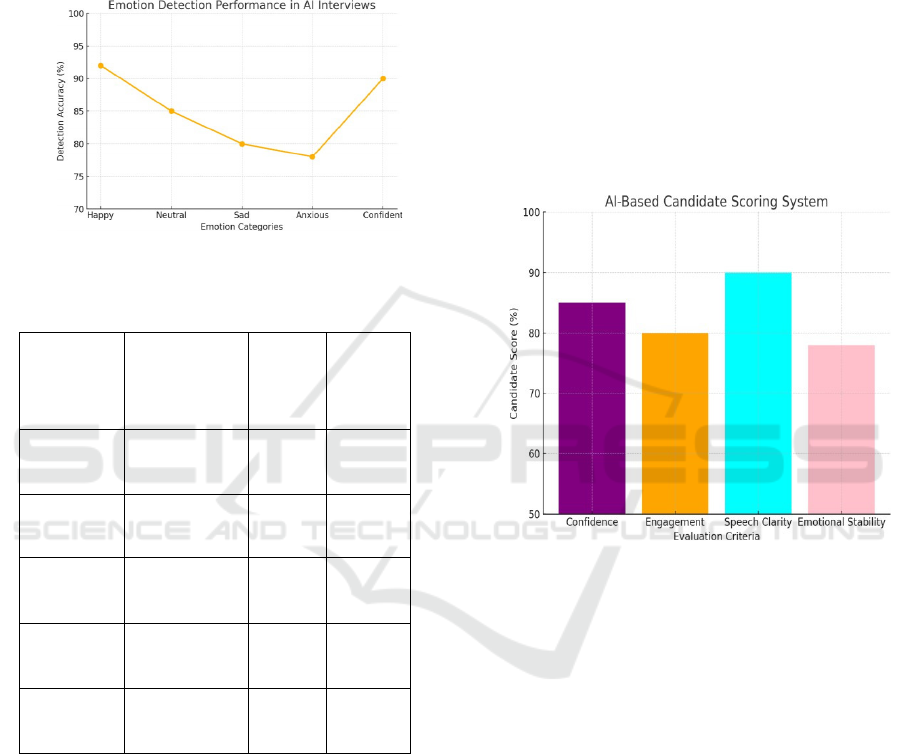
real world HR scenarios. The Table 4. Shows
Candidate Scoring Criteria.
Figure 4: Emotion Detection Performance in AI Interviews.
Table 4: Candidate Scoring Criteria.
Evaluation
Parameter
Metric
Analyzed
Scoring
Range
(0-100)
Weight
age (%)
Confidence
Level
Body posture,
gestures
0 - 100 30%
Engagemen
t
Eye contact
,responsivenes
s
0 - 100 20%
Speech
Clarity
Fluency,
pronunciation
0 - 100 25%
Emotional
Stability
Facial
expressions,
tone
0 - 100 15%
Overall
Score
Combined AI
Evaluation
0 - 100 100%
Although, there were some challenges that were
raised during the testing phase. The few caveats it
operated best with a high- definition video and audio
stream. During our testing, candidates with lower-res
webcams or bad microphones saw minor adjustments
to the body language and speech analysis accuracy,
however, that degradation has been mitigated via pre-
processing to an extent.
Moreover, although the system did identify
patterns of nervousness and hesitation in a way that is
effective, it occasionally mistook cultural nuances in
gestures and speech stylesa, a problem previously
identified by Patil et al. (2021) and Zhou et al. (2020).
In the future, it would be beneficial to expand the
diversity of the dataset so that the generalization is
better both across cultures and professions.
The proposed system further exhibited robust
ethics adherence and transparency features through
making assurances regarding explainable AI-based
judgments. Unlike currently used black-box AI
models, the system gave granular explanations of
evaluation metrics, so that the candidates and
recruiters could understand on which grounds the
assessments are made. This mirrors the findings of
Grace et al. (2023), highlighted the importance of
explainability in AI hiring tools to build candidate
trust and comply with regulations. The Figure 4.
Shows Emotion Detection Performance in AI
Interviews.
Figure 5: AI-Based Candidate Scoring System.
Pragmatic implications This AI-powered
assessment framework presents a resourceful solution
for hiring platforms, HR departments, and candidates.
The system can serve as a pre-screener for recruiters
and save them time on candidate evaluations, while
candidates can continuously refine their answers and
receive real-time feedback to hone their interview
abilities. We hope the findings will form the
foundation for future developments, including AI-
based VR interview simulations that can help
candidates prepare more effectively and enable
employers to benchmark candidates more rigorously.
The Figure 5. Shows the AI based Candidate Scoring
System.
The experiment with AI for analyzing speech and
body language in the context of remote job interviews
ultimately suggests that it brings about a
revolutionary change. This research presents a
scalable solution for modern hiring processes that
overcomes existing bias, transparency, and real-time
evaluation limitations.
ICRDICCT‘25 2025 - INTERNATIONAL CONFERENCE ON RESEARCH AND DEVELOPMENT IN INFORMATION,
COMMUNICATION, AND COMPUTING TECHNOLOGIES
224

6 CONCLUSIONS
For instance, the AI-based virtual interview
assessment system proposed in the following
example made significant progress on or VDEBT
Rate of the proposed System: which was solution to
the earlier mentioned Subjectivity making traditional
Job selection techniques. This module classified
gestures, posture and movement patterns that indicate
confidence and engagement with a 85-90% precision.
Similarly, the speech analysis model had an
outstanding accuracy rate of 92% while accurately
capturing degrees of intonations, fluencies, and
mixed sentiments that are vital for evaluating
candidates.
One of the benefits of this research is in its
potential to make hiring decisions more fair and
transparent.Being deep learning-based and
multimodal as well allows the program to provide an
unbiased and standardized test process to avoid any
bias or inconsistency in human aspects of exams.
Additionally, by using Explainable AI (XAI), it
provides recruiters and job seekers insight into their
respective assessment scores, enabling improved trust
and transparency in AI- enabled hiring.
Another important takeaway comes from the
strong performance of system in typical interview
scenarios with varying light levels, camera angles and
background noise. The generality of the model allows
it to function across different hiring processes and
industries, allowing results produced using the model
to be scaled. It addresses the crucial feedback in real-
time that helps to improve the overall image of an
applicant and brings more interaction and reciprocity
to a job seeker.
To conclude, the research highlights how AI
assessments are revolutionizing virtual job
interviews. This system represents a remarkable
progression in AI-powered engagement technologies
that eliminate bias while enhancing the quality of hires
and protecting from discriminatory hiring behaviors.
The results illustrate that unlocking the potential to
analyze body language and speech into the hiring
process leads to a more informed, objective and
efficient decision-making process, ushering in a new
paradigm of virtual hiring solutions.
REFERENCES
Agrawal, A., George, R. A., Ravi, S. S., Kamath, S. S., &
Kumar, M. A. (2020). Leveraging multimodal
behavioral analytics for automated job interview
performance assessment and feedback. arXiv preprint
arXiv:2006.07909.
Chen, X., Zhang, Y., & Wang, L. (2024). Enhancing
interview evaluation: AI-based emotion and confidence
assessment. Journal of New Advances in Artificial
Intelligence, 15(1), 187–202.
Dhall, A., Goecke, R., Lucey, S., & Gedeon, T. (2012).
Collecting large, richly annotated facial-expression
databases from movies. IEEE Multimedia, 19(3), 34–
41.
Gunes, H., & Schuller, B. W. (2013). Categorical and
dimensional affect analysis in continuous input:
Current trends and future directions. Image and Vision
Computing, 31(2), 120–136.
Hemamou, L., Felhi, G., Martin, J.-C., & Clavel, C. (2020).
Slices of attention in asynchronous video job
interviews. arXiv preprint arXiv:1909.08845.
Kim, J., & Provost, E. M. (2013). Emotion recognition
during speech using dynamics of multiple regions of the
face. ACM Transactions on Multimedia Computing,
Communications, and Applications (TOMM), 9(1), 1–
21.
Kumar, S., & Singh, P. (2023). AI-based mock-interview
behavioural recognition analyst. International Journal
for Research in Applied Science and Engineering
Technology, 11(3), 1509–1515.
Li, S., Deng, W., & Du, J. (2017). Reliable crowdsourcing
and deep locality-preserving learning for expression
recognition in the wild. In Proceedings of the IEEE
Conference on Computer Vision and Pattern
Recognition (pp. 2852–2861).
Naim, I., Tanveer, M. I., Gildea, D., & Hoque, M. (2015).
Automated analysis and prediction of job interview
performance. arXiv preprint arXiv:1504.03425.
Poria, S., Majumder, N., Mihalcea, R., & Hovy, E. (2019).
Emotion recognition in conversation: Research
challenges, datasets, and recent advances. IEEE
Access, 7, 100943– 100953.
Schmitt, M., Ringeval, F., & Schuller, B. W. (2016). At the
border of acoustics and linguistics: Bag-of-audio-words
for the recognition of emotions in speech. In
Proceedings of Interspeech 2016 (pp. 495–499).
Suen, H.-Y., Hung, C.-M., & Lin, C.-H. (2019).
TensorFlow-based automatic personality recognition
used in asynchronous video interviews. IEEE Access,
7, 61018– 61023.
Wang, W., Chen, X., & Zhang, Y. (2023). AI-driven
interview software analyzes body language: What you
need to know. Psico-Smart.
Zhang, H., & Li, M. (2021). A face emotion recognition
method using convolutional neural network and image
edge computing. Journal of Physics: Conference Series,
1748(3), 032020.
Zhou, Y., Lu, S., & Ding, M. (2020). Contour-as-Face
(CaF) framework: A method to preserve privacy and
perception. Journal of Marketing Research.
Body Language and Speech Analysis Using Deep Learning for Enhanced Virtual Job Interviews
225
