
English Text to Sign Language Translation Using Python and CNN
Manisha N. More, Jainil D. Bhanushali, Aditya Bhandari, Aadi Bhangdiya,
Yash Bhandari and Yogini Bhamare
Department of Computer Engineering, Vishwakarma Institute of Technology (VIT), Upper Indira Nagar, Bibwewadi, Pune,
Maharashtra, India
Keywords: CNN, Flask, NLP, Flask API, Tensor Flow, UI, Web Development, Tokenization.
Abstract: One of the most essential components of human existence is communication. It helps us communicate our
ideas and feelings, which strengthens our bonds with other people. We propose our project, which focusses
primarily on the deaf and mute community, with this important factor in mind. Any sign language, meanwhile,
is a complicated language that confronts many difficulties nowadays, such as a lack of trained interpreters and
low general public understanding. We use state-of-the-art technology, namely Convolutional Neural
Networks (CNNs) and Natural Language Processing (NLPs), to decode Sign Language in order to solve this
problem. This cutting-edge device helps hearing and non-hearing people communicate with each other. Our
system takes user-provided text and converts it into matching sign language films that are kept in a database
curated by the authors, enhancing accessibility and inclusivity for the deaf community.
1 INTRODUCTION
Sign language is utilised to facilitate communication
between such a vast number of followership members
and regular people. The community of people who are
deaf or hard of hearing use sign language, which is a
visual language. (M.M Mohan Reddy and G.
Soumya, 2021) It is one of the most crucial forms of
communication since it uses body language, face
expressions, and hand gestures to convey message. In
education, social interactions, and accessibility, sign
language is essential because it successfully closes
the communication gap between the hearing and the
deaf. (Sang-Ki Ko, et.al., 2019) However, sign
language specialists are not widely available
throughout the world. Engineers, programmers, and
others are working on a number of initiatives to
eradicate this.
One of the most effective way to tackle this issue
is the integration of advanced technologies so that
people can smoothly use it by sitting at their home.
(H.Y.H Lin and N. Murli, 2022) This project is an
effort of the same. Advanced technologies such as
Convolutional Neural Networks (CNN), Flask, and
Natural Language Processing (NLP) are used in this
project. These new technologies can recognise hand
movements and textbook, converting them into
accurate sign Language for flawless communication.
Our project helps in enabling users to communicate
without any issue with ease.
The primary aim of this paper is to analyse,
understand, and explore the development and
application of sign language in bridging the gap
between the hearing and deaf communities. (H.Y.H
Lin and N. Murli,2022) Our project’s main vision is
to give users a smooth and intuitive communication
experience, enhancing availability and inclusivity.
This will help them to communicate better with others
without putting in much effort. (Kulkarni,et.al., 2021)
2 LITERATURE REVIEW
2.1 Gesture-to-Text Translation Using
SURF for ISL
Using the Speeded-Up Robust Features (SURF)
model for feature extraction, Tripathi et al. suggested
a gesture-to-text translation system (K. M. Tripathi,
et.al., 2023). To enhance gesture identification, their
method makes use of image preprocessing techniques
such feature extraction, edge detection, and skin
masking. For classification, a Bag of Visual Words
(BoVW) model was used, and it achieved an accuracy
range of 79% to 92%. (P. Verma and K. Badli, 2022)
More, M. N., Bhanushali, J. D., Bhandari, A., Bhangdiya, A., Bhandari, Y. and Bhamare, Y.
English Text to Sign Language Translation Using Python and CNN.
DOI: 10.5220/0013879900004919
Paper published under CC license (CC BY-NC-ND 4.0)
In Proceedings of the 1st International Conference on Research and Development in Information, Communication, and Computing Technologies (ICRDICCT‘25 2025) - Volume 2, pages
189-194
ISBN: 978-989-758-777-1
Proceedings Copyright © 2025 by SCITEPRESS – Science and Technology Publications, Lda.
189
However, rather than fully translating text to signs, the
main focus of this study is gesture-to-text conversion.
2.2 Speech to ISL Translator Using
Rule-Based Methods
Using a rule-based methodology, Jadhav et al. created
a speech-to-ISL translation system that translates
spoken words into ISL gestures (K. Jadhav, et.al.,
2021). Using voice-to-text conversion, the system
first translates speech into text before mapping the
text to matching ISL signs that are kept in a database.
Although this approach guarantees grammatical
accuracy, it is not flexible enough to translate in real
time and has trouble with complicated sentence
patterns. (R. Harini,et.al., 2020 )
2.3 Speech to ISL Translator Using
NLP
An NLP-based method for speech-to-ISL translation
was presented by Bhagat et al. (D. Bhagat, et.al.,
2022), who used parsing, tokenization, and
lemmatization techniques to divide sentences into
signable parts. Their technology ensures smoother
communication by retrieving relevant ISL indicators
from a specified database. (K. Yin and J. Read, 2020)
However, its scalability and robustness are
challenged by out-of-vocabulary words and a lack of
ISL datasets.
2.4 Translating Speech to ISL Using
Natural Language Processing
In order to translate spoken words into ISL
animations, Sharma et al. investigated natural
language processing (NLP) methods such
tokenization, parsing, and part-of-speech tagging (P.
Sharma,et.al., 2022). Their technology takes audio
input, translates it into text, and then compares it to
ISL sign videos that have already been captured. (N.
C. Camgoz, et.al., 2023) Although this method
enhances translation at the sentence level, real-time
implementation is challenging due to its dependence
on a fixed video database.
2.5 Speech to ISL Translation Using
Kinect-Based Motion Capture
Sonawane and colleagues created a Kinect-based ISL
translation system that uses Unity3D to convert
human motion into 3D animated ISL signs (P.
Sonawane, et.al., 2021). The technology is quite
engaging because it shows ISL indications in real-
time visually. However, its limited accessibility and
portability due to its reliance on Kinect technology
prevent it from being widely used. (S. Clifford M.
Murillo,et.al., 2021 )
2.6 Deep Learning-Based ISL
Translator Using CNN
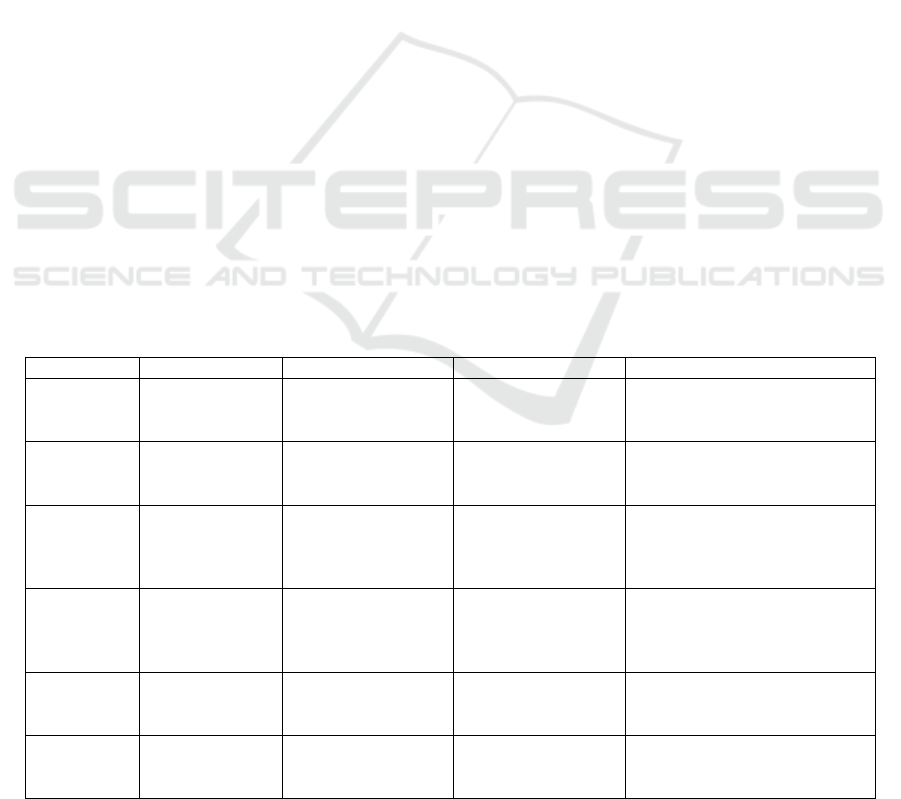
Table 1: Comparison of Methods.
Autho
r
Methodolo
gy
Database use
d
Accurac
y
Limitations
Tripathi et
al. (2023)
SURF-based
recognition of
gestures
42000 images used
(alphabets and
numbers)
79%-92% Restricted to conversion from
gestures to text (K. M.
Tripathi, et.al., 2023)
Jadhav et al.
(2021)
Rule-based
speech-to-ISL
translation
Pre-determined ISL
dictionary
Not specified Struggles with complex
sentences, and real time use
(K. Jadhav, et.al., 2021)
Bhagat et al.
(2022)
NLP-technique
that convert
speech to ISL
Finite ISL Dataset Not specified Faced issue with limited ISL
dataset, struggles with out-of-
vocabulary words (D. Bhagat,
et.al., 2022
)
Sharma et
al. (2022)
NLP-technique
that convert
speech- to-video
ISL s
y
ste
m
Pre-recorded ISL
videos database
Not specified Dependent on pre-recorded
ISL videos, not working in
real-time (P. Sharma,et.al.,
2022
)
Sonawane et
al. (2021)
Kinect-based
ISL translation
Captured motion
data from kinetic
Not specified Requires specialized Kinect
hardware, limits accessibility
(
P. Sonawane, et.al., 2021
)
Bagath et al.
(2023)
CNN-based
gesture
recognition
Large dataset (not
specified)
High Accuracy (not
numerically
defined)
Requires large datasets, high
computational power (B. S, D.
Varshini, and J. G., 2023)
ICRDICCT‘25 2025 - INTERNATIONAL CONFERENCE ON RESEARCH AND DEVELOPMENT IN INFORMATION,
COMMUNICATION, AND COMPUTING TECHNOLOGIES
190
A CNN-based ISL recognition system that uses deep
learning models to convert hand gestures into text
was proposed by Bagath et al. (B. S, D. Varshini, and
J. G., 2023). The system uses a Convolutional Neural
Network (CNN) to classify hand motions into ISL
signs after preprocessing them using computer vision
techniques. table 1 shows the Comparison of methods
Despite the great accuracy of this model, real-world
implementation is difficult due to its dependency on
big labelled datasets and significant computational
resources. (Z. Liang, et.al., 2023).
3 METHODOLOGY
Through this initiative we want to help deaf people.
The primary goal is to create an English text to sign
language translator. It will be useful to both deaf as
well as normal people. There are a lot of programmers
or engineers working on new ways on interaction
between normal human and a hard to hear human.
This project is an effort to remove the communication
barrier between normal people and hard of hearing
people. In this the user types the sentence or word or
number and the system will give its correct sign
gesture in the form of a video. The system is a
combination of Convolutional Neural Networks
(CNN), web frameworks (Flask API), Python,
Natural Language Processing (NLP), and front-end
concepts to create this translation tool. (S. Clifford M.
Murillo,et.al., 2021) A use of dataset containing all
the videos is done in this project. These videos are
resized, renamed and somewhat edited before actual
use. We haven’t included audio input because of
speech recognition challenges, background noises,
accents etc. Also, the language we speak and the sign
language have different grammar, so it may not
produce meaningful results. For the time being this
system only accepts text inputs and we can integrate
audio input also in the future.
The main component which we used in this
project Convolutional Neural Networks (CNN). It is
very useful in video processing tasks especially when
converting text to sign gestures. Based on the input
text CNN just predicts the correct sign gesture in in
(R. Harini,et.al., 2020). Next, we designed the system
in a webpage so that it will be user friendly. The UI is
made through basic web development components
HTML (for structure), CSS (for styling), Javascript
(functionality and connecting Flask to the webpage).
Flask is used as a backend framework which look
after the main model and user interface. An API is
created in Flask to accept input from user, this input
is passed through CNN model and the corresponding
sign gesture is displayed on user interface in the form
of video. The Javascript takes inputs in front end from
user and send request to Flask API in real time. The
CNN model is connected with Flask backend. This is
where the user input is processed and sign gesture is
displayed on the UI. Natural Language Processing
(NLP) is used in tokenization, grammar conversion
(rearranging words in proper order in sign gesture as
it is different from the grammar we speak).
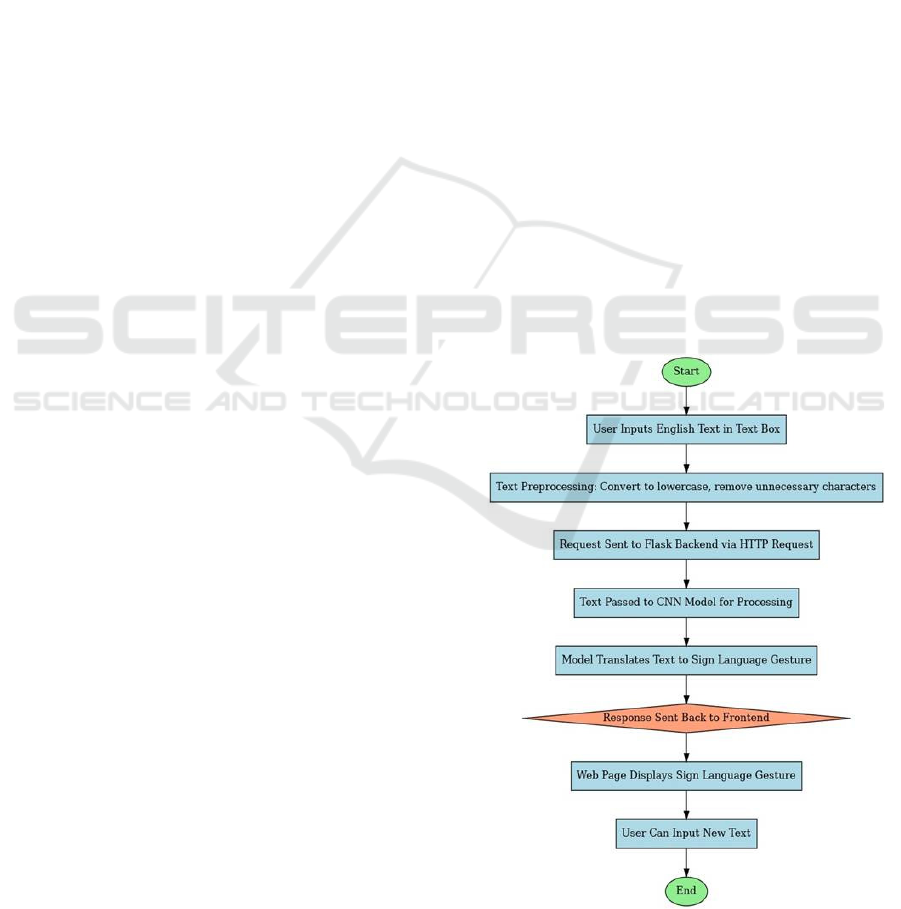
First user inputs English text in the textbox, clicks
on translate. Now, as part of text pre-processing step
in NLP text is converted to lowercase for better
matching to correct sign gesture, consistency and
reducing unnecessary duplicates. Also,
Lemmatization of text is done using NLP itself. It
means grouping together different forms of words so
that there is consistency in text processing like in
(Kulkarni,et.al., 2021). This is sent to Flask via HTTP
and then to CNN for text processing. The model
translates the text to accurate sign gesture in the form
of videos from our database. Videos are present of
letters, words, numbers. If user types a word or
sentence which is not present in our dataset, then the
concatenated version of the letters or numbers is
shown (S. Clifford M. Murillo,et.al., 2021).
Figure 1
shows the Working of system flowchart. This
concatenation can be in the form of letters or numbers
as well (Dr. S V.A Rao,et.al., 2022).
Figure 1: Working of System Flowchart.
English Text to Sign Language Translation Using Python and CNN
191

This video thus processed is shown on the
webpage where user can interact with it. The dataset
used in this is majorly animated one with American
sign language. This dataset has letters, numbers and
some important words we use in our day-to-day life
primarily in ASL... All videos are animated in this
dataset. We took this dataset online from Kaggle. It
contains labelled sign gestures videos. We somewhat
modified it for pre-processing steps in our project.
The final created system is tested properly before
actual use. Its accuracy and effectiveness are also
tested. During this project several challenges are
imposed. First is variation in sign gesture across
different regions. We have to look that the UI we
build is easy to understand for those who don’t know
much about technology.
So, this methodology provides an easy approach
to build an English text to sign language translator. In
the future we can improve the accuracy, we can
expand the dataset as well as more languages can be
added to it.
4 MAJOR MATHEMATICAL
EQUATIONS
The text processing is done which is known as
tokenization, meaning breaking a sentence into words
or words into letters. This is done with the help of
NLP techniques:
𝑇 = {𝑊1,𝑊2,𝑊3,…..𝑊𝑛 (1)
Where,
T = Tokenized sentence or word.
Wi = individual words or letters.
A word for example “Hello” is typed, it will be
treated as a sequence of letters: {‘h’, ‘e’, ‘l’, ‘l’, ‘o’}.
Then the lengths of the respective letters are checked:
If h is 2 sec, e is 3 sec and l is 1 sec, the total time to
display the concatenated video is given by their sum
∑
𝐷𝑢𝑟𝑎𝑡𝑖𝑜𝑛 𝑜𝑓 𝑙𝑒𝑡𝑡𝑒𝑟𝑠
(
𝑜𝑟 𝑤𝑜𝑟𝑑𝑠
)
𝑖
(2)
Therefore, for 5 letter clips
Total time = Duration 1 + Duration 2 + …. + Duration
5
2) Flask processing equation
Total duration to process a request to Flask is
𝑇 𝑡𝑜𝑡𝑎𝑙 = 𝑇 𝑝𝑟𝑒𝑝𝑟𝑜𝑐𝑒𝑠𝑠 + 𝑇 𝑖𝑛𝑓𝑒𝑟𝑒𝑛𝑐𝑒 +
𝑇 𝑟𝑒𝑠𝑝𝑜𝑛𝑠𝑒
(3)
Where:
T preprocess: Time taken for processing of text
(NLP)
T inference: Time taken for CNN model
T response: Time taken to send the final sign gesture
to the user
All the calculations of time are in milliseconds
(ms).
3) Word vector embedding:
After converting letters and words to lowercase, it is
still text. They should be converted to numbers for
processing by machine learning models. Therefore,
we use vectors for this.
Every word or letter is converted to vectors of
numbers. This help models to understand the
connection between words.
Equation is
E(w) = W ⋅ v + b (4)
E(w): Final numerical representation of word
v: input word vector (each word has this vector which
is a fixed size set of numbers).
W: Weight matrix (transform input word vector to
some other form which has more meaning).
b: Bias term (small value added so that models can
understand better).
How this all works together:
Step 1. User enter English text
Step 2. Conversion of text to Lowercase
Step 3. Tokenization of words
Step 4. Conversion of words to vectors
Step 5. Pass these vectors for sign language
conversion to the machine learning models.
5 RESULTS AND DISCUSSION
In this work of English text to sign language
translation, use of various modern techniques is done
such as CNN, Flask API, NLP etc. A very basic UI
design made up of HTML, CSS, Javascript is also
created which is completely user friendly. The figure
2,3,4,5,6 shows the results.It provides an easy
approach for people who are needy for this but don’t
know about technology much. Thus, this system helps
to bridge the gap between a normal person and a hard
to hear person.
The processing time and display of final result
take a few seconds. For small words or letters or
numbers it takes time below 5 seconds and if the
words are big or user enters a sentence, the
corresponding sign language is shown in 15 seconds
or less than that. The accuracy of this project is 100%
Here are some of the results of the system:
ICRDICCT‘25 2025 - INTERNATIONAL CONFERENCE ON RESEARCH AND DEVELOPMENT IN INFORMATION,
COMMUNICATION, AND COMPUTING TECHNOLOGIES
192
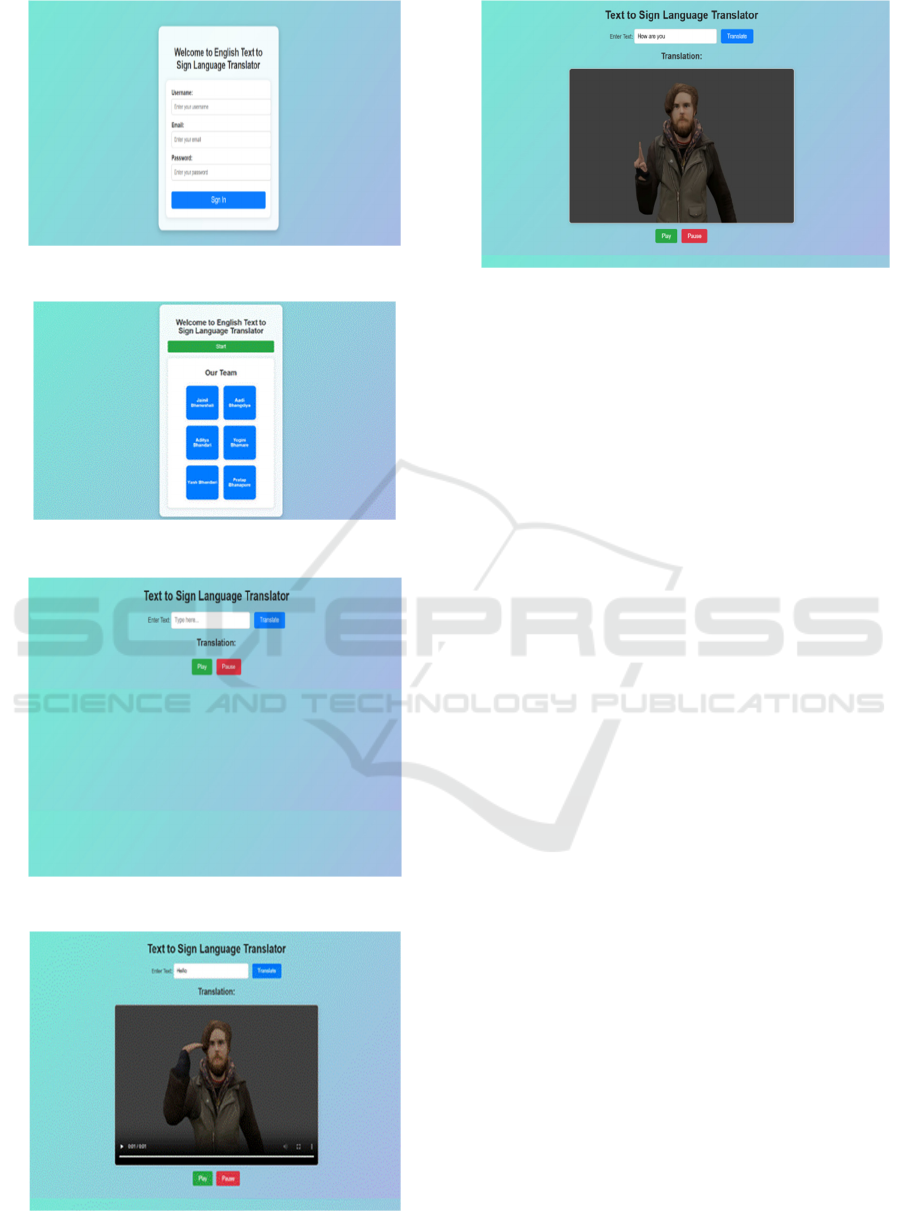
Figure 2: Screenshot of Result.
Figure 3: Screenshot of Result.
Figure 4: Screenshot of Result.
Figure 5: Screenshot of Result.
Figure 6: Screenshot of Result.
6 FUTURE SCOPE
This project has a wide range of development ideas
and future advancements. One is to expand the dataset
to include more words, phrases and even sentences to
improve translation. Next improvement we can do is
to provide multiple languages so that more people
who are actually needy can use this without any
language barrier. In the future we can take audio
inputs as well making it a real time speech recognition
system. Gesture based input can also be integrated
using camera and lenses. Computer vision and
technologies like media pipe can recognize live
movements giving real time translation. Further we
can also develop a mobile app for this project with all
enhancements. This app will be available for Android
as well as iOS.
7 CONCLUSIONS
The current ISL translation systems use a variety of
methods, including rule-based strategies, natural
language processing, machine learning, and gesture
recognition. Although organized text-to-sign
translation is provided via rule-based and natural
language processing techniques, they frequently lack
real-time adaptability. High accuracy is offered by
deep learning models, especially CNN-based
techniques, however they come with a high
computational cost and training data requirement.
Although they require specific technology, gesture-
based techniques like Kinect motion capture improve
real-time engagement. For a more complete ISL
translation system, future studies should concentrate
on hybrid strategies that combine natural language
processing, machine learning, and 3D animation.
English Text to Sign Language Translation Using Python and CNN
193

ACKNOWLEDGEMENTS
We are very thankful to Vishwakarma Institute of
Technology, Pune for helping us by giving this
fantastic platform and needed resources to develop
this project. We are also thankful to our faculty
mentors and teachers for their continuous help,
valuable inputs and guidance throughout the whole
process of research and developments. Their support
is very crucial role in making our project.
Additionally, we are also express our gratitude to
our college, class friends and collaborators for their
constructive feedback and discussions which help us
to modify and improve our project and refine our
approach.
REFERENCES
“Speech To Indian Sign Language (ISL) Translation
System,” 2021 International Conference on Computing,
A. Kulkarni, A.V Kariyal, Dhanush V, P.N Singh, “Speech
to Indian Sign Language Translator,” Proceedings of
the 3rd International Conference on Integrated
Intelligent Computing Communication & Security
(ICIIC 2021), Atlantis Press, volume 4, 2021
B. S, D. Varshini, and J. G. M, “Sign Language Translator
Using Python,” International Journal of Scientific
Research in Engineering and Management (IJSREM),
vol. 7, no. 8, pp. 1-3, 2023.
Based on Python," Material Science and Technology, vol.
22, no. 3, pp. 227–237, Mar. 2023.
Communication, and Intelligent Systems (ICCCIS), IEEE,
pp. 92-93, 2021.
D. Bhagat, H. Bharambe, and J. Joshi, “Speech to Indian
Sign Language Translator,” International Journal of
Advanced Research in Science, Communication and
Technology (IJARSCT), vol. 2, no. 3, pp. 538-541,
2022.
Dr. S V.A Rao, K.S Karthik, B. Shiva Sai, B. Sunil Kumar,
N Madhu, "Audio to Sign Language Translator Using
Python," Neuroquantology, vol. 20, issue 19, pp. 5461-
5468, Nov. 2022.
H.Y.H Lin, N. Murli, "BIM Sign Language Translator
Using Machine Learning (TensorFlow)," Journal of
soft computing and data mining, vol. 3, no. 1, pp. 68–
77, Jun. 2022.
K. Yin and J. Read, "Better Sign Language Translation with
STMC-Transformer," arXiv preprint,
arXiv:2004.00588, 2020.
K. Jadhav, S. Gangdhar, and V. Ghanekar, “Speech to ISL
(Indian Sign Language) Translator,” International
Research Journal of Engineering and Technology
(IRJET), vol. 8, no. 4, pp. 3696-3697, 2021.
K. M. Tripathi, P. Kamat, S. Patil, R. Jayaswal, S. Ahirrao,
and K. Kotecha, “Gesture-to-Text Translation Using
SURF for Indian Sign Language,” Applied System
Innovation, vol. 6, no. 35, 2023. DOI:
10.3390/asi6020035.
M.M Mohan Reddy, G. Soumya, "Sound to Sign Language
Translator
N. C. Camgoz, O. Koller, S. Hadfield, and R. Bowden,
"Sign Language Transformers: Joint End-to-End Sign
Language
P. Sharma, D. Tulsian, C. Verma, P. Sharma, and N. Nancy,
“Translating Speech to Indian Sign Language Using
Natural Language Processing,” Future Internet, vol. 14,
no. 253, pp. 1-17, 2022. DOI: 10.3390/fi14090253.
P. Verma, K. Badli, "Real-Time Sign Language Detection
Using TensorFlow, OpenCV, and Python,"
International Journal for Research in Applied Science
& Engineering Technology (IJRASET), vol. 10, issue
5, May 2022.
P. Sonawane, P. Patel, K. Shah, S. Shah, and J. Shah,
R. Harini, R. Janani, S. Keerthana, S. Madhubala and S.
Venkatasubramanian, "Sign Language Translation,"
2020 6th International Conference on Advanced
Computing and Communication Systems (ICACCS),
Coimbatore, India, 2020, pp. 883-886. DOI:
10.1109/ICACCS48705.2020.9074370
Recognition and Translation," in Proceedings of the
IEEE/CVF Conference on Computer Vision and
Pattern Recognition (CVPR), Seattle, WA, USA, 2020,
pp. 10023–10033.
S. Clifford M. Murillo, M. Cherry Ann E. Villanueva, K.
Issabella M. Tamayo, M. Joy V. Apolinario, M. Jan D.
Lopez, “Speak the Sign: A Real-Time Sign Language
to Text Converter Application for Basic Filipino Words
and Phrases,” Central Asian Journal of Mathematical
Theory and Computer Sciences, Volume: 02 Issue: 08,
Aug 2021
Sang-Ki Ko, Chang Jo Kim, H Jung, C Cho, "Neural Sign
Language Translation Based on Human Key point
Estimation," International Journal of Computer Vision,
vol. 9, no. 13, pp. 456–467, Jul. 2019.
V. Swathi, C.G Reddy, N. Pravallika, P. Varsha Reddy, Ch.
Prakash Reddy, “Audio to Sign Language Converter
Using Python,” Journal of Survey in Fisheries Sciences,
10(1), 2023, 2621-2630.
Z. Liang, H. Li, and J. Chai, "Sign Language Translation:
A Survey of Approaches and Techniques," Electronics,
vol. 12, no. 12, p. 2678, June 2023.
ICRDICCT‘25 2025 - INTERNATIONAL CONFERENCE ON RESEARCH AND DEVELOPMENT IN INFORMATION,
COMMUNICATION, AND COMPUTING TECHNOLOGIES
194
