
Revolutionizing Mining and Metals Industries: A Digital
Transformation Framework for Efficiency and Sustainability
Venugopalam Medicherla and Aasheesh Raizada
Department of Computer Engineering & Applications, Mangalayatan University, Aligarh, India
Keywords: Digital Transformation, Artificial Intelligence (AI), System Integration, Environmental Sustainability.
Abstract: There is a significant change occurring in the metals and mining sectors with the need to improve safety,
reduce operating costs, optimise operations, and address requirements in terms of sustainability. One method
to overcome such challenges and update industry processes is through digital transformation with the use of
cutting-edge technologies like blockchain, cloud computing, artificial intelligence (AI), the Internet of Things
(IoT), and digital twins. With the support of an IT architectural framework custom-designed to suit such
sectors, digital solutions that improve resiliency, sustainability, and operational efficiency can be integrated
with relative ease. The framework to be adopted ensures real-time processing, predictive analysis, and
allocation of resources through prioritizing modularity, scalability, and compatibility with legacy and new
systems. The effective application of new-age technologies to enhance productivity and efficiency is
illustrated through examples such as ArcelorMittal's smart factory program and Rio Tinto's autonomous
haulage systems. Integration with legacy systems, the absence of expertise, cybersecurity threats, and
communication issues in remote areas are major challenges despite the revolutionary promise of such
solutions. To offset such challenges, the paper recommends steps such as the use of hybrid models of IT
(cloud and edge computing) and investing in AI-based analytics and improving cybersecurity measures are
among the steps the research recommends to address such challenges. Moreover, the use of Iot-based sensors
and autonomous systems to monitor and optimise in real-time is described in detail. The mining and metals
industry can significantly enhance efficiency, safety, and environmental stewardship through the adoption of
a structured approach to digital transformation. It will ensure long-term growth and competitiveness in an
international context, a reality that is changing so rapidly.
1 INTRODUCTION
The metal and mining industries have been facing
increasing pressure in recent years to become green,
optimize, reduce costs, and improve safety. Digital
transformation is facilitated by new technologies that
offer a well-structured solution to all these issues.
Designing robust IT architectural designs relevant to
the specific needs of these industries is the central
element of this transformation.
This essay addresses how the metals and mining
industry is changing thanks to digitalization made
feasible through strategic IT architecture, and also
attaining greater operational efficiency and access to
a more sustainable future.
1.1 Problem Statement
Mining companies are faced with challenging tasks in
setting up digital transformation initiatives, even
though the potential for gain is boundless. Only 30%
of digital transformation initiatives meet their desired
objectives, as per industry sources Arias, L and
Gupta, S. (2023), attributing the requirement for a
well-crafted implementation plan.
1.1.1 The Need for Digital Transformation
in Mining and Metals
Sophisticated supply chains, changing customer
demands, and high capital needs are the features of
the mining and metals sector. Traditional practices
tend to create waste, require lots of manual labour,
and consume a lot of energy. Some of the key issues
180
Medicherla, V. and Raizada, A.
Revolutionizing Mining and Metals Industries: A Digital Transformation Framework for Efficiency and Sustainability.
DOI: 10.5220/0013879800004919
Paper published under CC license (CC BY-NC-ND 4.0)
In Proceedings of the 1st International Conference on Research and Development in Information, Communication, and Computing Technologies (ICRDICCT‘25 2025) - Volume 2, pages
180-188
ISBN: 978-989-758-777-1
Proceedings Copyright © 2025 by SCITEPRESS – Science and Technology Publications, Lda.

are:
• Operational inefficiencies: Legacy systems
and manual processes both increase human
error and reduce efficiency.
• Environmental Impact: The industry makes
a huge contribution to depleting resources and
emitting greenhouse gases.
• Safety: Owing to dangerous chemicals,
machinery failure, and unsafe working
conditions, mining remains one of the most
hazardous sectors.
• Regulator pressures: Sustainability practices
are mandated by more stringent environmental
regulations and ESG (Environmental, Social,
and Governance) expectations Brown et al.,
(2024).
In response to such issues, companies are
employing technologies such as artificial intelligence
(AI), the Internet of Things (IoT), cloud computing,
and data analytics as part of digital transformation.to
provide efficiency and sustainability
Carter et al.,
(2023).
2 LITERATURE REVIEW
2.1 Current State of Mining and
Metals Industry
2.1.1 Market Dynamics
As a result of changing market circumstances,
sustainability needs, and geopolitical tensions, the
metals and mining industry is going through
significant transition. Ernst & Young (2024) reveals
that 84% of mining executives feel that digitalization
is required to remain competitive. Various studies
illustrate how market uncertainty, including
unpredictable commodity prices, is impacting
operational performance and investment plans. Firms
are also being compelled to embrace more resilient
and sustainable business models by increasing
environment and regulatory pressures Chakraborty, P
and Verma, R. (2023).
As per research, supply chain disruption and
intensifying competition from developing markets,
typical of global crises, also escalate market pressures
Ernst and Young (2024). To contain supply chain
risks and enhance resilience, these findings from the
studies indicate the imperative for operational agility
using digital technology Gonzalez, H and Pereira, A.
(2024).
2.1.2 Operational Landscape
Sliding ore grades, increasing costs of production,
and increasing energy consumption are the primary
reasons behind the ongoing growth in mining
operational complexity Johnson, M. (2023). Studies
indicate that operational costs have risen by 12%
annually, mostly due to shortages of labor and
regulatory requirements (Kumar, A and Reynolds, T.
2023). Also, the skills shortages in the industry hinder
advanced mining technologies from being
implemented. Operational strategies are evolving to
address environmental issues and the demand for
sustainable methods of extraction. These issues
emphasize the use of digital technologies in process
streamlining and reducing costs while adhering to
international standards of sustainability (McKinsey
and Company 2024).
2.2 Digital Transformation Trends
2.2.1 Industry 4.0 Integration
Industry 4.0 technology that enhances predictive
abilities, reduces expenditure, and boosts efficiency.
There has been a reduction in costs to the tune of 15%
to 20% due to the application of autonomous mining
machinery, reports show. Similarly, it has been
demonstrated that IoT-enabled sensor networks and
AI-driven analytics can boost equipment efficiency
by 25% (Mining Technology Institute, 2024).
Because it enables real-time asset monitoring and
minimizes downtime, the use of digital twins in
predictive maintenance has also become increasingly
popular. Research goes on to explain how AI-
powered process automation is improving decision-
making through the analysis of both historical and
current data (Patel, K and Wang, J, 2023).
2.2.2 Emerging Technologies
AI and IoT are not the only technological
developments propelling digital transformation in
mining. The use of blockchain technology to ensure
ethical sourcing, supply chain transparency, and
regulatory compliance is growing (PwC, 2024). It
also emphasizes how edge computing can lower
latency and improve operational efficiency by
enabling real-time data processing at distant mining
sites.
Automation and robotics have also demonstrated
a great deal of promise, increasing safety by reducing
human exposure to dangerous situations. A change
towards a mining ecosystem that is more intelligent
Revolutionizing Mining and Metals Industries: A Digital Transformation Framework for Efficiency and Sustainability
181

and connected is indicated by the convergence of
these technologies.
2.3 IT Architectural Frameworks
2.3.1 Contemporary Models
More flexible and scalable models are becoming the
standard for contemporary IT architecture in mining.
Centralized control relies on cloud-based
architectures because they enable seamless data
integration and inter-site collaboration. Furthermore,
edge computing is critical for remote operations since
it resolves connectivity issues in remote mining areas.
Cloud and edge computing hybrid infrastructure
models are becoming the norm, enabling enterprises
to find balance between the data central storage and
real-time computational requirements. Elastic
infrastructure is progressively becoming essential to
address changing business requirements and
innovations.
2.3.2 Integration Approaches
Well-engineered frameworks are needed for
successful integration of digital solutions into mining.
Open-platform designs enable less complicated
communication between modern applications and
conventional systems so that seamless data passing
and simplicity of IT can be ensured. Standardized
interfaces also improve connectivity and the
efficiency of integration. The use of microservices
architecture, making it possible to develop
applications in modular forms and deploy them with
ease, is one of the most important trends. Greater
flexibility and real-time synchronization of data are
supported by an API-first strategy, connecting
different software solutions more closely.
3 METHODOLOGY
3.1 The Role of IT Architecture in
Digital Transformation
Digital change involves a rethinking of operating
models and involves more than the uptake of new
technologies. Technology investments are aligned
with business goals where an IT architecture is clearly
defined, ensuring smooth integration of digital
solutions.
3.1.1 Key Elements of a Robust IT
Architecture
• Data-Centricity: Consolidation, aggregation,
and processing of data from various sources
such as supply chain management software,
operational systems, and Internet of Things
sensors are termed as data-centricity. Data
availability, security, and quality are made
possible by following a robust data
governance framework.
• Scalability: Future growth and changing
business requirements are accommodated by
an agile architecture. Scalability and
operational effectiveness are optimized by
cloud-based solutions.
• Interoperability: Avoiding data silos,
standardized platforms (like OPC UA and MT
Connect) provide smooth interactions between
legacy and new digital systems.
• Security and Resilience: Cyber security is of
utmost importance and demands strong
encryption, intrusion detection, access
controls, and disaster recovery.
• Predictive analytics and real-time insights:
With the use of AI and machine learning,
operational optimization and anticipatory
decision-making are facilitated.
• Sustainability Integration: Technologies
that have the potential to optimize the use of
resources and minimize waste allow the
realization of sustainability objectives.
• Modularity and Maintainability: Modular
design facilitates easier system upgrades.
3.2 Cutting-edge Technologies Driving
Change, Efficiency, and
Sustainability
A plethora of advanced technologies are transforming
the mining and metal industries.
3.3 Innovative Technology
Encouraging Sustainability,
Efficiency, and Change
The mining and metal companiesare being changed
by a plethora of leading-edge technologies:
ICRDICCT‘25 2025 - INTERNATIONAL CONFERENCE ON RESEARCH AND DEVELOPMENT IN INFORMATION,
COMMUNICATION, AND COMPUTING TECHNOLOGIES
182
3.3.1 Sensors and the Internet of Things
(IoT)
IoT sensors prolong asset life and reduce downtime
by monitoring equipment performance,
environmental conditions, and predictive
maintenance.
3.3.2 Machine Learning and Artificial
Intelligence (AI)
AI-driven analytics enhance resource allocation,
supply chain efficiency, and operations. Machine
learning algorithms enable real-time decision-
making, which identifies patterns.
3.3.3 Edge and cloud computing
While edge computing guarantees real-time
processing in remote mining locations, increasing
operational efficiency, cloud solutions make data
storage and remote accessibility easier.
3.3.4 Digital Twins
By building virtual representations of physical assets,
digital twins make it possible to run simulations that
maximize efficiency and anticipate problems before
they arise.
3.3.5 Automation and Robots
Drones, robotic automation, and autonomous cars all
increase safety, lessen reliance on human labor, and
boost operational effectiveness in dangerous
situations.
3.3.6 Blockchain
Blockchain Blockchain ensures adherence to environ
mental and ethical standards by improving supply ch
ain traceability and transparency.
3.4 Case Studies: Digital
Transformation Success Stories
Case Study 1: Autonomous Haulage System
of Rio Tinto
Using IoT sensors and artificial intelligence, Rio
Tinto has put in place an autonomous haulage system
in Australia, allowing 24/7 operations with the least
human involvement. The outcome has been reduced
emissions, improved production, and cost savings.
Case Study 2: ArcelorMittal's Smart Factory
Project
Through artificial intelligence and IoT sensors spread
throughout its manufacturing sites, ArcelorMittal has
maximized energy use and cut waste, therefore
enhancing sustainability.
4 IMPLEMENTATIONS
4.1 Solution Architecture
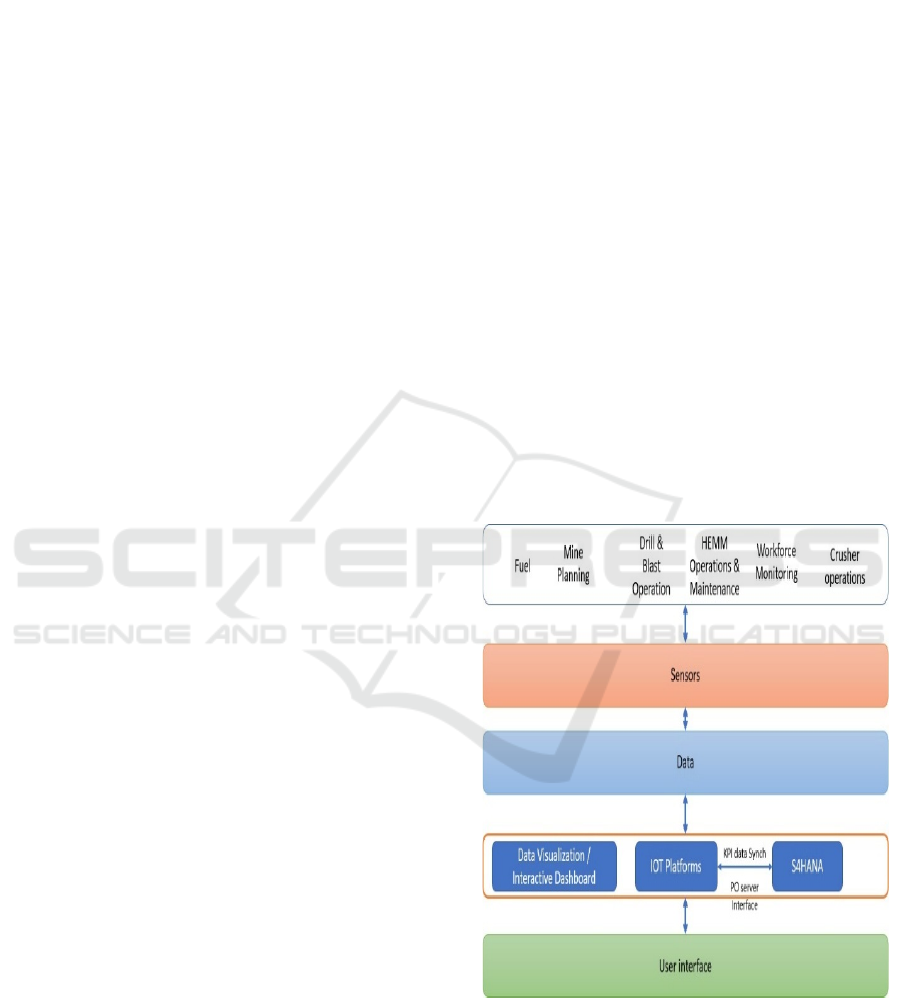
This Smart Mining-Digital Transformation prototype
solution aims to monitor activities in almost real-time
across the mines utilizing all HIEMM assets and
equipment, as well as their positions and locations.
Understand several equipment optimization and use.
Calculate the production output by tonnage, trips,
hour/shift, day/month, best equipment time, and trip
lengths. Track and control equipment fuel
consumption rates by tonnage-kilometer haul
distance and operating hours as well. To inform the
control room staff when equipment is moving without
permission across Geofence zones.
Figure 1: Solution Architecture diagram - key data flow.
As illustrated in Figure 2, the modular interaction
between human operators and machines is critical to
system performance. Figure 3 Shows the Digital
transformation Project Roadmap.
Revolutionizing Mining and Metals Industries: A Digital Transformation Framework for Efficiency and Sustainability
183
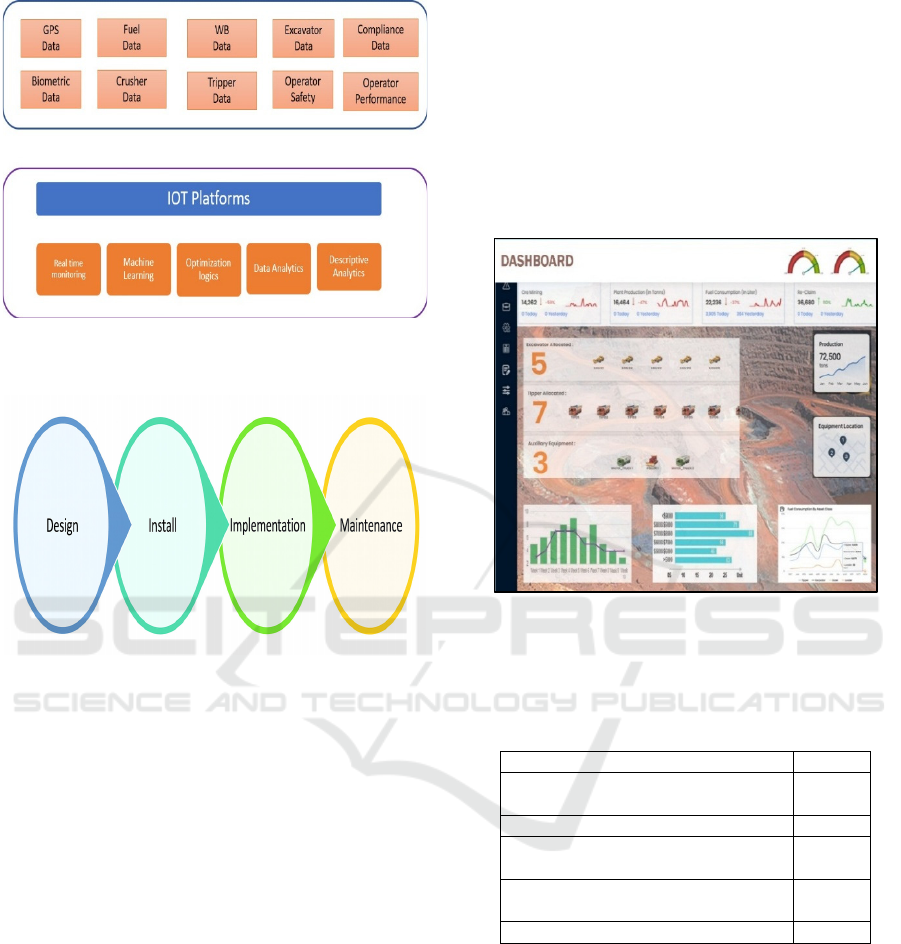
Figure 2: Modules in The Software Operation and Key Data
Flow from Man & Machine.
Figure 3: Digital transformation Project Roadmap.
Steps to follow
• Draft a project plan that outlines roles, duties,
procedures, and the dates and timelines for
project this architectural design prototype
completion.
• Putting the design into practice, including all
software module changes that the KPIs
implement for and developing a plan that the
client can approve.
• Provide and configure hardware and other
necessary IOT devices in compliance with the
BOQ and fleet and equipment scope.
• Configure the wireless network in accordance
with the project design. Extend the network
beyond mine control rooms. The
MPLS/LL/5G internet in the mine control
room must be provided by the customer.
• To install mining software and connect it to
other devices and the network, use dashboard
applications. Work with other components of
the current ecosystem such as SAP s4hana and
other IT systems like WB, RFID, etc. to
conduct user testing, integration testing, and
training. Obtain customer approval before
going live.
• Put in place service personnel and on-site help.
Provide support and maintenance by the SLAs
for mines user support for best operational
efficiencies.
Software Application Landing
Shown in Figure 4. Summary of Equipment
Utilization and Material Handling Metrics Shown
in Table 1.
Figure 4: Software Application Landing.
Shift-wise Engagement Numbers
Table 1: Summary of Equipment Utilization and Material
Handling Metrics.
Total Excavators 6 units
Total Tippers
30
units
Avera
g
e Load
p
er Ti
pp
e
r
60 MT
Total Shift Running Hours
7.5
hours
Total Material Handled at
Weighbridges
8,000
MT
Average Qualit
y
0.75
4.2 Software features
A breakdown of the software’s functionality is
provided in Figure 5, showcasing the core modules
and feature sets. The real-time integration of mining
equipment through robust data acquisition systems is
visualized in Figure 6, while the communication
framework supporting inter-device connectivity
across the mining site is mapped in Figure 7. These
elements collectively contribute to an efficient and
intelligent mining ecosystem.
ICRDICCT‘25 2025 - INTERNATIONAL CONFERENCE ON RESEARCH AND DEVELOPMENT IN INFORMATION,
COMMUNICATION, AND COMPUTING TECHNOLOGIES
184
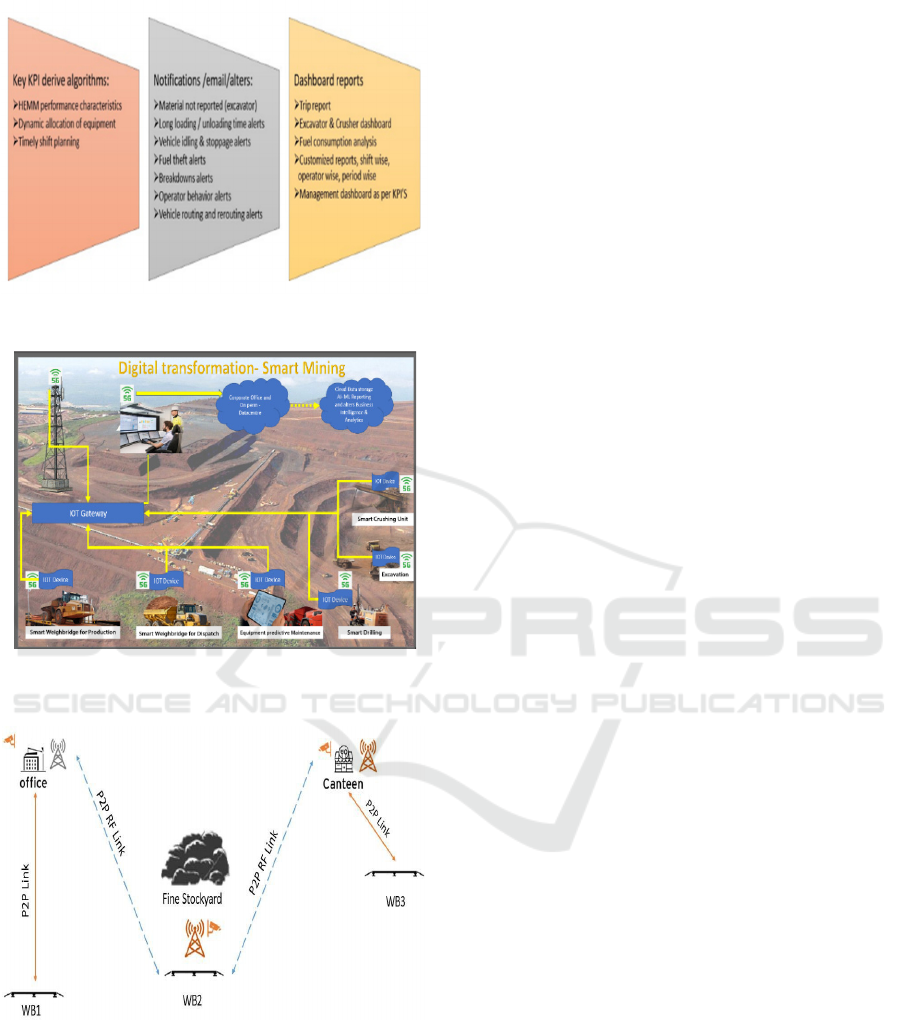
Figure 5: List of features in the software.
Figure 6: Mines Assets Network connectivity & Data
capturing.
Figure 7: Communication Networks at Mining Site.
4.2.1 Data Capturing
• Resource management and inventory tracking
to arrange all production needs. comprising
every task, such as blasting, loading,
dispatching, crushing, screening, excavating,
and hauling.
• The capacity to trace all materials through all
operational operations and all the way to the
mine head's ultimate material dispatch.
• Capturing data in real time:
• Drilling and blasting: Recording the
consumables used, the drilling machine's
performance, and the operator's
performance.
• Excavation: Materials are loaded
according to quantity, quality, and
position.
• Haulage: Transporting materials from one
location to another. monitoring delays and
improving results.
• Weighbridge: Manages the amount of
material moved from the source to the final
location.
• A user-friendly dashboard that is based on
different roles and responsibilities will be
made available.
• Mobile apps should make real-time data and
output simple.
• Notification of an alarm or warning to
management and the operator if they are
approaching any borders or prohibited areas.
• All actions and real-time data that are gathered
and updated on the dashboard should be
clearly shown.
4.2.2 Asset Management
• Examine and monitor the resources.
• Oversee planned maintenance, incidents, and
any outages.
• Checking and recording the machine hours
and odometers before and after.
• The total number of minutes lost to breaks
throughout each shift.
• Real-time tracking of equipment performance,
including allocation, utilization, and
availability.
4.2.3 KPI’s
• Tracking the difference between planned and
actual output.
• Predictive analysis and historical performance
data analysis.
Revolutionizing Mining and Metals Industries: A Digital Transformation Framework for Efficiency and Sustainability
185
• Performance of the Equipment.
• Estimates and Distribution Target vs. Actual.
• Idle time and operation.
• Option to relocate an asset from one activity to
another in any shift during a day.
• Durations of Maintenance.
• Downtime.
• The consumption of fuel
4.2.4 Stockpile Management
Output types to be defined along with all required
parameters and grade attributes.
Stockpiles are to be geo-fenced and linked exclusively
with a particular material type.
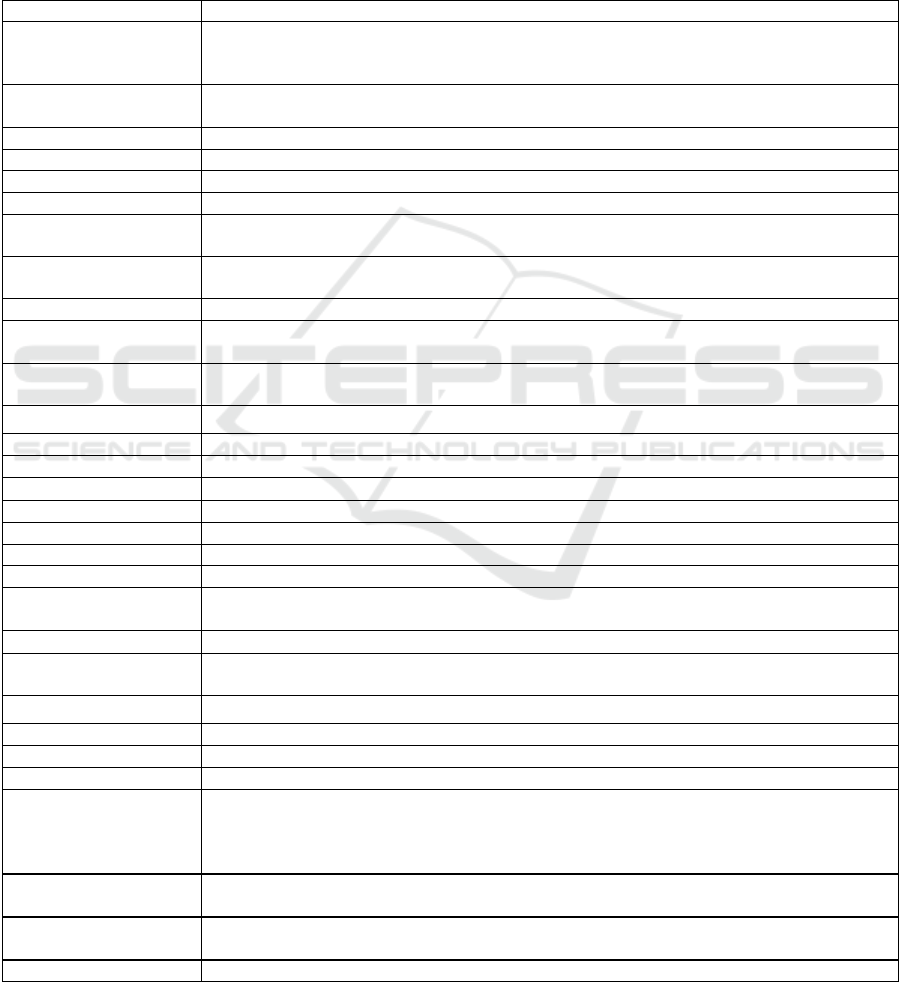
Table 2 Shows the
Sample List of Features Needed in Software.
Table 2: Sample List of Features Needed in Software.
Cate
g
or
y
Feature
General
Track vehicles in the mine dashboard to find the vehicle positions at any point of time. To find
and record each activity's start and end timings and the ideal timing for each equipment
Realtime. Ma
y
use the GPS/.
General
All the data points mentioned here have to be captured automatically, with
minimal/no manual intervention
General All e
q
ui
p
ment shoul
d
b
e visible in nea
r
real-time
Production No. of tri
p
s made durin
g
the shift/da
y
Production Start Date/Time of ever
y
trip made with loading time
Production En
d
Date/Time of ever
y
trip made with loading time
Excavator Utilization
Excavator utilization in terms of engine ON hours to be recorded with start &
en
d
time
Excavator Utilization
Even when excavator engine is ON, utilization has to be monitored using boom
movement/swin
g
Excavator Utilization An
y
b
reakdowns of excavato
r
have to
b
e recorde
d
an
d
re
p
orte
d
Excavator Utilization
All stoppages (engine OFF) should be provided with reasons such as lunch time, breakdown,
b
lasting, rain etc. Operator will give input on the display
p
rovide
d
in the machine
Excavator Utilization
Excavator operator should know how many trucks are in queue/waiting for
loading anytime
Truck Utilization Truck utilization in terms of engine ON hours to be recorded with start & end time
Truc
k
Utilization Truc
k
sto
pp
a
g
es shoul
d
b
e monitore
d
with en
g
ine OFF
Truck Utilization Truck stoppages should be monitored with engine ON or idling somewhere
Fuel Monitoring Fuel consumed by truck should be provided to carry ROM/OB
Fuel Monitoring Any fuel theft from the truc
k
fuel tan
k
has to
b
e recorde
d
Communication All trucks/excavators shoul
d
have voice communication
p
rovision
Communication Truc
k
drivers/excavato
r
o
p
erators can
b
e
g
uide
d
from control room
Wei
g
h Brid
g
e Wei
g
h
b
rid
g
e start/en
d
date/time with wei
g
h
b
rid
g
e numbe
r
Weigh Bridge
Each weighment should record with truck number, date/time, weight & weigh bridge
numbe
r
Weigh Bridge All trips weight data has to be in sync with weigh bridge weighment data
Crusher and screener
Utilization
Crusher working hours to be provided with start/end date/time, idle and breakdown time to be
recorde
d
Camera Surveillance Monitor trucks idling near excavator (no data, but monitoring video in control room)
Alerts Excavato
r
idle while engine is ON
Alerts Excavato
r
idle while engine is OFF, no loading
MIS/SAP All required data hol
d
b
e reflected in SAP directly & automatically /FTP sync
Drilling Equipment
Performance parameters like depth of drilling, location equipment, meterage drilled/hour, and
working hours of equipment. Equipment has to be mapped by. Drilling location/face – Subject
to the availability of data in PLC and OEM allows to connect with PLC along with data sharing
p
rotocol is
p
rovided b
y
OEM
Wheel Loader
All performance parameters like the excavator need to capture for wheel loader which will be
under loading activity. This includes the quality of materials.
Wheel Loader
Wheel loader deployed for supporting work needs to capture location, working hours, idle,
b
reak down, maintenance, etc.
Wate
r
tanke
r
Location trackin
g
,tri
p
s/hours, time s
p
ent fo
r
fillin
g
of water, tri
p
time, etc.
ICRDICCT‘25 2025 - INTERNATIONAL CONFERENCE ON RESEARCH AND DEVELOPMENT IN INFORMATION,
COMMUNICATION, AND COMPUTING TECHNOLOGIES
186

5 CHALLENGES
5.1 Challenges and Considerations in
IT Architectural Design
Despite the many advantages of digital
transformation, there are still implementation
difficulties:
• Legacy Systems: Integrating outdated
infrastructure with modern digital solutions
can be costly and challenging.
• Connectivity Problems: Many mining
operations are located in remote locations with
inadequate internet connectivity, making
connections challenging (Riley, B and
Thompson, M, 2023).
• Data Silos: The lack of standardized data
sharing protocols hinders a unified operational
envision (Schneider Electric, 2024).
• Cybersecurity Issues: Strong security
measures are required because operations are
more susceptible to cyberattacks as they
become more digitalized.
• Skills Gaps in the Workforce: Organizations
need skilled IT specialists to lead digital
projects successfully.
• ROI Justification: Demonstrating the
quantifiable benefits of digital transformation
is necessary to obtain funding.
6 RECOMMENDATIONS
6.1 Strategic Recommendations for a
Successful Digital Transformation
To achieve the most from digital transformation,
mining and metal firms need to:
• Establish a Clear Digital Strategy: Align
long-term corporate goals with technology
uptake.
• Invest in scalable IT infrastructure to create
flexible, interoperable systems that can change
to align with market trends.
• Enhance AI/ML Capabilities: Apply
advanced AI models to automate processes
and undertake predictive analytics.
• Increase the Use of Robotics and
Autonomous Systems: Automated processes
enhance productivity and security.
• Prioritize data-driven decision-making:
Leverage analytics to enhance sustainability
and maximize performance.
• Take Industry Collaboration as an
assumption: For innovation, partner with
technology vendors and universities.
• Prioritize cybersecurity: Implement strict
security protocols to protect critical
infrastructure and data.
7 SUMMARY AND
CONCLUSIONS
Literature emphasizes that market volatility,
sustainability-related issues, and ineffective
operations have increased the mining and metals
sector's reliance on digital transformation. Industry
4.0 technologies such as blockchain, IoT, and AI are
making operations more efficient, but problems with
employee adaptation, integration, and cybersecurity
risks remain.
To ensure a smooth digital transformation, a well-
organized IT architecture is necessary, with cloud-
based, edge computing, and hybrid models being key
components. Open, standardized, and scalable
frameworks are needed because they help mining
companies deal with the challenges of contemporary
industrial operations. Interoperability and real-time
data processing must be given top priority by
organizations going forward to boost competitiveness
and promote sustainable growth (Riley, B and
Thompson, M, 2023).
At this critical moment, digital transformation is
not an option but rather a requirement for the mining
and metal industries. Businesses will set the standard
for efficiency, sustainability World Economic Forum.
(2024), and competitive advantage by utilizing
cutting-edge IT architectures and new technologies.
Future developments in the sector will be greatly
influenced by sustained investment in digital
innovation and strategic alliances.
In an environment that is changing quickly,
mining and metals companies can boost
sustainability, operational resilience, and long-term
growth by implementing an organized approach to
digital transformation.
Revolutionizing Mining and Metals Industries: A Digital Transformation Framework for Efficiency and Sustainability
187

REFERENCES
Arias, L., & Gupta, S. (2023). The role of AI in mining
automation: Enhancing operational efficiencies.
Journal of Industrial Technology, 39(3), 112-128.
https://doi.org/XXXX
Brown, J., Smith, R., & Patel, K. (2024). Digital
transformation in mining: A systematic review. Mining
Technology Review, 45(2),7892.https://doi.org/XXXX
Carter, D., & Morrison, L. (2023). Cybersecurity
challenges in industrial IoT for mining operations.
International Journal of Cybersecurity, 11(4), 201-215.
https://doi.org/XXXX
Chakraborty, P., & Verma, R. (2023). Cloud computing
adoption in heavy industries: Challenges and solutions.
International Journal of Cloud Technology, 27(5), 89-
105. https://doi.org/XXXX
Ernst & Young. (2024). Global mining digital
transformation survey 2024. EY Mining Reports.
Retrieved from www.ey.com/miningdigitalreport
Gonzalez, H., & Pereira, A. (2024). Blockchain
applications in supply chain transparency for the metal
industry. Journal of Supply Chain Innovation, 18(2),
52-68. https://doi.org/XXXX
Johnson, M. (2023). IT architectural frameworks for mining
operations. Journal of Mining Technology, 32(4), 156-
170. https://doi.org/XXXX
Kumar, A., & Reynolds, T. (2023). The impact of edge
computing on real-time mining analytics. Journal of
Emerging Technologies, 21(6), 99-118.
https://doi.org/XXXX
McKinsey & Company. (2024). The future of mining:
Digital innovation. McKinsey Reports. Retrieved from
www.mckinsey.com/miningdigital
Mining Technology Institute. (2024). Digital
implementation guidelines for mining operations.
Retrievedfromwww.miningtechinstitute.org/digitalgui
delines
Patel, K., & Wang, J. (2023). Sustainability in mining:
Leveraging digital twins for efficiency. Green
TechnologyJournal,30(7),134148.https://doi.org/XXX
X
PwC. (2024). Mine 2024: The global state of mining
technology adoption. PwC Industry Reports. Retrieved
from www.pwc.com/mining2024
Riley, B., & Thompson, M. (2023). AI-driven predictive
maintenance in mining: A case study approach.
Engineering AI Review, 15(3), 67-82.
https://doi.org/XXXX
Schneider Electric. (2024). Smart mining: Digital
transformation strategies for industrial efficiency.
Industry White Paper. Retrieved from
www.se.com/smartmining
World Economic Forum. (2024). Harnessing Industry 4.0
for sustainable mining operations. WEF Reports.
Retrieved from www.weforum.org/miningindustry40
ICRDICCT‘25 2025 - INTERNATIONAL CONFERENCE ON RESEARCH AND DEVELOPMENT IN INFORMATION,
COMMUNICATION, AND COMPUTING TECHNOLOGIES
188
