SafeShe: IoT‑Enabled Women Security and Well‑Being
Joyce A., Mohanalakshmi S., Rohini P. and Mohana S.
Department of Computer Science and Engineering, PSNA College of Engineering and Technology, Kothandaram Nagar,
Dindigul, Tamil Nadu, India
Keywords: IoT‑Based Safety Device, Real‑Time Location Tracking, Emergency Alert System Live Camera Module,
Global Positioning System.
Abstract: Ensuring the safety of women in vulnerable situations is an imperative societal concern. Women are
particularly at risk when traveling alone on deserted roads, making their safety a critical issue that affects their
daily lives, limits their mobility, and restricts their opportunities. Threats such as street harassment,
cyberbullying, domestic violence, and workplace exploitation continue to endanger their security. This
proposed project introduces an IoT-based Women’s Safety Device, a portable and user-friendly system
designed to provide immediate assistance during emergencies. The device integrates GPS technology, a live
camera module, and a communication system to deliver real-time location tracking, visual evidence, and
automated alert notifications to emergency contacts and law enforcement authorities. Unlike existing systems,
our project features an enhanced video-capturing capability, ensuring comprehensive monitoring and
response.
1 INTRODUCTION
Women’s safety is a significant topic of discussion in
today’s society, as incidents of harassment, violence,
and unsafe situations continue to occur in different
parts of the world. Despite laws and security
measures, many women still face challenges in
ensuring their safety, especially in unfamiliar or high-
risk environments. Factors such as lack of immediate
assistance, difficulty in reporting incidents in real-
time, and delayed responses from authorities often
make these situations worse. Public spaces,
workplaces, and even homes can sometimes become
unsafe, highlighting the need for reliable safety
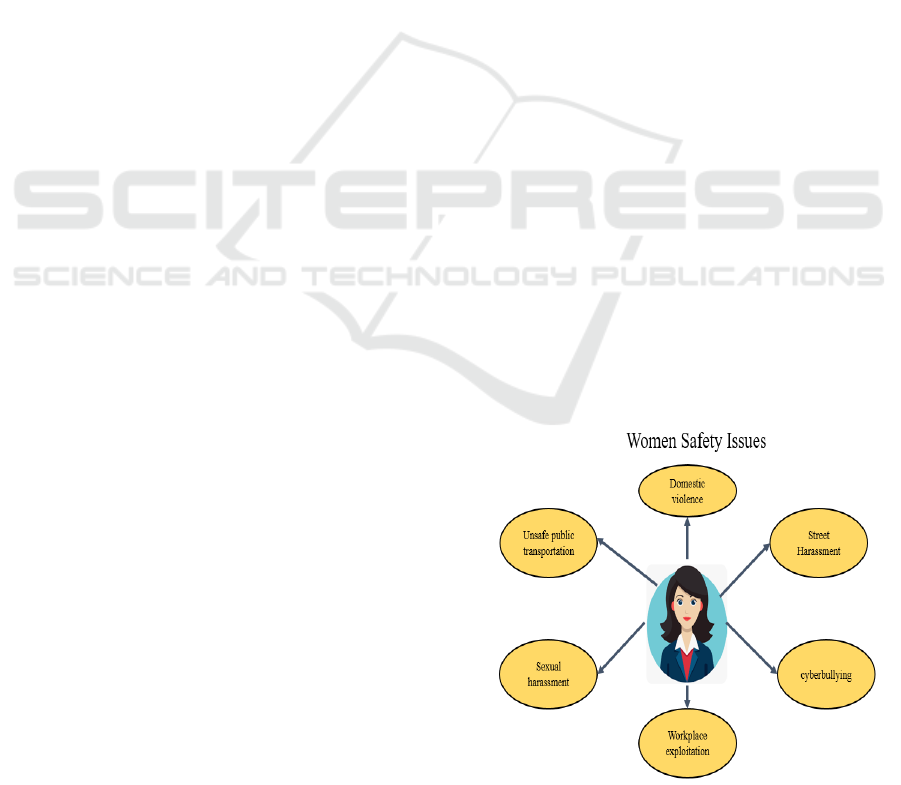
solutions. Figure 1 illustrates the Women Safety
issues.
More than 75% of women reported feeling
unsafe while commuting alone at night, especially in
poorly lit areas. One of the biggest problems pointed
out was law enforcement response time, with more
than 60% of the survey respondents unhappy with
emergency services. Poor knowledge of existing
safety technology was another concern expressed by
the surveyed women, as many are oblivious to the
presence of mobile apps or IoT-based solutions to
help in case they are in distress. The survey also
reiterated issues of accessibility as over 40% of
women stated that in a dangerous situation, they may
not always be able to lay their hands on a smartphone
or an active internet connection. The second
highlighted issue concerned privacy and data
security, with respondents fearing that their personal
data in tracking-based systems could be misused.
Social factors, such as stigma for reporting
harassment or fear of not being taken seriously, can
deter women from seeking assistance.
Figure 1: Women Safety Issues.
A., J., S., M., P., R. and S., M.
SafeShe: IoT-Enabled Women Security and Well-Being.
DOI: 10.5220/0013879300004919
Paper published under CC license (CC BY-NC-ND 4.0)
In Proceedings of the 1st International Conference on Research and Development in Information, Communication, and Computing Technologies (ICRDICCT‘25 2025) - Volume 2, pages
155-160
ISBN: 978-989-758-777-1
Proceedings Copyright © 2025 by SCITEPRESS – Science and Technology Publications, Lda.
155

The system is activated by pressing a button,
which immediately triggers multiple safety measures.
It sends an alert message along with real-time GPS
location updates to emergency contacts, police, and
law enforcement authorities. Simultaneously, a
buzzer emits a loud alarm sound to alert nearby
individuals and deter potential threats. Additionally,
the device captures live video footage and transmits it
to authorities, providing crucial evidence for a faster
and more effective response. With these integrated
features, the device aims to enhance security, ensure
timely intervention, and offer a dependable solution
for women’s safety.
2 LITERATURE REVIEW
Monika Ingole et al., (2024) Temperature sensor,
accelerometer, GPS, GSM, buzzer tracks movement,
sends alerts, and activates an emergency buzzer. This
system features as Real-time Tracking, Emergency
Alerts, Temperature Monitoring. (Pratiksha S. Patil et
al., 2024) Heartbeat sensor, bend sensor, Arduino,
GSM monitors heart rate fluctuations and sends
emergency calls/messages with location Real-time
Health & Movement Monitoring, Automatic
Emergency Alerts, Quick Medical Response &
Safety. Janani S et al., (2024) AI- Tensilica Controller,
accelerometer, iBeacon, cloud server detects shaking,
triggers alerts, and continuously tracks via cloud. This
advanced integration improves-Powered Smart
Response Continuous Tracking & Cloud Storage.
Pallavi Devendra Deshpande et al., (2024) Arduino,
GPS, GSM, vibration alert continuously tracks
location, sends alerts, and warns nearby people with
sound/vibration. The system provides, Instant
Alerts& Communication. Immediate Warnings for
Safety. (Hrucha Wankhade et al., 2022) GPS, GSM,
WiFi ESP8266, shock mechanism sends location,
stores pulse rate in the cloud, and can shock an
attacker. This advanced integration improves as
Instant Emergency Alerts,Self-defense Mechanism
,Real-time Tracking & Cloud Storage.( N. Penchalaiah
et al., 2024)Alarm system, voice recognition
automatically issues an alarm and uses voice
commands for emergency assistance. Include this
advance for, Hands-free Emergency Activation,
Enhanced Safety & Accessibility.
C K Gomathy, Ms.S.Geetha Arduino, panic switch,
laser diode, buzzer sends manual alerts, shocks
attackers, and activates a buzzer with a laser diode.
This system features as Instant Emergency Alerts,
Self-defense Mechanism, Multi-layered Warning
System. (Garima Tiwari et al., 2020) Fingerprint
scanner, GPS, GSM, buzzer requires authentication,
sends location if not scanned every minute, and alerts
surroundings. This advanced system ensures,
Enhanced Security with Authentication, Automatic
Emergency Alerts & Tracking, Immediate
Surrounding Alerts, Enhanced Safety & Anti-
kidnapping Protection, Remote Safety Monitoring.
Riddhi Shah, Miloni Ganatra., (2018) Heartbeat
sensor, GSM, GPS continuously tracks heart rate and
sends location via GSM if abnormal readings are
detected. Include the advance for Location Tracking
for Quick Response, Automatic Emergency Alerts,
Prevention of Medical Emergencies, Ideal for High-
risk Individuals. ( D. G. Monisha et al., 2016) Android
app, ARM controller, Bluetooth, RF detector syncs
with a smartphone, tracks location, records audio, and
detects hidden cameras. This system feature as
Smartphone Integration & Control, Multi-functional
Security System, Real-time Alerts & Detection
(Ashutosh Agrahari et al., 2024) IoT, Artificial
Intelligence (AI), and biosensors in a wearable device
to provide real-time health monitoring and personal
security for consumers. This system features as
Enhanced Personal Security, AI-powered Smart
Analysis, Real-time Health Monitoring.
(Uzma Omer et al., 2023) IoT, sensors, GPS, GSM,
AI, and cloud computing for enhancing women's
safety by enabling real-time monitoring, emergency
alerts, and secure data storage for quick response and
prevention. This system features as Secure Data
Storage & Evidence Collection, Instant Emergency
Alerts & Location Tracking, Real-time Monitoring &
Threat Detection (V. Ramesh babu et al., 2021) GPS,
GSM, sensors, and alert systems for enhancing
women's safety by enabling, emergency
communication, and automated threat detection. This
system featurse as Quick Emergency
Communication, Automated Threat Detection,
Proactive Safety Measures.
T. Sowmya et al., (2020) GPS, sensors,
microcontrollers, and cloud computing for women's
safety. The system enables real-time tracking,
emergency alerts, and data storage for quick response
and prevention of threats. This advanced integration
improves as Secure Data Storage & Analysis, Instant
Emergency Alerts, Fast & Reliable Response System
(T.P. Suma G. Rekha., 2021) IoT, sound sensors for
screaming detection, video capturing, automatic
distress alerts, video evidence collection, and
emergency response activation to enhance personal
security. This system features as Automated Threat
Detection & Response, Evidence Collection for Legal
Support, Live Monitoring & Remote Access,
ICRDICCT‘25 2025 - INTERNATIONAL CONFERENCE ON RESEARCH AND DEVELOPMENT IN INFORMATION,
COMMUNICATION, AND COMPUTING TECHNOLOGIES
156
Automated Emergency Response Real-time Video
Evidence Collection, Instant Emergency Activation.
3 METHODOLOGY
3.1 Block Diagram
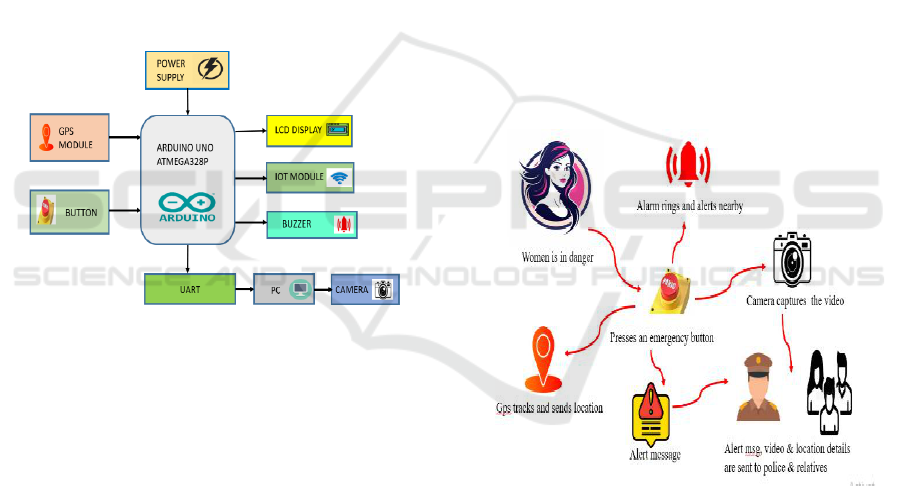
• Arduino UNO(ATmega328P): acts as the
main controller, interfacing with sensors, the
IoT module, and other components as shown
in figure 2.
• GPS Module (Neo-6M): captures the real
time location coordinates and sends it.
• IoT module (NodeMCU ESP8266):
provides Wi-Fi connectivity to transmit
updates to the IoT Cloud app.
• Buzzer: sounds to alert nearby individuals
about the distress situation.
Figure 2: Block Diagram.
• LCD Display: displays system status.
• Camera: captures the video during the
emergency and sends them.
• Button: Pressing the emergency button
activates the entire safety protocol.
• Power Supply Unit: Provides the necessary
voltage and current to operate.
• UART Cable: Universal Asynchronous
Receiver-Transmitter facilitates serial
communication between the Arduino and
other devices like the PC.
• PC: Personal Computer acts as an interface
for data processing, storage, or cloud
integration to enhance system capabilities.
• Arduino Ide 1.8.19: Arduino IDE 1.8.19 is
a stable, user-friendly environment for
writing, compiling, and uploading
Embedded C code to Arduino boards like the
Uno (ATmega328P).
• Python IDLE 3.12: Python IDLE 3.12
enables writing and executing Python code
to capture and transmit live video during
emergencies, sending footage to law
enforcement or emergency contacts.
• IoT Cloud app: IoT Cloud app enables real-
time monitoring, sending alerts, and
displaying the GPS location and emergency
status on the user’s phone.
3.2 Implementation
When the user presses the emergency button, multiple
actions are triggered simultaneously. The buzzer is
activated, producing a loud alarm sound to alert
people nearby and deter potential threats.
Simultaneously, the system obtains the real-time GPS
location and transmits it to emergency contacts, law
enforcement authorities, and an IoT cloud platform
for tracking. An alert message is sent with location
details to ensure a quick response. Additionally, the
camera module captures live video footage and sends
it to the authorities as evidence. Figure 3 illustrates
the methodology diagram.
Figure 3: Methodology.
The system effectively performs the following
functions upon pressing the emergency buttons.
• Buzzer Activation – The buzzer emits a
loud alarm sound, which alerts nearby
individuals, helping to draw attention and
deter potential threats.
• GPS Location Transmission – The system
accurately captures the user's real-time
location and sent it via an alert message to
emergency contacts and law enforcement
authorities. The GPS coordinates were
precise and will update in real-time.
SafeShe: IoT-Enabled Women Security and Well-Being
157

• Alert Message Delivery – The emergency
alert message containing location details will
be sent to predefined contacts and
authorities, ensuring immediate response.
• Video Transmission – The camera module
successfully records and transmits real-time
video footage to the police, providing crucial
evidence for quicker action.
The demonstration of this system proved that
combining real-time safety mechanisms with the IoT
can provide improved biological health response
time." Traditional mobile-based safety applications
generally required time-consuming steps to unlock a
phone and reach use the app, while this use case
benefits from one point activation of a dedicated
safety device, making it far more practical in critical
moments. In summary, the IoT-based Women’s
Safety Device is a cost-effective, scalable and user-
friendly solution for improving the safety of women
in society. This system could become a key safety
instrument for practical applications with further
refinements.
3.3 Random Forest Algorithm for
Women Safety
Random Forest is an ensemble learning algorithm that
combines multiple decision trees to improve
prediction accuracy.
3.4 Formula for Decision Trees in
Random Forest
Each decision tree makes a prediction, and the final
output is determined by majority voting (for
classification) or averaging (for regression).
For classification:
where:
• k is the class label (safe/unsafe),
• n is the number of trees in the forest,
• yi is the predicted class from the i th tree.
For a decision tree node split, we use the Gini Index:
where:
• pi is the probability of class i,
• c is the number of classes.
3.5 How It Works in Women's Safety
IoT Devices
Random Forest can be used in the IoT-based
Women’s Safety Device to enhance threat detection
and decision-making. It can analyze real-time data
from the device and predict whether the situation is
safe or unsafe based on historical patterns and input
features.
Step 1. Data Collection & Features Used
The model can use multiple features to detect
potential threats, such as:
• GPS Data – Analyzing whether the location
is in a high-risk area based on past crime
data.
• Time of Day – Identifying whether the user
is in a potentially unsafe situation (e.g., late-
night travel).
Step 2. Decision-Making Using Random Forest
• Each decision tree in the Random Forest
model analyzes different factors (GPS, time,
movement, voice).
• The model predicts whether the situation is
SAFE or UNSAFE using majority voting.
• If the majority of decision trees classify the
situation as "unsafe," the alert system is
automatically activated.
Step 3. Gini Index for Node Splitting
The Gini Index formula is used to determine the best
feature for splitting the decision tree:
where:
• P
i
is the probability of class ii (safe or unsafe).
• c is the number of classes.
A lower Gini Index means a better split, helping the
model identify unsafe situations more accurately.
Step 4. Predicting Safety Status
For classification, the final prediction is based on
majority voting
where:
• k is the class label (safe/unsafe).
ICRDICCT‘25 2025 - INTERNATIONAL CONFERENCE ON RESEARCH AND DEVELOPMENT IN INFORMATION,
COMMUNICATION, AND COMPUTING TECHNOLOGIES
158

• n is the number of trees in the forest.
• y
i
is the predicted class from the i-th tree.
If a majority of trees are predicted unsafe, a buzzer is
activated, GPS and video data are transmitted to
authorities, and an alert message is sound.
Incorporating Random Forest into the IoT-based
Women Safety Device, this model enables intelligent
predictions of potentially harmful situations and the
ability to automatically send alerts, significantly
improving personal safety in the present moment. By
doing so we can respond proactively rather than
reactively when the need arises, as opposed to
waiting for an emergency to intervene manually.
4 ADVANTAGES
• Immediate Response: The system activates
instantly, sending alerts and location data for
faster emergency assistance.
• Real Time Tracking: GPS coordinates are
transmitted live, allowing responders to
locate the user without delays.
• Local Awareness: The buzzer and LCD
notify nearby individuals, encouraging
immediate help during emergencies.
• Visual Evidence: Captured images provide
responders with valuable context, aiding
faster and more informed decision-making.
• Remote Monitoring: IoT integration
enables real-time data access through cloud
platforms or mobile applications.
• User-Friendly Design: The system requires
minimal input-a simple button press triggers
the entire safety sequence.
5 CONCLUSIONS
Today’s world has become a place of concern for
women due to several factors like rising harassment
and violence. Even when laws and security measures
are in place, on-the-spot intervention is often delayed
because it can be hard to report an emergency and find
someone in distress. To overcome these problems the
project presents an IoT based Women’s Safety
Device which is a portable and simple operating
system that offers users immediate assistance in
situations of distress.
Multiple safety features build upon one another to
provide a quick and comprehensive response when
this device is activated. The device button will act as
the pattern activation button which will allow the
user to initialize the system with a single press. When
activated, a buzzer produces a loud alarm sound to
attract attention from the public, in hopes that the
sound will deter the attacker you are facing. At the
same time, the device also records the user’s GPS
location and shares it with emergency contacts, law
enforcement bodies, and an IoT cloud platform for
tracking purpose. Moreover, a live video stream is
also logged and transmitted for the authorities,
forming important evidence and assisting rescue
teams as well as playing a crucial role in potential
legal cases.
Overall, the IoT enabled Women Safety Device is
one of the most useful portable and practical safety
device giving women the ability to summon
emergency assistance immediately. This device not
only improves personal security and accelerates law
enforcement response but does so by integrating IoT
technology, real-time location tracking, live video
processing, and an alarm system.
6 FUTURE SCOPE
The future scope of a women's safety IoT project can
be expanded with several advanced technologies to
improve efficiency, accuracy, and user experience.
Here are some key future enhancements:
• Fingerprint Recognition: Prevents
unauthorized access to the safety device/app.
• Hands-Free SOS Activation: Voice recognition
enables users to send distress signals without
pressing a button.
• AI-Based Route Optimization: Suggests the
safest route based on real-time crime data.
• Blockchain for Secure Data Handling:
Blockchain can be used for security purposes.
REFERENCES
Ashutosh Agrahari, Ruchi Agarwal, Pawan Singh ,
Abhishek Singh Kilak, Deepak Gupta Ankit Vidyarthi.
“Marvelous Hand: An IoT-Enabled Artificial
Intelligence Based Human-Centric Biosensor Design
for Consumer Personal Security Application” in Ieee
Transactions On Consumer Electronics, Vol. 70, No. 1,
February 2024
D. G. Monisha, M. Monisha, G. Pavithra and R.
Subhashini. “Safety Device and Application-FEMME”
in Indian Journal of Science and Technology, Vol
9(10),DOI:10.17485/ijst/2016/v9i10/88898, March
2016.
Dr. Pallavi Devendra Deshpande, Dr. Archana Ratnparakhi,
Dr. Gauri Ghule, Dr. Shraddha Habbu. “Women Safety
SafeShe: IoT-Enabled Women Security and Well-Being
159

Device With Gps Tracking And Alerts Using Arduino”
in YMER || ISSN : 0044-0477, volume 23 : issue 04
(april) – 2024.
Dr.C K Gomathy, Ms.S.Geetha.” Women Safety Device
Using Iot” in International Journal of Scientific
Research in Engineering and Management (IJSREM)
Volume: 05 Issue: 10 | Oct – 2021.
Garima Tiwari, Adarsh Tiwari, Amit Kumar, Himanshu
Verma,Kalyan Krishna Awasthi.” ‘Kavach' - Women
Safety Device with Gps Tracking And Sms Alert” in
2020 JETIR July 2020, Volume 7, Issue 7.
Hrucha Wankhade, Siddhi Mahajan, Prof. Shobhika P
Gopnarayan. “Womens Safety Device with GPS
Tracking and Alert” in International Journal for
Research in Applied Science & Engineering
Technology (IJRASET) ISSN: 2321-9653; IC Value:
45.98; SJ Impact Factor: 7.538 Volume 10 Issue VIII
August 2022- Available at www.ijraset.com.
Janani S, Mrs. L. Jibanpriya Devi, Mrs. M.R. Mahalakshmi,
Mr. V. Parthiban.” Smart wearable device for women
safety using ibeacon technology” in International
Research Journal of Modernization in Engineering
Technology and Science, Volume:06/Issue:03/March-
2024.
Monika Ingole, Pranay Chide , Ajit Ukey , Araju Chamlate
, Aarti Ukey. “Smart Wearable Device for Women” in
International Journal of Innovations in Engineering and
Science, www.ijies.net, Vol. 9, No. 3, May 2024 PP.
20-24.
Muhammad Shoaib Farooq S. A. M. Gilani,Ayesha
Masooma, Uzma Omer, Andzabihullah Atal, Rabia
Tehseen. “The Role of IoT in Woman’s Safety: A
Systematic Literature Review” in Creative Commons
Attribution-NonCommercial-NoDerivatives 4.0
License 2023.
N. Penchalaiah, M. Susmitha, C. Vinay Kumar Reddy, D.
V. Pavan Kalyan Rao, D. Sreelekha.” An IoT Based
Smart Wearable Device for Women Safety” in Special
Issue of First International Conference on Information
Technology, Computing & Applications (ICITCA
2021), Volume 03 Issue 05S May 2021.
Pratiksha S. Patil , Swati B. Tamkhade , Sakib S. Mulani ,
Prof. P. B. Yadav , Prof. S. R. Gore.” A Review Paper
on Women Safety Device with GPS Tracking and
Alerting” in International Journal of Research
Publication and Reviews, Vol 5, no 1, pp 5782-5788
January 2024.
Riddhi Shah, Miloni Ganatra. ” Women Safety Device With
GPS Tracking And Alerts” in International Journal of
Creative Research Thoughts (IJCRT), Volume 6, Issue
2 April 2018.
T. Sowmya, D. Triveni, D. Keerthana, A. Vasantha
Lakshmi, K. Padma Priya, G. Kavya. “Women’s Safety
System Using Iot” in International Research Journal of
Engineering and Technology (IRJET) Volume: 07
Issue: 03 | Mar 2020.
T.P. Suma G. Rekha “Study on Iot Based Women Safety
Devices With Screaming Detection And Video
Capturing” in International Journal of Engineering
Applied Sciences and Teclogy, 2021 Vol. 6, Issue 7,
ISSN No. 2455-2143, Pages 257-262
V. Ramesh babu, M, Senthilmurugan.B, Shyam.A,
Venkatesan. M. Y, M. Anand.“Empowering Women’s
Safety Using IoT” in Journal of Propulsion Technology
ISSN: 1001-4055 Vol. 44 No. 6 (2023).
ICRDICCT‘25 2025 - INTERNATIONAL CONFERENCE ON RESEARCH AND DEVELOPMENT IN INFORMATION,
COMMUNICATION, AND COMPUTING TECHNOLOGIES
160
