
Automatic Gas Leakage Detection and Fire Protection for Industrial
Safety
Padma E., Vignesh Kumar R., Arjun T. and Loguprasath P.
Department of Computer Science & Engineering, Nandha Engineering College, Erode, Tamil Nadu, India
Keywords: Gas Leakage Detection, Fire Detection, Arduino Uno, MQ‑2 Gas Sensor, Flame, Sensor, Buzzer Alert, DC
Fan, Servo Motor, Water Pump, SIM800 Module, Real‑Time Monitoring.
Abstract: Gas leaks and burning accidents are hazards that pose a serious threat to safety and can cause tremendous
damage and loss of life this project is an Iot-based gas leakage and fire detection system based on Arduino
uno an mq-2 gas sensor flame sensor buzzer dc fan servo motor water pump and sim800 module empowered
by providing real-time monitoring and automatic safety interventions once a leak is detected it sends out a
buzzer warning that turns on the dc fan to ventilate the gas hazard and the servo motor moves to open the
ventilation to improve airflow simultaneously an sms warning alert is sent to the users using the sim800
module for real-time alertness following the incident of a fire the system turns on the water pump for
extinguishing the fire and sends an sms notification by delivering an automated and timely response the
system reduces human intervention to a minimum and thereby various possible explosive and fire hazards
while at the same time the project proposes an economical efficient and effective safety shield for residential
industrial and commercial functions reliant on IoT and automation.
1 INTRODUCTION
Fire accidents and gas handling represent serious
threats to human life and property. Many mainstream
monitoring methods today rely on manual
interventions that may slow down and be ineffective
in emergencies. Therefore, the work on this project is
aimed at developing an IoT-based gas leaf and fire
detection system with Arduino UNO, Alleys, Fire
Brigade Sensor, Summer, DC Fan, Servomotor, Water
Pump, and SIM800 modules. The system performs
actual monitoring of gas concentration and fire
hazards, triggers alarms, and performs safety
measures accordingly. When a gas leak is recognized,
the buzzer sounds, the DC fan is turned on and
ventilation is opened by the servo motor.
Additionally, SMS notifications are sent to the user
via the SIM800 module. Therefore, notifications are
guaranteed in real-time. The water pump is turned on
by the fire. The combination of IoT and automation
will help the project improve the safety of residential,
industrial, and commercial spaces, minimize risks,
and promote timely responses without human
intervention.
2 LITERATURE STUDY
The literature overview reflects key improvements in
IoT-based gas monitoring systems, emission
recognition, and sensor networks, focusing on cost
reduction, real-time monitoring, and remote.
Communications. Malik et al. (2020) and Kumar et
al. (2019) an examples of research findings showing
the combination of IoT and sensor technologies for
inexpensive and scalable gas recognition solutions,
particularly for smart city environments. Alan M John
et al. (2017) and Swapnil Kadam et al. (2024)
highlight the importance of reliable communication
in ensuring immediate response to gas leaks.
Furthermore, Sharma et al. (2018) and Khan et al.
(2017) highlight the importance of reliable sensor
networks and IoT platforms to ensure accuracy and
reliability. However, there are areas where current
technologies remain, such as energy efficiency,
integration of artificial intelligence, and detection of
multi-GA, which offers a range of future innovations.
Overall, these studies shape the improvements in safe
and efficient housing and industrial and urban gas
monitoring systems.
Literature research is modifying the development
of gas monitoring and leak recognition systems with
150
E., P., R., V. K., T., A. and P., L.
Automatic Gas Leakage Detection and Fire Protection for Industrial Safety.
DOI: 10.5220/0013879200004919
Paper published under CC license (CC BY-NC-ND 4.0)
In Proceedings of the 1st International Conference on Research and Development in Information, Communication, and Computing Technologies (ICRDICCT‘25 2025) - Volume 2, pages
150-154
ISBN: 978-989-758-777-1
Proceedings Copyright © 2025 by SCITEPRESS – Science and Technology Publications, Lda.

a special focus on IoT and GSM-based solutions.
Jagtap et al. (2016) propose a GSM-based LPG gas
weight and leak detection system. This focuses on the
integration of gravity measurement and long-distance
arms for safety improvements. Similarly, Shrivastava
et al. (2013) introduce a GSM-based gas claver
recognition system, highlighting the use of GSM
technology for real-time notifications, avoiding
dangerous accidents. Gupa et al. (2016) Contribute to
the area using an IoT-based intelligent gas monitoring
and alarm system. This demonstrates the power of
IoT for real-time data recording and analysis.
Furthermore, Khan et al. (2018) investigate gas leak
detection with the help of IoT devices. This focuses
on how IoT improves identification efficiency and
response time. Together, these studies highlight the
need for IoT and GSM integration for effective gas
monitoring, leakage recording, and remote
notification. Energy efficiency, multi-GA
recognition, and sophisticated AI integration are areas
of future research and innovation despite such
research.
3 PROPOSED SYSTEM
The IoT-based gas leaf and fire detection system aims
to be an automated real-time security concept for
implementing gas leak detection and fire service
associations. The system includes a combination of
Arduino UNO and alleyway interface (MQ-2), flame
sensor, summer, DC fan, servo motor, water pump,
and SIM800 module. The alarm system (Summer)
opens the ventilation outlet via a servo motor to turn
on the fan and hand over gas when the alley sensor
detects the gas mirror to a minimum. Send an SMS
alarm to the user via the SIM800. This means that
users will be noticed immediately. If flame
recognition occurs through the flame sensor, the
water pump will start. Industrial and commercial
institutions.
4 METHODOLOGY
The methodology of the Arduino UNO-based gas
clever recognition system includes a combination of
various components to facilitate monitoring,
detection, and automated actions in real time. The
system starts from an alleyway, identifying leaks and
sending signals to the Arduino Uno -microcontroller.
In the event of a gas leak, the Arduino triggers a
buzzer to notify the user, indicating that the GSM
module (SIM800) sends an SMS alarm to a pre-
programmed contact. At the same time, the DC fan is
turned on, and the surface and diluent gas
concentration. When the fire sensor captures the
flame, the Arduino operates the servo engine to close
the gas valve to stop another leak and switch the
water pump to extinguish the fire. The system is
programmed to automatically operate to respond
quickly to gas leaks and fire threats. Arduino always
pursues sensors and adjusts the actuator. This
provides a powerful and stable solution for the
detection of gas leaks and emergency responses. This
approach uses IoT functions for remote notifications
and combines several security measures to maximize
user security and reduce risk.
Figure 1 shows the IoT-
Based Fire and Gas Detection System Block
Diagram.
Figure 1: IoT-Based Fire and Gas Detection System Block
Diagram.
4.1 Advantages
Observe early warnings and prevention - the system
constantly monitors gas and reacts after recognition,
preventing the possibility of an accident. The engine
and water pump are activated at the same time with
less manual intervention. Effect.Reduced Possibility
of Explosion and Fire Damage - The system
minimizes the risk of explosion and fire damage by
activating gas leakage gas activated by water pumps
during fire. Remote Monitoring via IoT - IoT-enabled
systems allow users to send notifications even if they
are not available at this location. This ensures the
security of residential, industrial, and commercial
buildings. Compared to traditional fire and gas safety
systems. Mode; Maintenance is very low, providing
uninterrupted security 24 hours a day.
Automatic Gas Leakage Detection and Fire Protection for Industrial Safety
151
5 SYSTEM IMPLEMENTATIONS
5.1 Hardware Requirements
5.1.1 Gas Sensor
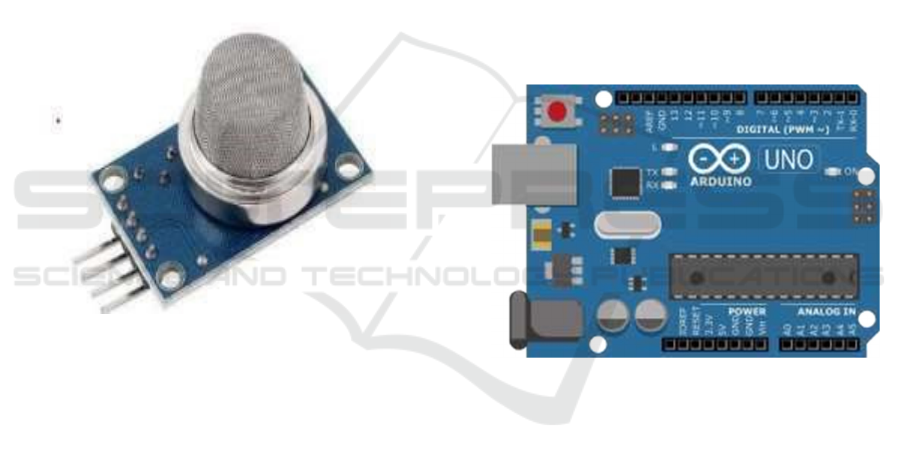
Generally, the valley presents four pens on an
Arduino board. On this board, two send performance-
aware data, one sends it to the Arduino UNO. This is
a very reasonable and effective semiconductor alley
module with analog and digital outputs. This module
uses MQ2 smoke and flammable alleys to recognize
gas. No external components are required. The VCC
and floor needles simply need to be connected and
ready to go straight away. Thresholds are defined in a
simple configuration via potentiometers. The MQ2's
smoke and flammable alleyways can easily connect
to any microcontroller, including the Arduino.
Figure
2 shows the Gas Sensor.
Figure 2: Gas Sensor.
5.1.2 Servo Motor
Servo motors are small and accurate rotary drive
elements for controlling the angular position, speed,
and acceleration of mechanical elements. It consists
of a DC or AC motor, a position search device, and a
steering circuit. These are mostly used when precise
movement control is required, such as in robotics,
automation, and aviation systems. A unique feature of
servo motors is that they can be converted to a
specific angle determined by the input signal.
Controls the position of the actuator via pulse width
modulation or PWM signals that specify the angle the
engine needs to rotate. In gas and leak recognition
systems, the servo engine controls the opening and
closing of the valve that unlocks the gas line when a
leak occurs. Their reliability, efficiency, and
smallness make them perfect for this application.
5.1.3 Processing Board
This is a microcontroller that typically has a user
development environment that compiles and provides
programs for the microcontroller. Arduino boards are
used in detail by enthusiasts, students, and experts to
develop interactive projects and prototypes in a
variety of fields, including robotics, home
automation, wearables, IoT applications, and more.
The beautiful thing about the Arduino platform is
based on a user-friendly IDE or integrated
development environment developed to allow for a
simplified version of the C++ programming
language. Users who minimize programming
backgrounds can write and upload programs through
this IDE. Arduino boards are available in a variety of
shapes and sizes with a variety of skills to meet the
requirements of your project. Many digital and analog
input start needles can be used to connect various
electronic devices such as sensors, actuators, and
more.
Figure 3 shows the Arduino Uno R3 SMD.
Figure 3: Arduino Uno R3 SMD.
5.1.4 Buzzer
Figure 4: Arduino Buzzer.
The buzzer provides an audible alert when an object
is detected, enhancing the system's user interface. It
helps to alert the user of potential obstacles or
hazards. Figure 4 shows the Arduino Buzzer.
5.1.5 Flame
Flame sensors are the heart of the system used to
recognize fire by capturing and capturing the
presence of flames. Flame sensors recognize
distinctive aspects of flame light, infrared radiation,
or ultraviolet rays, depending on the type of flame
ICRDICCT‘25 2025 - INTERNATIONAL CONFERENCE ON RESEARCH AND DEVELOPMENT IN INFORMATION,
COMMUNICATION, AND COMPUTING TECHNOLOGIES
152
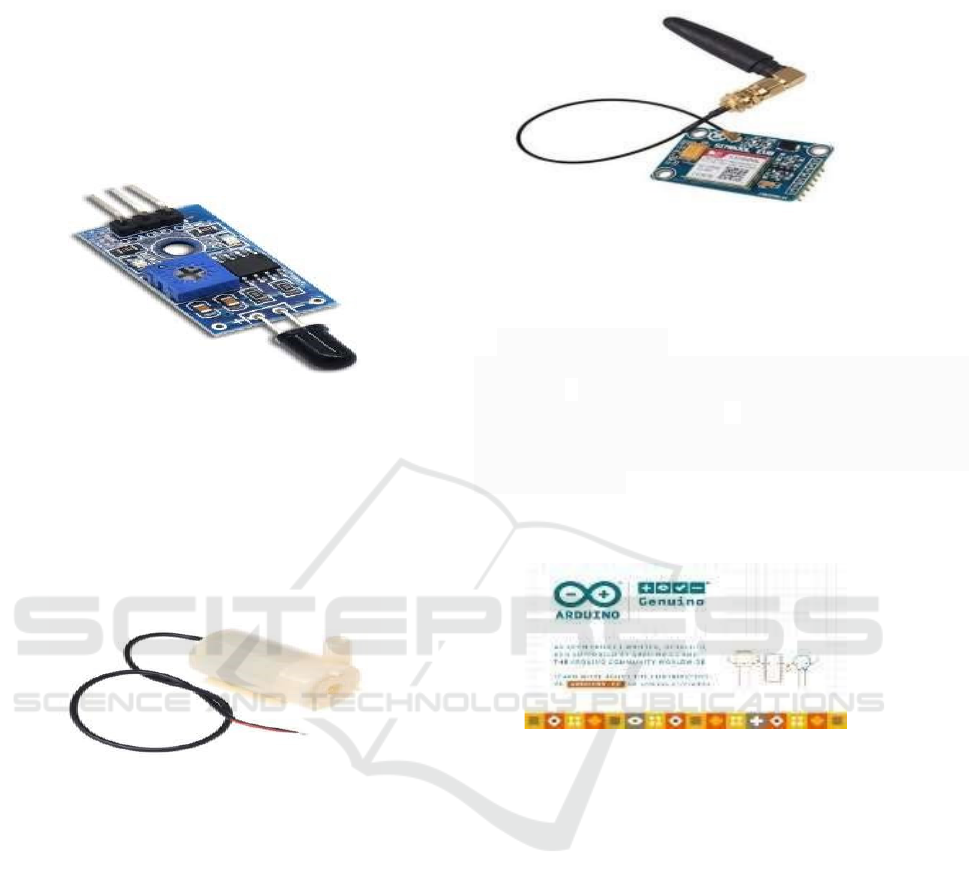
sensor. A fiery detector. Figure 5 shows the Arduino
Flame.
Records specific frequencies of UV (Ultra Violet)
and/or IR (Irtra-Red) to recognize burning fire. The
radiation produced by the flame is classified into
unique regions of the frequency/wavelength die
detector and only works in these regions to reduce
false alarms.
Figure 5: Arduino Flame.
5.1.6 Water Pump
A DC motor pump is a pump that uses direct current
(DC) to move fluids. DC motor pumps can be
powered by a battery, solar power, or a DC motor.
Figure 6 shows the Arduino Water Pump.
Figure 6: Arduino Water Pump.
5.1.7 SIM800L V2
The SIMCOM SIM800L V2.0 GSM/GPRS Module
is an Arduino-compatible quad-band GSM/GPRS
module. It facilitates the integration of the advantage
of these modules is that they operate at VCC and TTL
series levels using a 5-V voltage. Therefore, you can
directly interface it with an Arduino or any other basic
system at a 5V voltage. Many GPRS/GSM modules
are available on the market, necessitating the use of a
5-V regulator and level converter circuit. However,
the SIM800L V.2 GSM/GPRS module features a
built-in control circuit and a TTL level converter.
Below is a sample project based on SIM800L V.2 that
demonstrates how to control relays using SMS
controllers. It allows you to easily toggle and turn off
various devices at home, such as lamps, fans, and
more.
Figure 7 shows the SIM800L V2.
Figure 7: SIM800l V2.
5.2 Software Requirements
5.2.1 Arduino Ide
The Arduino Integrated Development Environment
(IDE) is a software application used for writing,
compiling, and uploading code to Arduino
microcontroller boards. It provides an intuitive and
user-friendly platform for programming Arduino
projects, even for those with minimal coding
experience. Figure 8 shows the Arduino IDE
Software Interface.
Figure 8: Arduino IDE Software Interface.
6 FUTURE SCOPE
There may be other sensors that need to be integrated
into the system and may be connected to temperature
and pressure sensors. Therefore, IoT gas recognition
systems can be integrated into Smart Home
Automation Systems over the next few years. This
integration ensures that cutoffs and emergency
protocols are triggered in the event of a gas leak,
improving security to reduce human intervention.
7 RESULT AND ANALYSIS
Gas leakage and fire prevention systems provide
operational security and protection of personnel,
property, and the environment in industrial
applications dealing with gas use or manufacturing.
Automatic Gas Leakage Detection and Fire Protection for Industrial Safety
153

The system integrates gas recognition sensors in leak
detection and alarm systems to alert you of various
means of fire control, such as sprinklers and gas
agents. Effective implementation requires early
detection and therefore should provide a quick
response to gas leaks and fires, minimizing the risk of
injury, damage, and production downtime. Figure 9
shows the Kit Structure.
Figure 9: Kit Structure.
8 CONCLUSIONS
IoT-enabled gas detection and fire extinguishing
technology based on Arduino UNO addresses
security issues related to environments susceptible to
gas escape and fire disasters. The system includes a
variety of sensors, DC fans, engine provisions, water
pumps, and GSM communicators providing summer,
real-time monitoring, automatic action, and remote
access. Alleyways raise alarms when certain gas
leaks occur, but fire detection guarantees immediate
effectiveness when stopping the fire. Energy savings
are completed with the automatic shutdown feature,
and the device will be turned off as soon as the threat
is finished. In addition, the SIM800 GSM is enabled
without going out on the site. General security with
complete solutions for gas leaks and fires. This
continues to live with this system.
REFERENCES
"Gas identificatie van LPG/CNG-system with GSM
Modül" kapı Alan M John, Bhavesh Purbia, Ankit
Sharma, mevrouw A.S Udapurkar in International
Journal of Advanced Research in Computers and
Telecommunications, Cilt. 6, no. 5, May 2017.
"GSM BASED GAS LEAKAGE DETECTION SYSTEM"
by Ashish Shrivastava, Ratnesh Prabhaker, Rajeev
Kumar, and Rahul Verma in International Journal of
Technical Research and Applications, Volume 1, Issue
2 (May-June 2013).
"GSM signal-based LPG leak detection and prevention
system" gateway Swapnil Kadam, Volume 10, Issue 3,
May-June-2024 http://ijsrcseit.com B. Deepika et al Int.
J. Sci. Res. Comput. Sci. Eng. Inf. Technol., May-June-
2024, 10 (3): 102-108 108 Sumit Bhinshi, Prathamesh
Borkar, Ritesh Gailwad, Prof. Prachi Gadhire,
International Research Journal of Engineering and
Technology (IRJET), Volume: 05 Issue: 03, March
2018.
"Security Alarm System Using GSM in Gas Lighting",
S.Rajitha, T. Swapna, VLSI in International Research
Journal and Embedded Systems-IJVES, Volume 03,
Issue 04; September- October 2012.
A. Kumar, A.P. Shukla, S. Kumari, and R. Singh,
"Emission Detection System for Smart Cities",
International Conference on Communications and
Signal Processing (ICCSP) 2019, 2019.
LPG Gas Weight and Leakage Detection System Using
GSM" by Mr.Sameer Jagtap, Prajkta Bhosale, Priyanka
Zanzane, Jyoti Ghogare in International Journal for
Research in Applied Science & Engineering
Technology (IJRASET), Volume 4 Issue III, March
2016.
M. S. Khan, M.I.Y. Essa, M.H. Alhussein and M.E. Al-
Kuhaili, "Development of Sensing and Reporting
Systems for IoT Applications", 2017 IEEE
International Conference on Electrical/Informatics
(EIT), 2017.
P. Sharma, S. Gupta, A. Kumar, and S. K. Bhandari,
"Sensor Networks for Gas Detection and Monitoring,"
9th International Conference on Computers,
Communications and Technology (ICCCNT) 2018,
2018.
R. Gupta, A. Srivastava, and R. Gupta, "An IoT- Based
Smart Gas Monitoring and Alerting System," 2016
IEEE International Conference on Computational
Intelligence and Computing Research (ICCIC), 2016
S.S. Malik, V.K. Shukla, A. Mishra, and S. Tiwari, "Design
of low-cost IoT-based gas monitoring system," 3rd
International Conference on Sustainable Intelligent
Systems (ICISS), 2020.
T.H. F. Khan, D. D. Behera, R. Sidha, A.Manouwar, "Gas
Leakage Detection Using IOT Tools", Department of
CSE, SRMIST, Chennai- India, B.Tech - CSE,
SRMIST, Chennai-India,2018
ICRDICCT‘25 2025 - INTERNATIONAL CONFERENCE ON RESEARCH AND DEVELOPMENT IN INFORMATION,
COMMUNICATION, AND COMPUTING TECHNOLOGIES
154
