
Whiteboard Text Recognition and Note Saving System
Hari Chandana B.
1
, Avula Adithya Babu
2
, Boya Udayasree
2
, Tamidepati Venkata Vindya Sai
2
,
Kottam Jagadesh
2
and Ke Eswar Goud
2
1
Department of ECE, Mohan Babu University erstwhile Sree Vidyanikethan Engineering College, Tirupati, Andra Pradesh,
India
2
Department of ECE, Sree Vidyanikethan Engineering College, Tirupati, Andra Pradesh, India
Keywords: OpenCV, Tesseract OCR (Optical Character Recognition).
Abstract: The use of modern technologies makes Whiteboard Text Recognition and Note Saving System to effectively
take handwritten notepad of whiteboard text to identify and save. It works by taking a picture of a white board
using a phone or camera, and uploading it for processing. The detected image is then improved using edge
detection, contrast, and noise removal algorithms through OpenCV— to better isolate portions of readable
text. With the contour detection and bounding box techniques, we are able to distinguish which RAW data
inside an image contains handwritten textual data that is then detected and segmented using OpenCV
algorithms. The extracted image segments are then passed into a TensorFlow based (OCR) model that
accurately predicts the handwritten characters. Postprocessing with formatting adjustments used to make the
recognized text more readable and accurate. The processed text is then saved in an ordered fashion into the
database, making it easily accessible for taking notes and retrieval. The user-friendly dashboard allows for
viewing, editing, and sharing of the digital notes, facilitating collaboration and sharing in both educational
and professional settings. The app converts handwriting from a whiteboard into a digital format that aid
knowledge sharing and collaboration. OpenCV is used for image preprocessing and TensorFlow for
recognizing words to achieve it.
1 INTRODUCTION
It is an experience data has evolved; the way we
collect, organize and share information” has changed
with the rapid development of digital tech.
Conventional whiteboards have not gone out of style
in the manual writing of notes in education and
collaborative spaces. Yet, it has downsides: risk of
losing important notes, inefficiency in sharing info
and organizations, etc. To overcome these challenges,
we present a novel system of whiteboard text
recognition and note-saving, using optical character
recognition (OCR) technology, to effectively convert
handwritten notes to a digital format.
With cross-industry demands for efficient
information management in professional and
academic settings, the process of quickly digitizing
and storing whiteboard notes can recognize
significant productivity trade-offs. As hybrid models
of working, learning and collaborating become the
new normal for education and workplaces across the
world, this technology brings instant access to stored
content, while enabling instant sharing and archiving
of key information. Our solution uses computer
vision to crop the text from a live lecture video with
an incredibly low false positive rate. We achieve this
with high recognition accuracy and adaptability to
different handwriting styles using modern OCR
techniques. The note creation and uploading system
has an intuitive user interface that can be easily
utilized by a wide variety of users.
This study is about the design, implementation,
performance and real-life use of the system.
Depending on the need, this means we can have a
more analysis-oriented experience on the success of
our system, e.g. we can say that our means to this end,
a more systematic and organized approach towards
note taking, is the achieved fit.
2 LITERATURE SURVEY
This paper, titled "Handwritten Text Recognition
using Deep Learning with TensorFlow" written by Sri
100
B., H. C., Babu, A. A., Udayasree, B., Sai, T. V. V., Jagadesh, K. and Goud, K. E.
Whiteboard Text Recognition and Note Saving System.
DOI: 10.5220/0013877800004919
Paper published under CC license (CC BY-NC-ND 4.0)
In Proceedings of the 1st International Conference on Research and Development in Information, Communication, and Computing Technologies (ICRDICCT‘25 2025) - Volume 2, pages
100-104
ISBN: 978-989-758-777-1
Proceedings Copyright © 2025 by SCITEPRESS – Science and Technology Publications, Lda.
Yugandhar Manchala and students of Aditya Institute
of Technology and Management, describes the
implementation of the TensorFlow package for neural
networks (CNN and RNN) in combination with CTC
layers in order to create a reliable handwritten OCR
system. This model trained on the IAM Handwriting
Database exceeds 90.3% accuracy while efficiently
accommodating the diversity of handwritten input
and working best on low-noise images. We use a
CNN-RNN architecture for the feature extraction and
sequence learning modules, supplemented by image
preprocessing, data loading, model management and
system integration Python modules. As an additional
help in the outputted text produced by the text on the
system, at the centre lies the python spell-checker
that processes the recognised text. It is scalable to
increased performance when larger datasets are
introduced, and can be adapted to full-line text
recognition.
Nikitha A, Geetha J Dr, and JayaLakshmi D.S Dr
describe a handwritten text recognition (HTR) system
using deep learning techniques based on their work
"Handwritten Text Recognition using Deep
Learning" in their paper from Ramaiah Institute of
Technology. It employs 2D-CNN and Long Short-
Term Memory (LSTM) networks (concretely 2D-
LSTM) to boost the accuracy of recognition at the
word level. Trained on the IAM Handwriting Dataset,
the model achieves 8.2% Character Error Rate (CER)
and 27.5% Word Error Rate (WER) with a accuracy
of 94% HTR combines OCR to convert handwritten
text to digital text and the design leverages pre-
processing techniques including noise reduction,
segmentation, and binarization so that the text has
optimal image quality. This configuration enhances
document durability, storage efficiency, and text
accessibility useful properties in the context of
archiving and retrieval. Its flexible architecture
allows for future scaling up and cross-language
capabilities, making it a wonderful candidate for
automated text digitisation
3 PROPOSED METHOD
3.1 System Overview
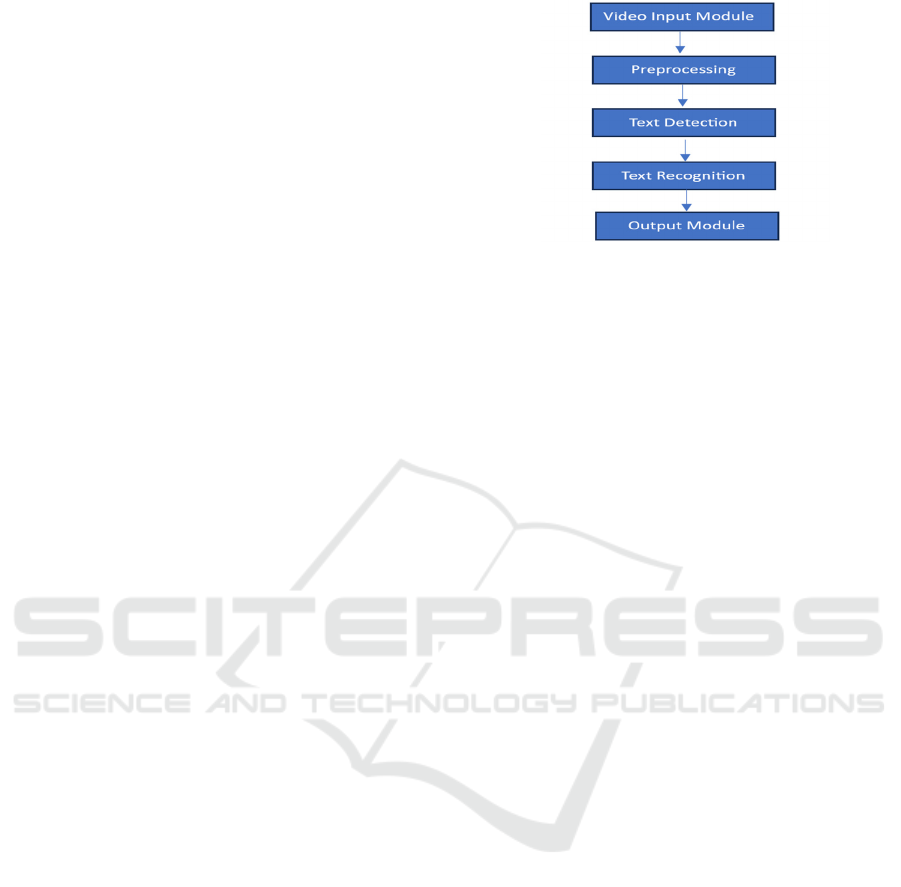
Figure 1 illustrates the architecture. Video Input
Module: The video input module receives frames
from a live camera stream or an input video file. It
acts as a gateway which feeds raw video data for
processing. The frames are extracted in a sequence so
that the flow is uniform for analysis. By providing a
Figure 1: System Architecture.
continuous flow of visual data to the system, this
module paves the way for the next few stages.
Preprocessing: The sharpness of shown Video
Frames, again enhances detection and recognition
accuracy. To make computations faster, frames are
converted to grey scale which discards unnecessary
information (color). Gaussian or median noise
reduction filters will clean the frames of distortion.
Text regions are enhanced using contrast
enhancement which further increases the accuracy of
the characters.
Text Detection: The process of finding areas in
every frame that contain text, which helps us find
regions of interest. The text sections are fragmentized
via edge-detection, bounding box, and neural net
techniques. This act of focusing on certain locations
leaves behind unnecessary data in the background.
This improvement expedites and enhances the
subsequent phase of text recognition.
Text Recognition: Text recognition utilizes
Optical Character Recognition (OCR) to recognize
the localized text areas determined in the previous
step. The system goes through each region and turns
any recognised characters into machine readable text.
This stage transforms the pixel data into a defined
text structure, human-readable and eligible for further
processing to the next stages.
Output element: Once the text has been detected,
the output module displays or saves it for practical
consumption. It also generates editable text files such
as for real-time applications. txt or. csv files
respectively, or provide a real-time view. This step
enables the completion of pipelines and allows to
perform data analysis, documentation, workflow
integration, etc.
3.2 Video Input Module
The video input module reads frames from a live
video feed, which is the primary source of data for the
text recognition system. This module provides a
Whiteboard Text Recognition and Note Saving System
101
continuous stream from a connected camera (if
available) or from a video file if it is provided through
the boot pack. The module keeps track of parameters
such as frame rate, resolution and video format to
achieve optimal frame quality and mitigate
processing delays. By normalizing these inputs, the
Video Input Module helps standardize each frame for
the subsequent stages of the pipeline, making
processing uniform and efficient in real-time
applications.
3.3 Preprocessing
The pre-processing level processes each video frame
to enhance the precision of text detection and
recognition.
Grayscale Conversion: The process of grayscale
conversion simplifies each video frame to a single
channel that contains intensity values and removes all
colour components. To do this, the algorithm
enhances and removes noise from the output image,
making it easy to process the image for text detection
and also less expensive computationally. All
grayscale retains is the hue and saturation of text
relative to the background the stuff necessary for
mattering text. Without colour there is a reduced
possibility of you making a mistake or your eye
straying to something else in the same frame. It
simplifies the process in a way that provides better
detection accuracy by driving the system to pay
attention to the structural elements of a text.
Denoising: Denoising is one of the basic
preprocessing step which users do to remove
unwanted components or visual noise from a video
frame. Image smoothing is achieved by methods like
Gaussian and median filters which reduce high-
frequency noise and does not hide important image
details such as edges. Gaussian filters use a weighted
average of the surrounding pixel values across a
region, producing a smoothening effect that
eliminates any pixel noise without distorting text.
Median filters on the other hand are designed to
remove outlier types of noise such as speckle noise
and salt-and-pepper noise by taking a median value
of each pixel with its neighbours. As a result, the
performance of text recognition algorithms is
improved in the denoising process, leaving the text
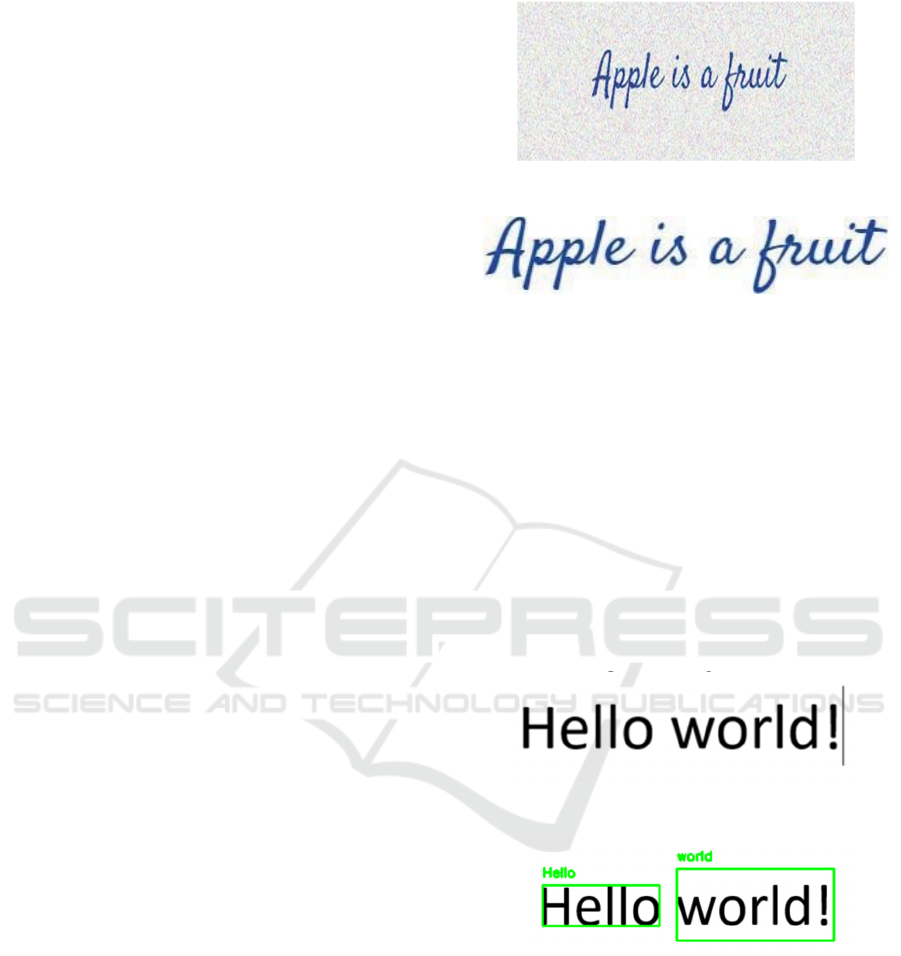
sharp and clear. Figure 2 and 3 gives the information
of noise in the image and noise eliminated image.
Figure 2: Noise in the Image.
Figure 3: Noise Being Eliminated from the Input Image.
3.4 Text Detection
After pre-processing, the image is passed to:
Tesseract OCR to read the text, at which point the
content analysis begins. Now, for each individual
character in the image we will use Tesseract’s
image_to_boxes method. It calculates bounding
boxes around each character to identify areas that
contain text using each identified character's
coordinates (x, y, width, and height). These bounding
boxes in figure 4 make it easier to verify and debug
the detection process by visually showing which
regions of the image are likely to contain the text.
Figure 4 is the input text image.
Figure 4: Input Image Having Text.
Figure 5: Text Detection from Input Image.
3.5 Text Recognition
Text recognition is the stage of recovering the text
from an image after the text detection phase. At this
step, Optical Character Recognition (OCR) methods
like Tesseract OCR are applied to identify and
transform the detected text regions to machine-
readable text. Once the text has been recognized and
boxed, the next step is to find out what characters,
words or phrases are inside those boxes. These
ICRDICCT‘25 2025 - INTERNATIONAL CONFERENCE ON RESEARCH AND DEVELOPMENT IN INFORMATION,
COMMUNICATION, AND COMPUTING TECHNOLOGIES
102
algorithms analyse the pixel patterns of the image.
Once the text is detected and recognized, the spell-
checking algorithms help it figure out if there are any
errors or if any words have been misidentified. This
is a crucial step for guaranteeing the accuracy of the
extracted text. There are multiple techniques to
achieve this such as dictionary-based techniques,
context-aware models, machine learning-based
techniques, etc. The document is converted into a
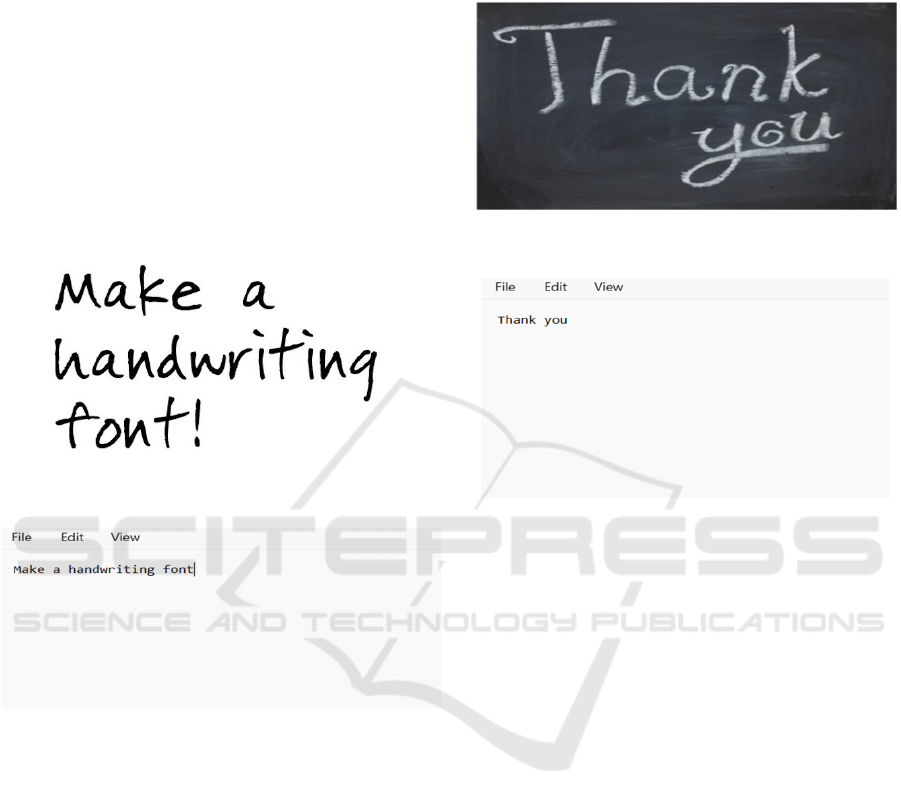
structured text-based as shown in figure 7 editable
format. This text can then be processed or leveraged
in applications such as document digitization, data
extraction, and organization. Figure 6 is the hand-
written image.
Figure 6: Input Handwritten Text.
Figure 7: Output Recognized Text.
3.6 Output Module
In a text recognition system, a text file as shown in
figure 9 is generated after the output module
transforms raw text returned from OCR to some
structured text format which is editable, organized,
and ready for post-processing. It transforms the text
into a standardized format by correcting errors,
formatting it for maximum clarity, and saving it in
widely supported formats like. txt or. csv. The
structure of the output allows it to be interacted with
easily by data analysis, indexing, and automated
workflow technologies so the text may be searched
and retrieved simply. Incorporating metadata and
allowing for spell corrections make for better quality
and more useful text for applications like document
digitization, research, data mining, and legal record-
keeping. As a last note, this phase makes sure the
detected text is dynamic not static. Figure 8 is the
input of text image for recognition.
Figure 8: Input Image for Text Recognition.
Figure 9: Output Recognized Text Saved in Notepad.
4 RESULTS AND DISCUSSION
So, the final goal of this project is to get text from
live lectures recording using OpenCV and Tesseract
OCR. Starting with the OpenCV recording of
individual frames from the live video stream, it
follows a sequence of preprocessing steps to enhance
visibility of the text and to maximize the accuracy of
text recognition. These processes include grayscale
conversion that reduces image complexity by
removing color information and noise reduction
methods such as Gaussian blur that remove any visual
distortion and pollution from the background. After
preprocessing, the frame is passed to the text
recognition stage, where recognition and extraction of
the text in the image happens using Tesseract OCR.
The recognized text is subsequently machine-
learning-auto-corrected to fix any recognition issues
such as misinterpreted/similar to real character or
word. All these techniques together allow the system
to extract the clean, correct text from a live lecture
video no matter what handwriting style, size, or
orientation it is.
Whiteboard Text Recognition and Note Saving System
103

5 CONCLUSIONS
Finally, this paper introduces a very efficient method
for text identification and recognition, which uses
newly developed image processing algorithms and
OCR tools like Tesseract. The process starts with
input image pre-processing to enhance the quality.
Text detection is then performed to determine the
areas that contain text, and finally, text recognition
extracts the text using optical character recognition
methods. The presented approach precisely identifies
and extracts text from different picture sources which
can be purposeful in document digitalization, data
extraction, and automated content analysis.
REFERENCES
A. Graves, S. Fernandez, F. Gomez, and J. Schmidhuber,
“Connection- ist temporal classification: Labelling
unsegmented sequence data with recurrent neural
networks,” in ICML, 2006.
A. Graves and J. Schmidhuber, “Offline handwriting
recognition with multidimensional recurrent neural
networks,” in NIPS, 2009.
A. Graves, M. Liwicki, S. Fernndez, R. Bertolami, H.
Bunke, and J. Schmidhuber, “A novel connectionist
system for unconstrained hand- writing recognition,”
PAMI, vol. 31, no. 5, pp. 855–868, 2009.
D. Keysers, T. Deselaers, H. A. Rowley, L. Wang, and V.
Carbune, “Multi-language online handwriting
recognition,” PAMI, vol. 39, no. 6, pp. 1180–1194,
2017.
D. Castro, B. L. D. Bezerra, and M. Valena, “Boosting the
deep multidi- mensional long-short-term memory
network for handwritten recognition systems,” in
ICFHR, 2018.
Gideon Maillette de Buy Wenniger;Lambert
Schomaker;Andy Way,”No Padding Please: Efficient
Neural Handwriting Recognition”, in ICDAR 2019.
Herleen Kour;Naveen Kumar Gondhi,”Machine Learning
approaches for Nastaliq style Urdu handwritten
recognition: A survey” in ICACCS, 2020.
J. Puigcerver, “Are multidimensional recurrent layers really
necessary for handwritten text recognition?” in ICDAR,
2017.
J. Walker, Y. Fujii, and A. C. Popat, “A web-based ocr
service for documents,” in DAS, Apr 2018, pp. 21–22.
M. Kozielski, P. Doetsch, and H. Ney, “Improvements in
rwth’s system for off-line handwriting recognition,” in
ICDAR, 2013.
Nikitha A, Geetha J, and JayaLakshmi D.S, "Handwritten
Text Recognition using Deep Learning," in 2020 5th
International Conference on Recent Trends on
Electronics, Information, Communication &
Technology (RTEICT-2020), Bangalore, India, Nov.
2020, pp. 388–392, doi:
10.1109/RTEICT49044.2020.9315679
P. Doetsch, M. Kozielski, and H. Ney, “Fast and robust
training of re- current neural networks for offline
handwriting recognition,” in ICFHR, 2014.
P. Voigtlaender, P. Doetsch, S. Wiesler, R. Schlter, and H.
Ney, “Sequence-discriminative training of recurrent
neural networks,” in ICASSP, 2015
P. Voigtlaender, P. Doetsch, and H. Ney, “Handwriting
recognition with large multidimensional long short-
term memory recurrent neural networks,” in ICFHR,
2016.
Rohan Vaidya;Darshan Trivedi;Sagar Satra;Prof.
Mrunalini Pimpale, ”Handwritten Character
Recognition Using Deep-Learning”, in ICICCT, 2018.
S. Ghosh and A. Joshi, “Text entry in indian languages on
mobile: User perspectives,” in India HCI, 2014.
S. Y. Manchala, J. Kinthali, K. Kotha, K. S. Kumar, and J.
Jayalaxmi, "Handwritten Text Recognition using Deep
Learning with TensorFlow," International Journal of
Engineering Research & Technology (IJERT), vol. 9,
no. 5, pp. 594–600, May 2020.
Shahbaz Hassan, Ayesha Irfan, Ali Mirza, Imran Siddiqi,
”Cursive Handwritten Text Recognition using Bi-
Directional LSTMs: A case study on Urdu
Handwriting”, in Deep-ML, 2019.
T. Bluche and R. Messina, “Gated convolutional recurrent
neural net- works for multilingual handwriting
recognition,” in ICDAR, vol. 01, 2017.
V. Pham, T. Bluche, C. Kermorvant, and J. Louradour,
“Dropout improves recurrent neural networks for
handwriting recognition,” in ICFHR, 2014.
V. Carbune, P. Gonnet, T. Deselaers, H. A. Rowley, A.
Daryin, M. Calvo, L.-L. Wang, D. Keysers, S. Feuz,
and P. Gervais, “Fast multi-language lstm-based online
handwriting recognition,” ArXiV, 2019.
ICRDICCT‘25 2025 - INTERNATIONAL CONFERENCE ON RESEARCH AND DEVELOPMENT IN INFORMATION,
COMMUNICATION, AND COMPUTING TECHNOLOGIES
104
