
Leveraging Spatiotemporal Pattern for Cyberattack Detection in
Distribution Systems
Paradesi Subba Rao, Vemu Raghavendrasharma, Vadde Harikrishna, Degulapadu Mondla Varun Tej,
Pasupuleti Sangeeth Kumar and Pula Sandeep Kumar
Department of Computer Science and Engineering, Santhiram Engineering College,
Nandyal‑518501, Andhra Pradesh, India
Keywords: Machine Learning, Spatiotemporal Analysis, Convolutional Neural Networks (CNNs), Long Short‑Term
Memory (LSTM), Cybersecurity, Power Distribution Networks, Cyberattack Detection, Random Forests.
Abstract: The growing digitalization of power systems where networks are used for the distribution of electricity has
also made them susceptible to emerging sophisticated cyber threats, which necessitates the need for advanced
detection systems. Traditional security approaches have often failed to capture the complex spatiotemporal
dynamics of cyberattacks, leading to delayed or false negative identification of a threat. Here we propose a
machine learning based cyber security system which leverages LSTM networks and CNNs to extract spatial
features and detect temporal behaviour patterns, and uses Random Forest for making decisions. The proposed
approach is able to enhance detection accuracy and reduce the false positive rates by using spatiotemporal
data as compared to traditional techniques.
1 INTRODUCTION
The growing complexity and interdependence of
modern distribution networks have rendered them
susceptible to cyberattacks. Traditional techniques
for cyberattack detection often involve rule-based or
static analysis systems which may not suffice against
advanced, adaptable attackers. Yet it allows a more
flexible and effective way to detect cyberattacks
using spatiotemporal pattern in data. But
spatiotemporal patterns can help uncover structure
and behaviour patterns in data that may indicate
normal or abnormal activity describing spatial and
temporal dependencies. Patterns or abnormalities
indicating cyberattacks can be detected by looking at
the patterns. Machine learning algorithms do fairly
well at spatiotemporal patterns, especially Random
Forests, Convolutional Neural Networks (CNN) and
Long Short-Term Memory (LSTM) networks.
1.1 Networks Using Long Short-Term
Memory (LSTM)
Sequence prediction tasks. They can learn long-term
dependencies and temporal patterns better than other
models. For example, LSTM networks could be used
to detect such anomalies that do not fit expected
patterns in times of cyberattacks through modelling
the network usage over time.
1.2 Convolutional Neural Networks
(CNN)
CNNs are primarily employed in the processing and
analysis of image and other spatial data but can also
be applied to time-series data treating it as a
sequence of spatial patterns. This enables CNNs to
discover local correlations within data which may be
useful in detecting spatial anomalies in network
traffic. Combining spatial and temporal patterns
enables better cyberattack detection through the
application of CNNs and LSTM networks together.
1.3 Random Forest
The Random Forests are an ensemble learning
method that combine multiple decision trees to
improve its classification performance. They perform
very well on high-dimensional data, and they may
deliver insights into feature importance. Random
Rao, P. S., Raghavendrasharma, V., Harikrishna, V., Tej, D. M. V., Kumar, P. S. and Kumar, P. S.
Leveraging Spatiotemporal Pattern for Cyberattack Detection in Distribution Systems.
DOI: 10.5220/0013877500004919
Paper published under CC license (CC BY-NC-ND 4.0)
In Proceedings of the 1st International Conference on Research and Development in Information, Communication, and Computing Technologies (ICRDICCT‘25 2025) - Volume 2, pages
89-93
ISBN: 978-989-758-777-1
Proceedings Copyright © 2025 by SCITEPRESS – Science and Technology Publications, Lda.
89

Forests can be used in the detection of cyberattacks,
where a large number of features of network traffic
are checked to identify patterns associated with an
attack.
1.4 Objectives
The main goal of this research is to create an end-to-
end framework for detecting cyberattacks in
distribution systems using spatiotemporal patterns.
This comprises:
• Compiling and preprocessing distribution system
network traffic data.
• Finding spatiotemporal patterns in the data using
Random Forests, CNNs, and LSTM networks.
• Evaluating how well these algorithms detect
cyberattacks in comparison.
• Evaluating the new strategy's effectiveness by
contrasting it with traditional techniques.
This study will aim to provide a better and more
dependable method for identifying cyberattacks on
distribution systems by utilizing the advantages of
LSTM networks, CNNs, and Random Forest.
This will strengthen the security and dependability of
these infrastructures overall.
2 LITERATURE REVIEW
2.1 Distribution Systems Are Classified
by Machine Learning
As smart grids become more interconnected, there is
a rise in cyberattacks on electricity distribution
networks. Conventional rule-based security systems
have trouble identifying complex, dynamic assaults.
By examining both temporal trends and spatial
correlations in power system data, spatiotemporal
machine learning models offer a viable method to
improve cyberattack detection.
2.2 How Cyberattack Can Be Detected
in Systems for Distribution
System for distributing power cyberattacks can be
effectively detected by applying machine learning
techniques that examine patterns of network traffic,
voltage fluctuations, and system activity. The
integration of Long Short-Term Memory (LSTM)
networks and Convolutional Neural Networks
(CNNs), and Random Forest (RF) strengthens the
identification of attacks by understanding temporal
and spatial dependencies in system data.
• Data Collection & Preprocessing Sources:
SCADA logs, smart meter readings, network
activity, and system event logs.
• Preprocessing: Data normalization, feature
extraction, as well as noise reduction for
clean inputs during model training.
• Cyberattack Detection Methodology:
CNN for the Extraction of Spatial Features,
CNNs work well for spatial correlation
identification in system states the
convolutional layers learn normal vs.
abnormal system behaviour patterns and are
therefore effective at identifying localized
cyber intrusions.
• LSTM for Recognizing Temporal
Patterns: LSTMs are made to capture
sequential dependencies inside time-series
data and are therefore well-suited to identify
attacks that unfold over time. They examine
trends in power fluctuations, communication
delays, or anomalous command sequences in
the distribution network.
• Random Forest for Decision Making:
Random Forest classifier acts as the last
decision layer, combining features learned
by CNNs and LSTMs. It achieves strong
classification through the combination of
multiple decision trees that diminish
overfitting and enhance detection accuracy.
3 METHODOLOGY
3.1 Theoretical Structure
It starts with a raw data set such as a CSV file that
requires essential data pre-processing. This includes
rescaling the data so that each variable/feature has a
specific range (typically between −1 and 1), a data
loading system, and creating sequential structures for
time-series models. Exocytic Next Module Future
Extraction This is where the pre-processed data must
be analysed to identify relevant features. This
includes drawing out temporal features
(representations of trends and fluctuations with time),
spatial features, and static or location-based data.
These extracted variables form the basis of strong
prediction models.
Figure 1 show the Evolution of
Spatiotemporal patterns in Distribution systems.
It is where the extracted attributes are sent into the
Model Training module to train three different
models based on machine learning: Random Forest,
Long Short-Term Memory network (LSTM), and
ICRDICCT‘25 2025 - INTERNATIONAL CONFERENCE ON RESEARCH AND DEVELOPMENT IN INFORMATION,
COMMUNICATION, AND COMPUTING TECHNOLOGIES
90
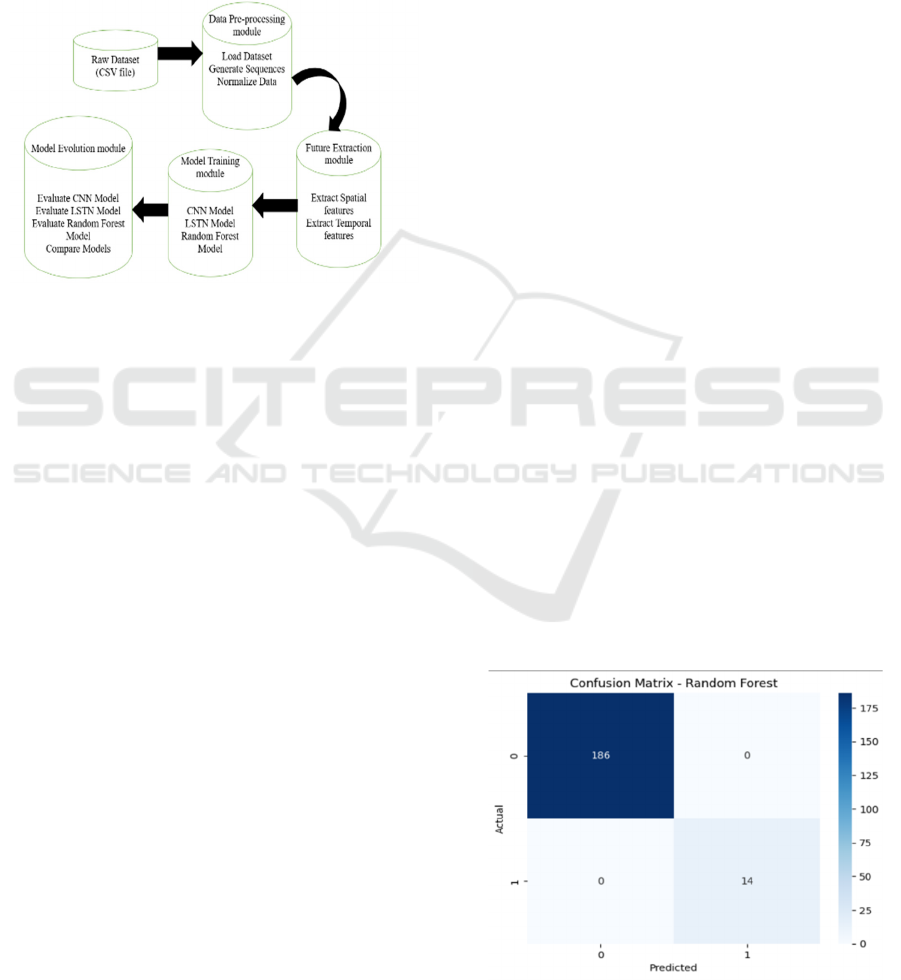
Convolutional Neural Network (CNN). The chosen
models were selected due to their ability to process
complex and sequential data effectively. This
Module analyses the performance of each trained
model. The CNN, LSTM, and Random forest models
are compared using the best measures to do so. From
the performances of the models, the best performing
model is selected to become the last deployed model.
This systematic process guarantees that we adopt the
most feasible model for the task.
Figure 1: Evolution of Spatiotemporal Patterns in
Distribution Systems.
3.2 The Datasets Data that Has Been
Utilized
The data used for detection of cyberattacks in
distribution systems must have both normal operating
data and examples of cyber intrusions, recording key
spatiotemporal features of system behaviour. Sources
of data are usually smart meter measurements, and
network traffic data, which give real-time information
on power system operation, voltage fluctuations, and
communication patterns among system elements.
Furthermore, testbeds like Power World Simulator,
IEEE test systems can be used to simulate real-world
threats like False Data Injection (FDI), Denial of
Service (DoS) attacks to create cyberattack scenarios.
The dataset contains a number of imperative features
such as time-series power measurements (voltage,
current, and frequency variations), network traffic
characteristics (packet size, source address,
destination address, and transmission delays publicly
accessible datasets like the ICS/SCADA
cybersecurity dataset, NSL-KDD, UNSW-NB15, and
CICIDS2017 is suitable for training machine learning
models, Moreover, simulated attack data over IEEE
33-Bus or 118-Bus test cases.
The dataset is pre-processed before model
training, comprising cleaning of data to deal with
missing values, feature scaling to meet the
requirements of CNN and LSTM models, and data
labelling to identify normal and attack cases. A well-
organized dataset allows the discussed machine
learning paradigm CNN to extract spatial features,
LSTM for temporal examination, and Random Forest
for classification efficiently detect cyber threats on
distribution systems to improve grid resilience and
security.
3.3 This Approach Is to Extract
Features Described
Feature extraction is crucial step in the process of
using spatiotemporal patterns for cyberattack
detection in distribution systems. Taking valuable
characteristics out of raw data enables us to convert
the data into a suitable format for use by machine
learning algorithms. Here, we detail the method for
feature extraction utilized in our work, which
comprises the utilization of Networks using Long
Short-Term Memory (LSTM), Convolutional Neural
Networks (CNN), and Random Forests.
Through the utilization of the advantages of
LSTM networks, CNNs, and Random Forests, our
feature extraction method guarantees that those
features most pertinent and significant to cyberattack
detection in distribution systems are utilized.
4 RESULTS AND EVALUATION
The Random Forest model successfully classifies 186
out of 186 examples, demonstrating good
performance in categorizing class '0'. However, it
only correctly classifies 14 out of 14 examples with
zero misclassifications as '0', demonstrating low
performance for class '1'. This indicates that class '1'
may have low recall but excellent precision.
Figure 2: Confusion Matrix – Random Forest.
Leveraging Spatiotemporal Pattern for Cyberattack Detection in Distribution Systems
91
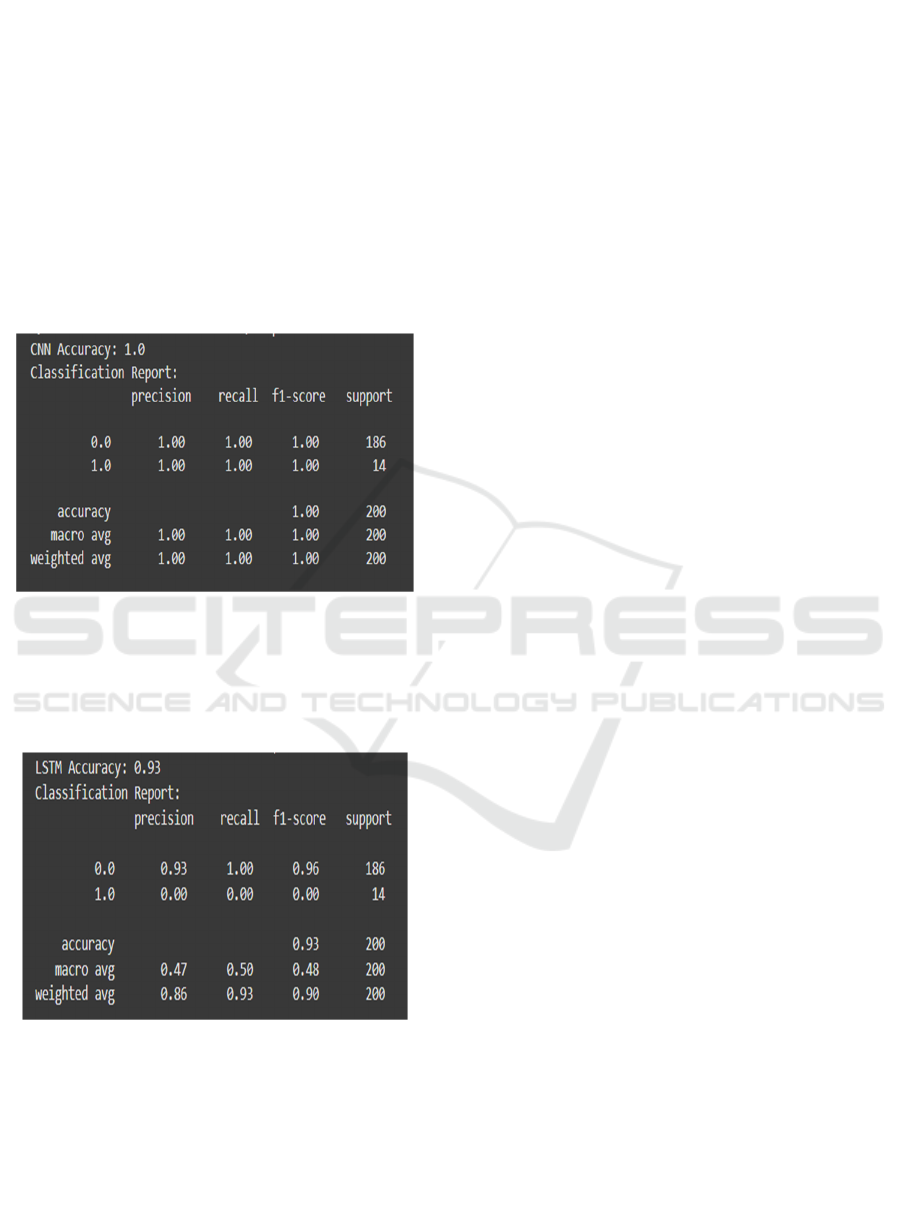
The model has a clear bias towards class '0'
prediction, suggesting that either the dataset is
unbalanced or the model requires further fine-tuning
to improve class '1' prediction. The model has to be
improved to perform better on the minority class,
although overall it has good accuracy for the majority
class. Figure 2 show the Confusion Matrix – Random
Forest.
An ideal classification on the given dataset is
demonstrated by the Convolutional Neural Network
(CNN) in the following report, which registers 100%
accuracy on all measures (precision, recall, and F1-
score) for both classes.
Figure 3 show the Optimal
CNN Classification Precision.
Figure 3: Optimal CNN Classification Precision.
The LSTM model achieves a 93% accuracy overall,
but struggles with predicting class '1', showing zero
precision, recall, and F1-score. Figure 4 show the
LSTM Model Performance.
Figure 4: LSTM Model Performance.
5 DISCUSSION
186 out of 186 correctly predicted the majority class
('0'), demonstrating the remarkable accuracy of the
Random Forest model.
With all accuracy metrics (precision, recall, and
F1-score) ideal for both classes, the CNN model
performs exceptionally well. It shows that the CNN
model has successfully identified the hidden patterns
and is prepared to accurately classify both majority
and minority classes.
The LSTM model has a high overall accuracy of
93%, highlighted especially by its outstanding
performance on the majority class ('0'). The CNN
model performs exceptionally well.
6 CONCLUSIONS
In our paper we provide a solution for cyberattack
detection in machine learning-based distribution
systems models. Out among the models tested, the
Random Forest Classifier proved the actual and
predictive analysis and also LSTM provide 0.93
accuracy. Which mainly describes how the data could
be detected and also ensure significantly increase
actual and prediction values.
REFERENCES
Paradesi Subba Rao,”Detecting malicious Twitter bots
using machine learning” AIP Conf. Proc. 3028, 020073
(2024),https://doi.org/10.1063/5.0212693
Paradesi SubbaRao,”Morphed Image Detection using
Structural Similarity Index Measure”M6 Volume 48
Issue 4 (December 2024),https://powertechjournal.com
Parumanchala Bhaskar, et al. "Machine Learning Based
Predictive Model for Closed Loop Air Filtering
System." Journal of Algebraic Statistics 13.3 (2022):
416-423.
Mahammad, Farooq Sunar, et al. "Prediction Of Covid-19
Infection Based on Lifestyle Habits Employing
Random Forest Algorithm." Journal Of Algebraic
Statistics 13.3 (2022): 40-45.
Devi, M. Sharmila, et al. "Machine Learning Based
Classification and Clustering Analysis of Efficiency of
Exercise Against Covid-19 Infection." journal of
algebraic statistics 13.3 (2022): 112-117.
Parumanchala Bhaskar, et al. "Incorporating Deep Learning
Techniques to Estimate the Damage of Cars During the
Accidents" AIP Conference Proceedings. Vol. 3028.
No. 1. AIP Publishing, 2024.
Mr.M.Amareswara Kumar,EFFECTIVE FEATURE
ENGINEERING TECHNIQUE FOR HEART
DISEASE PREDICTION WITH MACHINE
LEARNING” in International Journal of Engineering
& Science Research, Volume 14, Issue 2, April-2024
with ISSN 2277-2685.
Chaitanya, V. Lakshmi. "Machine Learning Based
Predictive Model for Data Fusion Based Intruder Alert
ICRDICCT‘25 2025 - INTERNATIONAL CONFERENCE ON RESEARCH AND DEVELOPMENT IN INFORMATION,
COMMUNICATION, AND COMPUTING TECHNOLOGIES
92

System." journal of algebraic statistics 13.2 (2022):
2477-2483
Mahammad, Farooq Sunar, Karthik Balasubramanian, and
T. Sudhakar Babu. "A comprehensive research on video
imaging techniques." All Open Access, Bronze (2019).
Parumanchala Bhaskar, et al “Cloud Computing Network
in Remote Sensing-Based Climate Detection Using
Machine Learning Algorithms” remote sensing in earth
systems sciences(springer).
Chaitanya, V. Lakshmi, and G. Vijaya Bhaskar. "Apriori vs
Genetic algorithms for Identifying Frequent Item Sets."
International journal of Innovative Research
&Development 3.6 (2014): 249-254.
Suman, Jami Venkata, et al. "Leveraging natural language
processing in conversational AI agents to improve
healthcare security." Conversational Artificial
Intelligence (2024): 699-711.
Mandalapu, Sharmila Devi, et al. "Rainfall prediction using
machine learning." AIP Conference Proceedings. Vol.
3028. No. 1. AIP Publishing, 2024.
Mahammad, Farooq Sunar, et al. "Key distribution scheme
for preventing key reinstallation attack in wireless
networks." AIP Conference Proceedings. Vol. 3028.
No. 1. AIP Publishing, 2024.
Chaitanya, V. Lakshmi, et al. "Identification of traffic sign
boards and voice assistance system for driving." AIP
Conference Proceedings. Vol. 3028. No. 1. AIP
Publishing, 2024
Mahammad, Farooq Sunar, and V. Madhu Viswanatham.
"Performance analysis of data compression algorithms
for heterogeneous architecture through parallel
approach." The Journal of Supercomputing 76.4
(2020): 2275-2288.
Devi, M. Sharmila, et al. "Extracting and Analyzing
Features in Natural Language Processing for Deep
Learning with English Language." Journal of Research
Publication and Reviews 4.4 (2023): 497-502.
Sunar, Mahammad Farooq, and V. Madhu Viswanatham.
"A fast approach to encrypt and decrypt video streams
for secure channel transmission." World Review of
Science, Technology and Sustainable Development
14.1 (2018): 11-28.
Gowthami, V., et al. "Knowledge Based System for
Immunity Improvement Against Covid-19 Infection."
journal of algebraic statistics 13.3 (2022): 01-07.
Mahammad, Farooq Sunar, et al. "Heuristics Approach
Based Expert System for Covid-19 Infection
susceptibility." journal of algebraic statistics 13.3
(2022): 46-51.
Reddy, E. Madhusudhana, and P. Bhaskar. "Able Machine
Learning Method for classifying Disease-Treatment
Semantic Relations from Bio-Medical Sentences." vol
5(2018):5.https://ieeexplore.ieee.org/document/96168
41
Leveraging Spatiotemporal Pattern for Cyberattack Detection in Distribution Systems
93
